A swell case
-
Lauren Fill
 and
Robert W. Hostoffer
and
Robert W. Hostoffer

A 31-year-old woman presented for evaluation in December 2021 with a history of recurrent facial and lip swelling for several years, as demonstrated in Figure 1. She also had a history of abdominal swelling or tongue swelling/throat closing sensation and has been intubated 16 times over her lifetime as a result. She experiences episodes sporadically, on average once per week. She has tried Benadryl as needed without success, denies a family history of angioedema, and takes no prescribed medications. A workup was initiated. The laboratory results obtained during a symptom-free period revealed low C4 (7 mg/dL; normal, 10–50 mg/dL) and C1q levels (8.3 mg/dL; normal, 10.2–20.3 mg/dL), with low C1 esterase inhibitor (18 mg/dL; normal, 21–39 mg/dL) and low C1 esterase inhibitor function (25 %; normal, >67 %). The significantly decreased C1q in the setting of no familial history of angioedema confirmed the diagnosis of acquired angioedema. The patient was started on subcutaneous icatibant, a C1-inhibitor replacement, as needed for rescue medication and her flares have decreased clinically.
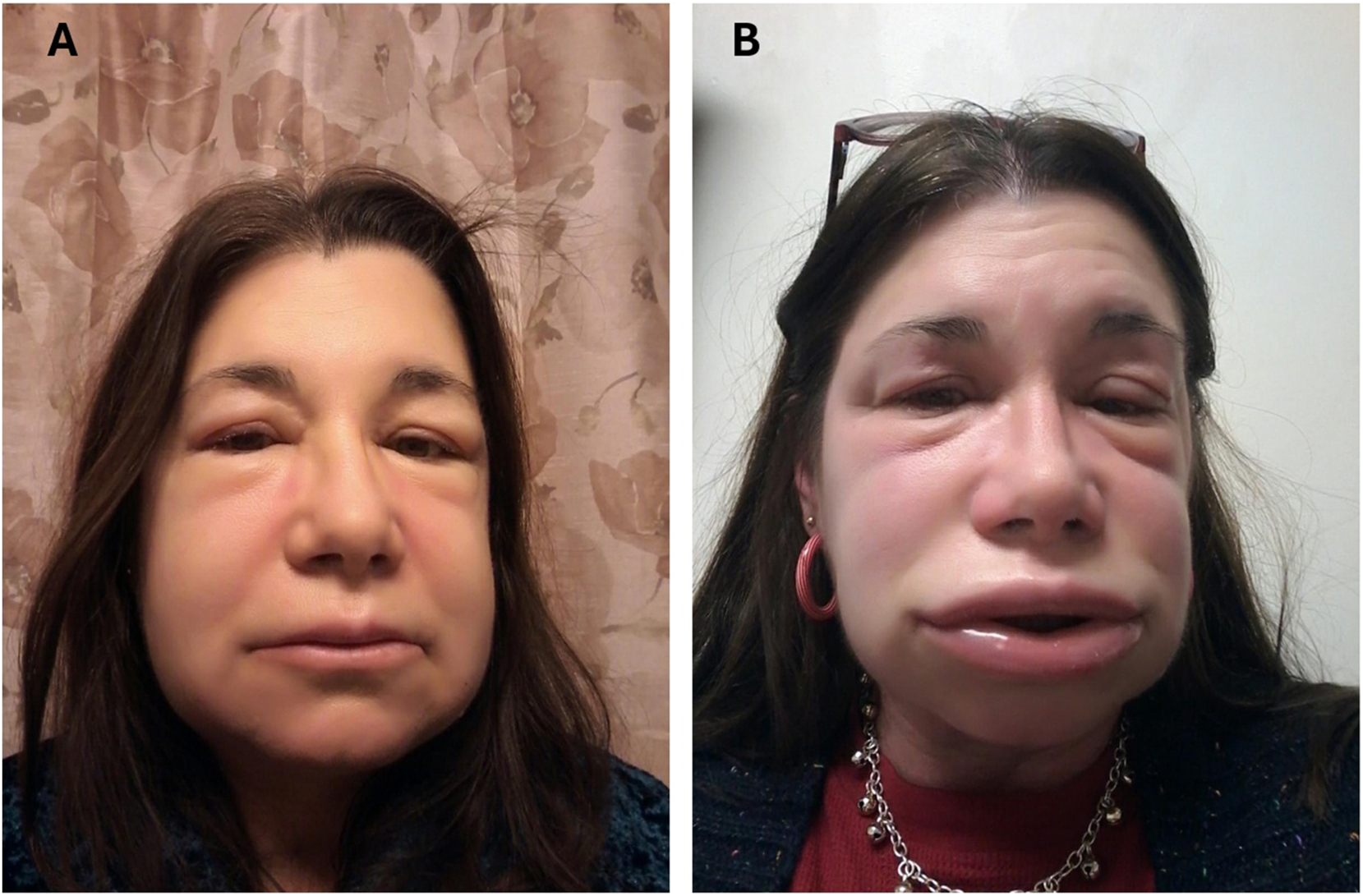
Subcutaneous and submucosal facial edema. Photographs taken in (A) October 2021 and (B) December 2021.
Angioedema is characterized by attacks of subcutaneous and submucosal swelling caused by an increase in vascular permeability, which at times can be life-threatening [1]. A subset of angioedema is bradykinin mediated with low level of C1-inhibitor [2]. The low C1 inhibitor concentration permits activation of the kallikrein–kinin, complement, fibrinolytic, and coagulation systems releasing vasoactive plasma kinins [2]. Both hereditary and acquired angioedema are due to C1-inhibitor deficiency [1]. HAE types 1 and 2 are characterized by decreased activity of C1 inhibitor due to a mutation in the C1 inhibitor gene [1]. Acquired angioedema is characterized by low level of C1 inhibitor level, function, C1q level, and C4 [3]. A distinguishing feature of acquired angioedema is low C1q level, as demonstrated in this patient, which is thought to be due to consumption by immune complexes [1]. Treatment of C1-inhibitor dependent angioedema is focused on replacement of C1-inhibitor either on maintenance or an as-needed level, depending on the frequency of attacks [3].
-
Research ethics: Not applicable.
-
Informed consent: Written consent was acquired from the patient.
-
Author contributions: All authors have accepted responsibility for the entire content of this manuscript and approved its submission.
-
Use of Large Language Models, AI and Machine Learning Tools: None declared.
-
Conflict of interest: None declared.
-
Research funding: None declared.
-
Data availability: Not applicable.
References
1. Zeerleder, S, Levi, M. Hereditary and acquired C1-inhibitor-dependent angioedema: from pathophysiology to treatment. Ann Med 2016;48:256–67. https://doi.org/10.3109/07853890.2016.1162909.Search in Google Scholar PubMed
2. Bygum, A. Hereditary angio-oedema in Denmark: a nationwide survey. Br J Dermatol 2009;161:1153–8. https://doi.org/10.1111/j.1365-2133.2009.09366.x.Search in Google Scholar PubMed
3. Cicardi, M, Aberer, W, Banerji, A, Bas, M, Bernstein, JA, Bork, K, et al.. Classification, diagnosis, and approach to treatment for angioedema: consensus report from the Hereditary Angioedema International Working Group. Allergy 2014;69:602–16. https://doi.org/10.1111/all.12380.Search in Google Scholar PubMed
© 2025 the author(s), published by De Gruyter, Berlin/Boston
This work is licensed under the Creative Commons Attribution 4.0 International License.
Articles in the same Issue
- Frontmatter
- Cardiopulmonary Medicine
- Review Article
- Signs and symptoms of vertebrobasilar insufficiency secondary to atherosclerosis: a systematic review
- General
- Brief Report
- Geographical distribution of osteopathic urology residents and match trends in the United States
- Medical Education
- Original Article
- Scholar 12 longitudinal outcomes: osteopathic research development application to facilitate scholarly activity during the pandemic and beyond
- Neuromusculoskeletal Medicine (OMT)
- Brief Report
- Osteopathic manipulation to increase lactation quantity: a prospective case series
- Public Health and Primary Care
- Review Article
- Emergency department wait times in concordance with blood alcohol content and subsequent alcohol use disorder
- Clinical Image
- A swell case
Articles in the same Issue
- Frontmatter
- Cardiopulmonary Medicine
- Review Article
- Signs and symptoms of vertebrobasilar insufficiency secondary to atherosclerosis: a systematic review
- General
- Brief Report
- Geographical distribution of osteopathic urology residents and match trends in the United States
- Medical Education
- Original Article
- Scholar 12 longitudinal outcomes: osteopathic research development application to facilitate scholarly activity during the pandemic and beyond
- Neuromusculoskeletal Medicine (OMT)
- Brief Report
- Osteopathic manipulation to increase lactation quantity: a prospective case series
- Public Health and Primary Care
- Review Article
- Emergency department wait times in concordance with blood alcohol content and subsequent alcohol use disorder
- Clinical Image
- A swell case
