On geometries of the Conway group Co3 and their McLaughlin group subgeometries
-
Alexander A. Ivanov


Abstract
Recently, the author published a book [A. A. Ivanov, Ever-Evolving Groups—an Introduction to Modern Finite Group Theory, Algebr. Appl. 32, Springer, Cham, 2025]
where he summarised the recent progress in the geometric theory of sporadic groups and outlined some geometries which require further investigation.
Among them was
a geometry for the smallest Conway sporadic simple group
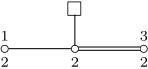 originally introduced in [M. A. Ronan and G. Stroth, Minimal parabolic geometries for the sporadic groups, European J. Combin.
5 (1984), 1, 59–91]
(cf. [M. A. Ronan, Coverings of certain finite geometries, Finite Geometries and Designs, London Math. Soc. Lecture Note Ser. 49, Cambridge University, Cambridge (1981), 316–331, Table 1]
and [F. Buekenhout, Diagram geometries for sporadic groups, Finite Groups—Coming of Age (Montreal 1982), Contemp. Math. 45, American Mathematical Society, Providence (1985), geometry (23), p. 14]), which we denote by
originally introduced in [M. A. Ronan and G. Stroth, Minimal parabolic geometries for the sporadic groups, European J. Combin.
5 (1984), 1, 59–91]
(cf. [M. A. Ronan, Coverings of certain finite geometries, Finite Geometries and Designs, London Math. Soc. Lecture Note Ser. 49, Cambridge University, Cambridge (1981), 316–331, Table 1]
and [F. Buekenhout, Diagram geometries for sporadic groups, Finite Groups—Coming of Age (Montreal 1982), Contemp. Math. 45, American Mathematical Society, Providence (1985), geometry (23), p. 14]), which we denote by
 The elements of type 1, 2, 3, and 4 in the geometry
Acknowledgements
It is a great pleasure to sincerely thank the referee for their exceptionally detailed and professional comments on an earlier version of this paper. These remarks led to several substantial improvements and clarifications, including
the explicit use of the geometry
recall and application of the fundamental dichotomy principle (Theorem 2), a concept that was something of a manifesto in the 1990s but is now often forgotten, even among experts in diagram geometries;
the use of this principle to establish the infiniteness of the universal cover of the minimal parabolic geometry of
the removal of any explicit reliance on data computed for me by Andries Brouwer (to whom I nevertheless remain deeply grateful);
a complete reworking of the paper’s exposition, which, while rendering many of the referee’s specific comments moot, significantly improved the overall clarity and structure.
-
Communicated by: Michael Giudici
References
[1] B. Baumeister, A. A. Ivanov and D. V. Pasechnik, A characterization of the Petersen-type geometry of the McLaughlin group, Math. Proc. Cambridge Philos. Soc. 128 (2000), no. 1, 21–44. 10.1017/S0305004199004028Search in Google Scholar
[2] A. E. Brouwer and H. Van Maldeghem, Strongly Regular Graphs, Encyclopedia Math. Appl. 182, Cambridge University, Cambridge, 2022. 10.1017/9781009057226Search in Google Scholar
[3] F. Buekenhout, Diagram geometries for sporadic groups, Finite Groups—Coming of Age (Montreal 1982), Contemp. Math. 45, American Mathematical Society, Providence (1985), 1–32. 10.1090/conm/045/822231Search in Google Scholar
[4] A. Chermak, B. Oliver and S. Shpectorov, The linking systems of the Solomon 2-local finite groups are simply connected, Proc. Lond. Math. Soc. (3) 97 (2008), no. 1, 209–238. 10.1112/plms/pdn011Search in Google Scholar
[5] J. H. Conway, Three lectures on exceptional groups, Sphere Packings, Lattices and Groups, Springer, New York (1993), 267–298. 10.1007/978-1-4757-2249-9_10Search in Google Scholar
[6]
J. H. Conway, R. T. Curtis, S. P. Norton, R. A. Parker and R. A. Wilson,
[7] J.-M. Goethals and J. J. Seidel, The regular two-graph on 276 vertices, Discrete Math. 12 (1975), 143–158. 10.1016/0012-365X(75)90029-1Search in Google Scholar
[8] A. A. Ivanov, Geometry of Sporadic Groups. I, Encyclopedia Math. Appl. 76, Cambridge University, Cambridge, 1999. 10.1017/CBO9780511525933Search in Google Scholar
[9] A. A. Ivanov, Ever-Evolving Groups—an Introduction to Modern Finite Group Theory, Algebr. Appl. 32, Springer, Cham, 2025. 10.1007/978-3-031-89011-6Search in Google Scholar
[10] A. A. Ivanov and S. V. Shpectorov, The flag-transitive tilde and Petersen-type geometries are all known, Bull. Amer. Math. Soc. (N. S.) 31 (1994), no. 2, 173–184. 10.1090/S0273-0979-1994-00511-7Search in Google Scholar
[11] A. Pasini, Covers of finite geometries with nonspherical minimal circuit diagram, Buildings and the Geometry of Diagrams, Lecture Notes in Math. 1181, Springer, Berlin (1986), 218–241. 10.1007/BFb0075517Search in Google Scholar
[12] A. Pasini and S. Tsaranov, Bounding the size of certain rank 3 geometries with designs as rank 2 residues, Discrete Math. 155 (1996), 183–204. 10.1016/0012-365X(94)00382-SSearch in Google Scholar
[13] M. A. Ronan, Coverings of certain finite geometries, Finite Geometries and Designs, London Math. Soc. Lecture Note Ser. 49, Cambridge University, Cambridge (1981), 316–331. 10.1017/CBO9781107325579.032Search in Google Scholar
[14] M. A. Ronan, On the second homotopy group of certain simplicial complexes and some combinatorial applications, Quart. J. Math. Oxford Ser. (2) 32 (1981), no. 126, 225–233. 10.1093/qmath/32.2.225Search in Google Scholar
[15] M. A. Ronan and S. D. Smith, 2-local geometries for some sporadic groups, The Santa Cruz Conference on Finite Groups, Proc. Sympos. Pure Math. 37, American Mathematical Society, Providence (1980), 283–289. 10.1090/pspum/037/604595Search in Google Scholar
[16] M. A. Ronan and G. Stroth, Minimal parabolic geometries for the sporadic groups, European J. Combin. 5 (1984), no. 1, 59–91. 10.1016/S0195-6698(84)80020-7Search in Google Scholar
[17]
S. V. Shpectorov,
The universal 2-cover of the 𝑃-geometry
[18] J. Tits, A local approach to buildings, The Geometric Vein, Springer, New York (1981), 519–547. 10.1007/978-1-4612-5648-9_35Search in Google Scholar
[19] S. V. Tsaranov, Representation and classification of Coxeter monoids, European J. Combin. 11 (1990), no. 2, 189–204. 10.1016/S0195-6698(13)80073-XSearch in Google Scholar
[20] R. A. Wilson, Vector stabilizers and subgroups of Leech lattice groups, J. Algebra 127 (1989), no. 2, 387–408. 10.1016/0021-8693(89)90260-3Search in Google Scholar
© 2026 Walter de Gruyter GmbH, Berlin/Boston
