Illocutionary-act-type sensitivity and discursive sequence: An examination of quotation
-
Etsuko Oishi is a professor of linguistics at Tokyo University of Science. She has been working on Austinian speech act theory, and published papers on expositives, indexicality, evidentiality and modality, and discourse markers
. She contributed her paper of apologies toHandbooks of Pragmatics ,The Pragmatics of Speech Actions (edited by Marina Sbisà and Ken Turner). She is the co-editor (with Anita Fetzer) ofContext and Contexts: Parts Meet Whole? (John Benjamins 2011).

Abstract
The present paper develops the concept of discourse within Austin’s original speech act theory as laid out in Austin, J. L., [1962]1975 How to do things with words. Oxford: Oxford University Press, and provides a model to explain illocutionary acts in discourse. In uttering something, a speaker performs an illocutionary act and imports its conventional effect into the discourse, in which the next speaker (the hearer in the preceding turn) performs an illocutionary act and brings about its effect, and the sequenced effects develop the discourse. Both the content of an utterance imported into the discourse as the illocutionary effect and the discursive sequence that the utterance creates are sensitive to the illocutionary-act-type that it performs. Quotation is examined from this perspective, and it is claimed that a speaker indicates a locution by means of quotation marks while performing an illocutionary act. The speaker (i) performs an illocutionary act pertaining to the locution, (ii) reports an illocutionary (or perlocutionary) act in another discourse by means of the locution by which the act was performed (or a part of it), or (iii) indicates a part of the locution of the present utterance, and thus signals a special sense or referent, or importance. Depending on the type of illocutionary act, the quoted material is imported into the discourse in a specific way.
1 A speech act-theoretic model of discourse
Cornish (2009: 185) defines discourse as “the hierarchically structured product of the constantly evolving sequence of utterance, illocutionary, propositional and indexical acts jointly performed by the discourse partners.” Similarly, but in terms of Austin’s ([1962]1975) original speech act theory, discourse can be defined as the evolving sequence of effects brought about by illocutionary acts. In the following, Austin’s idea of felicity conditions and classes of illocutionary acts, in particular, the expositive illocutionary act class, are examined to describe how illocutionary effects are sequenced and, accordingly, the discourse evolves.
According to Austin’s ([1962]1975: 14–15) felicity conditions, a certain person in certain circumstances whose utterance of certain words brings about a certain conventional effect (in [A.1]) is distinguished from the particular person in a given case (in [A.2]). For terminological convenience, the former is in the present paper referred to as the addresser, while the latter as the speaker.
There must exist an accepted conventional procedure having a certain conventional effect, that procedure to include the uttering of certain words by certain persons in certain circumstances, and further,
the particular persons and circumstances in a given case must be appropriate for the invocation of the particular procedure invoked.
The procedure must be executed by all participants both correctly and
completely.
Where, as often, the procedure is designed for use by persons having certain thoughts or feelings, or for the inauguration of certain consequential conduct on the part of any participant, then a person participating in and so invoking the procedure must in fact have those thoughts or feelings, and the participants must intend so to conduct themselves, and further
must actually so conduct themselves subsequently.
(emphasis added)
Similarly, a certain person in certain circumstances on whom the addresser brings about a certain conventional effect (in [A.1]), the addressee, is distinguished from the particular person in a given case to whom the speaker speaks (in [A.2]), the hearer. Furthermore, certain circumstances in which a certain conventional effect is brought about (in [A.1]) are distinguished from the particular circumstances in a given case in which the speaker and the hearer communicate (in [A.2]). The former is referred to as the context while the latter as the discourse.
For a certain illocutionary act to be successfully performed and for its conventional effect to be brought about, the speaker, the hearer and the discourse in a given case must be appropriate to serve as the addresser, the addressee and the context of the illocutionary act, respectively. These speaker-addresser, hearer-addressee and discourse-context differences tend to be ignored, but they become evident when infelicitous cases are examined (Austin [1962]1975: 15–20).
Let us illustrate how an illocutionary act is performed and its conventional effect is brought about using Oishi’s (2020)[1] model in Figure 1.
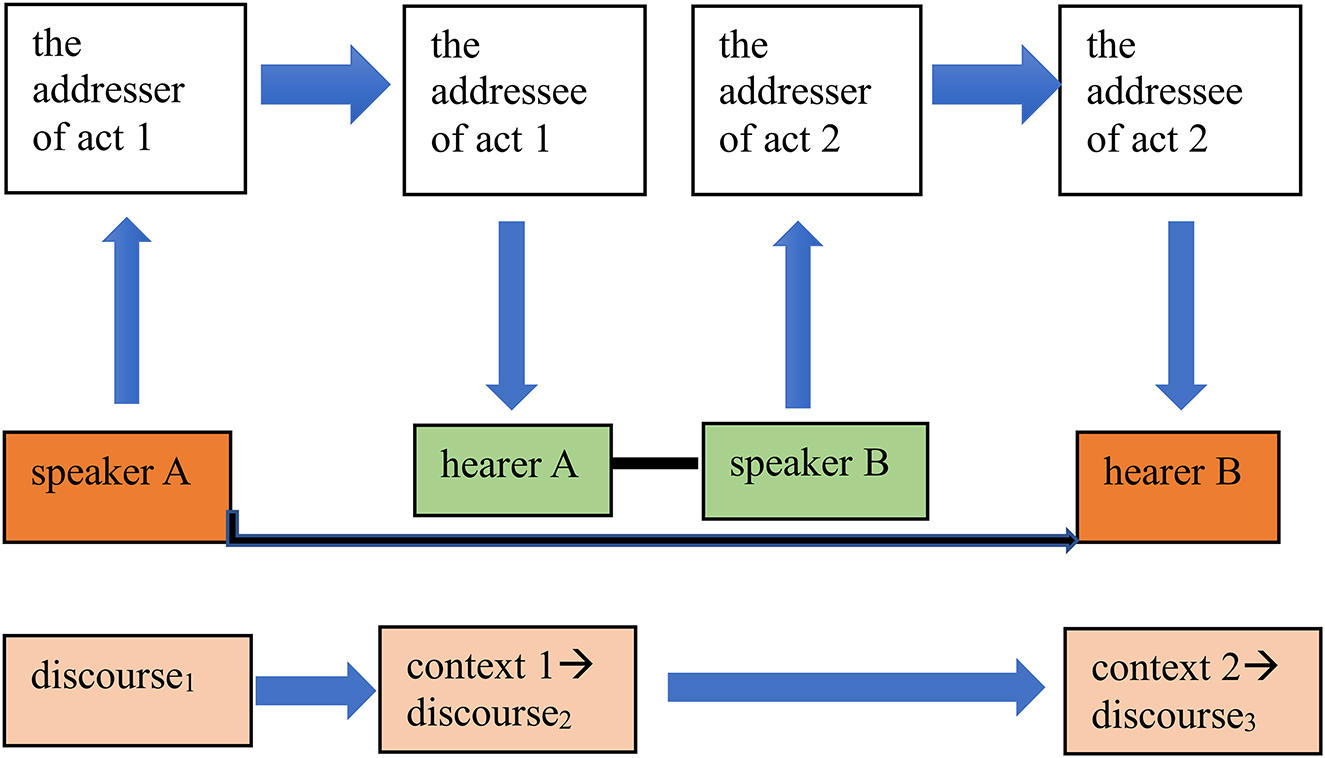
The model of performing an illocutionary act.
When the speaker A performs the illocutionary act 1, assuming her/himself, the hearer A and the discourse1 as the addresser, the addressee and the context of the act 1, respectively, and the hearer A agrees to share those assumptions (shown by her/his uptake[2]), the conventional effect of the act 1 is brought about, and the discourse1 evolves into discourse2. When the speaker B (i.e., the hearer A) responds to discourse2 and performs the illocutionary act 2, assuming her/himself, the hearer B (i.e., the speaker A) and the discourse2 as the addresser, the addressee and the context of the act 2, respectively, and the hearer B agrees to share those assumptions, the conventional effect of the act 2 is brought about, and the discourse2 evolves into discourse3. This process is repeated until the communication ends, where the discourseN is produced as the result of the sequenced effects brought about by the illocutionary acts.
This model of discourse focuses on participants of a discourse who develop the discourse by performing illocutionary acts. A speaker produces a particular type of illocutionary effect, inviting a hearer to react in a specific way, which evolves the discourse in a particular direction. An illocutionary effect might be produced in a longer stretch of interaction, in which (i) an exchange for clarification or (ii) an other- or self-repair is included. A speaker and a hearer might jointly produce an illocutionary effect, or utterances might overlap because two speakers try to produce an illocutionary effect at the same time. Discourse markers and other linguistic devices might be used to mitigate or strengthen the illocutionary effect, or to indicate a relationship among participants or the connectedness between the illocutionary effect produced by the present utterance with the preceding one or an upcoming one.
The focus on social interaction between individual participants as Goffman (1981) and Mey (2001) distinguishes the present model from those of others which view a development of the discourse as updates of information, as in dynamic semantics (Kamp and Reyle 1993), dynamic syntax (Cann et al. 2005) and formal semantics (Ginzburg and Cooper 2014). The goal of elucidating speech acts of individual participants in a discourse distinguishes the present study from Conversation Analysis (Sacks et al. 1974), which aims to isolate fundamental structures of conversation from stretches of interaction between people.
Participants within a discourse perform various types of illocutionary act and develop the discourse accordingly. Austin ([1962]1975: 153–61) distinguishes five classes of illocutionary acts, namely Verdictives, Exercitives, Commissives, Behabitives, and Expositives, and describes them as follows:
The first, verdictives, are typified by the giving of a verdict, as the name implies, by a jury, arbitrator, or umpire. But they need not be final; they may be, for example, an estimate, reckoning, or appraisal. It is essentially giving a finding as to something—fact, or value—which is for different reasons hard to be certain about.
The second, exercitives, are the exercising of powers, rights, or influence. Examples are appointing, voting, ordering, urging, advising, warning, &c.
The third, commissives, are typified by promising or otherwise undertaking; they commit you to doing something, but include also declarations or announcements of intention, which are not promises, and also rather vague things which we may call espousals, as for example, siding with. They have obvious connexions with verdictives and exercitives.
The fourth, behabitives, are a very miscellaneous group, and have to do with attitudes and social behaviour. Examples are apologizing, congratulating, commending, condoling, cursing, and challenging.
The fifth, expositives, are difficult to define. They make plain how our utterances fit into the course of an argument or conversation, how we are using words, or in general, are expository. Examples are ‘I reply’, ‘I argue’, ‘I concede’, ‘I illustrate’, ‘I assume’, ‘I postulate’. We should be clear from the start that there are still wide possibilities of marginal or awkward cases, or of overlaps. (151) (original emphasis)
When an illocutionary act is performed with the hearer’s uptake, its conventional effect is imported into the discourse: the recognition of the effect of an illocutionary act as well as the assumption that the speaker, the hearer and the discourse serve as the addresser, the addressee and the context of the illocutionary act, respectively, becomes a part of the shared understanding between the speaker and the hearer of the discourse. The hearer is invited to respond to the produced effect, and, when s/he actually does, the discourse evolves in the direction that the speaker intended.
When a speaker performs an illocutionary act of (i) the verdictive type and the hearer’s uptake is secured, it becomes a shared understanding between the speaker and the hearer that the speaker has established a fact or value: for example, the speaker has acquitted or convicted someone, or found something as a matter of fact or hold something as a matter of law (153). The hearer is invited to perform an act about the established fact or value. Similarly, in case of an illocutionary act of (ii) the exercitive type, the shared understanding is that the speaker has exercised a power, right or influence: for example, the speaker has appointed or ordered someone, or named something or voted for something (155–56). The hearer is invited to perform an illocutionary act about the exercised power, right or influence. In case of an illocutionary act of (iii) the commissive type, the shared understanding is that the speaker has committed her/himself: for example, the speaker has promised something or pledged her/himself (157–59). The hearer is invited to perform an illocutionary act while taking the speaker’s commitment for granted. In case of an illocutionary act of (iv) the behabitive type, the shared understanding is that the speaker has exhibited an attitude or social behavior: for example, the speaker has apologized or thanked someone, or criticized or favored something (160–61). The hearer is invited to perform an illocutionary act as a response to the speaker’s attitude or social behavior. In case of an illocutionary act of (v) the expositive type, the shared understanding is that the speaker has explicated how the present utterance becomes a part of the argument or conversation between the speaker and the hearer, or how words are used in the present discourse: for example, the speaker has informed the hearer, the speaker’s knowledge has been reported or testified, or the speaker has explicated the usage or referent of a word (161–63). The hearer is invited to perform an illocutionary act pertaining to the developed argument or conversation or perform an illocutionary act on the explicated usage or referent of the word.
Searle (1979) and his followers (e.g., Vanderveken 1990a, 1990b) do not adopt Austin’s classification (cf. Sbisà 1984). Searle criticizes Austin’s classification regarding heterogeneity within some of the categories and the lack of systematicity of the principles of classification, which makes “a very large number of verbs find themselves smack in the middle of two competing categories” (10). He proposes the classes of Assertives, Directives, Commissives, Expressives, and Declarations (12–17).
However, Austin’s classification aims to reveal different aspects of social interaction on which a speaker produces an effect, hereby inviting a hearer to react. Austin postulates that there are mainly five aspects of social interaction in human communication: a fact or value is established (verdictives), a power, right or influence is exercised (exercitives), a commitment is expressed (commissives), an attitude or social behavior is exhibited (behabitives), and an argument or conversation is developed, or a word is used in a particular usage or with a particular referent (expositives). The hearer is invited to respond to the aspect of the social interaction on which the speaker has produced an effect. It is possible that some illocutionary acts produce an effect on two or more aspects at the same time and, in that case, the hearer is expected to react to those effects at the same time.
By making the separate class of expositives, Austin tries to show that an utterance produces an effect on the argument or conversation in which a speaker and a hearer engage in a given discourse, or the usage or referent of a word(s) there. What effects Austin postulates as those of expositive illocutionary acts can be learned by examining Austin’s ([1962]1975: 162–63) list of expositives:
affirm, deny, state, describe, class, identify
remark, mention, ?interpose[3]
inform, apprise, tell, answer, rejoin
3a. ask
testify, report, swear, conjecture, ?doubt, ?know, ?believe
accept, concede, withdraw, agree, demur to, object to, adhere to, recognize, repudiate
5a. correct, revise
postulate, deduce, argue, neglect, ?emphasize
begin by, turn to, conclude by
7a. interpret, distinguish, analyse, define
7b. illustrate, explain, formulate
7c. mean, refer, call, understand, regard as
It is controversial whether Austin attaches any significance to the group (1)–(7c). Urmson says “… The general significance of the grouping is obvious but there is no definite key to it in the extant papers” (Austin [1962]1975: 162n.). The present paper, however, develops an argument on the assumption that expositives in each group bring about a distinctive type of effect on the argument or conversation or the usage or referent of a word(s) in a given discourse.
The effect of expositives in each group can be specified by examining the shared object of them. For example, the answer to the question “What is affirmed, denied, stated, described, classed, or identified?” suggests the object of the expositives of the group 1: a state of affairs. It is then hypothesized that the expositives of this group produce an effect on the argument or conversation by adding, say, a stated or described state of affairs. Descriptions of the object and the type of effect of expositives in the seven main groups (1–7) and the five sub-groups (3a, 5a, and 7a–c) are as follows:[4]
Group 1 expositives: A state of affairs is affirmed, denied, stated, described, classed, or identified, and consequently the stated or described state of affairs, for example, is added to the argument or conversation.
Group 2 expositives: A comment is remarked, mentioned, or interposed, and consequently the remarked or interposed comment, for example, is added to the argument or conversation.
Group 3 expositives: The addressee is informed, apprised, told, answered, or rejoined, and consequently the advanced knowledge of the addressee is added to the argument or conversation.
Group 3a expositives: The addressee is asked, and consequently the request for the addressee’s knowledge is added to the argument or conversation.
Group 4 expositives: Knowledge is testified, reported, sworn, conjectured, doubted, known, or believed, and consequently the testified or reported knowledge, for example, is added to the argument or conversation.
Group 5 expositives: A statement is accepted, conceded, withdrawn, agreed, demurred to, objected to, adhered to, recognized, or repudiated. Consequently, the acceptance or withdrawal of a statement, for example, is added to the argument or conversation.
Group 5a expositives: A statement is corrected or revised, and consequently the corrected or revised statement, for example, is added to the argument or conversation.
Group 6 expositives: A conclusion is postulated, deduced, argued, neglected, or emphasized, and consequently the postulated or deduced conclusion, for example, is added to the argument or conversation.
Group 7 expositives: An argument or conversation is begun by, turned to, or concluded by, and consequently, for example, an argument is begun, turned to, or concluded.
Group 7a expositives: A sound (as a phone) is explicated by being interpreted, distinguished, analyzed, or defined.
Group 7b expositives: Words (as a pheme) are explicated by being illustrated, explained, or formulated.
Group 7c expositives: Words (as a rheme) are explicated by being meant, referred, called, understood, or regarded as.
It is very difficult to specify the effect of group (7a–c) expositives only by analyzing their shared objects. Some expositive illocutionary acts should explicate how words are used, and Austin distinguishes three locutionary acts of uttering sounds[5] and words: phonetic, phatic and rhetic acts (Austin [1962]1975: 92–93). Therefore, it is postulated in the present paper that group (7a)–(7c) expositives are acts about phones, phemes, and rhemes, respectively. The detail of these locutionary acts and group (7a–c) expositive acts pertaining to them are explained in Section 2.
In performing one of the group 1–6 expositive illocutionary acts, a speaker develops the preceding discourse into the present one in which the argument or conversation has developed: for example, the speaker has described a state of affairs (group 1), remarked a comment (group 2), informed the hearer (group 3), asked the hearer (group 3a), reported her/his knowledge (group 4), accepted a statement (group 5), corrected a statement (group 5a), or postulated a conclusion (group 6). In performing a group 7 expositive illocutionary act, a speaker develops the preceding discourse by beginning or concluding an argument or conversation through the present utterance, and, in performing group 7a–c expositive illocutionary acts, a speaker develops the preceding discourse into the present one in which the speaker has explicated a phone (group 7a), pheme (group 7b), or rheme (group 7c).
The content of an utterance, that is, the shared understanding between the speaker and the hearer of what the speaker communicates in the present discourse by an utterance, depends on the type of the illocutionary act that the speaker performs in uttering it. In the present paper, this is referred to by illocutionary-act-type sensitivity of the content of an utterance.
Let us illustrate this by using the utterance (printed in italics) in the exchange between Edward Miliband (EM) and Prime Minister David Cameron (PM) at the April 18, 2012 session of Prime Minister’s Questions (PMQs):[6]
EM (Doncaster North) (Lab): … Mr Speaker, can the Prime Minister confirm that the cut in the 50p tax rate on which we will be voting tonight will be worth at least £40,000 a year to Britain’s millionaires?
PM: The cut in the 50p tax rate is gonna be paid five times over by the richest people in our country. But I notice, Mr Speaker, I notice, Mr Speaker, he doesn’t ask about unemployment.
In uttering “But I notice, Mr Speaker, I notice, Mr Speaker, he [EM] doesn’t ask about unemployment,” the PM performs an expositive illocutionary act and produces the effect of beginning a new part of the argument about unemployment (a group 7 expositive).[7] The content of the utterance, that is, what he communicates with EM and the audience of this PMQs discourse by the utterance, is not simply that the PM notices that EM did not ask about unemployment, which is a rheme in Austin’s ([1962]1975: 92–93) terminology.[8] , [9] It is rather that he has started the topic of unemployment, and EM and the audience know that the PM will explain in the following turn how the government of the Conservative Party reduced unemployment.
In performing an illocutionary act, the speaker of a given discourse communicates with the hearer something much more specific than a rheme (or proposition), or even distinct from it.[10] Searle’s (1979: 1) symbolization of illocutionary acts, F(p), where F stands for the illocutionary force of an utterance and p its propositional content, is misleading: it indicates that a full-fledged propositional content is expressed independently of the illocutionary force of the utterance.
In the following section, the act of quoting is examined as an example of illocutionary-act-type sensitivity: a locution enclosed within quotation marks plays a particular role and becomes a part of the specific content of an utterance depending on the illocutionary-act-type of the utterance that includes it.
2 Quotation
2.1 Semantic theories of quotation
Quotation is regarded as a sound/letter, word (or a part of it), phrase, sentence, utterance or text which is enclosed within quotation marks. Quotation has been characterized by its function of mentioning; the word “bachelor” in (1) is mentioned, not used to talk about an unmarried man:
| “Bachelor” has eight letters. |
Five semantic theories of quotation have been advocated: (i) (Proper) Name Theory, (ii) Description Theory, (iii) Demonstrative Theory, (iv) Disquotational Theory, and (v) Identity Theory. The following is a short summary of them.[11]
According to the Name Theory (Quine 1940; Tarski 1956), quotations are unstructured proper names of the quoted expressions, that is, quoted expressions name their referents.[12] The theory adequately explains that (i) co-referential expressions are not exchangeable, just as the proper name “Cicero” is not exchangeable for the co-referential name “Tully,” and (ii) the creation of new quotations is possible, just as new proper names are created.
Geach (1957, 1970) revises the Name Theory and advocates the Description Theory. The quotation of an expression describes word for word, what is being quoted. This guarantees that a quoted series of expressions is always a series of quoted expressions, including a string of language.
According to Davidson’s (1979) Demonstrative Theory, the inscription inside quotation marks does not refer to anything at all, but the quotation marks do all the referring. “‘X’ is a noun” is equivalent to “X. That complex of shapes is a noun,” and “‘X …’ is a sentence” is equivalent to “X … The expression of which this is a token is a sentence.” The followers of the theory include Partee (1973), Goldstein (1984), Garcia-Carpintero (1994, 2004, 2017, 2021, and Cappelen and Lepore (1997). The theory accounts for productivity of generating novel quotations; there is no limit to the kinds of entities that can be demonstrated. It also adequately explains why a word quoted cannot be substituted by its synonym; quotation marks demonstrate different objects.
On the account of the Disquotational Theory (Ludwig and Ray 1998, 2017; Richard 1986), the semantic rule for pure quotation is given by the reference clause (Q), “for any Φ, [‘Φ’] refers to Φ”, where Φ takes on expressions as values, and square brackets are used as Quinean corner quotes (Ludwig and Ray 2017: 102). The theory explains how synonyms are unexchangeable: they are different expressions with different values. It, on the other hand, explains a close relationship between quotations and their semantic values: quotations refer to expressions as values.
On the Fregean view referred to as Identity Theory (Frege 1892; Searle 1969; Washington 1992), when an expression is referred to by means of quotation, the quoted material itself is a linguistic referring expression, in which quotation marks serve to clarify the fact that the quoted material refers to itself.[13] Other versions of Identity Theory are proposed by Reimer (1996, 2003) and Saka (1998, 2005, 2011, 2013, 2017. Identity Theory explains how quotation can be used to introduce novel words and symbols: if new symbols and signs can be mentioned, then they can also be quoted. The theory also explains how quotations and semantic values are closely related: the quoted material refers to itself as a semantic value of the expression or its instantiation. The capacity of mentioning is limitless, and, therefore, potentially infinite new quotations can be understood and generated.
These theories of quotation explain satisfactorily pure quotation as in (1) and, to a lesser degree, direct quotation. However, the problem they face is to explain (i) mixed quotation (Cappelen and Lepore 1997; Davidson 1979; Davis 2021), (ii) open quotation (Recanati 2000, 2001, 2010), and (iii) scare/emphatic quotes (Abbott 2003; Predelli 2003), in which the quoted material is used.
The sentences in (2) and (4) are examples of mixed quotation. The quoted material, “has a certain anomalous feature” in (2) and “is difficult to understand” in (4), contributes to the meaning of the sentence which includes it, as the words do in indirect quotations (3) and (5), respectively:
| Quine says that quotation “has a certain anomalous feature.” (Davidson 1979) |
| Quine says that quotation has a certain anomalous feature. |
| Alice said that life “is difficult to understand.” (Cappelen and Lepore 1997) |
| Alice said that life is difficult to understand. |
The following is the examples of open quotation:
| Stop that John! “Nobody likes me”, “I am miserable” … Don’t you think you exaggerate a bit? (Recanati 2001) |
| The story-teller cleared his throat and started talking. “Once upon a time, there was a beautiful princess named Arabella. She loved snakes and always had a couple of pythons around her …” (Recanati 2001) |
“Nobody likes me” and “I am miserable” in (6) keep their “normal meaning” (Recanati 2001: 649), and “[t]he meaning of the sentences within the quotation marks [in (7)] is obviously relevant to the meaning of the whole discourse, to which it undoubtedly contributes” (652). Recanati (2001: 667) summarizes “[…,] closed quotation undoubtedly is a semantic phenomenon. In contrast, open quotation is pragmatic: It is a matter of what people do with words, rather than a matter of content and truth-conditions” (original emphasis).
The following ([8]–[10]) is Predelli’s (2003) examples of scare quotes:
| In offset printing “proofs” of illustrations come from the darkroom, not the proof press. (Chicago Manual of Style) |
| The “debate” resulted in three cracked heads and two broken noses. (Chicago Manual of Style) |
| Life is “what happens while you are making other plans.” |
“The writer [of (8)] knows or suspects that the word ‘proofs’ is not properly applicable to cases involving illustrations,” the “debate” in (9) is a sarcastic use, and “the author [of (10)] appeals to a specific source, the pop icon John Lennon, which she thinks her audience may (though need not) be able to identify” (Predelli 2003: 2–4). Predelli concludes that “the material enclosed within quotation marks is used, and it provides (possibly among other things) its customary semantic contribution to the information content associated with the sentence in which it occurs” (4–5) (original emphasis).
A related type of quotation is so-called a greengrocer’s quote, which is a noncitational, emphatic use (Abbott 2003). The following examples are from Abbott (2003):
| Please use other “door” |
| “Confidential” |
| We are “closed” |
| “A set of 4 legs with screws” |
| “Committed to Excellence” |
The quoted material in these examples is all used and plays a customary role.
The difficulty for the proposed theories is that, while (pure) quotation attracts philosophers’ attention in the first place because of its nature of being mentioned without being used, they have to explain the nature of being used to describe quotation in general. It is possible to claim that quoted expressions can be either mentioned or used (e.g., Saka 1998),[14] but it is obviously better to have a unified theory to describe different types of quotation. Using the discursive model of illocutionary acts proposed in Section 1, I aim to provide such a theory of quotation.
2.2 Speech act theory of quotation
When a speaker performs an expositive illocutionary act, s/he explicates how the present utterance fits into the course of the argument or conversation s/he and the hearer engage in, and thus s/he develops the argument or conversation. The speaker also explicates the usage or referent of a word(s) in the present discourse. The quoted material plays a distinctive role depending on the type of the expositive illocutionary act of the enclosing utterance, and the varied roles that the quoted material plays result in different types of quotation.
The relevant expositive illocutionary-act-types include group 7a–c expositives, in which a phone, pheme, or rheme of the locutionary act is, for example, distinguished, formulated, and understood, respectively. In performing this type of act, the speaker separates a phone, pheme, or rheme from the rest of the utterance s/he utters using quotation marks. Quotation marks are used this way in pure quotation as in (1).[15] Austin ([1962]1975: 92–93) explains phones, phemes, and rhemes as follows:
We may agree, without insisting on formulations or refinements, that to say anything is
(A.a) always to perform the act of uttering certain noises (a ‘phonetic’ act), and the utterance is a phone;
(A.b) always to perform the act of uttering certain vocables or words, i.e. noises of certain types belonging to and as belonging to a certain vocabulary, in a certain construction, i.e. conforming to and as conforming to a certain grammar, with a certain intonation, &c. This act we may call a ‘phatic’ act, and the utterance which it is the act of uttering a ‘pheme’ (as distinct from the phememe of linguistic theory); and
(A.c) generally to perform the act of using that pheme or its constituents with a certain more or less definite ‘sense’ and a more or less definite ‘reference’ (which together are equivalent to ‘meaning’). This act we may call a ‘rhetic’ act, and the utterance which it is the act of uttering a ‘rheme’. (original emphasis)[16]
The function of separating a locution (a phone, pheme, or rheme) from the rest of the utterance that the speaker utters as an illocutionary act pertaining to it is referred to as the locution-separating function of quotation marks.
The second type of quotation occurs when a speaker performs the act of reporting an illocutionary (or perlocutionary) act in another discourse[17] (a group [4] expositive) to develop the argument or conversation. When the speaker A reports the illocutionary (or perlocutionary) act that the speaker B performed in another discourse by means of the rheme of the speaker B’s utterance, the rheme is enclosed within quotation marks (direct quotation). When the speaker A reports the illocutionary (or perlocutionary) act by means of a part of rheme of the speaker B’s utterance, the partial rheme is enclosed within quotation marks (mixed quotation). When the speaker A reports a series of illocutionary (or perlocutionary) acts that the speaker B performed in another discourse by means of the rhemes of speaker B’s utterances, these rhemes are enclosed within quotation marks (open quotation).[18] These uses of quotation marks are referred to as the discourse-separating function of quotation marks.
The third type of quotation occurs when a speaker encloses a part of the rheme of the present utterance within quotation marks to signal a specific usage or referent, or importance. Scare quotes and greengrocer’s quotes are of this type. This function is referred to as the signaling function of quotation marks.
In all of these types of quotation, the quoted material is used in the sense that it contributes to the content of the illocutionary act(s) performed. In pure quotation, the quoted material of a phone, pheme, or rheme is, for example, distinguished, formulated, or understood as a (7a–c) group expositive act, and, as an illocutionary effect, the usage or referent of a sound or a word(s) is explicated. In direct, mixed and open quotation, the quoted material as (a part of) an illocutionary (or perlocutionary) act(s) in another discourse is brought, via the locution, to the present discourse as the content of the illocutionary act of reporting (a group [4] expositive). As the illocutionary effect, the reported knowledge of the illocutionary (or perlocutionary) act(s) in another discourse develops the argument or conversation in which the speaker and the hearer engage in the present discourse. In scare and emphatic quotes, the speaker performs various types of illocutionary acts and produces their conventional effects while using a part of the rheme of the present utterance in a specific usage or with a specific referent, or while giving it a special importance.
This speech act theory of quotation is different from pragmatic theory of quotation such as Gutzmann and Stei (2011), who support the contention that quotation marks give rise to a conversational implicature (Grice 1989). It is possible to say that a speaker implicates that a part of the rheme of the present utterance has a special sense/reference or importance by enclosing it with quotation marks (the signaling function). However, when a speaker encloses a locution within quotation marks to separate it from the rest of the utterance that s/he utters as an illocutionary act pertaining to it (the locution-separating function), s/he does not implicate anything. Neither does s/he when s/he encloses a rheme of an utterance in another discourse to report it (the discourse-separating function). The present theory is also different from Gregoromichelaki’s (2017) theory of natural language processing, which claims that quotation marks are to indicate to the parser that a non-default processing strategy is to be pursued. Understanding a locution or an illocutionary act in another discourse by means of quotation marks is not non-default in the proposed speech theory of quotation.
In the following subsections (2.2.1–2.2.3), three types of quotation are illustrated.
2.2.1 The locution-separating function in pure quotation
When a speaker utters a phone to interpret, distinguish, analyze or define it (as a group [7a] expositive), s/he encloses it within quotation marks, separating it from the rest of the utterance. In (16), the sound “po-ta-to-chip” is distinguished/analyzed as the chirp of a bird:
| Suddenly the bird opens its mouth and chirps a call that sounds like “po-ta-to-chip.” (National Geographic Kids) |
When a speaker utters a pheme (i.e., a word belonging to a certain vocabulary, which is in a certain grammatical construction) to illustrate, explain or formulate it (as a group [7b] expositive), s/he encloses it within quotation marks, separating it from the rest of the utterance. Austin ([1962]1975: 96) says “Obviously in the definition of the phatic act two things were lumped together; vocabulary and grammar.” Let us start with a pheme as a word belonging to and as belong to a certain vocabulary. In (17), a novel word is explained as a blend of two existing words.
| The word “webinar” is a blend of “web” and “seminar.” (a company webpage) |
The phemes (as words in a certain grammatical construction), “It’s essential that he be here” and “It’s essential that he is here” in (18) are separated by quotation marks from the rest of the utterance, which performs the illocutionary act of explaining the phemes (a group [7b] expositive): the former pheme (“It’s essential that he be here”) uses subjunctive mood while the latter (“It’s essential that he is here”) does not.
| For instance, “It’s essential that he be here” uses subjunctive mood while “It’s essential that he is here” does not. (Wikipedia) |
Rhemes (a pheme with a certain more or less definite “sense” and a more or less definite “reference” or a part of it) can be meant, referred to, called, understood, and regarded as by group (7c) expositives, and enclosed within quotation marks. In (19) the rheme “I gave my best … left to give” is regarded as (the expression of) the butler’s realization that his whole life has been wasted in service of a Nazi sympathizer (a group [7c] expositive).[19]
| The climax of “The Remains of the Day” (1989), Ishiguro’s perfect, Booker Prize-winning novel, pivots on a butler’s realization that his whole life has been wasted in service of a Nazi sympathizer. (“I gave my best to Lord Darlington. I gave him the very best I had to give and now — well — I find I do not have a great deal more left to give.”) (The New York Times) |
2.2.2 The discourse-separating function of quotation in direct, mixed and open quotations
The following is part of an online article of The Independent about Theresa May’s speech delivered on the 24th of July 2019:
| Theresa May left 10 Downing Street for the last time as prime minister with a warning to her successor that he must deliver an “exit from the European Union in a way that works for the whole United Kingdom”. Ms May’s emotional departure speech before the famous black door of No 10 was briefly interrupted by a shout of “Stop Brexit” from a heckler outside the iron gates. She paused only briefly before saying: “I think the answer to that is ‘I think not.’” (Woodcock 2019) |
The first quotation (“exit from the European Union in a way that works for the whole United Kingdom”) is a mixed quotation, the second (“Stop Brexit”) a direct quotation, and the third (“I think the answer to that is ‘I think not’”) a direct quotation within a direct quotation. The writer performs the illocutionary act of reporting in the newspaper discourse by the utterances which include these quotations.
The first utterance reports the following part of May’s speech:
| Of course, much remains to be done – the immediate priority being to complete our exit from the European Union in a way that works for the whole United Kingdom.[20] |
This illocutionary act, which was performed in the discourse of May and the audience, is reported as “a warning to her successor” by the writer in the newspaper discourse. The content of the warning is partly reported by the writer’s locution and partly by May’s own locution, the latter of which is enclosed within quotation marks (“exit from the European Union in a way that works for the whole United Kingdom”). The writer uses the quotation marks to separate May’s locution by which she performed the illocutionary act in the discourse of her and the audience of her last speech, from the writer’s locution by which he reports May’s illocutionary act in the newspaper discourse.
The second and third quotations come from the following part of May’s speech, which was briefly interrupted by the heckler’s shout “Stop Brexit”:
| […] Finally and most of all, I want to thank my husband Philip – who has been my greatest supporter and my closest companion. (“Stop Brexit”) [a pause] I think the answer to that is I think not. [a pause] I am about to leave Downing Street but I am proud to continue as the Member of Parliament for Maidenhead.[21] |
The heckler’s perlocutionary act of urging May to stop Brexit in the discourse of him and May is reported in the newspaper discourse by means of the heckler’s locution “Stop Brexit” (in [20]). The quotation marks separate the heckler’s locution by which the perlocutionary act was performed in the discourse of him and May from the writer’s locution in the utterance which is performed as the act of reporting in the newspaper discourse.
“I think the answer to that is ‘I think not’” was May’s illocutionary act of digressing from a main topic (a group [7] expositive) performed in the discourse of her and the audience, in which she strayed from the acts of expressing her gratitude (behabitive acts)[22] and demurred (a group [5] expositive) at the heckler’s urge. The single quotation marks are used to separate May’s illocutionary act of demurring at the heckler’s urge in the discourse of her and him from her act of digressing performed by the whole utterance in the discourse of her and the audience. Both acts are reported by May’s locutions. The double quotation marks are used to separate May’s illocutionary act of demurring in the discourse of her and the audience from the writer’s act of reporting in the newspaper discourse. This is illustrated by Figure 2 below.

She paused only briefly before saying: “I think the answer to that is ‘I think not.’”
This use of the two sets of quotation supports our idea that the illocutionary (or perlocutionary) act reported via a locution is enclosed within quotation marks. May’s act of demurring at the heckler’s urge is enclosed within the single quotation marks, which is inside the double quotation marks that separate her act of digressing in the discourse of her and the audience from the newspaper discourse. If quotation marks are used to report locutionary acts, two sets of quotation marks would not be necessary; the newspaper writer would write as “I think the answer to that is I think not.”
Open quotation is a case in which a speaker reports a series of illocutionary acts performed in another discourse, and quotation marks are used to separate those illocutionary acts from the illocutionary act of reporting them in the present discourse. The text in (23) is a newspaper article.
| Authorities [of Myanmar] have issued arrest warrants for nearly 40 celebrities known for opposing military rule, including social media influencers, singers and models, under a law against inciting dissent in the armed forces. The charges, announced on state television’s evening news bulletin on Friday and Saturday, can carry a prison term of three years. One of those charged, blogger Thurein Hlaing Win, told Reuters he was shocked to see himself branded a criminal and had gone into hiding. “I didn’t do anything bad or evil. I stood on the side of truth,” he said by telephone from an undisclosed location. “If I get punished for that, my conscience is clear. My beliefs will not change. Everyone knows the truth.” (Birsel 2021) |
A series of illocutionary acts performed by blogger Thurein Hlaing Win in the telephone discourse of him and the newspaper writer are enclosed within quotation marks and separated from the illocutionary act of reporting them in the newspaper discourse. The blogger denied that he did anything bad or evil (a group [1] expositive); he described himself as standing on the side of truth (a verdictive act);[23] he committed himself that, even if he got punished, his conscience would be clear and his beliefs would not change (a commissive act);[24] he assessed that everyone in Myanmar knew the truth (a verdictive act).
The text in (24) is a literary example from the novel Klara and the Sun written by Kazuo Ishiguro. Klara is an Artificial Friend, an android bought by parents to provide companionship for their teenage children. She is chosen by Josie, a fragile young woman who has an illness that may kill her as it killed her sister. Rick is Josie’s neighbour and is devoted to her. In this scene Klara asks the Sun for special nourishment for Josie to get well.
| ‘I know favoritism isn’t desirable. But if the Sun is making exceptions, surely the most deserving are young people who will love one another all their lives. Perhaps the Sun may ask, “How can we be sure? What can children know about genuine love?” But I’ve been observing them carefully, and I’m certain it’s true. They grew up together, and they’ve each become a part of the other. Rick told me this himself only today. I know I failed in the city, but please show your kindness once more and give your special help to Josie. Tomorrow, or perhaps the next day, please look in on her and give her the kind of nourishment you gave Beggar Man. I ask you this, even though it may be favoritism, and I failed in my mission.’ (Ishiguro 2021) |
The single quotation marks in ‘I know favoritism isn’t desirable. … I failed in my mission’ separates from the narrator’s (Klara’s) discourse the discourse in which Klara asks the Sun for special nourishment and explains why Josie deserves it. Within this discourse, there is another discourse Klara imagines: the Sun listens to Klara’s appeal and gives her a critical comment, “How can we be sure? What can children know about genuine love?” The illocutionary act in this discourse is indicated by double quotation marks.
2.2.3 The signaling function in scare and emphatic quotes
Scare quotes are the case in which a speaker encloses within quotation marks a part of the rheme of the utterance that s/he utters to perform an illocutionary act. The quotation marks signal that the usage or referent of the enclosed part of the rheme should be interpreted specially.
The following is the summary of the BBC online article titled “Sophia Duleep Singh: Princess and suffragette inspires children’s book”:
| The “extraordinary” story of an Indian princess and suffragette has been immortalised in a children’s book. (BBC) |
The writer performs the illocutionary act of describing the launch of the book “My Story: Princess Sophia Duleep Singh” as immortalizing in a children’s book the extraordinary story of an Indian princess and suffragette. In this act, the quotation marks that enclose the part of the rheme of the utterance (“extraordinary”) signal that the rheme is used in a special sense in this illocutionary act. In the latter part of the article discourse, the reader understands the story is extraordinary in the sense it is about “a princess of the Punjab, a god-daughter of Queen Victoria and a revolutionary fighter for equality and justice.”
Quotation marks also signal that a part of the rheme of the present utterance is used with a special reference. Let us use the example (19) again. The rheme, “The Remains of the Day,” refers to (a group [7c] expositive) Kazuo Ishiguro’s Booker Prize-winning novel.
| The climax of “The Remains of the Day” (1989), Ishiguro’s perfect, Booker Prize-winning novel, pivots on a butler’s realization that his whole life has been wasted in service of a Nazi sympathizer. (“I gave my best to Lord Darlington. I gave him the very best I had to give and now — well — I find I do not have a great deal more left to give.”) (The New York Times) |
Greengrocer’s quotations are the case in which the quotation marks signal that the enclosed part of the rheme has a special importance in the illocutionary act performed.
The following is a part of the Channel 24 online article:
| The sum, equating to $1.40 or R21.45 is payable by Associated Newspapers for misuse of private information, and it will also have to pay a “confidential sum” for infringing her copyright. (Channel 24) |
The article is about the news that the Duchess of Sussex won her legal fight against the publisher of the Mail on Sunday over a letter she had sent to her father. The quotation marks in “confidential sum” signals the special importance that the rheme has in the act of describing the court ruling: besides the token damages of $1.40 or R21.45, the sum, which is confidential, will have to be paid by Associated Newspapers for infringing her copyright.
2.2.4 Other issues of quotation
The preceding subsections have shown that the speech act theory of quotation adequately captures the features of the pure, direct, mixed, open quotation, and scare and greengrocer’s quotes. Along the way, the quotation of a sound is analyzed as a locution-separating, in particular, phone-separating quotation. Other issues of quotation raised in the literature can be analyzed successfully by the theory as well.
Illocutionary acts about phones, phemes, and rhemes (group [7a–c] expositives) are ubiquitous, so is the illocutionary act of reporting an illocutionary (perlocutionary) act in another discourse (a group [4] expositive). This explains why quotation is productive.
Iterability of quotation was exemplified in a direct quotation within a direct quotation in 2.2.1: the speaker A in a discourse performed an illocutionary act pertaining to an illocutionary (or perlocutionary) act in another discourse while enclosing the locution within quotation marks, and further the speaker A’s illocutionary act is reported by the speaker B in the present discourse, who encloses the speaker A’s locution within quotation marks. Other types include (i) a pure quotation within a direct quotation, in which the speaker A performed an illocutionary act about a phone, pheme, or rheme, which is reported by the speaker B in the present discourse; (ii) a scare or greengrocer’s quote in a direct quotation, in which, by quotation marks, a speaker in a discourse signaled a special usage, referent or importance of a part of the rheme of the utterance performed as an illocutionary act, which is reported in the present discourse.
Non-exchangeability can be explained by the proposed theory as follows. When a speaker performs a group 7-c illocutionary act about a word as a rheme, such as referring to it or meaning it, s/he uses the rheme in a specific sense or with a definite referent. Therefore, the rheme is not exchangeable with the rheme of another token of the same word that is used in a different sense or with a different referent.
“2019 novel coronavirus” in (27) is not exchangeable with “COVID-19” although they refer to the same virus. The writer means by “2019 novel coronavirus” the virus known before:
| Official names have been announced for the virus responsible for COVID-19 (previously known as “2019 novel coronavirus”) and the disease it causes. |
| The official names are: |
| Disease |
| coronavirus disease |
| (COVID-19) |
| Virus |
| severe acute respiratory syndrome coronavirus 2 |
| (SARS-CoV-2) |
|
(WHO webpage) |
Another issue is how translated words/sentences can be quoted. The sense or reference of a word as a rheme is specified in an illocutionary act, and the specified sense or referent of the rheme can be expressed in the language of a discourse. In the example (28), the writer identified (a group [1] expositive) “Faster, higher, stronger” as the motto by which Shauna Coxsey, a professional rock climber, would be living. The enclosed rheme of ‘Faster, higher, stronger’ in English is used to express the specified sense of the rheme of the original Olympic Games motto in Latin, “Citius, Altius, Fortius.”
| ‘Faster, higher, stronger’- that’s the Games motto Shauna Coxsey will be living by day and night in her pursuit of perfection ahead of her Olympic debut this summer. (Team GB webpage) |
Another example in (29) is the headline of an online news article. The writer reports the commotion among French people caused by President Macron’s utterance in an interview for Le Parisien newspaper. The writer in the newspaper discourse reports Macron’s utterance not by means of his locution “emmerder” in the interview discourse but “piss off” in English, which is the same sense of the locution “emmerder.”
| Covid: French uproar as Macron vows to ‘piss off’ unvaccinated (BBC) |
3 Concluding remarks
The present paper presents a model of discourse within Austin’s original speech act theory. The speaker in a given discourse utters something as the addresser of an illocutionary act and invites the hearer to be the addressee of the illocutionary act, assuming the present discourse as the context of the illocutionary act. When the hearer accepts these assumptions, the illocutionary effect is brought about and the discourse1 evolves into discourse2. This evolution of the discourse invites or motivates the hearer to perform a further illocutionary act, which further develops the discourse. The term “discourse” is used to refer to (i) the abstract construct of a communication channel between a speaker and a hearer, (ii) a particular stage of a social interaction in which a speaker performs an illocutionary act, and (iii) a stretch of social interaction in which illocutionary acts are performed in sequence.
Austin assumes there are mainly five aspects of social interaction between a speaker and a hearer on which the speaker can bring about an effect by an utterance. One of them is expositives, and the speaker develops an argument or conversation by fitting the present utterance into its course, or clarifies usages or references of a word(s).
One of the important implications of forming the class of expositives is that the content of an utterance shared by the speaker and the hearer in a given discourse is not a rheme (proposition), as shown by Searle’s (1979: 1) symbolization, F(p). The utterance content is understood and shared as a particular part of the ongoing argument or conversation, or as the clarification of a sound or word(s) as a locution, which belongs to a language, not the world. In the former case, the content of an utterance is more specific than its rheme, and, in the latter, the content of an utterance should not be interpreted as if the utterance is about a thing (an object or a state of affairs) in the world.
The challenge for the semantic theories of quotation is that an utterance pertaining to a locution, in which the locution is enclosed within quotation marks, should be analyzed as an equivalent way of analyzing an utterance about a thing in the world. They also face the challenge of analyzing an utterance pertaining to an utterance(s) in another discourse, in which the utterance(s) is/are enclosed within quotation marks, as the same way of analyzing an utterance about a thing in the world. The present theory proposes that those utterances be analyzed on the pragmatic level as an illocutionary act of a particular expositive type: a specific use of a sound or words as a locution is explicated, or an utterance(s) in another discourse fit(s) into the course of the argument or conversation as the speaker’s knowledge.
About the author
Etsuko Oishi is a professor of linguistics at Tokyo University of Science. She has been working on Austinian speech act theory, and published papers on expositives, indexicality, evidentiality and modality, and discourse markers. She contributed her paper of apologies to Handbooks of Pragmatics, The Pragmatics of Speech Actions (edited by Marina Sbisà and Ken Turner). She is the co-editor (with Anita Fetzer) of Context and Contexts: Parts Meet Whole? (John Benjamins 2011).
References
Abbott, Barbara. 2003. Some notes on quotation. In Philippe De Brabanter (ed.), Hybrid quotations, 13–26. Amsterdam: John Benjamins.10.1075/bjl.17.02abbSearch in Google Scholar
Austin, J. L. [1962]1975. How to do things with words. Oxford: Oxford University Press.10.1093/acprof:oso/9780198245537.001.0001Search in Google Scholar
Cann, Ronnie, Ruth Kempson & Lutz Marten. 2005. The dynamics of language. Amsterdam: Elsevier.Search in Google Scholar
Cappelen, Herman & Ernest Lepore. 1997. Varieties of quotation. Mind 106. 429–450. https://doi.org/10.1093/mind/106.423.429.Search in Google Scholar
Cappelen, Herman & Ernest Lepore. 1999. Using, mentioning and quoting: A reply to Saka. Mind 108. 741–750. https://doi.org/10.1093/mind/108.432.741.Search in Google Scholar
Cappelen, Herman, Ernest Lepore & Matthew McKeever. 2019. Quotation. In Edward N. Zalta (ed.), The Stanford encyclopedia of philosophy (Summer 2020 Edition). Stanford University. Available at: https://plato.stanford.edu/entries/quotation/.Search in Google Scholar
Cornish, Francis. 2009. Discourse anaphora. In Jacob L. Mey (ed.), Concise encyclopedia of pragmatics, 184–191. Oxford: Elsevier.10.1016/B0-08-044854-2/04290-5Search in Google Scholar
Davidson, Donald. 1979. Quotation. Theory and Decision 11. 27–40. https://doi.org/10.1007/bf00126690. (Reprinted in Davison 1984: 79–92).Search in Google Scholar
Davidson, Donald. 1984. Inquiries into truth and interpretation. Oxford: Oxford University Press.Search in Google Scholar
Davis, Wayne A. 2021. Cognitive propositions and semantic expressions. Intercultural Pragmatics 18(3). 337–358. https://doi.org/10.1515/ip-2021-2012.Search in Google Scholar
Frege, Gottlob. 1892. On sense and reference. In Peter Geach & Max Black (eds.), Translations from the philosophical writings of Gottlob Frege, 3rd edn., 56–78. Oxford: Blackwell, 1980.10.1515/9783111546216-003Search in Google Scholar
Garcia-Carpintero, Manuel. 1994. Ostensive signs: Against the identity theory of quotation. Journal of Philosophy 91. 253–264. https://doi.org/10.2307/2940753.Search in Google Scholar
Garcia-Carpintero, Manuel. 2004. The deferred ostension theory of quotation. Noûs 38(4). 674–692. https://doi.org/10.1111/j.0029-4624.2004.00488.x.Search in Google Scholar
Garcia-Carpintero, Manuel. 2017. Reference and reference-fixing in pure quotation. In Paul Saka & Michael Johnson (eds.), The semantics and pragmatics of quotation, 169–194. Cham: Springer.10.1007/978-3-319-68747-6_7Search in Google Scholar
Garcia-Carpintero, Manuel. 2021. Lying vs. misleading: The adverbial account. Intercultural Pragmatics 18(3). 391–413. https://doi.org/10.1515/ip-2021-2011.Search in Google Scholar
Geach, Peter. 1957. Mental acts. London: Routledge Kegan Paul.Search in Google Scholar
Geach, Peter. 1970. Logic matters. Oxford: Blackwell.Search in Google Scholar
Ginzburg, Jonathan & Robin Cooper. 2014. Quotation via dialogical interaction. Journal of Logic, Language and Information 23(3). 287–311. https://doi.org/10.1007/s10849-014-9200-5.Search in Google Scholar
Goffman, Erving. 1981. Forms of talk. Philadelphia: University of Philadelphia Press.Search in Google Scholar
Goldstein, Laurence. 1984. Quotation of types and other types of quotation. Analysis 44. 1–6. https://doi.org/10.1093/analys/44.1.1.Search in Google Scholar
Gómez-Torrente, Mario. 2013. How quotations refer. Journal of Philosophy 110(7). 353–390. https://doi.org/10.5840/jphil2013110721.Search in Google Scholar
Gómez-Torrente, Mario. 2017. Semantics vs. pragmatics in impure quotation. In Paul Saka & Michael Johnson (eds.), The semantics and pragmatics of quotation, 135–167. Cham: Springer.10.1007/978-3-319-68747-6_6Search in Google Scholar
Gregoromichelaki, Eleni. 2017. Quotation in dialogue. In Paul Saka & Michael Johnson (eds.), The semantics and pragmatics of quotation, 195–255. Cham: Springer.10.1007/978-3-319-68747-6_8Search in Google Scholar
Grice, Paul. 1989. Studies in the way of words. Cambridge, Mass: Harvard University Press.Search in Google Scholar
Gutzmann, Daniel & Erik Stei. 2011. How quotation marks what people do with words. Journal of Pragmatics 43(10). 2650–2663. https://doi.org/10.1016/j.pragma.2011.03.010.Search in Google Scholar
Johnson, Michael. 2017. Quotation through history: A historical case for the proper treatment of quotation. In Paul Saka & Michael Johnson (eds.), The semantics and pragmatics of quotation, 281–302. Cham: Springer.10.1007/978-3-319-68747-6_10Search in Google Scholar
Johnson, Michael. 2018. Pure quotation and natural naming. Journal of Philosophy 115(10). 550–566. https://doi.org/10.5840/jphil20181151031.Search in Google Scholar
Kamp, Hans & Uwe Reyle. 1993. From discourse to logic. Dordrecht: Kluwer.10.1007/978-94-017-1616-1Search in Google Scholar
Ludwig, Kirk & Greg Ray. 1998. Semantics for opaque contexts. Philosophical Perspectives 12. 141–166. https://doi.org/10.1111/0029-4624.32.s12.6.Search in Google Scholar
Ludwig, Kirk & Greg Ray. 2017. Unity in the variety of quotation. In Paul Saka & Michael Johnson (eds.), The semantics and pragmatics of quotation, 99–134. Cham: Springer.10.1007/978-3-319-68747-6_5Search in Google Scholar
Mey, Jacob L. 2001. Pragmatics: An introduction, 2nd edn. Oxford/Massachusetts: Blackwell.Search in Google Scholar
Oishi, Etsuko. 2015. Follow-ups as speech acts in mediated political discourse. In Anita Fetzer, Elda Weizman & Lawrence N. Berlin (eds.), The dynamics of political discourse: Forms and functions of follow-ups, 33–58. Amsterdam: John Benjamins.10.1075/pbns.259.02oisSearch in Google Scholar
Oishi, Etsuko. 2017. Illocutionary effects, presupposition, and implicature. In Stavros Assimakopoulos (ed.), Pragmatics at its interfaces, 71–88. Boston & Berlin: Walter de Gruyter.10.1515/9781501505089-005Search in Google Scholar
Oishi, Etsuko. 2020. Discourse markers as indicators of connectedness between expositive illocutionary acts. Pragmatics and Society 11(1). 1–23. https://doi.org/10.1075/ps.17028.ois.Search in Google Scholar
Oishi, Etsuko & Anita Fetzer. 2016. Expositives in discourse. Journal of Pragmatics 96. 49–59. https://doi.org/10.1016/j.pragma.2016.03.005.Search in Google Scholar
Partee, Barbara. 1973. The syntax and semantics of quotation. In Stephen R. Anderson & Paul Kiparsky (eds.), A Festschrift for Morris Halle, 410–418. New York: Holt, Reinehart and Winston.Search in Google Scholar
Predelli, Stefano. 2003. Scare quotes and their relation to other semantics issues. Linguistics and Philosophy 26. 1–28. https://doi.org/10.1023/a:1022278209949.10.1023/A:1022278209949Search in Google Scholar
Quine, Willard Van Orman. 1940. Mathematical logic. Boston, MA: Harvard University Press.Search in Google Scholar
Recanati, François. 2000. Oratio obliqua, oratio recta: An essay on metarepresentation. Cambridge, MA: MIT Press.10.7551/mitpress/5163.001.0001Search in Google Scholar
Recanati, François. 2001. Open quotation. Mind 110. 637–687. https://doi.org/10.1093/mind/110.439.637.Search in Google Scholar
Recanati, François. 2010. Truth-conditional pragmatics. Oxford: Oxford University Press.10.1093/acprof:oso/9780199226993.001.0001Search in Google Scholar
Reimer, Marga. 1996. Quotation marks: Demonstratives or demonstrations? Analysis 56. 131–141. https://doi.org/10.1093/analys/56.3.131.Search in Google Scholar
Reimer, Marga. 2003. Too counter-intuitive to believe? Pragmatic accounts of mixed quotation. Belgian Journal of Linguistics 17. 167–186. https://doi.org/10.1075/bjl.17.10rei.Search in Google Scholar
Richard, Mark. 1986. Quotation, grammar, and opacity. Linguistics and Philosophy 9. 383–403. https://doi.org/10.1075/bjl.17.10rei.Search in Google Scholar
Sacks, Harvey, Emanuel A. Schegloff & Gail Jefferson. 1974. A simplest systematics for the organization of turn-taking for conversation. Language 50. 696–735. https://doi.org/10.1353/lan.1974.0010.Search in Google Scholar
Saka, Paul. 1998. Quotation and the use-mention distinction. Mind 107. 113–135. https://doi.org/10.1093/mind/107.425.113.Search in Google Scholar
Saka, Paul. 2005. Quotational constructions. In Philippe De Brabanter (ed.), Hybrid quotations, 187–212. Amsterdam: John Benjamins.10.1075/bjl.17.11sakSearch in Google Scholar
Saka, Paul. 2011. The act of quotation. In Elke Brendal, Jörg Meibauer & Marcus Steinbach (eds.), Understanding quotation, 303–322. Berlin: Mouton De Gruyter.10.1515/9783110240085.303Search in Google Scholar
Saka, Paul. 2013. Quotation. Philosophy Compass 8(10). 935–949. https://doi.org/10.1111/phc3.12069.Search in Google Scholar
Saka, Paul. 2017. Blah, blah, blah: Quasi-quotation and unquotation. In Paul Saka & Michael Johnson (eds.), The semantics and pragmatics of quotation, 35–63. Cham: Springer.10.1007/978-3-319-68747-6_2Search in Google Scholar
Sbisà, Marina. 1984. On illocutionary types. Journal of Pragmatics 8. 93–112.10.1016/0378-2166(84)90066-3Search in Google Scholar
Sbisà, Marina. 2006. Speech acts without propositions? Grazer Philosophische Studien 72. 155–178.10.1163/18756735-072001008Search in Google Scholar
Sbisà, Marina. 2007. How to read Austin. Pragmatics 17. 461–473.10.1075/prag.17.3.06sbiSearch in Google Scholar
Searle, John. 1969. Speech acts: An essay in the philosophy of language. Cambridge: Cambridge University Press.10.1017/CBO9781139173438Search in Google Scholar
Searle, John R. 1979. Expression and meaning: Studies in the theory of speech acts. Cambrige: Cambridge University Press.10.1017/CBO9780511609213Search in Google Scholar
Tarski, Alfred. 1956. The concept of truth in formalized languages. In Logic, semantics, metamathematics: Papers from 1923-1938, 152-178, tr. J. H. Woodger. Oxford: Clarendon Press.Search in Google Scholar
Vanderveken, Daniel. 1990a. Meaning and speech acts: Volume 1, Principles of language use. Cambridge: Cambridge University Press.Search in Google Scholar
Vanderveken, Daniel. 1990b. Meaning and speech acts: Volume 2, Formal semantics of success and satisfaction. Cambridge: Cambridge University Press.Search in Google Scholar
Washington, Corey. 1992. The identity theory of quotation. Journal of Philosophy 89. 582–605. https://doi.org/10.2307/2941057.Search in Google Scholar
Sources
Birsel, Robert. 2021. Easter eggs are symbol of defiance for anti-coup protesters in Myanmar. The Independent. Available at: https://www.independent.co.uk/asia/southeast-asia/myanmar-easter-eggs-protest-coup-b1826547.html.Search in Google Scholar
Ishiguro, Kazuo. 2021. Klara and the Sun. Faber & Faber. Kindle Edition.Search in Google Scholar
Woodcock, Andrew. 2019. Theresa May heckled by anti-Brexit protester as she leaves Downing Street for last time. The Independent. Available at: https://www.independent.co.uk/news/uk/politics/theresa-may-brexit-boris-johnson-speech-downing-street-tory-leadership-a9018911.html.Search in Google Scholar
© 2022 Etsuko Oishi, published by De Gruyter, Berlin/Boston
This work is licensed under the Creative Commons Attribution 4.0 International License.
Articles in the same Issue
- Frontmatter
- Research Articles
- Pragmatic impairment and COVID-19
- Implicit strategies aimed at persuading the audience in public debates
- The total speech act: Infelicities and cultural variations. The contribution of women anthropologists
- The development of presupposition: Pre-schoolers’ understanding of regret and too
- Illocutionary-act-type sensitivity and discursive sequence: An examination of quotation
- Moorean utterances and the illocutionary dynamics of assertion
Articles in the same Issue
- Frontmatter
- Research Articles
- Pragmatic impairment and COVID-19
- Implicit strategies aimed at persuading the audience in public debates
- The total speech act: Infelicities and cultural variations. The contribution of women anthropologists
- The development of presupposition: Pre-schoolers’ understanding of regret and too
- Illocutionary-act-type sensitivity and discursive sequence: An examination of quotation
- Moorean utterances and the illocutionary dynamics of assertion
