EduMeme: using internet memes in foreign language education from an edusemiotic perspective
-
Ibrahim Halil Topal
Ibrahim Halil Topal (b. 1989) holds a PhD in ELT and has taught English for about 13 years at the College of Foreign Languages, Gazi University. His research interests include educational technology, program evaluation, teacher education, and educational phonetics and phonology. Among his publications are “An edusemiotic approach to teaching intonation in the context of English language teacher education” (2024) and “An examination of Turkish EFL teacher trainees’ pronunciation knowledge, perception, and production” (2024).


Abstract
Harnessing a diverse array of iconic, indexical, and symbolic signs – both linguistic and paralinguistic – edusemiotics serves as a comprehensive and multidisciplinary foundation for instructional practices. In this framework, language teachers create engaging spaces for students to construct meaning and discover significance actively. Given the growing popularity of internet memes (IMs) within digital communities and their potential educational benefits, this paper tackles the integration of IMs into foreign language education through the edusemiotic lens. The proposed EduMeme method illustrates the unique advantages of using IMs as multimodal sign systems in language teaching environments and highlights their versatility across disciplines. The paper concludes with suggestions for further exploration into the pedagogical impact of this novel approach in various educational contexts with learners from a wide range of linguistic backgrounds.
1 Introduction
Internet memes (IMs) are essential to digital culture, helping people express linguistic and cultural ideas about economic, political, and social topics (Rogers and Giorgi 2024; Wiggins 2019). These units of cultural information spread quickly through social media, often mixing with sociolinguistic contexts (Drăguşin 2024). Typically, IMs use various media (audio, GIFs, visuals, and text) and employ irony, humor, and satire to convey messages effectively (Sidekerskienė and Damaševičius 2024). By simplifying complex ideas, IMs have become widespread and influenced online communication and information sharing (Lin and Sun 2023; Rogers and Giorgi 2024).
Scholars from various fields, including education, are fascinated by IMs (Zhang and Cassany 2023). Studies in different learning environments show that IMs can improve learning outcomes (Altukruni 2022; Elkhamisy and Sharif 2024). The diverse media forms of IMs help people easily express their emotions and ideas, making IMs effective tools for cultural and linguistic communication (Guleria et al. 2024; Panther and Crovitz 2024). Using IMs in language education is an innovative approach that mirrors authentic language use and cultural interaction, thereby improving understanding, memory, and language skills (Kayali and Altuntas 2021; Kiaer 2024; Sidekerskienė and Damaševičius 2024; Smith 2023; Valente and Xerri 2023).
Edusemiotics combines semiotics and educational theory, viewing learning as an interactive process where learners create meaning through signs (Semetsky 2017; Stables 2016). This approach indicates that education is more than just communicating information (Deely and Semetsky 2017). It involves creating, comprehending, and interpreting knowledge using diverse sign systems like languages, images, gestures, and other cultural elements (Campbell et al. 2019; Lacković 2020a, 2020b; Topal 2024). Influenced by scholars like Marcel Danesi, Andrew Stables, and Inna Semetsky, edusemiotics argues that human cognition and learning are fundamentally semiotic processes (Campbell 2019; Paolucci 2021; Stables et al. 2018). By stressing learners’ interaction with and interpretation of signs, this approach highlights the importance of culture, context, and prior knowledge in education (Lacković 2020a, 2020b; Topal 2024). Edusemiotics explicitly challenges language-centrism in education, promoting a more inclusive approach that integrates both linguistic and non-linguistic signs. This perspective aligns with biosemiotics, as highlighted in Campbell et al. (2019). Additionally, recent extensions of the edusemiotic framework within postdigital literacy underscore its relevance and applicability in contemporary educational contexts (Campbell and Olteanu 2024). This makes edusemiotics particularly suitable for exploring unconventional instructional tools such as IMs, which are rich in multidimensional meanings and require an interpretative approach to fully understand their significance.
Given the increasing role of digital media in language education contexts (Lotherington and Bradley 2024) and the potential pedagogical benefits of IMs in foreign language education (Kayali and Altuntas 2021; Kiaer 2024; Sidekerskienė and Damaševičius 2024; Smith 2023; Valente and Xerri 2023), this article examines how IMs may be harnessed effectively for teaching foreign languages within an edusemiotic framework. However, the growing body of research on using IMs in education (Boyle 2022; Sidekerskienė and Damaševičius 2024; Tidy et al. 2024), including language education (Kayali and Altuntas 2021; Kiaer 2024; Nguyen et al. 2022; Smith 2023; Wang et al. 2024), has so far focused on individual language aspects with learners in different educational contexts. For instance, Kayali and Altuntas (2021) explored the impact of IMs on vocabulary recall among medicine majors and yielded positive results. Nguyen et al. (2022) spotlighted building digital literacy skills through IMs. In another study, Smith (2023) addressed student agency through culturally relevant meme creation (ideomemes). On the other hand, Wang et al. (2024) tackled the transmission of emotions through Chinese memes. Hence, the literature lacks a guiding framework for applying an edusemiotic perspective to teaching foreign languages through IMs.
The rationale behind proposing a framework for teaching foreign languages through IMs from an edusemiotic perspective is multifaceted. According to edusemiotics, education involves both linguistic and extra-linguistic signs (Gómez Redondo et al. 2024; Semetsky 2014; Stables and Semetsky 2014). The multimodality of IMs, which includes images, videos, texts, and sounds, means they can be seen as paralinguistic signs. This makes them inherently more multiply modal than language, which primarily relies on textual and spoken forms, and therefore more effective in engaging learners in foreign language education. Furthermore, edusemiotics posits that humans are living symbols capable of interpreting and using information to learn and grow (Semetsky 2017). This aligns with the evolving nature of IMs among diverse internet users (Canizzarro 2016; Molina 2020; Seiffert-Brockmann et al. 2018), making IMs a dynamic tool for language learners to interact with and interpret.
Edusemiotics also emphasizes the importance of collaborative learning environments, where teachers and learners work together to create meaning and significance (Semetsky 2017). In the context of foreign language education, IMs can facilitate this collaboration by providing a shared cultural and linguistic reference point for discussion and interpretation. Signs facilitate the understanding of abstract and complex concepts, such as cultural and linguistic structures (Semetsky 2017; Stables and Semetsky 2014). IMs, with their rich, multimodal content, help learners grasp these concepts more easily, making them an effective instructional tool in language education.
In addition, biosemiotics highlights the interconnectedness of biological and cultural sign systems, supporting the holistic approach of edusemiotics (Campbell et al. 2019). Using IMs in language teaching can leverage these connections, helping students understand the cultural and contextual nuances of the language. Social semiotics further underscores the role of signs in social interactions and cultural contexts (Gualberto and Kress 2019), making it relevant to understanding IMs in educational settings. By using IMs, language educators can tap into the social and cultural aspects of communication, enriching the learning experience.
Postdigital educational theory reflects the integration of digital technologies in education (Jandrić and Ford 2022), aligning with the use of IMs as contemporary educational tools. This makes IMs particularly relevant in today’s digital learning environments. Ecosemiotics, which explores the relationship between ecological systems and sign processes (Maran 2020), also complements the edusemiotic perspective by emphasizing the environmental context of learning. For example, IMs can be used to illustrate metaphors related to nature, helping learners understand the interconnectedness of language and the environment (Urlica and Stefanović 2018).
One of the core principles of edusemiotics is the emphasis on learning through practical experience (Semetsky 2017; Stables and Semetsky 2014; Topal 2024). Creating IMs using iconic (e.g., the distracted boyfriend meme reflecting familiar scenarios), indexical (e.g., Bernie Sanders in a chair meme for temporal relevance), and symbolic (e.g., “That feeling when…” meme conveying meaning through social agreement) signs can lead to positive learning outcomes, including enhanced engagement, motivation, comprehension, and recall, as supported by previous research (Glasford and Joy 2024; Sidekerskienė and Damaševičius 2024; Smith 2023).
2 Edusemiotics and foreign language education
Edusemiotics is the abbreviated form of educational semiotics. Termed by Danesi (2010), edusemiotics rests on Peircean philosophy, which views humans as living signs (Campbell 2019; Deely and Semetsky 2017). It serves as a comprehensive framework for education that considers signs a fundamental unit for analysis (Semetsky and Stables 2014) and utilizes signs as a means of reasoning (Quay 2017). In the field of edusemiotics, both linguistic and paralinguistic signs – whether natural or created – such as images, sounds, and videos are part of a multimodal strategy in education. Equally, the varied meanings and forms of signs allow their educational use from several viewpoints (Topal 2024). Additionally, the teacher–student relationship operates through the logic of signs, allowing interconnected and interdependent interaction and involving immersion in a sign system for shared understanding (Semetsky 2017). Moreover, the nature of edusemiotics strongly supports using this perspective when teaching complex phenomena (Topal 2024), like cultural nuances, abstract linguistic structures, or pragmatic language use.
In addition to mastering sign usage, learners and teachers must be semiotically conscious (Guichon and Wigham 2016; Jones et al. 2021) – aware of signs’ roles (Deely 2017) – and competent (Asenova et al. 2023; Deely and Semetsky 2017; Erton 2018), a central concept in Greimasian semiotics, suggesting that the success of meaning depends on the subject’s competence (Pikkarainen 2014). As teaching is beneficial to the degree that it makes specific knowledge significant for learners (Legg 2017), edusemiotics may afford conducive opportunities for meaningful foreign language pedagogy whereby meaning is negotiated and constructed through manifold signs (e.g., IMs). Edusemiotically speaking, it is essential to create a collaborative learning environment where learners and teachers have disparate roles; the prior establishes meaning and significance, while the latter assumes responsibility for providing this opportunity (Semetsky 2017).
In Peircean semiotics, signs are divided into icons, indexes, and symbols according to the relationship between the signifier and the signified (Thellefsen 2024). Icons are signs that resemble or imitate an object, commonly having a physical similarity or direct likeness to it (Nöth 2020). They play a significant role in education because they are easily recognizable and can help learners perceive visual similarities (Zhu and Yang 2023). IMs function as icons in foreign language education, especially when visualizing familiar situations or emotions that resemble real-life scenarios. The “distracted boyfriend” meme (Figure 1), for example, is a type of reaction meme where the gaze shifts due to distraction or shifting priorities, resembling recognizable human behavior and illustrating expressions or actions that learners must describe in the target language.

The “distracted boyfriend” meme (photo credit: Antonio Guillem, retrieved from https://www.wired.com/story/distracted-boyfriend-meme-photographer-interview/).
Indexes are signs with direct, causal, or contextual relationships with their objects, indicating or pointing to them by association (Nielsen and Sol Sansiñena 2024). In educational settings, indexes emphasize the significance of context and association in learning, guiding learners to draw connections between signs and their referents (Tytler and Prain 2022). IMs serve as indexes when related to specific, recognizable cultural events or moments. The “Bernie Sanders in a chair” meme (Figure 2) may serve, for instance, to allow language learners to practice idiomatic expressions (e.g., I’m just sitting here, minding my own business) or contextual vocabulary.

The “Bernie Sanders in a chair” meme (photo credit: Brendan Smialowski, retrieved from https://www.esquire.com/news-politics/a35293541/bernie-sanders-viral-photo-photographer-interview/).
Symbols are signs with arbitrary or conventional connections to objects, resting on acquired cultural conventions or shared meanings (Sebeok 2001). In language education, symbols play a crucial role in representing knowledge that learners acquire through cultural understanding and learned associations. This connection between symbols and language learning is evident in the way that language inherently involves symbols, making their use in education both inevitable and essential. IMs are rich in symbolic meanings, particularly when paired with textual information. To exemplify, the “Pepe the Frog” meme grew from what was originally a cartoon character created by Matt Furie. However, it has evolved to symbolize diverse political and cultural meanings over time (Glitsos and Hall 2019), indicating how images (or IMs) can acquire new meanings based on their use and cultural ties. This meme can be used in foreign language contexts to spark discussion on different stages of Pepe’s evolutionary symbolism (Figure 3).

The “Pepe the frog” meme (photo credit: Matt Furie, retrieved from https://www.bbc.com/news/world-us-canada-37493165).
As Atoofi (2017: 232–233) remarked, language education’s task “is confronting, contrasting, comparing, and associating multiple signs and sign systems (whether verbal or nonverbal), linguistic expressions and value systems, spheres of knowledge, and lived experiences.” In this sense, not only photographic content but also IMs in textual, videographic, and GIF formats may be harnessed in foreign language education (Wagener 2021). Incorporating semiotics in language education is not new, with language teaching methods including “semiotic clues or elements including objects, pictures, realia, and gestures” (Topal 2024:188) at varying levels. However, no one-size-fits-all approach can be best leveraged for language teaching. Additionally, moving beyond traditional methods, Kumaravadivelu’s (2001) post-method pedagogy underscores context-sensitive language teaching (particularity), teacher-constructed practice (practicality), and identity formation/social transformation (possibility). For this very reason, edusemiotics can act as an integrative conceptual framework for language teachers by ushering them toward developing their methods through linguistic (e.g., languages) and extra-linguistic (e.g., IMs) signs (Topal 2024).
3 IMs as multimodal semiotic tools in language learning
Derived from the Greek mimeisthai, meaning “to imitate” (Harper 2024), the term meme was initially coined by Richard Dawkins, who referred to it as “a unit of cultural transmission” (1976: 208). More precisely, a meme is “an idea, behavior, style or usage that spreads from person to person within a culture” (Blackmore 2000: 65). Originally, Dawkins (2006) likened memes to genes – just like genes moving from body to body, memes replicate this process and move from mind to mind. IMs are typically humorous pictures, videos, or other texts “copied with slight variations and shared by internet users” (Bahlmann Bollinger et al. 2020: 23). Shifman (2013: 367) describes IMs as “units of popular culture that are circulated, imitated, and transformed by individual internet users, creating a shared cultural experience in the process.”
Intricately linked to social, political, religious, and economic contexts, IMs are used extensively by internet users (Al Rousan et al. 2023). Given the prevalence of internet usage (e.g., social media platforms), especially by young people, IMs are quite popular with online youth groups (Seiffert-Brockmann et al. 2018), usually forming a digital culture (García López and Cardama 2020; Wiggins 2019). Due to their nature, IMs can instantly go viral (Marino 2022). In addition, IMs are habitually multimodal – containing auditory, textual, and visual input (Sidekerskienė and Damaševičius 2024). This combination of sensory cues assists language learners by creating better learning opportunities through stimulation of various brain parts (Muñoz 2022; Zhao et al. 2023).
Employing IMs in foreign language education can be justified for several reasons. First, as mentioned earlier, IMs are produced in different multimodal formats (e.g., visual-textual, audio-visual, and GIF). For example, a meme with a shocked face[1] (visual) with the caption (textual) “When you realize your assignment is due today” showcases the contextual use of the phrase in a humorous way. Such multimodal combinations facilitate the formation of associative links, contributing to learning gains (Mirzaei et al. 2023; Puimège et al. 2023). Second, IMs can foster the learning of idiomatic and colloquial expressions (i.e., cultural nuances) through humor and relatability. For instance, a meme captioned with “I can’t even”[2] may expose language learners to slang that might not be covered in class.
Third, the simplicity, ubiquity, and emotional engagement of IMs may aid comprehension and retention (Wang et al. 2024). Fourth, IMs (particularly those sparking discussion) may foster developing critical thinking skills among learners (Domínguez-Romero and Bobkina 2021; Wells 2018). Fifth, the development of multiple literacies (e.g., digital, information, and media) is fostered through IMs (Boyle 2022; Domínguez-Romero and Bobkina 2021; Nguyen et al. 2022; Panther and Crovitz 2024). Consequently, integrating IMs into language education may promote motivating, culturally relevant, memorable, and relatable learning experiences.
4 Applying the EduMeme method in the classroom
Edusemiotically, foreign language learning through IMs highlights meaning-making using various signs. This section presents some strategies to integrate IMs in teaching different types of awareness, knowledge, and skills required in foreign language education. Accordingly, the use of IMs within foreign language education contexts will be referred to as educational memetics (edumemetics), with the types of memes used in this regard named educational memes (EduMemes), and the method used in this regard called the EduMeme method.
This study refers to the EduMeme method as teaching foreign languages using various IMs. The EduMeme method posits that IMs may be utilized in foreign language education, from teaching language skills to developing awareness, competencies, and literacies. Its foundational principles include multimodality, cultural relevance, active engagement, and semiotic meaning construction. Fundamentally, IMs contain multimodal input serving as semiotic signs (Fan 2022) and reflecting cultural and societal phenomena (Rogers and Giorgi 2024; Wiggins 2019), encouraging active learner involvement by interpreting visual, textual, and auditory signs (Glasford and Joy 2024; Sidekerskienė and Damaševičius 2024; Smith 2023). The EduMeme method’s core elements include teaching language skills (e.g., vocabulary, grammar, pronunciation, listening, speaking, and writing), raising awareness (e.g., phonological, pragmatic, intercultural, metalinguistic, and emotional), and developing literacies (e.g., digital, information, and media) for the sake of aiding communicative linguistic competence and digital competence.
The method can be implemented in various forms in the context of foreign language education. First, IMs can be analyzed for manifold purposes, from directing attention to linguistic features to discussing how multimodality contributes to humor and meaning construction. This memetic analysis may aid language comprehension, prompt critical thinking (e.g., interpretative skills), and reinforce semiotic awareness (Domínguez-Romero and Bobkina 2021; Huang et al. 2024; Panther and Crovitz 2023). Second, meme creation may contribute to language development through active language use, problem-solving, meaningful communicative tasks (where learners convey their ideas creatively through IMs), autonomy, and engagement (Elkhamisy and Sharif 2024; Sidekerskienė and Damaševičius 2024). Using comparative tasks is another way to implement the method in language teaching settings, resulting in intercultural awareness (e.g., cultural differences in humor, idiomatic language, and societal values), linguistic sensitivity (e.g., how humor and tone vary across languages), translational skills (e.g., translatable and untranslatable expressions or references), and communication skills (through metalinguistic discussions) (Glasford and Joy 2024; Kocbek 2014; Nissenbaum and Shifman 2018). IMs can further be exploited for storytelling in language education contexts, contributing to narrative skills, creative expression, and relatability/relevance (Sottilotta and Cannamela 2019; Vazquez-Calvo et al. 2024).
Concerning assessment and feedback in the EduMeme method, language teachers may utilize formative assessment, peer feedback, and individual reflections. Learner-created memes can be assessed in terms of language use, cultural relevance, creativity, and visual/textual appropriateness. Similarly, language learners can provide constructive feedback on their memes regarding language and creativity. Additionally, language learners may be asked to reflect on their learning experiences through IMs. Similar applications are available in the literature, with IMs used for digital multimodal composition (Fernández Molina 2020; Ryu et al. 2022).
Having explained the EduMeme method, in the following sections I introduce practicable means for implementing the method in foreign language education.
4.1 Language awareness, knowledge, and skills
While grammar is recognized as one of the fundamental constituents of language proficiency (van Rijt and Coppen 2021), it is crucial to view it within a broader edusemiotic framework. Proficient language users must not only acquire grammatical awareness, knowledge, and competence but also develop a holistic understanding of language that incorporates semiotic and communicative competences. IMs, as culturally relevant and easily recognizable visual-textual artifacts, engage learners in interpreting and creating meaning. This method fosters integrative linguistic competence by making grammar learning more dynamic, contextual, and relatable, thereby aligning with the principles of edusemiotics. However, scholars from diverse backgrounds report challenges with grammar in manifold languages, including Turkish (Boylu et al. 2022), English (Zannan Alghamdy 2023), Spanish (Zalbidea et al. 2021), Italian (Vallerossa 2024), and French (Markey 2022). IMs may play a facilitative role in that regard, with teachers highlighting specific tenses, sentential patterns, or grammatical constructs. Learners can utilize memetic analysis to interpret grammar and link rules with real-life expressions. Previous research has shown that grammar teaching is supported through multimodal cues and IMs (Kalyuzhna et al. 2023; Muñoz et al. 2023) (Figure 4).

Practicing the present simple tense through IMs (photo credit: Imgflip, retrieved from https://imgflip.com/i/2thbj2).
Along with grammar, vocabulary is the building block of language proficiency (Sullivan et al. 2021). Proficient language users must possess a good vocabulary range and control as part of their linguistic knowledge (Uchihara and Clenton 2023). Nevertheless, researchers identified vocabulary-related issues among learners from diverse language contexts (Barwasser et al. 2021; Chou 2023; Ma et al. 2022). Accordingly, multimodal cues embedded in IMs may help learners decode new vocabulary, linking visual cues and text to context. As Figure 5 illustrates, IMs present new vocabulary in different languages (French, in this case) in a humorous and relatable way. Previous scholarly work revealed the positive impacts of IMs and multimodal input on vocabulary learning and retention (Altukruni 2022; Kayali and Altuntas 2021).

Teaching French vocabulary through IMs (photo credit: Frenchified, retrieved from https://frenchified.com/2022/10/02/french-memes-as-an-authentic-resource/).
Pronunciation is another skill, some aspects of which can be taught through IMs. Intelligible pronunciation is a must for effective communication (Levis and Silpachai 2021; Walker and Archer 2024), and language learners must have satisfactory phonological awareness, knowledge, and skills as part of phonological control within the linguistic competence (Topal 2019). However, pronunciation is challenging for language learners from different linguistic backgrounds (Nagle et al. 2023; Topal and Altay 2022). Accordingly, as in Figure 6, IMs may be exploited to increase learners’ pronunciation awareness (in Spanish in this case), directing their attention to phonetic differences. Earlier studies provided evidence for effective pronunciation teaching and learning through visual cues (Li 2024; Tsunemoto et al. 2022), supporting our claim. Language teachers can thus use IMs with phonetic jokes or references to dialects and accents, reinforcing the symbolic relationship between text and pronunciation.

A meme on differences in Spanish pronunciation (photo credit: Bored Panda, retrieved from https://tr.pinterest.com/pin/68609594313195080/).
IMs may also assist in practicing writing skills in foreign language education. Writing is an essential productive skill for language proficiency, along with orthographic control (Topal 2024). However, learners from various linguistic backgrounds find some aspects of writing (e.g., spelling, discourse markers, and punctuation) challenging (Blázquez-Carretero and Woore 2021; Bressoux et al. 2023; Yoon 2021). Therefore, while creating IMs, learners can develop their writing skills by writing captions or describing a meme’s scenario. Caption writing may also promote engagement (through humorous and relatable content and cultural-linguistic relevance), foster creativity (by encouraging originality and experimenting with languages), and support learner autonomy (through personalized learning and self-directed practice) and collaboration (through shared creativity, peer feedback, and role-playing scenarios). Previous studies yielded supporting evidence in this regard (Clinton-Lisell and Kelly 2024; Lin and Sun 2023; Vinokurova 2021). Edusemiotically, they construct their semiotic signs through word selection aligning with visual contexts. Relevant literature also observed that the teaching of writing was fostered through multimodal cues (Altherr Flores 2021; Lim and Kessler 2024), supporting our claim.
Figure 7 playfully emphasizes the significance of punctuation marks in writing.

An example meme for punctuation in writing (photo credit: The Language Nerds, retrieved from https://thelanguagenerds.com/2019/grammar-memes/).
Speaking is yet another language skill that can be practiced through IMs, which serve as conversation starters. Speaking is a crucial productive skill that language learners must master for communicative language competence (Renandya and Nguyen 2022). Nonetheless, language learners worldwide expressed difficulty speaking in the target language (Aizawa et al. 2020; Chou 2024). Employing interactive, engaging, and humorous materials like IMs may lower their affective filter and raise their willingness to communicate. Discussing IMs, as in Figure 8, involves interpreting signs and the verbal expressions of those interpretations, contributing to meaning construction.

A meme as a warm-up for oral presentations (photo credit: Imgflip, retrieved from https://imgflip.com/tag/public+speaking?sort=top-2020).
4.2 Intercultural awareness
Intercultural awareness (ICA) refers to the “dynamic and flexible relationships between languages and cultures” (Baker 2015: 130). It is a central component of intercultural communicative competence (ICC), which refers to the ability to communicate effectively with people from diverse cultural backgrounds and is based on five main components: attitudes, knowledge, skills of interpreting and relating, skills of discovery and interaction, and critical cultural awareness (Byram 1997). Given the intricate relationship between cultures and languages (Kim 2020), language learners must have ICA and ICC (Baker 2022; Byram 2020). One engaging way to do this is to use IMs, since they are often steeped in cultural references, inside jokes, and popular media, reflecting a society’s current events, humor, and values (Nissenbaum and Shifman 2018; Seiffert-Brockmann et al. 2018). Understanding such IMs can, therefore, assist learners to grasp the language and cultural context. Figure 9 shows cultural IMs that could be leveraged to raise ICA.
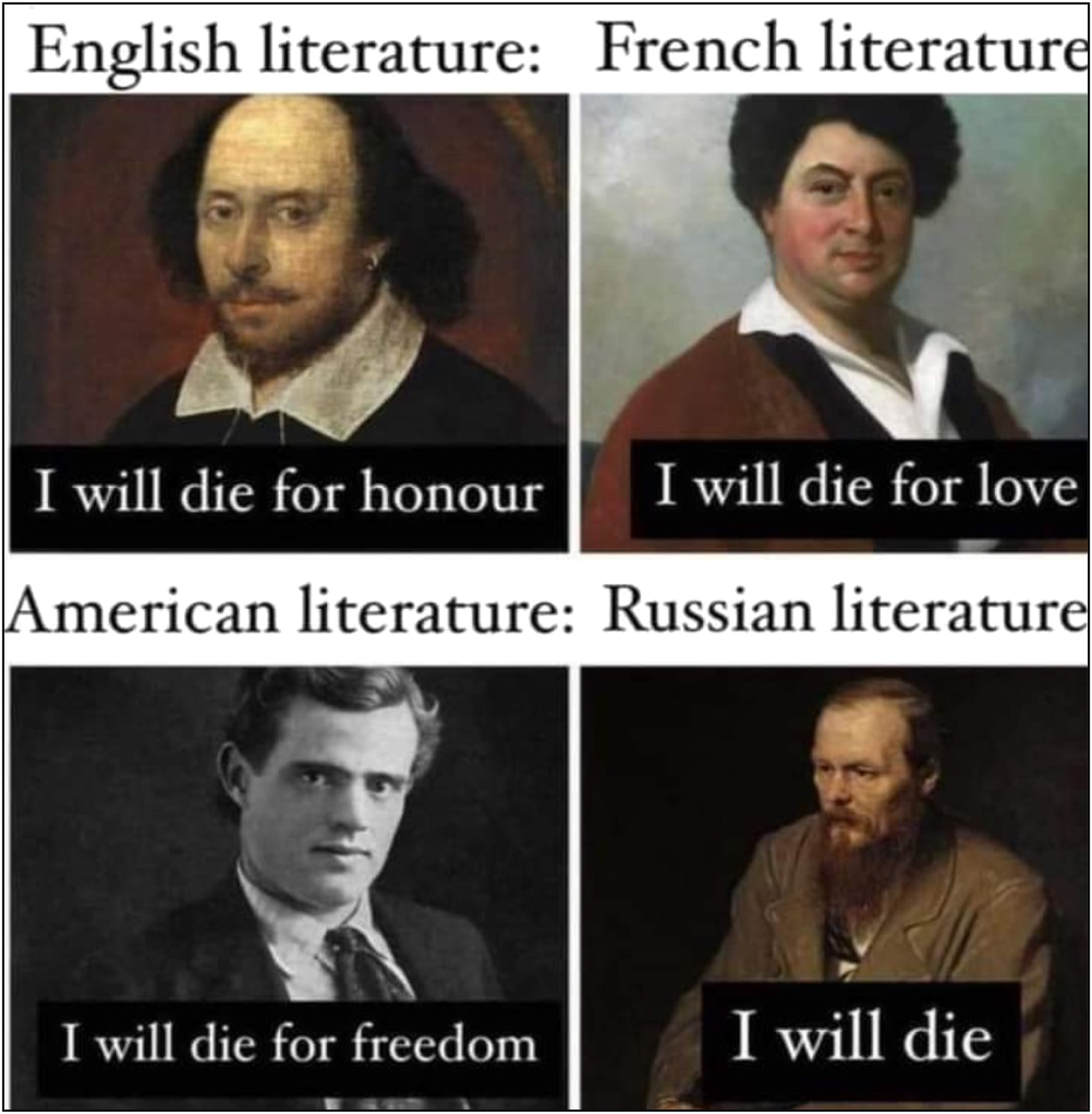
A meme on the differences between different literatures (photo credit: Reddit, retrieved from https://www.reddit.com/r/memes/comments/j3sfcr/culture_cultivates_us/).
4.3 Pragmatic awareness and competence
Pragmatics is concerned with grasping the context in which language is utilized, which includes tone, levels of politeness, and implied meanings (Thomas 2014). Proficient language users must develop pragmatic awareness, knowledge, and competence as part of language proficiency or communicative language competence (Korkmaz and Karatepe 2023). However, doing this may be challenging for language learners from diverse backgrounds (Alsuhaibani 2020; Ren 2022). IMs frequently include language that relies on subtle hints, humor, or irony, making them a valuable tool for teaching these intricacies (Barclay and Downing 2023). An example meme, as in Figure 10, may be used to illustrate the significance of the pragmatic use of colloquial expressions.

The significance of pragmatic meaning (photo credit: iFunny, retrieved from https://ifunny.co/picture/will-you-be-long-yes-i-m-coming-over-OVcyojxx7?s=cl).
4.4 Critical thinking skills
Critical thinking skills, referring to the cognitive processes involving information analysis, evaluation, and synthesis for better judgment decisions, are among the four Cs of 21st-century learning to develop successful society members for a global community (Anggraeni et al. 2023; Topal 2021). Despite the significance of these skills, research shows that language learners lack critical thinking skills, and more interventions are necessary to cultivate critical language thinkers (Lu and Xie 2024; Teng and Yue 2023). In that sense, IMs may be employed to serve as complex signs requiring interpretation, aligning with the edusemiotic goal of promoting active meaning-making (Figure 11).

A meme prompting critical thinking (photo credit: ADHDinos, retrieved from https://www.reddit.com/r/funny/comments/s5ectv/critical_thinking/?rdt=41493).
4.5 Digital literacy
Digital literacy is one of the information, media, and technology skills included within the P21 Framework for 21st Century Learning (González-Pérez and Ramírez-Montoya 2022). It is “the ability to access, manage, understand, integrate, communicate, evaluate and create information safely and appropriately through digital technologies for employment, decent jobs, and entrepreneurship” (UNESCO 2018: 26). IMs are popular among young people, who can be considered digital natives or the internet generation (Janschitz and Penker 2022), since they are participants in digital discourse. However, research in diverse contexts reveals the inadequacy of digital literacy levels among language learners (Dashtestani and Hojatpanah 2022; Reddy et al. 2023). Through engagement with digital signs, language learners apply interpretation and content creation that align with their online experiences, contributing to media literacy construction (Domínguez-Romero and Bobkina 2021; Lacković 2020a, 2020b). Language teachers may accordingly use some websites with tools for meme creation in their classes. Some of these sites are listed below:
Previous studies promoted meme creation for various pedagogical benefits (Kayali and Altuntas 2021; Smith 2023; Vinokurova 2021), supporting our argument.
4.6 Emotional intelligence
Emotional intelligence “concerns the ability to carry out accurate reasoning about emotions and the ability to use emotions and emotional knowledge to enhance thought” (Mayer et al. 2008: 511). Research has shown that emotionally intelligent learners enjoy language learning more and cope well with related problems (Resnik and Dewaele 2023). By nature, IMs involve humor (Torres-Marín et al. 2022), and thus the students engage with decoding humorous content, which contributes to their emotional intelligence (Hylen 2021) as they learn to recognize the cultural nuances, implied meanings, and social cues embedded in IMs. In this regard, language teachers may introduce IMs with puns, polysemy, or cultural humor and conduct classroom discussions about the reasons for humorous content and its impact on cultural attitudes or beliefs. This way, language learners may be able to develop emotional awareness of other people from similar or different cultures (Figure 12).

A meme that may spark a discussion on emotional intelligence (photo credit: r/memes, retrieved from https://www.reddit.com/r/memes/comments/ldcb8v/im_attracted_to_emotional_intelligence/).
4.7 Global awareness
Like digital literacy, global awareness is also included in the P21 Framework for 21st Century Learning as one of the twenty-first-century interdisciplinary themes (Batelle for Kids 2019). Learners must employ twenty-first-century skills to recognize and tackle global challenges, engage with people from various cultures, religions, and lifestyles, and foster mutual respect and open communication in personal, professional, and community settings (Jing 2023). Additionally, they should strive to comprehend different nations and cultures, including using languages other than English (Corbett 2022). Using IMs to raise global awareness of global issues was also voiced in previous studies (Mason et al. 2023; Zhang and Pinto 2021), upholding our argument. Figure 13 shows a meme that may stimulate discussion on a legal act regarding a global environmental issue (i.e., plastic usage).

A meme on one of the global issues (photo credit: Beyond Plastics, retrieved from https://www.beyondplastics.org/meme-contest-winner).
However, there may be some potential pitfalls of applying the EduMeme method. First, it is crucial to note that IMs may come across as culturally insensitive. Therefore, language teachers must be careful when choosing IMs, since some may carry unintended meanings or references, causing potential offense in some cultures (Marlin-Bennett and Jackson 2022). Also, IMs are consumed rapidly despite their permanence of popularity (Hagen and Venturini 2024). This requires teachers to keep updated about trend memes. Additionally, there may be minor linguistic barriers to meme creation, since humor and some cultural references may not translate easily (Chiaro 2024). Considering these downsides is likely to result in better utilization of the method.
5 Discussion
Grown exponentially since their birth in the mid-1970s (Dawkins 1976), memes have acquired a distinct dimension after the emergence of social media platforms. Since then, they have become an indispensable communication tool among digital communities (Nguyen et al. 2022; Wagener 2021). Used for various purposes, IMs serve as a multimodal semiotic means for expressing ideas and emotions without physical, cultural, and linguistic borders (Oyemade and Adeagbo 2020; Wagener 2021). An increasing interest in IMs has been observed in education, particularly language education (Han and Smith 2023; Kayali and Altuntas 2021; Smith 2023; Wang et al. 2024). The potential pedagogical affordances and the lack of research on using IMs within the edusemiotic framework have motivated this study. Accordingly, this article has focused on using IMs in foreign language education from an edusemiotic perspective.
Mirroring previous research on using IMs in language education, this study differs in the conceptual framework within which it is established. Rather than focusing only on specific language skills or areas, as done in earlier work, this study hinges its arguments on a broader structure (i.e., edusemiotics), employing manifold sign systems for instructional or pedagogical purposes. The method proposed in this study (i.e., the EduMeme method) can, therefore, be considered unique because it may be used to teach not only specific but any foreign languages. Similarly, it can be employed in teaching and practicing both particular language skills (e.g., vocabulary and grammar) and broader aspects of language education (e.g., emotional intelligence and global awareness). In this sense, it embraces the facilitative role that edusemiotics plays in education by providing sundry signs (e.g., icons, indexes, and symbols). Equally, the EduMeme method proposed in this study can be adopted by foreign language learners, teachers, practitioners, and administrators thanks to the interdisciplinary characteristic of edusemiotics (Semetsky 2017).
Regarding the use of the EduMeme method in language classrooms, this article suggests alternative methods for language education from an edusemiotic viewpoint, focusing on the need for diverse instructional strategies that can be applied effectively in different languages and contexts and at varying educational levels. By using iconic, indexical, and symbolic signs, along with textual, visual, and auditory tools embedded in IMs, the method addressed in this study caters to nearly all language levels (from A1 to C2 in the Common European Framework of Reference for Languages [CEFR]). For example, teachers can conduct a meme-matching activity with basic language users (A1–A2) in which learners are provided with a set of memes and target vocabulary items to create simple captions (e.g., an image of a sunny day with a caption starter: “Hace…,” which Spanish learners complete choosing the correct word, “sol”). For independent users (B1–B2), teachers can lead an activity whereby learners are asked to create a meme storyboard using relevant vocabulary and narrative structures (e.g., a story about a vacation gone wrong, using memes to describe each phase – “Non c’è più la mia valigia!” for Italian learners). An example activity with proficient users could, for example, include a meme news summary wherein learners summarize a recent news event or a cultural topic (e.g., a meme about environmental issues using “Die Erde brennt” for German learners).
The suggested method introduced in this study can be used for language awareness, knowledge, and skills (e.g., grammar, vocabulary, phonological awareness, writing, orthographic control, and speaking), intercultural awareness, pragmatic awareness, critical thinking skills, digital literacy, emotional intelligence, and global awareness. Although not under the same name, the EduMeme method – an edusemiotic framework for using memes in foreign language education – may also be exploited in other fields, such as mathematics (Bini et al. 2020), psychology (Kath et al. 2024), and interpersonal communication (Paul 2020), as well as other literacies, such as information (Boyle 2022), health (Headley et al. 2022), and visual literacy (Domínguez-Romero and Bobkina 2021). The interdisciplinary characteristic of the method makes it distinctive for its applicability to other fields, skills, and literacies thanks to the broad application of the edusemiotic perspective it has adopted. In addition, the intertextuality of IMs facilitates the method’s implementation across diverse foreign language education contexts.
On the whole, by adopting a holistic approach against the backdrop of edusemiotics, this article has provided novel, practical techniques for incorporating IMs into foreign language teaching. The interdisciplinary nature of edusemiotics and the intertextuality of IMs have lifted the physical, linguistic, and contextual borders, rendering the EduMeme method’s applicability among manifold language teaching environments. Although the current study aligned with previous studies tackling the use of IMs as semiotic cues (Han and Smith 2023; Huang et al. 2024; Kalyuzhna et al. 2023), it differed in scope (e.g., language skills, multiliteracies, and language-related awareness), focus (e.g., multimodality, edusemiotics, and engagement), purpose (e.g., enhance language learning, promote multiple literacies, and foster awareness), and approach (e.g., memetic analysis, meme creation, and task-based activities).
6 Conclusions
This article examined the potential of IMs as edusemiotic tools for teaching diverse language skills, awareness, and literacies in foreign language education contexts (Danesi 2010). It illustrated how IMs as semiotic signs can be employed across various proficiency levels by characterizing IMs and demonstrating their relevance to language learning and teaching. This descriptive analysis aims to broaden our understanding of using signs for educational purposes. Future research is encouraged to explore several key areas: (i) learner and teacher perceptions of implementing the EduMeme method, (ii) the pedagogical effectiveness of this approach, (iii) the role of IMs in teaching intercultural communication, (iv) the contribution of the multimodal nature of IMs to pedagogical benefits, (v) the long-term impact of the method on language learning outcomes, (vi) the application of this method to teaching other languages, and (vii) the potential challenges and ethical considerations associated with using IMs in education.
About the author
Ibrahim Halil Topal (b. 1989) holds a PhD in ELT and has taught English for about 13 years at the College of Foreign Languages, Gazi University. His research interests include educational technology, program evaluation, teacher education, and educational phonetics and phonology. Among his publications are “An edusemiotic approach to teaching intonation in the context of English language teacher education” (2024) and “An examination of Turkish EFL teacher trainees’ pronunciation knowledge, perception, and production” (2024).
Acknowledgments
The figures in the article are used in good faith, in keeping with Section 107 of U.S. copyright law, and as such constitute fair use of copyrighted material. According to Section 107 of U.S. copyright law, “the fair use of a copyrighted work, including such use by reproduction in copies or phonorecords or by any other means specified by that section, for purposes such as criticism, comment, news reporting, teaching (including multiple copies for classroom use), scholarship, or research, is not an infringement of copyright.”
-
Research ethics: Not applicable.
-
Informed consent: Not applicable.
-
Author contributions: The author has accepted responsibility for the entire content of this manuscript and approved its submission.
-
Competing interests: The author declares no competing interests.
-
Research funding: None declared.
-
Data availability: The links to the figures are provided beneath them.
References
Aizawa, Ikuya, Heath Rose, Gene Thompson & Samantha Curle. 2020. Beyond the threshold: Exploring English language proficiency, linguistic challenges, and academic language skills of Japanese students in an English medium instruction programme. Language Teaching Research 27(4). 837–861. https://doi.org/10.1177/1362168820965510.Search in Google Scholar
Al Rousan, Rafat, Ahmad Al Harahsheh & Safwat Al Rousan. 2023. “What’s in a meme?” A thematic analysis of memes related to COVID-19 in Jordan. Onomázein Revista de Lingüística Filología y Traducción 61. 212–235. https://doi.org/10.7764/onomazein.61.10.Search in Google Scholar
Alsuhaibani, Zainab. 2020. Developing EFL students’ pragmatic competence: The case of compliment responses. Language Teaching Research 26(5). 847–866. https://doi.org/10.1177/1362168820913539.Search in Google Scholar
Altherr Flores, Jenna A. 2021. The semiotics of writing: How adult L2 learners with emergent literacy make meaning in assessment texts through writing. Journal of Second Language Writing 51. 100793. https://doi.org/10.1016/j.jslw.2021.100793.Search in Google Scholar
Altukruni, Raja. 2022. A systematic literature review on the integration of internet memes in EFL/ESL classrooms. Arab World English Journal 13(4). 237–250. https://doi.org/10.24093/awej/vol13no4.15.Search in Google Scholar
Anggraeni, Desak Made, Binar Kurnia Prahani, Nadi Suprapto, Noly Shofiyah & Budi Jatmiko. 2023. Systematic review of Problem Based Learning Research in fostering critical thinking skills. Thinking Skills and Creativity 49. 101334. https://doi.org/10.1016/j.tsc.2023.101334.Search in Google Scholar
Asenova, Miglena, Agnese Del Zozzo & George Santi. 2023. Unfolding teachers’ interpretative knowledge into semiotic interpretative knowledge to understand and improve mathematical learning in an inclusive perspective. Education Sciences 13(1). 65. https://doi.org/10.3390/educsci13010065.Search in Google Scholar
Atoofi, Saeid. 2017. Knowledge as a sign: An edusemiotic theory of learning heritage language. In Inna Semestsky (ed.), Edusemiotics – A handbook, 221–234. Singapore: Springer.10.1007/978-981-10-1495-6_16Search in Google Scholar
Bahlmann Bollinger, Chelsey, Sarah Lupo & Brian Sullivan. 2020. Nobody really does the reading: Rethinking reading accountability using technology tools. In Pamela M. Sullivan, Jessica L. Lantz & Brian A. Sullivan (eds.), Handbook of research on integrating digital technology with literacy pedagogies, 433–455. Pennsylvania: IGI Global.10.4018/978-1-7998-0246-4.ch019Search in Google Scholar
Baker, Will. 2015. Research into practice: Cultural and intercultural awareness. Language Teaching 48(1). 130–141. https://doi.org/10.1017/s0261444814000287.Search in Google Scholar
Baker, Will. 2022. Intercultural and transcultural awareness in language teaching. Cambridge: Cambridge University Press.10.1017/9781108874120Search in Google Scholar
Barclay, Katie & Leanne Downing. 2023. Memes, history and emotional life. Cambridge: Cambridge University Press.10.1017/9781009063715Search in Google Scholar
Barwasser, Anne, Karolina Urton, Turid Knaak & Matthias Grünke. 2021. Intentional and incidental vocabulary acquisition through multi-component storytelling: The case of German L2 primary school students. Language Teaching Research 28(6). 2453–2486. https://doi.org/10.1177/13621688211047962.Search in Google Scholar
Battelle for Kids. 2019. P21 resources: 21st century learning resources. Battelle for Kids. https://www.battelleforkids.org/insights/p21-resources/ (accessed 28 November 2024).Search in Google Scholar
Bini, Giulia, Ornella Robutti & Angelika Bikner-Ahsbahs. 2020. Maths in the time of social media: Conceptualizing the internet phenomenon of mathematical memes. International Journal of Mathematical Education in Science and Technology 53(6). 1257–1296. https://doi.org/10.1080/0020739x.2020.1807069.Search in Google Scholar
Blackmore, Susan. 2000. The power of memes. Scientific American 283(4). 64–73. https://doi.org/10.1038/scientificamerican1000-64.Search in Google Scholar
Blázquez-Carretero, Miguel & Robert Woore. 2021. Can a ‘pedagogical’ spellchecker improve spelling accuracy in L2 Spanish? Language Learning & Technology 25(2). 135–157.10.64152/10125/73437Search in Google Scholar
Boyle, Christina. 2022. How do you meme?: Using memes for information literacy instruction. The Reference Librarian 63(3). 82–101. https://doi.org/10.1080/02763877.2022.2084210.Search in Google Scholar
Boylu, Emrah, Mete Yusuf Ustabulut & Ezgi Ingi. 2022. Grammar-learning beliefs of students who learn Turkish as a foreign language. International Journal of Psychology and Educational Studies 9(1). 32–50. https://doi.org/10.52380/ijpes.2022.9.1.442.Search in Google Scholar
Bressoux, Pascal, Bernard Slusarczyk, Ludovic Ferrand & Michel Fayol. 2023. Is spelling related to written composition? A longitudinal study in French. Reading and Writing 37(3). 615–639. https://doi.org/10.1007/s11145-023-10414-6.Search in Google Scholar
Byram, Michael. 1997. Teaching and assessing intercultural communicative competence. Clevedon: Multilingual Matters.Search in Google Scholar
Byram, Michael. 2020. Teaching and assessing intercultural communicative competence: Revisited. Bristol, UK: Multilingual Matters.10.2307/jj.22730614Search in Google Scholar
Campbell, Cary & Alin Olteanu. 2024. The challenge of postdigital literacy: Extending multimodality and social semiotics for a new age. Postdigital Science and Education 6(2). 572–594. https://doi.org/10.1007/s42438-023-00414-8.Search in Google Scholar
Campbell, Cary. 2019. Educating semiosis: Foundational concepts for an ecological edusemiotic. Studies in Philosophy and Education 38(3). 291–317. https://doi.org/10.1007/s11217-018-9617-4.Search in Google Scholar
Campbell, Cary, Alin Olteanu & Kalevi Kull. 2019. Learning and knowing as semiosis: Extending the conceptual apparatus of semiotics. Sign Systems Studies 47(3/4). 352–381. https://doi.org/10.12697/sss.2019.47.3-4.01.Search in Google Scholar
Cannizzaro, Sara. 2016. Internet memes as internet signs: A semiotic view of digital culture. Sign Systems Studies 44(4). 562–586. https://doi.org/10.12697/sss.2016.44.4.05.Search in Google Scholar
Chiaro, Delia. 2024. Humor and translation: Cultural implications. In Thomas E. Ford, Władysław Chłopicki & Giselinde Kuipers (eds.), De Gruyter handbook of humor studies, vol. 2, 201–220. Berlin: Walter de Gruyter.10.1515/9783110755770-012Search in Google Scholar
Chou, Mu-Hsuan. 2023. Strategies for interactive listening in modern foreign language learning. Language Awareness 32(1). 169–191. https://doi.org/10.1080/09658416.2022.2047194.Search in Google Scholar
Chou, Mu-Hsuan. 2024. Communication strategies, difficulties, and speaking tasks in foreign language learning. Sage Open 14(3). https://doi.org/10.1177/21582440241266324.Search in Google Scholar
Clinton-Lisell, Virginia & Alison E. Kelly. 2024. Are scientific memes motivating and does public sharing affect motivation? Psychology Learning & Teaching 23(1). 26–42. https://doi.org/10.1177/14757257231197359.Search in Google Scholar
Corbett, John. 2022. An intercultural approach to English language teaching (Languages for Intercultural Communication and Education), 2nd edn. Bristol, UK: Multilingual Matters.Search in Google Scholar
Danesi, Marcel. 2010. Forward. In Inna Semetsky (ed.), Semiotics education experience, vii–xi. Rotterdam, The Netherlands: Sense Publishers.Search in Google Scholar
Dashtestani, Reza & Shamimeh Hojatpanah. 2022. Digital literacy of EFL students in a junior high school in Iran: Voices of teachers, students and ministry directors. Computer Assisted Language Learning 35(4). 635–665. https://doi.org/10.1080/09588221.2020.1744664.Search in Google Scholar
Dawkins, Richard. 1976. The selfish gene. Oxford: Oxford University Press.Search in Google Scholar
Dawkins, Richard. 2006. The selfish gene: 30th anniversary edition, 3rd edn. Oxford, UK: Oxford University Press.Search in Google Scholar
Deely, John & Inna Semetsky. 2017. Semiotics, edusemiotics and the culture of education. Educational Philosophy and Theory 49(3). 207–219. https://doi.org/10.1080/00131857.2016.1190265.Search in Google Scholar
Domínguez Romero, Elena & Jelena Bobkina. 2021. Exploring critical and visual literacy needs in digital learning environments: The use of memes in the EFL/ESL university classroom. Thinking Skills and Creativity 40. 100783. https://doi.org/10.1016/j.tsc.2020.100783.Search in Google Scholar
Drăguşin, Elena Denisa. 2024. The clipped language revolution: Exploring clipping in contemporary social media English. Intertext 63(1). 32–44. https://doi.org/10.54481/intertext.2024.1.03.Search in Google Scholar
Elkhamisy, Fatma Alzahraa & Asmaa Fady Sharif. 2024. Project-based learning with memes as an innovative competency-boosting tool: A phenomenological interpretive study. Interactive Learning Environments 32(5). 1–18. https://doi.org/10.1080/10494820.2022.2133147.Search in Google Scholar
Erton, İsmail. 2018. The essence of semiotics as a mediator of communication and cognition. International Online Journal of Education and Teaching 5(2). 267–277.Search in Google Scholar
Fan, Yi. 2022. Analyzing the semiotic nature of gifs: Visual nominalization and visual telicity. Language and Semiotic Studies 8(3). 45–65. https://doi.org/10.1515/lass-2022-2004.Search in Google Scholar
Fernández Molina, Javier. 2020. Memes and Twitter as ICT-friendly formats of feedback and self-assessment tested within the CLIL course at the faculty of education. In Rosabel Roig-Vila (ed.), La docencia en la Enseñanza Superior. Nuevas aportaciones desde la investigación e innovación educativas, 1194–1201. Barcelona, Spain: Octaedro.Search in Google Scholar
García López, Fátima & Sara Martínez Cardama. 2020. Strategies for preserving memes as artefacts of digital culture. Journal of Librarianship and Information Science 52(3). 895–904. https://doi.org/10.1177/0961000619882070.Search in Google Scholar
Glasford, Mark Nicholas & J. John Love Joy. 2024. Exploring learners’ attitudes towards meme consumption and their implications for classroom use. Interactive Learning Environments 33(3). 1–11. https://doi.org/10.1080/10494820.2024.2412062.Search in Google Scholar
Glitsos, Laura & James Hall. 2019. The Pepe the Frog meme: An examination of social, political, and cultural implications through the tradition of the Darwinian absurd. Journal for Cultural Research 23(4). 381–395. https://doi.org/10.1080/14797585.2019.1713443.Search in Google Scholar
Gómez Redondo, Susana, Claudio J. Rodríguez Higuera, Juan R. Coca & Alin Olteanu. 2024. Transhumanism, society and education: An edusemiotic approach. Studies in Philosophy and Education 43(2). 177–193. https://doi.org/10.1007/s11217-024-09927-6.Search in Google Scholar
González-Pérez, Laura Icela & María Soledad Ramírez-Montoya. 2022. Components of Education 4.0 in 21st century skills frameworks: Systematic review. Sustainability 14(3). https://doi.org/10.3390/su14031493.Search in Google Scholar
Gualberto, Clarice & Gunther Kress. 2019. Social semiotics. In Renee Hobbs & Paul Mihailidis (eds.), The international encyclopedia of media literacy, 1–9. Hoboken: John Wiley & Sons.10.1002/9781118978238.ieml0226Search in Google Scholar
Guichon, Nicolas & Ciara R. Wigham. 2016. A semiotic perspective on webconferencing-supported language teaching. ReCALL 28(1). 62–82. https://doi.org/10.1017/s0958344015000178.Search in Google Scholar
Guleria, Aishvi, Kamya Varshney, Garima Pahwa, Shreya Singhal & Nonita Sharma. 2024. Multimodal sentiment analysis of English and Hinglish memes. Multimedia Tools and Applications. https://doi.org/10.1007/s11042-024-19640-8.Search in Google Scholar
Hagen, Sal & Tommaso Venturini. 2024. Memecry: Tracing the repetition-with-variation of formulas on 4chan/pol. Information, Communication & Society 27(3). 466–497. https://doi.org/10.1080/1369118x.2023.2216769.Search in Google Scholar
Han, Yiting & Blaine Smith. 2023. An ecological perspective on the use of memes for language learning. Language Learning & Technology 27(2). 155–175.10.64152/10125/73507Search in Google Scholar
Harper, Douglas. 2024. Meme (n.). Online Etymology Dictionary. https://www.etymonline.com/word/meme (accessed 28 November 2024).Search in Google Scholar
Headley, Sely-Ann, Tiffiny Jones, Amar Kanekar & Jody Vogelzang. 2022. Using memes to increase health literacy in vulnerable populations. American Journal of Health Education 53(1). 11–15. https://doi.org/10.1080/19325037.2021.2001777.Search in Google Scholar
Huang, Xinyu, Yifan Han, Yi Ran, Yakun Yang & Yixin Yang. 2024. The rise of cross-language internet memes: A social semiotic analysis. Signs and Society 12(2). 125–141. https://doi.org/10.1086/729125.Search in Google Scholar
Hylen, Michael G. 2021. Cultivating emotional intelligence: The 5 habits of the emotion coach. Lanham, MD: Rowman & Littlefield.Search in Google Scholar
Jandrić, Petar & Derek R. Ford (eds.). 2022. Postdigital ecopedagogies: Genealogies, contradictions, and possible futures. Cham: Springer.10.1007/978-3-030-97262-2Search in Google Scholar
Janschitz, Gerlinde & Matthias Penker. 2022. How digital are ‘digital natives’ actually? Developing an instrument to measure the degree of digitalisation of university students – The DDS-index. Bulletin of Sociological Methodology/Bulletin de Méthodologie Sociologique 153(1). 127–159. https://doi.org/10.1177/07591063211061760.Search in Google Scholar
Jing, Hongtao. 2023. Developing global awareness for global citizenship education: English language teachers’ beliefs and practices in China. Singapore: Springer Nature.10.1007/978-981-99-4179-7Search in Google Scholar
Jones, Pauline, Annette Turney, Wendy Nielsen & Helen Georgiou. 2021. Preparing for teaching digital literacies in the curriculum disciplines. In Maria Grazia Sindoni & Ilaria Moschini (eds.), Multimodal literacies across digital learning contexts, 187–213. New York, NY: Routledge.10.4324/9781003134244-15Search in Google Scholar
Kalyuzhna, Alevtyna, Iryna Lavrinenko & Olena Radchenko. 2023. Presenting grammar through internet memes in teaching English for specific purposes. Cognition, Communication, Discourse 26. 68–82. https://doi.org/10.26565/2218-2926-2023-26-04.Search in Google Scholar
Kath, Lisa M., Gordon B. Schmidt, Sayeedul Islam, William P. Jimenez & Jessica L. Hartnett. 2024. Getting psyched about memes in the psychology classroom. Teaching of Psychology 51(3). 345–351. https://doi.org/10.1177/00986283221085908.Search in Google Scholar
Kayali, Nurda Karadeniz & Aslı Altuntaş. 2021. Using memes in the language classroom. Shanlax International Journal of Education 9(3). 155–160. https://doi.org/10.34293/education.v9i3.3908.Search in Google Scholar
Kiaer, Jieun. 2024. Conversing in the metaverse: The embodied future of online communication. London: Bloomsbury Publishing.10.5040/9781350338548Search in Google Scholar
Kim, Deoksoon. 2020. Learning language, learning culture: Teaching language to the whole student. ECNU Review of Education 3(3). 519–541. https://doi.org/10.1177/2096531120936693.Search in Google Scholar
Kocbek, Alenka. 2014. Unlocking the potential of translation for FLT. Linguistica 54(1). 425–438. https://doi.org/10.4312/linguistica.54.1.425-438.Search in Google Scholar
Korkmaz, Sedat & Çiğdem Karatepe. 2023. Exploring the pragmatic awareness and competence of EFL instructors at tertiary level. Anadolu Journal of Educational Sciences International 13(1). 34–55. https://doi.org/10.18039/ajesi.1086084.Search in Google Scholar
Kumaravadivelu, Bala. 2001. Toward a postmethod pedagogy. TESOL Quarterly 35(4). 537–560. https://doi.org/10.2307/3588427.Search in Google Scholar
Lacković, Nataša. 2020a. Inquiry graphics in higher education. Cham: Palgrave MacMillan.10.1007/978-3-030-39387-8Search in Google Scholar
Lacković, Nataša. 2020b. Thinking with digital images in the post-truth era: A method in critical media literacy. Postdigital Science and Education 2(2). 442–462. https://doi.org/10.1007/s42438-019-00099-y.Search in Google Scholar
Legg, Catherine. 2017. Diagrammatic teaching: The role of iconic signs in meaningful pedagogy. In Inna Semetsky (ed.), Edusemiotics – A handbook, 29–45. Singapore: Springer.10.1007/978-981-10-1495-6_3Search in Google Scholar
Levis, John M. & Alif Silpachai. 2021. Speech intelligibility. In The Routledge handbook of second language acquisition and speaking, 160–173. New York: Routledge.10.4324/9781003022497-15Search in Google Scholar
Li, Ying. 2024. Enhancing L2 sound learning through the integration of audio-visual information: Phonetic training in the classroom. Language Teaching Research. https://doi.org/10.1177/13621688231219773.Search in Google Scholar
Lim, Jungmin & Matt Kessler. 2024. Multimodal composing and second language acquisition. Language Teaching 57(2). 183–202. https://doi.org/10.1017/s0261444823000125.Search in Google Scholar
Lin, Xi & Qi Sun. 2023. Student-generated memes as a way to facilitate online discussion for adult learners. Psychology in the Schools 60(12). 4826–4840. https://doi.org/10.1002/pits.22884.Search in Google Scholar
Lotherington, Heather & Noah Bradley. 2024. Hey Siri: Should #language, , and follow me be taught? A historical review of evolving communication conventions across digital media environments and uncomfortable questions for language teachers. Language Learning and Technology 28(1). 1–19.10.64152/10125/73552Search in Google Scholar
Ma, Qing, Jinlan Tang & Shanru Lin. 2022. The development of corpus-based language pedagogy for TESOL teachers: A two-step training approach facilitated by online collaboration. Computer Assisted Language Learning 35(9). 2731–2760. https://doi.org/10.1080/09588221.2021.1895225.Search in Google Scholar
Maran, Timo. 2020. Ecosemiotics: The study of signs in changing ecologies. Cambridge: Cambridge University Press.10.1017/9781108942850Search in Google Scholar
Marino, Gabriele. 2022. Semiotics of virality: From social contagion to internet memes. Signata – Annales des sémiotiques/Annals of Semiotics 13. https://doi.org/10.4000/signata.3936.Search in Google Scholar
Markey, Michael. 2022. Learning a foreign language in immersion and second language acquisition contexts – Students’ multilingual experiences with French in Ireland. Journal of Immersion and Content-Based Language Education 10(1). 33–61. https://doi.org/10.1075/jicb.19014.mar.Search in Google Scholar
Marlin-Bennett, Renée & Susan T. Jackson. 2022. DIY cruelty: The global political micro-practices of hateful memes. Global Studies Quarterly 2(2). https://doi.org/10.1093/isagsq/ksac002.Search in Google Scholar
Mason, Alicia, Elizabeth Spencer, Tricia Combs, Tanner Glenn, Brooklyn Peterson, Isaac Lewis & Emerson Tice. 2023. Fandom and activism: Experimenting with memetic communication appeals about human rights issues during the 2022 winter Olympic games. In Gashaw Abeza & Jimmy Sanderson (eds.), Social media in sport, 13–29. New York, NY: Routledge.10.1080/08934215.2023.2256803Search in Google Scholar
Mayer, John D., Richard D. Roberts & Sigal G. Barsade. 2008. Human abilities: Emotional intelligence. Annual Review of Psychology 59(1). 507–536. https://doi.org/10.1146/annurev.psych.59.103006.093646.Search in Google Scholar
Mirzaei, Azizullah, Mahshid Azizi Farsani & Heesun Chang. 2023. Statistical learning of L2 lexical bundles through unimodal, bimodal, and multimodal stimuli. Language Teaching Research. https://doi.org/10.1177/13621688231193079.Search in Google Scholar
Molina, Maria D. 2020. What makes an internet meme a meme? Six essential characteristics. In Sheree Josephson, James Kelly & Ken Smith (eds.), Handbook of visual communication: Theory, methods, and media, 380–394. New York, NY: Routledge.10.4324/9780429491115-35Search in Google Scholar
Muñoz, Carmen. 2022. Audiovisual input in L2 learning. Language, Interaction and Acquisition 13(1). 125–143. https://doi.org/10.1075/lia.22001.mun.Search in Google Scholar
Muñoz, Carmen, Geòrgia Pujadas & Anastasiia Pattemore. 2023. Audio-visual input for learning L2 vocabulary and grammatical constructions. Second Language Research 39(1). 13–37. https://doi.org/10.1177/02676583211015797.Search in Google Scholar
Nagle, Charlie L., Amanda Huensch & Germán Zárate-Sández. 2023. Exploring phonetic predictors of intelligibility, comprehensibility, and foreign accent in L2 Spanish speech. The Modern Language Journal 107(1). 202–221. https://doi.org/10.1111/modl.12827.Search in Google Scholar
Nguyen, Hanh, Wendy Chambers & Marilyn Abbott. 2022. Building ESL learners’ digital literacy skills using internet memes. TESL Canada Journal 39(1). 83–103. https://doi.org/10.18806/tesl.v39i1/1368.Search in Google Scholar
Nielsen, Peter Juul & María Sol Sansiñena. 2024. Indexicality: The role of indexing in language structure and language change. Berlin: De Gruyter Mouton.10.1515/9783110791433Search in Google Scholar
Nissenbaum, Asaf & Limor Shifman. 2018. Meme templates as expressive repertoires in a globalizing world: A cross-linguistic study. Journal of Computer-Mediated Communication 23(5). 294–310. https://doi.org/10.1093/jcmc/zmy016.Search in Google Scholar
Nöth, Winfried. 2020. The iconic, indexical, and symbolic in language: Overlaps, inclusions, and exclusions. In Pamela Perniss, Olga Fischer & Christina Ljungberg (eds.), Operationalizing iconicity, 307–326. Amsterdam: John Benjamins.10.1075/ill.17.18notSearch in Google Scholar
Oyemade, Olubunmi & Adeife Adeagbo. 2020. Memes as ideological representations in the 2019 Nigerian presidential campaigns: A multimodal approach. Language and Semiotic Studies 6(1). 78–103. https://doi.org/10.1515/lass-2020-060104.Search in Google Scholar
Panther, Leah & Darren Crovitz. 2024. Critical memetic literacies in English education: How do you meme? New York, NY: Routledge.10.4324/9781003384700Search in Google Scholar
Paolucci, Claudio. 2021. Cognitive semiotics. Cham: Springer International Publishing.Search in Google Scholar
Paul, Aditi. 2020. Memes as means for understanding interpersonal communication: A formative assignment. Communication Teacher 34(4). 346–354. https://doi.org/10.1080/17404622.2019.1681484.Search in Google Scholar
Pikkarainen, Eetu. 2014. Competence as a key concept of educational theory: A semiotic point of view. Journal of Philosophy of Education 48(4). 621–636. https://doi.org/10.1111/1467-9752.12080.Search in Google Scholar
Puimège, Eva, Maribel Montero Perez & Elke Peters. 2023. Promoting L2 acquisition of multiword units through textually enhanced audiovisual input: An eye-tracking study. Second Language Research 39(2). 471–492. https://doi.org/10.1177/02676583211049741.Search in Google Scholar
Reddy, Pritika, Kaylash Chaudhary & Shamina Hussein. 2023. A digital literacy model to narrow the digital literacy skills gap. Heliyon 9(4). e14878. https://doi.org/10.1016/j.heliyon.2023.e14878.Search in Google Scholar
Ren, Wei. 2022. Second language pragmatics. Cambridge: Cambridge University Press.Search in Google Scholar
Renandya, Willy A. & Minh Thi Thuy Nguyen. 2022. Teaching speaking in L2 contexts. In Eli Hinkel (ed.), Handbook of practical second language teaching and learning, 269–280. Routledge.10.4324/9781003106609-22Search in Google Scholar
Resnik, Pia & Jean-Marc Dewaele. 2023. Learner emotions, autonomy and trait emotional intelligence in ‘in-person’ versus emergency remote English foreign language teaching in Europe. Applied Linguistics Review 14(3). 473–501. https://doi.org/10.1515/applirev-2020-0096.Search in Google Scholar
Rogers, Richard & Giulia Giorgi. 2024. What is a meme, technically speaking? Information, Communication & Society 27(1). 73–91. https://doi.org/10.1080/1369118x.2023.2174790.Search in Google Scholar
Ryu, Jieun, Young Ae Kim, Seungmin Eum, Seojin Park, Sojung Chun & Sunyoung Yang. 2022. The assessment of memes as digital multimodal composition in L2 classrooms. Journal of Second Language Writing 57. 100914. https://doi.org/10.1016/j.jslw.2022.100914.Search in Google Scholar
Sebeok, Thomas Albert. 2001. Signs: An introduction to semiotics. Toronto: University of Toronto Press.Search in Google Scholar
Seiffert-Brockmann, Jens, Trevor Diehl & Leonhard Dobusch. 2018. Memes as games: The evolution of a digital discourse online. New Media & Society 20(8). 2862–2879. https://doi.org/10.1177/1461444817735334.Search in Google Scholar
Semetsky, Inna. 2014. Taking the edusemiotic turn: A body∼mind approach to education. Journal of Philosophy of Education 48(3). 490–506. https://doi.org/10.1111/1467-9752.12082.Search in Google Scholar
Semetsky, Inna. 2017. Edusemiotics – A handbook. Singapore: Springer.10.1007/978-981-10-1495-6Search in Google Scholar
Shifman, Limor. 2013. Memes in a Digital World: Reconciling with a conceptual troublemaker. Journal of Computer-Mediated Communication 18(3). 362–377. https://doi.org/10.1111/jcc4.12013.Search in Google Scholar
Sidekerskienė, Tatjana & Robertas Damaševičius. 2024. Pedagogical memes: A creative and effective tool for teaching stem subjects. International Journal of Mathematical Education in Science and Technology. 1–31. https://doi.org/10.1080/0020739x.2024.2328818.Search in Google Scholar
Smith, Christopher A. 2023. One does not simply teach idioms: Meme creation as innovative practice for virtual EFL Learners. RELC Journal 54(3). 714–728. https://doi.org/10.1177/00336882211044878.Search in Google Scholar
Sottilotta, Elena Emma & Danila Cannamela. 2019. Six memos for teaching Italian as a foreign language: Creativity, storytelling, and visual imagination in the language classroom. EuroAmerican Journal of Applied Linguistics and Languages 6(1). 37–55. https://doi.org/10.21283/2376905x.10.133.Search in Google Scholar
Stables, Andrew. 2016. Edusemiotics as process semiotics: Towards a new model of semiosis for teaching and learning. Semiotica 2016(212). 45–57. https://doi.org/10.1515/sem-2016-0126.Search in Google Scholar
Stables, Andrew, Winfried Nöth, Alin Olteanu, Sébastien Pesce & Eetu Pikkarainen. 2018. Semiotic theory of learning: New perspectives in the philosophy of education. New York, NY: Routledge.10.4324/9781315182438Search in Google Scholar
Sullivan, Alice, Vanessa Moulton & Emla Fitzsimons. 2021. The intergenerational transmission of language skill. The British Journal of Sociology 72(2). 207–232. https://doi.org/10.1111/1468-4446.12780.Search in Google Scholar
Teng, Mark Feng & Mei Yue. 2023. Metacognitive writing strategies, critical thinking skills, and academic writing performance: A structural equation modeling approach. Metacognition and Learning 18(1). 237–260. https://doi.org/10.1007/s11409-022-09328-5.Search in Google Scholar
Thellefsen, Martin Muderspach. 2024. Signifying unity: Exploring the interplay of semiotics, universalism and pluralism in information science. Journal of Documentation 80(4). 922–938. https://doi.org/10.1108/jd-07-2023-0144.Search in Google Scholar
Thomas, Jenny A. 2014. Meaning in interaction: An introduction to pragmatics. New York, NY: Routledge.Search in Google Scholar
Tidy, Helen, Rachel S. Bolton-King, Ruth Croxton, Carrie Mullen, Leisa Nichols-Drew, Felicity Carlysle-Davies, Kimberlee S. Moran & Joanne Irving-Walton. 2024. Enhancing the student learning experience through memes. Science & Justice 64(3). 280–288. https://doi.org/10.1016/j.scijus.2024.03.004.Search in Google Scholar
Topal, İbrahim Halil. 2019. CEFR-oriented probe into pronunciation: Implications for language learners and teachers. Journal of Language and Linguistic Studies 15(2). 420–436. https://doi.org/10.17263/jlls.586087.Search in Google Scholar
Topal, İbrahim Halil. 2021. Pronunciation as part of the 4Cs in 21st century skills. In Arif Sarıçoban, Şahin Sarı, Bilge Metin Tekin & Cihan Yazgı (eds.), Proceedings of AELTE 2022: 21st century challenges in English language teaching, 22–35. Ankara, Türkiye: AELTE.Search in Google Scholar
Topal, Ibrahim Halil. 2024. An edusemiotic approach to teaching intonation in the context of English language teacher education. Semiotica 2024(259). 185–216. https://doi.org/10.1515/sem-2023-0203.Search in Google Scholar
Topal, İbrahim Halil & İsmail Fırat Altay. 2022. Revisiting the problematic English sounds for prospective Turkish EFL teachers. International Online Journal of Education and Teaching 9(4). 1794–1816.Search in Google Scholar
Torres-Marín, Jorge, Ginés Navarro-Carrillo, Michael Eid & Hugo Carretero-Dios. 2022. Humor styles, perceived threat, funniness of COVID-19 memes, and affective mood in the early stages of COVID-19 lockdown. Journal of Happiness Studies 23(6). 2541–2561. https://doi.org/10.1007/s10902-022-00500-x.Search in Google Scholar
Tsunemoto, Aki, Rachael Lindberg, Pavel Trofimovich & Kim McDonough. 2022. Visual cues and rater perceptions of second language comprehensibility, accentedness, and fluency. Studies in Second Language Acquisition 44(3). 659–684. https://doi.org/10.1017/s0272263121000425.Search in Google Scholar
Tytler, Russell & Vaughan Prain. 2022. Supporting student transduction of meanings across modes in primary school astronomy. Frontiers in Communication 7. 863591. https://doi.org/10.3389/fcomm.2022.863591.Search in Google Scholar
Uchihara, Takumi & Jon Clenton. 2023. The role of spoken vocabulary knowledge in second language speaking proficiency. The Language Learning Journal 51(3). 376–393. https://doi.org/10.1080/09571736.2022.2080856.Search in Google Scholar
UNESCO. 2018. A global framework of reference on digital literacy skills for indicator 4.4.2. Quebec, Canada: UNESCO Institute for Statistics.Search in Google Scholar
Urlica, Alina-Andreea & Sandra Stefanović. 2018. Ecolinguistic qualities of the optimal English language learning experience. International Journal for Quality Research 12(2). 537–546. https://doi.org/10.18421/IJQR12.02-14.Search in Google Scholar
Valente, David & Daniel Xerri. 2023. Innovative practices in early English language education. Cham: Palgrave MacMillan.10.1007/978-3-031-12922-3Search in Google Scholar
Vallerossa, Francesco. 2024. ‘I think mangiò might be passé simple’: Exploring multilingual learners’ reflections on past tense verb morphology. International Journal of Multilingualism 21(1). 112–130. https://doi.org/10.1080/14790718.2022.2036159.Search in Google Scholar
van Rijt, Jimmy H. M. & Peter-Arno J. M. Coppen. 2021. The conceptual importance of grammar. Pedagogical Linguistics 2(2). 175–199. https://doi.org/10.1075/pl.21008.van.Search in Google Scholar
Vazquez-Calvo, Boris, James York, Ju Seong Lee, Di Zou & Michelle Mingyue Gu. 2024. Fan and ludic practices for enhancing EFL writing and reflection. In Ju Seong Lee, Di Zou & Michelle Mingyue Gu (eds.), Technology and English language teaching in a changing world: A practical guide for teachers and teacher educators, 157–171. Cham: Palgrave Macmillan.Search in Google Scholar
Vinokurova, Valentina. 2021. Memes: Learning, bonding, and emotional support in times of COVID-19. Russian Language Journal 71(2). 271–288. https://doi.org/10.70163/0036-0252.1014.Search in Google Scholar
Wagener, Albin. 2021. The postdigital emergence of memes and gifs: Meaning, discourse, and hypernarrative creativity. Postdigital Science and Education 3(3). 831–850. https://doi.org/10.1007/s42438-020-00160-1.Search in Google Scholar
Walker, Robin & Gemma Archer. 2024. Teaching English pronunciation for a global world. Oxford: Oxford University Press.Search in Google Scholar
Wang, Fei, Pei-ji Chen, Wen-yang Li & Hiroshi Yokoi. 2024. An exploratory study on the transmission of language memes: The case of Chinese language memes. Journal of Creative Communications 19(3). 276–294. https://doi.org/10.1177/09732586231220431.Search in Google Scholar
Wiggins, Bradley E. 2019. Discursive power of memes in digital culture: Ideology, semiotics, and intertextuality. New York, NY: Routledge.10.4324/9780429492303Search in Google Scholar
Yoon, Hyung-Jo. 2021. Interactions in EFL argumentative writing: Effects of topic, L1 background, and L2 proficiency on interactional metadiscourse. Reading and Writing 34(3). 705–725. https://doi.org/10.1007/s11145-020-10085-7.Search in Google Scholar
Zalbidea, Janire, Bernard I. Issa, Mandy Faretta-Stutenberg & Cristina Sanz. 2021. Initial proficiency and L2 grammar development during short-term immersion abroad. Studies in Second Language Acquisition 43(2). 239–267. https://doi.org/10.1017/s0272263120000376.Search in Google Scholar
Zannan Alghamdy, Rashed. 2023. Efficacy of problem-based learning strategy to enhance EFL learners’ paragraph writing and grammar skills. Arab World English Journal 14(1). 43–58. https://doi.org/10.24093/awej/vol14no1.3.Search in Google Scholar
Zhang, Leticia-Tian & Daniel Cassany. 2023. From writing to drawing: Examining visual composition in danmu-mediated textual communication. Discourse, Context & Media 53. 100699. https://doi.org/10.1016/j.dcm.2023.100699.Search in Google Scholar
Zhang, Bingbing & Juliet Pinto. 2021. Changing the world one meme at a time: The effects of climate change memes on civic engagement intentions. Environmental Communication 15(6). 749–764. https://doi.org/10.1080/17524032.2021.1894197.Search in Google Scholar
Zhao, Yuhao, Yu Chen, Kaiwen Cheng & Wei Huang. 2023. Artificial intelligence based multimodal language decoding from brain activity: A review. Brain Research Bulletin 201. 1–13. https://doi.org/10.1016/j.brainresbull.2023.110713.Search in Google Scholar
Zhu, Tiejun & Yujin Yang. 2023. Research on mobile learning platform interface design based on college students’ visual attention characteristics. PLOS One 18(7). e0283778. https://doi.org/10.1371/journal.pone.0283778.Search in Google Scholar
© 2025 the author(s), published by De Gruyter, Berlin/Boston
This work is licensed under the Creative Commons Attribution 4.0 International License.
Articles in the same Issue
- Frontmatter
- Research Articles
- On the naturalist foundations of any truly general theory of signs
- “Invitational” metaphors in China Women’s News: gender egalitarianism, feminist axiology, and female autonomy
- Negotiation of identity and indexical order in linguistic landscapes in Hong Kong: a comparison among Central, Tsim Sha Tsui, and Sheung Shui
- EduMeme: using internet memes in foreign language education from an edusemiotic perspective
- The semiotics of lie and lying: a journey to hyperreality
- An illustration of the polysemiosis of jade as a sign vehicle in traditional Chinese culture – an exemplar of formal and essential intuition
- The magic of repetition: the narrative presentation of time in Yeats’s poetry
Articles in the same Issue
- Frontmatter
- Research Articles
- On the naturalist foundations of any truly general theory of signs
- “Invitational” metaphors in China Women’s News: gender egalitarianism, feminist axiology, and female autonomy
- Negotiation of identity and indexical order in linguistic landscapes in Hong Kong: a comparison among Central, Tsim Sha Tsui, and Sheung Shui
- EduMeme: using internet memes in foreign language education from an edusemiotic perspective
- The semiotics of lie and lying: a journey to hyperreality
- An illustration of the polysemiosis of jade as a sign vehicle in traditional Chinese culture – an exemplar of formal and essential intuition
- The magic of repetition: the narrative presentation of time in Yeats’s poetry
