Exploring Approaches to Interpreting Studies
-
Binhua Wang (b.1974) is professor of interpreting and translation studies and Programme Director of MA Conference Interpreting and Translation Studies in the Centre for Translation Studies at University of Leeds. He is a fellow of the Chartered Institute of Linguists (CIOL) and expert member (fellow) of the Translators Association of China (TAC). His research interests lie in various aspects of interpreting and translation studies, in which he has published over 50 peer-reviewed articles, including nearly 40 in refereed CSSCI/Core and SSCI/A&HCI journals such as
Interpreting, Meta, Perspectives , andBabel and over a dozen in peer-reviewed collected volumes.

Abstract
This article explores the relevance of semiotic perspectives on and approaches to Interpreting Studies. Interpreting can be perceived as textual (re)production, as communicative interaction, and as a sociocultural activity, and can be studied in the linguistic and structural approach at the micro-dimension, the pragmatic and communicative approach at the meso-dimension, and in the sociocultural approach at the macro-dimension respectively. Different degrees of applicability can be identified in structural semiotics, interpretive semiotics, and social semiotics. Multimodal analysis integrating linguistic semiotics, paralinguistic semiotics, and non-linguistic semiotics is identified as having great potential in examining the communicative process of interpreting in its entirety.
1 Introduction
Translation and interpreting are forms of intersemiotic, interlingual, and cross-cultural mediation involving the rendition of written texts or oral speeches from one language to another. As translation and interpreting activities are prevalent in almost all areas of international and cross-cultural communication, they present fertile research areas for semiotics.
Translation and Interpreting Studies is a relatively young interdiscipline becoming autonomous in its own right, which has experienced remarkable development over the past decades in both empirical exploration and theoretical and methodological construction by drawing on concepts, theories, and methods of relevant disciplines. Within the discipline, a recent development is the conceptualization of translation and interpreting as socially situated activities and translators and interpreters as agents of not only linguistic and communicative mediation, but also cultural and ideological mediation. After the emergence of the linguistic approach to translation studies from the 1950s to the 1980s, which centered on the concept of “equivalence” between the source text and the target text, there followed the “cultural turn” in the 1990s, which expanded the scope of research to include the cultural aspect of translation and interpreting. In the past decade, the discipline has shown increasing awareness of adopting a more critical stance toward the relationship between discursive practices and their social embedding, which is labeled by some scholars (e.g. Wolf 2004) as the “social turn” or “sociological turn” of Translation and Interpreting Studies. Such a perspective is articulated by Baker (2006: 322), saying that “it is far more productive to examine contextualization as a dynamic process of negotiation and one that is constrained by the uneven distribution of power which characterizes all exchanges in society, including those that are mediated by translators and interpreters.”
Against the background of the different “turns” in Translation and Interpreting Studies, how can the interdiscipline of translation and interpreting be further developed without losing its identity? In this article I will overhaul the major perspectives, approaches, and analytic paradigms of Interpreting Studies on the one hand, and on the other explore the relevance and applicability of structural semiotics, interpretive semiotics, and social semiotics to Interpreting Studies.
2 The relevance of semiotics to Interpreting Studies
As inspired by semiotics, Roman Jakobson, the trailblazer of translation studies, distinguished three ways of interpreting a verbal sign: “it may be translated into other signs of the same language, into another language, or into another, nonverbal system of symbols” (Jakobson 1959: 233). He goes on to label three different types of “translation” (Jakobson 1959: 233):
Intralingual translation or rewording is an interpretation of verbal signs by means of other signs of the same language.
InterIingual translation or translation proper is an interpretation of verbal signs by means of some other language.
Intersemiotic translation or transmutation is an interpretation of verbal signs by means of signs of nonverbal sign systems.
While no argument is necessary for the relevance of the concept of “interIingual translation or translation proper,” which has been the focus of research in translation (and interpreting) studies, particular elaboration can be given on the relevance of “intralinguistic translation,” rewording, or paraphrase to one of the representative theories in Interpreting Studies, i.e. the interpretive theory or théorie du sens as proposed by the Paris School (Seleskovitch & Lederer 1984).
As outlined vividly by Seleskovitch and Lederer (1984: 185) in Figure 1, the proper interpreting process is not a straightforward transcoding process from Language 1 to Language 2 as it appears, but a process of making sense of the source language (SL) from the speaker and then making sense in the target language (TL) to the listener (as represented by the other two lines in the triangle). That means the interpreter needs to do intralinguistic translation or make sense by integrating the incoming new linguistic messages with his/her extralinguistic prior knowledge.
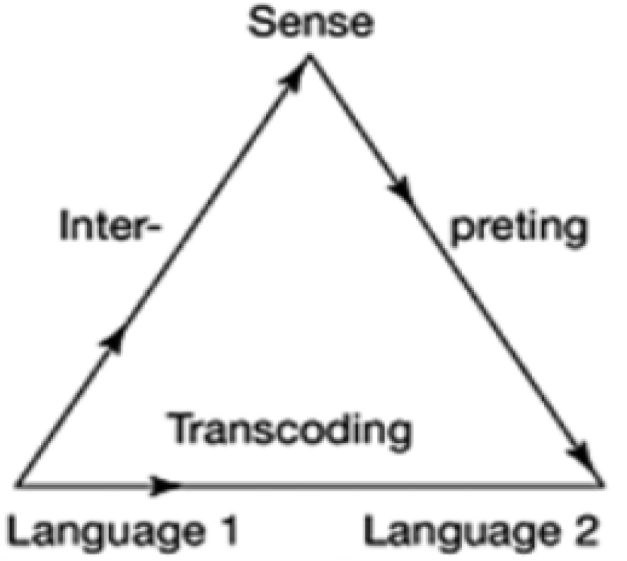
The triangular model of interpreting
The perception that interpreting involves much more than verbal transfer can be further elaborated through the lens of C. S. Pierce’s “interpretative semiotics.” Along this line, semiotics is defined by Stecconi (2009: 260) as “studies of how people make sense of their experience of the world and how cultures share and give currency to this understanding.” In the same vein, translation can be seen “as a subspecies of interpretation,” which “does not simply involve substituting single terms with their alleged synonyms, nor does it involve comparing sign systems per se. Instead, it involves confronting textual situations against a background of different (partial) encyclopedias, that is, of specific forms of socially and culturally shared knowledge set in different historical situations” (Eco & Nergaard 1998: 219).
I believe semiotics has a lot more to offer, especially in further consolidating the view held by interpreting scholars, but not yet prevalently known to scholars in translation studies and linguistics, that interpreting is not merely verbal transfer. In this sense, semiotics is useful for Translation Studies (including translation studies and interpreting studies) for the following five reasons (Stecconi 2007: 15): a) it is a theory of signs in general, not of verbal language; b) it provides a viable model for the core of translation events; c) it redefines the traditional image of translating as transfer; d) it casts new light on equivalence and loss; and e) it affords an investigation of the logico-semiotic conditions to translation in general.
I will elaborate further the relevance and significance of applying the concept of “intersemiotic translation” to Interpreting Studies in order to have a better understanding of the communicative process in interpreting, as discussed later in Section 5.
3 Taking stock of approaches, perspectives and analytic paradigms in Interpreting Studies
3.1 Approaches and perspectives in Interpreting Studies
Interpreting Studies is increasingly adopting interdisciplinary approaches to the perception, description, interpretation, and explanation of interpreting as intertextual and intercultural transposition. The approaches to Interpreting Studies can be configured into the following four categories with different perspectives on the phenomenon of interpreting:
The cognitive approach, which focuses on the cognitive process(ing) of interpreting. Interpreting is a complex cognitive bilingual processing activity featured with multitasking of cognitive operations. The objects of analysis in this approach include: the mechanism of listening comprehension in interpreting, the mechanism of working memory in interpreting, the mechanism of note-taking in consecutive interpreting, the mechanism of target-language activation (or bilingual conversion) in interpreting, the mechanism of simultaneous listening and speaking (or split attention) in simultaneous interpreting, the mechanism of ear–voice span (or managing décalage) in simultaneous interpreting, the mechanism of coordination among multiple tasks, etc.
The linguistic and structural approach, which focuses on the aspect of interpreting as text (re)production. The objects of analysis include: cohesion and coherence in interpreting, texture and textuality in interpreting, intertextuality in interpreting, thematic and information structure in interpreting, discoursal shifts in interpreting, etc.
The pragmatic and communicative approach, which focuses on the aspect of interpreting as language use. The objects of analysis include: speech act in interpreting, implicatures in interpreting, participation and footing in interpreting, mediation and turn-taking in interpreting, situational context in interpreting, etc.
The sociocultural approach, which focuses on the aspect of interpreting as social practice. The objects of analysis include: genre in interpreting, register in interpreting (including field, tenor, and mode), sociocultural context in interpreting, transitivity in interpreting, (multi)modality in interpreting, appraisal, attitude and positioning in interpreting, power and ideology in interpreting, etc.
As is shown in Figure 2, Interpreting Studies can be approached in the following ways with increasing breadth: a) the cognitive approach and b) the linguistic and structural approach at the micro-dimension, c) the pragmatic and communicative approach at the meso-dimension, and d) the sociocultural approach at the macro-dimension. Interpreting is thus perceived as cognitive processing in the first approach, as textual (re)production in the second approach, as communicative interaction in the third approach, and as sociocultural activity in the fourth approach. With the exception of the first approach, all of the other three can be identified as being relevant to semiotics, including structural semiotics, interpretive semiotics, and social semiotics.

Multiple approaches to Interpreting Studies
3.2 Analytic paradigms of Interpreting Studies
As rightly pointed out by Eco & Nergaard (1998: 221), translation (and interpreting) involves “passing from a text ‘a’, elaborated according to a semiotic system ‘A’, into a text ‘b’, elaborated according to a semiotic system ‘B.’” While exploring the relevancy of semiotic approaches to Interpreting Studies, we must be aware that interpreting is different from monolingual communication mainly in the following three aspects: a) the role of interpreter as an extra participant in the communication process, b) the processing and production of bilingual discourses, and c) the function of different linguistic, social, and cultural conventions involved in the multilingual mediation. In other words, different from monolingual semiotic analysis, Interpreting Studies needs to deal with two or more texts/discourses and their processing.
Therefore, Interpreting Studies can be conducted in the following analytic paradigms with different foci: 1) the process-analytic paradigm, which analyzes the cognitive and interactive process of interpreting; 2) the source-text (ST) and target-text (TT) contrastive paradigm, which compares and contrasts the source text and target text of interpreting; 3) target-text descriptive paradigm, which describes the features of the target text in interpreting; and 4) target-text contrastive paradigm, which compares and contrasts different target-text versions of the same source speech in interpreting. The paradigms of Interpreting Studies can be mapped as in Figure 3.

Analytic paradigms of Interpreting Studies
4 Communicative models of consecutive interpreting and simultaneous interpreting
As an object of study, interpreting is a unique type of behavior and activity in textual (re)production, communicative interaction, and sociocultural actions, not only because it involves the interpreter as the mediator between the primary participants (i.e. the speaker and the listener), but also because both the source-language discourse and the target-language discourse are “multi-composite discourse,” which is composed of verbal information, paraverbal information and nonverbal information.
At the stage of listening and analysis, the interpreter needs to not only absorb what the speaker has said (verbal information), but also perceive how the speaker has said it when making sense of the source speech. Through aural perception, the interpreter needs to make sense of the pauses, stress, intonation, speed, prosody, articulation, fluency, or hesitation in the speech (paraverbal information); through visual perception, he/she needs to make sense of the speaker’s expression, gesture, and body language, as well as the visual aids such as the PowerPoint and images used by the speaker (nonverbal information).
The listener in the interpreted communicative event also needs to make sense from the “multi-composite discourse.” He/she would listen to the verbal rendition from the interpreter along with the paraverbal and nonverbal information from the interpreter. He/she would also perceive how the original speech has been delivered by the speaker, i.e. take in the paraverbal and nonverbal information from the speaker. What adds to the complexity of the interpreter-mediated communication is that the speaker and the listener are always from two different cultures, which means they might more often than not use and perceive paraverbal and nonverbal communicative resources in different ways. The multimodal communication models of consecutive interpreting (in which the speaker and the interpreter speak consecutively) and of simultaneous interpreting (in which the interpreter interprets when the speaker speaks) are shown in Figure 4 and Figure 5.
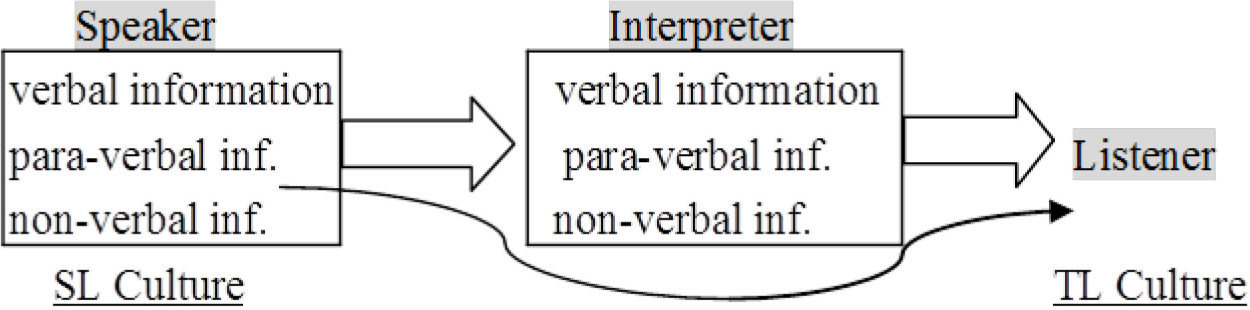
The multimodal communication model of consecutive interpreting
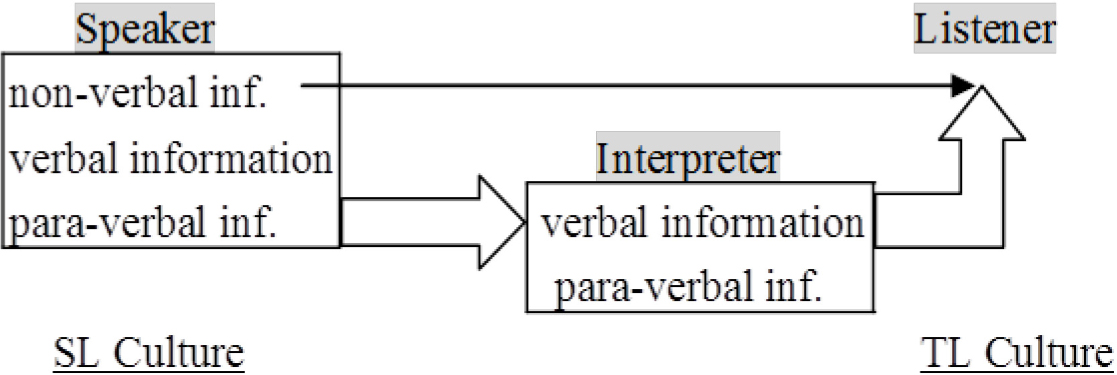
The multimodal communication model of simultaneous interpreting
5 From semiotic analysis to multimodal analysis of interpreting
From the above discussion, we can see that interpreting and interpreted discourse can be examined more thoroughly with multimodal analysis, which links linguistic semiotics with paralinguistic semiotics and non-linguistic semiotics and integrates the linguistic and structural, pragmatic and communicative, and sociocultural approaches.
Interpreted discourse provides the window through which we can examine almost all aspects of the interpreting behavior and activity, such as the interpreting process, the interpreting product, and the role of the interpreter. Therefore, it is important to describe the features of interpreted discourse systematically and fully, including its verbal/textual features, paraverbal features, and nonverbal features.
Early studies tended to describe the verbal/textual features as the whole. For example, Shlesinger (1989) analyzed the features of orality/literateness and found there is an equalizing effect along the oral–literate continuum in simultaneously interpreted discourse, which means that orality is reduced in the interpreting of source speeches that are strong in orality and that orality is enhanced in the interpreting of source speeches that are strong in literateness. Wang & Hong (2011) examined the orality/literate shift in Chinese–English consecutive interpreting. They employed ten parameters of orality/literateness based on relevant previous studies and conducted analysis into the on-site consecutive interpreting of two press conferences. Quantitative analysis reveals that the degree of orality salient in the source text of the first press conference is significantly reduced by consecutive interpreting and the degree of literateness prominent in the source text of the second press conference is also significantly reduced by consecutive interpreting.
The verbal information in interpreting and its effect can be analyzed more thoroughly with the toolkits of systemic functional linguistics or social semiotics, especially the register analysis based on three variables associated with three strands of meaning, which can be summarized as follows (Munday 2016: 145):
Ideational meaning in translation and interpreting through analysis of the variable of field (i.e. what the text is about and how this experience is represented), which focuses on transitivity structures (verb types, selection of active/passive, selection of grammatical subject, use of nominalization instead of verb);
Interpersonal meaning in translation and interpreting through analysis of the variable of tenor (i.e. relationship between participants), which includes pronouns (“I/we” exclusive or inclusive, “you” formal or informal), modality (modal verbs and adverbs) and evaluative lexis;
Textual meaning in translation and interpreting through analysis of the variable of mode (i.e. the form of communication), which includes cohesion (the way a text holds together lexically through lexical repetition, use of pronouns in place of nouns, collocation, etc.) and thematic and information structures (word order and placement of elements in the text).
As an example for illustration, Wang and Feng (2018) adopted the approach of systemic functional linguistics in exploring stance-taking in interpreted political discourse. Relatively large-scale data are generated from the Corpus of CEIPPC (Chinese–English Interpreting for Premier Press Conferences), a parallel bilingual corpus comprising 15 transcribed press conferences of two premiers of the Chinese government between 1998 and 2012 that were interpreted by seven institutional interpreters. Corpus tools such as frequency, keyword list, hot word list, and cluster are employed to identify attitudinal and ideology-laden keywords in a bilingual parallel corpus of interpreted political discourse from China. Critical points of decision-making in interpreting are elucidated and the way that Chinese ideology is re-contextualized is revealed using a framework from the appraisal theory (including attitude, graduation, and engagement).
The paraverbal information in interpreting, including pauses, stress, intonation, speed, prosody, articulation, and fluency or influency, can be annotated and analyzed in the pragmatic and communicative approach. Inspirations can be found from Hatim & Mason (1990, 1997) and Mason (2001), who adopted the pragmatic approach in the analysis of dialogue interpreting, which “allows the analyst to understand far more about the organization of interaction (turn-taking, sequence organization, the function of pauses, dealing with problems in talk) and to search for the clues that point towards the meanings that are projected, received and negotiated among participants” (Mason 2015: 113).
“The study of the contribution that non-verbal semiotics makes to written and spoken texts as loci of translation and interpreting activity has been patchy” (Pérez-González 2014: 119). Multimodal analysis can play a much bigger role in analyzing nonverbal information (or kinesics) in interpreting, including gaze, facial expressions, body orientation, gesture, and body language, which has not received full attention yet in Interpreting Studies. “Translation and interpreting often interplay with the semiotics of the human body. This term designates the use of para-verbal signs – including but not limited to voice qualities, cadence, inflection, or rate of speech – and non-verbal signifiers – such as gestures or movements”; however, “non-verbal meaning-making and its impact on the theorization of translation and interpreting remains largely unaddressed” (Pérez-González 2014: 119–120).
Early studies have pointed out the importance of understanding the role of paraverbal language and nonverbal language in making and conveying meaning in interpreting (e.g. Poyatos 1987/2002; Ais 1998). According to Poyatos (1987/2002: 240–242), verbal language, paralanguage and kinesics are seen as “a functionally cohesive structure” that can operate simultaneously, alternate with, or substitute for each other in different communicative situations. Paralanguage is “audible communication beyond words” and kinesics is “visual communication with and beyond words.” Since the speaker communicates with words, paralinguistic features, and kinesic behaviors, there are expressive limitations if the interpreter relies only on words to convey the information and meaning to the listener.
Thanks to the advancement of relevant technological tools, the multimodal analysis research interest about nonverbal information in interpreting has been rising recently, especially in dialogue interpreting (e.g. Mason 2001, 2009; Zagar Galvao 2009; Davitti 2016; etc.). Zagar Galvao (2009) investigated gestures in simultaneous interpreting through a mixed approach of open experimenting, field observation, and interviews with professional conference interpreters. Her findings revealed that gestures in simultaneous interpreting have multiple interrelated functions and dimensions (pragmatic, discursive, interactional, modal, cognitive).
The view that paraverbal and nonverbal semiotic resources are considered ancillary to verbal semiotic resources is changing. As pointed out by Pasquandrea (2012), in order to gain a thorough understanding of the communicative dynamics of interpreter-mediated interaction, “[v]erbal and nonverbal semiotic resources constitute an integrated system, which needs to be analyzed as a whole” (Pasquandrea 2012: 150). In this sense, multimodal analysis as “a scholarly spin-off of social semiotics and systemic functional linguistics” that “aims to formalize the socially situated nature of meaning-making practices” (Pérez-González 2014: 127) has much to offer. As a case in point, Gao and Wang (2017) propose a multilayer framework of multimodal analysis underpinned by the stratification theory in systemic-functional linguistics, which integrates the multimodal approach into Interpreting Studies. Empowered by the corpus techniques, the multilayer framework of multimodal analysis can enable interpreting researchers to do data interpretation and explanation cross-modally, in particular when distant language pairs (such as English and Chinese) entail investigation into visual and contextual data.
6 Concluding remarks
The significance of taking semiotic perspectives on Interpreting Studies is manifold. Semiotic perspectives can offer both bottom-up and top-down approaches to analysis into different layers of interpreting, including linguistic, pragmatic and communicative, and sociocultural aspects. While the linguistic, cultural, and sociological approaches to Interpreting Studies highlight one aspect more prominently than another, semiotic perspectives promise an effective approach to building links among all the different aspects, especially a relationship between form and function and between language use and the interpreter’s role in interpreting.
Semiotic perspectives are also of special significance to Interpreting Studies because the field has been strongly shaped by the perspective of cognitive processing, which focused on the interpreting process, especially cognitive operation in the process, while more descriptive studies are called for about the interpreting product. With more evidence about the interpreted discourse, or language use in interpreting, there will be new findings about the interpreting process and interpreting strategies.
It should be noted that the previous semiotic perspectives have always been shaped by monolingual analysis. If more efforts are put into conducting “contrastive semiotic analysis” and in comparing European and non-European languages whose conceptual structures may differ crucially, there will also be new findings contributing to the development of semiotics. In this sense, semiotic studies into interpreting and translation may also help to expand the frontier of semiotics.
About the author
Binhua Wang (b.1974) is professor of interpreting and translation studies and Programme Director of MA Conference Interpreting and Translation Studies in the Centre for Translation Studies at University of Leeds. He is a fellow of the Chartered Institute of Linguists (CIOL) and expert member (fellow) of the Translators Association of China (TAC). His research interests lie in various aspects of interpreting and translation studies, in which he has published over 50 peer-reviewed articles, including nearly 40 in refereed CSSCI/Core and SSCI/A&HCI journals such as Interpreting, Meta, Perspectives, and Babel and over a dozen in peer-reviewed collected volumes.
Acknowledgements
This article is written as a tribute to the late Prof. Jiazu Gu, who would be very pleased to see the continuing success of the journal of Chinese Semiotic Studies.
References
Ais, Ángela Collados. 1998. La evaluación de la calidad en interpretación simultánea: La importancia de la comunicación no verbal [Quality assessment in simultaneous interpreting: The importance of nonverbal communication]. Albolote (Granada): Editorial Comares.Search in Google Scholar
Baker, Mona. 2006. Contextualization in translator- and interpreter-mediated events. Journal of Pragmatics 38(3), 321–337.10.1016/j.pragma.2005.04.010Search in Google Scholar
Eco, Umberto & Siri Nergaard. 1998. Semiotic approaches. In Mona Baker (ed.), Routledge encyclopedia of translation studies, 218–222. London: Routledge.Search in Google Scholar
Gao, Fei & Binhua Wang. 2017. Multimodal corpus approach to dialogue interpreting studies in the Chinese context: Towards a multi-layer analytic framework. The Interpreters’ Newsletter, 22.Search in Google Scholar
Hatim, Basil & Ian Mason. 1990. Discourse and the translator. London: Longman.Search in Google Scholar
Hatim, Basil & Ian Mason. 1997. The translator as communicator. London & New York: Routledge.Search in Google Scholar
Jacobson, Roman. 1959. On linguistic aspects of translation. In Reuben A. Brower (ed.), On translation, 232–239. Cambridge, MA: Harvard University Press.10.4159/harvard.9780674731615.c18Search in Google Scholar
Mason, Ian. 2001. Triadic exchanges: Studies in dialogue interpreting. Manchester: St. Jerome Publishing.Search in Google Scholar
Mason, Ian. 2009. Role, positioning and discourse in face-to-face interpreting. In Raquel de Pedro Ricoy, Isabelle Perez and Christine Wilson (eds.), Interpreting and translating in public service settings. Policy, practice, pedagogy, 52–73. Manchester: St. Jerome Publishing.Search in Google Scholar
Mason, Ian & Stewart Miranda. 2001. Interactional pragmatics, face and the dialogue interpreter. In Ian Mason (ed.), Triadic exchanges: Studies in dialogue interpreting, 51–70. Manchester: St. Jerome Publishing.Search in Google Scholar
Mason, Ian. 2015. Discourse analytical approaches. In Franz Pöchhacker (ed.), Routledge encyclopedia of interpreting studies, 111–116. London: Routledge.Search in Google Scholar
Munday, Jeremy. 2016. Introducing translation studies (4th edn.). London and New York: Routledge.10.4324/9781315691862Search in Google Scholar
Pérez-González, Luis. 2014. Multimodality in translation and interpreting studies, In Sandra Bermann & Catherine Porter (eds.). A companion to translation studies, 119–131. Chichester: Wiley-Blackwell.10.1002/9781118613504.ch9Search in Google Scholar
Poyatos, Fernando. 1987/2002. Nonverbal communication in simultaneous interpreting and consecutive interpreting. A theoretical model and new perspectives, Franz Pochhacker & Miriam Shlesinger (eds.), The interpreting studies reader, 235–246. London: Routledge.Search in Google Scholar
Seleskovitch, Danica & Marianne Lederer. 1984. Interpréter pour traduire. Paris: Didier Erudition.10.1075/babel.31.2.18danSearch in Google Scholar
Shlesinger, Miriam. 1989. Simultaneous interpretation as a factor in effecting shifts in the position of texts on the oral–literate continuum. MA Thesis. Tel Aviv University.Search in Google Scholar
Stecconi, Ubaldo. 2007. Five reasons why semiotics is good for translation studies, Yves Gambier, Miriam Shlesinger, Radegundis Stolze (eds.) Doubts and directions in translation studies. Selected contributions from the EST congress, Lisbon 2004, 15–26. Amsterdam/Philadelphia: John Benjamins.10.1075/btl.72.05steSearch in Google Scholar
Stecconi, Ubaldo. 2009. Semiotics. In Mona Baker & Gabriela Saldanha (eds.). Routledge encyclopedia of translation studies (2nd edn.), 260–263. London: Routledge.Search in Google Scholar
Torop, Peeter. 2008. Translation as communication and auto-communication. Sign System Studies 36(2), 375–397.10.12697/SSS.2008.36.2.06Search in Google Scholar
Wang, Binhua & Dezheng Feng. 2018. A corpus-based study of stance-taking in interpreted political discourse. Perspectives: Studies in Translatology. 26(2), 246–260.10.1080/0907676X.2017.1395468Search in Google Scholar
Wang, Binhua & Lei Hong. 2011. A descriptive study of oral/literate shift in Chinese–English consecutive interpreting. Chinese Translators Journal (中国翻译). 32 (2). 73–77.Search in Google Scholar
Zagar Galvão, Elena. 2009. Speech and gesture in the booth – A descriptive approach to multimodality in simultaneous interpreting. In Dries De Crom (ed.), Selected Papers of the CETRA Research Seminar in Translation Studies 2008. Leuven: CETRA [Online].Search in Google Scholar
© 2018 Walter de Gruyter GmbH, Berlin/Boston
Articles in the same Issue
- Frontmatter
- Part One: Chinese Semiotics and Western Traditions
- Semiotics – Another Window on the World
- Part One: Chinese Semiotics and Western Traditions
- The Historic Mission of Chinese Semiotic Scholars
- Part Two: Cultural Signs and Sign Theories
- Exploring Approaches to Interpreting Studies
- Part Two: Cultural Signs and Sign Theories
- Translating the Idea of Hua
- Part Two: Cultural Signs and Sign Theories
- The Anthroposemiotics of Jokes in Funeral Rituals
- Part Two: Cultural Signs and Sign Theories
- Barthes’s Semiotic Theory and the TCSL Classroom
- Part Two: Cultural Signs and Sign Theories
- Cultivating the Guessing Instinct
- Part Two: Cultural Signs and Sign Theories
- A Short Introduction to Edusemiotics
Articles in the same Issue
- Frontmatter
- Part One: Chinese Semiotics and Western Traditions
- Semiotics – Another Window on the World
- Part One: Chinese Semiotics and Western Traditions
- The Historic Mission of Chinese Semiotic Scholars
- Part Two: Cultural Signs and Sign Theories
- Exploring Approaches to Interpreting Studies
- Part Two: Cultural Signs and Sign Theories
- Translating the Idea of Hua
- Part Two: Cultural Signs and Sign Theories
- The Anthroposemiotics of Jokes in Funeral Rituals
- Part Two: Cultural Signs and Sign Theories
- Barthes’s Semiotic Theory and the TCSL Classroom
- Part Two: Cultural Signs and Sign Theories
- Cultivating the Guessing Instinct
- Part Two: Cultural Signs and Sign Theories
- A Short Introduction to Edusemiotics
