Examining trust in public service news providers: A comparison of the BBC and NHK
-
Dr Steve Pickering is Assistant Professor in Political Science at the University of Amsterdam and Honorary Professor at Brunel University of London. He received his PhD from Lancaster University and has held previous positions at Kobe University and the University of Essex. His research focuses on political trust, public opinion and health, using large-scale survey data and computational social science methods. Recent work includes studies on vaccination attitudes, institutional trust and public attitudes to policing in the UK and Japan.

 ,
,
Yosuke Sunahara is a Professor in public administration at the Graduate School of Law, Kobe University. He received his PhD in political science from the University of Tokyo in March 2009. His research focuses on Japanese politics and public administration, with particular emphasis on local autonomy. His recent work explores the historical development of housing policy in Japan, the use of personal information in digitalized social policy, and the role of trust in governance.
and

Abstract
This study examines trust in public service broadcasters (PSBs), traditional news media, and social media news by comparing the BBC in England and NHK in Japan. Using 19 months of survey data, we analyze how demographics, political alignment, and general trust influence perceptions of PSBs. While the BBC enjoys high trust levels comparable to traditional news media, NHK does not hold the same distinction and consistently ranks lower than both traditional and social media news in Japan. Our findings reveal that trust in the BBC is highly polarized along political lines, with Conservative voters expressing significantly lower levels of trust. In contrast, NHK’s trust levels remain more stable across the political spectrum and are actually higher among Liberal Democratic Party (LDP)[1] supporters. These patterns reflect the different governance structures of the two broadcasters, with the BBC operating under a license fee model with editorial independence and NHK being directly overseen by the Japanese Diet. These results highlight the challenges which public service broadcasters face in maintaining trust in a rapidly evolving media landscape. While PSBs continue to play a vital role in providing reliable news, their credibility is shaped by national political contexts and institutional structures, with significant variation in how different audiences perceive them.
1 Introduction
Access to free and unbiased news media is traditionally seen as a key component of a democratic society. Public service broadcasters (PSBs) play a central role in providing accurate and reliable information, often receiving higher levels of trust than commercial media. However, recent shifts in the media landscape–driven by the rise of digital platforms, increased political scrutiny, and declining institutional trust–have placed PSBs under greater pressure to maintain their credibility. While previous research has examined media trust broadly (Fawzi et al., 2021; Newton, 2016), few studies have conducted direct cross-national comparisons of trust in specific PSBs. This study addresses this gap by comparing trust in the BBC (UK) and NHK (Japan) within their respective media ecosystems.
We contribute to the existing literature in three key ways. First, by focusing on England and Japan, we provide a comparative perspective on how different governance structures shape trust in PSBs. The BBC, despite its legally independent status, has faced recurrent political attacks, particularly from right-wing politicians who question its impartiality. NHK, in contrast, operates under government oversight via parliamentary budget approval, creating a different but equally significant set of constraints on perceived independence (Jung, 2017; Krauss, 2000). By examining trust levels across these two models, we assess whether different institutional arrangements yield divergent patterns of public confidence in PSBs.
Second, we go beyond aggregate measures of media trust by explicitly comparing trust in PSBs to trust in traditional news media and social media news. While PSBs are often categorized under “traditional media,” we test whether they command distinct trust levels or are perceived similarly to other legacy media outlets. This distinction is crucial, as previous studies have suggested that institutional trust in media varies across brands, platforms, and political contexts (Hanitzsch et al., 2018; Strömbäck et al., 2020).
Finally, we extend existing research on the role of demographics and political ideology in shaping trust in PSBs. Previous studies indicate that education, political ideology, and trust in government strongly influence media trust (Picone and Donders, 2020; Tsfati and Ariely, 2014). We test these relationships in both the UK and Japan, assessing whether patterns of trust polarization differ across contexts. Our findings offer new insights into how PSBs navigate political legitimacy and credibility in an era of increasing media diversification.
Using survey data from 19 months of nationally representative surveys in England and Japan, we compare trust in public service broadcasters, traditional news media, and social media. Our results reveal that while the BBC retains high trust levels, this trust is sharply polarized along political lines, with Conservative supporters displaying significantly lower levels of confidence in the institution. In contrast, NHK’s trust levels are more stable across the political spectrum, though they rank lower than other traditional news sources in Japan. These findings highlight the ongoing challenges that PSBs face in maintaining trust across different political and cultural environments.
The remainder of this article is structured as follows. The next section discusses the role of trust in news media, distinguishing between institutional trust in PSBs and broader media trust. We then detail our data and methodology before presenting our findings. In the final sections, we discuss the implications of our results, outline study limitations, and propose directions for future research.
2 Public service broadcasters and trust
News media act as purveyors of information. Citizens typically rely on news outlets to filter, curate, and verify information, making trust in media a cornerstone of healthy democratic discourse (Fawzi et al., 2021). Trust in democratic institutions more broadly captures whether citizens believe that these institutions can effectively fulfil their mandate (Levi and Stoker, 2000). Scholars distinguish between general trust, which is part of the social fabric, and specific trust, grounded in personal experiences and assessments of competence and fairness (Citrin and Stoker, 2018; Levi and Stoker, 2018; Rothstein and Stolle, 2008).
Fawzi et al. (2021) highlight various levels at which news media trust can be analyzed: trust in the media as a public institution, trust in particular media organizations, and trust in specific brands or channels. Given the abundance of news sources, people may trust or distrust multiple outlets simultaneously (Strömbäck et al., 2020). Classic conceptions of trust in media often equate it with expertise and credibility (Hovland et al., 1953). Large-scale surveys (like the World Values Survey) sometimes measure trust by type (TV, radio, newspapers, social media), though more focused studies ask respondents about trust in specific brands (e.g., Hopmann et al., 2015).
Picone and Donders (2020) define public service media as any media across platforms that foster democratic, cultural, and social well-being. This aligns with the original Reithian objectives of informing, educating, and entertaining. How the public perceives–and trusts–PSBs is thus vital, given its intended role as a bulwark of reliable, high-quality reporting. Yet as Campos-Rueda and Goyanes (2023) note, theoretical or regulatory perspectives have often overshadowed user-based research on trust and performance. Before one can appraise the performance of a PSB outlet, it is key to understand whether it is deemed credible to begin with.
Public service media often enjoy high levels of perceived importance (Just et al., 2017; Sehl, 2020; Urbániková and Smejkal, 2023), especially during crises (Newton, 2020; Yonekura, 2012). However, some qualifiers exist. For instance, older, higher-educated audiences tend to favor PSB (Schulz et al., 2019). Right-wing or lower-educated groups may be more skeptical (Picone and Donders, 2020). More broadly, the so-called “rainmaker” effect (Newton, 2016) posits that a credible, well-funded public broadcaster can elevate trust across the entire media landscape. Conversely, any perceived bias from PSBs can appear more egregious than bias from commercial outlets (Asano et al., 2023).
Public service broadcasters have long played a crucial role in democratic societies by providing reliable and accurate information. However, the rise of the internet and the increasing ability of individuals to selectively access diverse sources of information pose new challenges to PSBs. Even when public service media deliver highly accurate news, citizens may adopt a more skeptical stance toward its content. Previous research has suggested that a strong sense of individual self-determination can conflict with trust in news media, leading to a more critical evaluation of information (Aharoni et al., 2024). Individuals who believe they can discern accurate information from social media–despite its mixture of credible and misleading content–may place greater trust in the information they actively select rather than in information presented by institutional sources. In this media landscape, where individuals perceive themselves as capable of independently identifying reliable news, public service media may increasingly be viewed as just another media outlet susceptible to disseminating misinformation.
Yet the legacy of PSBs in providing fact-based, reliable news is now increasingly tested by digital platforms. Individuals who feel empowered to “do their own research” online may become more critical of institutional outlets (Aharoni et al., 2024). This sense of personal autonomy can sometimes dampen trust in official sources, including public service broadcasters. Additionally, demographic factors such as age, gender, and education yield inconsistent results across contexts (Arlt, 2018; Chung et al., 2012; Hopmann et al., 2015; Tsfati and Ariely, 2014), while younger cohorts may find social media more appealing (Elvestad et al., 2017; Fletcher and Nielsen, 2018). Political ideology is another influential factor: In the U.S. context, conservative viewers tend to distrust mainstream media more (Gronke and Cook, 2007). Similar patterns are observed in some European settings (Hanitzsch et al., 2018).
Based on these findings, we propose five main hypotheses:
The older the respondent, the more they trust the public service provider.
University graduates have a higher level of trust in public service providers than non-graduates.
The higher the level of general trust of a respondent, the more they trust the public service provider.
The higher the level of trust in the government, the more the respondent trusts the public service provider.
The more right-wing a respondent is, the less they trust the public service provider.
We now turn to the specific institutional contexts of the BBC and NHK, which we selected for their shared status as large, historically influential PSB outlets and their different political constraints and cultural environments.
The BBC and NHK
Historically, public service broadcasters held monopolies in many countries. Although today they face competition from commercial rivals and digital platforms, their funding structures (often via license fees) and their charters still tie them closely to the state–a connection that can raise questions about editorial independence (Hanretty, 2010).
The BBC. The British Broadcasting Corporation (BBC) began broadcasting in 1922 as British Broadcasting Company and was reformed into the current entity in 1927. Its first director general, John Reith, is by many seen as the founding father of public service broadcasting, and to this day the concept of Reithian ideals of educating, informing, and entertaining underpin the general view of public service broadcasters. The BBC had a monopoly on TV until 1955, when the Independent Television (ITV) companies started their broadcasts. Unusually, the BBC radio monopoly lasted until 1973. The BBC is state-owned and operates under a royal charter in which the object, mission, and public purpose is set out. Crucially, it prohibits advertising and also sets out the governing of the BBC, which since 2017 is run by a board of which the chair and four non-executive members (one representing each of the four nations) are appointed by the Secretary of State for Culture, Media and Sport, while five other non-executive and four executive members are appointed by the board.
The BBC has been involved in various controversies during its existence, such as not following the government’s requests during the Falklands and Northern Ireland conflicts, leading to the resignation of the Director General Alasdair Milne. In recent years, the Hutton Inquiry criticized the management processes and journalistic practices of the BBC and led to several high-profile resignations, including the Director General, Greg Dyke. In 2012, the Jimmy Saville scandal broke which revealed that a BBC investigative program into the decades-long sexual abuse by the BBC children’s TV presenter Jimmy Saville had been prevented from being broadcast. A similar program was later broadcast on ITV, the main national challenger to the BBC. Also on the financial side has the BBC had its share of controversies, both in terms of contracts to certain stars and also of severance payments that went far beyond what was deemed reasonable and later saw a limit introduced as to how much anyone could receive in severance pay.
NHK. The predecessor of NHK was established in 1926 through the merger of three existing broadcasting stations in Tokyo, Nagoya, and Osaka. In 1950, NHK became a special corporation under the Broadcasting Law, and it began television broadcasting in 1953. According to the Broadcasting Law, NHK is mandated to broadcast politically neutral programs and is prohibited from advertising, being funded by subscription fees instead. Despite its institutional independence, akin to that of the BBC (Hanretty, 2010), NHK’s political independence, which is directly supervised by the government, is often perceived as vulnerable (Jung, 2017).
Direct political interference in NHK’s programming is highly criticized; however, the legal authority of the Parliament to determine NHK’s overall budget imposes a significant constraint. Harsh criticism from NHK towards the administration often sparks debates in the Diet regarding NHK’s budget. The Liberal Democratic Party (LDP), in power for extended periods, has influenced NHK through the budget process, even if individual politicians cannot officially intervene in its broadcasts (Krauss, 2000). The LDP’s internal power struggles sometimes extended to NHK’s executive board, as exemplified by the appointments of Shima Keiji and Ebisawa Katsuji, both of whom have strong ties to the LDP. While social media accounts for an increasing proportion of news consumption in Japan, most still get their political news from television (Taniguchi, 2015). The Japanese public service provider, NHK, delivers daily news and is considered to be politically neutral. Following from Asano et al. (2023), there is an assumption that NHK delivers accurate and non-biased news. This is evidenced by Asano et al. (2023) and also supported by public opinion polls in Japan. However, this neutrality is often associated with its boring nature (Krauss, 2000).
NHK’s mission is to provide accurate information and serve as a public forum that brings people together. As a result, it tends to report on established facts and avoid controversial issues or unresolved value debates. By steering clear of politically sensitive topics, NHK seeks to maintain its neutrality and minimize the risk of political intervention. However, this approach does not guarantee immunity from political influence. In the 2010s, politicians aligned with the right-wing Abe administration exerted significant pressure on NHK, perceiving its coverage as left-leaning (Jung, 2017). This political interference triggered criticism from both sides of the spectrum: Conservatives accused NHK of bias, while leftists condemned it for capitulating to political pressure. When dominant political figures emerge, NHK’s fragile independence becomes more apparent, exposing vulnerabilities in its institutional autonomy and undermining its credibility.
3 Data and methodology
This study employs a comparative survey approach to assess trust in public service broadcasters, traditional news media, and social media news in England and Japan. The data were collected through 19 waves of nationally representative surveys, conducted monthly between December 2022 and June 2024. These surveys were designed specifically for this research project, rather than being drawn from pre-existing datasets. To ensure robust national representation, survey administration was carried out by YouGov in the UK and Rakuten Insight in Japan.
Respondents were asked about their trust in three levels of news media: (1) public service broadcasters: trust in the BBC (UK) or NHK (Japan); (2) traditional news media : trust in news from newspapers and television in general; and (3) social media news: trust in news from platforms such as Twitter and Facebook.
Each of these measures was captured on a 7-point Likert scale, ranging from 1 (no trust at all) to 7 (complete trust). By structuring the analysis at these three levels, we assess not only how trust in public service broadcasters compares to other media types but also whether PSBs hold a distinct status within their respective media landscapes.
To explore the factors influencing trust in the BBC and NHK, we included a range of demographic, political, and attitudinal variables. Age was measured as a continuous variable, ranging from 18 to 98 in England and 18 to 79 in Japan. Gender was coded as a binary variable (1 = Women, 0 = Men), while education was recorded as a binary indicator distinguishing university graduates from non-graduates. Political ideology was measured using an 11-point left-right scale, with higher values indicating a more right-wing orientation. In addition, respondents were asked to rate their trust in government and general interpersonal trust, both measured on the same 7-point scale as media trust. Political affiliation was accounted for by including party support variables, which captured respondents’ self-reported support for major political parties in each country.
For the data analysis, we employed ordinary least squares (OLS) regression to estimate the relationships between these independent variables and trust in public service broadcasters. Although the dependent variables are ordinal in nature, robustness checks using ordered logistic regression confirmed that OLS models produced substantively similar results in terms of direction and significance levels. Given the ease of interpretation associated with OLS models, we present these results in the main analysis. Replication data and code for this study are publicly available on the Harvard Dataverse: https://doi.org/10.7910/DVN/AUE81C.
Despite the strengths of this approach, some limitations should be noted. While our dataset includes a comprehensive set of demographic and political predictors, we were unable to control for media consumption patterns, as the survey did not include detailed questions on respondents’ news sources. This omission is partly due to space constraints in the survey instrument, and partly due to cross-national differences in how media consumption is structured. Additionally, income was not included as a control variable, as more than one-third of respondents declined to report their earnings, and its exclusion avoided introducing systematic missingness that might bias the results. Nonetheless, these limitations do not undermine the robustness of our core findings, as the key theoretical variables–political ideology, education, and trust in government–remain central in explaining variation in trust in public service broadcasters across both countries.
Descriptive statistics.
|
|
Japan |
England |
||||||||
|
|
n |
M |
SD |
min |
max |
n |
M |
SD |
min |
max |
|
Age |
28 660 |
50.04 |
16.24 |
18 |
79 |
11 170 |
49.96 |
17.71 |
18 |
98 |
|
Women |
28 660 |
0.5 |
0.5 |
0 |
1 |
11 170 |
0.55 |
0.5 |
0 |
1 |
|
Left-Right |
28 576 |
5.05 |
1.58 |
0 |
10 |
11 058 |
4.89 |
2.12 |
0 |
10 |
|
Degree |
28 660 |
0.48 |
0.5 |
0 |
1 |
11 170 |
0.32 |
0.46 |
0 |
1 |
|
Trust Govt |
28 457 |
3.15 |
1.46 |
1 |
7 |
11 164 |
2.71 |
1.53 |
1 |
7 |
|
Trust General |
28 618 |
3.14 |
1.55 |
1 |
7 |
11 166 |
3.6 |
1.59 |
1 |
7 |
|
Trust NHK/BBC |
28 486 |
3.11 |
1.53 |
1 |
7 |
11 170 |
3.55 |
1.7 |
1 |
7 |
|
Trust Trad News |
28 474 |
3.79 |
1.44 |
1 |
7 |
11 163 |
3.52 |
1.51 |
1 |
7 |
|
Trust Social MediaNews |
28 454 |
3.4 |
1.27 |
1 |
7 |
11 167 |
2.44 |
1.27 |
1 |
7 |
4 Analysis
Basic descriptive statistics for our key variables are presented in Table 1. As noted by Strömbäck et al. (2020), trust in media can be analyzed differently. Here, we focus on media types, comparing traditional news media and social media with the particular brands of public service broadcasters in the UK and Japan. Our survey ran for nearly two years, and in Figure 1 we show the stability of the public’s views within each of the trusts. The largest difference occurs between the types of media. Traditional news media in the UK has an average trust level of 3.5, while that of social media is below 2.5. Interestingly, trust in the BBC is only slightly above trust in traditional news media, and in some parts of the survey period map it is close to trust in traditional news. In Japan, trust in traditional news media is slightly higher than in the UK, and trust in NHK is slightly lower than in the BBC. The BBC is a major representative of traditional media in the UK. However, in Japan there are other trusted traditional media outlets, particularly newspapers, in addition to NHK, suggesting that traditional media is trusted collectively.
A notable difference is observed in the level of trust in news shared on social media. In the UK, many people give negative ratings to news shared on social media, while this is not the case in Japan. Previous research has suggested that in environments where highly reliable media outlets exist, social media tend to be a less significant source of information (Elvestad et al., 2017). In the UK, the BBC holds a privileged status as a highly trusted public service media institution. In contrast, NHK in Japan does not enjoy the same level of distinction. Instead, Japan’s traditional media landscape is shaped by ideologically neutral major newspapers and television stations, many of which have ownership ties to newspaper conglomerates. These outlets generally provide non-political, homogeneous information, contributing to a broadly trusted traditional media environment (Hayashi, 2020). Unlike the BBC, NHK does not command uniquely high trust and is perceived more as one of many traditional news sources. At the same time, trust in social media is relatively high in Japan, arguably due to the way news is disseminated. Social media platforms often serve as extensions of traditional media, where news from established outlets is widely shared on major portal sites.
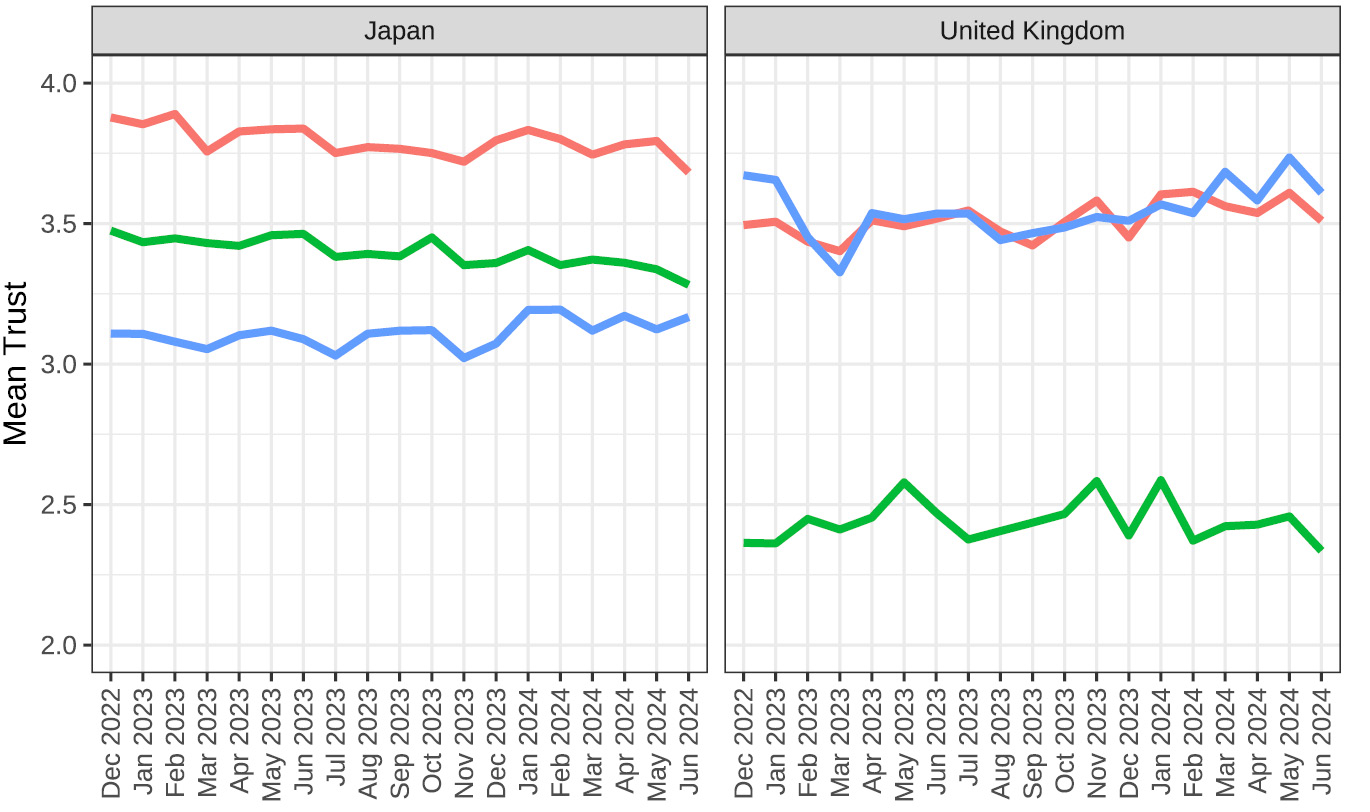
Trust in media types.
The descriptive statistics tell us one story, but to get a stronger understanding of the factors associated with trust in news media and the particular institution, we turn to multivariate analysis. In Table 2 we present the results of models looking at trust in traditional news media, social media news, and the BBC/NHK.
Regression analysis of trust in traditional news media, social media news, and the BBC/NHK.
|
|
Dependent variable |
|||||
|
|
Trust Trad News |
Trust SM News |
Trust BBC |
Trust Trad News |
Trust SM News |
Trust NHK |
|
|
(1) |
(2) |
(3) |
(4) |
(5) |
(6) |
|
Age |
–0.011** |
–0.035*** |
–0.008* |
0.008** |
–0.019*** |
–0.001 |
|
|
(0.004) |
(0.004) |
(0.005) |
(0.003) |
(0.003) |
(0.003) |
|
Age squared |
0.0001*** |
0.0002*** |
0.0001** |
0.00005 |
0.0002*** |
0.0001*** |
|
|
(0.00004) |
(0.00004) |
(0.00005) |
(0.00003) |
(0.00003) |
(0.00003) |
|
Women |
0.042* |
0.094*** |
–0.051* |
0.119*** |
0.111*** |
0.109*** |
|
|
(0.025) |
(0.023) |
(0.028) |
(0.016) |
(0.015) |
(0.017) |
|
Degree |
0.195*** |
–0.143*** |
0.257*** |
0.024 |
–0.128*** |
0.127*** |
|
|
(0.028) |
(0.026) |
(0.031) |
(0.016) |
(0.015) |
(0.017) |
|
Left-Right |
–0.041*** |
0.006 |
–0.125*** |
–0.075*** |
0.002 |
–0.049*** |
|
|
(0.007) |
(0.007) |
(0.008) |
(0.005) |
(0.005) |
(0.005) |
|
Trust General |
0.166*** |
0.095*** |
0.241*** |
0.127*** |
0.110*** |
0.184*** |
|
|
(0.008) |
(0.008) |
(0.009) |
(0.005) |
(0.005) |
(0.005) |
|
Trust Govt |
0.410*** |
0.210*** |
0.401*** |
0.400*** |
0.307*** |
0.426*** |
|
|
(0.009) |
(0.008) |
(0.010) |
(0.006) |
(0.005) |
(0.006) |
|
Vote Conservative |
–0.112*** |
–0.204*** |
–0.394*** |
|
|
|
|
|
(0.039) |
(0.035) |
(0.043) |
|
|
|
|
Vote Labour |
0.165*** |
0.075** |
0.318*** |
|
|
|
|
|
(0.040) |
(0.036) |
(0.043) |
|
|
|
|
Vote Liberal Democrat |
0.379*** |
–0.150*** |
0.788*** |
|
|
|
|
|
(0.051) |
(0.046) |
(0.056) |
|
|
|
|
Vote LDP |
|
|
|
–0.130*** |
–0.054*** |
0.049** |
|
|
|
|
|
(0.022) |
(0.020) |
(0.023) |
|
Vote CDP |
|
|
|
0.417*** |
0.168*** |
0.467*** |
|
|
|
|
|
(0.033) |
(0.030) |
(0.034) |
|
Vote PDP |
|
|
|
–0.303*** |
0.117*** |
–0.018 |
|
|
|
|
|
(0.042) |
(0.038) |
(0.043) |
|
Vote Komei |
|
|
|
–0.093** |
0.058 |
0.088* |
|
|
|
|
|
(0.045) |
(0.042) |
(0.047) |
|
Vote JIP |
|
|
|
0.138*** |
0.100*** |
0.004 |
|
|
|
|
|
(0.026) |
(0.024) |
(0.027) |
|
Vote JCP |
|
|
|
0.134*** |
0.042 |
0.154*** |
|
|
|
|
|
(0.048) |
(0.044) |
(0.049) |
|
Vote Other |
–0.051 |
–0.104** |
–0.104* |
–0.523*** |
0.151*** |
–0.501*** |
|
|
(0.056) |
(0.051) |
(0.062) |
(0.046) |
(0.042) |
(0.047) |
|
Constant |
2.091*** |
2.785*** |
2.292*** |
1.960*** |
2.359*** |
0.962*** |
|
|
(0.110) |
(0.099) |
(0.120) |
(0.082) |
(0.075) |
(0.085) |
|
Observations |
11,043 |
11,048 |
11,049 |
26,240 |
26,222 |
26,210 |
|
R2 |
0.247 |
0.147 |
0.290 |
0.254 |
0.183 |
0.293 |
|
Adjusted R2 |
0.246 |
0.146 |
0.289 |
0.253 |
0.183 |
0.292 |
|
Note: |
*p<0.1; **p<0.05; ***p<0.01 |
|||||
Models 1 to 3 are for England, while Models 4 to 6 are for Japan. Looking at age first of all, we see that in England, there is a negative relationship between age and trust in all three forms of media, but the effect is not as pronounced with the BBC. This contrasts with Japan, which does see older people trusting social media news less but trusting traditional news more. There is no effect for NHK. Based on the age variable itself, we find no support for H1. However, this changes somewhat when we take the square of age, as we find a positive relationship for all three in England and for social media news and NHK in Japan, suggesting a curvilinear relationship: Our oldest respondents would seem to have more trust in these media. Based on age squared, we can find in favor of H1. The relationship is non-linear, but our much older respondents tend to trust the public service broadcasters more.
Gender has a notable effect. Women in Japan are significantly more trusting of all three forms of media. In England, however, while this is the case for social media news, there is less of an effect for traditional news, and a small negative effect for trust in the BBC.
The effect of a university degree is more easily comparable across the countries. People with a university degree trust the BBC and NHK more and social media news less. This offers clear support for H2. The selection of news sources is closely linked to media trust, and university graduates in both the UK and Japan tend to place greater trust in public service media. However, this preference is more pronounced in the UK. The strong positive effect of having a university degree on trust in traditional media in the UK is likely driven by its association with the BBC. In Japan, by contrast, while traditional media as a whole are generally more trusted than NHK, university graduates deviate from this trend. Among this group, NHK is actually trusted more than traditional media, suggesting that higher education in Japan fosters a greater inclination to trust public service media.
Trust has a uniform effect across both countries. The more trusting people are in general, and the more they trust the government, the more trust they have in all forms of media. H3 and H4 are clearly supported. In both the UK and Japan, a rightward shift on the political spectrum correlates with decreased trust in public service broadcasters and traditional news, offering clear support for H5.
The political parties make for some interesting differences. A note should be made here on methodology. In England, respondents were asked which party they voted for in the 2019 general election. In some cases, we do not know the answer to this question, as respondents may not want to tell us. Alternatively, they may not have been old enough to vote, or there may have been some other impediment to them voting. We use this unknown group as the reference category. In Japan, respondents were not asked how they voted but instead which party they usually support. In this case, we used those who do not support a political party as our reference group. We recognize that there are methodological differences here but believe that we can still make a reasonable comparison across the two countries.
In England, there is distrust in all three forms of media among Conservative voters. The coefficient is greatest with regard to the BBC. This aligns with a long history of calls by members of the Conservative Party to end the television license fee, which would deprive the BBC of its main source of funding. The reverse is the case for Labour voters, who have higher levels of trust in all three media, again with the BBC having the greatest coefficient. The Liberal Democrats are also interesting, having less trust in social media, but significantly more trust in the BBC and traditional news.
Turning to Japan, the picture is more complex. LDP supporters have lower trust in traditional news and social media news, but the relationship is positive for NHK. It is suggested that, for supporters of the LDP in particular, the term “traditional news” refers to left-leaning newspapers. This suggests two things. First, traditional news and NHK are fulfilling two different roles in Japan, whereas there seems to be more overlap in England. Second, support for NHK among LDP voters suggests that NHK is not regarded as a political football as the BBC is by the Conservative Party. CDP voters have significantly higher trust in all three forms of media compared to other party supporters, and it is interesting that the relationship between trust in NHK and party alignment is either positive or not existing at all for all of the major parties: None of them have a negative relationship. The only negative relationship we see is among those who support one of the other fringe parties: Such party supporters have lower trust in NHK.
5 Discussion
Our results must also be considered with some caveats. First, our measures of trust in media types and media brands are simple. In fact, the more detailed recommendation of Strömbäck et al. (2020) suggests that we should have expanded the questions to be able to dig deeper into the nature of similarities and differences in media trust in the UK and Japan. This was unfortunately not possible for us. The timing of surveys is also something which must be considered. Coming out of a pandemic where for a period entertainment and news had become much more important as people could not leave their houses, a period which was generally longer in Japan than in the UK, it allows us to examine the relationship over a longer time period. We have examined our results for wave effects, that is, whether results are due to unobserved variation between waves. The results do not change for either country or either types of trust in media; they are robust for wave effects.
Another issue is the explanatory power that our models have, ranging from 15 % to 29 % of the variation in the dependent variable. This is clearly modest and suggests that most of the variation is unexplained. There are some clear omissions here, for instance, we do not include income. First, this would mean losing over a third of the respondents who are not willing to disclose their personal income either exactly or in bands of values. Second, among those that would be dropped would be an overrepresentation of particular groups, which means that any estimates including income would be biased against those. We also fully accept that we do not have a measure for media consumption included, that is, we do not know how much the respondents use media or, for that matter, from where they get their news media. This would be a serious omission if the goal of the article were different. There might well be a relationship between the news you consume and the news you trust, as also reported by Fawzi et al. (2021), but as reported by the same authors, it is also possible to trust media that you do not consume. If unlimited resources were available, then this would have been another option to include, unfortunately, that is rarely the case and certainly not here.
6 Conclusion
This study provides new insights into the dynamics of trust in public service broadcasters by comparing the BBC and NHK alongside broader trust in traditional news media and social media news. Using 19 months of survey data, we find that while the BBC maintains a relatively high level of trust, it is deeply polarized along political lines, particularly among Conservative voters. In contrast, NHK’s trust levels remain more stable across the political spectrum, yet it does not command the same distinction as the BBC and is often rated lower than both traditional news and social media news in Japan.
These findings contribute to the growing literature on media trust by demonstrating that trust in PSBs is not uniform across countries but shaped by institutional structures, political pressures, and broader media ecosystems. The BBC, on the one hand, despite facing political scrutiny, benefits from a legacy of editorial independence that solidifies its trust among some audiences while alienating others. NHK, on the other hand, operates under a government-linked funding model which may buffer it from extreme partisan distrust but also prevents it from standing out as a uniquely trusted media institution. This distinction suggests that the governance models of PSBs directly influence how they are perceived.
Beyond institutional factors, our study reinforces the role of political ideology in shaping media trust. The strong negative association between right-wing political orientation and trust in PSBs is particularly evident in the UK, aligning with existing research on media skepticism among conservative audiences (Hanitzsch et al., 2018; Picone and Donders, 2020). However, the absence of a strong anti-NHK sentiment among Japanese conservatives suggests that partisan divides in media trust are not inevitable but contingent on the political positioning of public broadcasters within national media landscapes.
Despite the strengths of our approach, some limitations must be acknowledged. Our models explain only a portion of the variance in media trust, suggesting that other unmeasured factors–such as media consumption habits and direct exposure to PSB content–may further shape trust levels. Additionally, while our surveys cover an extensive time period, future research could examine how external events (e.g., political controversies, scandals, or regulatory changes) influence fluctuations in trust over time.
Moving forward, research on public service media must account for shifting audience expectations and digital fragmentation. As younger, digitally savvy audiences increasingly bypass traditional news sources, the role of PSBs as cornerstones of reliable journalism may come under greater strain. Further studies could explore whether PSBs’ digital strategies, audience engagement efforts, or content innovations can mitigate declining trust, or whether broader shifts in media consumption habits will further erode their credibility.
In sum, this study highlights the persistent yet evolving role of PSBs in shaping public trust in news media. While the BBC and NHK both operate as national public broadcasters, their divergent trust patterns illustrate how political, institutional, and cultural contexts shape the credibility of media institutions. Understanding these dynamics is crucial as governments, regulators, and broadcasters themselves navigate the future of public service media in an era of increasing media distrust and political fragmentation.
Statements and declarations
About the authors
Dr Steve Pickering is Assistant Professor in Political Science at the University of Amsterdam and Honorary Professor at Brunel University of London. He received his PhD from Lancaster University and has held previous positions at Kobe University and the University of Essex. His research focuses on political trust, public opinion and health, using large-scale survey data and computational social science methods. Recent work includes studies on vaccination attitudes, institutional trust and public attitudes to policing in the UK and Japan.
Yosuke Sunahara is a Professor in public administration at the Graduate School of Law, Kobe University. He received his PhD in political science from the University of Tokyo in March 2009. His research focuses on Japanese politics and public administration, with particular emphasis on local autonomy. His recent work explores the historical development of housing policy in Japan, the use of personal information in digitalized social policy, and the role of trust in governance.
Acknowledgements
We would like to acknowledge the assistance of Dorothy Yen, Naoko Matsumura, Thomas Scotto, Atsushi Tago, Jason Reifler, Naofumi Fujimura, Han Dorussen, Masahiro Zenkyo and Shun Ikeda for their work in securing the funding for this project.
Ethical considerations: The Ethical Review Committee of Brunel University London approved this research, reference number 35290-LR-Jan/2022-37313-1.
Consent to participate: Not applicable.
Consent for publication : Not applicable.
Declaration of conflicting interest: The author(s) declared no potential conflicts of interest with respect to the research, authorship, and/or publication of this article.
Funding statement: This research was funded by the UKRI/ ESRC (grant number ES/W011913/1) and the JSPS (grant number JPJSJRP 20211704).
Data availability: Full replication data and code are available through the Harvard Dataverse, at https://doi.org/10.7910/DVN/AUE81C.
Funder Name: Japan Society for the Promotion of Science
Funder Id: http://dx.doi.org/10.13039/501100001691
Grant Number: JPJSJRP 20211704
Funder Name: Economic and Social Research Council
Funder Id: http://dx.doi.org/10.13039/501100000269
Grant Number: ES/W011913/1
References
Aharoni, T., Tenenboim-Weinblatt, K., Kligler-Vilenchik, N., Boczkowski, P., Hayashi, K., Mitchelstein, E., & Villi, M. (2024). Trust-oriented affordances: A five-country study of news trustworthiness and its socio-technical articulations. New Media & Society, 26(6), 3088–3106. https://doi.org/10.1177/14614448221096310.1177/14614448221096334Search in Google Scholar
Arlt, D. (2018). Who trusts the news media? Exploring the factors shaping trust in the news media in German-speaking Switzerland. Studies in Communication Sciences, 18(2), 231–245. https://doi.org/10.24434/j.scoms.2018.02.00310.24434/j.scoms.2018.02.003Search in Google Scholar
Asano, T. A., Tago, A., & Tanaka, S. (2023). The role of public broadcasting in media bias: Do people react differently to pro-government bias in public and private media? Political Behavior, 45(3), 1219–1240. https://doi.org/10.1007/s11109-021-09756-010.1007/s11109-021-09756-0Search in Google Scholar
Campos-Rueda, M., & Goyanes, M. (2023). Public service media for better democracies: Testing the role of perceptual and structural variables in shaping citizens’ evaluations of public television. Journalism, 24(11), 2493–2513. https://doi.org/10.1177/1464884922111494810.1177/14648849221114948Search in Google Scholar
Chung, C. J., Nam, Y., & Stefanone, M. A. (2012). Exploring online news credibility. The relative influence of traditional and technological factors. Journal of Computer-Mediated Communication, 17(2), 171–186. https://doi.org/10.1111/j.1083-6101.2011.01565.x10.1111/j.1083-6101.2011.01565.xSearch in Google Scholar
Citrin, J., & Stoker, L. (2018). Political trust in a cynical age. Annual Review of Political Science, 21, 49–70. https://doi.org/10.1146/annurev-polisci-050316-09255010.1146/annurev-polisci-050316-092550Search in Google Scholar
Elvestad, E., Phillips, A., & Feuerstein, M. (2017). Can trust in traditional news media explain cross-national differences in news exposure of young people online? A comparative study of Israel, Norway and the United Kingdom. Digital Journalism, 6(2), 216–235.10.1080/21670811.2017.1332484Search in Google Scholar
Fawzi, N., Steindl, N., Obermaier, M., Prochazka, F., Arlt, D., Blöbaum, B., Dohle, M., Engelke, K. M., Hanitzsch, T., Jackob, N., Jakobs, I., Klawier, T., Post, S., Reinemann, C., Schweiger, W., & Ziegele, M. (2021). Concepts, causes and consequences of trust in news media – a literature review and framework. Annals of the International Communication Association, 45(2), 154–174. https://doi.org/10.1080/23808985.2021.196018110.1080/23808985.2021.1960181Search in Google Scholar
Fletcher, R., & Nielsen, R. K. (2018). Are people incidentally exposed to news on social media? A comparative analysis. New Media & Society, 20(7), 2450–2468. https://doi.org/10.1177/146144481772417010.1177/1461444817724170Search in Google Scholar
Gronke, P., & Cook, T. E. (2007). Disdaining the media. The American public’s changing attitudes toward the news. Political Communication, 24(3), 259–281. https://doi.org/10.1080/1058460070147159110.1080/10584600701471591Search in Google Scholar
Hanitzsch, T., van Dalen, A., & Steindl, N. (2018). Caught in the nexus. A comparative and longitudinal analysis of public trust in the press. The International Journal of Press/Politics, 23(1), 3–23. https://doi.org/10.1177/194016121774069510.1177/1940161217740695Search in Google Scholar
Hanretty, C. (2010). Explaining the de facto independence of public broadcasters. British Journal of Political Science, 40(1), 75–89. http://dx.doi.org/10.1017/S000712340999024X10.1017/S000712340999024XSearch in Google Scholar
Hayashi, K. (2020). The silent public in a liberal state: Challenges for Japan’s journalism in the age of the internet. In Y. Funabashi & G. J. Ikenberry (Eds.), The crisis of liberal internationalism: Japan and the world order (pp. 325–358). Brookings Institution Press.10.5040/9780815751069.ch-010Search in Google Scholar
Hopmann, D. N., Shehata, A., & Strömbäck, J. (2015). Contagious media effects: How media use and exposure to game-framed news influence media trust. Mass Communication and Society, 18(6), 776–798. https://doi.org/10.1080/15205436.2015.102219010.1080/15205436.2015.1022190Search in Google Scholar
Hovland, C. I., Janis, I. L., & Kelley, H. H. (1953). Communication and persuasion. Yale University Press.Search in Google Scholar
Jung, J. H. (2017). The logic of broadcast content regulation under LDP administrations since the 2000s and controversy over NHK’s rightward shift. Seoul Journal of Japanese Studies, 3(1), 161–188.Search in Google Scholar
Just, N., Büchi, M., & Latzer, M. (2017). A blind spot in public broadcasters’ discovery of the public: How the public values public service. International Journal of Communication, 11, 992–1011.Search in Google Scholar
Krauss, E. S. (2000). Broadcasting politics in Japan: NHK and television news. Cornell University Press.10.7591/9781501731808Search in Google Scholar
Levi, M., & Stoker, L. (2000). Political trust and trustworthiness. Annual Review of Political Science, 3(1), 475–507. https://doi.org/10.1146/annurev.polisci.3.1.47510.1146/annurev.polisci.3.1.475Search in Google Scholar
Newton, K. (2016). Public service and commercial broadcasting: Impacts on politics and society. The Political Quarterly, 87(1), 31–38. https://doi.org/10.1111/1467-923X.1221410.1111/1467-923X.12214Search in Google Scholar
Newton, K. (2020). Government communications, political trust and compliant social behaviour: The politics of Covid‐19 in Britain. The Political Quarterly, 91(3), 502–513. https://doi.org/10.1111/1467-923X.1290110.1111/1467-923X.12901Search in Google Scholar
Picone, I., & Donders, K. (2020). Reach or trust optimisation? A citizen trust analysis in the Flemish public broadcaster VRT. Media and Communication, 8(3), 348–358. https://doi.org/10.17645/mac.v8i3.317210.17645/mac.v8i3.3172Search in Google Scholar
Rothstein, B., & Stolle, D. (2008). The state and social capital: An institutional theory of generalized trust. Comparative Politics, 40(4), 441–459. https://doi.org/10.5129/001041508X1291136238335410.5129/001041508X12911362383354Search in Google Scholar
Schulz, A., Levy, D. A. L., & Nielsen, R. K. (2019). Old, educated, and politically diverse: The audience of public service news. Reuters Institute for the Study of Journalism. https://doi.org/10.60625/risj-5kzq-z093Search in Google Scholar
Sehl, A. (2020). Public service media in a digital media environment: Performance from an audience perspective. Media and Communication, 8(3), 359–372. https://doi.org/10.17645/mac.v8i3.314110.17645/mac.v8i3.3141Search in Google Scholar
Strömbäck, J., Tsfati, Y., Boomgaarden, H., Damstra, A., Lindgren, E., Vliegenthart, R., & Lindholm, T. (2020). News media trust and its impact on media use. Toward a framework for future research. Annals of the International Communication Association, 44(2), 139–156. https://doi.org/10.1080/23808985.2020.175533810.1080/23808985.2020.1755338Search in Google Scholar
Taniguchi, M. (2015). Politics and mass media [Seiji to Masumedia]. Tokyo Daigaku Shuppankai.Search in Google Scholar
Tsfati, Y., & Ariely, G. (2014). Individual and contextual correlates of trust in media across 44 countries. Communication Research, 41(6), 760–782. http://dx.doi.org/10.1177/009365021348597210.1177/0093650213485972Search in Google Scholar
Urbániková, M., & Smejkal, K. (2023). Trust and distrust in public service media: A case study from the Czech Republic. Media and Communication, 11(4), 297–307. https://doi.org/10.17645/mac.v11i4.705310.17645/mac.v11i4.7053Search in Google Scholar
Yonekura, R. (2012). Media use and information behaviour of foreigners in Japan during disasters: Results of a telephone survey targeting foreigners of four nationalities. (米倉律 (2012). 災害時における在日外国人のメディア利用と情報行動~4国籍の外国人を対象とした電話アンケートの結果から~.) The NHK Monthly Report on Broadcast Research, 62(8), 62–75.Search in Google Scholar
© 2025 the author(s), published by Walter de Gruyter GmbH, Berlin/Boston
This work is licensed under the Creative Commons Attribution 4.0 International License.
