Profiling analytic causative construction in Chinese: a multifactorial analysis of diachronic change
-
Qiaoyun Chen


Abstract
Taking a multifactorial approach, this article profiles the formal and semantic changes of Chinese analytic causative construction (CACC for short) and its jiao 1 , jiao 2 , ling, rang and shi micro-constructions. It is found that CACC micro-constructions have undergone two types of formal change. Building on a data-driven periodization of diachronic data, this study analyzes semantic changes of CACC and its micro-constructions from semasiological and onomasiological perspectives and at local constituent and global construction levels. Major findings are as follows: six stages are identified in the semantic development of CACC micro-constructions. Semasiologically, diachronic semantic prototypicality of CACC remains constant while that of its micro-constructions changes with time. A general polysemization route is followed by CACC and its micro-constructions, with the superordinate CACC governing the subordinate micro-constructions in semantic change pathway. Onomasiologically, diachronic semantic division of labor among CACC micro-constructions varies over time. For CACC micro-constructions, semantics of local causer, causee and effected predicate tends to change in concert with global constructional semantics at early and late periods of semantic development, whereas local and global semantic changes during the intermediary stages are usually partially coordinated. This study has demonstrated the application of collostructional analysis in investigating diachronic semantic change of a construction.
1 Introduction
As one of the basic concepts that underlie human cognition (Zadeh 1997), causation is expressed as lexical, morphological and analytic causatives in many languages in the world (Levshina et al. 2013: 828; Shibatani and Pardeshi 2002: 85). The analytic causative construction can be represented with the pattern below, with an example from Mandarin Chinese:
CAUSER + V1 + CAUSEE + V2 [+ AFFECTEE]
| 高温使自来水变得温热。 | ||||
| gaowen | shi | zilaishui | biande | wenre. |
| heat | cause | tap water | become | warm |
| ‘The heat caused the tap water to become warm.’ | ||||
The form of fillers in individual slots varies broadly across languages, ranging from a single lexical item to a complex clause. The CAUSER regularly takes the form of a noun, a noun phrase or a clause. V1 is the causative verb or auxiliary while V2 stands for the effected predicate. The AFFECTEE is present if V2 is transitive.
Adopting a corpus-based multifactorial approach, this study models the formal and semantic changes of Chinese analytic causative construction (henceforth CACC). In history, CACC is instantiated predominantly by constructions constituted by the following mono-morphemic causative verbs, viz. jiao 1 (叫), jiao 2 (教), ling (令), rang (让), shi (使) (Chang 2005). In this study, corpus instances (i.e., constructs) of jiao 1 , jiao 2 , ling, rang and shi constructions are investigated for three reasons, which also serve as the assumptions for this exploration. Firstly, changes of a construction occur in its usages and the locus of change is the construct (Traugott and Trousdale 2013: 2). Secondly, departing from the indirect imperative, the verbs have all acquired causative usages over time (Chang 2005). Thirdly, their division of labor in conveying causation has changed substantially (Chang 2005). Following Traugott and Trousdale (2013: 16), the constructional schematicity hierarchy involved in CACC is illustrated in Figure 1.

Constructional schematicity hierarchy involved in CACC (N: noun; V: verb).
Immediately subsumed under the schematic pivotal construction, the sub-schematic CACC is the abstraction across the intermediate jiao 1 , jiao 2 , ling, rang and shi micro-constructions which are in turn instantiated by various constructs. The lower three levels take the center stage in the present investigation. Constructs being the locus of constructional change (Traugott and Trousdale 2013: 2), examining the change patterns for tokens of jiao 1 , jiao 2 , ling, rang and shi micro-constructions lays the groundwork for exploring the changes of the superordinate CACC and its subordinate micro-constructions.
Given that a construction is viewed as a form-meaning pairing (Goldberg 1995), the current investigation of diachronic constructional changes in CACC attends to both formal and semantic aspects. Setting formal and semantic dimensions apart makes it possible to trace constructional change and constructionalization (Traugott and Trousdale 2013). The study of semantic change, which is given more weight, is conducted from the semasiological and onomasiological perspectives (Geeraerts 2010) and at local constituent and global construction levels. From the semasiological (i.e., one form with multiple meanings) perspective, the polysemization process and/or change in semantic prototypicality are tracked for the superordinate CACC and its subordinate micro-constructions. On the basis of constructs, within-level and between-level analyses are made. The within-level analysis is concerned with jiao 1 , jiao 2 , ling, rang and shi micro-constructions: they belong to the same level in Figure 1; each individual construction became polysemous over time and some of them underwent shifts in semantic prototypicality. The between-level analysis seeks to illustrate the interrelationship in semantic change between CACC and its micro-constructions. From the onomasiological (i.e., multiple forms for one concept/meaning) perspective, the diachronic semantic division of labor between the near-synonymous jiao 1 , jiao 2 , ling, rang and shi micro-constructions, which together form the semantic domain of causation, is investigated. Semantic changes occurring in local constituents, i.e., the CAUSER, V1, CAUSEE, V2 and the global micro-construction are examined to explore whether they change in a coordinated and systematic manner.
To address these issues, the following research questions are posed:
What are the temporal stages of diachronic semantic change of CACC micro-constructions?
How have CACC micro-constructions changed formally over time? What are semantic changes like from semasiological and onomasiological perspectives and at local constituent and global construction levels?
What are the factors that significantly motivate the semantic changes over time?
The remainder of the article is structured as follows. The theoretical frameworks, the conceptualization and typology of causation along with a brief review of CACC studies are provided in Section 2. The subsequent section introduces the procedures for data collection and annotation and the methodology. Section 4 conducts exploratory studies, which are followed by confirmatory studies in Section 5. Section 6 summarizes major findings, discusses the categorization of diachronic semantics of CACC and explores the driving force for semantic changes. The article concludes with some theoretical and methodological implications in Section 7.
2 Literature review
2.1 Theoretical frameworks
This study is theoretically grounded in the broad discipline of diachronic construction grammar (Hilpert 2013, 2021]; Noël and Colleman 2021; Traugott and Trousdale 2013), the approach of diachronic probabilistic grammar (Szmrecsanyi 2013) and the prototype theory in Cognitive Linguistics.
Firstly, this study is situated within the diachronic construction grammar framework. The often implicit association between diachronic construction grammar and a usage-based language model entails a focus on the frequency of construction use (Noël and Colleman 2021: 663). According to Hilpert (2013: 461), a corpus-based study of constructional changes involves attention to how a construction changes in its frequency, form and function. Frequency changes of a construction include changes in its text frequency, relative frequency (i.e., token frequency), productivity (i.e., type frequency) and its association with a certain genre and variety (Hilpert 2013: 461). Formal changes incorporate morphophonemic change, morphosyntactic change, change in argument structure and host class expansion (Hilpert 2013: 461; Himmelmann 2004). Among the function/semantic changes proposed in Hilpert (2013: 461), analogical extension and collocational change, both of which pertain to the collocate set of a construction, offer insights to this study. The former, representing the qualitative change in the collocate set, is operationalized as an increasing range of fillers for a given constructional slot (Hilpert 2013: 471) and deemed a sign of increasing constructional productivity (Noël and Colleman 2021: 666). The latter analyzes shifting collocational preferences within a construction, thereby revealing the quantitative change of the collocate set. Applying collostructional analysis (Gries and Stefanowitsch 2004) to diachronic data (e.g., Hilpert 2006) can bring to light the changes in collocational strength and thus semantic development of a construction. Traugott and Trousdale (2013: 27) distinguish between constructional changes and constructionalization. They are tightly intertwined: constructional changes precede and will probably trigger constructionalization, which enables further constructional changes. The process of constructionalization concerns changing degrees of schematicity, productivity and compositionality of a construction (Traugott and Trousdale 2013: 22). Constructional schematicity is gradable, forming a hierarchy that consists of four levels: schemas, subschemas, micro-constructions and constructs (i.e., empirically attested tokens) (Traugott and Trousdale 2013: 16). Methodologically, frequency measurement, together with diachronic multivariate analyses and the use of inferential statistics are instrumental in documenting changes in the usage of a construction (Hilpert 2013).
Secondly, this study draws on the approach of diachronic probabilistic grammar, which assumes that “the cognitive mechanisms underlying present-day probabilistic patterns also underlie past variation” (Szmrecsanyi 2013: 45). Implications from this assumption are two-fold (Szmrecsanyi 2013: 45): (1) as is the case with present-day language users, past language users’ linguistic knowledge includes knowledge about probabilities; (2) if present-day language users can make probabilistic predictions of other speakers’ syntactic choices, so did language users in the past. Studies within this approach aim to explore how the probabilistic knowledge about grammar evolves over time by identifying a significant interaction effect between language-internal predictors and real time in regression analysis (Szmrecsanyi 2013: 45).
Thirdly, the prototype theory (Rosch 1975; Rosch and Mervis 1975) underpins the description and interpretation in this investigation. The form and meaning of a construction exhibit prototype effects (Geeraerts 1997; Goldberg 1995; Taylor 1995: 200). It stands to reason that the effects permeate constructions of different schematicity. There are two basic operationalizations of prototypicality (Geeraerts 1986: 288; Glynn 2014a: 121): frequency-based prototypicality (i.e., relative frequency commonness) and salience-based prototypicality (i.e., perceptual-conceptual prominence). The frequency-based operationalization of prototypicality is adopted in this investigation. Traugott and Trousdale (2013: 65) suggest that as micro-constructions within a schema may change in their frequencies and collocational possibilities, so their prototypicality may shift accordingly. Jiao 1 , jiao 2 , ling, rang and shi constructs extracted from corpus, which are foundational to this study, are regarded as constituting a prototypical category. In this light, we will look into the changes in semantic prototypicality of CACC and its micro-constructions.
2.2 Conceptualization and typology of causation
In the literature, the conceptualization and typology of causation have been widely discussed, influential among which are the force-dynamic framework (Talmy 1988, 2000]) and the (in)direct causation hypothesis (Verhagen and Kemmer 1997). Talmy (2000: 482) analyzes the event structure of a causative situation, holding that it consists of a causing subevent and a caused/resulting subevent. According to the (in)direct causation hypothesis, causation is classified into two broad categories, i.e., direct versus indirect causation, based on the flow of energy in physical and abstract senses. The former refers to the causative situation in which “there is no intervening energy source ‘downstream’ from the initiator: if the energy is put in, the effect is the inevitable result” (Verhagen and Kemmer 1997: 70). In the case of indirect causation, “it is recognized that some other force besides the initiator is the most immediate source of energy in the effected event” (Verhagen and Kemmer 1997: 67). Correspondingly, the semantics of participants in the causative event is reinterpreted: the causer is the source of energy whereas the causee is simultaneously the immediate recipient of the energy from the causer and the agent of the effected predicate; the effectee, if present, is the endpoint of energy flow (Verhagen and Kemmer 1997: 63).
Four types of causation are distinguished based on a mental-physical level distinction and the animacy of the causer and causee (Croft 1991: 167), as listed below in order of increasing directness and diminishing animacy of causer and/or causee from left to right:
inducive → volitional → affective → physical
At the indirect end of the continuum is inducive (i.e., mental-on-mental) causation. It is typically indirect in that one animate entity could not work directly on the mind of another animate entity and so has no direct control over the actions of the latter (Verhagen and Kemmer 1997: 68). Residing on the other end is physical causation that involves two physical entities. In between, volitional (i.e., mental-on-physical) and affective (i.e., physical-on-mental) causation falls somewhere along the continuum. Nonetheless, the typology is not comprehensive enough given that not all causative situations can fit neatly into the categories. An example like “Violent games make people commit violent acts” extracted from COCA corpus could not be properly categorized under any of the causation types. Hence, some refinements are proposed so as to make it all-encompassing. Following the approach of Croft (1991: 168), the volition of the participants in the causative event, which plays a critical role, is taken into account in addition to their animacy in the present investigation. These two dimensions are inextricably intertwined. The volition is understood in this study as the causer’s intention in bringing about the causing events (in other words, the intention to initiate the flow of energy) and the causee’s volition in effecting the causal change. A volitional causer or causee is definitely animate and therefore “mental” in Croft’s terms (Croft 1991: 167). By contrast, a non-volitional causer or causee is not necessarily inanimate and “physical” – it might also incorporate an animate causer who acts as an unintentional initiator of energy flow or an animate causee who lacks volition in implementing the casual change. As a result, the contents of inducive, volitional, affective and physical causation are enriched, as elaborated with English examples in Table 1 (most of the examples are extracted from COCA).
Causation types and the configuration of animacy and volition.
| Causer feature | Causee feature | Causation type | ||
|---|---|---|---|---|
| Animate & volitional | + | Animate & volitional | = | Inducive |
| e.g., The coach made us play a short friendly game between … | ||||
|
|
||||
| Animate & volitional | + | Inanimate physical | = | Volitional |
| Animate & non-volitional | ||||
| e.g., You make the flowers bloom. | ||||
| I will let them grow in peace to be strong men and women. | ||||
|
|
||||
| Animate & non-volitional | + | Animate & non-volitional/volitional & mental V 2 | = | Affective |
| Animate & volitional | + | |||
| Inanimate physical | + | |||
| e.g., You (a baby)
make
me feel like a horrible father. They bring you a flier, ask what you want. They make you feel welcome. Her remark made me ponder what she would consider to be music. |
||||
|
|
||||
| Animate & non-volitional | + | Animate & volitional | = | Motivating |
| Inanimate physical | + | |||
| e.g., You
make
me want to kill you! The pandemic made people wash hands more frequently. |
||||
|
|
||||
| Inanimate physical | + | Inanimate physical | = | Physical |
| Inanimate physical | + | Animate & non-volitional | ||
| Animate & non-volitional | + | Inanimate physical | ||
| Animate & non-volitional | + | Animate & non-volitional | ||
| e.g., The wind
makes
the trees brush up against each other in waves. Unruly hair makes him look more like a skipper than a scholar. I don’t know how I let things get so out of hand. While performing, an excellent singer will make his/her audience sing involuntarily. |
||||
As can be seen in Table 1, the mental-level and physical-level entities in Croft (1991: 167) have been diversified. To illustrate, affective causation is no longer confined to the scene in which an inanimate causer exerts an influence on an animate cognizer in his/her state of mind. Instead, the causer might be a volitional or non-volitional animate entity (see Table 1 for examples). In the same vein, in addition to the prototypical configuration of two physical entities, physical causation also contains other cases, albeit rare, that involve non-volitional animate entities (see Table 1 for examples). Moreover, the existing typology is supplemented with another causation type – motivating causation wherein a volitional causee is motivated by a non-volitional (animate or inanimate) causer to take some action (e.g., “The pandemic made people wash hands more frequently.”). To this point, the original causation continuum is modified to accommodate more causative circumstances and looks like “inducive → volitional → affective → motivating → physical”.
As far as CACC is concerned, another typology emerges from its semantic development pathway in history. Chang (2005: 123) argues that the semantic change of CACC follows the route of “indirect imperative → deliberate causation → non-deliberate causation → descriptive causation”. In deliberate causation, the causer is normally volitional and has a clear intention of producing the caused event specified by “CAUSEE + V2 [+ AFFECTEE]” (Chang 2005: 122). It subsumes the more specific scene in which the CAUSER is an event deliberately initiated by someone in order to bring about the caused event (Chang 2005: 135). Conversely, non-deliberate causation is characterized by a non-volitional causer which is responsible for the caused event, but with no intention involved (Chang 2005: 132). With a non-volitional causer, descriptive causation is seen as a special type of non-deliberate causation (Chang 2005: 123). The causee should be a sentient being, which is usually an indefinite individual typically signified by ren (人 ‘people/someone’); the effected predicate being confined to the semantic classes of sentiments, emotions, impressions and attitudes, the construction is affective and used to portray the causer in terms of the feelings evoked by it in the causee (Chang 2005: 123). For illustration, an example is given in (2).
| 结果令人欣慰。 | |||
| jieguo | ling | ren | xinwei. |
| the result | make | people/someone | gratified |
| ‘The result is gratifying.’ | |||
It is descriptive of the result by referring to the probably universal feelings it has aroused in an indefinite and therefore common people. The proposition can be paraphrased as “a gratifying result”.
In this study, the two aforementioned classification schemes for causation are used to annotate the semantics of CACC micro-constructions. The dichotomy between deliberate and non-deliberate causation is termed the “general causative semantics” while the typology of inducive, volitional, affective, motivating and physical causation constitutes the “specific causative semantics”. The two classification schemes are interrelated: inducive and volitional causation is distinctly deliberate while motivating and physical causation belongs to the non-deliberate category. Affective causation can be either deliberate or non-deliberate. The causation types of CACC micro-constructions and their interaction, along with the chronology (indicated with the arrow) are visualized in Figure 2.

Causation types of CACC micro-construction across time.
2.3 Chinese analytic causative construction
This section reviews the literature on the diachronic formal and semantic changes of CACC. Generally speaking, diachronic studies of CACC, especially those with a quantitative orientation, have received scant attention in comparison to its synchronic investigations (e.g., Chen 2020; Liesenfeld et al. 2022).
CACC originates syntactically and semantically from the usage of indirect imperative (aka. shiyi 使役), which shares the same pattern as CACC, that is, “CAUSER + V1 + CAUSEE + V2 [+ AFFECTEE]”. In indirect imperative cases, the CAUSER tends to be a person of higher status who deliberately orders the CAUSEE, the one of lower rank, to carry out a certain mission designated by V2 (Chang 2005: 125). Importantly, V2 should be controllable by CAUSEE (Chang 2005: 122), or put differently, CAUSEE has the ability to do V2 (Cao 2011: 605). The caused event is expected to be done by CAUSEE and therefore has not happened yet (Chang 2005: 124).
Chang (2005) and Cao (2011) investigate the mechanisms underlying the semantic changes of CACC. Chang (2005: 120) points out that generalization of the subject type, the reference of the object and the meaning of indirect imperative verb is the rule that governs the aforementioned semantic change pathway of “indirect imperative → deliberate causation → non-deliberate causation → descriptive causation”. The first step of semantic change from indirect imperative to causative, i.e., the causativization of the indirect imperative construction, is triggered by the semantic generalization of V1 as well as the lessening control of CAUSEE in performing V2 (Chang 2005). That explains why initial occurrences of CACC are largely deliberate (Chang 2005: 131). The transition from deliberate causation to non-deliberate one is claimed to be driven by the generalization of CAUSER and the change in the factivity of the caused event, that is, whether the event has occurred and become a fact (Chang 2005: 136). To be specific, that the scope of CAUSER expands from human beings to events or physical entities makes it possible for CACC to receive a non-deliberate causative interpretation (Chang 2005: 136). It entails declining volition on the part of CAUSER. The descriptive-causation reading of CACC arises under two conditions: (1) the V2 slot is filled by a gradable predicate that describes human feelings (e.g., manyi 满意 ‘satisfy’) (Chang 2005: 140); (2) the CAUSEE is a generic person, usually denoted by ren (人 ‘people/someone’), who gets the feelings, serving as a dummy element in the construction (Chang 2005: 123). As summarized in Cao (2011: 605), the indirect-imperative shi construction exhibits the following semantic features: [+animate] and [+definite] for both CAUSER and CAUSEE, [+superior] in CAUSER-CAUSEE relationship, [+controllable] in CAUSEE-V2 interaction, [+intentional] of CAUSER in the causative event and [+unhappened] of the caused event. Cao (2011: 607) states that changes of these semantic features constitute the driving force for the shift from indirect imperative to causation in shi. In addition, absence of CAUSER and the tendency of CAUSEE to be indefinite combine to undermine the sense of indirect imperative (Cao 2011: 604). Yet, the causative relationship inherent in the indirect imperative construction persists, thereby leading to the gradual establishment of causative usages.
The form of CACC in contemporary Mandarin Chinese conforms more closely to the common pattern of analytic causatives, i.e., “CAUSER + V1 + CAUSEE + V2 [+ AFFECTEE]”. Though generally in line with this schematic pattern, CACC in ancient Chinese is more flexible in that the CAUSEE does not always surface in the construction: it may be totally absent from the construction or it may be absent in its normal place between V1 and V2 but has appeared in the text before V1 within the same sentence. For illustration, an example from Guoyu in the Chunqiu period (i.e., the Spring and Autumn Period) is given below:
| 君加惠于臣, 使不冻馁。 | |||||
| jun | jiahuiyu | chen | shi | bu | dongnei |
| monarch | favor | subject | make | not | suffer from cold and hunger |
| ‘You (the monarch) bestow favors upon me (the subject) and make me not suffer from cold and hunger.’ | |||||
In this example, the causee chen (臣 ‘me the subject’) is absent from its normal place in between the causative verb shi and the effected predicate budongnei but has appeared in the text before shi in the same sentence. Li (2003) and Cao (2011: 603) propose the rules of overt and covert presentation of CAUSEE. On these grounds, CACC has undergone the obligatorification of CAUSEE. It can also be seen as a change in the argument structure of V1 that represents the CACC micro-construction. Furthermore, CACC micro-constructions have undergone host-class expansion inasmuch as CAUSER and V2 have experienced an expansion of their grammatical categories. For instance, CAUSER started as a noun or noun phrase in both indirect imperative construction and CACC, then the verb, verbal phrase and clause were assimilated into the slot.
Summarizing, previous studies have elaborated on the process, conditions, results and mechanisms of diachronic change for CACC and its micro-constructions. For the semantic change, previous studies have demonstrated that semantic changes of local constituents play a critical role in the semantic changes of the global construction. Continuing with this line of research, this study seeks to test these findings with a corpus-based empirical investigation and aims to shed more light by delving into the interaction between local and global semantic changes of CACC micro-constructions. Former analyses are premised on the historical time periods of either language development or socio-economic development. A case in point of the former is the stages of Old, Middle and Modern Chinese, while the latter is typically the dynasties in history. As the stages of change for a specific linguistic unit do not necessarily coincide with general linguistic or historical periods, the practice runs the risk of obscuring real differences or distorting trends in the diachronic data and affecting the interpretations thereof. To obviate the problem, this study uses the DiaHClust (Schätzle and Booth 2019), a data-driven approach to periodization based on the variability-based neighbor clustering method (VNC for short) (Gries and Hilpert 2008, 2010], 2012]), to partition the diachronic data and proceeds to examine the microscopic changes.
3 Data and methodology
3.1 Data collection
The data of this study were drawn from the Classical Chinese sub-corpus in the corpus compiled by the Center for Chinese Linguistics (henceforth CCL), Peking University (Zhan et al. 2003). This sub-corpus totals around 1.09 billion Chinese characters and spans approximately 3,000 years from the Zhou Dynasty to Minguo. All tokens of jiao 1 , jiao 2 , ling, rang and shi in all historical periods were extracted, disregarding the part of speech. The data then went through a procedure in which instances of semantics other than indirect imperative and causation were manually eliminated. From the remaining data, 150 instances of jiao 1 , jiao 2 , ling, rang and shi constructions were randomly extracted for each historical period;[1] all instances would be retrieved if there were less than 150 pieces in a historical period. Instances denoting causation were retained for further study. An overview of the data is provided in Table 2.
Raw frequencies of CACC micro-constructions in the sample.
| CACC micro-construction | Raw frequency |
|---|---|
| jiao 1 (叫) | 420 |
| jiao 2 (教) | 1,043 |
| ling (令) | 1,476 |
| rang (让) | 305 |
| shi (使) | 1,400 |
| Total | 4,644 |
3.2 Variables for data coding
The tokens of CACC micro-constructions were manually annotated for various variables listed in Table 3 that record the information on formal and semantic dimensions. The levels for the variable “semantic class of effected predicate” were set by referencing Levshina et al. (2013: 835).
Variables of annotation for CACC constructs.
| Variable | Level |
|---|---|
| Micro-construction type (i.e., V1) | jiao 1 , jiao 2 , ling, rang, shi |
| General causative semanticsa | Deliberate, non-deliberate |
| Specific causative semantics | Inducive, volitional, affective, motivating, physical causation |
| Animacy of causer/causee/affectee | Animate, inanimate |
| Semantic class of causer | Abstract entity, action, animal, divine being, event, human, material, nation, organization, state of being |
| Semantic class of causee | Abstract entity, action, animal, divine being, event, human, material, nation, organization, place, state of being |
| Semantic class of affectee | Abstract entity, action, animal, divine being, emotion, event, human, material, nation, organization, place, profession, state of being |
| Causer presence | Yes, no |
| Causee presenceb | Yes, no, pre-posed |
| Causee controllability in the caused eventc | High, medium, low |
| Form of effected predicate (i.e., V2) | zhi (知 ‘know’), xiao (笑 ‘laugh’), etc. |
| Semantic class of effected predicate (i.e., V2) | Appearance/occurrence/other perceived phenomena, aspectual verb, change in possession, change in state of being, creation/transformation/destruction of objects, emotion, existence/location/maintaining a position, getting information, intellectual processes/states, mental influence, motion, physical manipulation, physiological processes/states, social interaction, other |
| Genre | Fiction, non-fiction |
| Corpus period | Zhou, Chunqiu, …, Minguo |
| DiaHClust semantic VNCd period | VNC1, VNC2, VNC3, … |
-
aDescriptive causation proposed in Chang (2005) was not included as a level in this study since there were few occurrences, which were annotated as non-deliberate causation. bThe level “no” was used to code the causee which is completely absent from the constructs; the level “pre-posed” was used to annotate the causee that is absent in its normal position in between V1 and V2 but has appeared in the text before V1 in the same sentence. cThe variable was coded according to the semantic class of the effected predicate. The level “high” was used to code the following effected predicate semantics which is controllable: change in possession, creation/transformation/destruction of objects, mental influence, physical manipulation, physiological processes/states and social interaction. Effected predicates denoting change in state of being, getting information, intellectual processes/states and motion were labeled “medium” as they might be either controllable or uncontrollable. The rest belonged to the level “low” except “other” which was annotated according to the specific form of the effected predicate. dThough the DiaHClust was implemented for clustering, the label VNC was used to name the stages for the sake of convenience.
3.3 Methodology
Methodologically, this study takes the probabilistic, multivariate and distributional approaches. Data-driven in nature, they lend themselves to the modeling of language change and variation, especially when linguistic data for some periods are scarce or unbalanced. Making use of state-of-the-art techniques, we aim to build a multivariate probabilistic model of constructional change for CACC.
For the first research question, as previously mentioned, temporal stages of diachronic semantic change were distinguished using DiaHClust (Schätzle and Booth 2019). The remaining two questions were addressed based on the periodization from DiaHClust. As to the second question, we used descriptive statistics to explore semantic changes of CACC and its micro-constructions from both semasiological and onomasiological perspectives. The methods of diachronic distinctive collexeme analysis and co-varying collexeme analysis were applied to study local and global semantic changes. Formal changes were charted by investigating the obligatorification of the causee using multiple correspondence analysis and host-class expansion of causer and the effected predicate. For the third research question, multinomial logistic regression models were fitted to determine the significant variables and/or interaction terms that drive the changes.
4 Exploratory studies
4.1 Periodization of semantic change for CACC micro-constructions
Normalized frequencies of specific causative semantics (i.e., inducive, volitional, affective, motivating and physical causation) were computed for jiao 1 , jiao 2 , ling, rang, shi micro-constructions in each historical period.[2] A 25*14 data frame was created by combining the matrices of these normalized frequencies, based on which a correlation matrix (Pearson’s r) was calculated for DiaHClust. The agglomeration method of average was applied and the dendrogram is presented in Figure 3.

DiaHClust result.
A six-cluster solution with an average silhouette width of 0.46 is identified as the optimal clustering. The cluster membership is illustrated in Figure 4, along with its connection with the periods of Chinese language history suggested in Jing-Schmidt and Peng (2016).

Cluster membership of historical periods from DiaHClust.
According to the result of DiaHClust, semantic development of CACC has undergone six stages of different lengths, from VNC1 to VNC6. As is apparent in Figure 4, the stages and the periods of Chinese language history do not overlap completely. In what follows, we will zoom in and examine the microscopic variations across VNC stages and how CACC semantics transitions from one VNC stage to another. The data for each VNC stage were obtained by combining the data from the historical periods that belong to the VNC stage, on the basis of which the annotation of the variable “DiaHClust semantic VNC period” in Table 3 was added to all tokens.
4.2 Formal changes of CACC
The causee in CACC, which might be absent in history, is compulsory in contemporary Mandarin. To capture the formal change of causee obligatorification, multiple correspondence analysis (MCA) was performed using the FactoMinerR package in R (R Core Team 2022) for four variables, i.e., DiaHClust semantic VNC period, micro-construction type, causer and causee presence. An important caveat is added that DiaHClust periodization was not done separately for formal changes of CACC. Instead, the periodization of CACC semantic change generated by Diahclust was used in MCA for two reasons: firstly, DiaHClust semantic VNC stages mark the passage of time, and therefore are capable of reflecting general formal change; secondly, integrating semantic change stages and formal changes in a MCA is instrumental to detecting constructionalization or constructional change. Inertia scores from the adjusted version of MCA indicate that the first two dimensions represent 75.7 % (Dim.1: 60.9 %, Dim.2: 14.8 %) of the total variance. The results are visualized in Figure 5.

MCA of DiaHClust semantic VNC period, micro-construction type, causer and causee presence.
In the plot of a correspondence analysis, the degree of association between different usage features is visualized as the proximity and distance of data points (Glynn 2014b: 455). The closeness of features that are far away from the center of the plot suggests a strong association between them (see Glynn 2014b: 459 for an example). The location of features on opposite sides of a dimension in the plot indicates that they are contrasted by the dimension. The first dimension (Dim.1) apparently contrasts early VNC stages with later ones and deserves more attention. In the top right quadrant, the first two VNC stages, absent and pre-posed causees as well as shi micro-construction are proximate to one another. It suggests that these VNC stages are associated with absent and pre-posed causees. VNV3 and VNC4 occupy the bottom right quadrant, which also contains the labels of absent causer and ling micro-construction. Located in the left half of Figure 5 are present causer and causee, VNC5 and VNC6. Jiao 1 , jiao 2 and rang micro-constructions scatter across the left-hand part of Figure 5. Therefore, presence of causer and causee is typical of more recent VNC stages that bear much resemblance to contemporary Chinese. The second dimension (Dim.2) will not be detailed as the first dimension is the most explanatory and has revealed the association of interest. In sum, CACC has experienced a formal change of causee obligatorification, with VNC3 and VNC4 being the watershed. According to Huang (2015: 34), the general change of Chinese language towards analyticity peaks around the Tang and Song dynasties, which correspond to VNC3 and VNC4 in this study. As is widely acknowledged, word order and the use of independent words are critical for the syntax and meaning expression in an analytic language.
Host-class expansion, another type of constructional change, is observed in the causer and effected predicate of CACC micro-constructions. Among the present causers, the noun and noun phrase are the most frequent and remain so across time. Clausal causers date back to VNC1, whereas verbal causers first occurred in CACC constructs in the historical period of Donghan, that is, in VNC2 and onwards. Causees in the sample, if present, all appear in the form of a noun or noun phrase. The typical and most frequent form of the effected predicate is a verb, in addition to the less common adjectival form. Clausal effected predicate, though infrequent, first appeared in Zhanguo, the last historical period of VNC1.
4.3 Semantic changes of CACC
In this section, microscopic variations within and between VNC stages are studied in terms of specific causative semantics, from semasiological and onomasiological perspectives on the one hand and at local and global levels on the other.
4.3.1 Semasiological variation of CACC semantics
Semasiologically, all types of specific causative semantics, i.e., inducive, volitional, affective, motivating and physical causation, are present in six VNC periods. The distribution is quantified by summing up the normalized frequencies of specific causative semantics of jiao 1 , jiao 2 , ling, rang and shi micro-constructions in every VNC stage, as visualized in Figure 6. Therefore, we are exploring semasiological semantic change of the overall CACC instead of individual micro-constructions.
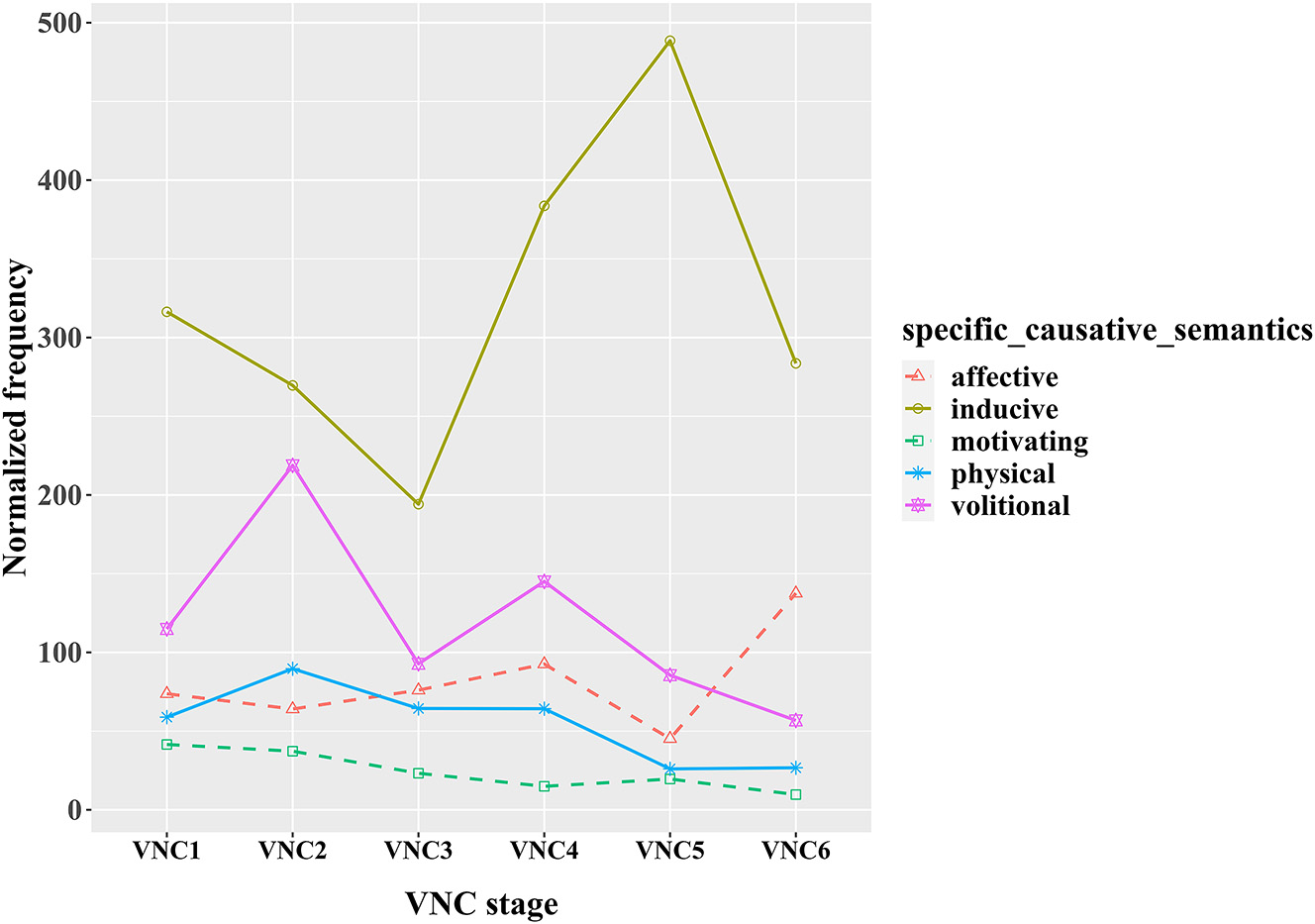
Change in normalized frequencies of specific causative semantics of CACC.
From Figure 6 one can see that cases of inducive causation outnumber those of other semantic types. Motivating causation has the lowest frequency and remains stable. According to the frequency-based operationalization of prototypicality, inducive causation can be deemed a robust prototypical semantics of CACC and motivating causation the peripheral one. In other words, unlike many constructions previously studied, the sub-schematic CACC in Figure 1 turns out to be quite constant in the status of its semantics. On closer inspection, however, the normalized frequencies of specific causative semantics for individual CACC micro-constructions in each VNC stage have shown that semantic prototypicality of ling, rang and shi micro-constructions has changed with time.
4.3.2 Onomasiological variation of CACC semantics
The onomasiological semantic variation of CACC concerns the changes in diachronic division of labor among jiao 1 , jiao 2 , ling, rang and shi micro-constructions in expressing different specific causative semantics. To detail how the semantic changes of CACC unfold onomasiologically, the distribution of specific causative semantics among jiao 1 , jiao 2 , ling, rang and shi micro-constructions in six VNC stages is illustrated in Figure 7. Recall that inducive and volitional causation is definitely deliberate, whereas motivating and physical causation is absolutely non-deliberate. The deliberateness of affective causation varies by context. For the sake of comparison, the bars for different semantics are positioned by order of deliberateness: inducive and volitional causatives locate on the left and motivating and physical causatives on the right while affective causation is in between.

Relative frequencies of specific causative semantics of CACC micro-constructions by VNC stage.
Generally speaking, the constructional means of causation expression in VNC5 and VNC6 are evidently more diversified as compared to those in previous stages. Jiao 2 , ling and shi micro-constructions carve up the conceptual space of causation in VNC1, later joined by rang micro-construction in VNC2 and jiao 1 micro-construction in VNC4. In the first four VNC stages, jiao 2 , ling and shi micro-constructions, as the mainstay of causation expression, permeate all semantic types almost completely. Major onomasiological changes have occurred in VNC5 and VNC6 when jiao 1 and rang micro-constructions markedly encroach on the causative semantic domain of existing micro-constructions.
Specifically, inducive and volitional causation, as revealed in the previous section to be the more prototypical semantics of CACC, is expressed overwhelmingly by ling and shi micro-constructions from VNC1 to VNC4. However, in the last two VNC periods, the role of shi micro-construction in conveying inducive causation is taken over by jiao 1 , jiao 2 and rang micro-constructions, whereas volitional causation continues to be expressed by ling and shi micro-constructions. With regard to affective, motivating and physical causative scenarios, they are described dominantly by means of jiao 2 , ling and shi micro-constructions throughout the stages, especially in VNC5 and VNC6 even though jiao 1 and rang micro-constructions begin to play a part in these periods. The results corroborate the claim of Chang (2005: 134) that the longer an indirect imperative construction develops, the higher the frequency of its non-deliberate causatives will be. Ling and shi micro-constructions, which have the longest history, have more occurrences of non-deliberate motivating and physical causation in VNC6 than others. In addition, deliberate causation is argued to be expressed mainly by means of the most recent indirect imperative construction in history (Chang 2005: 133). It comes as no surprise given that causative semantics is derived from indirect imperative (Chang 2005). Notably, jiao 1 and rang constructions as emerging CACC micro-constructions account for a substantial percentage of inducive causation in VNC6. Inducive causation is probably the first meaning that a micro-construction would take on when it acquires causative semantics. For illustration, rang micro-construction in VNC2 and jiao 1 micro-construction in VNC4 both begin their causative journey with inducive causation. In a sense, the semantic change path of CACC proposed in Chang (2005), i.e., from deliberate causation to non-deliberate causation, is borne out.
4.3.3 Summary
The analyses point to the relationship between the semantics of CACC and its micro-constructions. CACC is overarching and governs the semantic change of its micro-constructions. Jiao 1 , jiao 2 , ling, rang and shi micro-constructions, though differing temporally in acquiring causative meaning, follow the same semantic evolution route, that is, from deliberate causative to non-deliberate causative.
In particular, there is a two-way interaction between the semasiological and onomasiological semantic changes of CACC: prototypicality of inducive causation in CACC is constantly consolidated by emerging micro-constructions; inducive causation is more hospitable when new candidates of CACC micro-construction arise. Overall, findings from the semasiological perspective reveal that while semantic prototypicality of CACC holds steady, that of CACC micro-constructions might change through time. Onomasiologically, the diachronic division of labor among CACC micro-constructions in expressing specific causative meanings changes with time.
4.4 A closer look: local and global semantic variation of CACC
Though constrained and influenced by the superordinate CACC, jiao 1 , jiao 2 , ling, rang and shi micro-constructions have their own semantic histories. Himmelmann (2004) accentuates the importance of syntagmatic context for the study of a grammaticizing element. In what follows, diachronic distinctive collexeme analysis (Hilpert 2006) and co-varying collexeme analysis (Stefanowitsch and Gries 2005) are employed to explore diachronic semantic variation at the local level of individual constituents and at the global level of micro-constructions, along with the interrelationship between them. It should be noted that the methods are not applied to specific collexemes but to constituent semantics and constructional semantics.
4.4.1 Diachronic distinctive semantic analysis
Diachronic distinctive collexeme analysis was used to identify distinctive semantics of causer, causee, effected predicate and the CACC micro-constructions associated with VNC stages so as to bring to light their respective changes. Regularly, the method is applied to specific collexemes under the assumption that different collocational preferences reflect semantic differences (Hilpert 2006). Therefore, close scrutiny of the changes in distinctive collexemes that have been semantically categorized will provide clues about diachronic semantic change. The present investigation directly targeted constituent semantics and constructional semantics instead of collexemes per se. The frequencies of constituent semantics and constructional semantics in every VNC stage were used as the input data so as to carry out a diachronic distinctive semantic analysis. As revealed in the previous section, causativization of jiao 1 , jiao 2 , ling, rang and shi micro-constructions do not synchronize. It is not sensible to ignore this influence and conflate the semantics of a certain constructional constituent from all five micro-constructions. Shi construction, with the longest history and a comparatively even distribution across VNC stages, stands out as an ideal candidate for a case study. The diachronic distinctive semantic analysis was performed using the pv.Fisher.collostr function in the Rling package (Levshina 2015: 245) in R. Table 4 presents the collostructional strength between constituent semantics, constructional semantics and VNC periods of shi micro-construction. A value of 1.3 or higher corresponds to p < 0.05 and indicates that the semantics is significantly distinctive of the VNC stage. Table 4 contains only significantly distinctive semantics.
Diachronic distinctive semantic analysis for shi construction.
| Semantics of | VNC1 | VNC2 | VNC3 | VNC4 | VNC5 | VNC6 |
|---|---|---|---|---|---|---|
| Causer | Human 8.34 Nation 2.2 |
Human 4 | Divine being 1.87 | Human 1.37 | Action 3.63 | Action 4.63 Event 4.14 State of being 3.55 |
| Causee | Human 1.87 | Materail 3.63 Nation 2.31 |
Animal 1.72 Divine being 1.61 |
Abstract entity 2.67 | NA | Human 4.56 |
| Effected predicate | Social interaction 3.77 Physical manipulation 2.36 |
Existence 1.37 occurrence and other perceived phenomenon 1.53 | Aspectual verb 2.16 Change in state of being 1.34 |
Getting information 2.8 Mental influence 2.14 |
Motion 2.27 | Intellectual processes or states 11.64 Emotion 1.91 |
| shi construction | Inducive causation 6.12 | Physical causation 1.34 | Physical causation 2.04 | Inducive causation 1.91 | NA | Affective causation 12.63 |
It can be seen that distinctive causer semantics from VNC1 to VNC4 is markedly animate, whereas inanimate causers are distinctive of the last two VNC stages. As for the causee, distinctive semantics has shifted from human in VNC1 to material and nation in VNC2, followed by animal and divine being in VNC3 and abstract entity in VNC4. While VNC5 is devoid of distinctive causee semantics, human causee is distinctive in VNC6. The between-stage differences in the distinctive semantics of effected predicates reflect changing controllability and intention of the causee in performing the action. Particularly, VNC1 and VNC6 form a contrast: distinctive in VNC1 are social interaction (e.g., jian 监 ‘to supervise’) and physical manipulation (e.g., zhen 鸩 ‘to kill sb. with poisoned wine’), which involve significant causee controllability and intention; distinctive semantics of the effected predicate in VNC6 includes intellectual processes/states (e.g., zhi 知 ‘to know’; bian 辨 ‘to discern’) and emotion (e.g., kuaile 快乐 ‘happy’), which tend to be uncontrollable for the causee. The in-between VNC stages are distinctive in effected predicates denoting the following contents: (1) existence/location/maintaining a position (e.g., ju 居 ‘to live’); (2) appearance/occurrence/other perceived phenomena (e.g., yong 涌 ‘to bubble up’); (3) aspectual verb (e.g., qi 起 ‘to arise’); (4) change in state of being (e.g., diao 凋 ‘to wither’); (5) getting information (e.g., kan 看 ‘to look at’); (6) mental influence (e.g., you 诱 ‘to tempt’); (7) motion (e.g., fei 飞 ‘to fly’). These are either controllable or uncontrollable for the causee.
The results of diachronic distinctive constituent and constructional semantic analysis for shi micro-construction corroborate arguments in previous introspective research. Chang (2005: 132) claims that causativization of shiyi (i.e., indirect imperative) construction is initiated by the change of effected predicates from controllable items through intermediate ones to uncontrollable ones. In our study, preserving features of the shiyi construction, distinctive semantics of effected predicate in VNC1 is controllable. Stages from VNC2 to VNC5 serve as the transitional periods since the effected predicates are controllable and/or uncontrollable. VNC6 is characterized with the normally uncontrollable mental processes. Concerning the time of change, shifts in distinctive semantics of causee, effected predicate and the shi micro-construction appear to occur for the first time in VNC2, while the change of distinctive causer semantics happens in VNC5.
Given that diachronic distinctive semantic analysis is made separately for the local causer, causee, the effected predicate and the global shi micro-construction, comparing the changes in their distinctive semantics is capable of illuminating the relationship between local and global semantic changes for a construction. In VNC1, VNC2, VNC3, VNC4 and VNC6, when distinctive semantics is all present, three points are noteworthy. Firstly, within a VNC stage, distinctive semantics of local constituents might be completely compatible (in VNC1 and VNC6) or partially compatible (in VNC2, VNC3 and VNC4) with the distinctive semantics of the global micro-construction. As an illustration, in VNC1, distinctive semantics of local causer (human and nation), causee (human), effected predicate (social interaction and physical manipulation) is congruent with the global distinctive semantics (inducive causation). Secondly, across VNC stages, the changes in distinctive semantics are not always synchronous at the local and global levels. From VNC1 to VNC2, the global distinctive semantics has shifted from inducive causation to physical causation, yet the distinctive causer semantics remains to be human. From VNC5 to VNC6, the changes in distinctive semantics of local constituents and those of the construction are coordinated. Thirdly, distinctive constructional semantics does not necessarily coincide with prototypical constructional semantics in the same VNC period. An inspection of the normalized frequencies of specific causative semantics for shi micro-construction shows that inducive causation is the prototypical constructional semantics from VNC1 to VNC5; the prototypical one for VNC6 is affective causation. Therefore, prototypical constructional semantics accords with distinctive constructional semantics in VNC1, VNC4 and VNC6 for shi micro-construction.
4.4.2 Co-varying semantic analysis for CACC micro-constructions
The method of co-varying collexeme analysis was employed using Coll.analysis 4.0 (Gries 2022) in order to get a clearer picture of local and global semantic variation in CACC micro-constructions. The research investigates how the semantics of causer, causee, effected predicate and construction co-varies with the causative verbs (i.e., the micro-constructions) within every VNC stage, and then a comparison is made between different stages. The data from VNC4 to VNC6 were used since tokens of jiao 1 , jiao 2 , ling, rang and shi micro-constructions are all available in the last three stages. The results are presented in Table 5. A log-likelihood ratio (LLR) score higher than 3.84 indicates the attraction is statistically significant at the level of 0.05; a score smaller than −3.84 implies that the pair repels each other significantly. A maximum of 6 most significantly attracted and repelled co-varying pairs are introduced in Table 5.
Co-varying semantic analysis from VNC4 to VNC6.
| VNC4 | VNC5 | VNC6 | ||||
|---|---|---|---|---|---|---|
| Attracted pair | Repelled pair | Attracted pair | Repelled pair | Attracted pair | Repelled pair | |
| Causer | shi-event 17.81 jiao1-human 9.46 jiao2-human 6.39 |
shi-human −19.25 ling-event −4.88 rang-human −4.25 |
shi-action 79.53 jiao1-human 65.23 shi-event 50.30 ling-human 47.12 shi-state of being 9.42 rang-event 7.35 |
shi-human −172.15 jiao1-event −42.64 ling-event −40.44 jiao1-action −25.02 ling-action −14.17 jiao1-state of being −10.58 |
jiao1-human 108.77 shi-action 74.97 shi-event 63.60 rang-human 60.22 ling-state of being 26.78 jiao2-human 22.75 |
shi-human −263.52 jiao1-action −30.51 rang-event −30.05 ling-human −25.10 jiao1-state of being −23.90 jiao1-event −23.02 |
| Causee | ling-human 9.83 shi-abstract entity 5.41 shi-material 4.68 |
shi-human −12.57 rang-human −7.60 |
shi-materail 46.80 jiao1-human 18.43 ling-human 9.87 shi-abstract entity 9.26 jiao2-human 4.16 |
shi-human −54.54 jiao1-materail −13.94 jiao2-material −6.72 jiao1-abstract entity −6.53 ling-materail −4.97 |
shi-material 23.40 jiao1-human 10.41 shi-abstract entity 10.22 shi-nation 10.10 rang-divine being 6.63 jiao2-place 5.83 |
shi-human −37.53 jiao2-material −9.99 jiao1-material −9.29 |
| Effected predicate | shi-mental influence 8.65 shi-existence/location 8.04 jiao2-physical manipulation 5.73 |
shi-change in possession −8.80 jiao2-emotion −6.61 shi-physical manipulation −6.20 jiao2-change in state of being −4.42 jiao1-existence/location −4.15 shi-social interaction −3.97 |
rang-physiological process 62.33 shi-existence/location 52.38 jiao1-motion 23.91 shi-intellectual process 13.26 ling-physical manipulation 10.83 ling-creation/transformation/destruction of objects 9.29 |
jiao1-existence/location −23.28 shi-physical manipulation −18.48 jiao1-intellectual process −14.32 rang-physical manipulation −9.65 shi-physiological process −8.85 jiao1-change in state of being −8.73 |
shi-existence/location 97.97 ling-emotion 97.43 rang-phsiological process 45.18 shi-intellectual process 42.94 jiao1-physical manipulation 26.84 jiao2-motion 8.22 |
shi-physical manipulation −56.58 ling-social interaction −25.66 jiao1-existence/location −21.02 jiao1-emotion −14.49 rang-intellectual process −13.81 jiao2-emotion −11.87 |
| Construction | jiao1-inducive 11.42 shi-physical 9.93 shi-volitional 5.03 jiao2-motivating 4.40 |
shi-inducive −18.79 jiao2-physical −12.54 ling-motivating −4.68 jiao1-volitional −4.66 |
jiao1-inducive 93.04 shi-volitional 57.36 ling-inducive 27.84 shi-physical 27.01 shi-motivating 18.59 shi-affective 14.38 |
shi-inducive −150.02 jiao1-volitional −45.96 jiao1-affective −17.00 jiao1-physical −12.82 jiao1-motivating −9.47 ling-physical −9.11 |
jiao1-inducive 90.44 shi-volitional 88.35 rang-inducive 78.24 ling-affective 60.59 shi-physical 24.39 shi-motivating 20.39 |
shi-inducive −193.37 ling-inducive −51.30 rang-affective −30.15 jiao1-volitional −29.99 jiao1-physical −25.15 jiao1-affective −24.68 |
In VNC4, co-varying constituent semantics significantly attracted to shi as a causative verb is the event causers and material causees, effected predicates of existence/location/maintaining a position. At the level of constructional semantics, shi significantly attracts physical and volitional causation. On the flip side, repelled combinations are found between shi and the human causers and causees, effected predicates denoting change in possession, physical manipulation and social interaction as well as inducive causation. The same attraction and repulsion relationships in shi continue into VNC5 and VNC6. It is consistent with what Figure 7 has revealed – shi micro-construction, being in the later period of semantic development, significantly pairs with inanimate causers, causees, uncontrollable effected predicates and non-deliberate causation in the last three VNC stages. In contrast, jiao 1 micro-construction is at the early stage of causativization and thus significantly attracts human causers and inducive causation in VNC4. In VNC5 and VNC6, jiao 1 significantly attracts human causers and causees, effected predicates of motion and physical manipulation (with a LLR value of 8.19 in VNC5, not displayed in Table 5). Similarly, in VNC6, co-varying with rang, another relatively new causative verb, are the human causers, the causees denoting divine being, effected predicates of physiological processes/states and inducive causation.
Ling, which is supposed to behave similarly to shi in the process of semantic change, seems to be an anomaly in VNC5. Significantly attracted co-varying pairs of ling are: ling and the human causers, ling and the human causees, ling and effected predicates related to physical manipulation and the creation/transformation/destruction of objects, as well as ling and inducive causation. Reasons for the apparent oddity will be proposed in the later section. The co-varying semantics of ling converges with shi in VNC6, thus the deviation of ling in VNC5 suggests that shi outpaces ling in diachronic semantic change.
4.4.3 Summary
As regards local and global semantic changes of a CACC micro-construction, implications from the diachronic distinctive semantic analysis for shi micro-construction and the co-varying pairs of causative verbs (representing CACC micro-constructions) and constituent/constructional semantics are summarized as follows.
Firstly, for CACC micro-constructions at the early and late periods of semantic development following the indirect imperative usage, there tends to be compatibility between distinctive semantics of local constituents and the global micro-construction. A case in point is the shi micro-construction in VNC1 and VNC6 in Table 4. Likewise, in the early and late periods of semantic change, local constituent semantics significantly attracted to the causative verbs is in agreement with the specific causative semantics significantly attracted to the verbs, such as jiao 1 and shi in the last three VNC stages in Table 5. By contrast, for CACC micro-constructions in the intermediate periods in between early and late periods of semantic change, local and global semantic changes are usually not coordinated. Constructional semantic change might precede, lag behind or co-occur with the semantic change of a local constituent (e.g., physical causation and the human causer of shi micro-construction in VNC2 in Table 4).
Secondly, semantic changes at local and global levels represent the constructional changes of CACC micro-constructions. As to constructionalization, the shi micro-construction will be discussed since we have scrutinized its semantic changes. Semantic changes of shi micro-construction illustrated in Figure 7, Tables 4 and 5, in conjunction with the general formal change of causee obligatorification in VNC3, VNC4 and onwards (Figure 5), are suggestive of possible constructionalization in shi micro-construction. It somehow lends support to the argument of Niu (2007) that shi has fully grammaticalized into a causative marker. Against the backdrop of general formal change of causee obligatorification and with ongoing semantic change, constructionalization of other CACC micro-constructions might be underway and needs further research.
5 Confirmatory studies
5.1 Semasiology: polysemization of CACC micro-constructions
To verify findings from exploratory studies, we fit logistic regression models on the data. Semasiologically, multinomial logistic regression was performed using the multinom function from the nnet package in R to detect factors significantly influencing the diachronic changes of CACC micro-constructions in terms of specific causative semantics. Despite ordered deliberateness therein, multinomial logistic regression instead of ordinal logistic regression was employed as the ordering is not a major concern in this study.
Various multinomial logistic regression models on all data were fitted, with specific causative semantics as the response. The purpose is to assess separately the interaction between VNC stages and the micro-construction type, causer animacy, causee animacy, causee controllability in implementing the effected predicate and the genre. The model selection process revealed that the interaction between micro-construction type and time has a significant effect on the diachronic semantic change of CACC micro-constructions (Figure 8). The McFadden R2 of the model is 0.12.

Probabilities of specific causative semantics for the interaction between VNC stage and CACC micro-construction type.
For CACC micro-constructions, a general trend is that the earlier the VNC stage, the higher the probabilities of inducive and/or volitional causation vis-à-vis those of other causative semantics. However, in later VNC stages, a decrease in the probabilities of inducive and/or volitional causation is equally notable. An exception is the inducive causative semantics of ling micro-construction. Ling, which originally means “to order/command”, is found to be very active in the expression of indirect imperative from the pre-Qin period to the Qing Dynasty (Chang 2005: 126). As noted by Chang (2005: 131), early cases of causative usage are largely deliberate, sharing the basic semantic features of indirect imperative instances, i.e., human causer, human causee, causer’s intention in carrying out the caused event and the “unhappened” state of the caused event. In this sense, inducive causation is the most closely, if not immediately, connected with indirect imperatives. Concomitant with the long-standing activeness of indirect imperatives in ling micro-construction, inducive causation has the highest normalized frequency among all causative semantics of ling micro-construction from VNC1 to VNC5 in this study. Besides, the literary genres popular in the Yuan and Ming dynasties that comprise VNC5 help boost the presence of inducive causation for not just ling micro-construction but also other CACC micro-constructions in VNC5. The Yuan and Ming dynasties are especially famous for drama, fiction and other vernacular literature, in which scenes involving inducive causation are common. These genres account for a very large portion of the Yuan and Ming sections in CCL and the sample of this study alike. Nevertheless, ling micro-construction follows the general trend in the long run: with the gradual decline of inducive causative semantics, ling micro-construction is used in contemporary Chinese mainly for descriptive causation and has a high degree of lexicalization (Tian and Zhang 2020).
By comparison, physical and motivating causation remains low in their probabilities throughout time, in spite of occasional spurts in some VNC periods. Probabilities of the intermediate affective causation of all micro-constructions are largely low from VNC1 to VNC4, and a modest increase is observed between VNC5 and VNC6. Overall, the probabilities of deliberate inducive and volitional causation are higher than those of non-deliberate motivating and physical causation. As such, diachronic semantic prototypicality and the semantic change path at the sub-schematic level of CACC are verified. Causer animacy, causee controllability in performing the effected predicate and genre do not interact with time in predicting specific causative semantics. In other words, the effects of the three variables on the semantic change of CACC micro-constructions do not depend on time – an animate causer consistently prefers inducive or volitional causation, while an inanimate causer regularly favors non-deliberate causation, irrespective of historical period. The influence of causee controllability is likewise not constrained by the passage of time. To sum up, CACC governs the semantic change path of jiao 1 , jiao 2 , ling, rang, shi micro-constructions. Whatever the etymology, a micro-construction of CACC will follow the same route of semantic change.
5.2 Onomasiology: diachronic semantic division of labor among CACC micro-constructions
In the same vein, various multinomial logistic regression models were fitted to detect factors that significantly influence the semantic division of labor among near-synonymous CACC micro-constructions over time. The final adequate model, with a McFadden R2 of 0.21, contains a VNC-genre interaction and the interaction between VNC stage and specific causative semantics. For a better interpretation, the interactions are presented graphically in Figures 9 and 10.

Probabilities of CACC micro-constructions for the interaction between VNC stage and specific causative semantics.

Probabilities of CACC micro-constructions for the interaction between VNC stage and genre.
The probabilities of jiao 2 , ling and shi micro-constructions are relatively higher in expressing all causative semantics in most VNC stages. With the passage of time, inducive causation gradually disfavors the aforementioned three micro-constructions and prefers jiao 1 and rang micro-constructions, the more recent alternative constructions from VNC4 onwards. Volitional causation shows a similar trend, but with an exception in shi micro-construction. On the contrary, affective, physical and motivating causation boosts the chances of ling and shi micro-constructions in later VNC stages. As such, the onomasiological semantic changes of CACC are confirmed.
As for the interaction between VNC stage and genre, fiction genres increase the likelihood of ling and shi micro-constructions in early VNC stages but favor jiao 1 , jiao 2 and rang micro-constructions as time goes on. In later VNC stages, non-fiction genres show a clear preference for ling and shi micro-constructions. The result is tied to the semantic change of the micro-constructions attested previously. It is in line with the findings in Chen (2020) that in contemporary Chinese the causative shi construction is more prevalent in formal registers. Jiao 1 and rang micro-constructions as emerging causative constructions prevail in inducive and volitional causation, and dominate fiction genres which involve the interaction between sentient beings.
6 Discussion
6.1 Summary of major findings
A summary of major findings is made in response to the research questions. For the first research question, there are six major periods in the semantic change of CACC micro-constructions.
Regarding the second question, CACC micro-constructions have undergone two types of formal change: obligatorification of causee and host-class expansion of the causer and effected predicate. Semantic change studies from the semasiological and onomasiological perspectives attest to the general polysemization route of CACC and its micro-constructions, that is, “deliberate causation (inducive and volitional causation) → deliberate/non-deliberate causation (affective causation) → non-deliberate causation (motivating and physical causation)”, as well as the diachronic semantic prototypicality of inducive causation in CACC. Moreover, the semantic division of labor among CACC micro-constructions is found to change across VNC stages. As to semantic changes along the constructional schematicity hierarchy, the present study shows that the superordinate CACC construction governs the semantic development path of its subordinate jiao 1 , jiao 2 , ling, rang, shi micro-constructions. Probing into the changes in the distinctive semantics of local constituents and global construction for shi micro-construction and the changes in the co-varying constituent and constructional semantics of jiao 1 , jiao 2 , ling, rang and shi in different VNC stages, we discover that the semantics of local causer, causee and effected predicate is more likely to change in concert with global constructional semantics in early and late periods of semantic development. The pictures in the intermediate stages are more varied. Additionally, notwithstanding the general semantic change path, distinctive semantics of local constituents and the global micro-construction might deviate from the general route in some period, as demonstrated in Tables 4 and 5.
For the third research question, semasiologically, a significant interaction is identified between micro-construction type and VNC period in predicting the specific causative semantics of CACC. The effects of causer animacy, causee controllability in performing the effected predicate and genre on specific causative semantics are not subject to temporal limitation. Onomasiologically, genre and specific causative semantics significantly interact with time in predicting the choice between jiao 1 , jiao 2 , ling, rang and shi, or rather the diachronic semantic division of labor between CACC micro-constructions.
6.2 Prototype categorization of CACC diachronic semantics
The specific causative semantics of CACC comprising a prototypical category, the discussion centers around the fuzzy boundary, prototypicality effect, family resemblance and radial structure exhibited by the semantics, as illustrated in Figure 11.

General semantic change route of CACC and semantic features.
To begin with, the semantics has fuzzy boundaries as inducive causation and indirect imperative have many semantic features in common. The semantics demonstrates graded prototypicality: inducive causation is more prototypical while motivating causation is more peripheral. The semantics ripples from inducive causation and forms a radial network. The semantic features of causer, causee and effected predicate that link with each specific causative semantics serve as tokens of family resemblance holding between the semantics. It is worth noting that semantic features of constructional constituents from two adjacent causative semantics in Figure 11 are more similar than distant ones. From a diachronic perspective, the sequence that constructs of different semantics are sanctioned and enter the network is roughly in line with how their semantic features resemble those of core/prototypical constructs (Peng 2016: 5). Constructs that are licensed later are assumed to contain semantic features which deviate more significantly from those of prototypical constructs, and vice versa.
6.3 Motivations of semantic change for CACC micro-constructions
Chang (2005: 149) argues that development of non-deliberate causation out of deliberate cases is driven by the expansion of causer type, that is, from human to non-human causers, as causer type is more liable to change as compared with other features (Chang 2005: 135). However, both collostructional analysis and logistic regression modelling of this study have suggested otherwise. The former method indicates that the development of constituent semantics and constructional semantics could be coordinated, while the latter has confirmed that there is no significant interaction between causer animacy and time in predicting specific causative semantics of CACC micro-constructions. This study reveals that semantic development of CACC micro-constructions might turn out to be concerted shifts on the part of constituent semantics and constructional semantics. The reason is not far to seek: there is high degree of compositionality in CACC, that is, constituent semantics provides cues to the constructional semantics to a large extent (Traugott and Trousdale 2013: 19). Each type of specific causative semantics is characterized by a typical configuration of causer, causee and effected predicate semantics. It remains to be tested if coordinated development will be observed between constituent semantics and constructional semantics when the degree of compositionality is lower in a construction.
The driving force for semantic change of CACC micro-constructions is proposed externally and internally. The external driving force is the emerging causative micro-construction(s). Upon entering the semantic domain of causation and still retaining the features of previous indirect imperative usage, new micro-constructions are used mainly for expressing inducive and volitional causation. Existing micro-constructions are edged out of deliberate causation and turn toward non-deliberate usages. The change of constituent semantics is the internal driving force. According to Bybee (2010: 130), lexical items that fill a slot of a construction form a category that would expand by analogy with early expressions. With analogy as the mechanism of change, the scope of causer, causee and effected predicate gradually increases. However, the direction of change for the original animate causer and causee can only be non-animate causer and causee; the effected predicate will change from highly controllable verbs to verbs involving medium or low controllability. Propelled by external and internal forces, semantics of CACC micro-constructions changes from deliberate causation to non-deliberate causation.
7 Conclusion
To conclude, some theoretical implications in relation to the semantic change of analytic causative construction and beyond are drawn from this study. First, semantic changes of a construction from the semasiological perspective concern the establishment of a polysemization route and the changes in semantic prototypicality. The hierarchy of constructional schematicity should be considered as changes of a schematic construction differ in many respects from those of substantive constructions (Peng 2016: 24). The interrelationship between the changes of a schematic construction and those of its subordinate constructions needs further examination. Semantic changes of a schematic construction from the onomasiological perspective deal with the diachronic division of labor among the near-synonymous sub-schematic constructions. Second, the degree of compositionality should be taken into consideration when studying semantic changes at the local and global levels of a construction. For a construction with a high degree of compositionality like the CACC micro-construction, its local and global semantic changes might be completely or partially coordinated, depending on the stage of semantic development. Third, it is advisable to integrate the semantic change study of a construction with its formal change study with an aim to reveal constructional changes and possibly constructionalization.
Methodologically, this study has demonstrated that collostructional analysis is applicable to studying the semantic change of a construction at local constituent and global construction levels. When using this method, it is viable to bypass collexeme and construction by working directly on constituent semantics and constructional semantics. Finally, this study is not without limitations. Lectal variation of CACC is restricted only to fiction and non-fiction genres; the rate of change is not quantitatively measured. It is our hope that future studies will address these issues and advance the study of analytic causative construction in particular and constructional change and constructionalization at large.
Funding source: The Philosophy and Social Science Program of Guizhou Province, China
Award Identifier / Grant number: 20GZQN11
Funding source: China Scholarship Council
Award Identifier / Grant number: 202308350049
-
Research funding: This work was funded by The Philosophy and Social Science Program of Guizhou Province, China (20GZQN11) and China Scholarship Council (202308350049) with the doi: https://doi.org/10.13039/501100004543.
References
Bybee, Joan. 2010. Language, usage and cognition. Cambridge: Cambridge University Press.10.1017/CBO9780511750526Search in Google Scholar
Cao, Jin. 2011. “Shiling ju” cong shanggu hanyu dao zhonggu hanyu de bianhua [The change of shi/ling (使/令) causative construction from Old Chinese to Middle Chinese]. Yuyan Kexue [Linguistic Sciences] 10(6). 602–617.Search in Google Scholar
Chang, Li-li. 2005. Cong shiyi dao zhishi [The causativisation of Chinese shi-yi constructions]. Taida Wenshizhe Xuebao 62. 119–152.Search in Google Scholar
Chen, Qiaoyun. 2020. Creating a 3D semantic profile of causative shi and rang: A constructional approach. Australian Journal of Linguistics 40(4). 405–427. https://doi.org/10.1080/07268602.2020.1834348.Search in Google Scholar
Croft, William. 1991. Syntactic categories and grammatical relations: The cognitive organization of information. Chicago: University of Chicago Press.Search in Google Scholar
Geeraerts, Dirk. 1986. On necessary and sufficient conditions. Journal of Semantics 5(4). 275–291. https://doi.org/10.1093/jos/5.4.275.Search in Google Scholar
Geeraerts, Dirk. 1997. Diachronic prototype semantics: A contribution to historical lexicology. Oxford: Clarendon Press.10.1093/oso/9780198236528.001.0001Search in Google Scholar
Geeraerts, Dirk. 2010. Theories of lexical semantics. Oxford: Oxford University Press.10.1093/acprof:oso/9780198700302.001.0001Search in Google Scholar
Glynn, Dylan. 2014a. The many uses of run: Corpus methods and socio-cognitive semantics. In Dylan Glynn & Justyna A. Robinson (eds.), Corpus methods for semantics: Quantitative studies in polysemy and synonymy, 117–144. Amsterdam/Philadelphia: John Benjamins.10.1075/hcp.43.05glySearch in Google Scholar
Glynn, Dylan. 2014b. Correspondence analysis: Exploring data and identifying patterns. In Dylan Glynn & Justyna A. Robinson (eds.), Corpus methods for semantics: Quantitative studies in polysemy and synonymy, 443–486. Amsterdam/Philadelphia: John Benjamins.10.1075/hcp.43.17glySearch in Google Scholar
Goldberg, Adele E. 1995. Constructions: A construction grammar approach to argument structure. Chicago: University of Chicago Press.Search in Google Scholar
Gries, Stefan Th. 2022. Coll.analysis 4.0. A script for R to compute perform collostructional analyses. Available at: https://www.stgries.info/teaching/groningen/index.html.Search in Google Scholar
Gries, Stefan Th. & Martin Hilpert. 2008. The identification of stages in diachronic data: Variability-based neighbor clustering. Corpora 3(1). 59–81. https://doi.org/10.3366/e1749503208000075.Search in Google Scholar
Gries, Stefan Th. & Martin Hilpert. 2010. Modeling diachronic change in the third person singular: A multifactorial, verb- and author-specific exploratory approach. English Language and Linguistics 14(3). 293–320. https://doi.org/10.1017/s1360674310000092.Search in Google Scholar
Gries, Stefan Th. & Martin Hilpert. 2012. Variability-based neighbor clustering: A bottom-up approach to periodization in historical linguistics. In Nevalainen Terttu & Elizabeth Closs Traugott (eds.), The Oxford handbook of the history of English, 134–144. Oxford: Oxford University Press.10.1093/oxfordhb/9780199922765.013.0014Search in Google Scholar
Gries, Stefan Th. & Anatol Stefanowitsch. 2004. Extending collostructional analysis: A corpus-based perspective on ‘alternations’. International Journal of Corpus Linguistics 9(1). 97–129. https://doi.org/10.1075/ijcl.9.1.06gri.Search in Google Scholar
Hilpert, Martin. 2006. Distinctive collexeme analysis and diachrony. Corpus Linguistics and Linguistic Theory 2(2). 243–256. https://doi.org/10.1515/cllt.2006.012.Search in Google Scholar
Hilpert, Martin. 2013. Corpus-based approaches to constructional change. In Thomas Hoffmann & Graeme Trousdale (eds.), The Oxford handbook of construction grammar, 458–475. Oxford: Oxford University Press.10.1093/oxfordhb/9780195396683.013.0025Search in Google Scholar
Hilpert, Martin. 2021. Three open questions in diachronic construction grammar. Ten lectures on diachronic construction grammar, 60–89. Leiden: Brill.10.1163/9789004446793_004Search in Google Scholar
Himmelmann, Nikolaus P. 2004. Lexicalisation and grammaticalization: Opposite or orthogonal? In Walter Bisang, Nikolaus P. Himmelmann & Björn Wiemer (eds.), What makes grammaticalization?: A look from its fringes and its components, 21–44. Berlin & New York: De Gruyter Mouton.10.1515/9783110197440.1.21Search in Google Scholar
Huang, C.-T. James. 2015. On syntactic analyticity and parametric theory. In Audrey Li, Andrew Simpson & Wei-Tien Dylan Tsai (eds.), Chinese syntax in a cross-linguistic perspective, 1–48. Oxford: Oxford University Press.10.1093/acprof:oso/9780199945658.003.0001Search in Google Scholar
Jing-Schmidt, Zhuo & Xinjia Peng. 2016. The emergence of disjunction: A history of the constructionalization in Chinese. Cognitive Linguistics 27. 101–136. https://doi.org/10.1515/cog-2015-0073.Search in Google Scholar
Levshina, Natalia. 2015. How to do linguistics with R: Data exploration and statistical analysis. Amsterdam/Philadelphia: John Benjamins.10.1075/z.195Search in Google Scholar
Levshina, Natalia, Dirk Geeraerts & Dirk Speelman. 2013. Mapping constructional spaces: A contrastive analysis of English and Dutch analytic causatives. Linguistics 51(4). 825–854. https://doi.org/10.1515/ling-2013-0028.Search in Google Scholar
Li, Zuofeng. 2003. “Shizi ju” in Zuozhuan [Shi-sentence in Zuozhuan]. In Li Zuofeng (ed.), Shanggu hanyu yufa yanjiu [A study on the grammar of Old Chinese], 94–106. Beijing: Beijing Guangbo Xueyuan Chubanshe [Beijing Broadcasting Institute Press].Search in Google Scholar
Liesenfeld, Andreas, Meichun Liu & Chu-Ren Huang. 2022. Profiling the Chinese causative construction with rang (讓), shi (使) and ling (令) using frame semantic features. Corpus Linguistics and Linguistic Theory 18(2). 263–306. https://doi.org/10.1515/cllt-2020-0027.Search in Google Scholar
Liu, Meili. 2023. Towards a dynamic behavioral profile of the Mandarin Chinese temperature term re: A diachronic semasiological approach. Corpus Linguistics and Linguistic Theory 19(2). 289–321. https://doi.org/10.1515/cllt-2021-0046.Search in Google Scholar
Niu, Shunxin. 2007. Putonghua zhong zhishici de sange yufahua jieduan [The three grammaticalization stages of causatives in Mandarin]. Shehui Kexuejia [Social Scientist] 3. 206–209.Search in Google Scholar
Noël, Dirk & Timothy Colleman. 2021. Diachronic construction grammar. In Xu Wen & John R. Taylor (eds.), The Routledge handbook of cognitive linguistics, 662–675. New York & Oxford: Routledge.10.4324/9781351034708-44Search in Google Scholar
Peng, Rui. 2016. Yufahua ● lishi goushi yufa ● goushihua – lishi xingtai jufa lilun fangfa de yanjin [Grammaticalization, diachronic construction grammar, constructionalization: The evolution of the approaches of historical morphosyntax]. Yuyan Jiaoxue yu Yanjiu [Language Teaching and Linguistic Studies] 2. 14–29.Search in Google Scholar
R Core Team. 2022. R: A language and environment for statistical computing. Vienna, Austria: R Foundation for Statistical Computing.Search in Google Scholar
Rosch, Eleanor. 1975. Cognitive representations of semantic categories. Journal of Experimental Psychology: General 104(3). 192–233. https://doi.org/10.1037//0096-3445.104.3.192.Search in Google Scholar
Rosch, Eleanor & Carolyn B. Mervis. 1975. Family resemblances: Studies in the internal structure of categories. Cognitive Psychology 7. 573–605. https://doi.org/10.1016/0010-0285(75)90024-9.Search in Google Scholar
Schätzle, Christin & Hannah Booth. 2019. DiaHClust: An iterative hierarchical clustering approach for identifying stages in language change. Proceedings of the 1st international workshop on computational approaches to historical language change, 126–135. Florence, Italy: Association for Computational Linguistics.10.18653/v1/W19-4716Search in Google Scholar
Shibatani, Masayoshi & Prashant Pardeshi. 2002. The causative continuum. In Masayoshi Shibatani (ed.), The grammar of causation and interpersonal manipulation, 85–126. Amsterdam/Philadelphia: John Benjamins.10.1075/tsl.48.07shiSearch in Google Scholar
Stefanowitsch, Anatol & Stefan Th. Gries. 2005. Covarying collexemes. Corpus Linguistics and Linguistic Theory 1(1). 1–43. https://doi.org/10.1515/cllt.2005.1.1.1.Search in Google Scholar
Szmrecsanyi, Benedikt. 2013. Diachronic probabilistic grammar. English Language and Linguistics 19. 41–68. https://doi.org/10.17960/ell.2013.19.3.002.Search in Google Scholar
Talmy, Leonard. 1988. Force dynamics in language and cognition. Cognitive Science 12(1). 49–100. https://doi.org/10.1016/0364-0213(88)90008-0.Search in Google Scholar
Talmy, Leonard. 2000. Toward a cognitive semantics, Volume I: Concept structuring systems. Cambridge, MA: The MIT Press.10.7551/mitpress/6847.001.0001Search in Google Scholar
Taylor, John R. 1995. Linguistic categorization: Prototypes in linguistic theory, 2nd edn. Oxford: Oxford University Press.Search in Google Scholar
Tian, Xiaoyu & Weiwei Zhang. 2020. Hanyu bianti zhong fenxixing zhishi goushi bianyi yanjiu – duofenlei luojisidi huigui jianmo [Chinese analytic causative constructions and their lectal variation: A multinomial logistic regression]. Waiyu yu Waiyu Jiaoxue [The Journal of Foreign Languages and Their Teaching] 3. 22–33 + 146–147.Search in Google Scholar
Traugott, Elizabeth C. & Graeme G. Trousdale. 2013. Constructionalization and constructional changes. Oxford: Oxford University Press.10.1093/acprof:oso/9780199679898.001.0001Search in Google Scholar
Verhagen, Arie & Suzanne Kemmer. 1997. Interaction and causation: Causative constructions in modern standard Dutch. Journal of Pragmatics 27(1). 61–82. https://doi.org/10.1016/s0378-2166(96)00003-3.Search in Google Scholar
Zadeh, Lotfi A. 1997. Toward a theory of fuzzy information granulation and its centrality in human reasoning and fuzzy logic. Fuzzy Sets and Systems 90(2). 111–127. https://doi.org/10.1016/s0165-0114(97)00077-8.Search in Google Scholar
Zhan, Weidong, Rui Guo & Yirong Chen. 2003. The CCL corpus of Chinese texts, available online at the website of Center for Chinese Linguistics (abbreviated as CCL) of Peking University. Available at: http://ccl.pku.edu.cn:8080/ccl_corpus.Search in Google Scholar
Supplementary Material
This article contains supplementary material (https://doi.org/10.1515/cllt-2023-0062).
© 2024 the author(s), published by De Gruyter, Berlin/Boston
This work is licensed under the Creative Commons Attribution 4.0 International License.
Articles in the same Issue
- Frontmatter
- I couldn’t help but wonder: do modals and negation attract?
- Reliable detection and quantification of selective forces in language change
- Alternation in the Mandarin disposal constructions: quantifying their evolutionary dynamics across twelve centuries
- Critical contingency competition in L2 clause positioning acquisition: the case of concessive clause by Chinese EFL learners
- The distributional properties of long nominal compounds in scientific articles: an investigation based on the uniform information density hypothesis
- The counting principle makes number words unique
- Profiling analytic causative construction in Chinese: a multifactorial analysis of diachronic change
Articles in the same Issue
- Frontmatter
- I couldn’t help but wonder: do modals and negation attract?
- Reliable detection and quantification of selective forces in language change
- Alternation in the Mandarin disposal constructions: quantifying their evolutionary dynamics across twelve centuries
- Critical contingency competition in L2 clause positioning acquisition: the case of concessive clause by Chinese EFL learners
- The distributional properties of long nominal compounds in scientific articles: an investigation based on the uniform information density hypothesis
- The counting principle makes number words unique
- Profiling analytic causative construction in Chinese: a multifactorial analysis of diachronic change
