In Memoriam —Allen Joseph Bard (1933–2024)
-
Larry R. Faulkner

Abstract
Professor Allen J. Bard, president of IUPAC during the biennium 1991-93, died in Austin at the age of 90 on February 11, 2024. He was a world-renowned electrochemist, recognized especially for placing the study of electrochemical reactions on a level of sophistication similar to that of homogeneous chemical processes.
In more than 60 years at the University of Texas at Austin, he guided 360 PhD students and post-doctoral associates and published more than 1000 peer-reviewed papers. The large topics on which he concentrated comprise a sizable fraction of electrochemistry in his time, including the mechanisms of electrode reactions, chemiluminescence from electrogenerated species, and photoelectrochemistry at semiconductor electrodes. He co-invented immunoassay by chemiluminescence and was an essential innovator in scanning electrochemical microscopy. Both tools have become commercially available and are widely employed. In his later years, he focused on what is now known as single-molecule electrochemistry, establishing methods that could detect individual electrochemical events. He often provided the first demonstrations. Some of his most striking results involved the formation and observation of individual catalytic centers of one to several atoms.
He is remembered as a superb teacher, able to inspire students through his own excitement with science and his ability to convey the essence of a complex subject with clarity and simplicity.
He also contributed through his influential texts, including three editions of Electrochemical Methods (Wiley, 1980, 2001, 2022, the last with L. R. Faulkner and H. S. White). Moreover, he edited three leading series in electrochemistry and was Editor-in-Chief of the Journal of the American Chemical Society for 20 years.
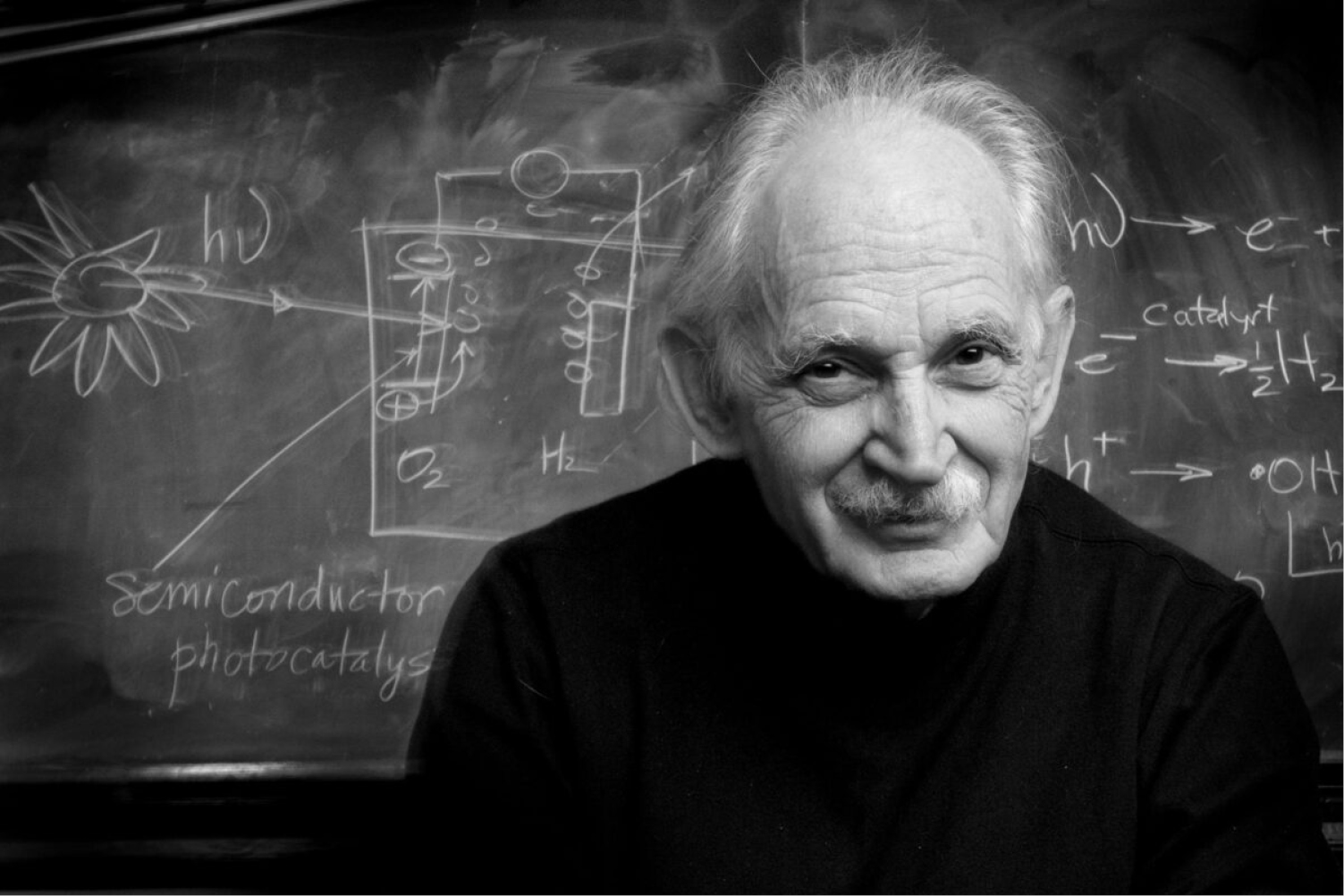
Photo © The University of Texas at Austin. Photo by Marsha Miller
Allen Bard’s activity in the 1980s within IUPAC was very much associated with IUPAC’s mission of a common language and the free exchange of information. He was a member of the Commission on Electrochemistry (1975-1983), being Vice-Chairman 1981-1983 and of the Commission on Chemical Kinetics (1983-1987). During this time, the book Standard Potentials in Aqueous Solution (A. J. Bard, R. Parsons, and J. Jordan, Eds., Dekker, 1985) was published as an IUPAC-based project. It continues to be an excellent source of data on standard potentials or species of most of the chemical elements.
The future developments predicted in his article “New challenges in electrochemistry and electroanalysis” in the IUPAC journal Pure and Applied Chemistry [64 (1992) 185-192; https://doi.org/10.1351/pac199264020185, based on his lecture at the 33rd IUPAC Congress, held in Budapest, Hungary, in August 1991] are the challenges felt today, over 30 years later.
In 1989, Bard was elected to be IUPAC Vice President, followed by President in 1991-1993 and Past President 1994-1995. He presented his Vice President’s Critical Assessment in the Hamburg General Assembly (1991), which assessed whether work that had been carried out with IUPAC sponsorship was all appropriate and recommending that a move should be made towards a more dynamic structure involving fewer permanent commissions, amalgamation of existing bodies where appropriate, and development of mechanisms for speeding up approval and publication of IUPAC recommendations.
His Critical Assessment commenced discussions that carried into later biennia regarding the IUPAC structure. Only in 2001 was organisational change implemented, with the abolition of most commissions and the creation of a more streamlined division structure in order to respond to the challenges of the 21st century in the chemical and related sciences.
Professor Bard was recognized broadly for his vast contributions. Among the distinctions were the U. S. National Medal of Science, the Priestley Medal, the Enrico Fermi Award, the Wolf Prize, the Welch Award, and the King Faisal International Prize. He was a member of the U. S. National Academy of Sciences.
©2024 by Walter de Gruyter Berlin/Boston
This work is licensed under the Creative Commons Attribution-NonCommercial-NoDerivatives 4.0 International License.
Articles in the same Issue
- Masthead - Full issue pdf
- Secretary General’s Column
- Managing the affairs of the Union, a brief history of the IUPAC Secretariat
- Features
- The PARTY Approach: How Friendship Transcended Borders for Science
- Blockchain Technology and its Use Along the Scientific Research Workflow
- IUPAC and Wikipedia: A Story with Upsides, Downsides, Lessons & Rewards
- IUPAC Wire
- Franziska Schoenebeck is the Thieme-IUPAC Prize Winner 2024
- Christine Luscombe is the recipient of the 2024 Stepto Lecture Award
- Athina Anastasaki is the recipient of the 9th Polymer International-IUPAC Award
- 2025 Distinguished Women in Chemistry/Chemical Engineering Award—Call for Nominations
- 2024 IUPAC-Zhejiang NHU International Award For Advancements In Green Chemistry—Call For Nominations
- IUPAC FAIR Chemistry Cookbook
- In Memoriam —Allen Joseph Bard (1933–2024)
- A tribute to Christo Balarew on the occasion of his 90th birthday
- Project Place
- Assessment of Reliability and Uncertainty of Solubility Data
- Human Drug Metabolism Database (hDMdb)
- JCGM Guides in Metrology—IUPAC working in the field of metrology with others broadly-based international organizations
- Making an imPACt
- A brief guide to measurement uncertainty (IUPAC Technical Report)
- Definition of the pnictogen bond (IUPAC Recommendations 2023)
- IUPAC Distinguished Women in Chemistry and Chemical Engineering Awards 2023
- Special issue of POLY-CHAR 2023 and in memory of Professor Melissa Chan Chin Han
- From water to chemicals: vision and opportunities of a sustainable hydrogen society
- IUPAC Provisional Recommendations
- Glossary of Terms for Mass and Volume in Analytical Chemistry
- Definition of materials chemistry
- Conference Call
- Systems Thinking and Sustainability—A Workshop at 5th ACRICE
- Worldwide Nurturing Green Chemistry Innovators
- Digit al Standards: A Path to Sustainable and Interoperable Chemical Data Exchange
- Mark Your Calendar
Articles in the same Issue
- Masthead - Full issue pdf
- Secretary General’s Column
- Managing the affairs of the Union, a brief history of the IUPAC Secretariat
- Features
- The PARTY Approach: How Friendship Transcended Borders for Science
- Blockchain Technology and its Use Along the Scientific Research Workflow
- IUPAC and Wikipedia: A Story with Upsides, Downsides, Lessons & Rewards
- IUPAC Wire
- Franziska Schoenebeck is the Thieme-IUPAC Prize Winner 2024
- Christine Luscombe is the recipient of the 2024 Stepto Lecture Award
- Athina Anastasaki is the recipient of the 9th Polymer International-IUPAC Award
- 2025 Distinguished Women in Chemistry/Chemical Engineering Award—Call for Nominations
- 2024 IUPAC-Zhejiang NHU International Award For Advancements In Green Chemistry—Call For Nominations
- IUPAC FAIR Chemistry Cookbook
- In Memoriam —Allen Joseph Bard (1933–2024)
- A tribute to Christo Balarew on the occasion of his 90th birthday
- Project Place
- Assessment of Reliability and Uncertainty of Solubility Data
- Human Drug Metabolism Database (hDMdb)
- JCGM Guides in Metrology—IUPAC working in the field of metrology with others broadly-based international organizations
- Making an imPACt
- A brief guide to measurement uncertainty (IUPAC Technical Report)
- Definition of the pnictogen bond (IUPAC Recommendations 2023)
- IUPAC Distinguished Women in Chemistry and Chemical Engineering Awards 2023
- Special issue of POLY-CHAR 2023 and in memory of Professor Melissa Chan Chin Han
- From water to chemicals: vision and opportunities of a sustainable hydrogen society
- IUPAC Provisional Recommendations
- Glossary of Terms for Mass and Volume in Analytical Chemistry
- Definition of materials chemistry
- Conference Call
- Systems Thinking and Sustainability—A Workshop at 5th ACRICE
- Worldwide Nurturing Green Chemistry Innovators
- Digit al Standards: A Path to Sustainable and Interoperable Chemical Data Exchange
- Mark Your Calendar
