Systematic Nomenclature of Organic, Organometallic and Coordination Chemistry. Chemical-Abstracts Guidelines with IUPAC Recommendations and Many Trivial Names

by Ursula Bünzli-Trepp
Logos Verlag Berlin 2021; 685 pp.
reviewed by Molly Strausbaugh, Edwin Constable, Andrey Yerin, and Ture Damhus, all of IUPAC Division VIII.
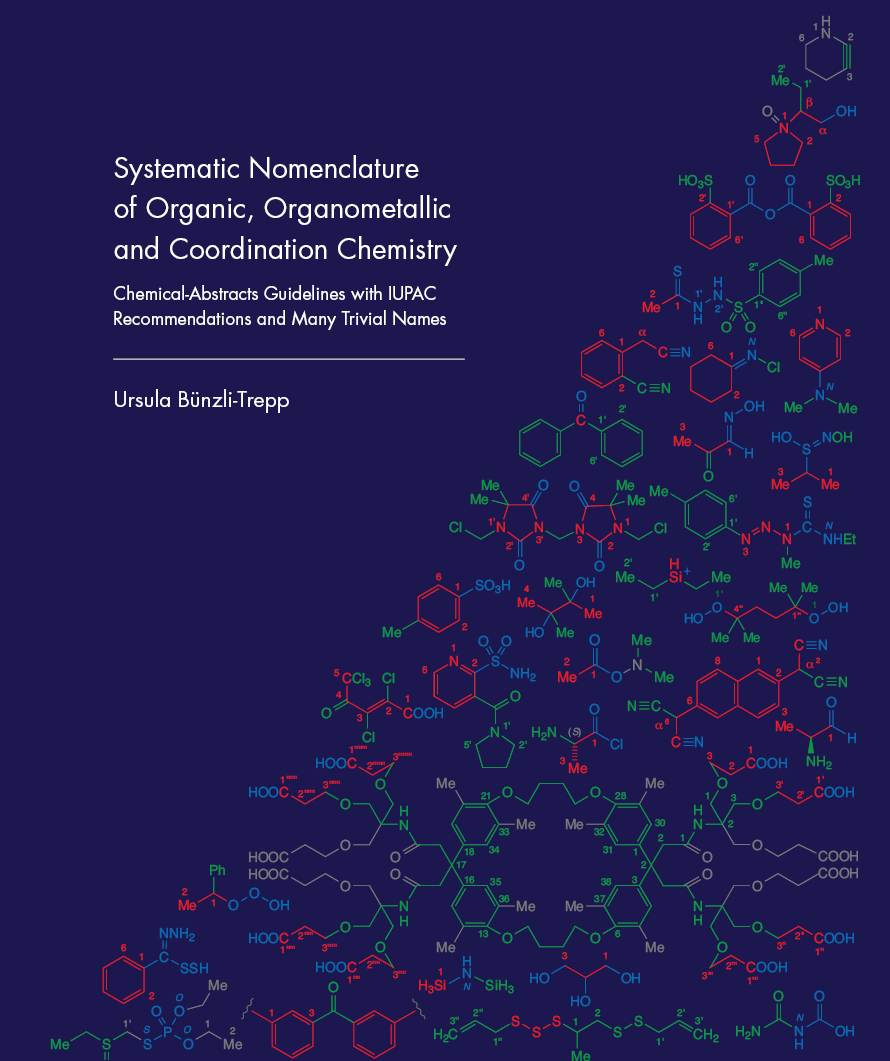
Accuracy and unambiguity are at the heart of good science communication, and the publication of the second edition of Ursula Bünzli-Trepp’s book on chemical nomenclature is a significant contribution toward achieving these standards. The title of the book is self-explanatory, and the author presents the topic in an encyclopedic manner. The book comprises six chapters: Directions for the use of this book, Fundamentals, Guide to name construction and name interpretation, Molecular-skeleton parents, Substituent prefixes, and Compound classes, together with appendices and tables. The coverage of organic compounds is more comprehensive than that of coordination and organometallic species, which is confined to 55 pages in the chapter entitled Compound classes. The text is an overview of the major nomenclature systems used in the Anglophone world but cannot be considered a complete guide to any of them. The liberal approach to nomenclature found in the primary literature is a justification for a book that shows what could (and could not) be considered an appropriate name.
The text usually emphasizes the differences between IUPAC and Chemical Abstracts Service (CAS) nomenclatures and occasionally gives value judgements of the approaches (see below on anionic ligands). Very often, the author lands on the side of the CAS name. Much of the book comprises loose paraphrases of IUPAC and CAS documents, making it a good reference work but does not necessarily enhance the readability. The organization of the sections might not be obvious to all readers, and it is not always simple to determine the hierarchical level of nomenclature to which a particular section belongs.
It is useful to consider what readers might expect to gain from this book:
1. An understanding of the basics of CAS and IUPAC nomenclature
2. The ability to convert an “official” CAS or IUPAC name to a structure
3. A feeling for the most appropriate nomenclature system to use for their compounds of choice
4. All of the above in an accessible and readable form that, at the same time, would serve as a single point of reference.
The structure of this review will center upon these four aspects.
In the first aspect, the author succeeds in giving a broad understanding of the principles of the two major systems of nomenclature, although the approach of dealing with them together has an inherent danger of leaving the reader confused and adopting hybrid nomenclature schemes (which probably is a fair assessment of the general approach to nomenclature by most practicing chemists). The author probably over-estimates the level of knowledge in the general community regarding the nuances and similarities of, as well as the differences in, the CAS and IUPAC systems. The 520 pages of main text are information-rich and contain numerous chemical structures which clearly illustrate the nomenclature principles. The author has had to base herself on the 2013 IUPAC Blue Book [1], which was, however, revised in the 2021 html online version [2]. The reader should refer also to the latter version. The present book fills a gap between the very short IUPAC publications, Brief Guide to Polymer Nomenclature [3], Brief Guide to the Nomenclature of Organic Chemistry [4] and Brief Guide to the Nomenclature of Inorganic Chemistry [5], the broader Principles of Chemical Nomenclature: A Guide to IUPAC Recommendations (2011) [6], and the full documentation in the IUPAC Red (2005) [7], Purple (2008) [8] and Blue (2013, 2021) [1, 2] Books and the CAS Index Guide [9].
The emphasis of the book is on the construction of accurate and unambiguous names for compounds of known structure. In reality, the opposite process is equally important for a chemist and the need to deconvolute a systematic, semi-systematic or trivial name in a chemical catalog or publication to a chemical structure is one of the most common ways in which nomenclature impinges on our everyday life. Despite the title of Chapter 3 mentioned above, this deconvolution aspect, as found in other general texts dealing with nomenclature, is not explicitly addressed in the current book. Although the process is relatively straightforward if IUPAC names are used, a degree of familiarity with the rules is essential. In a future edition, a flow chart illustrating this reverse procedure for both CAS and IUPAC names would considerably benefit the reader.
Although we like to think that chemists want to invest time in constructing accurate and unambiguous names for their compounds using one of the commonly accepted (i.e., CAS or IUPAC) systems, we know this is not the case. This book presents strategies for naming most of the types of compounds likely to be encountered in molecular chemistry. The author often prefers the CAS name over IUPAC, but usually gives justification for the choice. In many cases, the author only gives CAS names arguing that the CAS guidelines are simpler to apply than the IUPAC recommendations. This is a personal choice, and many readers may prefer the IUPAC system.
A particularly debatable subject is the naming of esters (Section 6.14). The functional class names preferred by IUPAC (“ethyl acetate” type) constitute a uniform system, while the CAS system is more complicated with different name constructions depending on the complexity of alcohol and acid components (e.g., “acetic acid ethyl ester” but “2-chloroethanol acetate”), and the book requires considerable space to describe the system.
Another example could be the discussion of anionic ligands on p. 465 and pp. 476-477. The IUPAC selection of “ido” endings for anionic ligands, such as chlorido, oxido and cyanido, was made to ensure a simple general and pedagogical procedure for generating ligand names from anion names. These names also distinguish these species when acting as ligands rather than as substituents, when they are notated chloro, oxo and cyano. These aspects do not seem to be appreciated by the Author.
The final question relates to accessibility and readability and whether the book can serve as a single point of reference. The book is not entirely successful in this respect. The text is attractively presented, although the font is relatively small. Colors are used sensibly and will be helpful, except to readers who are color-blind. Molecular structures are nicely drawn, although the hashed lines representing bonds pointing below the plane are ambiguous and have been replaced with hashed wedges by both CAS and IUPAC. Structures are generally placed where they are named in the text; Table 6.4 with the structural diagrams on the opposite page from the table of ligand abbreviations is much more user-friendly than the combination of two tables needed in IUPAC’s Red Book 2005 [7].
There is a genuine question of whether a 680-page book can really be readable. It is certainly more reader-friendly than the Blue Book, but in this respect, Principles of Chemical Nomenclature mentioned above probably succeeds better, although with less comprehensive coverage. The real question is who the target audience is and whether it can serve as a single point of reference. This is very difficult to answer. On the one hand, the book is too detailed for doctoral and pre-doctoral workers and, on the other hand, does not contain enough detail for the established researcher who really wants to find the “correct” name for a compound. So, in this sense, the text successfully reaches the “normal” audience of chemists who want to use names that other scientists will understand without recourse to IUPAC’s color books or the CAS guidelines. Paradoxically, however, the concept of the book in presenting all of IUPAC, CAS and trivial names might deter this audience if they are seeking “the name”.
The book does not properly address the future and pragmatic reality of nomenclature. We all know that in the laboratory, fully systematic names such as the book’s example 231 on p. 490, [1,1'-methylenebis[1,1-diphenylphosphine-κP]]bis(triphenylphosphine)palladium(2+) tetrafluoroborate(1–) (1:2), are not used, but rather short code-like names such as Pd-phosp or BJ219. Correct nomenclature is important for the precise identification of compounds in print and in electronic records. The future of nomenclature will increasingly involve machine-readable scripts, with a resultant drift away from plain text to precise code, which is not necessarily human-friendly. This omission from the book is all the more surprising considering that industry standard software such as ChemDraw can efficiently generate SMILES, InChI, and InChIKey descriptions for the vast majority of organic structures.
It would be surprising if a work of this length and with this large scope were completely free of errors, inaccuracies and omissions, but true typographical errors such as “bis(chlorate) (2 ClO4-)” on p. 477 seem to be rare.
There are issues of terminology, however. The introductory list of nomenclature terms under “Additive name” does not mention the use of additive procedures in coordination names and names of addition compounds—this is a significant omission. Under “Affix” in the same list, it says, “IUPAC uses the term affix as a collective term for prefixes and suffixes” (as if IUPAC does not include infixes). However, the wording in Section P-14.2 in the IUPAC Blue Book (1) is clear: “affixes (suffixes, infixes, and prefixes)”. Still further down, the definitions of “characteristic group” and “isolated group” are slightly surprising. For the less common term heterochains, one notes that there are homogeneous heterochains! A definition of “nonfunctional compound” is absent or at least difficult to find. The term “ending” is used differently from IUPAC, but the difference is explicitly acknowledged. In Table 3.2 and other places it seems that there is a seniority order of entire compounds of various kinds. It is not clear what this has to do with the choice of principal groups.
Bunzli-Trepp chooses to use “proton” generally instead of “hydron.” Just a matter of taste or convenience? The general name (from IUPAC) has officially been “hydron” since 1988, as opposed to “proton” specifically for 1H+.
Being very brief when referring to alternative names may lead to inaccuracies. On p. 508 for Cp it says “IUPAC: cyclopentadienyl” as if IUPAC does not use cyclopenta-2,4-dien-1-yl (which IUPAC does, but cyclopentadienyl is given as an acceptable short form). We also note that the forms cyclopentadienido or cyclopenta-2,4-dien-1-ido are recommended by IUPAC in the names of coordination and organometallic entities.
The title of the book refers also to trivial names, i.e., names containing no parts with a systematic meaning. Examples are given together with the definition of this term, but a couple of them (like D-glucose) contain stereodescriptors and may not be seen to fulfil the criterion. Further appearances of trivial names seem to be primarily those that have been adopted into systematics as names for parent hydrides or functional parents. Also, examples of various current systematic names are accompanied by notes giving alternatives, for example “trivially diethyl azodicarboxylate” or “trivially methylene chloride”. It may be debated whether these are true trivial names or just belong to older, more traditional, systematics.
The question is what expectations the title’s use of “trivial names” creates in the reader’s mind. One will not find a broad collection of daily-life trivial names like alum, borax, calomel, carborundum, caustic soda, ferroin, laughing gas, magnesia, nicotine, red lead, etc., not to speak of common international non-proprietary names like amfetamine and triclosan or eponyms like Caro’s acid and Zeise’s salt or toponyms like Epsom salt. At least these names are not in the index, which appears to be otherwise very comprehensive, although IUPAC variants mentioned in small print in the main text may not be included in the index (e.g., borinine, arsinine, phosphinane).
The author frequently uses the heading “Instructions” to introduce the principles of naming a specific compound, although these are actually “Descriptions” rather than “Instructions.” There are several mistaken usages of “principals” for “principles.” Some classes of compounds are dealt with by what is called “Specialist nomenclature,” although compounds like carbohydrates and polymers are important to many of us who are not specialists within these classes.
In conclusion, despite the specifics discussed above and some inconsistencies, this book provides a comprehensive and detailed summary of current systematic CAS and IUPAC nomenclature systems. The inclusion of a great number of chemical structures with their various systematic and trivial names makes it a very useful handbook for the nomenclature of many classes of chemical compounds.
References
1. Favre, H.A.; Powell, W.H. Nomenclature of Organic Chemistry: IUPAC Recommendations and Preferred Names 2013 (IUPAC Blue Book); Royal Society of Chemistry Publishing, 2014. DOI: 10.1039/9781849733069 10.1039/9781849733069Search in Google Scholar
2. Favre, H.A.; Powell, W.H. Nomenclature of Organic Chemistry: IUPAC Recommendations and Preferred Names 2013 (IUPAC Blue Book); html version with corrections as of 26 January 2022; IUPAC. https://iupac.qmul.ac.uk/BlueBook/ (accessed 2022-01-27).Search in Google Scholar
3. Hiorns, R.C.; et al. A brief guide to polymer nomenclature (IUPAC Technical Report). Pure Appl. Chem. 2012, 84 (10), 2167-2169. DOI: 10.1351/PAC-REP-12-03-0510.1351/PAC-REP-12-03-05Search in Google Scholar
4. Hellwich, K-H.; et. al. Brief guide to the nomenclature of organic chemistry (IUPAC Technical Report). Pure Appl. Chem. 2020, 92 (3), 527-539. DOI: 10.1515/pac-2019-010410.1515/pac-2019-0104Search in Google Scholar
5. Hartshorn, R.M.; Hellwich, K-H.; Yerin, A.; Damhus, T.; Hutton, A.T. Brief guide to the nomenclature of inorganic chemistry (IUPAC Technical Report). Pure Appl. Chem. 2015, 87 (9-10), 1039-1049. DOI: 10.1515/pac-2014-071810.1515/pac-2014-0718Search in Google Scholar
6. Leigh, G.J. (Ed.). Principles of Chemical Nomenclature: A Guide to IUPAC Recommendations. Royal Society of Chemistry Publishing, 2011.10.1039/9781839169021Search in Google Scholar
7. Connelly, N.G.; et. al. Nomenclature of Inorganic Chemistry: IUPAC Recommendations 2005; Royal Society of Chemistry Publishing, 2005.Search in Google Scholar
8. Jones, R.G.; et. al Compendium of Polymer Terminology and Nomenclature: IUPAC Recommendations 2008; Royal Society of Chemistry Publishing, 2009.10.1039/9781847559425Search in Google Scholar
9. CAS, Naming and Indexing of Chemical Substances for Chemical AbstractsTM, 2007 Edition; CAS, American Chemical Society, 2008, https://www.cas.org/sites/default/files/documents/indexguideapp.pdfSearch in Google Scholar
©2022 IUPAC & De Gruyter. This work is licensed under a Creative Commons Attribution-NonCommercial-NoDerivatives 4.0 International License. For more information, please visit: http://creativecommons.org/licenses/by-nc-nd/4.0/
Articles in the same Issue
- Masthead - Full issue pdf
- Treasurer's Column
- Wir schaffen das!
- Features
- The Garden Party at Wiltzangk
- The 2021 IUPAC World Chemistry Leadership Meeting
- Benign by Design
- Not just Good Chemistry
- TSAW—a lifelong challenge or simply an unsolved mystery?
- IUPAC Wire
- Winners of the 2022 IUPAC-Solvay International Award for Young Chemists
- Hanwha-TotalEnergies IUPAC Young Polymer Scientist Award 2022
- 8th Polymer International-IUPAC Award Goes to Zachary Hudson
- 2023 Distinguished Women in Chemistry/Chemical Engineering Award—Call for Nominations
- GWB2023 Sponsorship Opportunities
- Scientific Editor for Pure and Applied Chemistry—Call for Nominations
- IUPAC Centenary Endowment Board—Call for members
- IUPAC Blue Book
- IUPAC Emeritus Fellows
- Project Place
- Terms for Mechanisms of Polymer Growth
- Digital Representation of Units of Measurement
- IUPAC Green Book—Update and More
- Making an imPACt
- Seabed mining and blue growth: exploring the potential of marine mineral deposits as a sustainable source of rare earth elements (MaREEs) (IUPAC Technical Report)
- Standard atomic weights of the elements 2021 (IUPAC Technical Report)
- Terminology and the naming of conjugates based on polymers or other substrates (IUPAC Recommendations 2021)
- Glossary of terms used in physical organic chemistry (IUPAC Recommendations 2021)
- Synthesis design using mass related metrics, environmental metrics, and health metrics
- Bookworm
- Cheminformatics: Data and Standards
- Systematic Nomenclature of Organic, Organometallic and Coordination Chemistry. Chemical-Abstracts Guidelines with IUPAC Recommendations and Many Trivial Names
- Conference Call
- InChI Open Meeting
Articles in the same Issue
- Masthead - Full issue pdf
- Treasurer's Column
- Wir schaffen das!
- Features
- The Garden Party at Wiltzangk
- The 2021 IUPAC World Chemistry Leadership Meeting
- Benign by Design
- Not just Good Chemistry
- TSAW—a lifelong challenge or simply an unsolved mystery?
- IUPAC Wire
- Winners of the 2022 IUPAC-Solvay International Award for Young Chemists
- Hanwha-TotalEnergies IUPAC Young Polymer Scientist Award 2022
- 8th Polymer International-IUPAC Award Goes to Zachary Hudson
- 2023 Distinguished Women in Chemistry/Chemical Engineering Award—Call for Nominations
- GWB2023 Sponsorship Opportunities
- Scientific Editor for Pure and Applied Chemistry—Call for Nominations
- IUPAC Centenary Endowment Board—Call for members
- IUPAC Blue Book
- IUPAC Emeritus Fellows
- Project Place
- Terms for Mechanisms of Polymer Growth
- Digital Representation of Units of Measurement
- IUPAC Green Book—Update and More
- Making an imPACt
- Seabed mining and blue growth: exploring the potential of marine mineral deposits as a sustainable source of rare earth elements (MaREEs) (IUPAC Technical Report)
- Standard atomic weights of the elements 2021 (IUPAC Technical Report)
- Terminology and the naming of conjugates based on polymers or other substrates (IUPAC Recommendations 2021)
- Glossary of terms used in physical organic chemistry (IUPAC Recommendations 2021)
- Synthesis design using mass related metrics, environmental metrics, and health metrics
- Bookworm
- Cheminformatics: Data and Standards
- Systematic Nomenclature of Organic, Organometallic and Coordination Chemistry. Chemical-Abstracts Guidelines with IUPAC Recommendations and Many Trivial Names
- Conference Call
- InChI Open Meeting
