IUPAC recognized by OPCW

Abstract
The Director-General of the Organisation for the Prohibition of Chemical Weapons (OPCW), H.E. Mr Fernando Arias, is pleased to announce the decision of the OPCW-The Hague Award Committee to honour Robert Mikulak (US); Cheng Tang (China); and IUPAC as joint recipients of the 2019 OPCW–The Hague Award.
Mikulak and Tang have both been extensively involved in the negotiations of the Chemical Weapons Convention (CWC) and have collaborated with the OPCW on a broad range of topics. IUPAC has contributed to providing the OPCW with objective scientific knowledge on emerging areas of science related to the CWC, as well as carrying out education and outreach activities to chemistry practitioners and the general public.
The OPCW-The Hague Award is a legacy of the OPCW receiving the 2013 Nobel Prize for Peace and it recognises individuals and institutions that make an outstanding contribution towards the goals of the CWC. The Award was established in 2014 from the monetary prize accompanying the Nobel Prize for Peace and is supplemented by the City of The Hague. The award ceremony was held on 25 November 2019 in The Hague, during the first day of the Twenty-Fourth Conference of the States Parties to the Chemical Weapons Convention, and IUPAC Vice President Professor Christopher Brett received the Award on behalf of the Union.
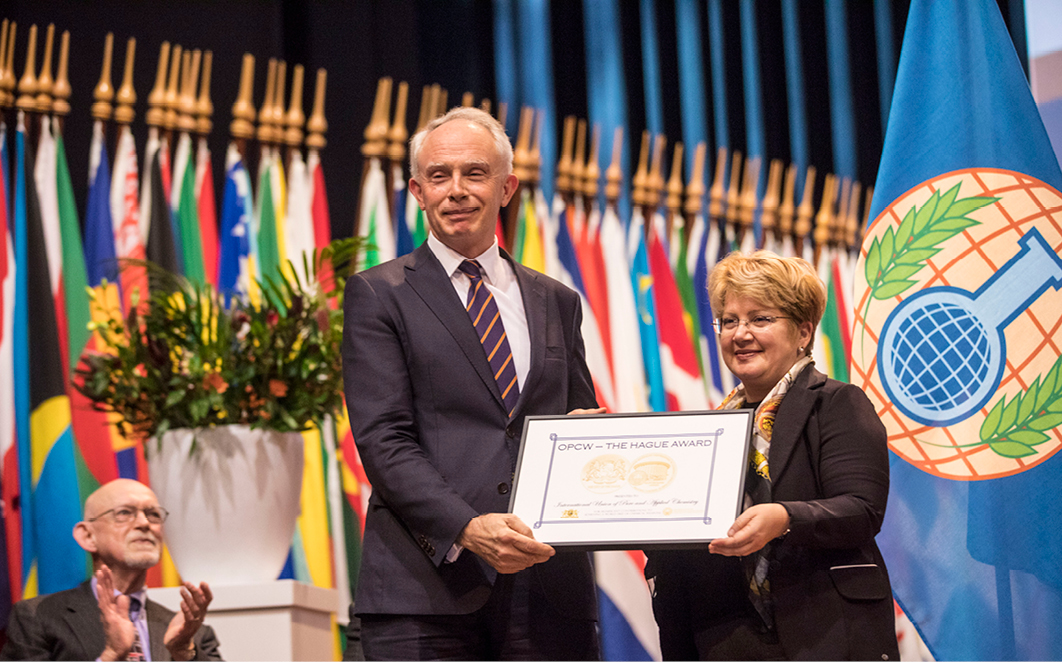
On behalf of IUPAC, Vice President Christopher Brett (left), accepts the 2019 OPCW-The Hague award from Romanian Ambassador to OPCW Brândușa Predescu, Vice Chairperson of the Executive Council.
Learn More
For a recent account of IUPAC’s commitment to supporting the norms of disarmament, see this IUPAC100 story by J. Forman and M. Cesa; https://iupac.org/100/stories/a-partnership-of-science-and-diplomacy-to-eliminate-chemical-weapons/
See also project ‘Building broader and deeper links between OPCW and IUPAC‘; https://iupac.org/project/2018-022-3-020.
https://iupac.org/iupac-is-one-of-the-recipients-of-the-2019-opcw-the-hague-award/
©2020 IUPAC & De Gruyter. This work is licensed under a Creative Commons Attribution-NonCommercial-NoDerivatives 4.0 International License. For more information, please visit: http://creativecommons.org/licenses/by-nc-nd/4.0/
Articles in the same Issue
- Masthead - Full issue pdf
- President's Column
- All on the Same Team
- Features
- Elements of Sports: From IYPT 2019 to Tokyo 20201
- Anti-doping: Two Scientists’ Points of View
- Pure and Applied Chemistry Special Topic Series
- A Global Discourse on the Future of Chemistry
- The Inaugural IYCN General Assembly
- From Young Attendees to Young Actors: The “Young Chemists Symposium” at IUPAC2019
- The IUPAC100 Global Women’s Breakfast Empowering Women in Chemistry
- IUPAC Wire
- IUPAC recognized by OPCW
- Chemical Weapons Convention Amended
- IUPAC-SOLVAY International Award for Young Chemists—Call for Nominations
- BIPM and IUPAC formalize a long-standing cooperation
- Grand Prix de la Fondation de la Maison de la Chimie—Call for Nominations
- DSM Bright Science Award 2020 in materials sciences—Call for Nominations
- 2020— International Year of Plant Health
- Project Place
- Impact of Objective Analysis of Clinical Trial Failures on Drug Discovery and Development Processes
- Basic Classification and Definitions of Polymerization Reactions
- Henry’s Law constants
- Experimental methods and data evaluation procedures for the determination of radical copolymerization reactivity ratios
- Enhanced recognition and encoding of stereoconfiguration by InChI tools
- Nomenclature and associated terminology for inorganic nanoscale particles
- IUPAC Provisional Recommendations
- Making an imPACt
- An inter-comparison of isotopic composition of neon via chemical assays and thermal analyses (IUPAC Technical Report)
- Definition of the chalcogen bond (IUPAC Recommendations 2019)
- Critically evaluated propagation rate coefficients for radical polymerizations: acrylates and vinyl acetate in bulk (IUPAC Technical Report)
- Experiments on adsorption at hydrous metal oxide surfaces using attenuated total reflection infrared spectroscopy (ATRIRS) (IUPAC Technical Report)
- Chemistry Teacher International, Best Practices in Chemistry Education
- Conference Call
- Spectroscopy and new horizons
- Solution Chemistry in Action!
- Flying Chemistry Educator Program in Ulang Bataar, Mongolia
- Innovative Chemistry for Environmental Enhancement
- Caribbean Celebrations
- Where 2B & Y
- Mark Your Calendar
Articles in the same Issue
- Masthead - Full issue pdf
- President's Column
- All on the Same Team
- Features
- Elements of Sports: From IYPT 2019 to Tokyo 20201
- Anti-doping: Two Scientists’ Points of View
- Pure and Applied Chemistry Special Topic Series
- A Global Discourse on the Future of Chemistry
- The Inaugural IYCN General Assembly
- From Young Attendees to Young Actors: The “Young Chemists Symposium” at IUPAC2019
- The IUPAC100 Global Women’s Breakfast Empowering Women in Chemistry
- IUPAC Wire
- IUPAC recognized by OPCW
- Chemical Weapons Convention Amended
- IUPAC-SOLVAY International Award for Young Chemists—Call for Nominations
- BIPM and IUPAC formalize a long-standing cooperation
- Grand Prix de la Fondation de la Maison de la Chimie—Call for Nominations
- DSM Bright Science Award 2020 in materials sciences—Call for Nominations
- 2020— International Year of Plant Health
- Project Place
- Impact of Objective Analysis of Clinical Trial Failures on Drug Discovery and Development Processes
- Basic Classification and Definitions of Polymerization Reactions
- Henry’s Law constants
- Experimental methods and data evaluation procedures for the determination of radical copolymerization reactivity ratios
- Enhanced recognition and encoding of stereoconfiguration by InChI tools
- Nomenclature and associated terminology for inorganic nanoscale particles
- IUPAC Provisional Recommendations
- Making an imPACt
- An inter-comparison of isotopic composition of neon via chemical assays and thermal analyses (IUPAC Technical Report)
- Definition of the chalcogen bond (IUPAC Recommendations 2019)
- Critically evaluated propagation rate coefficients for radical polymerizations: acrylates and vinyl acetate in bulk (IUPAC Technical Report)
- Experiments on adsorption at hydrous metal oxide surfaces using attenuated total reflection infrared spectroscopy (ATRIRS) (IUPAC Technical Report)
- Chemistry Teacher International, Best Practices in Chemistry Education
- Conference Call
- Spectroscopy and new horizons
- Solution Chemistry in Action!
- Flying Chemistry Educator Program in Ulang Bataar, Mongolia
- Innovative Chemistry for Environmental Enhancement
- Caribbean Celebrations
- Where 2B & Y
- Mark Your Calendar
