Elements of Education
-
Peter Atkins
Peter Atkins <
peter.atkins001@btinternet.com > was an Oxford professor of chemistry and fellow of Lincoln College until his retirement in 2007. He has written more than 70 books, the best-known of which is Physical Chemistry. His other major textbooks include Inorganic Chemistry, Molecular Quantum Mechanics, Physical Chemistry for the Life Sciences, and Elements of Physical Chemistry. He chaired the IUPAC Committee on Chemistry Education from 2001 to 2005.

Abstract
The periodic table was born in chemical education and thrives there still. Mendeleev was inspired to create his primitive but pregnant table in order to provide a framework for the textbook of chemistry that he was planning, and it has remained at the heart of chemical education ever since. It could be argued that the education of a chemist would be almost impossible without the table; at least, chemistry would remain a disorganized heap of disconnected facts. Thanks to Mendeleev and his successors, by virtue of the periodic table, chemical education became a rational discussion of the properties and transformations of matter. I suspect that the educational role of the periodic table is its most important role, for few research chemists begin their day (I suspect) by gazing at the table and hoping for inspiration, but just about every chemistry educator uses it as a pivot for their presentation.
In this article I shall step back from our modern perspective, and consider the periodic table in a broader context. I shall also avoid trying to give the impression that I am crafting a micro-textbook of inorganic chemistry as I explore the role of the periodic table in the education of a chemist. Instead I shall aim to pick out some of its more general features and focus on the attitudes about science that it inspires.
First, let me take you back to the early nineteenth century, when only a sprinkling of elements were known and in some sense were also known to be elemental. From that early viewpoint, I think it must have been almost impossible to envisage that there were relations between the elements, and that they were not merely a zoo of disconnected material entities. The supreme achievement of the periodic table is that it showed that the elements were not just a scattering of whimsically created entities, but were deeply and significantly related to one another. I think that someone from the distant past would be astonished to learn that matter was not a collection of islands but more an integrated continent of related entities. Indeed, poor John Newlands was laughed to scorn for his proposal that matter was constituted in musical octaves; but we now know that he was on the right track. The first element of education that the periodic table inspires is therefore that there is an underlying rationality in the fabric of the world. Such an attitude, that of an underlying rationality, pervades all science and should be at the forefront of our strategies of education.
The second feature of the periodic table worth emphasizing, but it hardly needs saying, is the importance of grouping the elements in the pattern the table portrays. Much of science begins with the identification of patterns, and the periodic table illustrates this procedure to perfection. The recognition of patterns is not just the embryo of scientific investigation but is the key to successful education, for it reduces the need for rote memory and facilitates comprehension.
Science, though, is empty-minded if it does not provide an understanding of the patterns it has identified. Charles Darwin’s recognition of the pattern of evolution and his formulation of an understanding of it in terms of natural selection is a supreme example of this procedure in biology. The primitive recognition of the eightfold way formulation of a pattern of fundamental particles is an example from fundamental particle physics. The supreme example in chemistry is of course the periodic table itself and its understanding in terms of the electronic structures of the atoms of the elements. Here the central lesson of the table is that it illustrates the interface between inorganic and physical chemistry, the latter providing an explanation of its form and the former providing an unparalleled illustration of its applications.
Even more broadly is the recognition that each division of science identifies its appropriate level of discourse. The eightfold way of physics is at one level; the recognition of species is the appropriate level of discourse in much of biology; and the periodic table reflects the fact that for chemists, the chemical elements, far from being actually elemental, are the appropriate entities for the discussion of much of chemistry. Now the lesson is that it is essential in science to select appropriate entities and to accept that they are functionally elemental for the level of discourse intended.
Inorganic chemistry is (to a physical chemist’s eye, and probably to an inorganic chemists eye too) an extraordinarily difficult subject to teach, even with the help of the periodic table, for the table represents not only the systematics of the relation between the elements but also the subtle differences in their personalities. Those personalities demand a different mode of discussion in different regions of the table, with thermodynamic attributes dominant in some regions and structural and perhaps kinetic considerations dominant elsewhere. It is difficult for the student to identify the appropriate mode. Here the existence of the periodic table and the subtlety of the variation of the properties of the elements demands judgement about how to describe and explain, and that in turn entails instilling a flexibility of attitude and a willingness to adapt. In its unconscious (I think unconscious) way, the very existence of inorganic chemistry and its basis in the periodic table encourages flexibility of mind. Students of inorganic chemistry might not always think that that flexibility is what they are acquiring, but acquiring it they are.
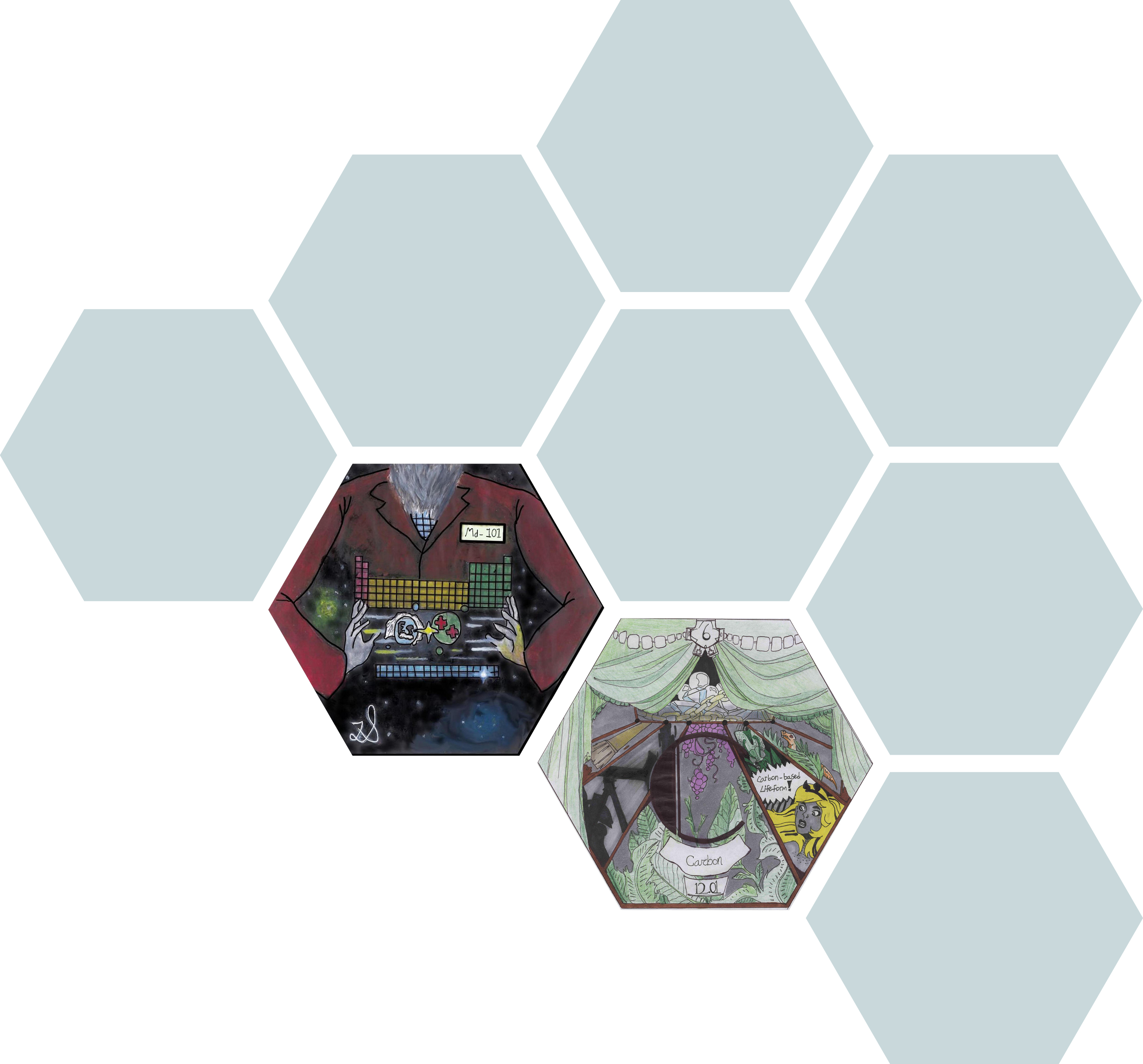
Md, mendelevium, 101—Westwood Community High School—Fort McMurray, Alberta, Canada—Teacher: Lori Simpson—Artist: Farah Sadek
C, carbon, 6—ATEMS (Academy of Technology, Engineering, Math, and Science) and ACT2 (Associated Chemistry Teachers of Texas)—Abilene, Texas, USA Teacher: Julee Isenhower—Artist: Layla Ingram-Alger
Superficial difficulties of teaching inorganic chemistry, softened and ameliorated by the periodic table, also result in yet another unconscious facilitation of learning and underlie what I think is an important outcome of the education of a chemist: students of chemistry become equipped to be non-chemists. Far from being an admission of failure in our system of education, I regard it as an extraordinary strength and a serious contribution to the economy of a country (and thereby the world at large). I have in mind that in commerce there are few clear-cut solutions. Successful commerce is largely the consequence of taking decisions in a milieu of conflicting influences. In the reality of commercial life, people have to identify dominant influences among many that might be in conflict, and then select the way forward. That summarizes inorganic chemistry, and the fact that a student has been trained to do something similar sets him or her up for being an ideal recruit for commerce. Perhaps the same can be said of students studying history; but the skill that chemists also have, and which is not developed much in history, is the ability to formulate and analyse conflicts quantitatively.
Organic chemistry sits rather uncomfortably in the periodic table, as its principal concern is with a single element, carbon. I wondered about the role of the periodic table in the broader educational aspects of this perhaps most useful (on account of its alliance with medicine and biology) of our branches, and have settled on mediocrity. I am not intending to denigrate organic chemistry by referring to mediocrity; far from it. I have in mind the importance of not being extreme. Carbon is the most mediocre of elements (the interesting etymology of ‘mediocrity’ is ‘half way up a mountain’), being perfectly content to bind to itself, and through being half way up the mountain of electronegativity and related properties, is able to spin out an extraordinary web of compounds. The general lesson—I am dealing only in general lessons in this article—is that when you make room for compromise rather than insisting on extremes an extraordinary universe of opportunity opens up. The element carbon lies in the middle of the all-important second period of the periodic table, and being neither too electronegative nor electropositive, and having a reasonably compliant electronic structure, is the king of mediocrity, with amazing and extraordinary consequences.
That of course leaves physical chemistry and its role in the periodic table. Given that physical chemistry provides the intellectual infrastructure of chemistry (I don’t want that to sound arrogant), our students, enthralled (ideally, but I know I am idealizing) by the fact that the periodic table summarizes so much of the universe, should be entranced by the realization that physical chemistry, particularly through the quantum theory of electronic structure, provides a rationalization of its structure. There is another lesson here, though, which is that of humility. My favourite element, from the point of view of electronic structure, is hydrogen, which well deserves its location at the apex of the table, for through our ability to solve its structure accurately, essentially without approximation, it lies at the heart of the description of the electronic structure of all the elements and therefor the subtle variation that underpins the structure of the table itself. The lesson, though, is the caution that lies in the way of reliable extrapolation. What I have in mind is the doubt I have that the periodic table could have been predicted a priori. Maybe a systematic numerical calculation of the electronic structures of all the elements (somehow disregarding the simplicity of the ordinal atomic numbers) might have resulted in the table, but the real strength of physical chemistry in this context has been displaying the importance of the interplay of empirical knowledge and computational electronic structure. That is its special role in the elements of education in this context, for that interplay emphasizes the importance in chemistry, and not just chemistry but any science, of the alliance of theory and observation. All science is a reticulation of theory and observation, each aiding and guiding the other to result in rich, detailed comprehension.
The periodic table displays other aspects of this interplay, especially through inorganic chemistry, for as I have already stressed, the interpretation of inorganic chemistry shades from structural properties in parts of the table to thermodynamic properties elsewhere, and physical chemistry of course provides the appropriate language and concepts of thermodynamics to bring life to this shading of aspects of interpretation.
The periodic table and the concept of the elements of education inspires all manner of other thoughts. One is the desert-island thought: if you were asked to identify the central elemental concept summarized by the periodic table which, with you isolated on a conceptual desert island and asked to set about rationalizing chemistry, what would it be? My choice would be atomic radius. In molecular biology a common precept is that shape determines function, with shape interpreted as including size, I think that the same maxim applies in the less elaborate region of chemistry. Atomic radius correlates with ionization energy and electron affinity, and thus it correlates with much of the energetics of bond formation. Atomic radius controls perhaps even more than simple energetics the numbers and arrangements of bonds that an element can form, and so is central to considerations of bonding and the formation and stereochemistry of compounds. Atomic radius plays a crucial role in the mechanisms of reactions, both in organic and inorganic chemistry, especially in the formation of intermediates and transition complexes. Atomic radius plays a role in the arrangement of electrons around nuclei, as well as that arrangement affecting the radius. When the elements form compounds, the sizes of the constituent atoms affect the size of the molecules and through that size (and the underlying aspects of the energetics of electron excitation, itself size-dependent) the intermolecular forces that determine the physical properties of the compounds. It is hard, in fact, to identify a property that cannot, with sufficiently deep probing, correlate in some way with atomic radius. Function, does indeed follow form and should perhaps be a fundamental element of education.

One representation of the periodic table is as a country to be visited, giving the opportunity to discuss its discovery, mapping, and its laws and administration. This is the kingdom of ionization energy.
There are so many aspects of the periodic table that inspire attitudes. One is the continuation of the table beyond Z = 118. This prospect inspires the view that chemistry (and science as a whole) is unbounded: as new elements are created (however useless they turn out to be), we have the sense that there is no limit to discovery, which itself should inspire optimism about the scientific endeavour. Then, as we reach into these distant shores of the table, we encounter the role of relativity and the prospect of the decay of periodicity. Relativity, though central to physics, now becomes central to chemistry, and we can, if so inclined, introduce our students to its ramifications at this periphery of our core interests.
The elements of education span more than the education of chemists, for they provide routes into the minds of the general public. Almost every member of the general public has encountered the periodic table; but it is often an icon of horror reminding them vaguely of their dislike of chemistry rather than an exquisite summary of a branch of knowledge. It is a challenge for us to convey its beauty and usefulness and use it to break down the psychological barrier between us and our public. I tried to do this some years ago with my little book The Periodic Kingdom, [1] in which I sought to portray the table as a country to visit, with chapters dealing with, among other topics, the discovery of the land, its mapping, and its laws and administration (Fig. 1). Others have developed that simple image into a series of stunning geophysical portrayals of the periodicity of properties. Another tack has been to devise stunning alternative visual portrayals of the table itself, universes removed from Mendeleev’s simple workaday list, although few of those beautiful re-imaginings are educationally helpful (I think). Others have spirited the table into other conceptual realms, with periodic properties of all manner of different concepts. All this is good, for it humanizes the table, keeps it in the public’s eye, and thereby brings our subject to the attention of others. All these variously motivated and imaginative entablatures have a common and admirable theme: they encourage people to identify patterns of relationships, which is the germ of science. Anything that encourages imagination should be a core aspect of the education of a chemist, because science in general is imagination in alliance with honesty.

H, hydrogen, 1—Exploits Valley Intermediate Grand Falls – Windsor, Newfoundland, Canada—Teacher: Krista Simms—Artists: Devyn Hogg, Maya Fifield, Emily Hayden, Claire Loder, Cora Hogg
Pa, protactinum, 91—Plano West Senior High School—Plano, Texas, USA—Teacher: Nicole Lyssy—Artist: Emily Ren
Perhaps there is another dimension to this survey of the elements of education. We chemists spin compounds from elements rather like authors spin sentences from words. The chemical elements are therefore like a restricted palette of words from which sentences are spun by their concatenation and reticulation. The sentences of literature are one-dimensional; our sentences are three dimensional, representing all the matter there currently is and yet to be formed. I suspect that there is little of practical use in that analogy, except that it shows the fecundity of the concepts that the actual periodic table inspires. Its anniversary certainly deserves to be celebrated for its elements, both actual and metaphorical, lie at the core of all present and future chemistry. 
The chemical elements tiles illustrating this feature are part of the IYPT Timeline of Elements project organized by Chem 13 News and the University of Waterloo in Ontario, Canada. See details and credits page 3.

About the author
Peter Atkins <peter.atkins001@btinternet.com> was an Oxford professor of chemistry and fellow of Lincoln College until his retirement in 2007. He has written more than 70 books, the best-known of which is Physical Chemistry. His other major textbooks include Inorganic Chemistry, Molecular Quantum Mechanics, Physical Chemistry for the Life Sciences, and Elements of Physical Chemistry. He chaired the IUPAC Committee on Chemistry Education from 2001 to 2005.
Reference
1. Peter Atkins, The periodic kingdom. Wiedenfeld and Nicolson (1995).Search in Google Scholar
©2019 IUPAC & De Gruyter. This work is licensed under a Creative Commons Attribution-NonCommercial-NoDerivatives 4.0 International License. For more information, please visit: http://creativecommons.org/licenses/by-nc-nd/4.0/
Articles in the same Issue
- Masthead - Full issue pdf
- Elements of IYPT2019
- Features
- Elements of X
- Elements of Credits
- Elements of Education
- Elements of Stars
- Elements of the Future
- Elements of Life at the Oxo Wall
- Elements of Technology
- Elements of Scarcity
- Elements of Flair and Fashion
- Elements of Heroism
- IUPAC Wire
- The Top Ten Emerging Technologies in Chemistry—Call for Proposals for 2020
- 2020 IUPAC-Richter Prize in Medicinal Chemistry—Call for Nominations
- Awardees of the 2019 IUPAC-Zhejiang NHU International Award for Advancements in Green Chemistry
- In Memoriam: René Dybkaer
- Project Place
- Human Health Risk Consideration on Nano-enabled Pesticides for Industry and Regulators
- Trace elements analysis of environmental samples with X-rays
- Making an imPACt
- Nomenclature and terminology for dendrimers with regular dendrons and for hyperbranched polymers (IUPAC Recommendations 2017)
- List of keywords for polymer science (IUPAC Technical Report)
- Recent advances in analysis of trace elements in environmental samples by X-ray based techniques (IUPAC Technical Report)
- Guidelines for unequivocal structural identification of compounds with biological activity of significance in food chemistry (IUPAC Technical Report)
- Polymer Networks: Structure, Properties, and Function
- The Battle for a Sustainable Food Supply
- IUPAC Provisional Recommendations
- Conference Call
- Blood-Biomaterial Interactions
- Advanced Polymers via Macromolecular Engineering
- Polymer for Sustainable Development
- Macrocyclic and Supramolecular Chemistry
- Crop Protection Chemistry
- Where 2B & Y
- Mark Your Calendar
- Index 2019
- Stamps International
- IYPT and The Mother of All Tables
Articles in the same Issue
- Masthead - Full issue pdf
- Elements of IYPT2019
- Features
- Elements of X
- Elements of Credits
- Elements of Education
- Elements of Stars
- Elements of the Future
- Elements of Life at the Oxo Wall
- Elements of Technology
- Elements of Scarcity
- Elements of Flair and Fashion
- Elements of Heroism
- IUPAC Wire
- The Top Ten Emerging Technologies in Chemistry—Call for Proposals for 2020
- 2020 IUPAC-Richter Prize in Medicinal Chemistry—Call for Nominations
- Awardees of the 2019 IUPAC-Zhejiang NHU International Award for Advancements in Green Chemistry
- In Memoriam: René Dybkaer
- Project Place
- Human Health Risk Consideration on Nano-enabled Pesticides for Industry and Regulators
- Trace elements analysis of environmental samples with X-rays
- Making an imPACt
- Nomenclature and terminology for dendrimers with regular dendrons and for hyperbranched polymers (IUPAC Recommendations 2017)
- List of keywords for polymer science (IUPAC Technical Report)
- Recent advances in analysis of trace elements in environmental samples by X-ray based techniques (IUPAC Technical Report)
- Guidelines for unequivocal structural identification of compounds with biological activity of significance in food chemistry (IUPAC Technical Report)
- Polymer Networks: Structure, Properties, and Function
- The Battle for a Sustainable Food Supply
- IUPAC Provisional Recommendations
- Conference Call
- Blood-Biomaterial Interactions
- Advanced Polymers via Macromolecular Engineering
- Polymer for Sustainable Development
- Macrocyclic and Supramolecular Chemistry
- Crop Protection Chemistry
- Where 2B & Y
- Mark Your Calendar
- Index 2019
- Stamps International
- IYPT and The Mother of All Tables
