Ionized calcium in serum exposed to air
-

 and
and

To the Editor,
One of the preanalytical errors that has received a lot of attention when it comes to ionized calcium (iCa2+) is air exposure. When exposing a sample to air, the partial pressure of CO2 will decrease [1]. This will cause the pH to increase, which increases albumin’s affinity for iCa2+, decreasing the concentration of iCa2+ [2]. As the partial pressure of CO2 decreases in the blood, carbonic anhydrase will convert HC03− + H+ into CO2 and H2O, allowing even more CO2 to escape and further increasing the pH of the sample [1]. Air exposure can potentially occur for two different reasons: air already present in the collection tube and when uncapping the sample. For this reason, the draw volume has to be adequate to ensure the intended ratio of blood to air in the sample from the start.
With advances within the field of robotics, it has become easier to half-automate analysis on instruments that are intended for human users. These robots are often not equipped with critical thinking and may sometimes fail to analyze individual samples. This means that certain samples may have been uncapped and then recapped without obtaining a result. If this issue is identified promptly, can the samples still be analyzed?
The aim of this study was therefore to investigate how the measured level of iCa2+ in serum samples is affected by air exposure near the time of analysis.
Specimens were selected from routine iCa2+ samples sent to Linköping University Hospital between the dates: 2024-01-29 and 2024-01-31. Sixty serum specimens were included in the study. Serum samples were collected in vacutainer tubes with a silica coagulation activator and without a gel separator, BD Vacutainer CAT 5/4 mL (Becton Dickinson, Franklin Lakes, NJ, USA). To qualify for inclusion, the sample first had to meet the standard local criteria for measurement of iCa2+. These criteria include the following: well-filled vial, never uncapped, and stored at 2–8 °C unless measurement can be done within 4 h from sampling. Additionally, visually hemolyzed samples (fHb ≳0.5 g/L) were avoided. All samples were centrifuged for 10 min at 2500×g.
After patient results had been reported and the specimen was destined for disposal, each sample was anonymized before any additional measurements were made. The study was conducted in accordance with the revised declaration of Helsinki from 2013. According to the guidelines of the regional ethics review board, no ethical permit is required for research on discarded blood samples where no traceable personal data remains.
Ionized calcium was measured with the ABL800 Flex instrument (Radiometer, Copenhagen, Denmark). The same instrument was used for all measurements. In addition to iCa2+, the pH of the sample was also determined during each measurement. QC-measurements on the instrument during January and February 2024 showed a CV for iCa2+ <0.5 %.
All statistical analysis was done with the aid of Excel (Microsoft, Redmond, WA, USA) and SPSS (IBM, Armonk, NY, USA). Normal distribution of data was investigated using the Kolmogorov-Smirnov test. ANOVA and Dunnett’s test for multiple comparisons was used to test if differences over time were significant. The correlation of a change in pH and a change in iCa2+ was determined using Pearson’s correlation coefficient. An alpha value of 0.05 was regarded as significant.
The median time to analysis was 4.46 h (range: 0.92–23.60 h) and the average initial value of iCa2+ in all samples was 1.23 mmol/L (range: 1.01–1.40 mmol/L). All iCa2+, pH-values, and differences compared to original values were normally distributed. Initial iCa2+ values and the difference to the new measurement can be seen in Table 1.
Average change of ionized calcium (iCa2+) in serum samples without separator gel exposed to air.
| Air exposure and, time to new measurement | Initial iCa2+, mmol/L | New measurement | Average iCa2+ change | Range of discrepancy | n |
|---|---|---|---|---|---|
| 1 min, after 1 h | 1.22 (±0.06) | 1.20 (±0.06) | −1.5 % (±0.8 %)a | −0.03 to +0.01 | 20 |
| 1 min, after 4 h | 1.23 (±0.07) | 1.21 (±0.07) | −1.8 % (±1.2 %)a | −0.05 to +0.01 | 20 |
| Continuously, 15 min | 1.24 (±0.08) | 1.21 (±0.08) | −2.2 % (±0.8 %)a | −0.04 to −0.01 | 20 |
| Continuously, 30 min | 1.24 (±0.08) | 1.18 (±0.08) | −4.4 % (±1.4 %)a | −0.10 to −0.03 | 20 |
| Continuously, 60 min | 1.24 (±0.08) | 1.16 (±0.08) | −6.2 % (±2.2 %)a | −0.13 to −0.03 | 20 |
| Continuously, 120 min | 1.27 (±0.07) | 1.12 (±0.06) | −11.3 % (±2.0 %)a | −0.20 to −0.09 | 12 |
| Continuously, 180 min | 1.27 (±0.07) | 1.06 (±0.07) | −16.0 % (±2.6 %)a | −0.25 to −0.14 | 12 |
| Continuously, 240 min | 1.27 (±0.07) | 1.03 (±0.06) | −18.4 % (±2.7 %)a | −0.28 to −0.16 | 12 |
-
All values are expressed in mmol/L. A total of 60 samples were used for the measurements. For 40 of these, air exposure lasted for 1 min and a new measurement was done after 1 or 4 h. The remaining samples were continuously exposed to air and additional measurements were done up to 4 h after the initial measurement. The iCa2+ values are expressed as mean (±SD). The range of individual discrepancies from the initial iCa2+ is also shown. aSignificantly different compared to the initial iCa2+ value (p<0.0001).
In addition to iCa2+, pH was also measured. For the recapped samples, the initial pH was 7.35 (SD: ±0.04) and it significantly (p<0.0001) increased to 7.40 (SD: ±0.04) after 1 h. For the samples that were reanalyzed after 4 h, the initial pH was 7.37 (SD: ±0.03), which then increased significantly (p<0.0001) to 7.43 (SD: ±0.03). In comparison, the samples that were never capped again showed a dramatic (p<0.0001) increase in pH from 7.35 (SD: ±0.06) to 7.82 (SD: ±0.07) after 4 h of continuous exposure to air. Change in pH and change in iCa2+ were inversely correlated (Figure 1) and showed a strong relationship with an R2-value of 0.89.
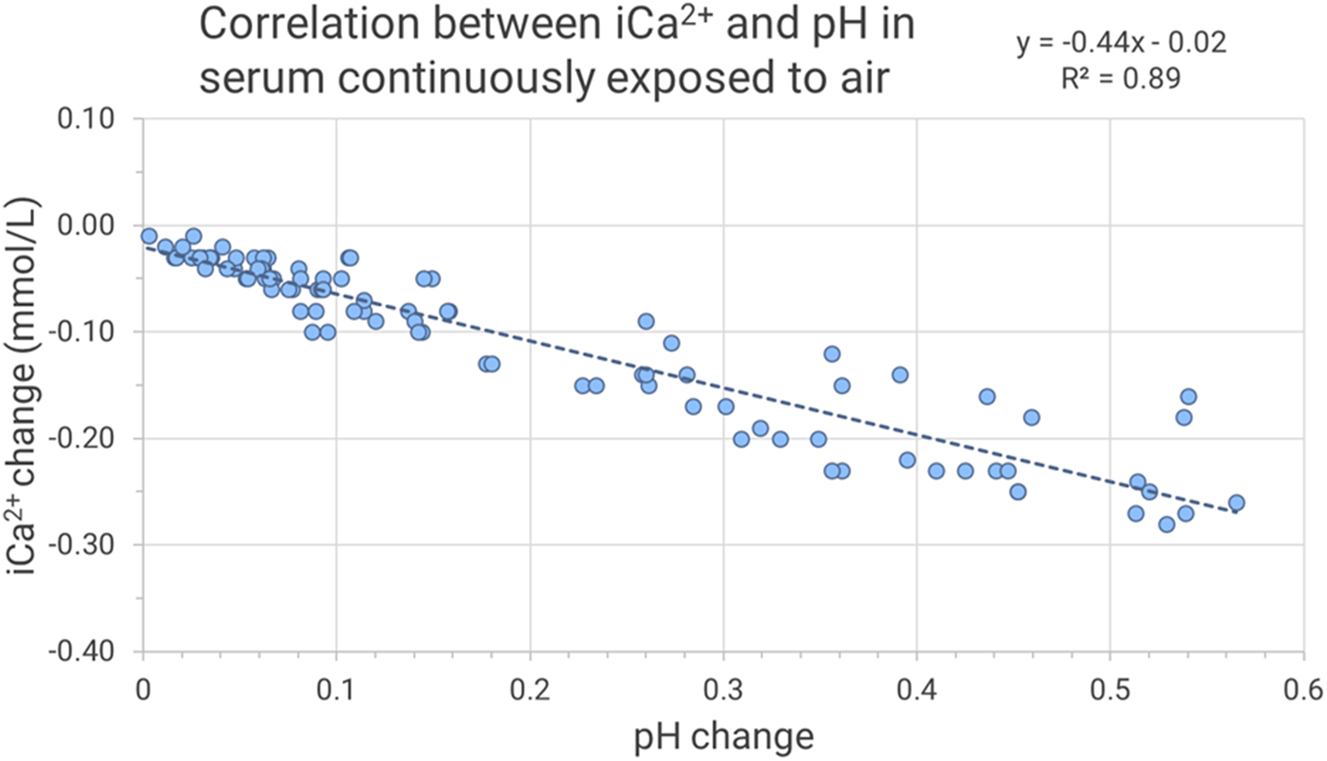
Correlation using Pearson’s correlation coefficient between change in pH and change in ionized calcium (iCa2+) in 20 serum samples without separator gel continuously exposed to air. Change in iCa2+ from the initial measurement is shown on the y-axis and the change in pH on the x-axis. The same 20 samples were measured again three times during the first 60 min, and 12 of these samples had additional measurements done at 120, 180, and 240 min, generating a total of 96 data points. A strong correlation could be seen between the change in pH and iCa2+.
Our findings are similar to what has been previously reported [3], [4], [5], [6], [7]. There however seems to be an entrenched belief that air exposure may have a significant effect on iCa2+. Several studies have indeed shown large effects on the measured level of iCa2+ when pH is altered by artificial means such as adding acid or base, or by controlling the concentration of CO2 [3], [4], [5], [6]. However, these studies never actually investigated how fast pH change occurs when serum, plasma, or whole blood is exposed to air. Nonetheless, these results have been used as the rationale behind the perceived lability of iCa2+ when exposed to air, prompting many laboratories to discard samples if not analyzed right away after uncapping.
The findings in this study suggest that a brief duration of air exposure has a very limited effect on pH and in turn the level of iCa2+. This however only applies to well-filled tubes, as incompletely filled samples may be more sensitive to air exposure. Our data also suggest that there is a slight delay before the pH change from the air exposure occurs. This likely explains why the pH increase in samples exposed to air for only 1 min and measured after 1 or 4 h was larger, 0.06 pH, than for samples exposed to air for 15 min and measured directly, 0.03 pH (p<0.0001).
There are several limitations in this study. Convenience sampling was used and as such, there was no true randomization of the samples selected for inclusion. Another limitation is that we did not investigate the effect of air exposure on plasma and whole blood samples or if serum vials with gel separators are less sensitive to air exposure than those without. There was also no clinical information available, which means that we do not know anything about any underlying conditions or how the small differences identified might have affected clinical interpretation of the value.
While it is important to minimize errors in sampling handling, it is also important to minimize the number of samples that are needlessly discarded. Although our findings add to the knowledge of this subject, there is still a further need to investigate the effects of air exposure in serum and plasma, with and without gel separator, and in whole blood. Additional knowledge could help facilitate automated solutions for iCa2+ without the need for cap penetration. An acceptable solution, for example, could be to uncap serum samples a few minutes before analysis in an ISE-module with a calcium ion selective electrode. The limited air exposure in such a scenario would only have a minimal impact on the measured level of iCa2+.
Air exposure for 1 min causes minimal changes in both iCa2+ (−1.6 %) and pH (from 7.35 to 7.40) if a new measurement is done within 4 h. Continuous exposure to air for 15 min followed by immediate measurement showed a similar decrease in levels of iCa2+ (2.2 %) and an increase in pH (from 7.35 to 7.38). Based on these findings, we recommend that serum samples should not be discarded when exposed to air for a duration of <15 min.
Acknowledgments
We would like to extend our gratitude to Mohamed Elsayed for making all the measurements included in this study. We could not have done it without you.
-
Research ethics: Not applicable.
-
Informed consent: Not applicable.
-
Author contributions: All authors have accepted responsibility for the entire content of this manuscript and approved its submission.
-
Use of Large Language Models, AI and Machine Learning Tools: None declared.
-
Conflict of interest: The authors state no conflict of interest.
-
Research funding: None declared.
-
Data availability: Data available in Supplementary Materials.
References
1. Boron, WF. Evaluating the role of carbonic anhydrases in the transport of HCO3--related species. Biochim Biophys Acta 2010;1804:410–21. https://doi.org/10.1016/j.bbapap.2009.10.021.Search in Google Scholar PubMed PubMed Central
2. Baird, GS. Ionized calcium. Clin Chim Acta 2011;412:696–701. https://doi.org/10.1016/j.cca.2011.01.004.Search in Google Scholar PubMed
3. Fogh-Andersen, N. Ionized calcium analyzer with a built-in pH correction. Clin Chem 1981;27:1264–7. https://doi.org/10.1093/clinchem/27.7.1264.Search in Google Scholar
4. Wybenga, DR, Ibbott, FA, Cannon, DC. Determination of ionized calcium in serum that has been exposed to air. Clin Chem 1976;22:1009–11. https://doi.org/10.1093/clinchem/22.7.1009.Search in Google Scholar
5. Wang, S, McDonnell, EH, Sedor, FA, Toffaletti, JG. pH effects on measurements of ionized calcium and ionized magnesium in blood. Arch Pathol Lab Med 2002;126:947–50. https://doi.org/10.5858/2002-126-0947-peomoi.Search in Google Scholar PubMed
6. Moore, EW. Ionized calcium in normal serum, ultrafiltrates, and whole blood determined by ion-exchange electrodes. J Clin Investig 1970;49:318–34. https://doi.org/10.1172/jci106241.Search in Google Scholar
7. Kirschbaum, B. Loss of carbon dioxide from serum samples exposed to air. Effect on blood gas parameters and strong ions. Clin Chim Acta 2003;334:241–4. https://doi.org/10.1016/s0009-8981(03)00242-0.Search in Google Scholar PubMed
Supplementary Material
This article contains supplementary material (https://doi.org/10.1515/cclm-2025-1183).
© 2025 the author(s), published by De Gruyter, Berlin/Boston
This work is licensed under the Creative Commons Attribution 4.0 International License.
Articles in the same Issue
- Frontmatter
- Editorials
- Counting cells is not enough: toward a global vision for quality and training in hematology
- Multi-cancer early detection revisited: insights and lessons from the PATHFINDER 2 study
- Review
- Automated reticulocyte counting: advances, standardization challenges, and clinical accessibility
- Opinion Papers
- Expert opinion within the context of the targeted evaluation of Regulation (EU) 2017/746 on in vitro diagnostic medical devices pursuant to Article 111 and Regulation (EU) 2024/1860
- Value is equal to outcome/costs: how to apply to laboratory medicine
- Does patient-based data monitoring allow us to reconsider the relationship between IQC and EQA?
- Genetics and Molecular Diagnostics
- Predictive genomic medicine enlarges the spectrum of predisposing mutations for head and neck cancers via a panel of 56 genes selected for human neoplasia in Southern Italy: a pilot study
- Failure Mode and Effects Analysis (FMEA) integrating quality indicators for risk assessment of the total testing process in human papillomavirus genotyping testing: a proactive risk analysis model for molecular diagnostics
- Impact of pneumatic tube system transport and blood collection tubes on cell-free DNA analysis of plasma samples
- General Clinical Chemistry and Laboratory Medicine
- Requiem for the Passing–Bablok nonparametric regression in assessing the agreement between two measurement methods
- Comparative analysis of ISO 15189:2022 with earlier versions with reference to ethics
- Estimated waste generation from 1 million basic metabolic panels: a multisite U.S. study
- Performance of GFAP and UCH-L1 compared to S100B in detecting intracranial injury: influence of age, hemolysis, neurodegenerative diseases, and extracranial fractures in a prospective cohort of over 1,000 patients
- Post-analytical practices in clinical mass spectrometry laboratories: an international survey across 57 countries
- Towards harmonization of autoantibody detection in relation to paraneoplastic neurological syndromes (PNS): a European Survey on laboratory practices
- Staining and serological characteristics of the AC-30 pattern in HEp-2 IIFA: a comparative study with AC-2 pattern
- Measuring neurofilament light in human plasma and cerebrospinal fluid: a comparison of five analytical immunoassays
- ADORE: the performance characteristics of five automated platforms in the analysis of urinary dysmorphic erythrocytes and pathological casts
- Influence of remnant cholesterol on direct LDL and HDL cholesterol measurement accuracy
- Dental amalgams and blood mercury concentrations in American adults
- Reference Values and Biological Variations
- Establishing reference intervals for high-sensitivity cardiac troponin T in neonates and infants
- Serum neuron-specific enolase – reference interval in Danish children and the impact of preanalytical factors
- Performance evaluation of quantitative hemoglobin A2 and fetal hemoglobin testing using commercially lyophilized vs. in-house whole blood controls in Chinese clinical laboratories: a 12-year analysis of National External Quality Assessment Data
- Hematology and Coagulation
- EQALM recommendations for the analytical performance specifications for blood smear interpretation in hematology: a need for standardization
- Cancer Diagnostics
- Flow cytometry, cytology and histology in the diagnosis of ocular hematologic neoplasms: a 15-year monocentric experience with a focus on ocular lymphomas
- Cardiovascular Diseases
- Comparison of the cardiac troponin I-cardiac troponin T-troponin C complex and cardiac troponin I and T in distinguishing myocardial infarction using a single sample at presentation
- Letters to the Editor
- Critical appraisal of presepsin for diagnosing late-onset sepsis in critically ill neonates
- Beyond cut-offs: optimizing presepsin for neonatal late-onset sepsis
- Pleural effusion with a thyroid signature: diagnostic utility of pleural fluid thyroglobulin
- Early autoimmune signature in a young woman: palmar erythema, capillaroscopic abnormalities, and triple autoantibody positivity including anti-nucleosome
- Confirmation of the value of the labile HbA1c/HbA1c-ratio in the presence of a Hb J-Baltimore variant: a clinical case
- Adverse analytical finding with trimetazidine after ingesting contaminated melatonin tablets sold in pharmacies… leading to the suspension of the athlete
- Ionized calcium in serum exposed to air
- Congress Abstracts
- Annual meeting of the Royal Belgian Society of Laboratory Medicine (RBSLM): “Beyond the Surface – Clinical biology of the apparently healthy individual”
Articles in the same Issue
- Frontmatter
- Editorials
- Counting cells is not enough: toward a global vision for quality and training in hematology
- Multi-cancer early detection revisited: insights and lessons from the PATHFINDER 2 study
- Review
- Automated reticulocyte counting: advances, standardization challenges, and clinical accessibility
- Opinion Papers
- Expert opinion within the context of the targeted evaluation of Regulation (EU) 2017/746 on in vitro diagnostic medical devices pursuant to Article 111 and Regulation (EU) 2024/1860
- Value is equal to outcome/costs: how to apply to laboratory medicine
- Does patient-based data monitoring allow us to reconsider the relationship between IQC and EQA?
- Genetics and Molecular Diagnostics
- Predictive genomic medicine enlarges the spectrum of predisposing mutations for head and neck cancers via a panel of 56 genes selected for human neoplasia in Southern Italy: a pilot study
- Failure Mode and Effects Analysis (FMEA) integrating quality indicators for risk assessment of the total testing process in human papillomavirus genotyping testing: a proactive risk analysis model for molecular diagnostics
- Impact of pneumatic tube system transport and blood collection tubes on cell-free DNA analysis of plasma samples
- General Clinical Chemistry and Laboratory Medicine
- Requiem for the Passing–Bablok nonparametric regression in assessing the agreement between two measurement methods
- Comparative analysis of ISO 15189:2022 with earlier versions with reference to ethics
- Estimated waste generation from 1 million basic metabolic panels: a multisite U.S. study
- Performance of GFAP and UCH-L1 compared to S100B in detecting intracranial injury: influence of age, hemolysis, neurodegenerative diseases, and extracranial fractures in a prospective cohort of over 1,000 patients
- Post-analytical practices in clinical mass spectrometry laboratories: an international survey across 57 countries
- Towards harmonization of autoantibody detection in relation to paraneoplastic neurological syndromes (PNS): a European Survey on laboratory practices
- Staining and serological characteristics of the AC-30 pattern in HEp-2 IIFA: a comparative study with AC-2 pattern
- Measuring neurofilament light in human plasma and cerebrospinal fluid: a comparison of five analytical immunoassays
- ADORE: the performance characteristics of five automated platforms in the analysis of urinary dysmorphic erythrocytes and pathological casts
- Influence of remnant cholesterol on direct LDL and HDL cholesterol measurement accuracy
- Dental amalgams and blood mercury concentrations in American adults
- Reference Values and Biological Variations
- Establishing reference intervals for high-sensitivity cardiac troponin T in neonates and infants
- Serum neuron-specific enolase – reference interval in Danish children and the impact of preanalytical factors
- Performance evaluation of quantitative hemoglobin A2 and fetal hemoglobin testing using commercially lyophilized vs. in-house whole blood controls in Chinese clinical laboratories: a 12-year analysis of National External Quality Assessment Data
- Hematology and Coagulation
- EQALM recommendations for the analytical performance specifications for blood smear interpretation in hematology: a need for standardization
- Cancer Diagnostics
- Flow cytometry, cytology and histology in the diagnosis of ocular hematologic neoplasms: a 15-year monocentric experience with a focus on ocular lymphomas
- Cardiovascular Diseases
- Comparison of the cardiac troponin I-cardiac troponin T-troponin C complex and cardiac troponin I and T in distinguishing myocardial infarction using a single sample at presentation
- Letters to the Editor
- Critical appraisal of presepsin for diagnosing late-onset sepsis in critically ill neonates
- Beyond cut-offs: optimizing presepsin for neonatal late-onset sepsis
- Pleural effusion with a thyroid signature: diagnostic utility of pleural fluid thyroglobulin
- Early autoimmune signature in a young woman: palmar erythema, capillaroscopic abnormalities, and triple autoantibody positivity including anti-nucleosome
- Confirmation of the value of the labile HbA1c/HbA1c-ratio in the presence of a Hb J-Baltimore variant: a clinical case
- Adverse analytical finding with trimetazidine after ingesting contaminated melatonin tablets sold in pharmacies… leading to the suspension of the athlete
- Ionized calcium in serum exposed to air
- Congress Abstracts
- Annual meeting of the Royal Belgian Society of Laboratory Medicine (RBSLM): “Beyond the Surface – Clinical biology of the apparently healthy individual”
