Learners’ views of (non)native speaker status, accent, and identity: an English as an international language perspective
-
Seyyed Hatam Tamimi Sa’d

ABSTRACT
The study examines perceptions of nonnative speakers (NNSs) of English toward accented speech and its relation with identity from the perspective of English as an international language (EIL). The data were collected from 51 Iranian EFL learners by means of questionnaires and interviews. The findings revealed the participants’ considerable uncertainty concerning the relationship between accent and socioeconomic and educational status as well as their reluctance to display their L1 identity through L1-accented speech. Furthermore, the results indicated that the participants are highly appreciative of NS accent, hold negative stereotypes of NNS accents and judge NNSs unfavorably. They exhibited a marked tendency to sound similar to NSs, regarding them as the best model of English accent to follow. The participants’ negative evaluations of NNSs’ accents of English are evidence of the dominance of Inner Circle speakers’ norms among the Expanding Circle speakers with implications for learning and teaching English as an international language.
1. Introduction
English is the most popular foreign language (FL) to learn in Iran although it does not serve as a means of communication and education in high school or tertiary levels across the country. Associated with prestige and stature, English is deemed as a means to development and progress in one’s education and career. In learning English, accent and attitudes toward it play a major role. Defined as “the pronunciation of sounds, to stress and intonation, or to the rhythm of speech” (Kachru 2011, 11), accent is perhaps the first aspect of the target language (TL) to which learners tend to pay attention. Learners also tend to construe the TL accent as an ongoing criterion upon which their language development is assessed by their peers, parents, and even teachers. Such assessment is accurately reflected in Cavallaro and Chin (2009, 143) statement, “Like it or not, we all judge others by how they speak.” A rigorous strand of research has long investigated how nonnative speakers (NNSs) view themselves and native speakers (NSs) in terms of accentedness. For instance, Kim (2008) found out that learners rate NNSs’ foreign-accented speech unfavorably regardless of their intelligibility, hence the inherent bias in their attitudes.
Contradictorily, research has also shown that when communication efficiency, as reflected in native-like unaccented pronunciation, and loyalty to one’s ethnic group affiliations conflict, learners are inclined to preserve their ethnic affiliations, thus negotiating and meeting their identity requirements (Gatbonton, Trofimovich, and Magid 2005). Researchers have therefore attempted to address the relation between identity and accentedness from a variety of aspects. According to Timmis (2002), the importance of accent and pronunciation lies in the fact that they are construed as the most fundamental aspect in which conformity to TL norms is expected from learners. In actuality, the fact that deviation from NS norms is regarded as an error is a long-standing fallacy (Jenkins 1998; MacKay 2003). Likewise, Levis (2005) posits that the role that identity plays in accent as important as that of biological factors like age and onset of learning.
The present study sets out to explore the perceptions of Iranian language learners of the relationship between identity and accent and pronunciation through the lens of the status of English as an international language (EIL), a context in which pronunciation and how a person sounds is regarded as closely related to his/her sociocultural identity (see, e.g., Sifakis and Sougari 2005). Specifically, the current research study was guided by the following research questions:
RQ #1. How do Iranian EFL learners view the significance of accent and pronunciation for communication?
RQ #2. What factors do Iranian EFL learners regard as influencing one’s accent and pronunciation?
RQ #3. How do Iranian EFL learners assess the status of native and nonnative speakers with regard to accent and pronunciation?
RQ #4. How do Iranian EFL learners view the relationship between accent and identity?
2. Review of literature
2.1. Native speakers, nonnative speakers, and circles of English
English, regarded as an international lingua franca (ELF), is the most widely taught and learned foreign language in the world. Today, English is perceived as being spoken in three types of context as reflected in Kachru’s (1985) frequently cited concentric circle model. Kachru (1985) argues that nowadays English is spoken in three “circles” in the world. In the Inner Circle which includes English-speaking countries such as the UK, the US, Canada, and Australia, English is spoken and learned as a first language (L1) or as a native language (ENL). The Outer Circle, also called the Extended Circle, includes countries such as India and Malawi where English is spoken as a second language (ESL) and is used for communicational, official, and institutional purposes. Finally, English is taught, learned, and spoken as a foreign language (EFL) in the Expanding Circle, or the Extending Circle, which includes countries like Iran, China, and Japan. Figure 1 below displays the three circles of English as outlined by Kachru (1985). It is noteworthy that a similar figure can be found in also in Kachru (2011, 27).
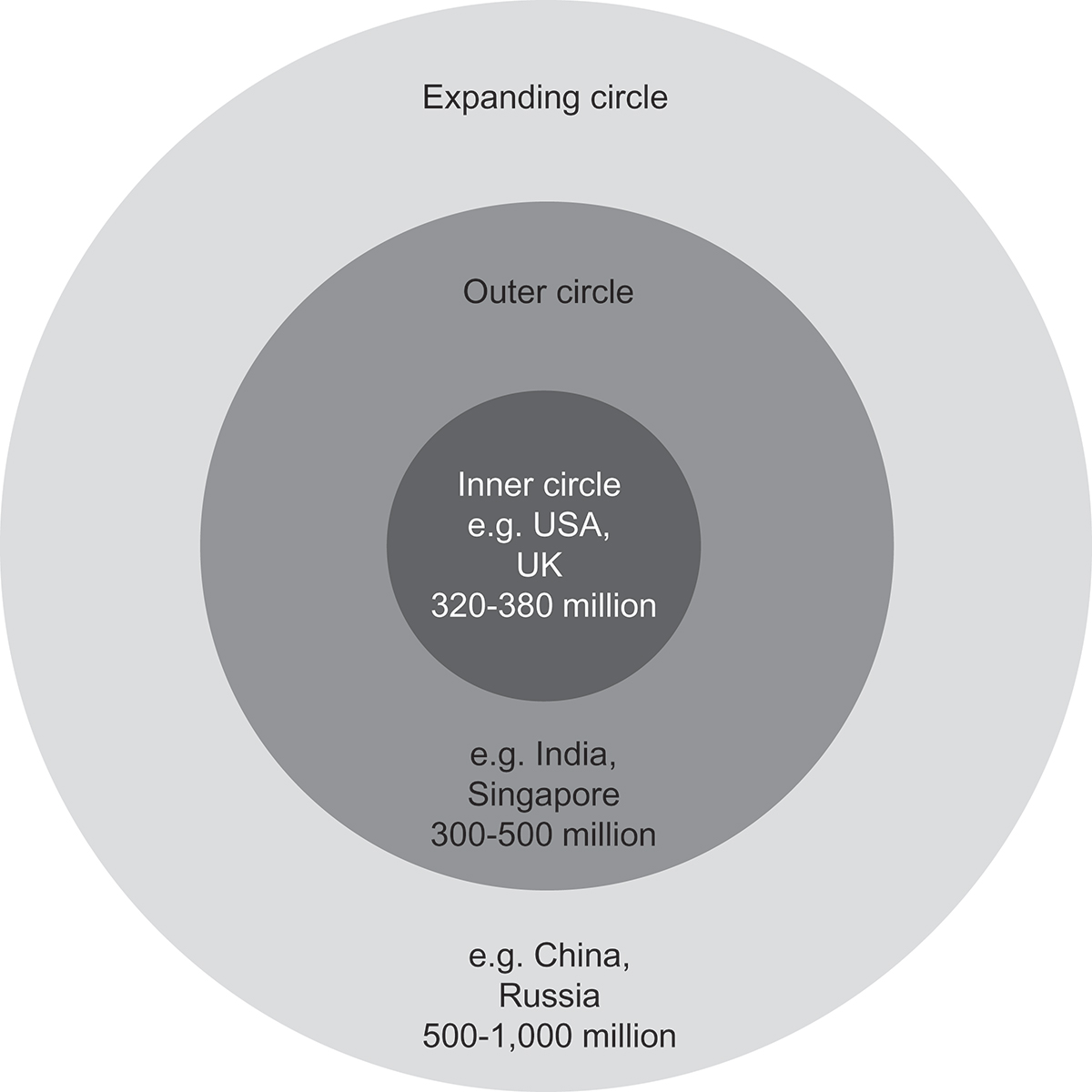
The three circles of English (Crystal 2003, 60).
As can be seen from the above figure, while the NNSs of English vastly outnumber its NSs and while, in the context of English as an international language (EIL), most communication occurs among NNSs and thus mutual intelligibility and comprehension should be given the highest priority (see Sifakis and Sougari 2005), native-like accent continues to receive the most attention in language pedagogy on the part of both teachers and learners. Similarly, Moyer (2007) took intelligibility as the departure point to discuss whether accent still assumes central importance in language learning to find out that immigrant learners of English in the US continue to have positive attitudes toward NS accents. Most recently, Carey, Sweeting, and Mannell (2015) argued that pronunciation instruction has long been strongly driven by native-speakerism (see Holliday 2005) and that almost all instructional materials aim at accent reduction, recommending that learners drop their foreign accents while speaking English. In this regard, native-speakerism is defined as “an unjustified and unfair favouritism to native speakers of English at the expense of non-native speakers” (Feyér 2012, 20).
2.2. Attitudes toward accent and identity
A rich body of scholarly literature exists on the intersection of accent and identity. Attitudes toward accent and pronunciation have received considerable research attention throughout the past few decades. Accent has been examined with regard to its relation to the negotiation of identity and participation in academic communities (Morita, 2004), learners’ ethnic group affiliations in ESL context (Gatbonton, Trofimovich, and Magid 2005), social pressure and identity negotiation (Lefkowitz and Hedgcock 2006), learners’ identity and motivation (Feyér 2012), and a wide range of other pertinent concepts and areas of research. This long and rigorous strand of research into accent and pronunciation has been mostly suggestive of learners’ positive attitudes toward NS accent(s) and unfavorable perceptions toward NNS accent (e.g., Cenoz and Lecumberri 1999; El-Dash and Busnardo, 2001; Hartshorn 2013; Kim 2008; Majanen 2008; McGee 2009; Soukup 2011; Walker and Zoghbor 2015). Kim (2008) even found out that ESL students rate foreign-accented speech negatively regardless of whether or not it was intelligible, confirming that intelligibility and foreign accent are two distinct and independent issues. On the other hand, Bresnahan et al. (2012) concluded that intelligibility has positive effects on learners’ attitudes toward NNSs’ accented speech. In addition, most research studies suggest that language learners hold negative attitudes toward nonnative English teachers, preferring native English teachers or nonnative English teachers who are native-accented (Butler 2003; Hartshorn 2013; Timmis 2002). Scales et al. (2006), for instance, examined the perspectives of 37 learners of English and 10 American native speakers on native and nonnative accents of English. The results showed a strong preference for NS accents and a remarkable correlation between the accent that was perceived by the participants to be the easiest to understand and the one that they preferred. On the other hand, the majority of the participants could not perceive the accents that they preferred to have. Scales et al. (2006) interpret this finding as the mismatch between learners’ desires and their true achievement. Negative attitudes toward nonnative-accented speech are prevalent among language teachers in addition to learners. Sifakis and Sougari (2005), for instance, found that Greek EFL teachers hold negative, stereotypic, mostly NS norm-bound, perceptions toward NNSs’ pronunciation. Likewise, Jenkins (2005) found out that nonnative English-speaking teachers (NNESTs) had grave reservations about whether or not to identify themselves as legitimate users of English. Research has revealed that, from learners’ viewpoints, accent must be regarded as a determining criterion in NNS teachers’ employability with NS accent as a positive point for teachers (Alenazi 2012). Researchers have also attempted to uncover the reasons for which learners view NNSs’ accents unfavorably. Baugh (2000) provides evidence of mockery, racism, ridicule, and discrimination against foreign-accented speakers of English who were perceived to have “funny accents.” This finding is further supported by research carried out in Inner Circle contexts such as the US where NSs have been reported to describe NNS varieties of English as “accented,” “broken,” and “little” (see Lindemann 2005). The beauty and attractiveness of NS accent have also been mentioned as a source of learners’ favorable attitudes toward it in different contexts such as Oman (Soukup 2011) and Denmark (Jarvella et al. 2001). Similarly, in a study of the attitudes of Hong Kong learners of English toward different varieties of English, Zhang (2010) found that Hong Kong English accent (HKed) was viewed with solidarity although American English was the most preferred variety. Zhang (2010) regarded such attitudes as expressing “linguistic self-hatred.” Despite the respectable stockpile of research on learners’ attitudes toward and their perceptions of accent and whether and how it relates to learner identity, this issue has not been systematically investigated in the context of Iran as an Expanding Circle context. Put differently, the study aims at giving learners a voice on the issue of accent and its relationship with identity where it is believed that learners’ voice has gone unheard (see Timmis 2002). Recently, researchers developed an interest in the possible connection of identity and pronunciation in a range of contexts. Waniek-Klimczak, Rojczyk, and Porzuczek (2015), for instance, investigated the extent to which Polish learners were willing to display their identities through their foreign accents. In another study motivated by the dearth of research into learners’ beliefs about the qualities of pronunciation teachers, Levis (2017) posited that while students’ beliefs were more inclined toward NEST teachers as better fitting pronunciation classes, their beliefs could be modified by stressing “professionalism as key to effective pronunciation teaching.”
More specifically, the objective of the present study was four-fold in that the study set out to explore the following issues from the viewpoints of Iranian EFL learners: (a) perceptions of and attitudes toward pronunciation and accent, (b) the significance of pronunciation and accent for communication, (c) the factors that impact on pronunciation or accent, and (d) how accent is conceived as related to one’s identity.
3. Method
3.1. Participants
The participants of the current study consisted of 51 Iranian EFL learners who studied English at the males’ department of a popular private language institute in Ahvaz, Iran. They comprised three classes to which the researcher had access for the purpose of the study and were randomly selected. The participants constituted males only, fell within the age range of 14–26 (14–18: 90%, 19–26: 10%; mean age = 15.9 years) and were of the following ethnic backgrounds: 41 Persians (80%), 9 Arabs (18%), and 1 Turk (2%). With regard to their proficiency level, the participants comprised pre-intermediate (43%) and intermediate (57%) learners and their English language learning experience ranged from 2 to 7 years (Mean = 4.1 years). The participants’ proficiency was determined on the basis of the in-house proficiency placement test which they had already taken prior to enrolling at the institute where they studied. Furthermore, as for their educational level, the participants comprised junior high school (45%), high school (51%), and tertiary level (4%) students. Besides, none of the participants had left the country or lived abroad before.
3.2. Instruments
The data were gathered by means of a 54-item questionnaire. Some of the questionnaire items were adopted from Feyér (2012) and some others from Lefkowitz and Hedgcock (2006) while a few other items were developed by the researcher based on his experience and predictions of what might relate to accent and identity. The participants were required to respond to the items on a 7-point Likert scale (1: Strongly disagree, 2: Disagree, 3: Somewhat disagree, 4: Somewhat agree, 5: Agree, 6: Strongly agree, 7: Not reported or no experience). The contents of the questionnaire items were concerned with four major areas and, as a result, it was divided into four sections: (a) importance of pronunciation for communication (16 items), (b) factors influencing pronunciation (12 items), (c) pronunciation and (non)native speakers’ status (20 items), and (d) accent and its relation to identity (6 items).
3.3. Native vs. nonnative speakers
In the present study, a native speaker is defined as anyone who was born in an English-speaking country (where English is spoken as a first language) such as England, Canada, or the US, has learned English as his/her native language and has spoken English as his/her native language since childhood. On the other hand, a nonnative speaker is defined as an individual who was not born in an English-speaking country and has not learned English as his/her native language. Therefore, nonnative speakers include those who speak English as a second or foreign language. These terms were carefully explained to the participants before they embarked to fill out the questionnaires.
3.4. Procedure and data analysis
After the questionnaire had been constructed with the help of previous research, it was translated into Persian. The English-to-Persian translation was done by the researcher and was intended to ensure the participants’ full comprehension of the questionnaire items since it was assumed that the participants might have difficulty understanding the questionnaire statements in English. The translation was further examined by an expert in the field of translation for any inaccuracies or ambiguities and subsequent modifications were carried out. The researcher was present while the participants filled out the questionnaires and answered any ambiguities concerning the items. The participants were also reassured that their responses would be used solely for research purposes and that their information would be kept confidential. To analyze the data, the researcher reported means, modes, standard deviations, frequencies, and percentages to compare the participants’ responses.
4. Results
Table 1 below presents the results of the descriptive statistics of the participants’ responses including means, modes, and standard deviations for all the questionnaire items.
Descriptive statistics of the questionnaire items.
| Item No. | N | Mean | Mode | Std. Deviation |
|---|---|---|---|---|
| Section #1: Importance of pronunciation for communication | ||||
| Item1 | 51 | 5.20 | 6 | 1.059 |
| Item2 | 51 | 4.90 | 6 | 1.285 |
| Item3 | 51 | 5.25 | 6 | 1.036 |
| Item4 | 51 | 5.31 | 6 | .990 |
| Item5 | 51 | 5.63 | 6 | .720 |
| Item6 | 51 | 5.55 | 6 | .730 |
| Item7 | 51 | 4.90 | 6 | 1.418 |
| Item8 | 51 | 5.65 | 6 | .688 |
| Item9 | 51 | 3.43 | 1a | 1.952 |
| Item10 | 51 | 2.57 | 1 | 1.942 |
| Item11 | 51 | 3.45 | 1 | 2.062 |
| Item12 | 51 | 4.35 | 4 | 1.659 |
| Item13 | 51 | 3.20 | 1 | 2.145 |
| Item14 | 51 | 2.73 | 1 | 2.011 |
| Item15 | 51 | 5.04 | 5 | 1.311 |
| Item16 | 51 | 4.51 | 4 | 1.155 |
| Section #2: Factors influencing pronunciation and accent | ||||
| Item17 | 51 | 4.76 | 6 | 1.380 |
| Item18 | 51 | 4.51 | 4 | 1.617 |
| Item19 | 51 | 4.55 | 5 | 1.433 |
| Item20 | 51 | 3.80 | 2 | 1.950 |
| Item21 | 51 | 4.73 | 7 | 2.458 |
| Item22 | 51 | 4.18 | 4 | 1.926 |
| Item23 | 51 | 4.18 | 4 | 1.424 |
| Item24 | 51 | 3.76 | 5 | 1.668 |
| Item25 | 51 | 4.29 | 3a | 1.747 |
| Item26 | 51 | 3.31 | 3 | 1.892 |
| Item27 | 51 | 4.76 | 5 | 1.350 |
| Item 28 | 51 | 5.45 | 6 | 1.514 |
| Section #3: Pronunciation and native and nonnative speakers | ||||
| Item 29 | 51 | 4.18 | 7 | 2.389 |
| Item 30 | 51 | 4.33 | 4 | 1.558 |
| Item 31 | 51 | 5.12 | 6 | 1.194 |
| Item 32 | 51 | 2.94 | 2 | 1.760 |
| Item 33 | 51 | 4.67 | 5 | 1.178 |
| Item 34 | 51 | 3.06 | 1 | 1.848 |
| Item 35 | 51 | 5.59 | 6 | .698 |
| Item 36 | 51 | 5.22 | 6 | 1.205 |
| Item 37 | 51 | 4.12 | 4 | 1.894 |
| Item 38 | 51 | 2.51 | 1 | 1.974 |
| Item 39 | 51 | 4.76 | 4 | 1.582 |
| Item 40 | 51 | 4.02 | 3a | 1.543 |
| Item 41 | 51 | 4.47 | 6 | 1.592 |
| Item 42 | 51 | 3.92 | 3a | 1.968 |
| Item 43 | 51 | 4.47 | 5 | 1.488 |
| Item 44 | 51 | 3.69 | 6 | 1.913 |
| Item 45 | 51 | 3.96 | 4a | 1.897 |
| Item 46 | 51 | 3.33 | 3 | 1.621 |
| Item 47 | 51 | 3.92 | 4 | 1.864 |
| Item 48 | 51 | 3.35 | 2a | 1.683 |
| Section #4: Accent and identity | ||||
| Item 49 | 51 | 5.06 | 6 | 1.348 |
| Item 50 | 51 | 4.94 | 6 | 1.555 |
| Item 51 | 51 | 4.98 | 6 | 1.029 |
| Item 52 | 51 | 3.45 | 3 | 1.781 |
| Item 53 | 51 | 5.51 | 6 | .946 |
| Item 54 | 51 | 5.45 | 6 | 1.205 |
According to Table 1, the participants’ most agreement is seen in the first and last sections of the questionnaire which relate to the importance of pronunciation for communication and the relationship between accent and identity, respectively. On the other hand, as the modes indicate, the participants seem to disagree most as to the factors that affect one’s pronunciation and accent and the status of the native vs. nonnative speakers (i.e., Sections 2 and 3 of the questionnaire).
4.1. Importance of pronunciation for communication
Table 2 presents the results of the participants’ attitudes toward the importance of pronunciation for communication which was addressed in the first research question.
Importance of pronunciation for communication.
| Statement | 1 Strongly disagree (%) | 2 Disagree (%) | 3 Somewhat disagree (%) | 4 Somewhat agree (%) | 5 Agree (%) | 6 Strongly agree (%) | 7 Not reported or no experience (%) |
|---|---|---|---|---|---|---|---|
| 1. Pronunciation is important for communication. | 2 | 0 | 3.9 | 15.7 | 27.5 | 51 | 0 |
| 2. I look up the pronunciation of words. | 2 | 2 | 7.8 | 25.5 | 23.5 | 33.3 | 5.9 |
| 3. Good pronunciation is valued and encouraged in my English class. | 0 | 2 | 2 | 19.6 | 27.5 | 43.1 | 5.9 |
| 4. If I have good pronunciation, I will be more confident in English. | 0 | 0 | 2 | 7.8 | 15.7 | 74.5 | 0 |
| 5. I make an effort to have good English pronunciation. | 0 | 0 | 2 | 7.8 | 23.5 | 66.7 | 0 |
| 6. I am concerned about my pronunciation. | 5.9 | 9.8 | 11.8 | 0 | 31.4 | 37.3 | 0 |
| 7. I want to improve the way I sound in English very much. | 0 | 0 | 2 | 0 | 27.5 | 70.6 | 0 |
| 8. It is important for me to please my peers when I speak in English. | 3.9 | 0 | 5.9 | 3.9 | 35.3 | 49 | 2 |
| 9. I try to guess where a speaker is from based on their pronunciation. | 3.9 | 5.9 | 5.9 | 27.5 | 25.5 | 13.7 | 17.6 |
| 10. It bothers me if someone’s pronunciation is difficult to understand. | 7.8 | 5.9 | 3.9 | 23.5 | 31.4 | 27.5 | 0 |
| 11. I often hear English spoken by non-native speakers. | 15.7 | 13.7 | 5.9 | 19.6 | 19.6 | 19.6 | 5.9 |
| 12. It is enough if I understand the gist of a text. | 17.6 | 13.7 | 23.5 | 19.6 | 15.7 | 7.8 | 2 |
| 13. I can guess where a speaker is from based on their pronunciation. | 7.8 | 19.6 | 15.7 | 25.5 | 5.9 | 11.8 | 13.7 |
| 14. I do not care about someone’s pronunciation as long as I can understand it. | 15.7 | 19.6 | 19.6 | 19.6 | 13.7 | 7.8 | 3.9 |
| 15. I can enjoy films in English even if I do not understand some words. | 2 | 7.8 | 2 | 11.8 | 25.5 | 49 | 2 |
| 16. It is important for me to please my instructor when I speak in English. | 2 | 0 | 0 | 9.8 | 21.6 | 64.7 | 2 |
It is seen from Table 2 that while the participants agree, whether slightly or strongly, with most of the questionnaire items concerned with the importance of pronunciation for communication, they seem to be more inclined toward some items such as items 1 (Strongly agree: 51%), 4 (Strongly agree: 74.5%), 5 (Strongly agree: 66.7%), 7 (Strongly agree: 70.6%), and 16 (Strongly agree: 64.7%). As can be seen, the highest level of agreement relates to item 4 which deals with the relationship between learners’ pronunciation and their confidence. On the other hand, the participants have expressed the highest level of disagreement with items 6 (Somewhat disagree: 11.8%), 12 (Somewhat disagree: 23.5%), and 14 (Strongly agree & Somewhat disagree: 19.6%). Finally, nearly the same level of disagreement and agreement, which can be interpreted as the participants’ uncertainty, can be seen in the case of item 12 which states that it is sufficient to understand the gist of the message with no regard to one’s accent or pronunciation.
4.2. Factors influencing pronunciation and accent
This part reports the results of the participants’ perceptions of the factors that impact on pronunciation and accent which was the subject of the second research question.
Table 3 shows that the most frequently selected response is “Somewhat agree” as can be seen from items 18, 20, 22, 24, and 25, followed by “Agree” in items 19, 23, 26, and 28. On the contrary, the highest level of disagreement is seen in item 17 which indicates 62.7% of overall disagreement, indicating that the participants do not perceive choral class repetition as an effective pedagogical technique. Nonetheless, the participants’ agreement with most other items might be indicative of the fact that all these factors (e.g., the presence of speakers from the same or opposite sex, peers with better oral skills, and repeating after the teacher/class) equally affect one’s pronunciation. This table also confirms that about one-third of the participants have no experience of the presence of the opposite sex in their classes (item 27), a familiar situation in language education in Iranian classes.
Factors influencing pronunciation and accent.
| Statement | 1 Strongly disagree (%) | 2 Disagree (%) | 3 Somewhat disagree (%) | 4 Somewhat agree (%) | 5 Agree (%) | 6 Strongly agree (%) | 7 Not reported or no experience (%) |
|---|---|---|---|---|---|---|---|
| 17. My pronunciation in English sounds best when I am repeating after the teacher with the whole class. | 31.4 | 17.6 | 13.7 | 5.9 | 11.8 | 7.8 | 11.8 |
| 18. My pronunciation in English sounds best when I am alone. | 9.8 | 3.9 | 11.8 | 25.5 | 19.6 | 23.5 | 5.9 |
| 19. My pronunciation in English sounds best in the presence of peers/classmates whose pronunciation and oral skills are better than mine. | 2 | 2 | 7.8 | 15.7 | 35.3 | 25.5 | 11.8 |
| 20. My pronunciation in English sounds best in the presence of both my instructor and my peers. | 0 | 5.9 | 7.8 | 39.2 | 27.5 | 15.7 | 3.9 |
| 21. My pronunciation in English sounds best when I am reading from the textbook or a worksheet. | 2 | 5.9 | 7.8 | 23.5 | 25.5 | 29.4 | 5.9 |
| 22. My pronunciation in English sounds best in the presence of peers/classmates whose pronunciation and oral skills are not quite as good as mine. | 2 | 13.7 | 7.8 | 29.4 | 11.8 | 25.5 | 9.8 |
| 23. My pronunciation in English sounds best when I am engaged in conversation with peers. | 2 | 5.9 | 15.7 | 23.5 | 25.5 | 19.6 | 7.8 |
| 24. My pronunciation in English sounds best in the presence of my instructor. | 3.9 | 7.8 | 17.6 | 29.4 | 25.5 | 9.8 | 5.9 |
| 25. My pronunciation in English sounds best in the presence of peers/classmates whom I do not know very well. | 5.9 | 7.8 | 21.6 | 21.6 | 19.6 | 5.9 | 17.6 |
| 26. My pronunciation in English sounds best in the presence of peers/classmates whom I know very well (i.e., friends and acquaintances). | 2 | 5.9 | 7.8 | 19.6 | 33.3 | 25.5 | 5.9 |
| 27. My pronunciation in English sounds best in the presence of members of the opposite sex. | 3.9 | 0 | 5.9 | 15.7 | 13.7 | 33.3 | 27.5 |
| 28. My pronunciation in English sounds best in the presence of members of the same sex. | 0 | 5.9 | 7.8 | 27.5 | 35.3 | 19.6 | 3.9 |
4.3. Pronunciation and native and nonnative speakers
Table 4 presents the participants’ perceptions toward native speakers’ and nonnative speakers’ pronunciation and their preference for each group. This issue was addressed in the third research question.
Pronunciation and native and nonnative speakers.
| Statement | 1 Strongly disagree (%) | 2 Disagree (%) | 3 Somewhat disagree (%) | 4 Somewhat agree (%) | 5 Agree (%) | 6 Strongly agree (%) | 7 Not reported or no experience (%) |
|---|---|---|---|---|---|---|---|
| 29. I believe my English instructor’s production provides me with an excellent model of native/native-like pronunciation. | 0 | 2 | 2 | 13.7 | 33.3 | 43.1 | 5.9 |
| 30. Sometimes I feel uncomfortable trying to sound like a native speaker of English in the presence of my instructor. | 41.2 | 19.6 | 7.8 | 9.8 | 7.8 | 5.9 | 7.8 |
| 31. Sometimes I feel uncomfortable trying to sound like a native speaker of English in the presence of peers/classmates whose pronunciation and oral skills are better than mine. | 13.7 | 19.6 | 13.7 | 11.8 | 17.6 | 13.7 | 9.8 |
| 32. My pronunciation in English sounds best in the presence of native speakers of English. | 17.6 | 5.9 | 15.7 | 7.8 | 0 | 5.9 | 47.1 |
| 33. Sometimes I feel uncomfortable trying to sound like a native speaker of English in the presence of classmates I do not know very well. | 13.7 | 9.8 | 9.8 | 19.6 | 17.6 | 17.6 | 11.8 |
| 34. Sometimes I feel uncomfortable trying to sound like a native speaker of English in the presence of both my instructor and my peers. | 9.8 | 15.7 | 19.6 | 17.6 | 23.5 | 7.8 | 5.9 |
| 35. Sometimes I feel uncomfortable trying to sound like a native speaker of English in the presence of peers/classmates whose pronunciation and oral skills are not quite as good as mine. | 17.6 | 21.6 | 23.5 | 13.7 | 7.8 | 3.9 | 11.8 |
| 36. Sometimes I feel uncomfortable trying to sound like a native speaker of English in the presence of members of the opposite sex. | 25.5 | 5.9 | 9.8 | 5.9 | 19.6 | 3.9 | 29.4 |
| 37. Compared to my classmates, my pronunciation in English is reasonably native-like. | 5.9 | 5.9 | 11.8 | 35.3 | 17.6 | 13.7 | 9.8 |
| 38. I can accurately recognize the difference between native-like and nonnative (“accented”) pronunciation in English. | 0 | 0 | 7.8 | 29.4 | 17.6 | 33.3 | 11.8 |
| 39. Sometimes I feel uncomfortable trying to sound like a native speaker of English in the presence of peers/classmates whom I know very well (i.e., friends and acquaintances). | 23.5 | 25.5 | 17.6 | 17.6 | 5.9 | 2 | 7.8 |
| 40. I really don’t notice when my classmates produce native-like speech in English. | 27.5 | 15.7 | 23.5 | 7.8 | 13.7 | 5.9 | 5.9 |
| 41. I really want to sound like a native speaker. | 0 | 0 | 9.8 | 0 | 23.5 | 64.7 | 2 |
| 42. I sometimes cringe when my classmates sound very nonnative-like when they speak English and/or when they make little effort to sound English. | 13.7 | 13.7 | 0 | 31.4 | 9.8 | 23.5 | 7.8 |
| 43. Occasionally, I deliberately avoid sounding like a native speaker of English. | 49 | 11.8 | 17.6 | 3.9 | 3.9 | 5.9 | 7.8 |
| 44. It bothers me if someone speaks English with a Persian accent. | 7.8 | 7.8 | 21.6 | 21.6 | 21.6 | 17.6 | 2 |
| 45. It bothers me if someone speaks English with a foreign accent other than Persian. | 3.9 | 7.8 | 17.6 | 17.6 | 21.6 | 23.5 | 7.8 |
| 46. I laugh inside when I hear somebody speak English with a Persian accent. | 17.6 | 7.8 | 19.6 | 9.8 | 19.6 | 15.7 | 9.8 |
| 47. It is acceptable that learners of English have different pronunciations. | 17.6 | 15.7 | 15.7 | 9.8 | 17.6 | 19.6 | 3.9 |
| 48. Native speakers of English are the best model of the English accent for me not nonnative speakers. | 2 | 3.9 | 0 | 9.8 | 15.7 | 62.7 | 5.9 |
It is seen from Table 4 that the participants agreed most of all with items 29 (Strongly agree: 43.1%), 41 (Strongly agree: 33.3%), and 48 (Strongly agree: 62.7%). These items relate to the role of the instructor in providing the learners with native/nonnative pronunciation, sounding like NSs, and NSs as the best model of the English accent, respectively. On the other hand, the most disagreement is seen in the case of items 30 (Strongly disagree: 41.2%), 39 (Disagree: 25.5%), 40 (Strongly disagree: 27.5%), and 43 (Strongly disagree: 49%). Perhaps more interesting is the participants’ relatively high inexperience with regard to items 32 (47.1%) and 36 (29.4%) which are concerned with sounding best in the presence of NSs and feeling uncomfortable to sound like NSs in the presence of members from the opposite sex, respectively. Finally, the most dispersed responses belong to items 34, 44, 45, 46, and 47. It can be seen that in most of these items the level of agreement and disagreement is nearly equal, indicating the participants’ reservations about the issues raised in these items (i.e., anxiety as a result of the presence of one’s instructor or peers, dissatisfaction with Persian-accented speech or foreign accents other than Persian, and acceptability of having different pronunciations).
4.4. Accent and identity
The last research question enquired as to the participants’ perceptions of the relationship between one’s accent and identity. The results are displayed in Table 5.
Accent and identity.
| Statement | 1 Strongly disagree (%) | 2 Disagree (%) | 3 Somewhat disagree (%) | 4 Somewhat agree (%) | 5 Agree (%) | 6 Strongly agree (%) | 7 Not reported or no experience (%) |
|---|---|---|---|---|---|---|---|
| 49. A person’s accent can indicate his/her socioeconomic status. | 23.5 | 17.6 | 5.9 | 23.5 | 9.8 | 13.7 | 0 |
| 50. A person’s accent can indicate his/her job. | 47.1 | 13.7 | 11.8 | 7.8 | 7.8 | 5.9 | 5.9 |
| 51. A person’s accent can indicate his/her education. | 27.5 | 15.7 | 7.8 | 9.8 | 15.7 | 19.6 | 3.9 |
| 52. One can show his/her identity through his/her accent. | 3.9 | 5.9 | 7.8 | 13.7 | 21.6 | 37.3 | 9.8 |
| 53. A person’s accent does not have anything to do with his/her identity. | 0 | 2 | 3.9 | 27.5 | 29.4 | 35.3 | 2 |
| 54. I like to show my identity through my accented speech in the foreign language I speak. | 17.6 | 13.7 | 23.5 | 17.6 | 11.8 | 9.8 | 5.9 |
Compared to Tables 2, 3, and 4, Table 5 shows the participants’ highest level of disagreement particularly in items 49 (Strongly disagree: 23.5%), 50 (Strongly disagree: 47.1%), 51 (Strongly disagree: 27.5%), and 54 (Strongly disagree: 23.5%). Besides, the participants’ agreement in this part is relatively low (see items 52 and 53). All in all, Table 4 indicates that the participants’ responses are quite dispersed, ranging from “Strongly disagree” to “Strongly agree.” All these indicate that the participants do not regard identity and socioeconomic and educational status as related. Two other items confirm this assumption, namely items 53 and 54. In this connection, item 53 demonstrates the participants’ remarkable agreement to the lack of relationship between one’s accent and his/her identity. In addition, the participants mostly refused to display their identities through their L1 accents (item 54).
4.5. Discussion
Current research stresses the significance of communication over any other aspect of speech including attractiveness of one’s accent. As Mey (1985, cited in Miller, 2004, 312) once argued, “one’s highest priority in speaking a foreign language should be to make oneself understood; sounding right is definitely a subordinate goal.” Despite Mey’s call for a communication-oriented goal in speaking the target language, the results of the present study indicate that the participants were strongly inclined to sound like native speakers rather than nonnative speakers. This finding is clearly in line with the results of previous similar research conducted in different contexts (e.g., Scales et al. 2006; Timmis 2002). An important finding is the participants’ confirmation that they enjoyed NSs’ accents, for example while watching movies, even when they did not understand everything being said. It is likely that EFL learners’ negative evaluations of NNSs’ accents are biased in favor of native speakers regardless of the fact that NNSs’ speech might also be as intelligible as, if not less intelligible than, that of NSs, an assumption that has already been supported by some researchers (e.g., Kim 2008). Likewise, EFL learners might hold such attitudes with the aim of avoiding the possible future negative evaluations, mockery, and racism on the part of NSs (see, e.g., Baugh 2000). Such biased, stereotypic attitudes may also exist against one group of NSs versus another group. For instance, Jarvella et al. (2001) have shown that Danish learners of English find British English more attractive than American English, both being NS. It can be argued that the prevalence of these attitudes results from the fact that pronunciation teaching has long been dominated by inner-circle norms and standards (Sifakis and Sougari 2005).
Another finding was the participants’ confirmation of the positive effect of “good” pronunciation on their confidence. Similarly, in the scholarly literature the ability to speak with a native accent has been associated with more self-confidence as well (Butler 2003). The participants sound the most dubious in their views of the factors impacting on pronunciation as “somewhat agree” is the most frequently selected response for six items (see Table 3). In addition, the participants’ substantiation of the ineffectiveness of repeating after the teacher as a technique for pronunciation instruction and their agreement with having better solitary pronunciation are of pedagogical significance (see Table 3). Although this is intended to be a tentative conclusion in want of experimental research, it is perhaps to the learners’ own advantage to allow them to practice and improve their oral skills such as pronunciation and accent on their own.
The results also indicated that nearly half of the participants reported that they did not have any experience of speaking in the presence of NSs while the others did not agree that their pronunciation sounds best in the presence of NSs. Such a standpoint might stem from the participants’ fear of NSs’ mockery of NNSs’ “funny accents” (Kubota 2001) in addition to fears of discrimination that is practiced against NNSs (Lindemann 2005; Lippi-Green 1994, 2012; Nguyen 1994). If this conclusion proves tenable, then it is plausible to discuss the participants’ views in light of Norton’s (1995, 1997) post-structuralist theory of social identity which attempts to elucidate the learner’s language learning experience in terms of power relations. According to Norton (1995), “SLA theory needs to develop a conception of the language learner as having a complex social identity that must be understood with reference to larger, and frequently inequitable social structures which are reproduced in day-to-day social interaction.” It is likely that the participants view NSs as having a top-down look at NNSs, a look in which NNSs are regarded as inferior to NSs due to having an accent when speaking English. This assumption sounds relatively plausible as accent is perceived to be a means of expressing one’s identity. In general, the results confirm the increased anxiety that learners feel when speaking the target language with a native accent as opposed to when putting on a foreign accent with their peers. It is fairly reasonable to hypothesize that viewing English as a commodity owned solely by its native speakers results in anxiety in learners because they deem themselves as incompetent, failed users of the target language, so to speak (see Aiello 2016). Furthermore, they reported that they felt anxious when speaking in the presence of speakers from the opposite sex unlike while speaking in the presence of speakers from the same sex which is totally understandable as nearly all language classes in private institutes do not follow a co-education policy.
What is more, the study presents useful insights into how the participants view accent as linked to identity (see Table 5). The participants’ dispersed responses in this part might be suggestive of their uncertainty and reservations as to whether and to what extent an individual’s identity is linked to and can be displayed by his/her socioeconomic and educational status. In general, the findings do not indicate the participants’ confirmation of any particular connection between accent and identity, a finding which supports Levis’s (2015) recent study. Arguably, in relation to identity, the participants’ marked preference for native-like pronunciation can hardly be interpreted as a possible means to negotiate their identities as legitimate speakers of English (Golombek and Jordan 2005). Rather, it can be viewed as their attempt to assimilate into the TL community and interact with NSs in more efficient ways. This finding is remarkably in line with Waniek-Klimczak, Rojczyk, and Porzuczek (2015) whose research findings indicated Polish learners’ unwillingness to display their ethnic identity through their Polish-accented pronunciation which the learners viewed as incorrect as a result of the presence of L1 features in their English accent. According to Turek (1990), such an orientation toward accent can demonstrate the learners’ integrative motivation and purposes of learning English. Researchers have, nonetheless, emphasized the need for the negotiation of learner identity. Drawing on Bucholtz and Hall (2005) work on identity, Macdonald (2015) argues that learners should engage in formulating their identities by positioning themselves as desirable speakers in interaction with other interlocutors. According to Macdonald (2015), this positioning helps learners develop confidence and therefore take active part in the language learning endeavor. As language is the individual’s most immediate and primary means to express one’s sociocultural identity (Sifakis and Sougari 2005), it is essential to examine how identity enactment is to be translated particularly in this age of rapid globalization.
5. Conclusion
Attitudes play a major role in shaping one’s language learning journey. Moyer (2007) postulates that positive attitudes are a powerful means in which teachers should invest so as to assist language learners attain authenticity in English accent. To sum up, the results were particularly indicative of the learners’ positive views of the significance of pronunciation for communication, their attempt to improve their pronunciation, the positive impact of better pronunciation on learners’ confidence as well as the its significance in pleasing one’s instructor. The findings clearly suggest Iranian learners tend to acquire a native-like accent in English which would not give away their L1 identity. Such attitudes, though conducive and useful in motivating learners to attempt to acquire intelligible pronunciation, might pose learners to an unattainable goal in accent as Cook (1999, 185) argues, “the prominence of the native speaker in language teaching has obscured the distinctive nature of the successful L2 user and created an unattainable goal for L2 learners.” In addition, research has shown that learners’ negative attitudes toward NNSs are not always for reasons of intelligibility but such perceptions are likely to be unjustified and biased in nature (Kim 2008).
Such negative evaluations might stem from issues and fear of ridicule, racism, discrimination, marginalization, and so forth that “speaking with an accent” brings about (see Baugh 2000; Lindemann 2005; Mugglestone 2015). In effect, research has demonstrated that native speakers might use accent to differentiate themselves from nonnative speakers (see, e.g., Park 2007). The results also reveal the participants’ ambivalence toward the link between identity and accent. In line with previous research (e.g., Bresnahan et al. 2012), the study findings are indicative of the hierarchy in the participants’ attitudes in that while native accents were the most preferred, foreign accents were also viewed somewhat positively on condition of intelligibility. Finally, the least preferred and, to be more precise, the non-preferred speech was the foreign, unintelligible accent.
The participants’ moderate degree of preference for foreign, intelligible accents is suggestive of some level of realism in their attitudes. From a practical point of view, Junqueira and Liu (2010) argue that since a large number of learners embark on learning a second language after puberty, intelligibility and comprehensibility, as opposed to native-like accent, must be set as a realistic goal for nonnative speakers to achieve in pronunciation, particularly once the undisputed effect of age and age of onset on learning is taken into account. This sounds a far more useful path for NNSs to take as most interaction in English today is of the NNS-NNS type. This is true particularly because research has failed to demonstrate any significant relationship between the degree of accentedness and comprehensibility (see, e.g., Munro and Derwing 1995); that is to say, researchers contend that speaking with an accent does not necessarily adversely affect comprehensibility and intelligibility in a way that leads to communication breakdown. As a result, the study has implications for students learning English as an international language (EIL). As most speakers of English are comprised mostly of NNSs from the Expanding Circle (i.e., EFL contexts) who will most probably use English in contact with other NNSs, then there remains little justification to attempt to acquire a native-like accent. From researchers’ viewpoint, EIL encompasses all the speakers of English in the world (Feyér 2012; Sifakis and Sougari 2005). As a result of such a definition, reliance on Inner Circle norms as the criteria to assess language learners sounds both questionable and unnecessary. This conclusion is based on the serious dispute among researchers in providing a clear-cut definition of the “native speaker” on the one hand (see Low 2015; Medgyes 2001) and on the heated discussion surrounding the notion of the ownership of English (see Norton 1997; Widdowson 1994) on the other.
The students’ ability to negotiate their identities is crucial to enabling them to participate in classroom communities and subsequently to access resources which are necessary for language development (see, e.g., Cook, 1999; Morita, 2004; Norton 1995, 1997). It must be noted that L1 speakers’ ownership of the exclusive right to dictate the rules of the target language, particularly in pronunciation, has recently turned into an area of heated debate and discussion (Aiello 2016; Gilbert and Levis 2001). Therefore, while it can be argued that the participants intend to integrate into the TL community by adopting the NS accent, it is also likely that such NS-oriented attitudes turn out to be more of a hindrance than a help as it is possible to prevent them from negotiating their identities. Researchers contend that learners need to construe themselves as legitimate users of the target language in their own right, not as measured by NS criteria (Anwaruddin, 2012).
5.1. Implications of the study
The participants’ fervent desire to imitate native speakers and to sound similar to them is very insightful, having clear pedagogical implications for practice. Primarily, it suggests that teachers, who, most probably, serve as the students’ most immediate input sources, need to improve their own pronunciation and must be equipped with the latest and most effective techniques of teaching and learning pronunciation. Second, still relevant to pronunciation instruction is the inherent implication for teacher education programs and policies and the attention they need to pay when it comes to developing teachers’ and students’ oral skills. Given that pronunciation instruction has long been a marginalized area of research and practice (Derwing and Munro 2005), most teachers are left to rely on their own intuitions and understanding of what constitutes efficient strategies to teach pronunciation. Perhaps most importantly, learners’ awareness needs to be raised as to the status of English in today’s world and as to the fact that not every deviation from Inner Circle norms is an error (Jenkins 1998; Low 2015); rather, it must be understood that all users of English, whether native or non-native speakers, have equal ownership over ELF (Aiello 2016).
5.2. Limitations of study
The findings of the present study are not conclusive given that the present study was limited from a number of aspects. First, it must be noted that in spite of the above arguments in favor of NNSs, some researchers perceive the NS model as better fitting educational purposes. Kuo (2006), for instance, states, “A native-speaker model […] would appear to be more appropriate and appealing in second language pedagogy than a description of English which is somewhat reduced and incomplete.” Besides, the participants included males only. Methodologically, quantitative research studies with a larger number of participants are required. Finally, qualitative data contribute substantially to understanding learners’ reasoning about accent and how it relates to identity in an EIL context.
Disclosure statement
No potential conflict of interest was reported by the author.
References
AielloJ.2016. ““Accent, Attitudes, and Ownership of English: Perspectives of Italian College-Bound Youth.” In ELF: Pedagogical and Interdisciplinary Perspectives, edited by N.Tsantila, J.Mandalios, and M.Ilkos, 293–299. Athens: Deree-The American College of Greece.Search in Google Scholar
AlenaziO.2012. “EFL Teachers’ Employability in Saudi Arabia: Native and Non-Native Speakers.” GSTF Journal of Law and Social Sciences2 (1): 210–215.Search in Google Scholar
AnwaruddinS. M.2012. “Learner Identity in Second Language Education.” 3L: the Southeast Asian Journal of English Language Studies18 (2): 13–23.Search in Google Scholar
BaughJ.2000. Beyond Ebonics: Linguistic Pride and Racial Prejudice. New York: Oxford University Press.Search in Google Scholar
BresnahanM. J., R.Ohashi, R.Nebashi, W. Y.Liud, and S. M.Shearmana. 2012. “Attitudinal and Affective Response toward Accented English.” Language & Communication22: 171–185. doi:10.1016/S0271-5309(01)00025-8.Search in Google Scholar
BucholtzM., and K.Hall. 2005. “Identity and Interaction: A Sociocultural Linguistic Approach.” Discourse Studies7 (4–5): 585–614. doi:10.1177/1461445605054407.Search in Google Scholar
ButlerY. G.2003. “Perception versus Reality: How Important Is It that Korean Elementary School Teachers Speak ‘Good English?’.” Working Papers in Educational Linguistics19 (1): 1–25.Search in Google Scholar
CareyM. D., A.Sweeting, and R. H.Mannell. 2015. “An L1 Point of Reference Approach to Pronunciation Modification: Learner-Centred Alternatives to ‘Listen and Repeat’.”Journal of Academic Language & Learning9 (1): 18–30.Search in Google Scholar
CavallaroF., and N. B.Chin. 2009. “Between Status and Solidarity in Singapore.” World Englishes28 (2): 143–159. doi:10.1111/weng.2009.28.issue-2.Search in Google Scholar
CenozJ., and M. L. G.Lecumberri. 1999. “The Acquisition of English Pronunciation: Learners’ Views.” International Journal of Applied Linguistics9 (1): 3–17. doi:10.1111/j.1473-4192.1999.tb00157.x.Search in Google Scholar
CrystalD.2003. English as a Global Language. New York: Cambridge University Press.Search in Google Scholar
CookV.1999. “Going Beyond the Native Speaker in Language Teaching.”TESOL Quarterly33 (2): 185–209.10.2307/3587717Search in Google Scholar
DerwingT. M., and M. J.Munro. 2005. “Second Language Accent and Pronunciation Teaching: A Research-Based Approach.” TESOL Quarterly39 (3): 379–397. doi:10.2307/3588486.Search in Google Scholar
El-DashL. G., and BusnardoJ.. 2001. “Brazilian Attitudes toward English: Dimensions of Status and Solidarity.” International Journal of Applied Linguistics11 (1): 57–74.10.1111/1473-4192.00004Search in Google Scholar
FeyérB.2012. “Investigating Hungarian EFL Learners’ Comprehension of and Attitudes Towards Speech Varieties of English: A Two-Phase Study.” WoPaLP6: 17–45.Search in Google Scholar
GatbontonE., P.Trofimovich, and M.Magid. 2005. “Learners’ Ethnic Group Affiliation and L2 Pronunciation Accuracy: A Sociolinguistic Investigation.” TESOL Quarterly39 (3): 489–511. doi:10.2307/3588491.Search in Google Scholar
GilbertJ. B., and J. M.Levis. 2001. “Review of the Phonology of English as an International Language [Jennifer Jenkins].” TESOL Quarterly35 (3): 505–506. doi:10.2307/3588037.Search in Google Scholar
GolombekP. R., and S. R.Jordan. 2005. “Becoming ‘Black Lambs’ Not ‘Parrots’: A Poststructuralist Orientation to Intelligibility and Identity.” TESOL Quarterly39 (3): 513–533. doi:10.2307/3588492.Search in Google Scholar
HartshornJ.2013. “An Analysis of ESL Learner Preferences for Native Accent Retention and Reduction.” The Journal of Language Teaching and Learning2: 1–20.Search in Google Scholar
HollidayA. R.2005. The Struggle to Teach English as an International Language. Oxford: Oxford University Press.Search in Google Scholar
JarvellaR. J., V.Bang, A. L.Jakobsen, and I. M.Mees. 2001. “Of Mouths and Men: Non-Native Listeners’ Identification and Evaluation of Varieties of English.” International Journal of Applied Linguistics11 (1): 37–56. doi:10.1111/1473-4192.00003.Search in Google Scholar
JenkinsJ.1998. “Which Pronunciation Norms and Models for English as an International Language?” ELT Journal52 (2): 119–126. doi:10.1093/elt/52.2.119.Search in Google Scholar
JenkinsJ.2005. “Implementing an International Approach to English Pronunciation: The Role of Teacher Attitudes and Identity.” TESOL Quarterly39 (3): 535–543. doi:10.2307/3588493.Search in Google Scholar
JunqueiraL., and D.Liu. 2010. “Intelligible Pronunciation: Towards an Approach Focused on Classroom Instruction.” Gláuks10 (1): 131–151.Search in Google Scholar
KachruB.1985. “Institutionalized Second Language Varieties.” In The English Language Today, edited by S.Greenbaum, 211–226. Oxford, UK: Pergamon.Search in Google Scholar
Kachru,Y., and C. L. Nelson. 2011. World Englishes in Asian Contexts. Hong Kong: Hong Kong University Press.Search in Google Scholar
KimT.2008. “Accentedness, Comprehensibility, Intelligibility, and Interpretability of NNESTs.” The CATESOL Journal20 (1): 7–26.Search in Google Scholar
KubotaR.2001. “Discursive Construction of the Images of U.S. Classroom.” TESOL Quarterly35 (1): 9–38. doi:10.2307/3587858.Search in Google Scholar
KuoI.2006. “Addressing the Issue of Teaching English as a Lingua Franca.” ELT Journal60 (3): 213–221. doi:10.1093/elt/ccl001.Search in Google Scholar
LefkowitzN., and J. S.Hedgcock. 2006. “Sound Effects: Social Pressure and Identity Negotiation in the Spanish Language Classroom.” Applied Language Learning16 (1): 17–42.Search in Google Scholar
LevisJ. M.2005. “Changing Contexts and Shifting Paradigms in Pronunciation Teaching.” TESOL Quarterly39 (3): 369–377. doi:10.2307/3588485.Search in Google Scholar
LevisJ. M.2015. “Learners’ Views of Social Issues in Pronunciation Learning.” Journal of Academic Language & Learning9 (1): 42–55.Search in Google Scholar
LevisJ. M.2017. “Students’ Beliefs about Native Vs. Non-Native Pronunciation Teachers.” In Native and Non-Native Teachers in English Language Classrooms, edited by J. D. D. M.Agudo, 205–238. Berlin: De Gruyter Mouton.10.1515/9781501504143-011Search in Google Scholar
LindemannS.2005. “Who Speaks “Broken English”? US Undergraduates’ Perceptions of Non-Native English.” International Journal of Applied Linguistics15 (2): 187–212. doi:10.1111/ijal.2005.15.issue-2.Search in Google Scholar
Lippi-GreenR.1994. “Accent, Standard Language Ideology, and Discriminatory Pretext in the Courts.” Language in Society23 (2): 163–198. doi:10.1017/S0047404500017826.Search in Google Scholar
Lippi-GreenR.2012. English with an Accent: Language, Ideology and Discrimination in the United States. London: Routledge.10.4324/9780203348802Search in Google Scholar
LowE.2015. Pronunciation for English as an International Language. New York: Routledge.Search in Google Scholar
MacKayS. L.2003. “Toward an Appropriate EIL Pedagogy: Re-Examining Common ELT Assumptions.” International Journal of Applied Linguistics13 (1): 1–22. doi:10.1111/1473-4192.00035.Search in Google Scholar
MajanenS.2008. “English as a Lingua Franca: Teachers’ Discourses on Accent and Identity.” Unpublished Master’s Thesis. University of Helsinki, Finland.Search in Google Scholar
McGeeK.2009. “Attitudes Towards Accents of English at the British Council, Penang: What Do the Students Want?” Malaysian Journal of ELT Research5: 162–205.Search in Google Scholar
MedgyesP.2001. “When the Teacher Is a Non-Native Speaker.” In Teaching English as a Second or Foreign Language, edited by M.Celce-Murcia, 429–442. USA: Heinle & Heinle, Thomson Learning.Search in Google Scholar
MeyJ.1985. Whose Language? A Study in Linguistic Pragmatics. Amsterdam/Philadelphia: John Benjamins.10.1075/pbcs.3Search in Google Scholar
MoyerA.2007. “Do Language Attitudes Determine Accent? A Study of Bilinguals in the USA.” Journal of Multilingua and Multicultural Development28 (6): 502–518. doi:10.2167/jmmd514.0.Search in Google Scholar
MugglestoneL.2015. “Accent as a Social Symbol.” In The Handbook of English Pronunciation, edited by M.Reed and J. M.Levis, 19–35. USA: Wiley Blackwell.10.1002/9781118346952.ch2Search in Google Scholar
MunroM. J., and T. M.Derwing. 1995. “Foreign Accent, Comprehensibility, and Intelligibility in the Speech of Second Language Learners.” Language Learning45 (1): 73–97. doi:10.1111/lang.1995.45.issue-1.Search in Google Scholar
MoritaN.2004. “Negotiating Participation and Identity in Second Language Academic Communities.” TESOL Quarterly38(4): 573–603.10.2307/3588281Search in Google Scholar
MillerJ.2004. Identity and Language Use: The Politics of Speaking ESL in Schools. In Negotiation of Identities in Multilingual Contexts, edited by A. Pavlenko and A. Blackledge290–315. Clevedon, England: Multilingual Matters.10.21832/9781853596483-013Search in Google Scholar
MacdonaldS.2015. “The Tutor Never Asked Me Questions”: Pronunciation and Student Positioning at University.” In Journal of Academic Language & Learning 9 (3): 31–41.Search in Google Scholar
NguyenB. B.1994. “Accent Discrimination and the Test of Spoken English: A Call for an Objective Assessment of the Comprehensibility of Nonnative Speakers.” Asian American Law Journal1: 117–153.Search in Google Scholar
NortonB.1995. “Social Identity, Investment, and Language Learning.” TESOL Quarterly29 (1): 9–31. doi:10.2307/3587803.Search in Google Scholar
NortonB.1997. “Language, Identity, and the Ownership of English.” TESOL Quarterly31 (3): 409–429. doi:10.2307/3587831.Search in Google Scholar
ParkJ.2007. “Co-Construction of Nonnative Speaker Identity in Cross-Cultural Interaction.” Applied Linguistics28 (3): 339–360. doi:10.1093/applin/amm001.Search in Google Scholar
ScalesJ., A.Wennerstrom, D.Richard, and S. H.Wu. 2006. “Language Learners’ Perceptions of Accent.” TESOL Quarterly40 (4): 715–738. doi:10.2307/40264305.Search in Google Scholar
SifakisN. C., and A.Sougari. 2005. “Pronunciation Issues and EIL Pedagogy in the Periphery: A Survey of Greek State School Teachers’ Beliefs.” TESOL Quarterly39 (3): 467–488. doi:10.2307/3588490.Search in Google Scholar
SoukupB.2011. “Language Attitudes in Oman regarding Variation in English Accents: A Field Study.” Vienna English Working Papers20 (1): 36–60.Search in Google Scholar
TimmisI.2002. “Native-Speaker Norms and International English: A Classroom View.” ELT Journal56 (3): 240–249. doi:10.1093/elt/56.3.240.Search in Google Scholar
TurekJ.1990. “International English: An American Perspective.” The Journal of TESOL France X2: 57–60.Search in Google Scholar
WalkerR., and W.Zoghbor. 2015. “The Pronunciation of English as a Lingua Franca.” In The Handbook of English Pronunciation, edited by M.Reed and J. M.Levis, 433–453. Malden: Wiley Blackwell.10.1002/9781118346952.ch24Search in Google Scholar
Waniek-KlimczakE., A.Rojczyk, and A.Porzuczek. 2015. “‘Polglish’ in Polish Eyes: What English Studies Majors Think about Their Pronunciation in English.” In Teaching and Researching the Pronunciation of English: Studies in Honour of Włodzimierz Sobkowiak, edited by E.Waniek-Klimczak and M.Pawlak, 23–34. New York: Springer.10.1007/978-3-319-11092-9_2Search in Google Scholar
WiddowsonH.1994. “The Ownership of English.” TESOL Quarterly28 (2): 377–389. doi:10.2307/3587438.Search in Google Scholar
ZhangQ.2010. “Attitudes beyond the Inner Circle: Investigating Hong Kong Students’ Attitudes Towards English Accents.” Unpublished Doctoral Dissertation, Newcastle University, UK.Search in Google Scholar
© 2018 Informa UK Limited, trading as Taylor & Francis Group
This work is licensed under the Creative Commons Attribution-NonCommercial-NoDerivatives 4.0 International License.
Articles in the same Issue
- Article
- Learners’ views of (non)native speaker status, accent, and identity: an English as an international language perspective
- World English and World Englishes: perspectives from English language learners in Iran
- News comments on facebook – a systemic functional linguistic analysis of moves and appraisal language in reader-reader interaction
Articles in the same Issue
- Article
- Learners’ views of (non)native speaker status, accent, and identity: an English as an international language perspective
- World English and World Englishes: perspectives from English language learners in Iran
- News comments on facebook – a systemic functional linguistic analysis of moves and appraisal language in reader-reader interaction
