
Professor Dr. Gernot Kostorz 65 years
-
H. Heinrich

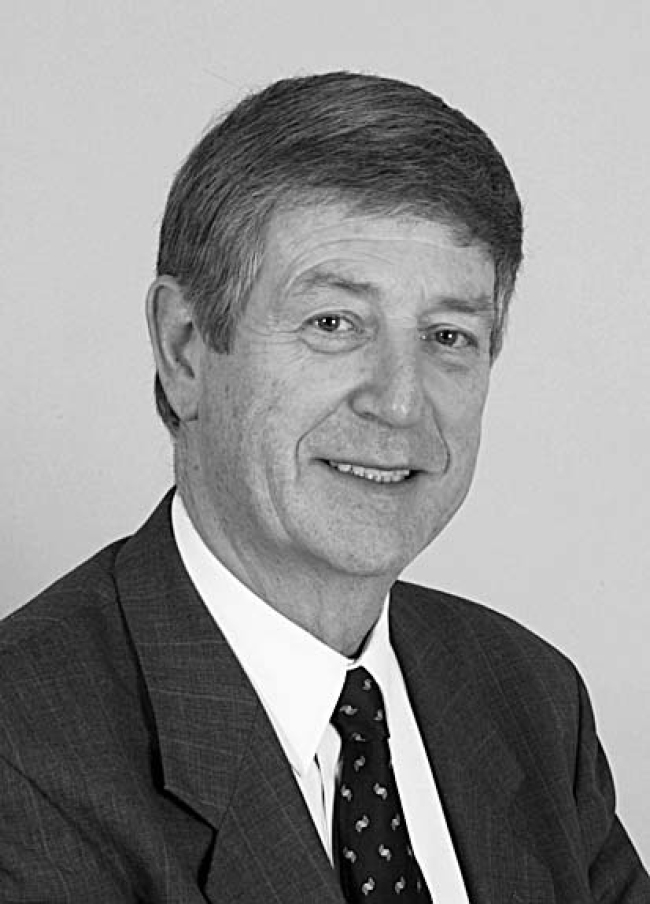
In March 2006, Gernot Kostorz will celebrate his 65th birthday. Friends all over the world take this date to congratulate him and to wish him many more years in good health. We hope he stays active as a colleague with critical advice.
Born in Kattowitz/Oberschlesien in March 1941, Gernot Kostorz studied not only Physics in Göttingen, but also Musicology. In the end, he did his diploma and his doctoral thesis in Physics, at the Institute of Metal Physics under the guidance of Peter Haasen. From then on, mechanical properties of alloys and their relation with the microstructure remained in the centre of his research. His efforts were also devoted to the growth of single crystals as they are required for his studies of fundamental materials properties. From 1968 to 1971 he worked at the Materials Science Division at the Argonne National Laboratory in the group of Tom Blewitt. He now investigated differences of mechanical properties at low temperatures when a material is in the normal or the superconducting state.
The subsequent seven years he spent at the Institut Laue-Langevin, where he used and advanced neutron scattering equipment. His expertise of small-angle neutron scattering in materials science is reflected in a series of excellent review articles. He also gave courses on phase transformations and plasticity at the University of Grenoble. The area of Grenoble further contributed to his appreciation of exquisite food and wine which is reflected in unforgettable social events over the years. From 1978 to 1980 Gernot Kostorz worked at the Max-Planck-Institut für Metallforschung in Stuttgart in the group of Volkmar Gerold, where he exploited the tool of small-angle scattering in the characterization of the kinetics of phase transformations at elevated temperature.
In 1980 he was appointed professor of Physics at the ETH Zürich. Gernot Kostorz joined the Institute of Applied Physics and has been its director since 1984. He immediately recognized the importance of Materials Science for the ETH Zürich and the necessity of the foundation of a new curriculum in 1981. His commitment was recognized when he was elected chairman of the Materials Science Division of the ETH-Zürich from 1984 to 1986. He also served as chairman of the Physics Department from 1996 to 1998. In his teaching and research, he has always promoted linking-up materials science and physics.
During the 26 years at ETH Zürich, Gernot Kostorz continuously contributed to the improvement of experimental tools for characterizing microstructures in small-angle and wide-angle scattering experiments, especially in his engagement for the Institut Laue Langevin and the Paul Scherrer Institut. Still he has always remained wide open to new upcoming fields, like high-temperature superconductors, solar cells, infrared detectors, and more recently magnetoplasticity. The success of his laboratory staff in the growth of high-quality alloy single crystals is well known – his more than 50 PhD students and the guest scientists much profited from this opportunity.
Gernot Kostorz has also supported electron microscopy for locally probing materials. He was largely involved in the acquisition of newest instrumentation. In 2003 he succeeded together with members of other departments to establish the Electron Microscopy Center at the ETH Zürich (EMEZ). His efforts as the first chairman of the EMEZ set the course to provide interdisciplinary research facilities and scientific as well as technical support for various departments and laboratories at the ETH Zürich.
Being a member of the German Society of Materials Science (DGM) since 1972, Gernot Kostorz was in the DGM council from 1987 to 1990, and its representative at the Federation of European Materials Scientists (FEMS). He was FEMS president from 1992 –1993 and was appointed its honorary member in 2003. Since 2004 he is also an honorary member of the DGM, and he received the Heyn Denkmünze of the DGM in 2005 in recognition of his pioneering contributions to introduce neutron scattering in materials research.
His publications amount to more than 270 research and review papers, and he was repeatedly editor of books and conference proceedings. Gernot Kostorz has always been devoted to the clarity of expression and to high standards in publications. He put this ability and his comprehensive knowledge into general use as an editor of “Materials Science and Engineering A” and “Journal of Applied Crystallography”. Since 2005, he has been Editor-in-Chief of the journals of the International Union of Crystallography.
Since his return to Europe, Gernot Kostorz has always been involved in improving contacts to Eastern-European scientists and to invite them to conferences and research appointments. We will not forget the Materials Science seminars over 15 years with our colleagues of the Lorand-Eötvös University in Budapest and the conferences he organised in Ascona. He has also been in continuous contact with colleagues in Poland and the Ukraine and at the Charles University in Prague. He was appointed honorary member of The Metals Science Society of the Czech Republic in 1996.
With his 65th birthday, Gernot Kostorz will have to retire from his duties as a professor of Physics at the ETH Zürich. Experts all over the world honor him by dedicating their papers in this special issue and covering a variety of topics which have attracted his interest during his scientific career. We both wish to express our deep personal thanks for the many inspiring and successful years we had at his institute. Merci!
© 2006 Carl Hanser Verlag, München
Artikel in diesem Heft
- Frontmatter
- Professor Dr. Gernot Kostorz 65 years
- Dislocation micromechanisms under single slip conditions
- Characterisation of short-range order using dislocations
- Between microscopic and mesoscopic descriptions of twin–twin interaction
- Influence of the thermoelastic effect on the acoustic properties of pure metals at low temperatures
- Recent progress in the area of bulk metallic glasses
- Formation of the ABC6-type ordered structure in fcc alloys
- Short-range order in Fe-21.9 at.% Al
- Criteria for developing castable, creep-resistant aluminum-based alloys – A review
- Phase decomposition and precipitation of metastable A2 phase in B2 ordered Co–Al–Fe alloys
- Atomic migration and ordering phenomena in bulk and thin films of FePd and FePt
- Late-stage coarsening of oil droplets of excess oil in microemulsions following a temperature quench
- Small-angle scattering from spherical particles on randomly oriented interfaces
- Ripening of L12 Ni3Ti precipitates in the framework of the trans-interface diffusion-controlled theory of particle coarsening
- Texture evolution in equiaxed polycrystalline L10-ordered FePd during coarsening at 600 °C
- Modulated structures in amorphous films of Cr-silicide prepared by electron-beam-deposition
- Early stages of nucleation and growth of Guinier –Preston zones in Al–Zn–Mg and Al–Zn–Mg–Cu alloys
- Experimental and theoretical characterization of Al3Sc precipitates in Al–Mg–Si–Cu–Sc–Zr alloys
- Ag2Al plates in Al–Ag alloys
- A critical analysis of the composite model as applied to high-temperature creep of Al and an Al–Mg alloy
- Damage behaviour of an Al2O3 particle-reinforced 6061 alloy induced by monotonic and cyclic deformation
- Deformation behaviour of ultrafine-grained magnesium with 3 vol.% graphite
- Press/Presse
- Conferences/Konferenzen
- Frontmatter
- Editorial
- Professor Dr. Gernot Kostorz 65 years
- Articles BBasic
- Dislocation micromechanisms under single slip conditions
- Characterisation of short-range order using dislocations
- Between microscopic and mesoscopic descriptions of twin–twin interaction
- Influence of the thermoelastic effect on the acoustic properties of pure metals at low temperatures
- Recent progress in the area of bulk metallic glasses
- Formation of the ABC6-type ordered structure in fcc alloys
- Short-range order in Fe-21.9 at.% Al
- Criteria for developing castable, creep-resistant aluminum-based alloys – A review
- Phase decomposition and precipitation of metastable A2 phase in B2 ordered Co–Al–Fe alloys
- Atomic migration and ordering phenomena in bulk and thin films of FePd and FePt
- Late-stage coarsening of oil droplets of excess oil in microemulsions following a temperature quench
- Small-angle scattering from spherical particles on randomly oriented interfaces
- Ripening of L12 Ni3Ti precipitates in the framework of the trans-interface diffusion-controlled theory of particle coarsening
- Articles AApplied
- Texture evolution in equiaxed polycrystalline L10-ordered FePd during coarsening at 600 °C
- Modulated structures in amorphous films of Cr-silicide prepared by electron-beam-deposition
- Early stages of nucleation and growth of Guinier –Preston zones in Al–Zn–Mg and Al–Zn–Mg–Cu alloys
- Experimental and theoretical characterization of Al3Sc precipitates in Al–Mg–Si–Cu–Sc–Zr alloys
- Ag2Al plates in Al–Ag alloys
- A critical analysis of the composite model as applied to high-temperature creep of Al and an Al–Mg alloy
- Damage behaviour of an Al2O3 particle-reinforced 6061 alloy induced by monotonic and cyclic deformation
- Deformation behaviour of ultrafine-grained magnesium with 3 vol.% graphite
- Notifications/Mitteilungen
- Press/Presse
- Conferences/Konferenzen
Artikel in diesem Heft
- Frontmatter
- Professor Dr. Gernot Kostorz 65 years
- Dislocation micromechanisms under single slip conditions
- Characterisation of short-range order using dislocations
- Between microscopic and mesoscopic descriptions of twin–twin interaction
- Influence of the thermoelastic effect on the acoustic properties of pure metals at low temperatures
- Recent progress in the area of bulk metallic glasses
- Formation of the ABC6-type ordered structure in fcc alloys
- Short-range order in Fe-21.9 at.% Al
- Criteria for developing castable, creep-resistant aluminum-based alloys – A review
- Phase decomposition and precipitation of metastable A2 phase in B2 ordered Co–Al–Fe alloys
- Atomic migration and ordering phenomena in bulk and thin films of FePd and FePt
- Late-stage coarsening of oil droplets of excess oil in microemulsions following a temperature quench
- Small-angle scattering from spherical particles on randomly oriented interfaces
- Ripening of L12 Ni3Ti precipitates in the framework of the trans-interface diffusion-controlled theory of particle coarsening
- Texture evolution in equiaxed polycrystalline L10-ordered FePd during coarsening at 600 °C
- Modulated structures in amorphous films of Cr-silicide prepared by electron-beam-deposition
- Early stages of nucleation and growth of Guinier –Preston zones in Al–Zn–Mg and Al–Zn–Mg–Cu alloys
- Experimental and theoretical characterization of Al3Sc precipitates in Al–Mg–Si–Cu–Sc–Zr alloys
- Ag2Al plates in Al–Ag alloys
- A critical analysis of the composite model as applied to high-temperature creep of Al and an Al–Mg alloy
- Damage behaviour of an Al2O3 particle-reinforced 6061 alloy induced by monotonic and cyclic deformation
- Deformation behaviour of ultrafine-grained magnesium with 3 vol.% graphite
- Press/Presse
- Conferences/Konferenzen
- Frontmatter
- Editorial
- Professor Dr. Gernot Kostorz 65 years
- Articles BBasic
- Dislocation micromechanisms under single slip conditions
- Characterisation of short-range order using dislocations
- Between microscopic and mesoscopic descriptions of twin–twin interaction
- Influence of the thermoelastic effect on the acoustic properties of pure metals at low temperatures
- Recent progress in the area of bulk metallic glasses
- Formation of the ABC6-type ordered structure in fcc alloys
- Short-range order in Fe-21.9 at.% Al
- Criteria for developing castable, creep-resistant aluminum-based alloys – A review
- Phase decomposition and precipitation of metastable A2 phase in B2 ordered Co–Al–Fe alloys
- Atomic migration and ordering phenomena in bulk and thin films of FePd and FePt
- Late-stage coarsening of oil droplets of excess oil in microemulsions following a temperature quench
- Small-angle scattering from spherical particles on randomly oriented interfaces
- Ripening of L12 Ni3Ti precipitates in the framework of the trans-interface diffusion-controlled theory of particle coarsening
- Articles AApplied
- Texture evolution in equiaxed polycrystalline L10-ordered FePd during coarsening at 600 °C
- Modulated structures in amorphous films of Cr-silicide prepared by electron-beam-deposition
- Early stages of nucleation and growth of Guinier –Preston zones in Al–Zn–Mg and Al–Zn–Mg–Cu alloys
- Experimental and theoretical characterization of Al3Sc precipitates in Al–Mg–Si–Cu–Sc–Zr alloys
- Ag2Al plates in Al–Ag alloys
- A critical analysis of the composite model as applied to high-temperature creep of Al and an Al–Mg alloy
- Damage behaviour of an Al2O3 particle-reinforced 6061 alloy induced by monotonic and cyclic deformation
- Deformation behaviour of ultrafine-grained magnesium with 3 vol.% graphite
- Notifications/Mitteilungen
- Press/Presse
- Conferences/Konferenzen
