
Revisiting agent pseudo-incorporation in Turkish: a dependent case theoretic perspective
-
Furkan Dikmen

 ,
Ömer Demirok
and
Ümit Atlamaz
,
Ömer Demirok
and
Ümit Atlamaz

Abstract
Dependent Case Theory takes accusative to be a dependent case, assigned to an NP only if it is c-commanded by another NP. Agent pseudo-incorporation structures in Turkish, where an accusative object is required to c-command the pseudo-incorporated agent, presents a challenge to the logic of dependent case calculus. We propose a reconciliation that calls for refining the conditions for dependent case assignment. Furthermore, we argue that agent pseudo-incorporation is made possible by a head that bundles the verbalization and agent introduction functions which are assumed by distinct heads in non-incorporation structures.
An anonymous reviewer rightly points out that bare adverbs are incompatible with non-specific indefinites as shown in (30a) while specific indefinites as well as bare NPs are compatible with them as shown in (30b) and (30c), respectively. Given that bare adverbs have been used to diagnose object pseudo-incorporation, in particular to show that pseudo-incorporation is a VP-level process, the idea that non-specific indefinites remain within the VP is challenged by their incompatibility with bare adverbs.
| *Ali | yavaş | bir | kitap | oku-du. |
| Ali | slow | one | book | read-PST |
| Intended: ‘Ali read a book slowly.’ | ||||
| Ali | bir | kitab-ı | yavaş | oku-du. |
| Ali | one | book-ACC | slow | read-PST |
| ‘Ali read a particular book slowly.’ | ||||
| Ali | yavaş | kitap | oku-du. |
| Ali | slow | book | read-PST |
| ‘Ali read books slowly.’ | |||
To declutter the syntactic representations in the main text, we did not fully articulate our assumptions about where objects/themes enter the derivation. Although the issue of where they are merged in syntax is somewhat orthogonal to the case theoretic puzzle concerning subject pseudo-incorporation in Turkish, we will sketch an analysis here that readily accommodates the contrast in (30). An analysis of this type calls for a distinction between the merge positions of pseudo-incorporated NPs and argumental DPs, reflecting the original insight in Öztürk (2005a, 2005b, 2009, where she argues that while pseudo-incorporated objects are introduced under VP, DP arguments are introduced via separate functional heads on top of the VP. Translating this proposal to our representations where we maintain a fully decompositional approach in the verbal domain, we propose that a theme head is responsible for introducing argumental DPs which are themes. Notably, occurring immediately below the verbalizer, the theme head is not a verbalizer, and directly combines with the root phrase in syntax as shown in (31).
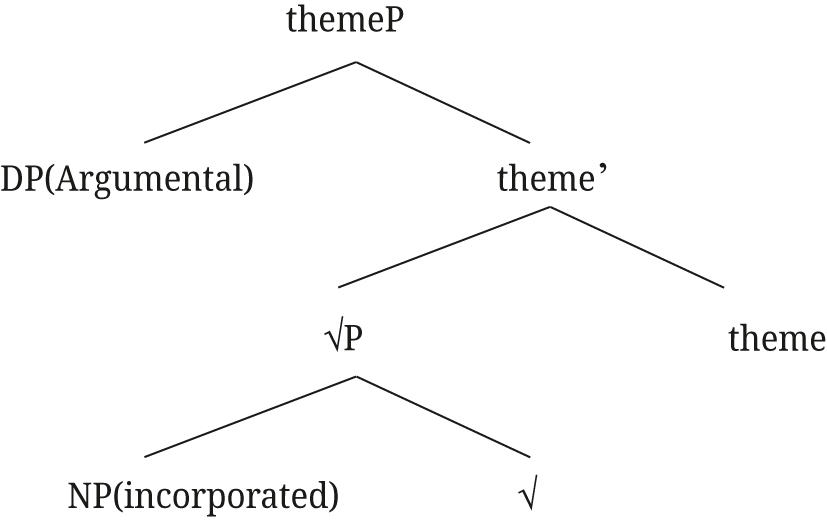
|
As we shall see, this addresses one half of the puzzle concerning the contrast in (30). The other half concerns the attachment site of bare adverbs. We argue for a lower attachment site for bare adverbs than regular VP modifiers. In particular, we propose that bare adverbs attach at the root level, i.e., before any verbalization applies. Our evidence comes from the so-called deverbal nouns that are able to license theme NPs as their complements. Arguably, these deverbal nouns are not verbal at any point in the derivation as shown by their incompatibility with manner adverbials in (32a). Crucially, however, they, along with their incorporated theme complements, are able to co-occur with bare adverbs as shown in (32b).
| (*hızlıca) | kek | yap-ım-ı |
| fast | cake | do-NMZ-CM |
| ‘(*fast) cake-baking’ | ||
| hızlı | kek | yap-ım-ı |
| fast | cake | do-NMZ-CM |
| ‘fast cake-baking’ | ||
The contrast between (32a) and (32b) supports the idea that bare adverbs attach to a position before verbalization, which we hypothesize to be the root phrase. Combining the two proposals, namely that argumental DPs are introduced in [spec, theme], and that bare adverbs attach to the root phrase, we account for the inability of non-specific indefinites to occur under bare adverbs. As shown in (33), the string where the bare adverb precedes the argumental non-specific indefinite is ruled out on the grounds that there is simply no position for non-specific indefinites to occur under the root phrase.
| *Ali | yavaş | bir | kitap | oku-du. |
| Ali | slow | one | book | read-PST |
| Intended: ‘Ali read a book slowly.’ | ||||
Under this analysis, there is still a pattern that is expected to be ruled in, but is nevertheless unacceptable. As shown in (34), the non-specific indefinite DP bir kitap, preceding the bare adverb, should be able to remain without an overt accusative case given that it is still within the first phase. We argue that what rules out (34) is not a syntactic, but a prosodic restriction that disallows any material between the verb and non-specific indefinites.
| *Ali | bir | kitap | yavaş | oku-du. |
| Ali | one | book | slow | read-PST |
| Intended: ‘Ali read books slowly.’ | ||||
While we do not know why non-specific indefinites, albeit being argumental DPs, exhibit this behavior, unlike other argumental DPs, there is evidence that the nature of the restriction is prosodic. Turkish allows right adjunction of bare adverbs as well as left adjunction as shown in (35). We hypothesize that the left versus right adjunction of bare adverbs uniformly targets the same level in the structure, i.e., the root phrase.
| Ali | koş-tu | yavaş. |
| Ali | run-PST | slow |
| ‘It was Ali whose running was slow.’ | ||
When we also employ right adjunction in (34), the sting becomes acceptable.
| Ali | bir | kitap | oku-du | yavaş. |
| Ali | one | book | read-PST | slow |
| ‘It was Ali who read books slowly.’ | ||||
To be able to accommodate non-specific indefinites into the picture, we had to make two assumptions, namely that bare adverbs modify root phrases, and that there is a prosodic constraint active in the grammar of Turkish which can be obviated by the right adjunction of the bare adverb. Although it may seem that these are ad hoc assumptions, they are in fact independently supported. In what follows, we discuss the interaction of bare adverbs with agent pseudo-incorporation, and argue that the two assumptions needed for non-specific indefinites are independently justified. The relevant piece of data is the inability of bare adverbs to occur in agent incorporation structures. For example, although the semantic content of the adverbial is compatible with the event described by the verb as illustrated in (37b), the bare adverb with the same semantic contribution cannot occur when the agent is pseudo-incorporated (37c).
| Arı | Ali-yi | yavaş/yavaşça | sok-tu. |
| bee | Ali-ACC | slow/slowly | sting-PST |
| ‘The bee stung Ali slowly.’ | |||
| Ali-yi | yavaşça | arı | sok-tu. |
| Ali-ACC | slowly | bee | sting-PST |
| ‘Ali got bee-stung slowly.’ | |||
| *Ali-yi | yavaş | arı | sok-tu. |
| Ali-ACC | slow | bee | sting-PST |
| Intended: ‘Ali got bee-stung slowly.’ | |||
The contrast between subject and object pseudo-incorporation with respect to the compatibility with bare adverbs is a welcome result in our analysis where agent pseudo-incorporation is made possible by vinc which semantically combines with its complement and then the agent NP in its specifier. The string in (37c) cannot be generated given that there is no position for the bare adverb above the pseudo-incorporated agent considering that vinc is introduced above the root phrase.
That said, if bare adverbs attach to the root phrase before the verbalization applies, that raises the question why the bare adverb prevents agent pseudo-incorporation construal in the sentence in (38). Given that the agent NP is a specifier to the verbalizer vinc, the low attachment of the bare adverb within the root phrase would rule in (38) for the pseudo-incorporation construal, all things being equal.
| Ali-yi | arı | yavaş | sok-tu. |
| Ali-ACC | bee | slow | sting-PST’ |
| Available: The bee stung Ali, and it was slow. (Definite reading) | |||
| Intended but unavailable: Ali got bee-stung, and it was slow. | |||
| (Pseudo-incorporation reading) | |||
We already have an account of why this reading is not ruled in. Recall that in explaining the inability of non-specific indefinites to precede bare adverbs, we invoked a prosodic constraint that could be obviated by right adjunction of the bare adverb. We argue that the same constraint is also active in case of agent pseudo-incorporation. The evidence that the prosodic constraint rules out the pseudo-incorporation reading in (38) is shown in (39) where the right adjunction of the bare adverb saves the pseudo-incorporation reading, allowing the adjacency between the incorporated agent and the verb, as opposed to (38) where pseudo-incorporation reading is unavailable.
| Ali-yi | arı | sok-tu | yavaş. |
| Ali-ACC | bee | sting-PST | slow |
| ‘Ali got bee-stung slowly.’ | |||
References
Baker, Mark. 2015. Case: Its principles and its parameters. Cambridge: Cambridge University Press.10.1017/CBO9781107295186Search in Google Scholar
Baker, Mark C. & Nadya Vinokurova. 2010. Two modalities of case assignment: Case in Sakha. Natural Language & Linguistic Theory 28(3). 593–642. https://doi.org/10.1007/s11049-010-9105-1.Search in Google Scholar
Bárány, András & Michelle Sheehan. (to appear). Challenges for dependent case theory. In Elena Anagnostopoulou, Christina Sevdali, & Dionysios Mertyris (eds.), On the place of case in the grammar. Oxford: Oxford University Press.Search in Google Scholar
Beavers, John & Andrew Koontz-Garboden. 2020. The roots of verbal meaning. Oxford: Oxford University Press.10.1093/oso/9780198855781.001.0001Search in Google Scholar
Chomsky, Noam. 2000. Minimalist inquiries: The framework. In Step by step: Essays on minimalist syntax in honor of Howard Lasnik. 89–155. Camridge, MA: MIT Press.Search in Google Scholar
Chomsky, Noam. 2001. Derivation by phase. In Michael Kenstowicz (ed.), Ken Hale: A life in language, 1–52. Cambridge, MA: MIT Press.10.7551/mitpress/4056.003.0004Search in Google Scholar
Dede, Müşerref. 1986. Definiteness and referentiality in Turkish verbal sentences. In Studies in Turkish linguistics, 147–164. Amsterdam: Benjamins.10.1075/tsl.8.09dedSearch in Google Scholar
Diesing, Molly. 1992. Indefinites: Linguistic inquiry monographs. Cambridge, Massachusetts: MIT Press.Search in Google Scholar
Embick, David & Rolf Noyer. 2007. Distributed morphology and the syntax/morphology interface. In The Oxford handbook of linguistic interfaces, 289324. Oxford: Oxford University Press.10.1093/oxfordhb/9780199247455.013.0010Search in Google Scholar
Enç, Mürvet. 1991. The semantics of specificity. Linguistic Inquiry 22(1). 1–25.Search in Google Scholar
Fox, Danny & David Pesetsky. 2005. Cyclic linearization of syntactic structure. Theoretical Linguistics 31(1–2). 1–45. https://doi.org/10.1515/thli.2005.31.1-2.1.Search in Google Scholar
Harley, Heidi. 2017. The “bundling” hypothesis and the disparate functions of little v. The Verbal Domain 3. 28.10.1093/oso/9780198767886.003.0001Search in Google Scholar
Harley, Heidi & Rolf Noyer. 2000. Formal versus encyclopedic properties of vocabulary: Evidence from nominalizations. In Bert Peeters (ed.), The lexicon-encyclopedia interface, 349–374. Oxford: Elsevier.10.1163/9780585474465_014Search in Google Scholar
Kechriotis, Z Ceyda Arslan. 2009. Referentiality in Turkish: Np/dp. In Essays on Turkish linguistics: Proceedings of the 14th international conference on Turkish linguistics, August 6–8, 2008, vol. 79, 83. Otto Harrassowitz Verlag.Search in Google Scholar
Kelepir, Meltem. 2001. Topics in Turkish syntax: Clausal structure and scope. Massachusetts Institute of Technology Dissertation.Search in Google Scholar
Kennelly, Sarah D. 1994. Caseless existential DPs in Turkish. Paris-8 Working Papers in Linguistics 158.Search in Google Scholar
Kornfilt, Jaklin & Omer Preminger. 2015. Nominative as no case at all: An argument from raising-to-accusative in Sakha. In Proceedings of the 9th workshop on Altaic formal linguistics, vol. 76, 109. Cambridge, MA: MITWPL.Search in Google Scholar
Kratzer, Angelika. 1996. Severing the external argument from its verb. In Phrase structure and the lexicon, 109–137. Dordrecht: Springer.10.1007/978-94-015-8617-7_5Search in Google Scholar
Levin, Theodore & Omer Preminger. 2015. Case in Sakha: Are two modalities really necessary? Natural Language & Linguistic Theory 33(1). 231–250. https://doi.org/10.1007/s11049-014-9250-z.Search in Google Scholar
Marantz, Alec. 1991. Case and licensing. In German Westphal, Benjamin Ao & Hee-Rahk Chae (eds.), Proceedings of ESCOL ’91, 234–253. Cornell Linguistics Club.Search in Google Scholar
Marantz, Alec. 1997. No escape from syntax: Don’t try morphological analysis in the privacy of your own lexicon. University of Pennsylvania Working Papers in Linguistics 4(2). 14.Search in Google Scholar
Nakipoğlu, Mine. 2009. The semantics of the Turkish accusative marked definites and the relation between prosodic structure and information structure. Lingua 119(9). 1253–1280. https://doi.org/10.1016/j.lingua.2009.02.006.Search in Google Scholar
Nakipoğlu, Mine. 2019. Towards a model of the relation between prosodic structure and object displacement in Turkish. In Word order in Turkish, 261–284. Cham: Springer.10.1007/978-3-030-11385-8_8Search in Google Scholar
Öztürk, Balkız. 2005a. Case, referentiality, and phrase structure. Amsterdam: John Benjamins.10.1075/la.77Search in Google Scholar
Öztürk, Balkız. 2005b. Pseudo-incorporation of agents. In University of Pennsylvania working papers in linguistics, 213–226.Search in Google Scholar
Öztürk, Balkız. 2009. Incorporating agents. Lingua 119(2). 334–358. https://doi.org/10.1016/j.lingua.2007.10.018.Search in Google Scholar
Perlmutter, David M. 1978. Impersonal passives and the unaccusative hypothesis. In Annual meeting of the Berkeley linguistics society, vol. 4, 157–190.10.3765/bls.v4i0.2198Search in Google Scholar
Pylkkänen, Liina. 2008. Introducing arguments. In Linguistic inquiry monographs, vol. 49. MIT Press.10.7551/mitpress/9780262162548.001.0001Search in Google Scholar
Sağ, Yagmur. 2019. The semantics of number marking: Reference to kinds, counting, and optional classifiers: Ph. D. thesis. New Brunswick, NJ: Rutgers University Dissertation.Search in Google Scholar
Sağ, Yagmur. 2022. Bare singulars and singularity in Turkish. Linguistics and Philosophy 45. 741–793. https://doi.org/10.1007/s10988-021-09323-0.Search in Google Scholar
Siddiqi, Daniel. 2019. On morpho-syntax. Catalan Journal of Linguistics. 153–163. https://doi.org/10.5565/rev/catjl.222.Search in Google Scholar
Türk, Utku & Pavel Caha. 2022. Nanosyntactic analysis of Turkish case system. In Proceedings of the workshop on Turkic and languages in contact with Turkic, vol. 6, 5051.10.3765/ptu.v6i1.5051Search in Google Scholar
© 2023 Walter de Gruyter GmbH, Berlin/Boston
