
Hot Tearing in an Investment Cast Burner Swirler
-
A. Neidel

Abstract
The damage case dealt with in the present work relates to a generally less common manufacturing defect that was discovered during its installation. The part was sourced from a supplier. An installation of the defective part in a large gas turbine engine used for energy generation could thus be prevented. The defect, a solidification crack, could have been repaired by welding and the component could have been used for operation. Instead, it was subjected to destructive examinations aiming at identifying what caused the crack. As the component could not possibly perform its function prior to being repaired by welding we are, in any event, talking about a damage case. The solidification crack initiated at a site of oxide infiltration. It was thus clearly a casting defect. The respective supplier was advised to reduce the content of non-metallic inclusions by the use of ceramic filters when the material is poured into the shell mold and a better control of the vacuum in the casting furnace.
Kurzfassung
Im vorliegenden Beitrag wird ein Schadensfall vorgestellt, der einen der üblicherweise seltener auftretenden Fertigungsfehler betrifft. Der Fehler wurde während der Montage des von einem Lieferanten bezogenen Gussteils festgestellt. So konnte ein Einbau des schadhaften Teils in eine große Gasturbine zur Energieerzeugung verhindert werden. Der Fehler, ein Erstarrungsriss, hätte schweißtechnisch repariert und das Bauteil im Betriebseinsatz verwendet werden können, wurde aber stattdessen zur Klärung der Rissursache zerstörend untersucht. Ein Schadensfall liegt jedenfalls vor, da das Bauteil vor der schweißtechnischen Sanierung seine Funktion nicht erfüllen konnte. Der Erstarrungsriss wurde an einer Oxideinschwemmung eingeleitet. Es handelte sich also eindeutig um einen Gussfehler. Dem Gusslieferanten wurde empfohlen, den Gehalt an nichtmetallischen Einschlüssen durch Verwendung von Keramikfiltern am Einguss in die Formschale und durch bessere Kontrolle des Vakuums im Gussofen zu reduzieren.
References / Literatur
[1] Neidel, A.; Fischer, B.; Wöhl, E.: Interner Bericht BLN MT/2018/0440, Berlin, June 6, 2018Suche in Google Scholar
[2] Poli, C.: Metal Casting Processes. In: Design for Manufacturing. A Structured Approach. 2001, pp. 115–126. DOI:10.1016/B978-075067341-9.50010-010.1016/B978-075067341-9.50010-0Suche in Google Scholar
[3] Lumley, R. N.: Aluminium Investment Casting and Rapid Prototyping for Aerospace Applications. In: Fundamentals of Aluminium Metallurgy. Recent Advances. Woodhead Publishing Series in Metals and Surface Engineering 2018, pp. 123–158. DOI:10.1016/B978-0-08-102063-0.00004-710.1016/B978-0-08-102063-0.00004-7Suche in Google Scholar
[4] Charmeux, J. F. et al.: A comparative study of three technologies for producing castings with micro/meso-scale features. in: 4 M 2006 – Second International Conference on Multi-Material Micro Manufacture. 2006, pp. 327–330. DOI:10.1016/B978-008045263-0/50074-X10.1016/B978-008045263-0/50074-XSuche in Google Scholar
[5] Dong, H.; Dai, H.: Casting, Semi-Solid Forming and Hot Metal Forming. In: Comprehensive Materials Processing, Volume 5, 2014, pp. 89–108. DOI:10.1016/B978-0-08-096532-1.00508-210.1016/B978-0-08-096532-1.00508-2Suche in Google Scholar
[6] Campbell, J.: Casting Manufacture. In: Complete Casting Handbook. Metal Casting Processes, Techniques and Design. Volume 2, 2011, pp. 1025–1025.10.1016/B978-1-85617-809-9.10018-0Suche in Google Scholar
[7] Bürgel, R.: Handbuch Hochtemperatur-Werkstofftechnik – Grundlagen, Werkstoffbeanspruchung, Hochtemperaturlegierungen. Friedr. Vieweg & Sohn Verlagsgesellschaft mbH, Braunschweig / Wiesbaden, 199810.1007/978-3-322-99904-7Suche in Google Scholar
[8] Sims, C. T.; Stoloff, N. S.; Hagel, W. C.: Superalloys II. John Wiley & Sons, New York, 1987Suche in Google Scholar
[9] Donachie, M. J., Donachie, S. J.: Superalloys: A Technical Guide. ASM International, Materials Park, OH, 2nd EditionSuche in Google Scholar
Susanne Riesenbeck

joined the Gas Turbine Plant of Siemens’ Energy Sector in 1984 and first underwent vocational training there. As a materials testing technician, one of the first fields of her professional endevours was steam turbine service, namely remaining lifetime assessment by means of the replica technique. She is a metallographer and one of the principal failure analysts in the materials testing laboratory. Her main fields of expertise comprise microstructural analyses of steel and iron castings.
Boromir Fischer
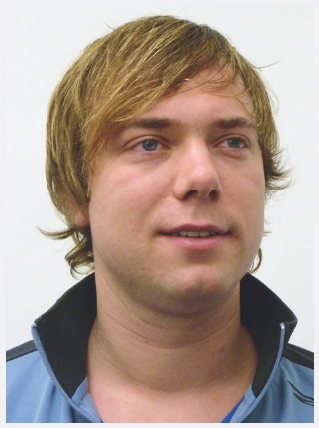
ccompleted a training as State Certified Technical Assistant for Metallography and Physical Material Analysis at Lette-Verein in Berlin. He has worked in the metallographic laboratory of the Siemens Gas Turbine Plant (Siemens-Gasturbinenwerk) Berlin for more than a decade. The key areas of his work are failure analysis and microstructural examinations using the field emission scanning electron microscope.
© 2023 Walter de Gruyter GmbH, Berlin/Boston, Germany
Artikel in diesem Heft
- Contents
- Editorial
- Editorial
- Image processing methods and light optical microscopy for in-situ quantification of chromatic change and anode dilation in Li-ion battery graphite anodes during (de-)lithiation
- A comprehensive study on the metallographic preparation of W-Re samples for high resolution electron-based microscopy
- Failure Analysis
- Hot Tearing in an Investment Cast Burner Swirler
- Picture of the Month
- Picture of the Month
- News
- Researchers develop optical method to verify topological phases in magnetic materials
- Meeting Dairy
- Meeting Diary
Artikel in diesem Heft
- Contents
- Editorial
- Editorial
- Image processing methods and light optical microscopy for in-situ quantification of chromatic change and anode dilation in Li-ion battery graphite anodes during (de-)lithiation
- A comprehensive study on the metallographic preparation of W-Re samples for high resolution electron-based microscopy
- Failure Analysis
- Hot Tearing in an Investment Cast Burner Swirler
- Picture of the Month
- Picture of the Month
- News
- Researchers develop optical method to verify topological phases in magnetic materials
- Meeting Dairy
- Meeting Diary
