
Microstructural analysis as a requirement for sinter-based additive manufacturing of highly conductive copper
-
J. Ott
studied Material Science at the University of Stuttgart at the insitute of material physics. In 2022 he recieved his doctoral degree at the institute of functional materials at the Saarland University in the field of sintering of copper for application in Additive Manufacturing. Currently he works as research engineer at the Robert Bosch GmbH in the corporate sector research.

Abstract
To further improve the range of battery-powered electric vehicles, new concepts in power electronics are required. The use of so-called “wide-bandgap” semiconductor materials, such as SiC, could meet the need for even more powerful power electronics, but this also increases the demands on the thermal management of the components. Complex copper cooler structures adapted to the temperature field could be a suitable way to meet these increasing requirements for heat dissipation.
However, conventional manufacturing techniques such as forging, casting and milling are reaching their limits for the production of complex Cu structures, and new processes such as additive manufacturing are coming into focus.
Additive manufacturing processes such as selective laser melting (SLM) place high demands on the laser system for highly-conductive copper (Cu) [1]. This means that less established sinter-based processes such as binder jetting (BJ) or fused filament fabrication (FFF) are also suitable for the production of complex Cu structures. In sinter-based methods, the sintering process and the microstructure, which is strongly influenced by it, is crucial for achieving good physical properties of the component [2].
In this work, methods are presented that allow for a quantitative and qualitative evaluation of the sintering process of copper at the microstructure level in order to derive optimized process parameters that enable higher sintering densities and thus greater conductivities. The influence of residual porosity and impurities on conductivity was investigated and allows for a specific prediction of the expected conductivity of sintered Cu structures.
Kurzfassung
Um die Reichweite von batteriebetriebenen Elektrofahrzeugen weiter zu verbessern, bedarf es neuer Konzepte in der Leistungselektronik. Die Verwendung von sogenannten „wide-bandgap“ Halbleitermaterialien, wie z. B. SiC, könnte den Bedarf nach noch leistungsfähigerer Leistungelektronik erfüllen, jedoch steigt dadurch auch der Anspruch an das thermische Management der Bauteile. Komplexe und an das Temperaturfeld angepasste Kühlerstrukturen aus Kupfer könnten da eine geeignete Möglichkeit, sein diesen steigenden Anforderungen an die Entwärmung gerecht zu werden.
Doch für die Herstellung von komplexen CuStrukturen stoßen konventionelle Fertigungstechniken wie Schmieden, Gießen und Fräsen an ihre Grenzen und neue Verfahren wie die additive Fertigung rücken in den Fokus.
Additive Fertigungsverfahren wie das selektive Laserschmelzen (SLM: Selective Laser Melting) stellen beim hochleitfähigen Material Kupfer (Cu) hohe Anforderungen an das Lasersystem [1], wodurch sich auch weniger etablierte sinterbasierte Verfahren, wie Binder Jetting (BJ) oder Fused Filament Fabrication (FFF), für die Fertigung von komplexen CuStrukturen anbieten. Bei sinterbasierten Verfahren ist der Sinterprozess und die dadurch stark beeinflusste Mikrostruktur entscheidend für das Erreichen guter physikalischer Eigenschaften des Bauteils [2].
In dieser Arbeit werden Methoden vorgestellt, die eine quantitative und qualitative Bewertung des Sinterprozess von Kupfer auf Gefügeebene zulässt, um daraus optimierte Prozessparameter abzuleiten, die höhere Sinterdichten und dadurch größere Leitfähigkeiten ermöglichen. Der Einfluss der Restporosität und von Verunreinigungen auf die Leitfähigkeit wurde untersucht und ermöglicht eine gezielte Vorhersage der zu erwartenden Leitfähigkeit von gesinterten Cu-Strukturen.
About the author
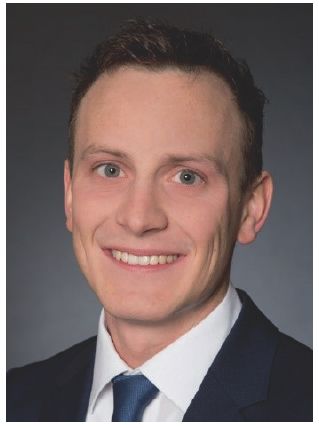
studied Material Science at the University of Stuttgart at the insitute of material physics. In 2022 he recieved his doctoral degree at the institute of functional materials at the Saarland University in the field of sintering of copper for application in Additive Manufacturing. Currently he works as research engineer at the Robert Bosch GmbH in the corporate sector research.
References / Literatur
[1] P. Lykov, E. Safonov und A. Akhmedianov: Selective Laser Melting of Copper,“ Material Science Forum 843 (2016), pp. 284–288. DOI:10.4028/www.scientific.net/MSF.843.284Search in Google Scholar
[2] Y. Bai: An exploration of binder jetting of copper, Rapid Prototyping Journal 21 (2015), pp. 21, 177–185. DOI:10.1515/pm-2020-000210.1515/pm-2020-0002Search in Google Scholar
[3] L. Kaden, G. Matthäus, T. Ullsperger, B. Seyfarth, S. Nolte: Selective laser melting of copper using ultrashort laser pulses at different wavelengths, in: EuroAsiaSPI, 2018. DOI:10.1108/RPJ-12-2014-018010.1108/RPJ-12-2014-0180Search in Google Scholar
[4] J. Ott: Dissertation: Druckloses Sintern von Cu für Hochleistungsanwendungen, Universität des Saarlandes, Saarbrücken, 2022. DOI:10.1080/00325899.2021.187180610.1080/00325899.2021.1871806Search in Google Scholar
[5] J. Ott, A. Burghardt, D. Britz und F. Mücklich: Free-sintering study of pressure-less manufactured green bodies made of fine Cu powder for electronic applications, in: Euro PM2020, Maastricht, Niederlande, 2019.Search in Google Scholar
[6] H. Ichnose und G. C. Kuczynski: Role of grain boundaries in sintering, Acta Metallurgica 10 (1962), pp. 209–214. DOI:10.1117/12.228995910.1117/12.2289959Search in Google Scholar
[7] J. Ott, A. Burghardt, D. Britz, S. Majauskaite und F. Mücklich: Qualitative and quantitative microstructural analysis of Cu for sintering optimization in additive manufacturing, Practical Metallography 1 (2021), pp. 32–47. DOI:10.22028/D291-3638710.22028/D291-36387Search in Google Scholar
[8] J. Ott, A. Burghardt, D. Britz, F. Mücklich: Influence of porosity and impurities on the thermal conductivity of pressure-less sintered Cu poweder green bodies, Powder Metallurgy 64, pp. 85–96. 10.1016/0001-6160(62)90118-910.1080/00325899.2021.1871806Search in Google Scholar
[9] D. Chapman: High Conductivity Copper for Electrical Engineering, Copper Development Association Publication (2016).Search in Google Scholar
© 2022 Walter de Gruyter GmbH, Berlin/Boston, Germany
Articles in the same Issue
- Contents
- Editorial
- Dear readers
- Microstructural analysis as a requirement for sinter-based additive manufacturing of highly conductive copper
- A heavenly sword – forging a Campo del Cielo meteorite
- Automated color etching of aluminum alloys
- Cryo ion polishing and high-resolution electron microscopy on a layered PEM composite of an automotive fuel cell
- Comparison of preparation techniques used for the identification of microstructural constituents in the microcrystalline structure of the eutectoid cold-work steel 80CrV2 (1.2235) after austempering
- New possibilities for macroscopic imaging in test laboratories – Modern light field objective lenses serving as the basis for large-scale 3D topography reconstruction and quantification
- Characterization of laser-welded structures in glass using acoustic microscopy
- “Metallography to go”: Mobile metallographic examinations directly on components
- Metallographic characterization of a gold-steel composite
- Failure Analysis
- Failure analysis of stainless and heat resisting steels, documented on selected examples
- Picture of the Month
- Picture of the Month
- People
- People
- News
- News
- Meeting Diary
- Meeting diary
Articles in the same Issue
- Contents
- Editorial
- Dear readers
- Microstructural analysis as a requirement for sinter-based additive manufacturing of highly conductive copper
- A heavenly sword – forging a Campo del Cielo meteorite
- Automated color etching of aluminum alloys
- Cryo ion polishing and high-resolution electron microscopy on a layered PEM composite of an automotive fuel cell
- Comparison of preparation techniques used for the identification of microstructural constituents in the microcrystalline structure of the eutectoid cold-work steel 80CrV2 (1.2235) after austempering
- New possibilities for macroscopic imaging in test laboratories – Modern light field objective lenses serving as the basis for large-scale 3D topography reconstruction and quantification
- Characterization of laser-welded structures in glass using acoustic microscopy
- “Metallography to go”: Mobile metallographic examinations directly on components
- Metallographic characterization of a gold-steel composite
- Failure Analysis
- Failure analysis of stainless and heat resisting steels, documented on selected examples
- Picture of the Month
- Picture of the Month
- People
- People
- News
- News
- Meeting Diary
- Meeting diary
