
Porosity in Medical Drills Caused by Fractured Carbides – A Review
-
S. Strobl
Susanne Strobl is working as a scientific officer at the Institute of Chemical Technologies and Analytics (TU-Wien) and is teaching supervisor of metallography. She studied chemistry and her doctoral thesis was about sintered steels.Roland Haubner is Ao.Univ.Prof. at TU-Wien. His fields of activity till now were industrial tungsten production, CVD (Chemical Vapor Deposition) and the lowpressure diamond deposition. He is also involved in materials characterization, ceramics, corrosion and archaeometallurgy.

Abstract
Just as 10 years ago, an examination of drills used in human medicine revealed cracks in the microstructure which can be attributed to fractured carbides. The drills are made of corrosion-resistant chromium steels with special carbides which are of the composition (Cr,Fe)23C6 and (Cr,Fe)7C3 (e. g. material no. 1.4125 or 1.4112). The cracks occur in the coarser carbides during the forming of the drills. It was considered problematic that the cracks are filled with contaminants which cannot be fully removed in the cleaning process. One of the drills examined for this study also contained MnS inclusions which is consistent with a “rust and acidresistant steel / free-machining steel” (e. g. material no. 1.4005).
Kurzfassung
Wie bereits vor 10 Jahren wurden bei Untersuchung an Bohrern aus der Humanmedizin Risse im Gefüge beobachtet, die auf gebrochene Karbide zurückgeführt werden können. Bei diesen Stählen handelt es sich um korrosionsbeständige Chromstähle mit Sonderkarbiden der Zusammensetzung (Cr,Fe)23C6 und (Cr,Fe)7C3 (z. B. Wkst.Nr. 1.4125 oder 1.4112). Die Risse treten bei der Formgebung der Bohrer in den gröberen Karbiden auf. Als problematisch wurde angesehen, dass bei mehrfacher Nutzung der Bohrer Verunreinigungen in Rissen bei der Reinigung nicht vollständig entfernt werden können. Bei den diesmal untersuchten Bohrern enthielt auch einer davon MnS Einschlüsse, was einem „Rost- und säurebeständiger Stahl / Automatenstahl“ entspricht (z. B. Wkst.Nr. 1.4005).
About the authors
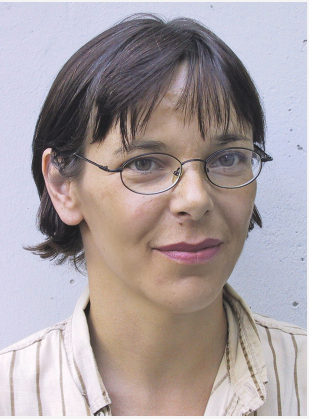
Susanne Strobl is working as a scientific officer at the Institute of Chemical Technologies and Analytics (TU-Wien) and is teaching supervisor of metallography. She studied chemistry and her doctoral thesis was about sintered steels.
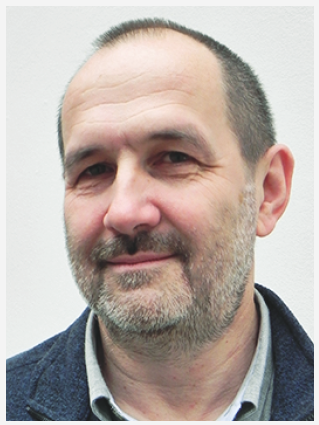
Roland Haubner is Ao.Univ.Prof. at TU-Wien. His fields of activity till now were industrial tungsten production, CVD (Chemical Vapor Deposition) and the lowpressure diamond deposition. He is also involved in materials characterization, ceramics, corrosion and archaeometallurgy.
5 Danksagung
Unser Dank gilt dem Lorenz Böhler Unfallkrankenhaus Wien, für die Bereitstellung der Bohrer. Weiters danken wir Lorenz Pinkas Bichler für seine Mithilfe im Rahmen eines Wahlpraktikums.
5 Acknowledgements
We would like to thank Lorenz Böhler Trauma Center, Vienna, for providing the drills and Lorenz Pinkas Bichler for his assistance during his practical training.
References / Literatur
[1] Henkel, A.; Langsteiner, A.; Linhardt, P.; Licka, T.: Repeat cycles of drilling equine cortical bone and cleaning and sterilization change the surface characteristics of untreated and electrochemically polished surgical drill bits, Pferdeheilkunde, 27 (2011) 652–663 DOI: 10.21836/PEM2011061210.21836/PEM20110612Suche in Google Scholar
[2] Strobl, S.; Haubner R.: Metallographische Untersuchungen an einem in der Chirurgie eingesetzten Dreistufenbohrer, Sonderbände der Praktischen Metallographie, 43 (2011) 141–146Suche in Google Scholar
[3] Haubner, R.; Strobl, S.; Henkel, A.: An Investigation into Porosity in Medical Drills caused by Broken Carbides, Praktische Metallographie – Practical Metallography, 49 (2012) 221–232 DOI: 10.3139/147.11016110.3139/147.110161Suche in Google Scholar
[4] Böhler Edelstahlhandbuch: http://www.bohleredelstahl.com/german/227_DEU_HTML.php (Mai 2011)Suche in Google Scholar
[5] Houdremont, E.: Handbuch der Sonderstahlkunde, 1956, Auflage 3, Verlag Stahleisen mbH, Düsseldorf DOI: 10.1007/978-3-662-11973-010.1007/978-3-662-11973-0Suche in Google Scholar
[6] Zopf, C.: Verschleiß- und Werkstoffuntersuchungen an Knochenbohrern, Diplomarbeit, Technische Universität Graz (2011)Suche in Google Scholar
[7] Höller, C.W.: Technical and Economic Analysis of the Process of Surgical Bone Drilling and Improvement Potentials, Master Thesis, Graz University of Technology (2015)Suche in Google Scholar
[8] Pazarci, O.; Torun, Y.; Ozturk, A.; Oztemur, Z.: Comparative Study of Different Drills for Bone Drilling: A Systematic Approach, Malaysian Orthopaedic Journal, 14 (2020) 83–89 DOI: 10.5704/MOJ.2007.01610.5704/MOJ.2007.016Suche in Google Scholar PubMed PubMed Central
[9] Vander Voort, G.F.: "Metallography – Principles and Practice", ASM International, 3rd printing (2004)10.31399/asm.hb.v09.a0003752Suche in Google Scholar
© 2021 Walter de Gruyter GmbH, Berlin/Boston, Germany
Artikel in diesem Heft
- Contents
- Editorial
- Editorial
- Application of the Color Etching Technique for Non-Ferrous Metals
- Campo del Cielo – an Iron Meteorite found in Argentina
- Failure Analysis
- Crack on the Inner Rim Flange of an Aluminum Rim
- Porosity in Medical Drills Caused by Fractured Carbides – A Review
- Picture of the Month
- Picture of the Month
- People
- Interview with Gundula Jeschke
- News
- Automatisierte chemische Synthese – Zuverlässige Herstellung und zügiger Erkenntnisgewinn
- Meeting Diary
- Meeting Diary
Artikel in diesem Heft
- Contents
- Editorial
- Editorial
- Application of the Color Etching Technique for Non-Ferrous Metals
- Campo del Cielo – an Iron Meteorite found in Argentina
- Failure Analysis
- Crack on the Inner Rim Flange of an Aluminum Rim
- Porosity in Medical Drills Caused by Fractured Carbides – A Review
- Picture of the Month
- Picture of the Month
- People
- Interview with Gundula Jeschke
- News
- Automatisierte chemische Synthese – Zuverlässige Herstellung und zügiger Erkenntnisgewinn
- Meeting Diary
- Meeting Diary
