
Scale-bridging Microstructural Analysis – A Correlative Approach to Microstructure Quantification Combining Microscopic Images and EBSD Data
-
M. Müller
Martin Müller studied Material Science at Saarland University. After getting his master’s degree, he worked 3.5 years at Brück GmbH as a Materials and Welding Engineer. Since 2018, doctoral student at the Chair of Functional Materials. Research in characterization and classification of bainitic microstructures.
 ,
D. Britz
,
D. Britz

Abstract
A comprehensive description of complex material structures may require characterization using different methods and observations across several scales. This work will present a correlative approach including light optical microscopy, scanning electron microscopy and electron backscatter diffraction, enabling microstructure quantification which combines microscopic images and electron backscatter diffraction data. The parameters obtained from electron backscatter diffraction such as misorientation parameters or grain and phase boundary data are an ideal source of information, complementing microscopic images. Two case studies performed on bainitic microstructures will be presented to demonstrate practical applications of this approach.
Kurzfassung
Eine vollumfängliche Beschreibung komplexer Werkstoff-Gefüge kann eine Charakterisierung mit verschiedenen Methoden und über mehrere Betrachtungsskalen hinweg erfordern. In dieser Arbeit wird ein korrelativer Ansatz, bestehend aus Lichtmikroskopie, Rasterelektronenmikroskopie und Elektronenrückstreubeugung, vorgestellt, der eine kombinierte Gefüge-Quantifizierung aus den Mikroskop-Aufnahmen sowie den Daten der Elektronenrückstreubeugung ermöglicht. Die aus der Elektronenrückstreu beugung gewonnenen Parameter, z. B. Missorientierungsparameter oder Daten über sowohl Korn- als auch Phasengrenzen, stellen eine ideale, komplementäre Informationsquelle zu den Mikroskop-Aufnahmen dar. Zwei Fallstudien an bainitischen Gefügen stellen die praktischen Anwendungsmöglichkeiten des Ansatzes vor.
About the author
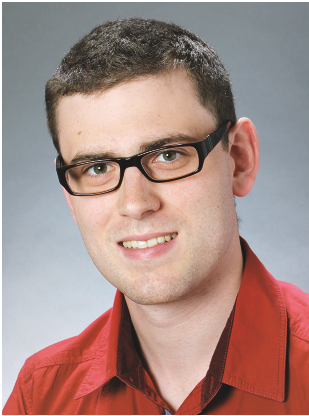
Martin Müller studied Material Science at Saarland University. After getting his master’s degree, he worked 3.5 years at Brück GmbH as a Materials and Welding Engineer. Since 2018, doctoral student at the Chair of Functional Materials. Research in characterization and classification of bainitic microstructures.
Acknowledgements
The authors would like to thank the Saarland State Chancellery for financial support within the ZuMat Project funded by the European Regional Development Fund (ERDF).
Danksagung
Die Autoren bedanken sich für die Förderung im Projekt ZuMat, gefördert von der Staatskanzlei des Saarlandes aus Mitteln des Europäischen Fonds für Regionale Entwicklung (EFRE).
References / Literatur
[1] Schwartz, A. J.; Kumar, M.; Adams, B. L.; Field, D. P.: Electron backscatter diffraction in materials science, 2nd Edition, Springer US, USA, 2009 DOI: 10.1007/978-0-387-88136-210.1007/978-0-387-88136-2Suche in Google Scholar
[2] Britz, D.; Webel, J.; Gola, J.: Pract. Metallogr. 54 (2017) 10, 685–696 DOI: 10.3139/147.11048410.3139/147.110484Suche in Google Scholar
[3] Britz, D.; Webel, J.; Schneider, A. S.; Mücklich, F.: Metall. Ital. 109 (2017) 3, 5 –10Suche in Google Scholar
[4] Li, X.; Ramazani, A.; Prahl, U.; Bleck, W.: Mater. Charact. 142 (2018), 179–186 DOI: 10.1016/j.matchar.2018.05.03810.1016/j.matchar.2018.05.038Suche in Google Scholar
[5] Gazder, A. A.; Al-Harbi, F.; Spanke, H.; Mitchell, D.R.G.; Pereloma, E. V.: Ultramicroscopy. 147 (2014), 114–132 DOI: 10.1016/j.ultramic.2014.07.00510.1016/j.ultramic.2014.07.005Suche in Google Scholar
[6] Zitová, B.; Flusser, J.: Image Vis. Comput. 21 (2003) 11, 977–1000 DOI: 10.1016/S0262-8856(03)00137-910.1016/S0262-8856(03)00137-9Suche in Google Scholar
[7] Goldstein, J.; Newbury, D. E.; Echlin, P.; Joy, D. C.; Romig Jr., A. D.; Lyman, C. E.; Fiori, C.; Lifshin, E.: Scanning Electron Microscopy and X-Ray Microanalysis: A Text for Biologists, Materials Scientists, and Geologists. 2nd Edition, Springer, New York, USA, 2012Suche in Google Scholar
[8] Hecht, E.: Optics. 4th Edition, Addison-Wesley, Harlow, Essex, England, 2001Suche in Google Scholar
[9] Lowe, D. G.: Int. J. Comput. Vis. 60 (2004) 2, 91–110 DOI: 10.1023/B:VISI.0000029664.99615.9410.1023/B:VISI.0000029664.99615.94Suche in Google Scholar
[10] Arganda-Carreras, I.; Sorzano, C. O. S.; Marabini, R.; Carazo, J.M.; Ortiz-De-Solorzano, C.; Kybic, J.: Lect. Notes Comput. Sci. 4241 (2006), 85–95 DOI: 10.1007/11889762_810.1007/11889762_8Suche in Google Scholar
[11] Schindelin, J.; Arganda-Carreras, I.; Frise, E.; Kaynig, V.; Longair, M.; Pietzsch, T.; Preibisch, S.; Rueden, C.; Saalfeld, S.; Schmid, B.; Tinevez, J.Y.; White, D.J.; Hartenstein, V.; Eliceiri, K.; Tomancak, P.; Cardona, A.: Nat Methods 9 (2012) 7, 676–682 DOI: 10.1038/nmeth.201910.1038/nmeth.2019Suche in Google Scholar PubMed PubMed Central
[12] Singh Phogat, R.; Dhamecha, H.; Pandya, M.; Chaudhary, B.; Potdar, M.: Int. J. Sci. Eng. Res. 5 (2014) 12, 44–49Suche in Google Scholar
[13] Sotiras, A.; Davatzikos, C.; Paragios, N.: IEEE Trans. Med. Imaging. 32 (2013) 7, 1153–1190 DOI: 10.1109/TMI.2013.226560310.1109/TMI.2013.2265603Suche in Google Scholar PubMed PubMed Central
[14] Koll, L.; Tsipouridis, P.; Werner, E. A.: J. Microsc. 243 (2011) 2, 206–219 DOI: 10.1111/j.1365-2818.2011.03495.x10.1111/j.1365-2818.2011.03495.xSuche in Google Scholar PubMed
[15] Britz, D.; Hegetschweiler, A.; Roberts, M.; Mücklich, F.: Mater. Perform. Charact. 5 (2016) 5, 553–563 DOI: 10.1520/MPC2016006710.1520/MPC20160067Suche in Google Scholar
[16] Feature Extraction – ImageJ, https://imagej.net/Feature_Extraction (accessed 28.04.2021)Suche in Google Scholar
[17] MTEX Toolbox | MTEX, https://mtex-toolbox.github.io/ (accessed 28.04.2021)Suche in Google Scholar
[18] Müller, M.; Britz, D.; Ulrich, L.; Staudt, T.; Mücklich, F.: Metals 630 (2020) 10, 1–19 DOI: 10.3390/met1005063010.3390/met10050630Suche in Google Scholar
[19] Müller, M.; Britz, D.; Mücklich, F.: ASM Adv. Mater. Process. 179 (2021), 16–2110.31399/asm.amp.2021-01.p016Suche in Google Scholar
[20] Gola, J.; Britz, D.; Staudt, T.; Winter, M.; Schneider, A. S.; Ludovici, M.; Mücklich, F.: Comput. Mater. Sci. 148 (2018), 324–335 DOI: 10.1016/j.commatsci.2018.03.00410.1016/j.commatsci.2018.03.004Suche in Google Scholar
[21] Gola, J.; Webel, J.; Britz, D.; Guitar, A.; Staudt, T.; Winter, M.; Mücklich, F.: Comput. Mater. Sci. 160 (2019), 186–196 DOI: 10.1016/j.commatsci.2019.01.00610.1016/j.commatsci.2019.01.006Suche in Google Scholar
[22] Webel, J.; Gola, J.; Britz, D.; Mücklich, F.: Mater. Charact. 144 (2018), 584–596 DOI: 10.1016/j.matchar.2018.08.00910.1016/j.matchar.2018.08.009Suche in Google Scholar
[23] Zajac, S.; Schwinn, V.; Tacke, K. H.: Mater. Sci. Forum. 500–501 (2005), 387–394 DOI: 10.4028/www.scientific.net/MSF.500-501. 38710.4028/www.scientific.net/MSF.500-501. 387Suche in Google Scholar
[24] Chen, Y. W.; Tsai, Y. T.; Tung, P. Y.; Tsai, S. P.; Chen, C. Y.; Wang, S. H.; Yang, J. R.: Mater. Charact. 139 (2018), 49–58 DOI: 10.1016/j.matchar.2018.01.04110.1016/j.matchar.2018.01.041Suche in Google Scholar
[25] Zhao, H.; Wynne, B. P.; Palmiere, E. J.: Mater. Charact. 123 (2017), 339–348 DOI: 10.1016/j.matchar.2016.11.02410.1016/j.matchar.2016.11.024Suche in Google Scholar
© 2021 Walter de Gruyter GmbH, Berlin/Boston, Germany
Artikel in diesem Heft
- Contents
- Editorial
- Patience Alone is not Enough – A Guide for the Preparation of Low-Defect Sections from Pure Copper
- Scale-bridging Microstructural Analysis – A Correlative Approach to Microstructure Quantification Combining Microscopic Images and EBSD Data
- Pigment Analysis Using Techniques from the Field of Materials Science – a Contribution to the Restoration of the “Frankfurt Kitchen”
- Metallography and Biomimetics – Or New Surfaces Without Chemistry?
- What can Günter Petzow's tetrahedron mean now?
- Picture of the Month
- Picture of the Month
- People
- Congratulations, dear Petz: Herzlichen Glückwunsch, lieber Petz!
- Meeting Diary
- Meeting Diary
Artikel in diesem Heft
- Contents
- Editorial
- Patience Alone is not Enough – A Guide for the Preparation of Low-Defect Sections from Pure Copper
- Scale-bridging Microstructural Analysis – A Correlative Approach to Microstructure Quantification Combining Microscopic Images and EBSD Data
- Pigment Analysis Using Techniques from the Field of Materials Science – a Contribution to the Restoration of the “Frankfurt Kitchen”
- Metallography and Biomimetics – Or New Surfaces Without Chemistry?
- What can Günter Petzow's tetrahedron mean now?
- Picture of the Month
- Picture of the Month
- People
- Congratulations, dear Petz: Herzlichen Glückwunsch, lieber Petz!
- Meeting Diary
- Meeting Diary
