
IUPAC Distinguished Women in Chemistry and Chemical Engineering Awards 2021
-
Mary J. Garson


It is a great pleasure to introduce a collection of papers submitted by awardees of the IUPAC Distinguished Women in Chemistry or Chemical Engineering Awards.
This recognition program promotes the accomplishments and achievement of women chemistry leaders worldwide. The awardees are selected based on excellence in basic or applied research, distinguished accomplishments in teaching or education, or demonstrated leadership or managerial excellence in the chemical sciences, and further identifies those women with a history of leadership within a chemistry-related organization and/or community service during their distinguished careers. (See https://iupac.org/what-we-do/awards/iupac-distinguished-women/).
The program was initiated as part of the celebrations held for the International Year of Chemistry in 2011, which honoured the awarding of the Nobel Prize for Chemistry to Marie Curie one hundred years earlier. A project entitled “Are Women still Underrepresented in Science” led by Janet Bryant and Ingrid Montes and with sponsorship by the American Chemical Society provided the initial basis of the award program. An inaugural set of 23 women were recognized at a dignified awards ceremony at the World Chemistry Congress held in San Juan, Puerto Rico in August 2011. A full day Symposium included motivational presentations by the awardees and covered stories of individual career journeys (with their inevitable “ups and downs”) as well as technical summaries of world-leading research. Some speakers further addressed the status of women chemists in their region of the world and highlighted governmental or NAO initiatives to increase the numbers of women progressing in science, technology, science education and mathematics (STEM) careers.
Since then, the tradition of acknowledging women chemists and chemical engineers through an awards ceremony and accompanying symposium has continued with support from IUPAC through its project system (Development and Recognition Programs for Women in Chemistry; chair Carolyn Ribes; https://iupac.org/project/2013-002-2-022; Accelerating Participation and Leadership of Women in Chemistry; co-chairs Carolyn Ribes and Angela WIlson (https://iupac.org/project/2015-007-1-020), and with further support from the International Council of Scientific Unions (now the International Science Council). Award ceremonies have been held at the following World Chemistry Congresses: Istanbul, Turkey (2013), Busan, Korea (2015), Sao Paulo, Brazil (2017), Paris, France (2019), and most recently in virtual format at Montreal, Canada (2021). A total of 82 women representing 29 countries have now been recognised by this distinctive program.
The distinguished women receiving awards between 2011 and 2017 were listed in the February 2019 preface of Pure and Applied Chemistry, (vol. 91, no. 2, 2019, p. 175) [1], introducing the first special collection of articles by awardees (https://www.degruyter.com/journal/key/pac/91/2/html).
The list of awardees for 2019 was: [2]
Professor Kim Baldridge, School Pharmaceutical Science and Technology, Tianjin, China
Professor Donna Blackmond, The Scripps Research Institute, La Jolla, CA, USA
Professor Susan Bourne, Department of Chemistry, Rondebosch, South Africa
Professor Janine Cossy, ESPCI, Paris, France
Professor Vicki Grassian, University of California San Diego, La Jolla, CA, USA
Professor Otilia Mó Romero, Univ Autonoma Madrid, Madrid, Spain
Professor Elizabeth Ann Nalley, Cameron University, Lawto, OK, USA
Professor Carol Vivien Robinson, University of Oxford, Oxford, United Kingdom
Professor Molly Shoichet, University of Toronto, Toronto, Canada
Professor Luisa Torsi, University of Bari Aldo Moro, Bari, Italy
Professor Chris Willis, School of Chemistry, Bristol, United Kingdom
Professor Pernilla Wittung-Stafshede, Chalmers University, Gothenburg, Sweden.

The 2019 Distinguished Women in Chemistry recognized in Paris during the World Chemistry Leadership Meeting and pictured with the WCLM panellists (see CI July 2020 for a report) (WCLM): (L to R): Chris Willis, Martin Brudermüller (BASF SE, WCLM panelist), Luisa Torsi, Elizabeth Ann Nalley, Guest Ben Feringa (NP 2016), Otilia Mó Romero, Janine Cossy, Ilham Kadri (Solvay, WCLM panelist), Andrey Grigoryevich Guryev (PhosAgro, WCLM panelist), Susan Bourne, Donna Blackmond, (unidentified), Molly Shoichet, Carolyn Ribes (Award presentation and Women in Chemistry Special Symposium coordinator), Kim Baldridge, Guest Jean-Pierre Sauvage (NP 2016), Angela Wilson (co-coordinator), Guest Jean-Marie Lehn (NP 1997), and on the far right, IUPAC President Qi-Feng Zhou.
The list of awardees for 2021 is given below: [3]
Professor Abeer Al Bawab, The University of Jordan, Amman, Jordan
Professor Anne Andrews, University of California in Los Angeles, CA, USA
Professor Mei-Hung Chiu, National Taiwan Normal University, Taipei, China/Taipei
Professor Jingbo (Louise) Liu, Texas A&M University-Kingsville and TAMU Energy Institute, TX, USA
Professor Katja Loos, University of Groningen, Netherlands
Professor Marcy Towns, Purdue University, West Lafayette, IN, USA
Professor Françoise M. Winnik, University of Helsinki, Finland
Professor Barbara Baird, Cornell University, Ithaca, NY, USA
Dr. Rachel Mamlok-Naaman, The Weizmann Institute of Science, Rehovot, Israel
Professor Kyoko Nozaki, The University of Tokyo, Japan
Professor Martina Stenzel, University of New South Wales, Sydney, Australia
Professor Supawan Tantayanon, Chulalongkorn University, Bangkok, Thailand.
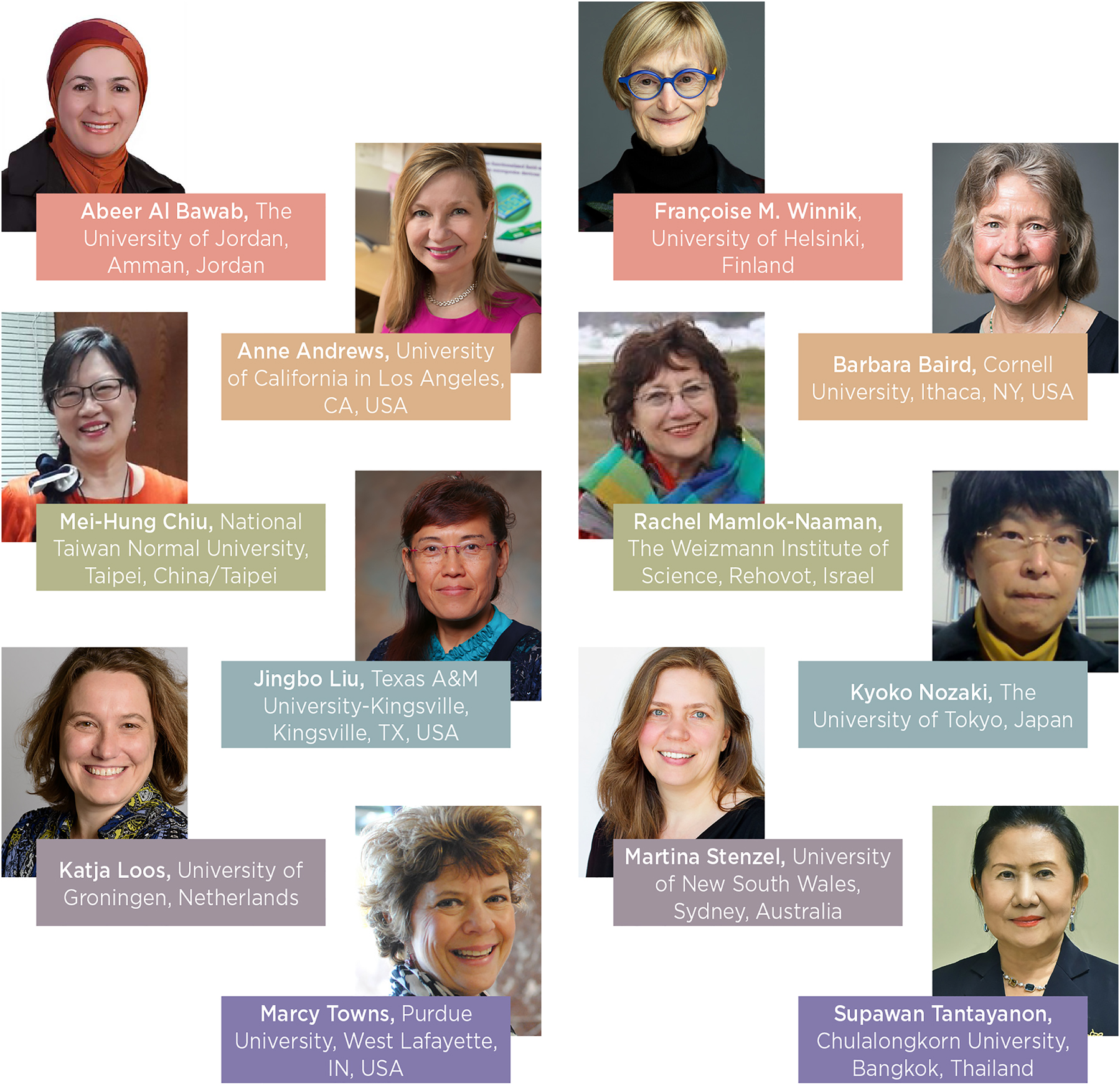
The collection of articles in this issue of Pure and Applied Chemistry have been written by 2021 awardees, with the exception that one manuscript is from a 2013 awardee. Some manuscripts explore individual career journeys, while others summarize the aims and accomplishments of high-level research programs. Between them, the offerings explore topics from pioneering women scientists from all parts of the globe and provide insight into their creativity.
Professor Mei-Hung Chiu (National Taiwan Normal University, China Taipei) introduces her journey in chemical education with a focus on student perceptions of chemical concepts and teacher awareness of student understanding that emerged from a large-scale survey The National Science Concept Learning Study undertaken in her country. The survey and its analysis by Professor Chiu together with other chemistry educators highlights the need to understand the core issues that students face when teachers construct classroom materials or presentations. Her manuscript also discusses the important concept of Systems Thinking and its role in chemical education. Very appropriately, given her earlier role as Chair of the Committee for Chemistry Education of IUPAC, she describes her involvement in outreach activities such as the Young Ambassadors for Chemistry (YAC) program and the Flying Chemistry Educators Program (FCEP). She also presents a project associated with the International Science Council (ISC), the survey “A Global Approach to the Gender Gap in Mathematics, Computing and Natural Sciences”, which was in part sponsored by IUPAC (see https://iupac.org/project/2017-007-1-020/). Research on chemistry-specific STEM issues continues through IUPAC project 2020-016-3-020.
The laboratory of Professor Barbara Baird from Cornell University, New York, USA integrates a broad range of experimental approaches to investigate molecular mechanisms of receptor-mediated cell signalling that enables cells to sense and respond to environmental cues. Notably, her group elucidates mechanisms in cell types involved in cancer and neurodegenerative diseases. In her manuscript, she credits early family life in the MidWest for key life skills, a supportive high school teacher for guiding her towards opportunities to explore science, and graduate school advisors for instilling the rigorous approach and critical thinking that she applies to projects in biophysical chemistry. She became the first woman faculty member in her department at Cornell University, eventually department chair and other leadership roles. Her article highlights her life/scientific partnership with Dr. David Holowska, to whom she dedicates her account.
Professor Abeer Al Bawab from the University of Jordan, Amman, Jordan, completed her PhD research at Clarkson University in the United States of America before returning to a highly successful academic career in Jordan where it is still not common for females to pursue STEM subjects. She has held numerous leadership roles, including as President of the Jordanian Chemical Society, and is an active member of several international societies as well as the Association of Jordanian Women Academics. Her current research interests are in applied physical chemistry, particularly nanoscience directed towards issues with the environment, water and food safety, and in chemical education. For this awards issue, she has written an article about “When passion meets purpose: love for chemistry drives female Jordanian professor”. Her description of tenacity and resilience during overseas graduate studies, as well as when combining family and professional life, and more recently significant health struggles, fittingly leads to her inspiring conclusion that “no adversity can stand in the way of your success”.
Professor Jingbo (Louise) Liu, Texas A&M University-Kingsville and TAMU Energy Institute Texas, USA is an international leader in the development of nanomaterials including solid oxide fuel cells and electrolysis cells. On her university webpage, she lists the best advice she ever received as “Love is patient, love is kind, love never ends” and she further acknowledges that what influenced her to study chemistry was the challenge to learn something new. In this issue, her manuscript is written with Hsuanyi Huang, Rong Li, Cuixia Li, Feng Zheng, Giovanni Ramirez, William Houf, Qiang Zhen and Sajid Basjir, and describes technical aspects of the design, evaluation and use of electrocatalysis nanomaterials. The use of such materials can lower the demand for traditional carbon-based fuel products in both stationery and portable power units, as well as in electric vehicles, provided energy conversion and storage efficiency can be optimised.
Professor Martina Stenzel from the University of New South Wales in Sydney Australia is Co-Director of the Centre for Advanced Macromolecular Design (CAMD) and is the Editorial Board Chair of Material Horizons as well as a member of the scientific advisory board shaping the scientific profile of Angewandte Chemie. Her chemistry education commenced in Germany, but after completing her PhD research in 1999, she moved to Australia where she has built a well-funded research program focusing on polymeric nanomaterials and biomaterials. Her review in this special issue, written with colleagues Radhika Raveendran, You Dan Xu, and Nidhi Joshi, first describes the use of polymerization techniques such as RAFT and ATPR to incorporate polymers into albumin-polymer hybrids, and then the application of these conjugates as drug delivery vehicles. The article further explains how these biomaterials hold significant potential to enhance cytotoxicity and controlled delivery of therapeutic agents.
Professor Supawan Tantayanon, Chulalongkorn University, Bangkok, Thailand is a senior member of the IUPAC community, and has served as the President of the Chemical Society of Thailand. Currently she is a national representative on the Interdivisional Committee on Green Chemistry and Sustainable Development as well as a Titular Member of the recently established Committee for Ethics, Diversity, Equity and Inclusion (CEDEI). She is well recognised throughout SE Asia for her contribution to chemical education, notably as convenor of workshops on small scale chemistry and microkits, and as the Chair of the Chemistry Olympiads Committee in Thailand. She was the recipient of the Federation of Asian Chemical Societies Award for Distinguished Contribution to Chemical Education in 2017. Her article in this issue of Pure and Applied Chemistry, written jointly with Rakhi Majumdar, describes the in situ synthesis of metal nanoparticle embedded soft hybrid materials via an eco-benign approach that removes the need to use toxic reagents or reaction media. Application of a palladium nanoparticle embedded gel as a recyclable heterogenous catalyst for carbon–carbon coupling under phosphine-free conditions, and in air, is described.
Professor Angela Wilson, currently President of the American Chemical Society, is a Past President of Division I (physical and biophysical) of IUPAC, and one of the creators of the Distinguished Women awards, as well as being an award winner in 2013. For this special issue, she has contributed a review manuscript co-written with David Kuntz. Their topic is machine learning and artificial intelligence, and they explore how smart algorithms are reshaping chemistry and yielding new insights that impact on just about every aspect of chemistry, both theoretical and experimental. Examples that have benefited from application of machine learning computations include quantitative structure activity relationships (QSAR), high throughput screening, molecular representations, molecular dynamics, DFT methods (widely used throughout all branches of chemistry), reaction rates, transition metal chemistry, quantum computing, and everyday analytical methodologies such as nuclear magnetic resonance, gas chromatography and mass spectrometry. The topic is of considerable interest, having been the focus of a World Chemistry Leaders Meeting at the 2021 World Chemistry Congress in Montreal [4].
Thanks are due to Professor Hugh Burrows, Editor of Pure and Applied Chemistry, and Professor Frances Separovic, guest-editor, for their significant work in putting together this special collection of manuscripts from some of the 2021 winners.
On behalf of Professor Angela Wilson and Dr. Carolyn Ribes, co-chairs of the IUPAC Distinguished Women in Chemistry or Chemical Engineering program, we hope that you enjoy this collection of articles. Be inspired by the feast of life stories, of research, and of creativity from these leading women chemists.
References
[1] F. Meyers, C. Ribes, A. K. Wilson. Pure Appl. Chem. 91, 175 (2019). https://doi.org/10.1515/pac-2019-2920.Suche in Google Scholar
[2] Chem. Int. 41(2), 28 (2019). https://doi.org/10.1515/ci-2019-0206.Suche in Google Scholar
[3] Chem. Int. 43(2), 27–29 (2021). https://doi.org/10.1515/ci-2021-0207.Suche in Google Scholar
[4] J. Frey, B. Lawlor, L. McEwen, C. Ober, A. Williams. Chem. Int. 44(3), 8–11 (2022). https://doi.org/10.1515/ci-2022-0303.Suche in Google Scholar
© 2022 IUPAC & De Gruyter. This work is licensed under a Creative Commons Attribution-NonCommercial-NoDerivatives 4.0 International License. For more information, please visit: http://creativecommons.org/licenses/by-nc-nd/4.0/
Artikel in diesem Heft
- Frontmatter
- In this issue
- Preface
- IUPAC Distinguished Women in Chemistry and Chemical Engineering Awards 2021
- Invited papers
- My journey in chemistry education
- My path in the company of chemistry
- When passion meets purpose: love for chemistry drives female Jordanian professor
- Perspective on advanced nanomaterials used for energy storage and conversion
- Progress of albumin-polymer conjugates as efficient drug carriers
- In-situ synthesis of metal nanoparticle embedded soft hybrid materials via eco-benign approach
- Machine learning, artificial intelligence, and chemistry: How smart algorithms are reshaping simulation and the laboratory
Artikel in diesem Heft
- Frontmatter
- In this issue
- Preface
- IUPAC Distinguished Women in Chemistry and Chemical Engineering Awards 2021
- Invited papers
- My journey in chemistry education
- My path in the company of chemistry
- When passion meets purpose: love for chemistry drives female Jordanian professor
- Perspective on advanced nanomaterials used for energy storage and conversion
- Progress of albumin-polymer conjugates as efficient drug carriers
- In-situ synthesis of metal nanoparticle embedded soft hybrid materials via eco-benign approach
- Machine learning, artificial intelligence, and chemistry: How smart algorithms are reshaping simulation and the laboratory
