
Green synthesis of spinel copper ferrite (CuFe2O4) nanoparticles and their toxicity
-
Saade Abdalkareem Jasim
 ,
Rosario Mireya Romero Parra
,
Rosario Mireya Romero Parra

Abstract
In this study, magnetic spinel copper ferrite (CuFe2O4) nanostructures were eco-friendly synthesized using Nasturtium officinale extract. Physicochemical properties of these nanostructures were determined by transmission electron microscopy, field emission scanning electron microscopy (FE-SEM), X-ray diffraction (XRD), vibrating sample magnetometry, and energy dispersive X-ray mapping analysis. XRD patterns conform to the CuFe2O4 formation. SEM results demonstrated ceramic spinel CuFe2O4 nanostructures with spherical surface morphologies. The cytotoxicity effect of CuFe2O4 nanostructures against rat pheochromocytoma (PC12) cells was evaluated based on MTT assay. The magnetic nanostructures had low toxicity at a concentration of 250 µg/mL. It appears that these nanostructures can be considered as suitable candidates for drug delivery and other biomedical applications, because of their low toxicity effects.
1 Introduction
Brain tumors and neurological diseases (e.g., Huntington’s, Alzheimer’s, and Parkinson’s) cause nerve cell damage, reduced motor control, cognitive impairment, and death [1]. Current treatments are expensive and have various side effects such as fatigue, general weakness, nausea, and increased liver enzymes, among others [2,3]. Therefore, researchers are looking for new methods to differentiate [4] and repair nerve neurons [5], and prevent diseases [6,7]. Recent findings suggest that a number of microstructures [8] and nanomaterials induce neuroprotective effects and preserve neuronal life [9,10]. Nanomaterials [11] play a significant role in the advancement of science [12–14] and technology [15–18]. These nanomaterials are deployed in the protection of neurons and treatment of brain tumors due to their nanometer size, antioxidant [19,20], surface plasmonic resonance properties [21,22], antimicrobial [23–27], magnetic properties [28], etc. [29,30]. New developments in science [31–33], innovative production [34–36] and technology [37–39] even in energy [40,41,42,43,44], computer [45–49], mathematic [50–55], geometry [56–63], and calculation [64–68] have significant impact on human health [69–72] and life [73,74].
In recent decades, ferrite magnetic nanoparticles (NPs) with the chemical formula of MFe2O4 (M: divalent metal ion, e.g., Zn, Co, Cu, etc.) [75,76] have attracted the attention of researchers in various biomedical fields including magnetic drug delivery [77], hyperthermia [78], catalyst [79], optical [80], labeling of cells [81], etc. [82–86]. Spinel ferrite NPs are of particular importance in neuroprotection [87], and can also be employed as magnetic resonance imaging contrast agents [88]. Ceramic structures [89–92] have been employed in the treatment and diagnosis of various diseases, such as cancers, catalyst [93], and neurological diseases. Spinel ferrites play important roles in biomedicine and nanomedicine due to multimetal components and their unique magnetic properties. Ferrite magnetic NPs can be easily separated and recovered in a reaction mixture by using an external magnet [94,95]. These types of magnetically recyclable nanostructure showed a high activity even after 13 cycles [79,96]. Copper ferrite NPs are ceramic nanoscale materials [97], which can be deployed for different biomedical and biological applications. Some synthesis methodologies of magnetic ferrite NPs are reported (Table 1).
Some synthesis methodologies of ferrite NPs and their magnetization values
| Ferrite NPs | Size (nm) | Synthesis methodology | Magnetization values (emu/g) | Ref. |
|---|---|---|---|---|
| CoFe2O4 | Below 50 | Autocombustion synthesis using egg white | 42.8 | [98] |
| CuFe2O4 | 77.7 | Sol–gel method | 32 | [99] |
| CuFe2O4/Fe2O3 core-shell | 80–200 | By a simple hydroxide co-precipitation and annealing method | 42 | [100] |
| CuFe2O4 | ∼9 (average) | Sonochemically | 9.3 | [101] |
| CuFe2O4 | 20–50 | Chemical co-precipitation | 2.7 | [102] |
| CuFe2O4 | 14.5–22.3 | Sol–gel autocombustion | 35.4 | [103] |
Plant extract or plant derivatives such as polysaccharides [104–106] with their medical usage [107–111] for the production of NPs could be an alternative to physiochemical synthesis methods [112].
In this study, copper ferrite NPs were eco-friendly synthesized using aqueous extract of Nasturtium officinale (family: Brassicaceae, English name: watercress). The physicochemical properties of these NPs were determined by X-ray diffraction (XRD), field emission scanning electron microscopy (FE-SEM), and vibrating-sample magnetometer (VSM) analyses. Finally, the cytotoxicity of these was evaluated against rat pheochromocytoma (PC12) cells based on MTT (3-[4,5-dimethylthiazol-2-yl]-2,5 diphenyltetrazolium bromide) assay.
2 Materials and methods
2.1 Materials
Iron(iii) chloride (Sigma-Aldrich, ≥98%), copper(ii) chloride (Sigma-Aldrich, ≥99%), and sodium hydroxide (Sigma-Aldrich, ≥ 98%) were utilized for the green synthesis of copper ferrite (CuFe2O4) nanoparticles (CFN). Deionized water was utilized in all stages of the synthesis. Rat pheochromocytoma (PC12) cells were purchased from the cellular bank of Pasteur Institute of Iran (Tehran). PC12 cell culture was performed with Dulbecco’s Modified Eagle’s Medium (DMEM; GIBCO, Invitrogen, Paisley, UK), penicillin and streptomycin (both from GIBCO, UK), Fetal Calf Serum (FCS; GIBCO, Invitrogen, Grand Island, NY, USA), and sodium pyruvate (GIBCO, USA) under normal conditions (37°C, 5% CO2, 1% antibiotic solution [pen-strep], high glucose DMEM containing 10% FCS). Cell viability was determined by tetrazolium dye MTT (3-[4,5-dimethylthiazol-2-yl]-2,5-diphenyltetrazolium bromide), and also dimethyl sulfoxide (DMSO) was obtained from Sigma-Aldrich (St. Louis, MO, USA).
2.2 Preparation of CFN
The flowering branches of watercress were washed with deionized water. Plant moisture was removed at 27°C. To each gram of watercress powder, 20 cc of deionized water was added and shaken at 27°C, overnight. Finally, the extract was separated with Whatman paper (size No. 40) and centrifuged. About 3.2 g of FeCl3·6H2O and 1.6 g CuCl2·2H2O was added to 200 cc of watercress aqueous extract at 60°C, respectively, and dissolved with stirring. The pH of the mixture was raised to 10 by utilizing NaOH 1 M solution. The final solution was stirred for 2 h at 60°C. The resulting NPs were washed with deionized water and finally dried at 60°C and calcined at 500°C for 8 h.
2.3 Characterization CFN
XRD analysis was deployed to determine the position of the crystal and the percentage of crystallinity of CFN using Panalytical X’PertPro. This analysis was performed in the 2θ of 10–80° using copper anode material. FE-SEM and energy dispersive X-ray (EDS) were deployed for evaluating the morphology and identifying the chemical composition of CFN, respectively (using sigma VP, ZEISS Company equipped with EDS detector of Oxford Instruments Company). The size and shape were determined by transmission electron microscopy (TEM) analysis using Philips CM120. Additionally, the magnetic properties of these NPs were analyzed using VSM analysis (LBKFB; Kashan Kavir Meghnatis Company, Iran) at room temperature.
2.4 Cytotoxicity evaluation of NPs using MTT test
The MTT assay was deployed to assess the cytotoxicity and viability of incubated cells in various concentrations (1, 10, 50, 100, 250, 500, and 1,000 µg/mL) of CFN. Doxorubicin (4 and 8 µg/mL) was utilized as positive control. Around 5,000 cells per well were seeded on the microplate. Concentration of NPs was transferred to each well. Plates were incubated at 37°C and 5% CO2 for 72 h. To perform the MTT assay, the MTT solution was added into each well. After 3 h incubation at 37°C, the medium was eliminated and 100 µL of DMSO was gently added to each well. Subsequently, the absorbance was measured at 490 nm by an enzyme-linked immunosorbent assay reader (BioTeks Elx 800). The IC50 (inhibitory concentration needed for cytotoxicity) was assessed by using the Probit test and plotting the level of inhibition vs the concentration.
3 Results
Figure 1 shows the XRD pattern of CFN synthesized at pH = 10 and temperature of 60°C. The XRD patterns of calcined CFN at 500°C for 4 and 8 h are shown in Figure 1a and b, respectively. The XRD spectrum of the calcined NPs for 4 h shows three broad peaks at 2θ = 35.9°, 57.2°, and 62.3°. The XRD spectrum of calcined NPs for 8 h shows five sharp peaks at 2θ = 30°, 35.9°, 43°, 57.2°, and 62.8°. Therefore, the synthesis process of crystallization of CFN strongly depended on the calcination time. The peaks mentioned in two XRD spectra correspond to the cubic spinel structure of the CFN [79,113,114].
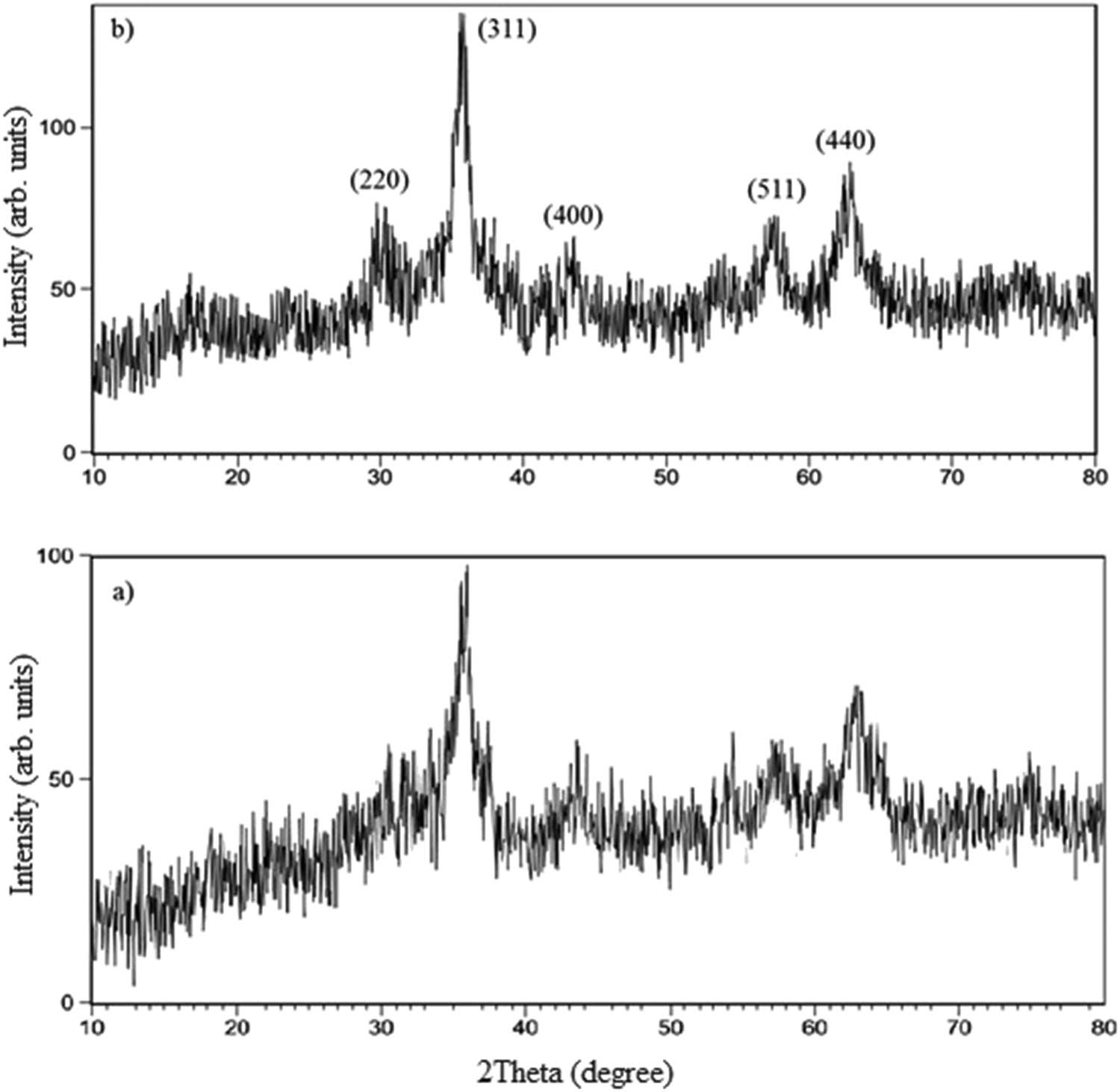
XRD spectrum of CFN after calcination at 500°C for 4 h (a) and 8 h (b).
Figure 2a and b shows the FE-SEM–EDS images prepared from calcined CFN NPs at 500°C for 4 and 8 h, respectively. SEM images of the calcined NPs for 4 and 8 h confirmed the plate-like and spherical surface morphology, respectively. Cubic and sheet-shaped plates with 76–141 nm wide illustrated that the NPs did not crystallize well in a short time (Figure 2a). As the crystallization time increases, the particles are formed in a regular and spherical manner of 15–50 nm (Figure 2b). Based on the results, by increasing the crystallization time, CFN were more spherical and smaller with higher purity. The presence of iron (59.3 wt%), copper (12.7 wt%), and oxygen (28 wt%) confirmed the type of element constituents of CFN [115]. The presence of element carbon in the EDS diagram was due to the residues of the plant extract in the structure of CFN (Figure 2c and d) [116].

FE-SEM–EDS images of NPs: FE-SEM of NPs calcined at 500°C for 4 h (a), 8 h (b), and EDS of CFN (c and d).
The TEM images with a bright-field background are shown in Figure 3. Nanostructure with spherical and elliptical morphology can be detected.
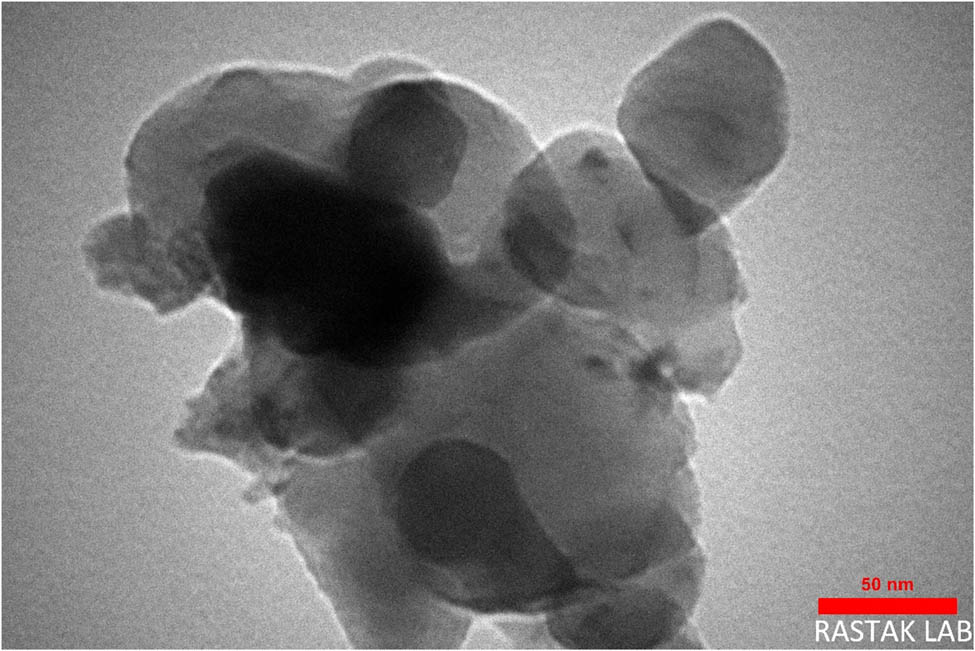
TEM images of CFN.
The magnetic properties of CFN at room temperature and ±16 kOe applied field are shown in Figure 4. The amount of magnetic saturation (Ms) for the synthesized NPs was 10 emu/g. According to the literature, CFN had weak superparamagnetic properties. Additionally, the amount of Ms of NPs depends on their size [117,118].
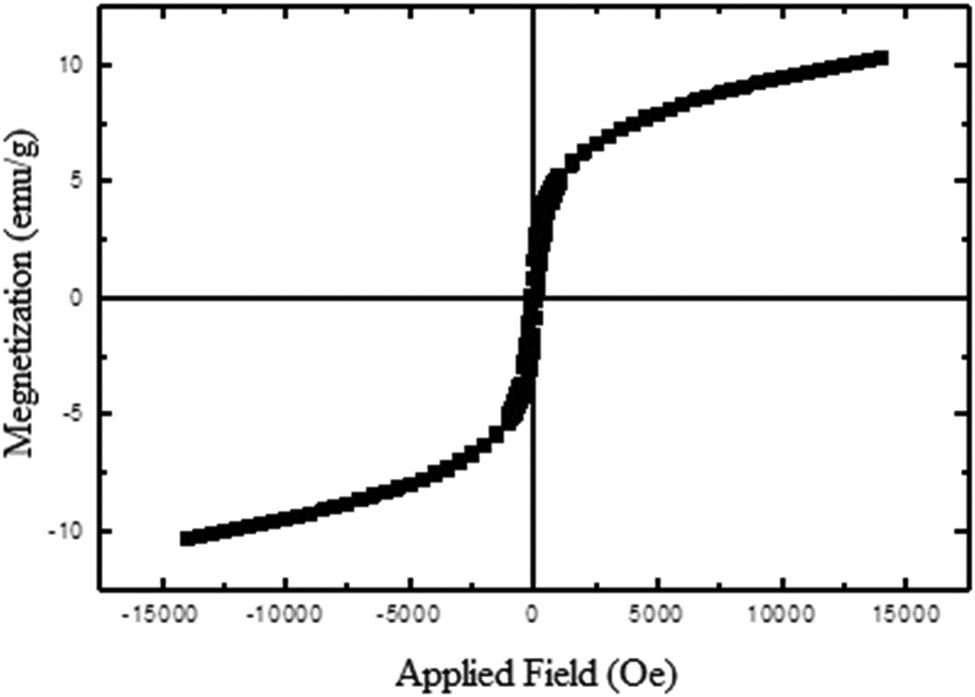
Hysteresis loop of CFN.
The cytotoxic effect of CFN was evaluated on PC12 cell lines using MTT assay and compared with the results obtained from the untreated cells (as negative control) and doxorubicin (as positive control) (Figure 5). The CFN demonstrated an insignificance index of anti-multiplication/cytotoxicity effects on PC12 cell lines with IC50 value 225.01 µg/mL. As shown in Figure 5, the cytotoxicity of NPs at a concentration of 250 µg/mL was higher than the positive control.
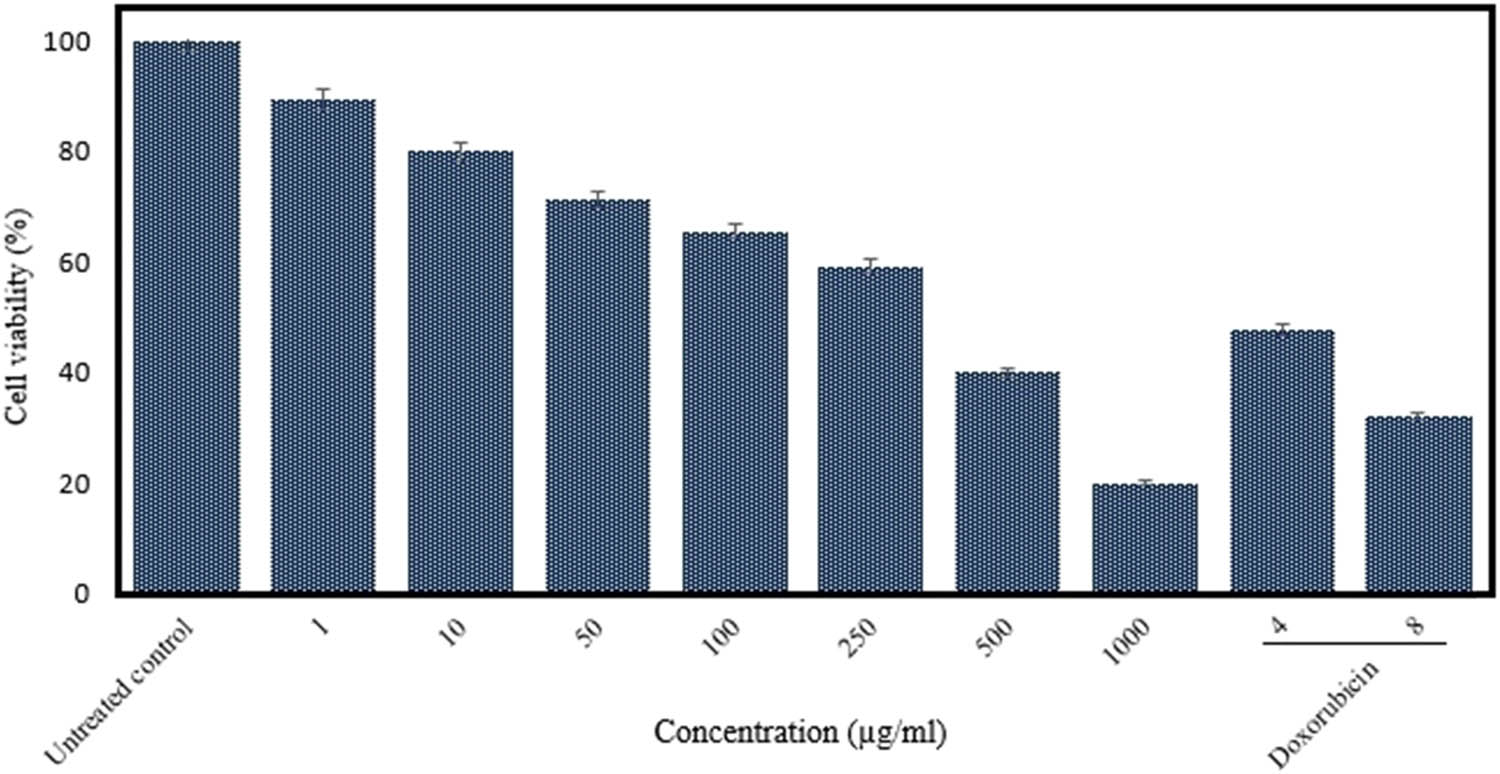
Cell viability of CFN on neuronal cell line in comparison with doxorubicin as positive control and untreated control (*P value < 0.01).
4 Discussion
In this study, CFN were successfully synthesized using N. officinale aqueous extract. The spinel structure and superparamagnetic behavior of these NPs were confirmed by XRD and VSM analyses. The cytotoxicity of these was evaluated by MTT method against neuronal PC12 cells for 72 h. The cytotoxicity of these at concentrations of 1–1,000 µg/mL was evaluated against rat pheochromocytoma (PC12) cells by MTT method. The CFN demonstrated an insignificance index of anti-multiplication/cytotoxicity effects on PC12 cell lines with IC50 value of 225.01 µg/mL.
According to the literature, plant extract as well as biogenic NPs of copper oxide and iron oxide are the best biological agents in reducing brain damage and treating degenerative neurological diseases. Kanagesan et al. reported that copper ferrite NPs had antioxidant and time-dependent anti-cancer properties at low concentrations and at high concentrations, respectively. These NPs had significant toxicity against human breast adenocarcinoma cancer cells at a concentration of 500 μg/mL [119]. CuFe2O4@Ag biogenic NPs with high permeability in human gastric adenocarcinoma and Michigan Cancer Foundation-7breast cancer caused fragmentation of cell nuclei and increased caspase-3 activity and apoptosis [120]. Copper ions increased the surface to volume ratio in CFN, thus demonstrating good antibacterial properties against Staphylococcus aureus [121].
In recent years, medicinal plants together with various nanomaterials can be considered as promising neuroprotective agents. Scientists are seeking to increase the neuroprotective effect of drugs by producing NPs using plant extracts. In one study, PC12 cell damage by methadone was reduced with Nigella sativa and CuO NPs [122]. In vivo studies demonstrated that iron NPs containing plant saponin could be employed as neuroprotective agent – with better performance than plant saponin due to the synergistic effects of iron NPs and saponin [123]. The synergy of metal ions and plant extracts has been proven in reducing brain damage and treating neurodegenerative diseases. CuO NPs synthesized by applying N. sativa L. have shown suitable antioxidant properties. These biogenic NPs protected phaeochromocytoma (PC12) cells from destructive agents by reducing nucleic acid damage, inflammatory agents, and activity of the enzyme caspase-3 [122]. Sharma et al. reported that magnetic iron oxide NPs were harmless to neurons. Additionally, these NPs in combination with other therapeutic agents were useful in brain and spinal cord injuries as diagnostic and therapeutic agents [124]. In another study, iron oxide NPs were studied (in vivo analysis) for the treatment of Parkinson’s disease, because of their unique magnetic properties, thus identifying these superparamagnetic NPs as neuroprotective agents [125]. Ruanglertboon et al. demonstrated that watercress ethanolic extract improved dexamethasone-induced neuronal destruction in male mice. These results introduced the N. officinale plant as a neuroprotective agent [126]. According to the literature and the results of this study, CFN and N. officinale extract demonstrated no toxicity on neuronal PC12 cells, and as well as promising functionality; therefore, they can be suggested as attractive neuroprotective agents.
5 Conclusion
In this study, CFN were synthesized using aqueous extract of N. officinale via a simple and green method. Physicochemical properties of these NPs were evaluated by XRD, FE-SEM, EDS, VSM, and TEM analyses. Further studies should be conducted to evaluate the biocompatibility and toxicity of these NPs with high functionality and unique properties for clinical and biomedical applications.
-
Funding information: This work was supported by Tarbiat Modares University.
-
Author contributions: All authors have accepted responsibility for the entire content of this manuscript and approved its submission.
-
Conflict of interest: The authors state no conflict of interest.
References
[1] Hamidian K, Sarani M, Sheikhi E, Khatami M. Cytotoxicity evaluation of green synthesized ZnO and Ag-doped ZnO nanoparticles on brain glioblastoma cells. J Mol Structure. 2022;1251:131962.10.1016/j.molstruc.2021.131962Search in Google Scholar
[2] Islam M, Sultana G, Khan R, Islam A, Mahmud H, Raihan S. Study on mitochondrial ATPase6 gene polymorphisms as a genetic risk factor for breast cancer in Bangladeshi women. Int J Sci Res Dental Med Sci. 2021;3:18–22.Search in Google Scholar
[3] Solano N, Perez L, Rivera E, Medina C. Hybrid odontogenic tumor with a unique presentation of the calcifying epithelial odontogenic tumor, adenomatoid odontogenic tumor, and calcifying odontogenic cyst: a case report. Int J Sci Res Dental Med Sci. 2021;3:50–4.Search in Google Scholar
[4] Razavi S, Seyedebrahimi R, Jahromi M. Biodelivery of nerve growth factor and gold nanoparticles encapsulated in chitosan nanoparticles for Schwann-like cells differentiation of human adipose-derived stem cells. Biochem Biophys Res Commun. 2019;513:681–7.10.1016/j.bbrc.2019.03.189Search in Google Scholar PubMed
[5] Angelova A, Angelov B. Dual and multi-drug delivery nanoparticles towards neuronal survival and synaptic repair. Neural Regeneration Res. 2017;12:886–9.10.4103/1673-5374.208546Search in Google Scholar PubMed PubMed Central
[6] Mousazadeh M, Palizban A, Salehi R, Salehi M. Gene delivery to brain cells with apoprotein E derived peptide conjugated to polylysine (apoEdp-PLL). J Drug Target. 2007;15:226–30.10.1080/10611860601148908Search in Google Scholar PubMed
[7] Zha T-H, Castillo O, Jahanshahi H, Yusuf A, Alassafi MO, Alsaadi FE, et al. A fuzzy-based strategy to suppress the novel coronavirus (2019-NCOV) massive outbreak. Appl Comput Math. 2021;160–76.Search in Google Scholar
[8] Nazeer M, Hussain F, Khan MI, El-Zahar ER, Chu Y-M, Malik M. Theoretical study of MHD electro-osmotically flow of third-grade fluid in micro channel. Appl Math Comput. 2022;420:126868.10.1016/j.amc.2021.126868Search in Google Scholar
[9] Chu Y-M, Shankaralingappa B, Gireesha B, Alzahrani F, Khan MI, Khan SU. Combined impact of Cattaneo-Christov double diffusion and radiative heat flux on bio-convective flow of Maxwell liquid configured by a stretched nano-material surface. Appl Math Comput. 2022;419:126883.10.1016/j.amc.2021.126883Search in Google Scholar
[10] Chu Y-M, Nazir U, Sohail M, Selim MM, Lee J-R. Enhancement in thermal energy and solute particles using hybrid nanoparticles by engaging activation energy and chemical reaction over a parabolic surface via finite element approach. Fractal Fract. 2021;5:119.10.3390/fractalfract5030119Search in Google Scholar
[11] Li B, Li C, Zhang Y, Wang Y, Jia D, Yang M, et al. Heat transfer performance of MQL grinding with different nanofluids for Ni-based alloys using vegetable oil. J Clean Prod. 2017;154:1–11.10.1016/j.jclepro.2017.03.213Search in Google Scholar
[12] Wang Y, Li C, Zhang Y, Yang M, Li B, Jia D, et al. Experimental evaluation of the lubrication properties of the wheel/workpiece interface in minimum quantity lubrication (MQL) grinding using different types of vegetable oils. J Clean Prod. 2016;127:487–99.10.1016/j.jclepro.2016.03.121Search in Google Scholar
[13] Zhang Y, Li C, Ji H, Yang X, Yang M, Jia D, et al. Analysis of grinding mechanics and improved predictive force model based on material-removal and plastic-stacking mechanisms. Int J Mach Tools Manufacture. 2017;122:81–97.10.1016/j.ijmachtools.2017.06.002Search in Google Scholar
[14] Guo S, Li C, Zhang Y, Wang Y, Li B, Yang M, et al. Experimental evaluation of the lubrication performance of mixtures of castor oil with other vegetable oils in MQL grinding of nickel-based alloy. J Clean Prod. 2017;140:1060–76.10.1016/j.jclepro.2016.10.073Search in Google Scholar
[15] Zhang Y, Li C, Jia D, Zhang D, Zhang X. Experimental evaluation of the lubrication performance of MoS2/CNT nanofluid for minimal quantity lubrication in Ni-based alloy grinding. Int J Mach Tools Manufacture. 2015;99:19–33.10.1016/j.ijmachtools.2015.09.003Search in Google Scholar
[16] Zhang Y, Li C, Jia D, Zhang D, Zhang X. Experimental evaluation of MoS2 nanoparticles in jet MQL grinding with different types of vegetable oil as base oil. J Clean Prod. 2015;87:930–40.10.1016/j.jclepro.2014.10.027Search in Google Scholar
[17] Wang Y, Li C, Zhang Y, Yang M, Li B, Dong L, et al. Processing characteristics of vegetable oil-based nanofluid MQL for grinding different workpiece materials. Int J Precis Eng Manufacturing-Green Technol. 2018;5:327–39.10.1007/s40684-018-0035-4Search in Google Scholar
[18] Zhang Y, Li HN, Li C, Huang C, Ali HM, Xu X, et al. Nano-enhanced biolubricant in sustainable manufacturing: from processability to mechanisms. Friction. 2022;10:803–41.10.1007/s40544-021-0536-ySearch in Google Scholar
[19] Rzigalinski BA, Carfagna CS, Ehrich M. Cerium oxide nanoparticles in neuroprotection and considerations for efficacy and safety. Wiley Interdiscip Rev: Nanomed Nanobiotechnol. 2017;9:e1444.10.1002/wnan.1444Search in Google Scholar PubMed PubMed Central
[20] Lu C, Wang YG, Zaman F, Wu X, Adhaduk M, Chang A, et al. Structural characterization and antioxidant activity of a novel high-molecular-weight polysaccharide from Ziziphus jujuba cv. Muzao. J Food Meas Charact. 2022;16:2191–200.10.1007/s11694-022-01288-3Search in Google Scholar
[21] Liu B, Liu G, Zhang B. Decoration of gold and silver nanoparticles by neuroprotective gabapentin drug and studying the release behavior by surface plasmon resonance. Chem Pap. 2021;75:1–7.10.1007/s11696-021-01661-4Search in Google Scholar
[22] Zhu H, Zhu J, Zhang Z, Zhao R. Crossover from linear chains to a honeycomb network for the nucleation of hexagonal boron nitride grown on the Ni (111) surface. J Phys Chem C. 2021;125:26542–51.10.1021/acs.jpcc.1c09334Search in Google Scholar
[23] Cao M, Chang Z, Tan J, Wang X, Zhang P, Lin S, et al. Superoxide radical-mediated self-synthesized Au/MoO3–x hybrids with enhanced peroxidase-like activity and photothermal effect for anti-MRSA therapy. ACS Appl Mater Interfaces. 2022;14(11):13025–37.10.1021/acsami.1c23676Search in Google Scholar PubMed
[24] Arkaban H, Barani M, Akbarizadeh MR, Pal Singh Chauhan N, Jadoun S, Dehghani Soltani M, et al. Polyacrylic acid nanoplatforms: antimicrobial, tissue engineering, and cancer theranostic applications. Polymers. 2022;14:1259.10.3390/polym14061259Search in Google Scholar PubMed PubMed Central
[25] Cao Y, Abbasi M, Alijani HQ, Akbarizadeh MR, Iravani S, Barani M, et al. Ceramic magnetic ferrite nanoribbons: eco-friendly synthesis and their antifungal and parasiticidal activity. Ceram Int. 2022;48:3448–54.10.1016/j.ceramint.2021.10.121Search in Google Scholar
[26] Nazaripour E, Mosazadeh F, Rahimi SS, Alijani HQ, Isaei E, Borhani F, et al. Ferromagnetic nickel(ii) oxide (NiO) nanoparticles: biosynthesis, characterization and their antibacterial activities. Rendiconti Lincei Scienze Fisiche e Naturali. 2022;33:1–8.10.1007/s12210-021-01042-9Search in Google Scholar
[27] Haghighat M, Alijani HQ, Ghasemi M, Khosravi S, Borhani F, Sharifi F, et al. Cytotoxicity properties of plant-mediated synthesized K-doped ZnO nanostructures. Bioprocess Biosyst Eng. 2022;45:97–105.10.1007/s00449-021-02643-2Search in Google Scholar PubMed
[28] Naserzadeh P, Hafez AA, Abdorahim M, Abdollahifar MA, Shabani R, Peirovi H, et al. Curcumin loading potentiates the neuroprotective efficacy of Fe3O4 magnetic nanoparticles in cerebellum cells of schizophrenic rats. Biomed Pharmacotherapy. 2018;108:1244–52.10.1016/j.biopha.2018.09.106Search in Google Scholar PubMed
[29] Gao T, Li C, Zhang Y, Yang M, Jia D, Jin T, et al. Dispersing mechanism and tribological performance of vegetable oil-based CNT nanofluids with different surfactants. Tribol Int. 2019;131:51–63.10.1016/j.triboint.2018.10.025Search in Google Scholar
[30] Zhang Y, Li C, Jia D, Li B, Wang Y, Yang M, et al. Experimental study on the effect of nanoparticle concentration on the lubricating property of nanofluids for MQL grinding of Ni-based alloy. J Mater Process Technol. 2016;232:100–15.10.1016/j.jmatprotec.2016.01.031Search in Google Scholar
[31] Zhao T-H, Wang M-K, Chu Y-M. A sharp double inequality involving generalized complete elliptic integral of the first kind. AIMS Math. 2020;5:4512–28.10.3934/math.2020290Search in Google Scholar
[32] Zhao T-H, Shi L, Chu Y-M. Convexity and concavity of the modified Bessel functions of the first kind with respect to Hölder means. Rev de la Real Academia de Cienc Exactas, Físicas y Naturales Ser A Matemáticas. 2020;114:1–14.10.1007/s13398-020-00825-3Search in Google Scholar
[33] Zhao T-H, Chu Y-M, Jiang Y-L, Li Y-M. Best possible bounds for Neuman-Sándor mean by the identric, quadratic and contraharmonic means. Abstr Appl Anal. 2013;28:626–34.10.1155/2013/348326Search in Google Scholar
[34] Qiao W, Wang Y, Zhang J, Tian W, Tian Y, Yang Q. An innovative coupled model in view of wavelet transform for predicting short-term PM10 concentration. J Environ Manag. 2021;289:112438.10.1016/j.jenvman.2021.112438Search in Google Scholar PubMed
[35] Zhang J, Li C, Zhang Y, Yang M, Jia D, Liu G, et al. Experimental assessment of an environmentally friendly grinding process using nanofluid minimum quantity lubrication with cryogenic air. J Clean Prod. 2018;193:236–48.10.1016/j.jclepro.2018.05.009Search in Google Scholar
[36] Xin C, Changhe L, Wenfeng D, Yun C, Cong M, Xuefeng X, et al. Minimum quantity lubrication machining of aeronautical materials using carbon group nanolubricant: from mechanisms to application. Chin J Aeronautics. 2021;36:1–12.Search in Google Scholar
[37] Qiao W, Li Z, Liu W, Liu E. Fastest‐growing source prediction of US electricity production based on a novel hybrid model using wavelet transform. Int J Energy Res. 2022;46:1766–88.10.1002/er.7293Search in Google Scholar
[38] Zhang S-w, Shang L-y, Zhou L, Lv Z-b. Hydrate deposition model and flow assurance technology in gas-dominant pipeline transportation systems: a review. Energy Fuels. 2022;36:4094–106.10.1021/acs.energyfuels.1c03812Search in Google Scholar
[39] Karthikeyan K, Karthikeyan P, Baskonus HM, Venkatachalam K, Chu YM. Almost sectorial operators on Ψ‐Hilfer derivative fractional impulsive integro‐differential equations. Math Methods Appl Sci. 2021;45:1–11.10.1002/mma.7954Search in Google Scholar
[40] Shi J, Zhao Y, He J, Li T, Zhu F, Tian W, et al. Deferred polarization saturation boosting superior energy-storage efficiency and density simultaneously under moderate electric field in relaxor ferroelectrics. ACS Appl Energy Mater. 2022;5:3436–46.10.1021/acsaem.1c04017Search in Google Scholar
[41] He J, Liu X, Zhao Y, Du H, Zhang T, Shi J. Dielectric stability and energy-storage performance of BNT-based relaxor ferroelectrics through Nb5+ and its excess modification. ACS Appl Electron Mater. 2022;4:735–43.10.1021/acsaelm.1c01129Search in Google Scholar
[42] Zhao T-H, Qian W-M, Chu Y-M. Sharp power mean bounds for the tangent and hyperbolic sine means. J Math Inequal. 2021;15:1459–72.10.7153/jmi-2021-15-100Search in Google Scholar
[43] Li B, Li C, Zhang Y, Wang Y, Jia D, Yang M. Grinding temperature and energy ratio coefficient in MQL grinding of high-temperature nickel-base alloy by using different vegetable oils as base oil. Chin J Aeronautics. 2016;29:1084–95.10.1016/j.cja.2015.10.012Search in Google Scholar
[44] Zhang D, Li C, Zhang Y, Jia D, Zhang X. Experimental research on the energy ratio coefficient and specific grinding energy in nanoparticle jet MQL grinding. Int J Adv Manuf Technol. 2015;78:1275–88.10.1007/s00170-014-6722-6Search in Google Scholar
[45] Zhao TH, Khan MI, Chu YM. Artificial neural networking (ANN) analysis for heat and entropy generation in flow of non‐Newtonian fluid between two rotating disks. Math Methods Appl Sci. 2022;45:1–12.10.1002/mma.7310Search in Google Scholar
[46] Zhao T-H, He Z-Y, Chu Y-M. Sharp bounds for the weighted Hölder mean of the zero-balanced generalized complete elliptic integrals. Comput Methods Funct Theory. 2021;21:413–26.10.1007/s40315-020-00352-7Search in Google Scholar
[47] Zhao T-H, Wang M-K, Zhang W, Chu Y-M. Quadratic transformation inequalities for Gaussian hypergeometric function. J Inequal Appl. 2018;2018:1–15.10.1186/s13660-018-1848-ySearch in Google Scholar PubMed PubMed Central
[48] Zhao T-H, Shen Z-H, Chu Y-M. Sharp power mean bounds for the lemniscate type means. Rev de la Real Academia de Cienc Exactas, Físicas y Naturales Ser A Matemáticas. 2021;115:1–16.10.1007/s13398-021-01117-0Search in Google Scholar
[49] Zhao T-H, Qian W-M, Chu Y-M. On approximating the arc lemniscate functions. Indian J Pure Appl Math. 2022;53:316–29.10.1007/s13226-021-00016-9Search in Google Scholar
[50] Zhao T, Wang M, Chu Y. On the bounds of the perimeter of an ellipse. Acta Math Sci. 2022;42:491–501.10.1007/s10473-022-0204-ySearch in Google Scholar
[51] Iqbal MA, Wang Y, Miah MM, Osman MS. Study on date–Jimbo–Kashiwara–Miwa equation with conformable derivative dependent on time parameter to find the exact dynamic wave solutions. Fractal Fract. 2021;6:4.10.3390/fractalfract6010004Search in Google Scholar
[52] Zhao T-H, Wang M-K, Chu Y-M. Concavity and bounds involving generalized elliptic integral of the first kind. J Math Inequal. 2021;15:701–24.10.7153/jmi-2021-15-50Search in Google Scholar
[53] Zhao T-H, Wang M-K, Chu Y-M. Monotonicity and convexity involving generalized elliptic integral of the first kind. Rev de la Real Academia de Cienc Exactas, Físicas y Naturales Ser A Matemáticas. 2021;115:1–13.10.1007/s13398-020-00992-3Search in Google Scholar
[54] Chu H-H, Zhao T-H, Chu Y-M. Sharp bounds for the Toader mean of order 3 in terms of arithmetic, quadratic and contraharmonic means. Math Slov. 2020;70:1097–1112.10.1515/ms-2017-0417Search in Google Scholar
[55] Chu Y, Zhao T. Concavity of the error function with respect to Hölder means. Math Inequal Appl. 2016;19:589–95.10.7153/mia-19-43Search in Google Scholar
[56] Zhao T-H, He Z-Y, Chu Y-M. On some refinements for inequalities involving zero-balanced hypergeometric function. AIMS Math. 2020;5:6479–95.10.3934/math.2020418Search in Google Scholar
[57] Song Y-Q, Zhao T-H, Chu Y-M, Zhang X-H. Optimal evaluation of a Toader-type mean by power mean. J Inequal Appl. 2015;2015:1–12.10.1186/s13660-015-0927-6Search in Google Scholar
[58] Chu Y-M, Zhao T-H. Convexity and concavity of the complete elliptic integrals with respect to Lehmer mean. J Inequal Appl. 2015;2015:1–6.10.1186/s13660-015-0926-7Search in Google Scholar
[59] Sun H, Zhao T, Chu Y, Liu B. A note on the Neuman-Sándor mean. J Math Inequal. 2014;8:287–97.10.7153/jmi-08-20Search in Google Scholar
[60] Chu Y, Zhao T, Liu B. Optimal bounds for Neuman-Sándor mean in terms of the convex combination of logarithmic and quadratic or contra-harmonic means. J Math Inequal. 2014;8:201–17.10.7153/jmi-08-13Search in Google Scholar
[61] Zhao T-H, Chu Y-M, Liu B-Y. Optimal bounds for Neuman-Sándor mean in terms of the convex combinations of harmonic, geometric, quadratic, and contraharmonic means. Abstr Appl Anal. 2012;2012:302635–9.10.1155/2012/302635Search in Google Scholar
[62] Wang M-K, Hong M-Y, Xu Y-F, Shen Z-H, Chu Y-M. Inequalities for generalized trigonometric and hyperbolic functions with one parameter. J Math Inequal. 2020;14:1–21.10.7153/jmi-2020-14-01Search in Google Scholar
[63] Xu H-Z, Qian W-M, Chu Y-M. Sharp bounds for the lemniscatic mean by the one-parameter geometric and quadratic means. Rev de la Real Academia de Cienc Exactas, Físicas y Naturales Ser A Matemáticas. 2022;116:1–15.10.1007/s13398-021-01162-9Search in Google Scholar
[64] Zhao T-H, Wang M-K, Hai G-J, Chu Y-M. Landen inequalities for Gaussian hypergeometric function. Rev de la Real Academia de Cienc Exactas, Físicas y Naturales Ser A Matemáticas. 2022;116:1–23.10.1007/s13398-021-01197-ySearch in Google Scholar
[65] Zhao T-H, Zhou B-C, Wang M-K, Chu Y-M. On approximating the quasi-arithmetic mean. J Inequal Appl. 2019;2019:1–12.10.1186/s13660-019-1991-0Search in Google Scholar
[66] Zhao T-H, Yang Z-H, Chu Y-M. Monotonicity properties of a function involving the psi function with applications. J Inequal Appl. 2015;2015:1–10.10.1186/s13660-015-0724-2Search in Google Scholar
[67] Chu Y-M, Wang H, Zhao T-H. Sharp bounds for the Neuman mean in terms of the quadratic and second Seiffert means. J Inequal Appl. 2014;2014:1–14.10.1186/1029-242X-2014-299Search in Google Scholar
[68] Yuming C, Tiehong Z, Yingqing S. Sharp bounds for Neuman-Sándor mean in terms of the convex combination of quadratic and first Seiffert means. Acta Math Sci. 2014;34:797–806.10.1016/S0252-9602(14)60050-3Search in Google Scholar
[69] Sazgar AK, Karimpour S, Abbaszadeh M, Parsa S. Virchow’s node in a different presentation. Int J Sci Res Dental Med Sci. 2020;2:105–6.Search in Google Scholar
[70] Chukwuanukwu T, Afiadigwe E, Apakama A, Chukwuanukwu R, Uchechukwu E, Nwankwo, et al. Epidemiology of cleft lip and palate in Nigeria: a data-based study. Int J Sci Res Dental Med Sci. 2021;3:73–7.Search in Google Scholar
[71] Barri Dizaj M, Abdolkarimpour Z, Rabie M, Mehrdad M. Comparison of oral manifestations in patients with hyperthyroidism and hypothyroidism in outpatient clinic of razi hospital in Rasht City in 2018. Int J Sci Res Dental Med Sci. 2019;1:1–6.Search in Google Scholar
[72] Rim K, Ameni C, Garrach BE, Chaouch MH, Touzi S. Anatomical dimension of the anterior maxillary alveolar process: a cone beam computed tomography study. Int J Sci Res Dental Med Sci. 2021;3:111–6.Search in Google Scholar
[73] He Z-Y, Abbes A, Jahanshahi H, Alotaibi ND, Wang Y. Fractional-order discrete-time SIR epidemic model with vaccination: chaos and complexity. Mathematics. 2022;10:165.10.3390/math10020165Search in Google Scholar
[74] Jin F, Qian Z-S, Chu Y-M, ur Rahman M. On nonlinear evolution model for drinking behavior under Caputo-Fabrizio derivative. J Appl Anal Comput. 2022;12:790–806.10.11948/20210357Search in Google Scholar
[75] Jalajerdi R, Ghanbari D. Microwave synthesis and magnetic investigation of CuFe2O4 nanoparticles and poly styrene-carbon nanotubes composites. J Nanostructures. 2016;6:278–84.Search in Google Scholar
[76] Amir M, Gungunes H, Baykal A, Almessiere MA, Sözeri H, Ercan I, et al. Effect of annealing temperature on magnetic and mössbauer properties of ZnFe2O4 nanoparticles by sol-gel approach. J Superconductivity Nov Magnetism. 2018;31:3347–56.10.1007/s10948-018-4610-2Search in Google Scholar
[77] Nigam A, Pawar S. Structural, magnetic, and antimicrobial properties of zinc doped magnesium ferrite for drug delivery applications. Ceram Int. 2020;46:4058–64.10.1016/j.ceramint.2019.10.243Search in Google Scholar
[78] Mazario E, Menendez N, Herrasti P, Canete M, Connord V, Carrey J. Magnetic hyperthermia properties of electrosynthesized cobalt ferrite nanoparticles. J Phys Chem C. 2013;117:11405–11.10.1021/jp4023025Search in Google Scholar
[79] Amir M, Sertkol M, Baykal A, Sözeri H. Magnetic and catalytic properties of CuxFe1−xFe2O4 nanoparticles. J Superconductivity Nov Magnetism. 2015;28:2447–54.10.1007/s10948-015-3050-5Search in Google Scholar
[80] Asiri S, Amir M, Güner S, Gungunes H, Batoo KM, Sertkol M, et al. Structural, optical and Mössbauer study of Ba1 − xCuxFe12O19 (0.5 ≤ x) nano hexaferrites. J Inorg Organomet Polym Mater. 2018;28:1446–56.10.1007/s10904-018-0794-ySearch in Google Scholar
[81] Ghanbarei S, Sattarahmady N, Zarghampoor F, Azarpira N, Hossein-Aghdaie M. Effects of labeling human mesenchymal stem cells with superparamagnetic zinc–nickel ferrite nanoparticles on cellular characteristics and adipogenesis/osteogenesis differentiation. Biotechnol Lett. 2021;43:1–15.10.1007/s10529-021-03134-wSearch in Google Scholar PubMed
[82] Amir M, Gungunes H, Slimani Y, Tashkandi N, El Sayed HS, Aldakheel F, et al. Mössbauer studies and magnetic properties of cubic CuFe2O4 nanoparticles. J Superconductivity Nov Magnetism. 2019;32:557–64.10.1007/s10948-018-4733-5Search in Google Scholar
[83] Asiri S, Sertkol M, Güngüneş H, Amir M, Manikandan A, Ercan İ, et al. The temperature effect on magnetic properties of NiFe2O4 nanoparticles. J Inorg Organomet Polym Mater. 2018;28:1587–97.10.1007/s10904-018-0813-zSearch in Google Scholar
[84] Rashid S, Abouelmagd EI, Khalid A, Farooq FB, Chu Y-M. Some recent developments on dynamical ℏ-discrete fractional type inequalities in the frame of nonsingular and nonlocal kernels. Fractals. 2022;30(2):2240110.10.1142/S0218348X22401107Search in Google Scholar
[85] Li C, Li J, Wang S, Zhang Q. Modeling and numerical simulation of the grinding temperature field with nanoparticle jet of MQL. Adv Mech Eng. 2013;5:986984.10.1155/2013/986984Search in Google Scholar
[86] Liu M, Li C, Zhang Y, An Q, Yang M, Gao T, et al. Cryogenic minimum quantity lubrication machining: from mechanism to application. Front Mech Eng. 2021;16:649–97.10.1007/s11465-021-0654-2Search in Google Scholar
[87] Jeun M, Jeoung JW, Moon S, Kim YJ, Lee S, Paek SH, et al. Engineered superparamagnetic Mn0. 5Zn0. 5Fe2O4 nanoparticles as a heat shock protein induction agent for ocular neuroprotection in glaucoma. Biomaterials. 2011;32:387–94.10.1016/j.biomaterials.2010.09.016Search in Google Scholar PubMed
[88] Liu J, Deng M, Huang Z, Yin G, Liao X, Gu J. Preparation of ZnFe2O4 nanoparticles in the template of silk-fibroin peptide and their neuro-cytocompability in PC12 cells. Colloids Surf B: Biointerfaces. 2013;107:19–26.10.1016/j.colsurfb.2013.01.072Search in Google Scholar PubMed
[89] Yang M, Li C, Zhang Y, Jia D, Zhang X, Hou Y, et al. Maximum undeformed equivalent chip thickness for ductile-brittle transition of zirconia ceramics under different lubrication conditions. Int J Mach Tools Manufacture. 2017;122:55–65.10.1016/j.ijmachtools.2017.06.003Search in Google Scholar
[90] Min Y, Li C, Zhang YB, Dongzhou J, Li R, Hou Y, et al. Predictive model for minimum chip thickness and size effect in single diamond grain grinding of zirconia ceramics under different lubricating conditions. Ceram Int. 2019;45(12, 15):14908–20.10.1016/j.ceramint.2019.04.226Search in Google Scholar
[91] Yang M, Li C, Zhang Y, Jia D, Li R, Hou Y, et al. Effect of friction coefficient on chip thickness models in ductile-regime grinding of zirconia ceramics. Int J Adv Manuf Technol. 2019;102:2617–32.10.1007/s00170-019-03367-0Search in Google Scholar
[92] Jia D, Li C, Zhang Y, Yang M, Zhang X, Li R, et al. Experimental evaluation of surface topographies of NMQL grinding ZrO2 ceramics combining multiangle ultrasonic vibration. Int J Adv Manuf Technol. 2019;100:457–73.10.1007/s00170-018-2718-ySearch in Google Scholar
[93] Xiong Q-M, Chen Z, Huang J-T, Zhang M, Song H, Hou X-F, et al. Preparation, structure and mechanical properties of sialon ceramics by transition metal-catalyzed nitriding reaction. Rare Met. 2020;39:589–96.10.1007/s12598-020-01385-6Search in Google Scholar
[94] Amir M, Ali W, Baykal A, Khan GS. Development of highly active, chemically stable and recyclable magnetic nanophotocatalyst based on plasmonic silver nanoparticles and photosensitive trans-3-(trans-4-imidazolyl) acrylic acid molecules. Appl Organomet Chem. 2021;35:e6229.10.1002/aoc.6229Search in Google Scholar
[95] Amir M, Baykal A, Sözeri H, Güngüneş H, Shirsath SE. Oleylamine surface functionalized FeCoyFe2−yO4 (0.0⩽y⩽1.0) nanoparticles. Arab J Chem. 2019;12:4971–81.10.1016/j.arabjc.2016.10.010Search in Google Scholar
[96] Amir M, Sözeri H, Korkmaz AD, Baykal A. Concentration and temperature-dependent magnetic properties of Ba1−xZnxFe12O19 hexaferrites. Ceram Int. 2018;44:988–92.10.1016/j.ceramint.2017.10.033Search in Google Scholar
[97] Caddeo F, Loche D, Casula MF, Corrias A. Evidence of a cubic iron sub-lattice in t-CuFe2O4 demonstrated by X-ray absorption fine structure. Sci Rep. 2018;8:797.10.1038/s41598-017-19045-8Search in Google Scholar PubMed PubMed Central
[98] Gabal MA, Katowah DF, Hussein MA, Al-Juaid AA, Awad A, Abdel-Daiem AM, et al. Structural and magnetoelectrical properties of MFe2O4 (M = Co, Ni, Cu, Mg, and Zn) ferrospinels synthesized via an egg-white biotemplate. ACS Omega. 2021;6:22180–87.10.1021/acsomega.1c02858Search in Google Scholar PubMed PubMed Central
[99] Mulud FH, Dahham NA, Waheed IF. Synthesis and characterization of copper ferrite nanoparticles. IOP Conference Series: Materials Science and Engineering; 2020. p. 07212510.1088/1757-899X/928/7/072125Search in Google Scholar
[100] Tran Thi TU, Phan VH, Pham Nguyen HT, Nguyen TL, Vu AN, Le TK. Synthesis of magnetic CuFe2O4/Fe2O3 core-shell materials and their application in photo-Fenton-like process with oxalic acid as a radical-producing source. J Asian Ceram Societies. 2021;9:1091–102.10.1080/21870764.2021.1939241Search in Google Scholar
[101] Mondal B, Kundu M, Mandal SP, Saha R, Roy UK, Roychowdhury A, et al. Sonochemically synthesized spin-canted CuFe2O4 nanoparticles for heterogeneous green catalytic click chemistry. ACS Omega. 2019;4:13845–52.10.1021/acsomega.9b01477Search in Google Scholar PubMed PubMed Central
[102] Arumugam S. Structural and magnetic properties of CuFe2O4 as-prepared and thermally treated spinel nanoferrites. Indian J Pure Appl Phys (IJPAP). 2015;52:124–30.Search in Google Scholar
[103] Satheeshkumar MK, Ranjith Kumar E, Srinivas C, Prasad G, Meena SS, Pradeep I, et al. Structural and magnetic properties of CuFe2O4 ferrite nanoparticles synthesized by cow urine assisted combustion method. J Magnetism Magnetic Mater. 2019;484:120–5.10.1016/j.jmmm.2019.03.128Search in Google Scholar
[104] Hou C, Yin M, Lan P, Wang H, Nie H, Ji X. Recent progress in the research of Angelica sinensis (Oliv.) Diels polysaccharides: extraction, purification, structure and bioactivities. Chem Biol Technol Agriculture. 2021;8:1–14.10.1186/s40538-021-00214-xSearch in Google Scholar
[105] Hajiseyedazizi SN, Samei ME, Alzabut J, Chu Y-m. On multi-step methods for singular fractional q-integro-differential equations. Open Math. 2021;19:1378–1405.10.1515/math-2021-0093Search in Google Scholar
[106] Rashid S, Sultana S, Karaca Y, Khalid A, Chu Y-M. Some further extensions considering discrete proportional fractional operators. Fractals. 2022;30:2240026.10.1142/S0218348X22400266Search in Google Scholar
[107] Mustapha SN, John A, Sheikh H, Chowdhury AJK, Yunus K. Acute-lethal toxicity test on juvenile Oreochromis niloticus exposed to Piper betle extract under static exposure. Ecofeminism Clim Change. 2020;1:79–87.10.1108/EFCC-03-2020-0001Search in Google Scholar
[108] Zuraidah M, John BA, Kamaruzzaman Y. Cytotoxicity on MCF7 cell lines exposed to an extract of the jacalin from jackfruit seed. Sci Herit J. 2017;1:16–8.10.26480/gws.02.2017.16.18Search in Google Scholar
[109] Abbas P, Hashim Y, Salleh HM. Cytotoxic effects and response surface optimization of solvent extraction of crude extracts from Aquilaria subintegra uninfected branch. Sci Herit J. 2018;2:10–5.10.26480/gws.02.2018.10.15Search in Google Scholar
[110] Wang J, Ai K, Lu L. Flame-retardant porous hexagonal boron nitride for safe and effective radioactive iodine capture. J Mater Chem A. 2019;7:16850–8.10.1039/C9TA04489BSearch in Google Scholar
[111] Liu W, Li J, Zheng J, Song Y, Shi Z, Lin Z, et al. Different pathways for Cr(iii) oxidation: implications for Cr (VI) reoccurrence in reduced chromite ore processing residue. Environ Sci Technol. 2020;54:11971–9.10.1021/acs.est.0c01855Search in Google Scholar PubMed
[112] Wang F, Khan MN, Ahmad I, Ahmad H, Abu-Zinadah H, Chu Y-M. Numerical solution of traveling waves in chemical kinetics: time fractional fishers equations. Fractals. 2022;30(2):2240051.10.1142/S0218348X22400515Search in Google Scholar
[113] Leichtweis J, Silvestri S, Welter N, Vieira Y, Zaragoza-Sánchez PI, Chávez-Mejía AC, et al. Wastewater containing emerging contaminants treated by residues from the brewing industry based on biochar as a new CuFe2O4/biochar photocatalyst. Process Saf Environ Prot. 2021;150:497–509.10.1016/j.psep.2021.04.041Search in Google Scholar
[114] Guo X, Xu Y, Wang K, Zha F, Tang X, Tian H. Synthesis of magnetic CuFe2O4 self-assembled hollow nanospheres and its application for degrading methylene blue. Res Chem Intermed. 2020;46:853–69.10.1007/s11164-019-03994-ySearch in Google Scholar
[115] Maleki A, Firouzi-Haji R, Farahani P. Green multicomponent synthesis of benzodiazepines in the presence of CuFe2O4 as an efficient magnetically recyclable nanocatalyst under solvent-free ball-milling conditions at room temperature. Org Chem Res. 2018;4:86–94.Search in Google Scholar
[116] Raeisi M, Alijani HQ, Peydayesh M, Khatami M, Bagheri Baravati F, Borhani F, et al. Magnetic cobalt oxide nanosheets: green synthesis and in vitro cytotoxicity. Bioprocess Biosyst Eng. 2021;44:1–10.10.1007/s00449-021-02518-6Search in Google Scholar PubMed
[117] Khayat Sarkar Z, Khayat Sarkar F. Synthesis and magnetic properties investigations of Fe3O4 nanoparticles. Int J Nanosci Nanotechnol. 2011;7:197–200.Search in Google Scholar
[118] Ghaani M, Saffari J. Synthesis of CuFe2O4 nanoparticles by a new co-precipitation method and using them as efficient catalyst for one-pot synthesis of naphthoxazinones. J Nanostructures. 2016;6:172–8.Search in Google Scholar
[119] Kanagesan S, Hashim M, AB Aziz S, Ismail I, Tamilselvan S, Alitheen N, et al. Evaluation of antioxidant and cytotoxicity activities of copper ferrite (CuFe2O4) and zinc ferrite (ZnFe2O4) nanoparticles synthesized by sol-gel self-combustion method. Appl Sci. 2016;6:184.10.3390/app6090184Search in Google Scholar
[120] Garfami M, Jalali A, Salehzadeh A. A novel CuFe2O4@ Ag nanocomposite biosynthesized by Spirulina platensis exhibits an anticancer effect on human gastric adenocarcinoma and Michigan Cancer Foundation‐7 breast cancer cell lines. Appl Organomet Chem. 2020;34:e5971.10.1002/aoc.5971Search in Google Scholar
[121] Atacan K, Özacar M, Özacar M. Investigation of antibacterial properties of novel papain immobilized on tannic acid modified Ag/CuFe2O4 magnetic nanoparticles. Int J Biol Macromolecules. 2018;109:720–31.10.1016/j.ijbiomac.2017.12.066Search in Google Scholar PubMed
[122] Yan W, Liu Y, Mansooridara S, Kalantari AS, Sadeghian N, Taslimi P, et al. Chemical characterization and neuroprotective properties of copper nanoparticles green-synthesized by Nigella sativa L. seed aqueous extract against methadone-induced cell death in adrenal phaeochromocytoma (PC12) cell line. J Exp Nanosci. 2020;15:280–96.10.1080/17458080.2020.1778167Search in Google Scholar
[123] Yang Q, Zhao C, Zhao J, Ye Y. Synthesis and neuroprotective effects of the complex nanoparticles of iron and sapogenin isolated from the defatted seeds of Camellia oleifera. Pharm Biol. 2017;55:428–34.10.1080/13880209.2016.1245346Search in Google Scholar PubMed PubMed Central
[124] Sharma HS, Menon PK, Lafuente JV, Aguilar ZP, Wang YA, Muresanu DF, et al. The role of functionalized magnetic iron oxide nanoparticles in the central nervous system injury and repair: new potentials for neuroprotection with Cerebrolysin therapy. J Nanosci Nanotechnol. 2014;14:577–95.10.1166/jnn.2014.9213Search in Google Scholar PubMed
[125] Umarao P, Bose S, Bhattacharyya S, Kumar A, Jain S. Neuroprotective potential of superparamagnetic iron oxide nanoparticles along with exposure to electromagnetic field in 6-OHDA rat model of Parkinson’s disease. J Nanosci Nanotechnol. 2016;16:261–9.10.1166/jnn.2016.11103Search in Google Scholar PubMed
[126] Ruanglertboon W, Kumarnsit E, Dej-Adisai S, Vongvatcharanon U, Udomuksorn W. The neuroprotective effect of Nasturtium officinale on learning ability and density of parvalbumin neurons in the hippocampus of neurodegenerative-induced mice model. Sains Malaysiana. 2019;48:2191–9.10.17576/jsm-2019-4810-15Search in Google Scholar
© 2022 Saade Abdalkareem Jasim et al., published by De Gruyter
This work is licensed under the Creative Commons Attribution 4.0 International License.
Articles in the same Issue
- Research Articles
- Theoretical and experimental investigation of MWCNT dispersion effect on the elastic modulus of flexible PDMS/MWCNT nanocomposites
- Mechanical, morphological, and fracture-deformation behavior of MWCNTs-reinforced (Al–Cu–Mg–T351) alloy cast nanocomposites fabricated by optimized mechanical milling and powder metallurgy techniques
- Flammability and physical stability of sugar palm crystalline nanocellulose reinforced thermoplastic sugar palm starch/poly(lactic acid) blend bionanocomposites
- Glutathione-loaded non-ionic surfactant niosomes: A new approach to improve oral bioavailability and hepatoprotective efficacy of glutathione
- Relationship between mechano-bactericidal activity and nanoblades density on chemically strengthened glass
- In situ regulation of microstructure and microwave-absorbing properties of FeSiAl through HNO3 oxidation
- Research on a mechanical model of magnetorheological fluid different diameter particles
- Nanomechanical and dynamic mechanical properties of rubber–wood–plastic composites
- Investigative properties of CeO2 doped with niobium: A combined characterization and DFT studies
- Miniaturized peptidomimetics and nano-vesiculation in endothelin types through probable nano-disk formation and structure property relationships of endothelins’ fragments
- N/S co-doped CoSe/C nanocubes as anode materials for Li-ion batteries
- Synergistic effects of halloysite nanotubes with metal and phosphorus additives on the optimal design of eco-friendly sandwich panels with maximum flame resistance and minimum weight
- Octreotide-conjugated silver nanoparticles for active targeting of somatostatin receptors and their application in a nebulized rat model
- Controllable morphology of Bi2S3 nanostructures formed via hydrothermal vulcanization of Bi2O3 thin-film layer and their photoelectrocatalytic performances
- Development of (−)-epigallocatechin-3-gallate-loaded folate receptor-targeted nanoparticles for prostate cancer treatment
- Enhancement of the mechanical properties of HDPE mineral nanocomposites by filler particles modulation of the matrix plastic/elastic behavior
- Effect of plasticizers on the properties of sugar palm nanocellulose/cinnamon essential oil reinforced starch bionanocomposite films
- Optimization of nano coating to reduce the thermal deformation of ball screws
- Preparation of efficient piezoelectric PVDF–HFP/Ni composite films by high electric field poling
- MHD dissipative Casson nanofluid liquid film flow due to an unsteady stretching sheet with radiation influence and slip velocity phenomenon
- Effects of nano-SiO2 modification on rubberised mortar and concrete with recycled coarse aggregates
- Mechanical and microscopic properties of fiber-reinforced coal gangue-based geopolymer concrete
- Effect of morphology and size on the thermodynamic stability of cerium oxide nanoparticles: Experiment and molecular dynamics calculation
- Mechanical performance of a CFRP composite reinforced via gelatin-CNTs: A study on fiber interfacial enhancement and matrix enhancement
- A practical review over surface modification, nanopatterns, emerging materials, drug delivery systems, and their biophysiochemical properties for dental implants: Recent progresses and advances
- HTR: An ultra-high speed algorithm for cage recognition of clathrate hydrates
- Effects of microalloying elements added by in situ synthesis on the microstructure of WCu composites
- A highly sensitive nanobiosensor based on aptamer-conjugated graphene-decorated rhodium nanoparticles for detection of HER2-positive circulating tumor cells
- Progressive collapse performance of shear strengthened RC frames by nano CFRP
- Core–shell heterostructured composites of carbon nanotubes and imine-linked hyperbranched polymers as metal-free Li-ion anodes
- A Galerkin strategy for tri-hybridized mixture in ethylene glycol comprising variable diffusion and thermal conductivity using non-Fourier’s theory
- Simple models for tensile modulus of shape memory polymer nanocomposites at ambient temperature
- Preparation and morphological studies of tin sulfide nanoparticles and use as efficient photocatalysts for the degradation of rhodamine B and phenol
- Polyethyleneimine-impregnated activated carbon nanofiber composited graphene-derived rice husk char for efficient post-combustion CO2 capture
- Electrospun nanofibers of Co3O4 nanocrystals encapsulated in cyclized-polyacrylonitrile for lithium storage
- Pitting corrosion induced on high-strength high carbon steel wire in high alkaline deaerated chloride electrolyte
- Formulation of polymeric nanoparticles loaded sorafenib; evaluation of cytotoxicity, molecular evaluation, and gene expression studies in lung and breast cancer cell lines
- Engineered nanocomposites in asphalt binders
- Influence of loading voltage, domain ratio, and additional load on the actuation of dielectric elastomer
- Thermally induced hex-graphene transitions in 2D carbon crystals
- The surface modification effect on the interfacial properties of glass fiber-reinforced epoxy: A molecular dynamics study
- Molecular dynamics study of deformation mechanism of interfacial microzone of Cu/Al2Cu/Al composites under tension
- Nanocolloid simulators of luminescent solar concentrator photovoltaic windows
- Compressive strength and anti-chloride ion penetration assessment of geopolymer mortar merging PVA fiber and nano-SiO2 using RBF–BP composite neural network
- Effect of 3-mercapto-1-propane sulfonate sulfonic acid and polyvinylpyrrolidone on the growth of cobalt pillar by electrodeposition
- Dynamics of convective slippery constraints on hybrid radiative Sutterby nanofluid flow by Galerkin finite element simulation
- Preparation of vanadium by the magnesiothermic self-propagating reduction and process control
- Microstructure-dependent photoelectrocatalytic activity of heterogeneous ZnO–ZnS nanosheets
- Cytotoxic and pro-inflammatory effects of molybdenum and tungsten disulphide on human bronchial cells
- Improving recycled aggregate concrete by compression casting and nano-silica
- Chemically reactive Maxwell nanoliquid flow by a stretching surface in the frames of Newtonian heating, nonlinear convection and radiative flux: Nanopolymer flow processing simulation
- Nonlinear dynamic and crack behaviors of carbon nanotubes-reinforced composites with various geometries
- Biosynthesis of copper oxide nanoparticles and its therapeutic efficacy against colon cancer
- Synthesis and characterization of smart stimuli-responsive herbal drug-encapsulated nanoniosome particles for efficient treatment of breast cancer
- Homotopic simulation for heat transport phenomenon of the Burgers nanofluids flow over a stretching cylinder with thermal convective and zero mass flux conditions
- Incorporation of copper and strontium ions in TiO2 nanotubes via dopamine to enhance hemocompatibility and cytocompatibility
- Mechanical, thermal, and barrier properties of starch films incorporated with chitosan nanoparticles
- Mechanical properties and microstructure of nano-strengthened recycled aggregate concrete
- Glucose-responsive nanogels efficiently maintain the stability and activity of therapeutic enzymes
- Tunning matrix rheology and mechanical performance of ultra-high performance concrete using cellulose nanofibers
- Flexible MXene/copper/cellulose nanofiber heat spreader films with enhanced thermal conductivity
- Promoted charge separation and specific surface area via interlacing of N-doped titanium dioxide nanotubes on carbon nitride nanosheets for photocatalytic degradation of Rhodamine B
- Elucidating the role of silicon dioxide and titanium dioxide nanoparticles in mitigating the disease of the eggplant caused by Phomopsis vexans, Ralstonia solanacearum, and root-knot nematode Meloidogyne incognita
- An implication of magnetic dipole in Carreau Yasuda liquid influenced by engine oil using ternary hybrid nanomaterial
- Robust synthesis of a composite phase of copper vanadium oxide with enhanced performance for durable aqueous Zn-ion batteries
- Tunning self-assembled phases of bovine serum albumin via hydrothermal process to synthesize novel functional hydrogel for skin protection against UVB
- A comparative experimental study on damping properties of epoxy nanocomposite beams reinforced with carbon nanotubes and graphene nanoplatelets
- Lightweight and hydrophobic Ni/GO/PVA composite aerogels for ultrahigh performance electromagnetic interference shielding
- Research on the auxetic behavior and mechanical properties of periodically rotating graphene nanostructures
- Repairing performances of novel cement mortar modified with graphene oxide and polyacrylate polymer
- Closed-loop recycling and fabrication of hydrophilic CNT films with high performance
- Design of thin-film configuration of SnO2–Ag2O composites for NO2 gas-sensing applications
- Study on stress distribution of SiC/Al composites based on microstructure models with microns and nanoparticles
- PVDF green nanofibers as potential carriers for improving self-healing and mechanical properties of carbon fiber/epoxy prepregs
- Osteogenesis capability of three-dimensionally printed poly(lactic acid)-halloysite nanotube scaffolds containing strontium ranelate
- Silver nanoparticles induce mitochondria-dependent apoptosis and late non-canonical autophagy in HT-29 colon cancer cells
- Preparation and bonding mechanisms of polymer/metal hybrid composite by nano molding technology
- Damage self-sensing and strain monitoring of glass-reinforced epoxy composite impregnated with graphene nanoplatelet and multiwalled carbon nanotubes
- Thermal analysis characterisation of solar-powered ship using Oldroyd hybrid nanofluids in parabolic trough solar collector: An optimal thermal application
- Pyrene-functionalized halloysite nanotubes for simultaneously detecting and separating Hg(ii) in aqueous media: A comprehensive comparison on interparticle and intraparticle excimers
- Fabrication of self-assembly CNT flexible film and its piezoresistive sensing behaviors
- Thermal valuation and entropy inspection of second-grade nanoscale fluid flow over a stretching surface by applying Koo–Kleinstreuer–Li relation
- Mechanical properties and microstructure of nano-SiO2 and basalt-fiber-reinforced recycled aggregate concrete
- Characterization and tribology performance of polyaniline-coated nanodiamond lubricant additives
- Combined impact of Marangoni convection and thermophoretic particle deposition on chemically reactive transport of nanofluid flow over a stretching surface
- Spark plasma extrusion of binder free hydroxyapatite powder
- An investigation on thermo-mechanical performance of graphene-oxide-reinforced shape memory polymer
- Effect of nanoadditives on the novel leather fiber/recycled poly(ethylene-vinyl-acetate) polymer composites for multifunctional applications: Fabrication, characterizations, and multiobjective optimization using central composite design
- Design selection for a hemispherical dimple core sandwich panel using hybrid multi-criteria decision-making methods
- Improving tensile strength and impact toughness of plasticized poly(lactic acid) biocomposites by incorporating nanofibrillated cellulose
- Green synthesis of spinel copper ferrite (CuFe2O4) nanoparticles and their toxicity
- The effect of TaC and NbC hybrid and mono-nanoparticles on AA2024 nanocomposites: Microstructure, strengthening, and artificial aging
- Excited-state geometry relaxation of pyrene-modified cellulose nanocrystals under UV-light excitation for detecting Fe3+
- Effect of CNTs and MEA on the creep of face-slab concrete at an early age
- Effect of deformation conditions on compression phase transformation of AZ31
- Application of MXene as a new generation of highly conductive coating materials for electromembrane-surrounded solid-phase microextraction
- A comparative study of the elasto-plastic properties for ceramic nanocomposites filled by graphene or graphene oxide nanoplates
- Encapsulation strategies for improving the biological behavior of CdS@ZIF-8 nanocomposites
- Biosynthesis of ZnO NPs from pumpkin seeds’ extract and elucidation of its anticancer potential against breast cancer
- Preliminary trials of the gold nanoparticles conjugated chrysin: An assessment of anti-oxidant, anti-microbial, and in vitro cytotoxic activities of a nanoformulated flavonoid
- Effect of micron-scale pores increased by nano-SiO2 sol modification on the strength of cement mortar
- Fractional simulations for thermal flow of hybrid nanofluid with aluminum oxide and titanium oxide nanoparticles with water and blood base fluids
- The effect of graphene nano-powder on the viscosity of water: An experimental study and artificial neural network modeling
- Development of a novel heat- and shear-resistant nano-silica gelling agent
- Characterization, biocompatibility and in vivo of nominal MnO2-containing wollastonite glass-ceramic
- Entropy production simulation of second-grade magnetic nanomaterials flowing across an expanding surface with viscidness dissipative flux
- Enhancement in structural, morphological, and optical properties of copper oxide for optoelectronic device applications
- Aptamer-functionalized chitosan-coated gold nanoparticle complex as a suitable targeted drug carrier for improved breast cancer treatment
- Performance and overall evaluation of nano-alumina-modified asphalt mixture
- Analysis of pure nanofluid (GO/engine oil) and hybrid nanofluid (GO–Fe3O4/engine oil): Novel thermal and magnetic features
- Synthesis of Ag@AgCl modified anatase/rutile/brookite mixed phase TiO2 and their photocatalytic property
- Mechanisms and influential variables on the abrasion resistance hydraulic concrete
- Synergistic reinforcement mechanism of basalt fiber/cellulose nanocrystals/polypropylene composites
- Achieving excellent oxidation resistance and mechanical properties of TiB2–B4C/carbon aerogel composites by quick-gelation and mechanical mixing
- Microwave-assisted sol–gel template-free synthesis and characterization of silica nanoparticles obtained from South African coal fly ash
- Pulsed laser-assisted synthesis of nano nickel(ii) oxide-anchored graphitic carbon nitride: Characterizations and their potential antibacterial/anti-biofilm applications
- Effects of nano-ZrSi2 on thermal stability of phenolic resin and thermal reusability of quartz–phenolic composites
- Benzaldehyde derivatives on tin electroplating as corrosion resistance for fabricating copper circuit
- Mechanical and heat transfer properties of 4D-printed shape memory graphene oxide/epoxy acrylate composites
- Coupling the vanadium-induced amorphous/crystalline NiFe2O4 with phosphide heterojunction toward active oxygen evolution reaction catalysts
- Graphene-oxide-reinforced cement composites mechanical and microstructural characteristics at elevated temperatures
- Gray correlation analysis of factors influencing compressive strength and durability of nano-SiO2 and PVA fiber reinforced geopolymer mortar
- Preparation of layered gradient Cu–Cr–Ti alloy with excellent mechanical properties, thermal stability, and electrical conductivity
- Recovery of Cr from chrome-containing leather wastes to develop aluminum-based composite material along with Al2O3 ceramic particles: An ingenious approach
- Mechanisms of the improved stiffness of flexible polymers under impact loading
- Anticancer potential of gold nanoparticles (AuNPs) using a battery of in vitro tests
- Review Articles
- Proposed approaches for coronaviruses elimination from wastewater: Membrane techniques and nanotechnology solutions
- Application of Pickering emulsion in oil drilling and production
- The contribution of microfluidics to the fight against tuberculosis
- Graphene-based biosensors for disease theranostics: Development, applications, and recent advancements
- Synthesis and encapsulation of iron oxide nanorods for application in magnetic hyperthermia and photothermal therapy
- Contemporary nano-architectured drugs and leads for ανβ3 integrin-based chemotherapy: Rationale and retrospect
- State-of-the-art review of fabrication, application, and mechanical properties of functionally graded porous nanocomposite materials
- Insights on magnetic spinel ferrites for targeted drug delivery and hyperthermia applications
- A review on heterogeneous oxidation of acetaminophen based on micro and nanoparticles catalyzed by different activators
- Early diagnosis of lung cancer using magnetic nanoparticles-integrated systems
- Advances in ZnO: Manipulation of defects for enhancing their technological potentials
- Efficacious nanomedicine track toward combating COVID-19
- A review of the design, processes, and properties of Mg-based composites
- Green synthesis of nanoparticles for varied applications: Green renewable resources and energy-efficient synthetic routes
- Two-dimensional nanomaterial-based polymer composites: Fundamentals and applications
- Recent progress and challenges in plasmonic nanomaterials
- Apoptotic cell-derived micro/nanosized extracellular vesicles in tissue regeneration
- Electronic noses based on metal oxide nanowires: A review
- Framework materials for supercapacitors
- An overview on the reproductive toxicity of graphene derivatives: Highlighting the importance
- Antibacterial nanomaterials: Upcoming hope to overcome antibiotic resistance crisis
- Research progress of carbon materials in the field of three-dimensional printing polymer nanocomposites
- A review of atomic layer deposition modelling and simulation methodologies: Density functional theory and molecular dynamics
- Recent advances in the preparation of PVDF-based piezoelectric materials
- Recent developments in tensile properties of friction welding of carbon fiber-reinforced composite: A review
- Comprehensive review of the properties of fly ash-based geopolymer with additive of nano-SiO2
- Perspectives in biopolymer/graphene-based composite application: Advances, challenges, and recommendations
- Graphene-based nanocomposite using new modeling molecular dynamic simulations for proposed neutralizing mechanism and real-time sensing of COVID-19
- Nanotechnology application on bamboo materials: A review
- Recent developments and future perspectives of biorenewable nanocomposites for advanced applications
- Nanostructured lipid carrier system: A compendium of their formulation development approaches, optimization strategies by quality by design, and recent applications in drug delivery
- 3D printing customized design of human bone tissue implant and its application
- Design, preparation, and functionalization of nanobiomaterials for enhanced efficacy in current and future biomedical applications
- A brief review of nanoparticles-doped PEDOT:PSS nanocomposite for OLED and OPV
- Nanotechnology interventions as a putative tool for the treatment of dental afflictions
- Recent advancements in metal–organic frameworks integrating quantum dots (QDs@MOF) and their potential applications
- A focused review of short electrospun nanofiber preparation techniques for composite reinforcement
- Microstructural characteristics and nano-modification of interfacial transition zone in concrete: A review
- Latest developments in the upconversion nanotechnology for the rapid detection of food safety: A review
- Strategic applications of nano-fertilizers for sustainable agriculture: Benefits and bottlenecks
- Molecular dynamics application of cocrystal energetic materials: A review
- Synthesis and application of nanometer hydroxyapatite in biomedicine
- Cutting-edge development in waste-recycled nanomaterials for energy storage and conversion applications
- Biological applications of ternary quantum dots: A review
- Nanotherapeutics for hydrogen sulfide-involved treatment: An emerging approach for cancer therapy
- Application of antibacterial nanoparticles in orthodontic materials
- Effect of natural-based biological hydrogels combined with growth factors on skin wound healing
- Nanozymes – A route to overcome microbial resistance: A viewpoint
- Recent developments and applications of smart nanoparticles in biomedicine
- Contemporary review on carbon nanotube (CNT) composites and their impact on multifarious applications
- Interfacial interactions and reinforcing mechanisms of cellulose and chitin nanomaterials and starch derivatives for cement and concrete strength and durability enhancement: A review
- Diamond-like carbon films for tribological modification of rubber
- Layered double hydroxides (LDHs) modified cement-based materials: A systematic review
- Recent research progress and advanced applications of silica/polymer nanocomposites
- Modeling of supramolecular biopolymers: Leading the in silico revolution of tissue engineering and nanomedicine
- Recent advances in perovskites-based optoelectronics
- Biogenic synthesis of palladium nanoparticles: New production methods and applications
- A comprehensive review of nanofluids with fractional derivatives: Modeling and application
- Electrospinning of marine polysaccharides: Processing and chemical aspects, challenges, and future prospects
- Electrohydrodynamic printing for demanding devices: A review of processing and applications
- Rapid Communications
- Structural material with designed thermal twist for a simple actuation
- Recent advances in photothermal materials for solar-driven crude oil adsorption
Articles in the same Issue
- Research Articles
- Theoretical and experimental investigation of MWCNT dispersion effect on the elastic modulus of flexible PDMS/MWCNT nanocomposites
- Mechanical, morphological, and fracture-deformation behavior of MWCNTs-reinforced (Al–Cu–Mg–T351) alloy cast nanocomposites fabricated by optimized mechanical milling and powder metallurgy techniques
- Flammability and physical stability of sugar palm crystalline nanocellulose reinforced thermoplastic sugar palm starch/poly(lactic acid) blend bionanocomposites
- Glutathione-loaded non-ionic surfactant niosomes: A new approach to improve oral bioavailability and hepatoprotective efficacy of glutathione
- Relationship between mechano-bactericidal activity and nanoblades density on chemically strengthened glass
- In situ regulation of microstructure and microwave-absorbing properties of FeSiAl through HNO3 oxidation
- Research on a mechanical model of magnetorheological fluid different diameter particles
- Nanomechanical and dynamic mechanical properties of rubber–wood–plastic composites
- Investigative properties of CeO2 doped with niobium: A combined characterization and DFT studies
- Miniaturized peptidomimetics and nano-vesiculation in endothelin types through probable nano-disk formation and structure property relationships of endothelins’ fragments
- N/S co-doped CoSe/C nanocubes as anode materials for Li-ion batteries
- Synergistic effects of halloysite nanotubes with metal and phosphorus additives on the optimal design of eco-friendly sandwich panels with maximum flame resistance and minimum weight
- Octreotide-conjugated silver nanoparticles for active targeting of somatostatin receptors and their application in a nebulized rat model
- Controllable morphology of Bi2S3 nanostructures formed via hydrothermal vulcanization of Bi2O3 thin-film layer and their photoelectrocatalytic performances
- Development of (−)-epigallocatechin-3-gallate-loaded folate receptor-targeted nanoparticles for prostate cancer treatment
- Enhancement of the mechanical properties of HDPE mineral nanocomposites by filler particles modulation of the matrix plastic/elastic behavior
- Effect of plasticizers on the properties of sugar palm nanocellulose/cinnamon essential oil reinforced starch bionanocomposite films
- Optimization of nano coating to reduce the thermal deformation of ball screws
- Preparation of efficient piezoelectric PVDF–HFP/Ni composite films by high electric field poling
- MHD dissipative Casson nanofluid liquid film flow due to an unsteady stretching sheet with radiation influence and slip velocity phenomenon
- Effects of nano-SiO2 modification on rubberised mortar and concrete with recycled coarse aggregates
- Mechanical and microscopic properties of fiber-reinforced coal gangue-based geopolymer concrete
- Effect of morphology and size on the thermodynamic stability of cerium oxide nanoparticles: Experiment and molecular dynamics calculation
- Mechanical performance of a CFRP composite reinforced via gelatin-CNTs: A study on fiber interfacial enhancement and matrix enhancement
- A practical review over surface modification, nanopatterns, emerging materials, drug delivery systems, and their biophysiochemical properties for dental implants: Recent progresses and advances
- HTR: An ultra-high speed algorithm for cage recognition of clathrate hydrates
- Effects of microalloying elements added by in situ synthesis on the microstructure of WCu composites
- A highly sensitive nanobiosensor based on aptamer-conjugated graphene-decorated rhodium nanoparticles for detection of HER2-positive circulating tumor cells
- Progressive collapse performance of shear strengthened RC frames by nano CFRP
- Core–shell heterostructured composites of carbon nanotubes and imine-linked hyperbranched polymers as metal-free Li-ion anodes
- A Galerkin strategy for tri-hybridized mixture in ethylene glycol comprising variable diffusion and thermal conductivity using non-Fourier’s theory
- Simple models for tensile modulus of shape memory polymer nanocomposites at ambient temperature
- Preparation and morphological studies of tin sulfide nanoparticles and use as efficient photocatalysts for the degradation of rhodamine B and phenol
- Polyethyleneimine-impregnated activated carbon nanofiber composited graphene-derived rice husk char for efficient post-combustion CO2 capture
- Electrospun nanofibers of Co3O4 nanocrystals encapsulated in cyclized-polyacrylonitrile for lithium storage
- Pitting corrosion induced on high-strength high carbon steel wire in high alkaline deaerated chloride electrolyte
- Formulation of polymeric nanoparticles loaded sorafenib; evaluation of cytotoxicity, molecular evaluation, and gene expression studies in lung and breast cancer cell lines
- Engineered nanocomposites in asphalt binders
- Influence of loading voltage, domain ratio, and additional load on the actuation of dielectric elastomer
- Thermally induced hex-graphene transitions in 2D carbon crystals
- The surface modification effect on the interfacial properties of glass fiber-reinforced epoxy: A molecular dynamics study
- Molecular dynamics study of deformation mechanism of interfacial microzone of Cu/Al2Cu/Al composites under tension
- Nanocolloid simulators of luminescent solar concentrator photovoltaic windows
- Compressive strength and anti-chloride ion penetration assessment of geopolymer mortar merging PVA fiber and nano-SiO2 using RBF–BP composite neural network
- Effect of 3-mercapto-1-propane sulfonate sulfonic acid and polyvinylpyrrolidone on the growth of cobalt pillar by electrodeposition
- Dynamics of convective slippery constraints on hybrid radiative Sutterby nanofluid flow by Galerkin finite element simulation
- Preparation of vanadium by the magnesiothermic self-propagating reduction and process control
- Microstructure-dependent photoelectrocatalytic activity of heterogeneous ZnO–ZnS nanosheets
- Cytotoxic and pro-inflammatory effects of molybdenum and tungsten disulphide on human bronchial cells
- Improving recycled aggregate concrete by compression casting and nano-silica
- Chemically reactive Maxwell nanoliquid flow by a stretching surface in the frames of Newtonian heating, nonlinear convection and radiative flux: Nanopolymer flow processing simulation
- Nonlinear dynamic and crack behaviors of carbon nanotubes-reinforced composites with various geometries
- Biosynthesis of copper oxide nanoparticles and its therapeutic efficacy against colon cancer
- Synthesis and characterization of smart stimuli-responsive herbal drug-encapsulated nanoniosome particles for efficient treatment of breast cancer
- Homotopic simulation for heat transport phenomenon of the Burgers nanofluids flow over a stretching cylinder with thermal convective and zero mass flux conditions
- Incorporation of copper and strontium ions in TiO2 nanotubes via dopamine to enhance hemocompatibility and cytocompatibility
- Mechanical, thermal, and barrier properties of starch films incorporated with chitosan nanoparticles
- Mechanical properties and microstructure of nano-strengthened recycled aggregate concrete
- Glucose-responsive nanogels efficiently maintain the stability and activity of therapeutic enzymes
- Tunning matrix rheology and mechanical performance of ultra-high performance concrete using cellulose nanofibers
- Flexible MXene/copper/cellulose nanofiber heat spreader films with enhanced thermal conductivity
- Promoted charge separation and specific surface area via interlacing of N-doped titanium dioxide nanotubes on carbon nitride nanosheets for photocatalytic degradation of Rhodamine B
- Elucidating the role of silicon dioxide and titanium dioxide nanoparticles in mitigating the disease of the eggplant caused by Phomopsis vexans, Ralstonia solanacearum, and root-knot nematode Meloidogyne incognita
- An implication of magnetic dipole in Carreau Yasuda liquid influenced by engine oil using ternary hybrid nanomaterial
- Robust synthesis of a composite phase of copper vanadium oxide with enhanced performance for durable aqueous Zn-ion batteries
- Tunning self-assembled phases of bovine serum albumin via hydrothermal process to synthesize novel functional hydrogel for skin protection against UVB
- A comparative experimental study on damping properties of epoxy nanocomposite beams reinforced with carbon nanotubes and graphene nanoplatelets
- Lightweight and hydrophobic Ni/GO/PVA composite aerogels for ultrahigh performance electromagnetic interference shielding
- Research on the auxetic behavior and mechanical properties of periodically rotating graphene nanostructures
- Repairing performances of novel cement mortar modified with graphene oxide and polyacrylate polymer
- Closed-loop recycling and fabrication of hydrophilic CNT films with high performance
- Design of thin-film configuration of SnO2–Ag2O composites for NO2 gas-sensing applications
- Study on stress distribution of SiC/Al composites based on microstructure models with microns and nanoparticles
- PVDF green nanofibers as potential carriers for improving self-healing and mechanical properties of carbon fiber/epoxy prepregs
- Osteogenesis capability of three-dimensionally printed poly(lactic acid)-halloysite nanotube scaffolds containing strontium ranelate
- Silver nanoparticles induce mitochondria-dependent apoptosis and late non-canonical autophagy in HT-29 colon cancer cells
- Preparation and bonding mechanisms of polymer/metal hybrid composite by nano molding technology
- Damage self-sensing and strain monitoring of glass-reinforced epoxy composite impregnated with graphene nanoplatelet and multiwalled carbon nanotubes
- Thermal analysis characterisation of solar-powered ship using Oldroyd hybrid nanofluids in parabolic trough solar collector: An optimal thermal application
- Pyrene-functionalized halloysite nanotubes for simultaneously detecting and separating Hg(ii) in aqueous media: A comprehensive comparison on interparticle and intraparticle excimers
- Fabrication of self-assembly CNT flexible film and its piezoresistive sensing behaviors
- Thermal valuation and entropy inspection of second-grade nanoscale fluid flow over a stretching surface by applying Koo–Kleinstreuer–Li relation
- Mechanical properties and microstructure of nano-SiO2 and basalt-fiber-reinforced recycled aggregate concrete
- Characterization and tribology performance of polyaniline-coated nanodiamond lubricant additives
- Combined impact of Marangoni convection and thermophoretic particle deposition on chemically reactive transport of nanofluid flow over a stretching surface
- Spark plasma extrusion of binder free hydroxyapatite powder
- An investigation on thermo-mechanical performance of graphene-oxide-reinforced shape memory polymer
- Effect of nanoadditives on the novel leather fiber/recycled poly(ethylene-vinyl-acetate) polymer composites for multifunctional applications: Fabrication, characterizations, and multiobjective optimization using central composite design
- Design selection for a hemispherical dimple core sandwich panel using hybrid multi-criteria decision-making methods
- Improving tensile strength and impact toughness of plasticized poly(lactic acid) biocomposites by incorporating nanofibrillated cellulose
- Green synthesis of spinel copper ferrite (CuFe2O4) nanoparticles and their toxicity
- The effect of TaC and NbC hybrid and mono-nanoparticles on AA2024 nanocomposites: Microstructure, strengthening, and artificial aging
- Excited-state geometry relaxation of pyrene-modified cellulose nanocrystals under UV-light excitation for detecting Fe3+
- Effect of CNTs and MEA on the creep of face-slab concrete at an early age
- Effect of deformation conditions on compression phase transformation of AZ31
- Application of MXene as a new generation of highly conductive coating materials for electromembrane-surrounded solid-phase microextraction
- A comparative study of the elasto-plastic properties for ceramic nanocomposites filled by graphene or graphene oxide nanoplates
- Encapsulation strategies for improving the biological behavior of CdS@ZIF-8 nanocomposites
- Biosynthesis of ZnO NPs from pumpkin seeds’ extract and elucidation of its anticancer potential against breast cancer
- Preliminary trials of the gold nanoparticles conjugated chrysin: An assessment of anti-oxidant, anti-microbial, and in vitro cytotoxic activities of a nanoformulated flavonoid
- Effect of micron-scale pores increased by nano-SiO2 sol modification on the strength of cement mortar
- Fractional simulations for thermal flow of hybrid nanofluid with aluminum oxide and titanium oxide nanoparticles with water and blood base fluids
- The effect of graphene nano-powder on the viscosity of water: An experimental study and artificial neural network modeling
- Development of a novel heat- and shear-resistant nano-silica gelling agent
- Characterization, biocompatibility and in vivo of nominal MnO2-containing wollastonite glass-ceramic
- Entropy production simulation of second-grade magnetic nanomaterials flowing across an expanding surface with viscidness dissipative flux
- Enhancement in structural, morphological, and optical properties of copper oxide for optoelectronic device applications
- Aptamer-functionalized chitosan-coated gold nanoparticle complex as a suitable targeted drug carrier for improved breast cancer treatment
- Performance and overall evaluation of nano-alumina-modified asphalt mixture
- Analysis of pure nanofluid (GO/engine oil) and hybrid nanofluid (GO–Fe3O4/engine oil): Novel thermal and magnetic features
- Synthesis of Ag@AgCl modified anatase/rutile/brookite mixed phase TiO2 and their photocatalytic property
- Mechanisms and influential variables on the abrasion resistance hydraulic concrete
- Synergistic reinforcement mechanism of basalt fiber/cellulose nanocrystals/polypropylene composites
- Achieving excellent oxidation resistance and mechanical properties of TiB2–B4C/carbon aerogel composites by quick-gelation and mechanical mixing
- Microwave-assisted sol–gel template-free synthesis and characterization of silica nanoparticles obtained from South African coal fly ash
- Pulsed laser-assisted synthesis of nano nickel(ii) oxide-anchored graphitic carbon nitride: Characterizations and their potential antibacterial/anti-biofilm applications
- Effects of nano-ZrSi2 on thermal stability of phenolic resin and thermal reusability of quartz–phenolic composites
- Benzaldehyde derivatives on tin electroplating as corrosion resistance for fabricating copper circuit
- Mechanical and heat transfer properties of 4D-printed shape memory graphene oxide/epoxy acrylate composites
- Coupling the vanadium-induced amorphous/crystalline NiFe2O4 with phosphide heterojunction toward active oxygen evolution reaction catalysts
- Graphene-oxide-reinforced cement composites mechanical and microstructural characteristics at elevated temperatures
- Gray correlation analysis of factors influencing compressive strength and durability of nano-SiO2 and PVA fiber reinforced geopolymer mortar
- Preparation of layered gradient Cu–Cr–Ti alloy with excellent mechanical properties, thermal stability, and electrical conductivity
- Recovery of Cr from chrome-containing leather wastes to develop aluminum-based composite material along with Al2O3 ceramic particles: An ingenious approach
- Mechanisms of the improved stiffness of flexible polymers under impact loading
- Anticancer potential of gold nanoparticles (AuNPs) using a battery of in vitro tests
- Review Articles
- Proposed approaches for coronaviruses elimination from wastewater: Membrane techniques and nanotechnology solutions
- Application of Pickering emulsion in oil drilling and production
- The contribution of microfluidics to the fight against tuberculosis
- Graphene-based biosensors for disease theranostics: Development, applications, and recent advancements
- Synthesis and encapsulation of iron oxide nanorods for application in magnetic hyperthermia and photothermal therapy
- Contemporary nano-architectured drugs and leads for ανβ3 integrin-based chemotherapy: Rationale and retrospect
- State-of-the-art review of fabrication, application, and mechanical properties of functionally graded porous nanocomposite materials
- Insights on magnetic spinel ferrites for targeted drug delivery and hyperthermia applications
- A review on heterogeneous oxidation of acetaminophen based on micro and nanoparticles catalyzed by different activators
- Early diagnosis of lung cancer using magnetic nanoparticles-integrated systems
- Advances in ZnO: Manipulation of defects for enhancing their technological potentials
- Efficacious nanomedicine track toward combating COVID-19
- A review of the design, processes, and properties of Mg-based composites
- Green synthesis of nanoparticles for varied applications: Green renewable resources and energy-efficient synthetic routes
- Two-dimensional nanomaterial-based polymer composites: Fundamentals and applications
- Recent progress and challenges in plasmonic nanomaterials
- Apoptotic cell-derived micro/nanosized extracellular vesicles in tissue regeneration
- Electronic noses based on metal oxide nanowires: A review
- Framework materials for supercapacitors
- An overview on the reproductive toxicity of graphene derivatives: Highlighting the importance
- Antibacterial nanomaterials: Upcoming hope to overcome antibiotic resistance crisis
- Research progress of carbon materials in the field of three-dimensional printing polymer nanocomposites
- A review of atomic layer deposition modelling and simulation methodologies: Density functional theory and molecular dynamics
- Recent advances in the preparation of PVDF-based piezoelectric materials
- Recent developments in tensile properties of friction welding of carbon fiber-reinforced composite: A review
- Comprehensive review of the properties of fly ash-based geopolymer with additive of nano-SiO2
- Perspectives in biopolymer/graphene-based composite application: Advances, challenges, and recommendations
- Graphene-based nanocomposite using new modeling molecular dynamic simulations for proposed neutralizing mechanism and real-time sensing of COVID-19
- Nanotechnology application on bamboo materials: A review
- Recent developments and future perspectives of biorenewable nanocomposites for advanced applications
- Nanostructured lipid carrier system: A compendium of their formulation development approaches, optimization strategies by quality by design, and recent applications in drug delivery
- 3D printing customized design of human bone tissue implant and its application
- Design, preparation, and functionalization of nanobiomaterials for enhanced efficacy in current and future biomedical applications
- A brief review of nanoparticles-doped PEDOT:PSS nanocomposite for OLED and OPV
- Nanotechnology interventions as a putative tool for the treatment of dental afflictions
- Recent advancements in metal–organic frameworks integrating quantum dots (QDs@MOF) and their potential applications
- A focused review of short electrospun nanofiber preparation techniques for composite reinforcement
- Microstructural characteristics and nano-modification of interfacial transition zone in concrete: A review
- Latest developments in the upconversion nanotechnology for the rapid detection of food safety: A review
- Strategic applications of nano-fertilizers for sustainable agriculture: Benefits and bottlenecks
- Molecular dynamics application of cocrystal energetic materials: A review
- Synthesis and application of nanometer hydroxyapatite in biomedicine
- Cutting-edge development in waste-recycled nanomaterials for energy storage and conversion applications
- Biological applications of ternary quantum dots: A review
- Nanotherapeutics for hydrogen sulfide-involved treatment: An emerging approach for cancer therapy
- Application of antibacterial nanoparticles in orthodontic materials
- Effect of natural-based biological hydrogels combined with growth factors on skin wound healing
- Nanozymes – A route to overcome microbial resistance: A viewpoint
- Recent developments and applications of smart nanoparticles in biomedicine
- Contemporary review on carbon nanotube (CNT) composites and their impact on multifarious applications
- Interfacial interactions and reinforcing mechanisms of cellulose and chitin nanomaterials and starch derivatives for cement and concrete strength and durability enhancement: A review
- Diamond-like carbon films for tribological modification of rubber
- Layered double hydroxides (LDHs) modified cement-based materials: A systematic review
- Recent research progress and advanced applications of silica/polymer nanocomposites
- Modeling of supramolecular biopolymers: Leading the in silico revolution of tissue engineering and nanomedicine
- Recent advances in perovskites-based optoelectronics
- Biogenic synthesis of palladium nanoparticles: New production methods and applications
- A comprehensive review of nanofluids with fractional derivatives: Modeling and application
- Electrospinning of marine polysaccharides: Processing and chemical aspects, challenges, and future prospects
- Electrohydrodynamic printing for demanding devices: A review of processing and applications
- Rapid Communications
- Structural material with designed thermal twist for a simple actuation
- Recent advances in photothermal materials for solar-driven crude oil adsorption
