
Fabrication of self-assembly CNT flexible film and its piezoresistive sensing behaviors
-
Xiaoyang Zhou
 ,
Jigang Zhang
,
Jigang Zhang

Abstract
Strain sensors are essential for health monitoring of complex-shaped structures. Here, carbon nanotube thin films (CNTFS) with different double-layers were fabricated on a flexible polyethylene terephthalate substrate using layer-by-layer self-assembly technique, and their resistance behaviors and piezoresistive sensing performances were comprehensively conducted. Results show that the assembled layers of CNTFS are evenly and compactly deposited with about 7–15 μm, and the resistance decreases with the increase in the assembly layer number. The piezoresistive sensing behavior increases first and then decreases with the increase in the number of assembly layers along with compression or tension cyclic loading; the nine-double-layer CNTFS shows the best linearity, sensitivity, hysterics, and repeatability of 3.22%, 0.12684/mm, 2.16%, and 3.06%, respectively.
1 Introduction
Structural health monitoring (SHM) is an effective means of non-destructive monitoring of the health of structures, as defined by Housner et al., to evaluate the internal damage and servicing status of the structure, to improve structural disaster prevention and mitigation and to guide the repair and maintenance of structures [1]. Sensors are the key elements to achieving SHM. There are various embedded sensor devices used for engineering, such as resistance strain gauges (wires), piezoelectric ceramics, fatigue life wires, shape memory alloys, and fiber optic gratings [2,3,4,5], and the embedded process is generally complex, with high cost, short life, poor interference resistance and corrosion resistance, the low survival rate, and poor compatibility with concrete further weakening the structure integrity [6,7,8]. With the development of functional materials, piezoresistive materials, piezoelectric ceramics, and other conductive/piezoelectric materials are mixed into cement concrete matrix to make intrinsic sensing blocks, but the preparation of sensing blocks requires complex operations such as mixing, pressing, and polarization and is not suitable for practical construction [9,10,11,12]. Zhang et al. studied the mechanical, electrical, and piezoresistive properties of the electrostatic self-assembled carbon nanotube/nano carbon black (CNT/NCB) cement-based sensor. It was shown that the higher content of filler led to a significant reduction in mobility and compressive strength, whereas at lower filler content, cement hydration severely affected the resistivity of the composite, and the piezoresistive sensitivity was negatively correlated with loading rate, resulting in loss of sensing information [13,14,15,16,17].
Compared to the intrinsically sensitive blocks mentioned above, the flexible strain sensor can be prepared in advance, eliminating the need for onsite fabrication, and can be adapting well to the requirements of various special sizes and shapes of structures, with minimal impact on the performance of the building material itself, and with high sensitivity. Among several common strain thin-film sensors (e.g., piezoresistive, piezoelectric, and capacitive-type) [18,19,20], the piezoresistive strain gauge thin-film sensor has the advantages of easy to fabricate, no polarization required, high accuracy, and good linearity, and is well suitable to the common needs of SHM.
With the continuous development of functional materials, more and more novel piezoresistive materials have emerged, such as metal nanomaterials, conductive polymers, and carbon-based conductive materials [21,22,23,24]. Since Iijima’s accidental discovery of CNTs by vacuum arc evaporation of graphite electrodes in 1991 [25,26], research around CNT has continued due to their unique mechanical [27,28], electrical [29], thermal [30,31], dielectric [32], and electromagnetic properties [33,34]. CNT has an excellent modulus of elasticity, with Young’s modulus of elasticity (0.27–0.95 TPa) reported for individual multi-wall CNT (MWNT) by Yu et al. [35], and for single-wall CNT (SWNT), the value is higher at 0.32–1.47 TPa [36]. This results in structural changes between the carbon elements of CNT when subjected to external forces, impeded electron movement, and changes in carrier mobility, which in turn affects macroscopic resistivity and exhibits excellent piezoresistive properties.
The piezoresistive effect of CNT-based composite is the key to their application in the field of sensors. CNT prepared by conventional methods is in the form of ultrafine powders, which can lead to agglomeration and uneven distribution during application due to side effects, high surface energy, and strong van der Waals forces between them, resulting in the material’s excellent properties not being effectively exploited. Young’s modulus of flexible piezoresistive nanocomposites made from a certain amount of MWNT dispersed in polydimethylsiloxane (PDMS) was investigated by Pardis et al. The results show that at a small amount of MWNT (w f = 0.25%), the inclusion of MWNT in the PDMS matrix resulted in a significant increase in Young’s modulus of the nanocomposites; however, exceeding content of this nanofiller did not increase Young’s modulus due to the agglomeration of MWNT inside the nanocomposite [37]. Therefore, nanomaterials should be made into macroscopic filaments, membranes, or blocks to enlarge the internal reaction surface and expand the range of molecular transfer [38], improving the mechanical and electrical properties of the nanomaterials without affecting the original properties [39,40,41]. There are various methods for the preparation of CNT macrobodies, such as solution spinning [42,43], array spinning [44,45,46], chemical vapor deposition [47], coating [48], layer-by-layer self-assembly (LBL) [49], electrophoretic deposition [50], Langmuir–Blodgett method [51,52], and blown bubble method [53]. The LBL does not require complex and expensive equipment, is used to obtain uniform and complete films at room temperature, simple to operate, does not require an excessive investment of resources, can be in-scale produced [54], and can finely control the composition and structure by adjusting the assembly conditions (e.g., salt concentration, pH, and dipping times [55]) and the components incorporated into the film [56]. It has become the simplest and most practical of the many CNT film preparation methods. Olek et al. reported a method for the assembly of homogeneous polyelectrolyte/MWNT films on glass substrates by the LBL technique, showing that homogeneous CNT films could be produced by this method and that the structural components of the assembled layers showed strong adhesion to each other [57]. Mamedov et al. assembled uniform polyelectrolyte/MWNT films on glass substrates using the LBL technique. MWNT uniformly covered the entire surface of the glass substrate and the resulting poly(acrylic acid) (PAA)/MWNT films exhibited extremely high mechanical strength with an ultimate tensile strength of 220 ± 40 MPa, and the LBL film strength could meet the requirements of the sensor [58].
Yang et al. assembled seven layers of Pt-CNT-CHIT (polyelectrolyte chitosan)/polystyrene sulfonate films on gold substrates, placed them in a 7% phosphate solution, and stirred for 30 min, with no significant change in peak current in cyclic voltammograms (CV). The relative standard deviation of the assembled films in ten consecutive CV tests was 4.5%. This indicates that the LBL film has sufficient stability against ionic attacks [59]. The stability of LBL films was also confirmed by Hong et al. through bending tests, where 25 layers of MWNT/reduced graphene oxide (rGO) films on a polyethylene terephthalate (PET) substrate maintained their initial resistivity values after 100 times 90° bends [60]. The relationship between the number of assembled layers and the electrical properties of the films was investigated by Park et al. using the LBL method where 2–20 layers of SWNT and poly diallyl dimethylammonium chloride (PDDA) were deposited alternately on a fused silica substrate. The electrical conductivity increased continuously with the increase in the number of assembled layers, while the change in conductivity was no longer significant when the number of assembled layers exceeded 9 [61]. Zhu et al. assembled a resistive vapor-sensing device using the LBL technique, which showed excellent sensitivity, linearity, and durability in humidity-sensing tests [62].
Most LBL CNT films are prepared on rigid substrates such as silicon, glass, and metal, making them difficult to use in flexible strain gauge thin-film sensors. Ma et al. investigated the piezoresistive sensing characteristics of LBL MWNT/rGO-polyurethane sponges under different pressures, showing that the rate of change of resistance gradually increased with increasing pressure and that the strain showed the same relationship with the rate of change of resistance [63]. Zhang and his team prepared LBL MWNT/PDDA human body thin films based on PDMS with tensile properties and low modulus of elasticity. It was found that the sensitivity of the LBL sensor depends on the number of layers of the MWNT assembly. By adjusting the number of layers of the assembly, sensors with different sensitivity requirements can be obtained. However, they used the two-electrode method to directly measure the resistance of the sensor through a multimeter, which could not avoid the influence of the contact resistance between the sensor film and the electrode. On the other hand, the influence of the number of LBL layers assembled on other sensor characteristics was not thoroughly studied [64,65,66].
In this article, a flexible CNT strain transducer was prepared based on the LBL technique. Positively charged PDDA and negatively charged carboxylated CNT were alternately deposited on a PET sheet to investigate the effect of the number of assembled layers on the resistance behaviors of the strain transducer as well as the piezoresistive sensing performance such as sensitivity, linearity, hysteresis, and repeatability.
2 Materials and test methods
2.1 Raw materials
The MWNT used in this experiment was >90% in purity, 10–20 nm in diameter, and 2–15 μm in average length. MWNT was treated with a 3:1 volume ratio of mixed concentrated sulfuric acid and concentrated nitric acid, and the mixture was diluted by cooling in a water bath at 80°C for 4 h. After cooling, the mixture was vacuum filtered through a 0.22 μm mixed fiber membrane and diluted several times until it reached a neutral filtrate; the mixture was dried at 50°C for 4 h to obtain carboxylated MWNT. The carboxylated MWNT dispersion was prepared at a concentration of 0.5 mg/mL and sonicated for 1 h.
PDDA was purchased from Aldrich, a 20% aqueous solution, prepared at a concentration of 15 mg/mL, with the addition of 0.5 mol/L of NaCl. NaCl increases the conductivity of the solution, increases the ionic strength, increases the ionic adsorption capacity, and helps to improve the self-assembly efficiency [67,68].
PET was selected as the assembly base, which had weak polarity, low surface energy, and weak adsorption capacity at room temperature. Therefore, the surface of PET was oxidized by ozone, and the macromolecular structure on the surface of PET was broken and wound, and the molecular chain structure and side groups were changed, forming −COOH/COOR group. The surface of PET became rough, and the adsorption capacity was enhanced [69].
2.2 Film fabrication
As shown in Figure 1, at room temperature, PET treated with ozone had a negative charge on its surface and is immersed in PDDA solution. The positively charged PDDA was adsorbed on PET, and the excess PDDA was removed with deionizing water. After drying in the air for 15 min, it was immersed in CNT solution for 20 min, washed, dried to complete the first layer assembly, and repeated the above steps to proceed to the next assembly round. According to the above steps, we assembled carbon nanotube thin films (CNTFS) with 3, 6, 9, and 12 different double layers. Figure 2 shows the composition of the assembled CNTFS structure.
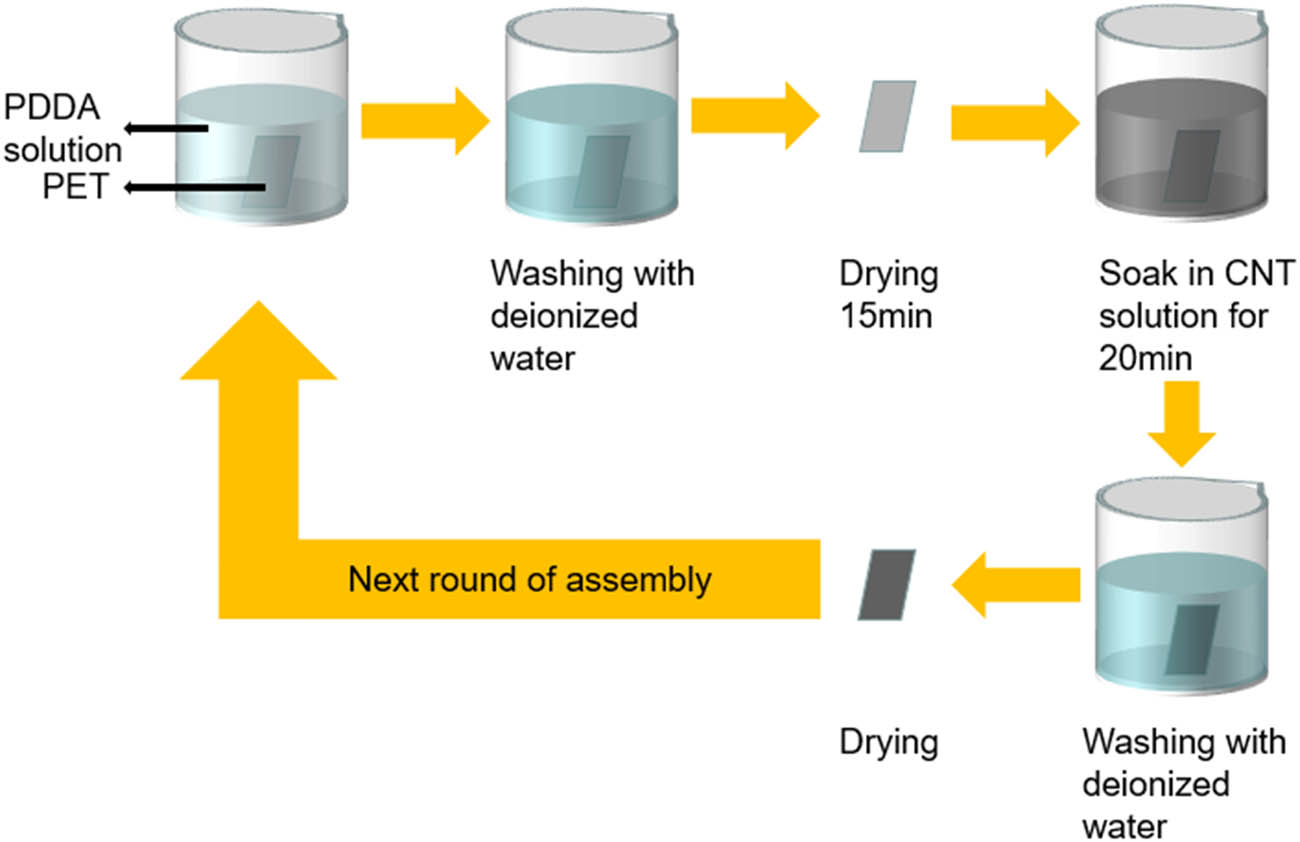
Assembly flowchart of self-assembly CNT film.
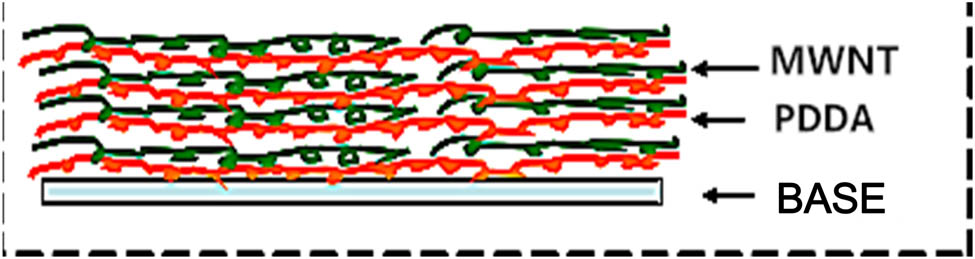
Schematic section structure of CNTFS.
2.3 Test methods
The four-electrode method is used to test the resistance change of different layers of CNTFS. CNTFS, DC power supply, and standard resistance box were in-series connected, by measuring the voltage at both ends of the CNTFS and standard resistance to obtain the resistance value of CNTFS. The four-electrode method effectively avoids the contact resistance between the electrode and CNTFS caused by the electrode acting as both voltage electrode and current electrode in the two-electrode method, which brings out more accurate resistances.
Scanning electron microscopy (SEM, S-5100 type) was used to observe the morphological characteristics of the strain gauge thin-film sensor, and the sample was broken up to observe the cross-sectional morphology.
A universal tensile testing machine (MTS (China) Ltd. Co.) was used to carry out the three-point bending test of the simply supported beam, as shown in Figure 3. The mid-span displacement of the film was controlled from 0 to 5 mm, and the loading rate was 2 mm/min. The resistance changes of the film with different assembly layers were studied under tensile and compressive stress states of the strain sensing film under five cyclic loads. And the sensor parameters involving piezoresistive linearity, sensitivity, repeatability, and hysteresis of the flexible film were comprehensively characterized.
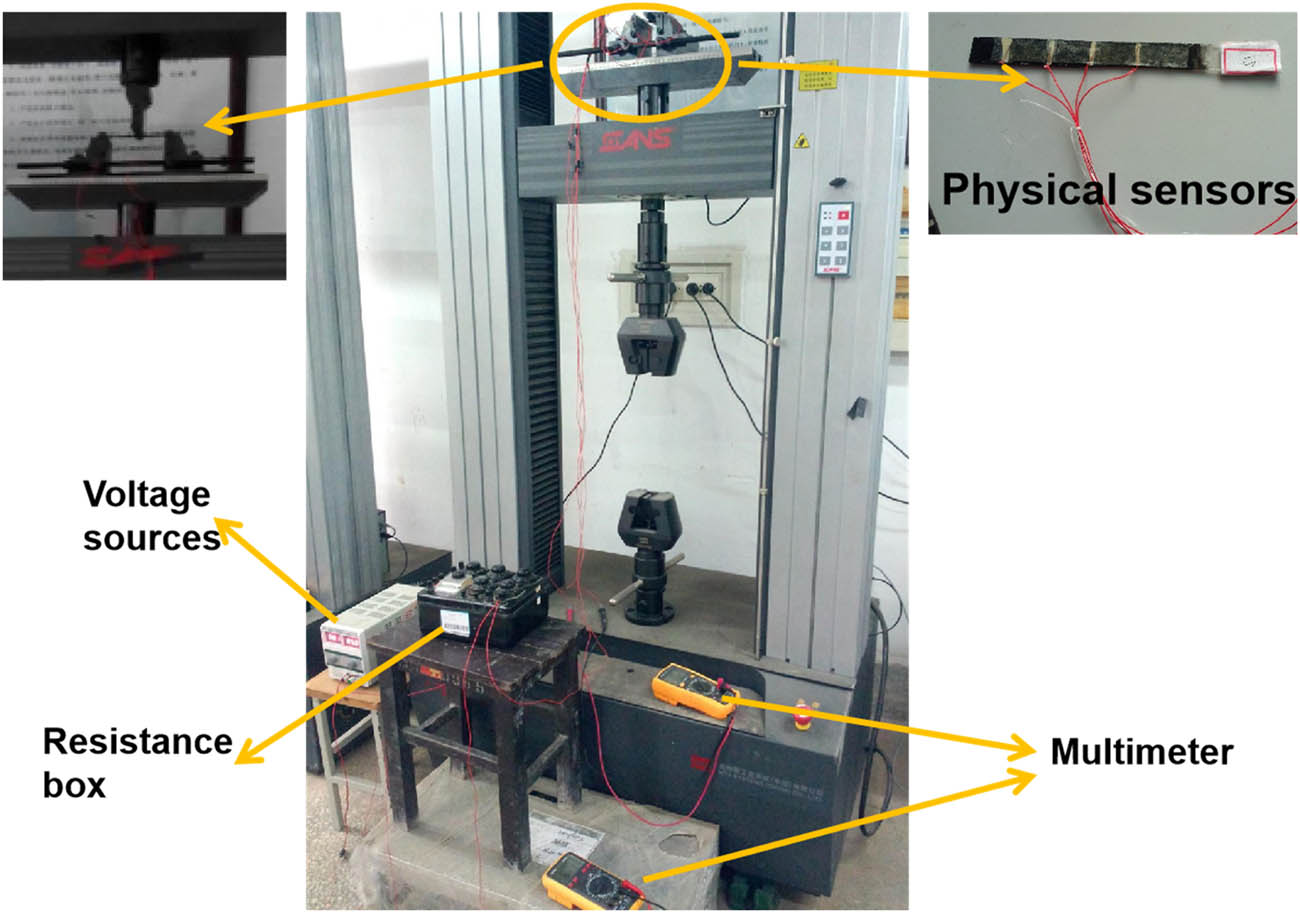
Piezoresistive testing of CNTFS under cyclic loading with four-electrode method by a universal testing machine.
3 Results and discussion
3.1 Morphology of CNTFS
Figure 4(a) shows SEM images of the surface of the CNTFS. Figure 4(b) and (c) shows the film cross-section, where the boundaries between the assembled layers are clear and the CNT is tightly connected to the PDDA, which is conducive to the connection between different layers of CNT and the improvement of electrical conductivity [70]. These pictures show that the CNT is uniformly deposited on the PET sheet, forming a dense, well-bonded, high-purity random CNT structure in the polymeric material, as shown in Figure 4(d), with a homogeneous mixture of CNT and PDDA and a stable ratio distribution, indicating a well-dispersed CNT solution.
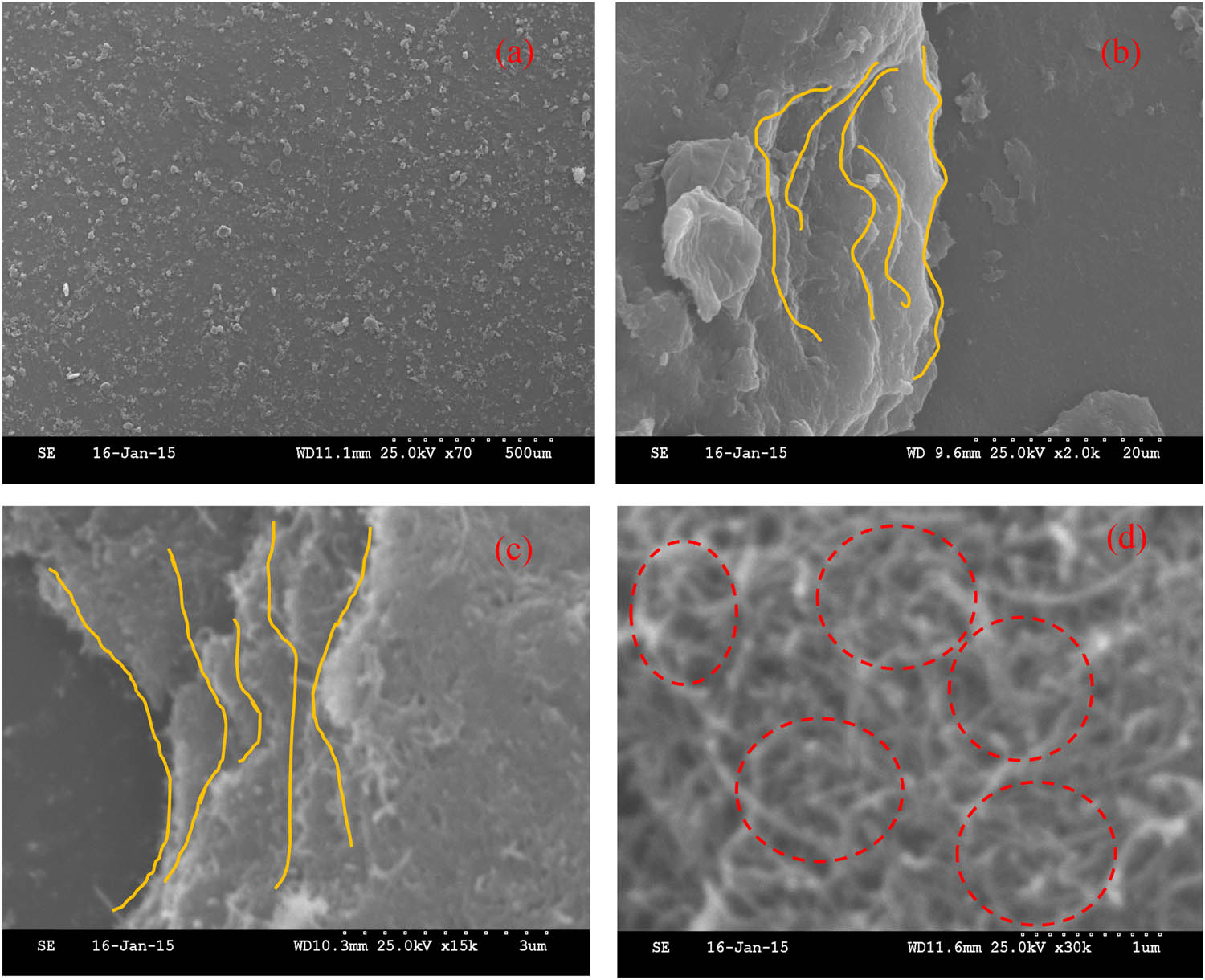
SEM images of self-assembled nine-double-layer CNTFS: (a) ×70, (b) ×2.0 k, (c) ×15 k, and (d) × 30 k (yellow line – assembled layer interface; dashed red circle – CNT distribution network).
3.2 Effect of the number of layers of CNTFS assembly on resistance properties
The trend of the film resistance properties with the number of assembled layers is shown in Figure 5. As the number of layers increases, the film resistance properties tends to decrease. It decreases rapidly at the beginning and then decreases slowly, and after the ninth layer, the trend of decreasing resistance properties is not obvious. The resistivities of 3, 6, 9, and 12 double-layer CNTFS are 127, 103, 18.3, and 7.98 kΩ cm, respectively, and the resistivity of the three-double-layer films is accordingly 15.9 times higher than that of the 12 double-layer film.
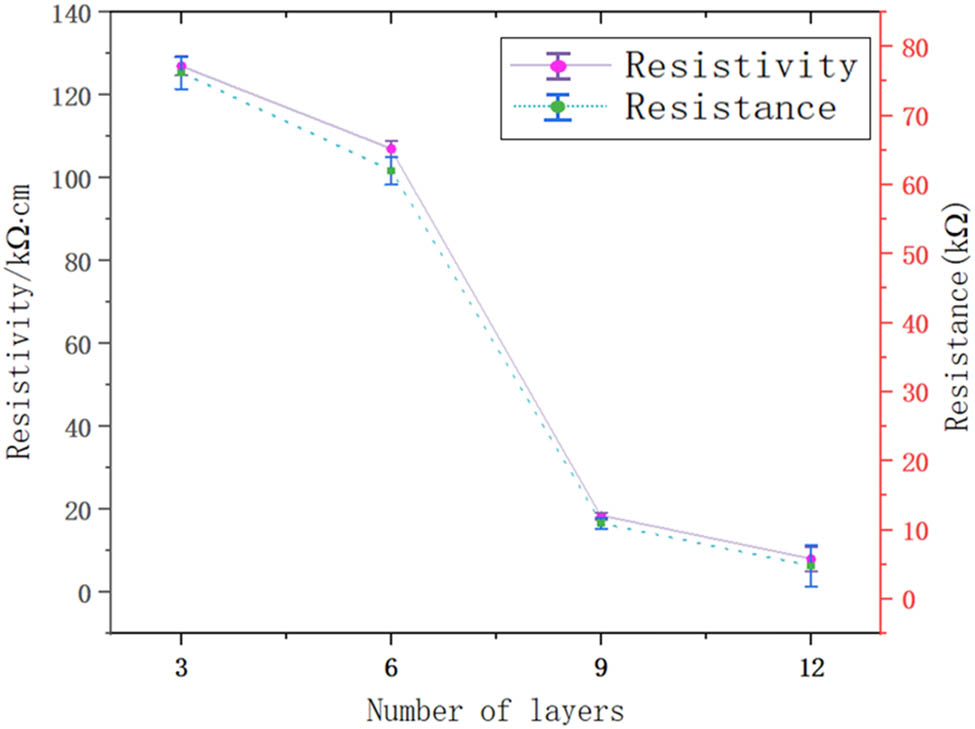
Relationship between the number of layers and resistance properties of CNTFS flexible film.
Figures 6 and 7 show that the relative rate of change in resistance is approximately linear with respect to displacement over the displacement range of 0–5 mm. When the film is compressed, the resistance decreases (ΔR < 0), and conversely when the film is stretched, the resistance increases (ΔR > 0). As the number of double layers increases, the relative change in resistance is the first to show an upward trend, and the relative change in resistance of the film is the largest at nine layers, reaching 80%; the relative change in resistance decreases as the number of double layers continues to increase, and the relative change in resistance of the 12-double-layer film is the smallest at about 50%.
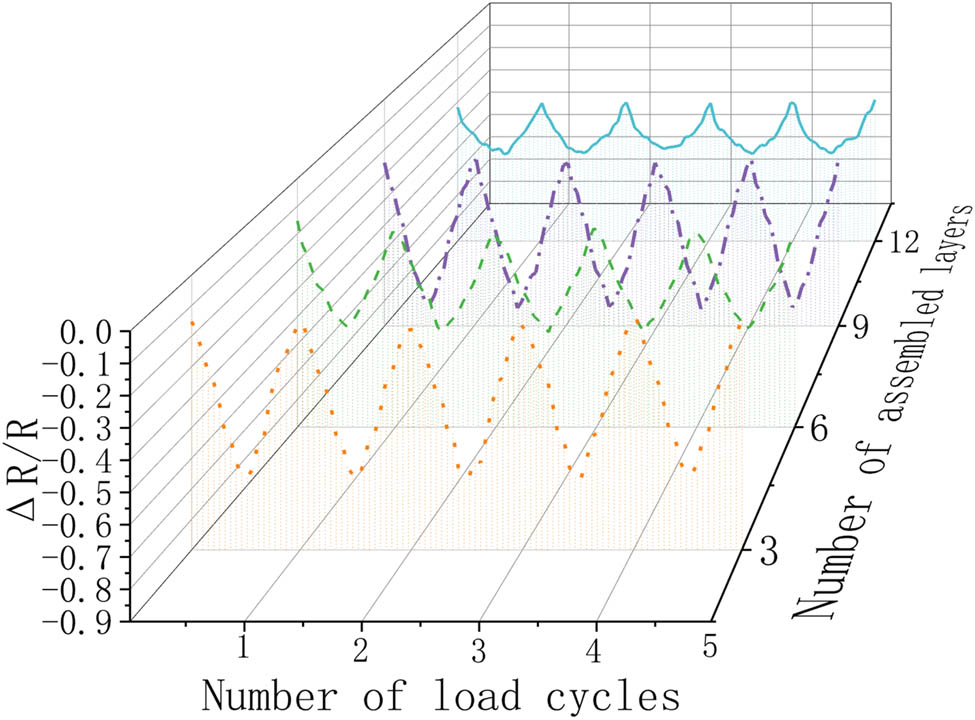
Relationship between change rate of resistance and mid-span displacement of varied double-layer CNTFS in compression side.
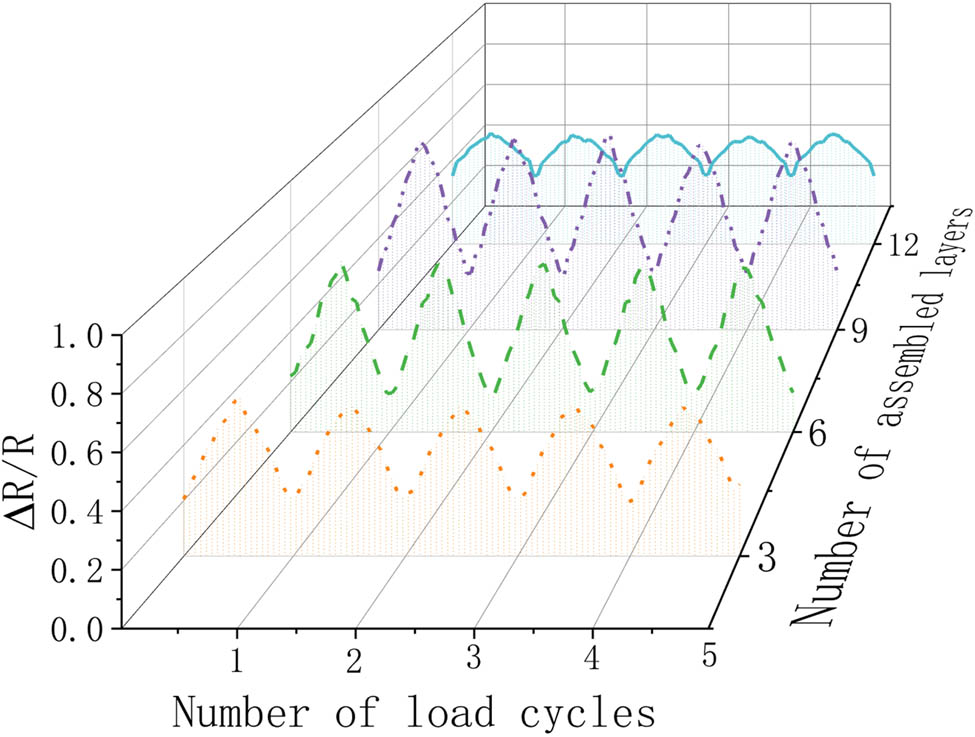
Relationship between change rate of resistance and mid-span displacement of varied double-layer CNTFS in tension side.
This variation in resistance and strain can be attributed to the relationship between the change in cross-sectional area and resistance from a macroscopic point of view. We know that the resistance is inversely proportional to the cross-sectional area when all other conditions are equal. Assume that the volume of the CNTFS remains constant during compression and stretching. When the film is in compression, the cross-sectional area of the film increases and the total film resistance decreases; when the film is stretched, the cross-sectional area decreases, and the total film resistance increases in response.
From the microscopic point of view, it can be understood as the change of CNT resistance. The resistance of the CNT film consists of two parts: the CNT’s own resistance (R 1) and the contact resistance (R 2) between the CNT tubes. The inter-tube contact resistance also includes the resistance R contact generated by direct contact of CNT and the resistance R tunnel generated by the tunneling effect. The piezoresistive effect of CNT is mainly the change in the forbidden bandwidth (E g ) and the inter-tube contact resistance R 2 due to deformation [71,72]. When the film is subjected to external forces, the internal lattice structure of the CNT changes, leading to changes in the tube diameter and helix angle, causing changes in the forbidden bandwidth E g and eventually leading to changes in the CNT’s own resistance R 1. The effect of CNT deformation on E g was noted in the study by Jamal et al. The E g of the original CNT was 0.879 eV, and the E g of the CNT was 0.135 and 1.147 eV for 10% compression and tensile deformation, respectively [73]. Deformation also leads to changes in R 2. Bao et al. argued that the contact between CNT and CNT occurs at the nanoscale, and the contact region consists of only a few atoms, which has a limited impact on the enhancement of conductivity [74]. Thus, film deformation mainly affects R tunnel, and when the film is deformed, the tunneling chance changes subsequently, and the resistance transfer between CNTs is affected, leading to the change of R 2. The change in film resistance is therefore the sum of the changes in R 1 and R 2.
The influence of the tunneling effect on resistance can also explain the trend of resistance varies with the increase in assembly layers. It also confirms the interlayer connection of the CNTs in the SEM image. The PDDA only glues the CNTs to each other and does not wrap the CNTs, and the layers of CNTs are not only simply connected in parallel. When the number of assembled layers increases from 3 to 9, the CNT spacing decreases, and the tunneling probability increases. Under the condition of high CNT, the chance of direct contact between CNT is greatly increased, but CNT may appear agglomerated, which is not conducive to the formation of the conductive pathway. Moreover, mutually close, single-root CNTs that can produce tunneling effects are rarely found. It is easy to know from the circuit knowledge that when two CNTS are effectively overlapped, the current will flow through the path with low resistance formed by overlap. The formed conductive network is not easy to change under the action of external forces [75]. Therefore, when the number of assembled layers continues to increase from 9 to 12, the resistance steadily decreases (Figure 5), but the relative rate of change in resistance becomes worse (Figures 6 and 7).
3.3 Effect of the number of layers of CNTFS assembly on sensing performance
The linearity δ is defined as the percentage of the maximum deviation Δmax between the curve of the relative rate of change of resistance–displacement relationship and its fitted straight line at standard conditions (20 ± 5°C) and the full-scale output value of the relative rate of change of resistance (ΔR/R)F.S.
The ideal sensor should have a strict one-to-one correspondence between input and output, and the smaller the linearity value, the better. The vast majority of current flexible sensors do not have the same characteristic linearity as rigid sensors [76,77], Table 1 shows that the average linearity of the 9-double-layer film is 3.22% minimum and the average linearity of the 12-double-layer film is 6.21% maximum, with a difference of 2.89%. Yasuoka et al. assume that the direct contact resistance is equal to the tunneling resistance and point out that the nonlinear variation of resistance is mainly caused by the tunneling resistance [78]. It is obvious that the linearity of the 12-double-layer CNT/PDDA-PET film cannot be explained.
Linearity of resistivity–displacement curves for different double layers of films
| Number of double layers | |||||
|---|---|---|---|---|---|
| Linearity | Number of load cycles | 3 | 6 | 9 | 12 |
| 1 | Tension | 3.09% | 6.07% | 2.58% | 6.54% |
| Compression | 2.80% | 3.33% | 3.76% | 3.51% | |
| 2 | Tension | 3.69% | 3.23% | 3.11% | 6.31% |
| Compression | 4.15% | 3.91% | 3.99% | 6.52% | |
| 3 | Tension | 3.74% | 2.25% | 2.50% | 6.58% |
| Compression | 4.31% | 3.77% | 2.75% | 5.89% | |
| 4 | Tension | 3.50% | 4.46% | 3.39% | 6.97% |
| Compression | 4.26% | 3.41% | 3.72% | 6.72% | |
| 5 | Tension | 3.82% | 4.67% | 3.11% | 6.57% |
| Compression | 4.80% | 4.40% | 3.29% | 6.51% | |
| Average linearity | 3.82% | 3.95% | 3.22% | 6.21% | |
Figure (8b) gives the sensitivity GF of CNTFS with different assembled layers under five cycles of loading and the same variation pattern as in Table 1. Nine-double-layer films have the largest GF with the average GF value of 0.12684/mm, and 12-double-layer films have the smallest GF of 0.03774/mm. Nine-double-layer films have 3.36 times the GF value of 12-double-layer. Figure 8(c) shows the hysteresis curve, where hysteresis is defined as the percentage of the maximum deviation
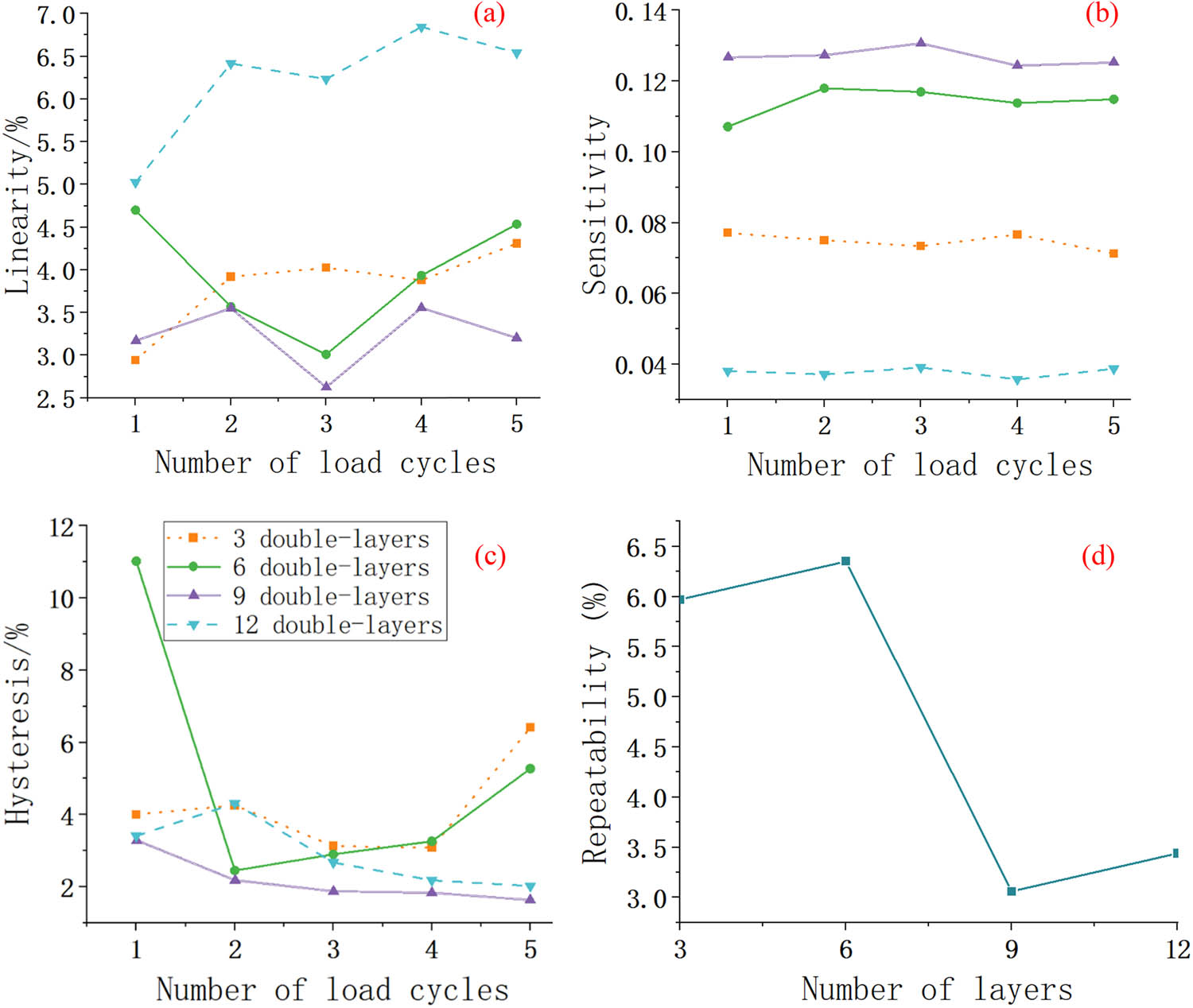
Effect of the number of layers of CNTFS assembly on sensing performance: (a) linearity, (b) sensitivity, (c) hysteresis, and (d) repeatability.
The smaller the hysteresis, the better the performance of the sensor. The hysteresis decreases and then increases with the increase in the number of film layers, reaching a minimum hysteresis average of 2.16% at nine layers.
Repeatability is also an important indicator to describe the sensing performance. When the displacement is changed multiple times for the full range according to the agreed direction, the degree of inconsistency in the relative rate of change of each resistance for each change–displacement, which also reflects the stability of the sensor. The repeatability error,
The e f is described by the maximum deviation in the forward and reverse travels, as shown in Figure 8(d). The maximum repeatability error is 6.35% for the six-double-layer film, and the minimum is 3.06% for the nine-double-layer film, and the nine-double-layer CNTFS has the best sensing repeatability.
Actually, the resistance of the film decreases linearly with increasing compression displacement and increases linearly with increasing tensile displacement. Microscopically, this is because when the CNT is subjected to loading, resulting in changes in diameter and helicity, causing changes in E g , which affects the resistance of the CNT itself. Moreover, the inter-tube distance of CNT also changes, which affects the electron transport and thus causes the inter-tube resistance of CNT to change. Macroscopic analysis suggests that under tensile displacement, the entire length of the film increases, the cross-sectional area decreases, and the overall total resistance of the film increases. In compression, the cross-sectional area decreases and the total resistance decreases.
The change rate of resistance increases with the increase in the number of assembled layers, but when the number of assembled layers exceeds 9, the connection between CNT layers increases, and more conductive networks are formed by direct contact between CNTs, yet the chance of tunneling decreases and the change rate of resistance decreases.
4 Conclusion
The assembled layers of CNTFS are evenly and compactly deposited with about 7–15 μm.
The resistance decreases gradually with the increase in the number of layers of film assembly, and the decreasing trend becomes flat when the number of assembled layers exceeds nine layers.
The CNTFS with varied double layers all show superior piezoresistive performance in terms of linearity, repeatability, and recoverability under five cyclic loadings. The nine-double-layer CNT film shows the most outstanding strain-sensitive performance in terms of linearity, sensitivity, hysteresis, and repeatability whose values are 3.22%, 0.12684/mm, 2.16%, and 3.06%, respectively.
Acknowledgments
The authors are obliged to the conducting mechanism discussion with Prof. Huarong Nie (Qingdao University of Science and Technology).
-
Funding information: This study was financially supported by the NSFC-Shandong Province Joint Key Project (Grant No. U2106222), the National Natural Science Foundation of China (No. 51878364), the project from The Fourth Construction Co., Ltd, China Construction Eighth Engineering Division, and the National “111” project, and Gaofeng discipline project funded by Shandong Province.
-
Author contributions: Conceptualization, supervision, and resources: Jianlin Luo, Jigang Zhang. Data curation, formal analysis, and methodology: Xiaoyang Zhou, Jianlin Luo, and Xiaoping Wu. Funding acquisition, investigation and project administration: Jianlin Luo, Jigang Zhang, and Min Zhu. Validation, visualization, and writing – original draft: Xiaoyang Zhou and Jianlin Luo. Writing – review and editing: Xiaoyang Zhou, Jianlin Luo and Xuejun Tao. All authors have accepted responsibility for the entire content of this manuscript and approved its submission.
-
Conflict of interest: The authors state no conflict of interest.
References
[1] Housner GW, Bergman LA, Caughey TK, Chassiakos AG, Claus RO, Masri SF, et al. Structural control: past, present, and future. J Eng Mech. 1997;123(9):897–971.10.1061/(ASCE)0733-9399(1997)123:9(897)Search in Google Scholar
[2] Mohan S, Banerjee A. Modelling of minor hysteresis loop of shape memory alloy wire actuator and its application in self-sensing. Smart Mater Struct. 2021;30(5):055011.10.1088/1361-665X/abeefaSearch in Google Scholar
[3] Tan X, Bao Y, Zhang Q, Nassif HH, Chen G. Strain transfer effect in distributed fiber optic sensors under an arbitrary field. Automat. Constr. 2021;124:103597.10.1016/j.autcon.2021.103597Search in Google Scholar
[4] Mieloszyk M, Majewska K, Ostachowicz W. Application of embedded fibre Bragg grating sensors for structural health monitoring of complex composite structures for marine applications. Mar Struct. 2021;76:102903.10.1016/j.marstruc.2020.102903Search in Google Scholar
[5] Kosukegawa H, Berkani S, Miki H, Takagi T. Structure and electrical properties of molybdenum-containing diamond-like carbon coatings for use as fatigue sensors. Diam Relat Mater. 2017;80:38–44.10.1016/j.diamond.2017.09.018Search in Google Scholar
[6] Bremer K, Wollweber M, Weigand F, Rahlves M, Kuhne M, Helbig R, et al. Fibre optic sensors for the structural health monitoring of building structures. Procedia Technol. 2016;26:524–9.10.1016/j.protcy.2016.08.065Search in Google Scholar
[7] Taheri S. A review on five key sensors for monitoring of concrete structures. Constr Build Mater. 2019;204:492–509.10.1016/j.conbuildmat.2019.01.172Search in Google Scholar
[8] Su H, Zhang N, Li H. Concrete piezoceramic smart module pairs-based damage diagnosis of hydraulic structure. Compos Struct. 2018;183(Jan):582–93.10.1016/j.compstruct.2017.07.010Search in Google Scholar
[9] Gupta S, Gonzalez JG, Loh KJ. Self-sensing concrete enabled by nano-engineered cement-aggregate interfaces. Struct Health Monit. 2017;16(3):309–23.10.1177/1475921716643867Search in Google Scholar
[10] Ding S, Ruan Y, Yu X, Han B, Ni YQ. Self-monitoring of smart concrete column incorporating CNT/NCB composite fillers modified cementitious sensors. Constr Build Mater. 2019;201:127–37.10.1016/j.conbuildmat.2018.12.203Search in Google Scholar
[11] Dong W, Li W, Tao Z, Wang K. Piezoresistive properties of cement-based sensors: Review and perspective. Constr Build Mater. 2019;203:146–63.10.1016/j.conbuildmat.2019.01.081Search in Google Scholar
[12] Gao S, Luo J, Zhang J, Teng F, Liu C, Feng C, et al. Preparation and piezoresistivity of carbon nanotube-coated sand reinforced cement mortar. Nanotechnol Rev. 2020;9(1):1445–55.10.1515/ntrev-2020-0112Search in Google Scholar
[13] Zhang L, Ding S, Li L, Dong S, Wang D, Yu X, et al. Effect of characteristics of assembly unit of CNT/NCB composite fillers on properties of smart cement-based materials. Compos Part A: Appl Sci Manufac. 2018;109:303–20.10.1016/j.compositesa.2018.03.020Search in Google Scholar
[14] Zhang L, Han B, Ouyang J, Yu X, Sun S, Ou J. Multifunctionality of cement based composite with electrostatic self-assembled CNT/NCB composite filler. Arch Civ Mech Eng. 2017;17(2):354–64.10.1016/j.acme.2016.11.001Search in Google Scholar
[15] Han B, Zhang L, Sun S, Yu X, Dong X, Wu T, et al. Electrostatic self-assembly CNT/NCB composite fillers reinforced cement-based materials with multifunctionality. Compos. Part A: Appl Sci Manufac. 2015;79:103–15.10.1016/j.compositesa.2015.09.016Search in Google Scholar
[16] Zhang L, Ding S, Han B, Yu X, Ni YQ. Effect of water content on the piezoresistive property of smart cement-based materials with carbon nanotube/nanocarbon black composite filler. Compos Part A: Appl Sci Manufac. 2019;119:8–20.10.1016/j.compositesa.2019.01.010Search in Google Scholar
[17] Teng F, Luo J, Gao Y, Zhou X, Zhang J, Gao S, et al. Piezoresistive/piezoelectric intrinsic sensing properties of carbon nanotube cement-based smart composite and its electromechanical sensing mechanisms: A review. Nanotechnol Rev. 2021;10(1):1873–94.10.1515/ntrev-2021-0112Search in Google Scholar
[18] Sarkar L, Singh SG, Vanjari SRK. Preparation and optimization of PVDF thin films for miniaturized sensor and actuator applications. Smart Mater Struct. 2021;30(7):075013.10.1088/1361-665X/abff15Search in Google Scholar
[19] Min SD, Wang C, Park DS, Park JH. Development of a textile capacitive proximity sensor and gait monitoring system for smart healthcare. J Med Syst. 2018;42(4):1–12.10.1007/s10916-018-0928-3Search in Google Scholar PubMed
[20] Yoon SG, Chang ST. Microfluidic capacitive sensors with ionic liquid electrodes and CNT/PDMS nanocomposites for simultaneous sensing of pressure and temperature. J Mater Chem C. 2017;5(8):1910–9.10.1039/C6TC03994DSearch in Google Scholar
[21] Singh K, Sharma S, Shriwastava S, Singla P, Gupta M, Tripathi CC. Significance of nano-materials, designs consideration and fabrication techniques on performances of strain sensors – A review. Mat Sci Semicon Proc. 2020;123(3):105581.10.1016/j.mssp.2020.105581Search in Google Scholar
[22] Jiu J, Suganuma K. Metallic nanowires and their application. IEEE T Comp Pack Man. 2016;6(12):1733–51.10.1109/TCPMT.2016.2581829Search in Google Scholar
[23] Gong XX, Fei GT, Fu WB, Fang M, Gao XD, Zhong BN, et al. Flexible strain sensor with high performance based on PANI/PDMS films. Org Electron. 2017;47:51–6.10.1016/j.orgel.2017.05.001Search in Google Scholar
[24] Le TH, Kim Y, Yoon H. Electrical and electrochemical properties of conducting polymers. Polymers-basel. 2017;9(4):150.10.3390/polym9040150Search in Google Scholar
[25] Iijima Sumio. Helical microtubules of graphitic carbon. Nature. 1991;354(6348):56–8.10.1038/354056a0Search in Google Scholar
[26] Guru K, Sharma T, Sharma T, Shukla KK, Mishra SB. Effect of Interface on the Elastic Modulus of CNT Nanocomposites. J Nanomech Micromech. 2016;6(3):04016004.10.1061/(ASCE)NM.2153-5477.0000109Search in Google Scholar
[27] Jolowsky C, Sweat R, Park JG, Hao A, Liang R. Microstructure evolution and self-assembling of CNT networks during mechanical stretching and mechanical properties of highly aligned CNT composites. Compos Sci Technol. 2018;166:125–30.10.1016/j.compscitech.2018.04.003Search in Google Scholar
[28] Tsentalovich DE, Headrick RJ, Mirri F, Hao J, Behabtu N, Young CC, et al. Influence of Carbon Nanotube Characteristics on Macroscopic Fiber Properties. ACS Appl Mater Inter. 2017;9(41):36189–98.10.1021/acsami.7b10968Search in Google Scholar PubMed
[29] Ebbesen TW, Lezec HJ, Hiura H, Bennett JW, Ghaemi HF, Thio T. Electrical conductivity of individual carbon nanotubes. Nature. 1996;382(6586):54–6.10.1038/382054a0Search in Google Scholar
[30] Chen Y, Zhang Q, Wen X, Yin H, Liu J. A novel CNT encapsulated phase change material with enhanced thermal conductivity and photo-thermal conversion performance. Sol Energ Mat Sol C. 2018;184:82–90.10.1016/j.solmat.2018.04.034Search in Google Scholar
[31] Gspann TS, Juckes SM, Niven JF, Johnson MB, Elliott JA, White MA, et al. High thermal conductivities of carbon nanotube films and micro-fibres and their dependence on morphology. Carbon. 2017;114:160–8.10.1016/j.carbon.2016.12.006Search in Google Scholar
[32] Lu X, Zhang A, Dubrunfaut O, He D, Pichon L, Bai J. Numerical modeling and experimental characterization of the AC conductivity and dielectric properties of CNT/polymer nanocomposites. Compos Sci Technol. 2020;194:108150.10.1016/j.compscitech.2020.108150Search in Google Scholar
[33] Wang H, Zheng K, Zhang X, Ding X, Zhang Z, Bao C, et al. 3D network porous polymeric composites with outstanding electromagnetic interference shielding. Compos Sci Technol. 2016;125:22–9.10.1016/j.compscitech.2016.01.007Search in Google Scholar
[34] Barathi Dassan EG, Anjang Ab Rahman A, Abidin MSZ, Akil HM. Carbon nanotube–reinforced polymer composite for electromagnetic interference application: A review. Nanotechnol Rev. 2020;9(1):768–88.10.1515/ntrev-2020-0064Search in Google Scholar
[35] Yu MF, Lourie O, Dyer MJ, Moloni K, Kelly TF, Ruoff RS. Strength and breaking mechanism of multiwalled carbon nanotubes under tensile load. Science. 2000;287(5453):637–40.10.1126/science.287.5453.637Search in Google Scholar PubMed
[36] Yu MF, Files BS, Arepalli S, Ruoff RS. Tensile loading of ropes of single wall carbon nanotubes and their mechanical properties. Phys Rev Lett. 2000;84(24):5552–5.10.1103/PhysRevLett.84.5552Search in Google Scholar PubMed
[37] Ghahramani P, Behdinan K, Moradi-Dastjerdi R, Naguib HE. Theoretical and experimental investigation of MWCNT dispersion effect on the elastic modulus of flexible PDMS/MWCNT nanocomposites. Nanotechnol Rev. 2022;11(1):55–64.10.1515/ntrev-2022-0006Search in Google Scholar
[38] Chen S, Luo J, Wang X, Li Q, Zhou L, Liu C, et al. Fabrication and piezoresistive/piezoelectric sensing characteristics of carbon nanotube/PVA/nano-ZnO flexible composite. Sci Rep-UK. 2020;10(1):8895.10.1038/s41598-020-65771-xSearch in Google Scholar PubMed PubMed Central
[39] Liu J, Hui D, Lau D. Two-dimensional nanomaterial-based polymer composites: Fundamentals and applications. Nanotechnol Rev. 2022;11(1):770–92.10.1515/ntrev-2022-0041Search in Google Scholar
[40] Zhang L, Li L, Wang Y, Yu X, Han B. Multifunctional cement-based materials modified with electrostatic self-assembled CNT/TiO2 composite filler. Constr Build Mater. 2020;238:117787.10.1016/j.conbuildmat.2019.117787Search in Google Scholar
[41] Zhang L, Zheng Q, Dong X, Yu X, Wang Y, Han B. Tailoring sensing properties of smart cementitious composites based on excluded volume theory and electrostatic self-assembly. Constr Build Mater. 2020;256:119452.10.1016/j.conbuildmat.2020.119452Search in Google Scholar
[42] Mukai K, Asaka K, Wu X, Morimoto T, Okazaki T, Saito T, et al. Wet spinning of continuous polymer-free carbon-nanotube fibers with high electrical conductivity and strength. Appl Phys Express. 2016;9(5):055101.10.7567/APEX.9.055101Search in Google Scholar
[43] He Z, Zhou G, Byun JH, Lee SK, Um MK, Park B, et al. Highly stretchable multi-walled carbon nanotube/thermoplastic polyurethane composite fibers for ultrasensitive, wearable strain sensors. Nanoscale. 2019;11(13):5884–90.10.1039/C9NR01005JSearch in Google Scholar
[44] Qiu L, Wang X, Tang D, Zheng X, Norris PM, Wen D, et al. Functionalization and densification of inter-bundle interfaces for improvement in electrical and thermal transport of carbon nanotube fibers. Carbon. 2016;105:248–259.10.1016/j.carbon.2016.04.043Search in Google Scholar
[45] Jiang Q, Wu L. Property enhancement of aligned carbon nanotube/polyimide composite by strategic prestraining. J Reinf Plast Comp. 2016;35(4):287–94.10.1177/0731684415614086Search in Google Scholar
[46] Nam TH, Goto K, Yamaguchi Y, Premalal EVA, Shimamura Y, et al. Improving mechanical properties of high volume fraction aligned multi-walled carbon nanotube/epoxy composites by stretching and pressing. Compos. B Eng. 2016;85:15–23.10.1016/j.compositesb.2015.09.012Search in Google Scholar
[47] Zhang Z, Zhang Y, Jiang X, Bukhari H, Zhang Z, Han W, et al. Simple and efficient pressure sensor based on PDMS wrapped CNT arrays. Carbon. 2019;155:71–76.10.1016/j.carbon.2019.08.018Search in Google Scholar
[48] Wu D, Wei M, Li R, Xiao T, Gong S, Xiao Z, et al. A percolation network model to predict the electrical property of flexible CNT/PDMS composite films fabricated by spin coating technique . Compos B Eng. 2019;174:107034.10.1016/j.compositesb.2019.107034Search in Google Scholar
[49] Shajari S, Ramakrishnan S, Karan K, Sudak LJ, Sundararaj U. Ultrasensitive wearable sensor with novel hybrid structures of silver nanowires and carbon nanotubes in fluoroelastomer: Multi-directional sensing for human health monitoring and stretchable electronics. Appl Mater Tody. 2022;26:101295.10.1016/j.apmt.2021.101295Search in Google Scholar
[50] Atiq Ur Rehman M, Chen Q, Braem A, Shaffer MSP, Boccaccini AR. Electrophoretic deposition of carbon nanotubes: recent progress and remaining challenges. Int Mate Rev. 2021;66(8):533–62.10.1080/09506608.2020.1831299Search in Google Scholar
[51] Zhang J, Wang M, Yang Z, Zhang X. Highly flexible and stretchable strain sensors based on conductive whisker carbon nanotube films. Carbon. 2021;176:139–47.10.1016/j.carbon.2021.01.130Search in Google Scholar
[52] Stanković NK, Todorović-Marković BM, Marković ZM. Self-assembly of carbon based nanoparticles films by Langmuir-Blodgett method. J Serb Chem Soc. 2020;85(9):1095–127.10.2298/JSC191225008SSearch in Google Scholar
[53] Wu S, Shi E, Yang Y, Xu W, Li X, Cao A. Direct fabrication of carbon nanotube-graphene hybrid films by a blown bubble method. Nano Res. 2015;8(5):1746–54.10.1007/s12274-014-0679-5Search in Google Scholar
[54] Gupta S, Heintzman E, Price C. Electrostatic layer-by-layer self-assembled graphene/multi-walled carbon nanotubes hybrid multilayers as efficient ‘all carbon’supercapacitors. J Nanosci Nanotechno. 2016;16(5):4771–82.10.1166/jnn.2016.12413Search in Google Scholar PubMed
[55] Tang X, Cheng D, Ran J, Li D, He C, Bi S, et al. Recent advances on the fabrication methods of nanocomposite yarn-based strain sensor. Nanotechnol Rev. 2021;10(1):221–36.10.1515/ntrev-2021-0021Search in Google Scholar
[56] Arslan M, Dönmez G, Ergün A, Okutan M, Albayrak Arı G, Deligöz H. Preparation, characterization, and separation performances of novel surface modified LbL composite membranes from polyelectrolyte blends and MWCNT. Polym Eng Sci. 2020;60(2):341–51.10.1002/pen.25289Search in Google Scholar
[57] Olek M, Ostrander J, Jurga S, Möhwald H, Kotov N, Kempa K, et al. Layer-by-Layer assembled composites from Multiwall carbon nanotubes with different morphologies. Nano Lett. 2004;4(10):1889–95.10.1021/nl048950wSearch in Google Scholar
[58] Mamedov AA, Kotov NA, Prato M, Guldi DM, Wicksted JP, Hirsch A. Molecular design of strong single-wall carbon nanotube/polyelectrolyte multilayer composites. Nat Mater. 2002;1(3):190–4.10.1038/nmat747Search in Google Scholar PubMed
[59] Yang M, Yang Y, Yang H, Shen G, Yu R. Layer-by-layer self-assembled multilayer films of carbon nanotubes and platinum nanoparticles with polyelectrolyte for the fabrication of biosensors. Biomaterials. 2006;27(2):246–55.10.1016/j.biomaterials.2005.05.077Search in Google Scholar PubMed
[60] Hong TK, Lee DW, Choi HJ, Shin HS, Kim BS. Transparent, flexible conducting hybrid multilayer thin films of multiwalled carbon nanotubes with graphene nanosheets. ACS Nano. 2010;4(7):3861–8.10.1021/nn100897gSearch in Google Scholar PubMed
[61] Park YT, Ham AY, Grunlan JC. High electrical conductivity and transparency in deoxycholate-stabilized carbon nanotube thin films. J Phys Chem C. 2010;114(14):6325–33.10.1021/jp911985gSearch in Google Scholar
[62] Zhu P, Kuang Y, Wei Y, Li F, Ou H, Jiang F, et al. Electrostatic self-assembly enabled flexible paper-based humidity sensor with high sensitivity and superior durability. Chem Eng J. 2021;404:127105.10.1016/j.cej.2020.127105Search in Google Scholar PubMed PubMed Central
[63] Ma Z, Wei A, Ma J, Shao L, Jiang H, Dong D, et al. Lightweight, compressible and electrically conductive polyurethane sponges coated with synergistic multiwalled carbon nanotubes and graphene for piezoresistive sensors. Nanoscale. 2018;10(15):7116–26.10.1039/C8NR00004BSearch in Google Scholar
[64] Zhang P, Chen Y, Li Y, Zhao Y, Wang W, Li S, et al. Flexible piezoresistive sensor with the microarray structure based on self-assembly of multi-walled carbon nanotubes. Sensors. 2019;19(22):4985.10.3390/s19224985Search in Google Scholar PubMed PubMed Central
[65] Wang W. Human flexible strain sensor based on PDMS/MWCNTs Layer-by-Layer Self-assembly. Thesis Shandong Univ Sci Technol. 2020 (in Chinese). Search in Google Scholar
[66] Wang W, Chen D, Liu J, Zhu J, Zhang P, Yang L, et al. Strain sensor for full-scale motion monitoring based on self-assembled PDMS/MWCNTs layers. J Phys D Appl Phys. 2019;53(9):095405.10.1088/1361-6463/ab5b2bSearch in Google Scholar
[67] Zhang D, Tong J, Xia B, Xue Q. Ultrahigh performance humidity sensor based on Layer-by-layer self-assembly of graphene oxide/polyelectrolyte nanocomposite film. Sensor. Actuat B-Chem. 2014;203:263–70.10.1016/j.snb.2014.06.116Search in Google Scholar
[68] Xiang Y, Lu S. Layer-by-layer self-assembly in the development of electrochemical energy conversion and storage devices from fuel cells to supercapacitors. Chem Soc Rev. 2012;41(21):7291–321.10.1039/c2cs35048cSearch in Google Scholar PubMed
[69] Khanchaitit P, Aht‐Ong D. Continuous surface modification process with ultraviolet/ozone for improving interfacial adhesion of poly (ethylene terephthalate)/epoxy composites. Polym Compos. 2006;27(5):484–90.10.1002/pc.20216Search in Google Scholar
[70] Gao E, Cao Y, Liu Y, Xu Z. Optimizing interfacial cross-linking in graphene-derived materials, which balances intralayer and interlayer load transfer. ACS Appl Mater Inter. 2017;9(29):24830–9.10.1021/acsami.7b04411Search in Google Scholar PubMed
[71] Lyapkosova OS, Lebedev NG. Piezoresistive effect in single-walled carbon nanotubes. Phys Solid State. 2012;54(7):1501–6.10.1134/S1063783412070232Search in Google Scholar
[72] Grow RJ. Electromechanical properties and applications of carbon nanotubes. Carbon nanotubes properties and applications. USA: CRC Press; 2018. p. 187–212.10.1201/9781315222127-7Search in Google Scholar
[73] Talla JA, Alsalieby AF. Effect of uniaxial tensile strength on the electrical properties of doped carbon nanotubes: density functional theory. Chin J Phys. 2019;59:418–25.10.1016/j.cjph.2019.01.022Search in Google Scholar
[74] Bao WS, Meguid SA, Zhu ZH, Weng GJ. Tunneling resistance and its effect on the electrical conductivity of carbon nanotube nanocomposites. J Appl Phys. 2012;111(9):7492.10.1063/1.4716010Search in Google Scholar
[75] Sun YY. Study on the Linearization of the Pressure Sensors Made of CNT/polymer Composite. Thesis Southwest Univ Sci Technol. 2019 (in Chinese). Search in Google Scholar
[76] Gao Y, Luo J, Zhang J, Zhou X, Teng F, Liu C, et al. Repairing performances of novel cement mortar modified with graphene oxide and polyacrylate polymer. Nanotechnol Rev. 2022;11(1):1778–91.10.1515/ntrev-2022-0091Search in Google Scholar
[77] Sanli A, Kanoun O. Electrical impedance analysis of carbon nanotube/epoxy nanocomposite-based piezoresistive strain sensors under uniaxial cyclic static tensile loading. J Compos Mater. 2020;54(6):845–55.10.1177/0021998319870592Search in Google Scholar
[78] Yasuoka T, Shimamura Y, Todoroki A. Electrical resistance change under strain of CNF/flexible-epoxy composite. Adv Compos Mater. 2010;19(2):123–38.10.1163/092430410X490446Search in Google Scholar
[79] He Y, Ming Y, Li W, Li Y, Wu M, Song J, et al. Highly Stable and Flexible Pressure Sensors with Modified Multi-Walled Carbon Nanotube/Polymer Composites for Human Monitoring. Sensors. 2018;18(5):1338.10.3390/s18051338Search in Google Scholar PubMed PubMed Central
© 2022 Xiaoyang Zhou et al., published by De Gruyter
This work is licensed under the Creative Commons Attribution 4.0 International License.
Articles in the same Issue
- Research Articles
- Theoretical and experimental investigation of MWCNT dispersion effect on the elastic modulus of flexible PDMS/MWCNT nanocomposites
- Mechanical, morphological, and fracture-deformation behavior of MWCNTs-reinforced (Al–Cu–Mg–T351) alloy cast nanocomposites fabricated by optimized mechanical milling and powder metallurgy techniques
- Flammability and physical stability of sugar palm crystalline nanocellulose reinforced thermoplastic sugar palm starch/poly(lactic acid) blend bionanocomposites
- Glutathione-loaded non-ionic surfactant niosomes: A new approach to improve oral bioavailability and hepatoprotective efficacy of glutathione
- Relationship between mechano-bactericidal activity and nanoblades density on chemically strengthened glass
- In situ regulation of microstructure and microwave-absorbing properties of FeSiAl through HNO3 oxidation
- Research on a mechanical model of magnetorheological fluid different diameter particles
- Nanomechanical and dynamic mechanical properties of rubber–wood–plastic composites
- Investigative properties of CeO2 doped with niobium: A combined characterization and DFT studies
- Miniaturized peptidomimetics and nano-vesiculation in endothelin types through probable nano-disk formation and structure property relationships of endothelins’ fragments
- N/S co-doped CoSe/C nanocubes as anode materials for Li-ion batteries
- Synergistic effects of halloysite nanotubes with metal and phosphorus additives on the optimal design of eco-friendly sandwich panels with maximum flame resistance and minimum weight
- Octreotide-conjugated silver nanoparticles for active targeting of somatostatin receptors and their application in a nebulized rat model
- Controllable morphology of Bi2S3 nanostructures formed via hydrothermal vulcanization of Bi2O3 thin-film layer and their photoelectrocatalytic performances
- Development of (−)-epigallocatechin-3-gallate-loaded folate receptor-targeted nanoparticles for prostate cancer treatment
- Enhancement of the mechanical properties of HDPE mineral nanocomposites by filler particles modulation of the matrix plastic/elastic behavior
- Effect of plasticizers on the properties of sugar palm nanocellulose/cinnamon essential oil reinforced starch bionanocomposite films
- Optimization of nano coating to reduce the thermal deformation of ball screws
- Preparation of efficient piezoelectric PVDF–HFP/Ni composite films by high electric field poling
- MHD dissipative Casson nanofluid liquid film flow due to an unsteady stretching sheet with radiation influence and slip velocity phenomenon
- Effects of nano-SiO2 modification on rubberised mortar and concrete with recycled coarse aggregates
- Mechanical and microscopic properties of fiber-reinforced coal gangue-based geopolymer concrete
- Effect of morphology and size on the thermodynamic stability of cerium oxide nanoparticles: Experiment and molecular dynamics calculation
- Mechanical performance of a CFRP composite reinforced via gelatin-CNTs: A study on fiber interfacial enhancement and matrix enhancement
- A practical review over surface modification, nanopatterns, emerging materials, drug delivery systems, and their biophysiochemical properties for dental implants: Recent progresses and advances
- HTR: An ultra-high speed algorithm for cage recognition of clathrate hydrates
- Effects of microalloying elements added by in situ synthesis on the microstructure of WCu composites
- A highly sensitive nanobiosensor based on aptamer-conjugated graphene-decorated rhodium nanoparticles for detection of HER2-positive circulating tumor cells
- Progressive collapse performance of shear strengthened RC frames by nano CFRP
- Core–shell heterostructured composites of carbon nanotubes and imine-linked hyperbranched polymers as metal-free Li-ion anodes
- A Galerkin strategy for tri-hybridized mixture in ethylene glycol comprising variable diffusion and thermal conductivity using non-Fourier’s theory
- Simple models for tensile modulus of shape memory polymer nanocomposites at ambient temperature
- Preparation and morphological studies of tin sulfide nanoparticles and use as efficient photocatalysts for the degradation of rhodamine B and phenol
- Polyethyleneimine-impregnated activated carbon nanofiber composited graphene-derived rice husk char for efficient post-combustion CO2 capture
- Electrospun nanofibers of Co3O4 nanocrystals encapsulated in cyclized-polyacrylonitrile for lithium storage
- Pitting corrosion induced on high-strength high carbon steel wire in high alkaline deaerated chloride electrolyte
- Formulation of polymeric nanoparticles loaded sorafenib; evaluation of cytotoxicity, molecular evaluation, and gene expression studies in lung and breast cancer cell lines
- Engineered nanocomposites in asphalt binders
- Influence of loading voltage, domain ratio, and additional load on the actuation of dielectric elastomer
- Thermally induced hex-graphene transitions in 2D carbon crystals
- The surface modification effect on the interfacial properties of glass fiber-reinforced epoxy: A molecular dynamics study
- Molecular dynamics study of deformation mechanism of interfacial microzone of Cu/Al2Cu/Al composites under tension
- Nanocolloid simulators of luminescent solar concentrator photovoltaic windows
- Compressive strength and anti-chloride ion penetration assessment of geopolymer mortar merging PVA fiber and nano-SiO2 using RBF–BP composite neural network
- Effect of 3-mercapto-1-propane sulfonate sulfonic acid and polyvinylpyrrolidone on the growth of cobalt pillar by electrodeposition
- Dynamics of convective slippery constraints on hybrid radiative Sutterby nanofluid flow by Galerkin finite element simulation
- Preparation of vanadium by the magnesiothermic self-propagating reduction and process control
- Microstructure-dependent photoelectrocatalytic activity of heterogeneous ZnO–ZnS nanosheets
- Cytotoxic and pro-inflammatory effects of molybdenum and tungsten disulphide on human bronchial cells
- Improving recycled aggregate concrete by compression casting and nano-silica
- Chemically reactive Maxwell nanoliquid flow by a stretching surface in the frames of Newtonian heating, nonlinear convection and radiative flux: Nanopolymer flow processing simulation
- Nonlinear dynamic and crack behaviors of carbon nanotubes-reinforced composites with various geometries
- Biosynthesis of copper oxide nanoparticles and its therapeutic efficacy against colon cancer
- Synthesis and characterization of smart stimuli-responsive herbal drug-encapsulated nanoniosome particles for efficient treatment of breast cancer
- Homotopic simulation for heat transport phenomenon of the Burgers nanofluids flow over a stretching cylinder with thermal convective and zero mass flux conditions
- Incorporation of copper and strontium ions in TiO2 nanotubes via dopamine to enhance hemocompatibility and cytocompatibility
- Mechanical, thermal, and barrier properties of starch films incorporated with chitosan nanoparticles
- Mechanical properties and microstructure of nano-strengthened recycled aggregate concrete
- Glucose-responsive nanogels efficiently maintain the stability and activity of therapeutic enzymes
- Tunning matrix rheology and mechanical performance of ultra-high performance concrete using cellulose nanofibers
- Flexible MXene/copper/cellulose nanofiber heat spreader films with enhanced thermal conductivity
- Promoted charge separation and specific surface area via interlacing of N-doped titanium dioxide nanotubes on carbon nitride nanosheets for photocatalytic degradation of Rhodamine B
- Elucidating the role of silicon dioxide and titanium dioxide nanoparticles in mitigating the disease of the eggplant caused by Phomopsis vexans, Ralstonia solanacearum, and root-knot nematode Meloidogyne incognita
- An implication of magnetic dipole in Carreau Yasuda liquid influenced by engine oil using ternary hybrid nanomaterial
- Robust synthesis of a composite phase of copper vanadium oxide with enhanced performance for durable aqueous Zn-ion batteries
- Tunning self-assembled phases of bovine serum albumin via hydrothermal process to synthesize novel functional hydrogel for skin protection against UVB
- A comparative experimental study on damping properties of epoxy nanocomposite beams reinforced with carbon nanotubes and graphene nanoplatelets
- Lightweight and hydrophobic Ni/GO/PVA composite aerogels for ultrahigh performance electromagnetic interference shielding
- Research on the auxetic behavior and mechanical properties of periodically rotating graphene nanostructures
- Repairing performances of novel cement mortar modified with graphene oxide and polyacrylate polymer
- Closed-loop recycling and fabrication of hydrophilic CNT films with high performance
- Design of thin-film configuration of SnO2–Ag2O composites for NO2 gas-sensing applications
- Study on stress distribution of SiC/Al composites based on microstructure models with microns and nanoparticles
- PVDF green nanofibers as potential carriers for improving self-healing and mechanical properties of carbon fiber/epoxy prepregs
- Osteogenesis capability of three-dimensionally printed poly(lactic acid)-halloysite nanotube scaffolds containing strontium ranelate
- Silver nanoparticles induce mitochondria-dependent apoptosis and late non-canonical autophagy in HT-29 colon cancer cells
- Preparation and bonding mechanisms of polymer/metal hybrid composite by nano molding technology
- Damage self-sensing and strain monitoring of glass-reinforced epoxy composite impregnated with graphene nanoplatelet and multiwalled carbon nanotubes
- Thermal analysis characterisation of solar-powered ship using Oldroyd hybrid nanofluids in parabolic trough solar collector: An optimal thermal application
- Pyrene-functionalized halloysite nanotubes for simultaneously detecting and separating Hg(ii) in aqueous media: A comprehensive comparison on interparticle and intraparticle excimers
- Fabrication of self-assembly CNT flexible film and its piezoresistive sensing behaviors
- Thermal valuation and entropy inspection of second-grade nanoscale fluid flow over a stretching surface by applying Koo–Kleinstreuer–Li relation
- Mechanical properties and microstructure of nano-SiO2 and basalt-fiber-reinforced recycled aggregate concrete
- Characterization and tribology performance of polyaniline-coated nanodiamond lubricant additives
- Combined impact of Marangoni convection and thermophoretic particle deposition on chemically reactive transport of nanofluid flow over a stretching surface
- Spark plasma extrusion of binder free hydroxyapatite powder
- An investigation on thermo-mechanical performance of graphene-oxide-reinforced shape memory polymer
- Effect of nanoadditives on the novel leather fiber/recycled poly(ethylene-vinyl-acetate) polymer composites for multifunctional applications: Fabrication, characterizations, and multiobjective optimization using central composite design
- Design selection for a hemispherical dimple core sandwich panel using hybrid multi-criteria decision-making methods
- Improving tensile strength and impact toughness of plasticized poly(lactic acid) biocomposites by incorporating nanofibrillated cellulose
- Green synthesis of spinel copper ferrite (CuFe2O4) nanoparticles and their toxicity
- The effect of TaC and NbC hybrid and mono-nanoparticles on AA2024 nanocomposites: Microstructure, strengthening, and artificial aging
- Excited-state geometry relaxation of pyrene-modified cellulose nanocrystals under UV-light excitation for detecting Fe3+
- Effect of CNTs and MEA on the creep of face-slab concrete at an early age
- Effect of deformation conditions on compression phase transformation of AZ31
- Application of MXene as a new generation of highly conductive coating materials for electromembrane-surrounded solid-phase microextraction
- A comparative study of the elasto-plastic properties for ceramic nanocomposites filled by graphene or graphene oxide nanoplates
- Encapsulation strategies for improving the biological behavior of CdS@ZIF-8 nanocomposites
- Biosynthesis of ZnO NPs from pumpkin seeds’ extract and elucidation of its anticancer potential against breast cancer
- Preliminary trials of the gold nanoparticles conjugated chrysin: An assessment of anti-oxidant, anti-microbial, and in vitro cytotoxic activities of a nanoformulated flavonoid
- Effect of micron-scale pores increased by nano-SiO2 sol modification on the strength of cement mortar
- Fractional simulations for thermal flow of hybrid nanofluid with aluminum oxide and titanium oxide nanoparticles with water and blood base fluids
- The effect of graphene nano-powder on the viscosity of water: An experimental study and artificial neural network modeling
- Development of a novel heat- and shear-resistant nano-silica gelling agent
- Characterization, biocompatibility and in vivo of nominal MnO2-containing wollastonite glass-ceramic
- Entropy production simulation of second-grade magnetic nanomaterials flowing across an expanding surface with viscidness dissipative flux
- Enhancement in structural, morphological, and optical properties of copper oxide for optoelectronic device applications
- Aptamer-functionalized chitosan-coated gold nanoparticle complex as a suitable targeted drug carrier for improved breast cancer treatment
- Performance and overall evaluation of nano-alumina-modified asphalt mixture
- Analysis of pure nanofluid (GO/engine oil) and hybrid nanofluid (GO–Fe3O4/engine oil): Novel thermal and magnetic features
- Synthesis of Ag@AgCl modified anatase/rutile/brookite mixed phase TiO2 and their photocatalytic property
- Mechanisms and influential variables on the abrasion resistance hydraulic concrete
- Synergistic reinforcement mechanism of basalt fiber/cellulose nanocrystals/polypropylene composites
- Achieving excellent oxidation resistance and mechanical properties of TiB2–B4C/carbon aerogel composites by quick-gelation and mechanical mixing
- Microwave-assisted sol–gel template-free synthesis and characterization of silica nanoparticles obtained from South African coal fly ash
- Pulsed laser-assisted synthesis of nano nickel(ii) oxide-anchored graphitic carbon nitride: Characterizations and their potential antibacterial/anti-biofilm applications
- Effects of nano-ZrSi2 on thermal stability of phenolic resin and thermal reusability of quartz–phenolic composites
- Benzaldehyde derivatives on tin electroplating as corrosion resistance for fabricating copper circuit
- Mechanical and heat transfer properties of 4D-printed shape memory graphene oxide/epoxy acrylate composites
- Coupling the vanadium-induced amorphous/crystalline NiFe2O4 with phosphide heterojunction toward active oxygen evolution reaction catalysts
- Graphene-oxide-reinforced cement composites mechanical and microstructural characteristics at elevated temperatures
- Gray correlation analysis of factors influencing compressive strength and durability of nano-SiO2 and PVA fiber reinforced geopolymer mortar
- Preparation of layered gradient Cu–Cr–Ti alloy with excellent mechanical properties, thermal stability, and electrical conductivity
- Recovery of Cr from chrome-containing leather wastes to develop aluminum-based composite material along with Al2O3 ceramic particles: An ingenious approach
- Mechanisms of the improved stiffness of flexible polymers under impact loading
- Anticancer potential of gold nanoparticles (AuNPs) using a battery of in vitro tests
- Review Articles
- Proposed approaches for coronaviruses elimination from wastewater: Membrane techniques and nanotechnology solutions
- Application of Pickering emulsion in oil drilling and production
- The contribution of microfluidics to the fight against tuberculosis
- Graphene-based biosensors for disease theranostics: Development, applications, and recent advancements
- Synthesis and encapsulation of iron oxide nanorods for application in magnetic hyperthermia and photothermal therapy
- Contemporary nano-architectured drugs and leads for ανβ3 integrin-based chemotherapy: Rationale and retrospect
- State-of-the-art review of fabrication, application, and mechanical properties of functionally graded porous nanocomposite materials
- Insights on magnetic spinel ferrites for targeted drug delivery and hyperthermia applications
- A review on heterogeneous oxidation of acetaminophen based on micro and nanoparticles catalyzed by different activators
- Early diagnosis of lung cancer using magnetic nanoparticles-integrated systems
- Advances in ZnO: Manipulation of defects for enhancing their technological potentials
- Efficacious nanomedicine track toward combating COVID-19
- A review of the design, processes, and properties of Mg-based composites
- Green synthesis of nanoparticles for varied applications: Green renewable resources and energy-efficient synthetic routes
- Two-dimensional nanomaterial-based polymer composites: Fundamentals and applications
- Recent progress and challenges in plasmonic nanomaterials
- Apoptotic cell-derived micro/nanosized extracellular vesicles in tissue regeneration
- Electronic noses based on metal oxide nanowires: A review
- Framework materials for supercapacitors
- An overview on the reproductive toxicity of graphene derivatives: Highlighting the importance
- Antibacterial nanomaterials: Upcoming hope to overcome antibiotic resistance crisis
- Research progress of carbon materials in the field of three-dimensional printing polymer nanocomposites
- A review of atomic layer deposition modelling and simulation methodologies: Density functional theory and molecular dynamics
- Recent advances in the preparation of PVDF-based piezoelectric materials
- Recent developments in tensile properties of friction welding of carbon fiber-reinforced composite: A review
- Comprehensive review of the properties of fly ash-based geopolymer with additive of nano-SiO2
- Perspectives in biopolymer/graphene-based composite application: Advances, challenges, and recommendations
- Graphene-based nanocomposite using new modeling molecular dynamic simulations for proposed neutralizing mechanism and real-time sensing of COVID-19
- Nanotechnology application on bamboo materials: A review
- Recent developments and future perspectives of biorenewable nanocomposites for advanced applications
- Nanostructured lipid carrier system: A compendium of their formulation development approaches, optimization strategies by quality by design, and recent applications in drug delivery
- 3D printing customized design of human bone tissue implant and its application
- Design, preparation, and functionalization of nanobiomaterials for enhanced efficacy in current and future biomedical applications
- A brief review of nanoparticles-doped PEDOT:PSS nanocomposite for OLED and OPV
- Nanotechnology interventions as a putative tool for the treatment of dental afflictions
- Recent advancements in metal–organic frameworks integrating quantum dots (QDs@MOF) and their potential applications
- A focused review of short electrospun nanofiber preparation techniques for composite reinforcement
- Microstructural characteristics and nano-modification of interfacial transition zone in concrete: A review
- Latest developments in the upconversion nanotechnology for the rapid detection of food safety: A review
- Strategic applications of nano-fertilizers for sustainable agriculture: Benefits and bottlenecks
- Molecular dynamics application of cocrystal energetic materials: A review
- Synthesis and application of nanometer hydroxyapatite in biomedicine
- Cutting-edge development in waste-recycled nanomaterials for energy storage and conversion applications
- Biological applications of ternary quantum dots: A review
- Nanotherapeutics for hydrogen sulfide-involved treatment: An emerging approach for cancer therapy
- Application of antibacterial nanoparticles in orthodontic materials
- Effect of natural-based biological hydrogels combined with growth factors on skin wound healing
- Nanozymes – A route to overcome microbial resistance: A viewpoint
- Recent developments and applications of smart nanoparticles in biomedicine
- Contemporary review on carbon nanotube (CNT) composites and their impact on multifarious applications
- Interfacial interactions and reinforcing mechanisms of cellulose and chitin nanomaterials and starch derivatives for cement and concrete strength and durability enhancement: A review
- Diamond-like carbon films for tribological modification of rubber
- Layered double hydroxides (LDHs) modified cement-based materials: A systematic review
- Recent research progress and advanced applications of silica/polymer nanocomposites
- Modeling of supramolecular biopolymers: Leading the in silico revolution of tissue engineering and nanomedicine
- Recent advances in perovskites-based optoelectronics
- Biogenic synthesis of palladium nanoparticles: New production methods and applications
- A comprehensive review of nanofluids with fractional derivatives: Modeling and application
- Electrospinning of marine polysaccharides: Processing and chemical aspects, challenges, and future prospects
- Electrohydrodynamic printing for demanding devices: A review of processing and applications
- Rapid Communications
- Structural material with designed thermal twist for a simple actuation
- Recent advances in photothermal materials for solar-driven crude oil adsorption
Articles in the same Issue
- Research Articles
- Theoretical and experimental investigation of MWCNT dispersion effect on the elastic modulus of flexible PDMS/MWCNT nanocomposites
- Mechanical, morphological, and fracture-deformation behavior of MWCNTs-reinforced (Al–Cu–Mg–T351) alloy cast nanocomposites fabricated by optimized mechanical milling and powder metallurgy techniques
- Flammability and physical stability of sugar palm crystalline nanocellulose reinforced thermoplastic sugar palm starch/poly(lactic acid) blend bionanocomposites
- Glutathione-loaded non-ionic surfactant niosomes: A new approach to improve oral bioavailability and hepatoprotective efficacy of glutathione
- Relationship between mechano-bactericidal activity and nanoblades density on chemically strengthened glass
- In situ regulation of microstructure and microwave-absorbing properties of FeSiAl through HNO3 oxidation
- Research on a mechanical model of magnetorheological fluid different diameter particles
- Nanomechanical and dynamic mechanical properties of rubber–wood–plastic composites
- Investigative properties of CeO2 doped with niobium: A combined characterization and DFT studies
- Miniaturized peptidomimetics and nano-vesiculation in endothelin types through probable nano-disk formation and structure property relationships of endothelins’ fragments
- N/S co-doped CoSe/C nanocubes as anode materials for Li-ion batteries
- Synergistic effects of halloysite nanotubes with metal and phosphorus additives on the optimal design of eco-friendly sandwich panels with maximum flame resistance and minimum weight
- Octreotide-conjugated silver nanoparticles for active targeting of somatostatin receptors and their application in a nebulized rat model
- Controllable morphology of Bi2S3 nanostructures formed via hydrothermal vulcanization of Bi2O3 thin-film layer and their photoelectrocatalytic performances
- Development of (−)-epigallocatechin-3-gallate-loaded folate receptor-targeted nanoparticles for prostate cancer treatment
- Enhancement of the mechanical properties of HDPE mineral nanocomposites by filler particles modulation of the matrix plastic/elastic behavior
- Effect of plasticizers on the properties of sugar palm nanocellulose/cinnamon essential oil reinforced starch bionanocomposite films
- Optimization of nano coating to reduce the thermal deformation of ball screws
- Preparation of efficient piezoelectric PVDF–HFP/Ni composite films by high electric field poling
- MHD dissipative Casson nanofluid liquid film flow due to an unsteady stretching sheet with radiation influence and slip velocity phenomenon
- Effects of nano-SiO2 modification on rubberised mortar and concrete with recycled coarse aggregates
- Mechanical and microscopic properties of fiber-reinforced coal gangue-based geopolymer concrete
- Effect of morphology and size on the thermodynamic stability of cerium oxide nanoparticles: Experiment and molecular dynamics calculation
- Mechanical performance of a CFRP composite reinforced via gelatin-CNTs: A study on fiber interfacial enhancement and matrix enhancement
- A practical review over surface modification, nanopatterns, emerging materials, drug delivery systems, and their biophysiochemical properties for dental implants: Recent progresses and advances
- HTR: An ultra-high speed algorithm for cage recognition of clathrate hydrates
- Effects of microalloying elements added by in situ synthesis on the microstructure of WCu composites
- A highly sensitive nanobiosensor based on aptamer-conjugated graphene-decorated rhodium nanoparticles for detection of HER2-positive circulating tumor cells
- Progressive collapse performance of shear strengthened RC frames by nano CFRP
- Core–shell heterostructured composites of carbon nanotubes and imine-linked hyperbranched polymers as metal-free Li-ion anodes
- A Galerkin strategy for tri-hybridized mixture in ethylene glycol comprising variable diffusion and thermal conductivity using non-Fourier’s theory
- Simple models for tensile modulus of shape memory polymer nanocomposites at ambient temperature
- Preparation and morphological studies of tin sulfide nanoparticles and use as efficient photocatalysts for the degradation of rhodamine B and phenol
- Polyethyleneimine-impregnated activated carbon nanofiber composited graphene-derived rice husk char for efficient post-combustion CO2 capture
- Electrospun nanofibers of Co3O4 nanocrystals encapsulated in cyclized-polyacrylonitrile for lithium storage
- Pitting corrosion induced on high-strength high carbon steel wire in high alkaline deaerated chloride electrolyte
- Formulation of polymeric nanoparticles loaded sorafenib; evaluation of cytotoxicity, molecular evaluation, and gene expression studies in lung and breast cancer cell lines
- Engineered nanocomposites in asphalt binders
- Influence of loading voltage, domain ratio, and additional load on the actuation of dielectric elastomer
- Thermally induced hex-graphene transitions in 2D carbon crystals
- The surface modification effect on the interfacial properties of glass fiber-reinforced epoxy: A molecular dynamics study
- Molecular dynamics study of deformation mechanism of interfacial microzone of Cu/Al2Cu/Al composites under tension
- Nanocolloid simulators of luminescent solar concentrator photovoltaic windows
- Compressive strength and anti-chloride ion penetration assessment of geopolymer mortar merging PVA fiber and nano-SiO2 using RBF–BP composite neural network
- Effect of 3-mercapto-1-propane sulfonate sulfonic acid and polyvinylpyrrolidone on the growth of cobalt pillar by electrodeposition
- Dynamics of convective slippery constraints on hybrid radiative Sutterby nanofluid flow by Galerkin finite element simulation
- Preparation of vanadium by the magnesiothermic self-propagating reduction and process control
- Microstructure-dependent photoelectrocatalytic activity of heterogeneous ZnO–ZnS nanosheets
- Cytotoxic and pro-inflammatory effects of molybdenum and tungsten disulphide on human bronchial cells
- Improving recycled aggregate concrete by compression casting and nano-silica
- Chemically reactive Maxwell nanoliquid flow by a stretching surface in the frames of Newtonian heating, nonlinear convection and radiative flux: Nanopolymer flow processing simulation
- Nonlinear dynamic and crack behaviors of carbon nanotubes-reinforced composites with various geometries
- Biosynthesis of copper oxide nanoparticles and its therapeutic efficacy against colon cancer
- Synthesis and characterization of smart stimuli-responsive herbal drug-encapsulated nanoniosome particles for efficient treatment of breast cancer
- Homotopic simulation for heat transport phenomenon of the Burgers nanofluids flow over a stretching cylinder with thermal convective and zero mass flux conditions
- Incorporation of copper and strontium ions in TiO2 nanotubes via dopamine to enhance hemocompatibility and cytocompatibility
- Mechanical, thermal, and barrier properties of starch films incorporated with chitosan nanoparticles
- Mechanical properties and microstructure of nano-strengthened recycled aggregate concrete
- Glucose-responsive nanogels efficiently maintain the stability and activity of therapeutic enzymes
- Tunning matrix rheology and mechanical performance of ultra-high performance concrete using cellulose nanofibers
- Flexible MXene/copper/cellulose nanofiber heat spreader films with enhanced thermal conductivity
- Promoted charge separation and specific surface area via interlacing of N-doped titanium dioxide nanotubes on carbon nitride nanosheets for photocatalytic degradation of Rhodamine B
- Elucidating the role of silicon dioxide and titanium dioxide nanoparticles in mitigating the disease of the eggplant caused by Phomopsis vexans, Ralstonia solanacearum, and root-knot nematode Meloidogyne incognita
- An implication of magnetic dipole in Carreau Yasuda liquid influenced by engine oil using ternary hybrid nanomaterial
- Robust synthesis of a composite phase of copper vanadium oxide with enhanced performance for durable aqueous Zn-ion batteries
- Tunning self-assembled phases of bovine serum albumin via hydrothermal process to synthesize novel functional hydrogel for skin protection against UVB
- A comparative experimental study on damping properties of epoxy nanocomposite beams reinforced with carbon nanotubes and graphene nanoplatelets
- Lightweight and hydrophobic Ni/GO/PVA composite aerogels for ultrahigh performance electromagnetic interference shielding
- Research on the auxetic behavior and mechanical properties of periodically rotating graphene nanostructures
- Repairing performances of novel cement mortar modified with graphene oxide and polyacrylate polymer
- Closed-loop recycling and fabrication of hydrophilic CNT films with high performance
- Design of thin-film configuration of SnO2–Ag2O composites for NO2 gas-sensing applications
- Study on stress distribution of SiC/Al composites based on microstructure models with microns and nanoparticles
- PVDF green nanofibers as potential carriers for improving self-healing and mechanical properties of carbon fiber/epoxy prepregs
- Osteogenesis capability of three-dimensionally printed poly(lactic acid)-halloysite nanotube scaffolds containing strontium ranelate
- Silver nanoparticles induce mitochondria-dependent apoptosis and late non-canonical autophagy in HT-29 colon cancer cells
- Preparation and bonding mechanisms of polymer/metal hybrid composite by nano molding technology
- Damage self-sensing and strain monitoring of glass-reinforced epoxy composite impregnated with graphene nanoplatelet and multiwalled carbon nanotubes
- Thermal analysis characterisation of solar-powered ship using Oldroyd hybrid nanofluids in parabolic trough solar collector: An optimal thermal application
- Pyrene-functionalized halloysite nanotubes for simultaneously detecting and separating Hg(ii) in aqueous media: A comprehensive comparison on interparticle and intraparticle excimers
- Fabrication of self-assembly CNT flexible film and its piezoresistive sensing behaviors
- Thermal valuation and entropy inspection of second-grade nanoscale fluid flow over a stretching surface by applying Koo–Kleinstreuer–Li relation
- Mechanical properties and microstructure of nano-SiO2 and basalt-fiber-reinforced recycled aggregate concrete
- Characterization and tribology performance of polyaniline-coated nanodiamond lubricant additives
- Combined impact of Marangoni convection and thermophoretic particle deposition on chemically reactive transport of nanofluid flow over a stretching surface
- Spark plasma extrusion of binder free hydroxyapatite powder
- An investigation on thermo-mechanical performance of graphene-oxide-reinforced shape memory polymer
- Effect of nanoadditives on the novel leather fiber/recycled poly(ethylene-vinyl-acetate) polymer composites for multifunctional applications: Fabrication, characterizations, and multiobjective optimization using central composite design
- Design selection for a hemispherical dimple core sandwich panel using hybrid multi-criteria decision-making methods
- Improving tensile strength and impact toughness of plasticized poly(lactic acid) biocomposites by incorporating nanofibrillated cellulose
- Green synthesis of spinel copper ferrite (CuFe2O4) nanoparticles and their toxicity
- The effect of TaC and NbC hybrid and mono-nanoparticles on AA2024 nanocomposites: Microstructure, strengthening, and artificial aging
- Excited-state geometry relaxation of pyrene-modified cellulose nanocrystals under UV-light excitation for detecting Fe3+
- Effect of CNTs and MEA on the creep of face-slab concrete at an early age
- Effect of deformation conditions on compression phase transformation of AZ31
- Application of MXene as a new generation of highly conductive coating materials for electromembrane-surrounded solid-phase microextraction
- A comparative study of the elasto-plastic properties for ceramic nanocomposites filled by graphene or graphene oxide nanoplates
- Encapsulation strategies for improving the biological behavior of CdS@ZIF-8 nanocomposites
- Biosynthesis of ZnO NPs from pumpkin seeds’ extract and elucidation of its anticancer potential against breast cancer
- Preliminary trials of the gold nanoparticles conjugated chrysin: An assessment of anti-oxidant, anti-microbial, and in vitro cytotoxic activities of a nanoformulated flavonoid
- Effect of micron-scale pores increased by nano-SiO2 sol modification on the strength of cement mortar
- Fractional simulations for thermal flow of hybrid nanofluid with aluminum oxide and titanium oxide nanoparticles with water and blood base fluids
- The effect of graphene nano-powder on the viscosity of water: An experimental study and artificial neural network modeling
- Development of a novel heat- and shear-resistant nano-silica gelling agent
- Characterization, biocompatibility and in vivo of nominal MnO2-containing wollastonite glass-ceramic
- Entropy production simulation of second-grade magnetic nanomaterials flowing across an expanding surface with viscidness dissipative flux
- Enhancement in structural, morphological, and optical properties of copper oxide for optoelectronic device applications
- Aptamer-functionalized chitosan-coated gold nanoparticle complex as a suitable targeted drug carrier for improved breast cancer treatment
- Performance and overall evaluation of nano-alumina-modified asphalt mixture
- Analysis of pure nanofluid (GO/engine oil) and hybrid nanofluid (GO–Fe3O4/engine oil): Novel thermal and magnetic features
- Synthesis of Ag@AgCl modified anatase/rutile/brookite mixed phase TiO2 and their photocatalytic property
- Mechanisms and influential variables on the abrasion resistance hydraulic concrete
- Synergistic reinforcement mechanism of basalt fiber/cellulose nanocrystals/polypropylene composites
- Achieving excellent oxidation resistance and mechanical properties of TiB2–B4C/carbon aerogel composites by quick-gelation and mechanical mixing
- Microwave-assisted sol–gel template-free synthesis and characterization of silica nanoparticles obtained from South African coal fly ash
- Pulsed laser-assisted synthesis of nano nickel(ii) oxide-anchored graphitic carbon nitride: Characterizations and their potential antibacterial/anti-biofilm applications
- Effects of nano-ZrSi2 on thermal stability of phenolic resin and thermal reusability of quartz–phenolic composites
- Benzaldehyde derivatives on tin electroplating as corrosion resistance for fabricating copper circuit
- Mechanical and heat transfer properties of 4D-printed shape memory graphene oxide/epoxy acrylate composites
- Coupling the vanadium-induced amorphous/crystalline NiFe2O4 with phosphide heterojunction toward active oxygen evolution reaction catalysts
- Graphene-oxide-reinforced cement composites mechanical and microstructural characteristics at elevated temperatures
- Gray correlation analysis of factors influencing compressive strength and durability of nano-SiO2 and PVA fiber reinforced geopolymer mortar
- Preparation of layered gradient Cu–Cr–Ti alloy with excellent mechanical properties, thermal stability, and electrical conductivity
- Recovery of Cr from chrome-containing leather wastes to develop aluminum-based composite material along with Al2O3 ceramic particles: An ingenious approach
- Mechanisms of the improved stiffness of flexible polymers under impact loading
- Anticancer potential of gold nanoparticles (AuNPs) using a battery of in vitro tests
- Review Articles
- Proposed approaches for coronaviruses elimination from wastewater: Membrane techniques and nanotechnology solutions
- Application of Pickering emulsion in oil drilling and production
- The contribution of microfluidics to the fight against tuberculosis
- Graphene-based biosensors for disease theranostics: Development, applications, and recent advancements
- Synthesis and encapsulation of iron oxide nanorods for application in magnetic hyperthermia and photothermal therapy
- Contemporary nano-architectured drugs and leads for ανβ3 integrin-based chemotherapy: Rationale and retrospect
- State-of-the-art review of fabrication, application, and mechanical properties of functionally graded porous nanocomposite materials
- Insights on magnetic spinel ferrites for targeted drug delivery and hyperthermia applications
- A review on heterogeneous oxidation of acetaminophen based on micro and nanoparticles catalyzed by different activators
- Early diagnosis of lung cancer using magnetic nanoparticles-integrated systems
- Advances in ZnO: Manipulation of defects for enhancing their technological potentials
- Efficacious nanomedicine track toward combating COVID-19
- A review of the design, processes, and properties of Mg-based composites
- Green synthesis of nanoparticles for varied applications: Green renewable resources and energy-efficient synthetic routes
- Two-dimensional nanomaterial-based polymer composites: Fundamentals and applications
- Recent progress and challenges in plasmonic nanomaterials
- Apoptotic cell-derived micro/nanosized extracellular vesicles in tissue regeneration
- Electronic noses based on metal oxide nanowires: A review
- Framework materials for supercapacitors
- An overview on the reproductive toxicity of graphene derivatives: Highlighting the importance
- Antibacterial nanomaterials: Upcoming hope to overcome antibiotic resistance crisis
- Research progress of carbon materials in the field of three-dimensional printing polymer nanocomposites
- A review of atomic layer deposition modelling and simulation methodologies: Density functional theory and molecular dynamics
- Recent advances in the preparation of PVDF-based piezoelectric materials
- Recent developments in tensile properties of friction welding of carbon fiber-reinforced composite: A review
- Comprehensive review of the properties of fly ash-based geopolymer with additive of nano-SiO2
- Perspectives in biopolymer/graphene-based composite application: Advances, challenges, and recommendations
- Graphene-based nanocomposite using new modeling molecular dynamic simulations for proposed neutralizing mechanism and real-time sensing of COVID-19
- Nanotechnology application on bamboo materials: A review
- Recent developments and future perspectives of biorenewable nanocomposites for advanced applications
- Nanostructured lipid carrier system: A compendium of their formulation development approaches, optimization strategies by quality by design, and recent applications in drug delivery
- 3D printing customized design of human bone tissue implant and its application
- Design, preparation, and functionalization of nanobiomaterials for enhanced efficacy in current and future biomedical applications
- A brief review of nanoparticles-doped PEDOT:PSS nanocomposite for OLED and OPV
- Nanotechnology interventions as a putative tool for the treatment of dental afflictions
- Recent advancements in metal–organic frameworks integrating quantum dots (QDs@MOF) and their potential applications
- A focused review of short electrospun nanofiber preparation techniques for composite reinforcement
- Microstructural characteristics and nano-modification of interfacial transition zone in concrete: A review
- Latest developments in the upconversion nanotechnology for the rapid detection of food safety: A review
- Strategic applications of nano-fertilizers for sustainable agriculture: Benefits and bottlenecks
- Molecular dynamics application of cocrystal energetic materials: A review
- Synthesis and application of nanometer hydroxyapatite in biomedicine
- Cutting-edge development in waste-recycled nanomaterials for energy storage and conversion applications
- Biological applications of ternary quantum dots: A review
- Nanotherapeutics for hydrogen sulfide-involved treatment: An emerging approach for cancer therapy
- Application of antibacterial nanoparticles in orthodontic materials
- Effect of natural-based biological hydrogels combined with growth factors on skin wound healing
- Nanozymes – A route to overcome microbial resistance: A viewpoint
- Recent developments and applications of smart nanoparticles in biomedicine
- Contemporary review on carbon nanotube (CNT) composites and their impact on multifarious applications
- Interfacial interactions and reinforcing mechanisms of cellulose and chitin nanomaterials and starch derivatives for cement and concrete strength and durability enhancement: A review
- Diamond-like carbon films for tribological modification of rubber
- Layered double hydroxides (LDHs) modified cement-based materials: A systematic review
- Recent research progress and advanced applications of silica/polymer nanocomposites
- Modeling of supramolecular biopolymers: Leading the in silico revolution of tissue engineering and nanomedicine
- Recent advances in perovskites-based optoelectronics
- Biogenic synthesis of palladium nanoparticles: New production methods and applications
- A comprehensive review of nanofluids with fractional derivatives: Modeling and application
- Electrospinning of marine polysaccharides: Processing and chemical aspects, challenges, and future prospects
- Electrohydrodynamic printing for demanding devices: A review of processing and applications
- Rapid Communications
- Structural material with designed thermal twist for a simple actuation
- Recent advances in photothermal materials for solar-driven crude oil adsorption
