
Recent developments and future perspectives of biorenewable nanocomposites for advanced applications
-
Austine Ofondu Chinomso Iroegbu


Abstract
Fossil-based resources are finite; thus, materials derivable from these resources are nonsustainable. As no methods for renewing the depleting fossil reserves have been discovered, humanity must seek renewable, sustainable, and efficient alternatives to satisfy its material needs and preserve civilization. Solar energy remains the “capital income” of the global community and is pivotal to meeting the current needs of humankind by using biorenewable resources. Hence, the scientific community should ultimately shift its focus away from the well-established field of fossil-based chemistry to the less examined area of biorenewable chemistry. Although nature-based materials offer enormous opportunities as eco-friendly and renewable resources toward materials sustainability, their application ranges are beset with limitations compared to conventional materials – hence, enhancing their properties for advanced applications toward sustainable development represents a very challenging task. This review discusses the existing techniques for various synergizing approaches developed in the fields of biology, chemistry, materials science, and nanotechnology to overcome the limitations of biorenewable nanocomposites, expand their application range into previously restricted areas, and establish biorenewables as viable alternatives to conventional materials fabricated from fossil-based resources. In addition, we briefly outline various preparation methods for biobased nanocomposites as their limitations and directions for future studies.
Graphical abstract

1 Introduction
Composites are combinations of two or more materials (heterogeneous systems) with a multiphase matrix structure produced via natural or synthetic processes. Each component of the composite matrix contributes to the bulk properties of the aggregate material [1]. A major attribute of composites is that both their constituents and interfaces between different components are physically distinguishable; in other words, composites represent the combinations of materials dispersed in a continuous matrix [2]. Composites can be found virtually anywhere, from the tiniest bones that support a bird’s structure to the towering skyscrapers lining our cities, and the significance of composite materials for the structural integrity of living and nonliving systems cannot be overemphasized. Hence, advances in composite material science and technology are of key importance for the advancement of human civilization. In spite of the synthetic composite industry that has grown extensively over the last seven decades [2], studies on the effective mimicking of the outstanding designs of natural composites with superior properties and multiple functionalities are very scarce. Such materials are purposefully designed to satisfy specific requirements; at the same time, they are environmentally benign, biodegradable, and biocompatible [3,4]. For example, biological composites such as bones in the human body function not only as support structure but also as agents for synthesizing red blood cells, platelets, and white blood cells; storing fats and minerals (such as calcium and phosphorous); and stabilizing the pH of the human blood by either releasing or absorbing alkaline salts [5], demonstrating the superiority of nature over humanity in terms of material design.
In terms of particle size, composites can be broadly classified into macrocomposites (size range: ≥5 μm, concrete), microcomposites (size range: 1–5 μm, particleboard), and nanocomposites (size range: ≤1 μm, natural bone tissues). Generally speaking, the ideal nanocomposite is a material with at least one constituent phase in the nanoscale range (up to 100 nm) or a solid structure with nanometer-scale dimensions and identifiable distances between its similar or dissimilar phases. These structural phases can be zero-dimensional (graphene quantum dots), one-dimensional (nanowires), two-dimensional (layered graphene), and three-dimensional (fullerenes) [4]. Because nanoscale materials possess high surface-to-volume ratios with exceptionally large fractions of surface atoms, they exhibit unique mechanical, electrical, optical, electrochemical, magnetic, catalytic, and structural properties. Hence, their combination into aggregate materials results in multifunctional behavior with characteristics deviating from the properties of the individual constituents [4,6]. Nanocomposites are fabricated to achieve properties and multiple functionalities that are ordinarily not demonstrated by conventional single-phase materials; however, there are numerous challenges to realizing this goal [4]. The science and technology of nanocomposites is a relatively new field with the term “nanocomposites” coined around 1982–1983 [7,8]; however, reports dated many centuries ago demonstrate that the fabrication of nanocomposite materials is as old as humankind [9]. For example, the Lycurgus cup (Figure 1) [10] dubbed “an exceptional piece of work” was manufactured around AD 400. First reported in 1845, this glass nanocomposite is dichroic and exhibits opaque greenish-yellow coloration under indirect light exposure (Figure 1a); however, under transmitted light, it assumes a translucent ruby-like color (Figure 1b) [10]. Chemical analyses have shown that the cup consists of a colloidal soda–lime–silica mixture with trace amounts of well-distributed silver–gold alloy nanoparticles (NPs) (≈1%) and approximately 10% of copper [10]. However, how exactly these metals were dissolved in the glass to produce the characteristics of the Lycurgus cup remains a subject of speculation for modern scientists [10].
![Figure 1
Portion of the Lycurgus cup with dichroic properties: (a) Opaque greenish yellow color under reflected light. (b) Translucent ruby-like color under transmitted light. Reproduced from ref. [10], Copyright 2008, Springer-Nature.](/document/doi/10.1515/ntrev-2022-0105/asset/graphic/j_ntrev-2022-0105_fig_001.jpg)
Portion of the Lycurgus cup with dichroic properties: (a) Opaque greenish yellow color under reflected light. (b) Translucent ruby-like color under transmitted light. Reproduced from ref. [10], Copyright 2008, Springer-Nature.
In 1924, Zschokke [11] reported the exceptional properties of the “Damask and Damascus blades” from the Middle East dated around AD 300 and AD 1700. These ultrahigh carbon steels possess extraordinary strength, are almost indestructible and shatter-proof, and exhibit extremely high resistance to blunting [11]. In recent years, it has been argued that in the blades, cementite nanowires are encapsulated into carbon nanotubes (CNTs), which may explain their remarkable properties. However, numerous attempts to replicate these blades by modern methods were unsuccessful as the exact manufacturing procedure has not been identified [12,13]. Moreover, archaeological excavations dated around AD 800 revealed the fabrication of a resilient and robust material from nanomaterials by the Mayans [14]. Referred to as “Maya blue,” it was manufactured by embedding indigo dye into the nanopores of palygorskite clay (magnesium–aluminum nanoclay). This relic nanocomposite exhibits stable pigmentation despite the exposure to harsh environmental conditions, including acidic, alkaline, and chemical solvents [14]. The interfacial chemistry between the organic and inorganic phases endows it with an exceptionally high resistance to discoloration, thereby providing new directions for fabricating stable hybrid nanostructured pigments [14] and furnishing a clear evidence of the existence of advanced art and possibly the science of nanocomposite fabrication long before the development of the modern instrumentation and technologies.
Because we live in the nano-age, there is scarcely any field of human endeavor that does not utilize nanoscale composites (Figure 2) [4,15]. The advancement of human civilization is directly related to the advancements in material science and engineering, hence a future without nanocomposites is unlikely even as humanity constantly pushes the boundaries of science and technology. However, the concept of nanocomposite science and technology involves controlled manipulation of the structures and properties of matter on the nanoscale, resulting in materials and states of matter with exceptional mechanical strength, resilience, toughness, and resistance to harsh environmental conditions [4], it also becomes a source of concern from the viewpoints of ecological integrity, human health, and sustainability as these engineered nanoscale materials can potentially resist to undergo decomposition and mineralization in the natural environment. When such nanomaterials are exposed to the natural environment through leaching and direct or accidental release, they can compromise and upset the Earth’s intricate and interrelated systems and generate complex environmental stresses for both the living and nonliving components [16]. Hence, the consensus in the scientific community is to pursue greener, biodegradable, and biocompatible alternative resources for the fabrication of nanocomposites, which satisfy the existing application needs without compromising their efficiency [17,18]. These materials can be fabricated as either stand-alone nanocomposites or integrated into other nonbiodegradable or nonbiocompatible materials to increase the potential for their breakdown in the natural environment, thereby promoting the nanocomposite decomposition process [19]. Biorenewable resources, such as cellulose, natural rubber, proteins, starch, and lignin, are considered promising candidates for the fabrication of such eco-friendly nanocomposites. Moreover, with the persistent calls for sustainable development [20], it has become necessary for stakeholders, such as chemical scientists, technologists, and engineers to respond and change the narrative by shifting the research focus toward materials and environmental sustainability for a better earth.

Various application ranges of nanocomposites that are continuously growing and expanding.
Although the nanocomposites fabricated from biorenewable materials possess many advantages, ranging from eco-sustainability to serving as greener alternatives to many conventional nanocomposites used in food packaging, drug delivery systems, and tissue engineering, they are also limited by certain drawbacks, including chemical instability and inferior mechanical and thermal properties compared with those of derived from fossil resources [7]. Unlike the previously published reviews on biorenewable nanocomposites (Table 1), this study discusses possible methods for synergizing various approaches currently used in biology, chemistry, materials science, and nanotechnology from a broader perspective to overcome the limitations of biorenewable nanocomposites, expand their application range into previously restricted areas, and establish biorenewables as viable alternatives to the conventional materials. In addition, various preparation methods for these biobased nanocomposites as well as their limitations and directions of future research studies are discussed.
Previously published reviews on biorenewable nanocomposites for sustainable development
| Title | Scope of review | Date published | Ref. |
|---|---|---|---|
| Cellulose-based bio- and nanocomposites: a review | The progress on cellulose macro- and nanofibers and their production and application in composite materials | 2011 | [21] |
| Bio-nanocomposites for food packaging applications | Focuses on bionanocomposites for packaging applications, such as PLA, polycaprolactone, poly (butylene succinate), chitosan, etc. | 2013 | [22] |
| A review on bionanocomposites based on chitosan and its derivatives for biomedical applications | Chitosan-based nanocomposites for biomedical applications. Their modifications and properties | 2015 | [23] |
| Polysaccharide-based bionanocomposites, properties, and applications: a review | Discusses the preparations, modifications, characterization, and applications of bio-nanocomposites based on various polysaccharides functionalized by different nanofillers | 2016 | [24] |
| Hybrid cellulose bionanocomposites from banana and jute fiber: a review of preparation, properties, and applications | Summarizes the importance of employing banana and jute in reinforcing polymer matrix. Further discusses cellulose nanoparticle reinforced composites and their preparation techniques with associated merits in their applications for sustainable development | 2017 | [25] |
| Nanocellulose, a versatile green platform: from bioresources to materials and their applications | Reviewed the current knowledge and limitations of nanocellulose-based materials from source, synthesis, and modification methodologies to material applications | 2018 | [26] |
| A review on electrically conducting polymer bionanocomposites for biomedical and other applications | Presents the progress made in bio-nanocomposites from renewable resources and their unique structure, functionality, and conductivity in various applications. Further presented are the merits of biocompatibility, biodegradability, and challenges toward the pursuit of sustainable development | 2020 | [27] |
| Chemistry, structures, and advanced applications of nanocomposites from biorenewable resources | Reviews the chemistry, structures, and applications of biobased nanocomposites | 2020 | [7] |
| Review on cellulose nanocrystal-reinforced polymer nanocomposites: processing, properties, and rheology | Demonstrates the recent progress of cellulose nanocrystals (CNCs) as reinforcing fillers. Further presented are the processing techniques, rheological behaviors, and performances of CNCs and advantages over conventional carbon/metal nanofillers in various applications | 2021 | [28] |
| Cellulose biomass-based sustainable hydrogels for wastewater remediation: chemistry and prospective | Focuses on cellulose biomass hydrogels toward water remediation. It also presents the latest technological advancements with current challenges and opportunities | 2022 | [29] |
| Biopolymeric nanocomposites for orthopedic applications | Reviews mechanical, biocompatibility, bioactivity, and structural viability of biopolymeric nanocomposites in orthopedic applications | 2022 | [30] |
2 Importance of biorenewable nanocomposites
Nanoreinforced polymeric systems (such as plastics), also known as polymer nanocomposites (PNCs), remain the bedrock of nanotechnology while ranking top in the fabrication and application ranges of nanoscale materials [1,31]. The PNC application range covers a vast area including automobiles, electronics, medicines, and environmental remediation materials because these categories of nanocomposites demonstrate outstanding thermal, mechanical, chemical, and gas barrier characteristics that are considerably different from those of their bulk counterparts [1,31]. The improved properties of PNCs are attributable to the large interfacial volume between the nano-sized heterogeneities and polymer chains in a multiphase matrix coupled with the physical, chemical, and/or biological interactions at their boundaries, which do not exist in the traditional micro-filled polymer composites [32]. Furthermore, the polymer chain mobility (i.e., glass transition) and relaxation properties are strongly influenced by the interactions between polymer chains and NPs, thus allowing manipulation of the rheological properties and glass transition temperature of a polymeric system by varying the NPs characteristics. For example, the mobility of polystyrene chains increases after their intercalation between the layers of a smectic clay (nanofillers) [33]. This phenomenon transcends the concept of local immobilization of polymer chains by the NPs and suggests the existence of a strong far-field effect of the nanofiller creating weakly bound structures with physical entrapments (such as bridges) in the matrix phase and temporary interactions between the filler particles [4,34].
PNCs have several advantages, including low cost, ease of fabrication, and high operation efficiency under harsh conditions, which make them the preferred candidates for nanocomposite fabrication [1,35,36]. Because we live in a polymer world [16], the dominance of polymer-based materials in nearly every human endeavor cannot be overstated [16]. Polymers have outperformed many competing materials, including metals, wood, and glass, owing to their resilience, high adaptability, low weight, low fabrication cost, and other advantages [37]. Furthermore, because the processability of nanocomposites critically affects their final characteristics and application range [38,39], PNCs are suitable for the fabrication of nanocomposites with different shapes and sizes through the well-known conventional processing techniques, such as extrusion, thermoforming, and injection molding, making PNCs one of the most versatile classes of nanoreinforced materials in these modern times [38,39]. However, despite the benefits and huge application potential of PNCs, there are growing concerns regarding the negative environmental and health effects of plastic materials on the natural environment [16,40]. Furthermore, because most commercial polymers employed in PNCs are fossil-based materials or synthetic polymers (Table 2), the microbial community in the natural environment has not been able to efficiently biodegrade or depolymerize, assimilate, and mineralize them. Although microbial and enzymatic degradation of synthetic polymers were observed in some studies [41,42], these processes were very limited. For example, certain conditions, such as temperature, pH, moisture content, ultraviolet (UV) radiation, and molecular weight of the polymer (its upper limit, e.g., 2,000 Da for polyethylene, cannot be exceeded), are required for efficient microbial degradation [43,44]. Nevertheless, owing to the chemical inertness, resilience, and robustness of conventional plastics, their incorporation into nature would take a significant amount of time, generating a considerable stress for the living and nonliving components of the natural environment [16]. In addition, the presence of plastic debris in the oceans results in a lower ocean efficiency (affecting the global heat balance) and revenue loss (estimated to exceed 1 trillion USD per annum) [16]. Furthermore, fossil resources are finite [45] and cannot be replenished by any modern technologies, and this causes a sustainability problem. Considering the negative contribution to the climate change (global warming), rising exploration costs, volatility, and related environmental degradation [46,47], fossil resources have recently come under serious scrutiny while potentially becoming a threat to the environmental and economic sustainability rather than an asset [48,49,50].
Commonly employed polymers for PNC fabrication with the corresponding application areas
| Common polymers used in fossil-based PNCs | ||
|---|---|---|
| Polymer type | Select application range | Ref. |
| Poly(vinylidene fluoride) and polydopamine (PDA) | Energy storage systems, photovoltaic (PV) backsheets, etc. | [36] |
| Polyamide and polysulfone | Membrane technology, fibers, films, etc. | [51] |
| Polyethersulfone | Membrane technology, environmental remediation | [52] |
| Poly(tetrafluoroethylene), polypropylene, polyethylene, polyethersulfone, polyetheretherketone, polyacrylonitrile, polyethersulfone, poly(phthalazinone ether sulfone ketone), poly(vinyl butyral), polyamide, polysulfone, polyol, and polyphenol | Membrane technology, food contact materials-packaging, PV backsheets, automobile composites, etc. | [1] |
| Polyepoxide (i.e., epoxy resin) | Tire reinforcement, coating technology, etc. | [53] |
| Polyacrylamide and polyaniline (PANi) | Drug release systems, anticorrosive coatings, etc. | [54] |
| Polymethylmethacrylate and polyimide | Electromagnetic (EM) interference shielding, sensors, supercapacitors, etc. | [55] |
It is unarguable that materials science and engineering play a key role in human civilization (including construction materials, medical tools, cooking utensils, agricultural yield optimization, packaging and energy storage materials) and that human existence without these materials is impossible [56]. Hence, the scientific community is currently focused on the fabrication of benign PNCs from biorenewables due to their environmental friendliness, closed material loop, cost efficiency, biodegradability, nontoxicity, biocompatibility (the ease of mineralization and assimilation in the natural environment), and sustainability (renewability) with related properties that are commensurate with or even exceed those of the materials fabricated from conventional polymers [6,57].
2.1 Biorenewables: a brief background
Biorenewables (the chemicals and materials derived from organic or biobased sources), such as plant matter, have long been proposed as promising alternative resources to fossil-derived chemicals and materials [58,59,60]. For example, sugarcane and pineapple crops can be optimized for the production of fermented alcohol, an intermediate chemical that may be subsequently used to produce formaldehyde used in the synthesis of various plastics, including urea–formaldehyde and phenol–formaldehyde resins [61,62]. The proliferation of biorenewable resources such as plant biomass for the fabrication of nanocomposites has several environmental benefits, including the possibility of mitigating the negative effects of CO2 emissions and the global warming. For example, during photosynthesis, plants consume CO2 while generating oxygen. The consumed CO2 is spread across the plant leaves, trunks, and roots. At the roots, CO2 is taken by microorganisms and converted to food sources by a fungal network inside the ground, thereby fueling a vast expanse of microbial communities in the food chain and making CO2 a source of nourishment in the ecosystem. Hence, plant biomass and the microbial community are extremely important for CO2 stabilization in the natural environment [63,64]. Despite the efforts spent on creating photosynthetic bioreactors [65,66], to the best of our knowledge, no technology developed by humankind for the capture and storage of CO2 from the atmosphere is as cost-effective, benign, and efficient as that purposefully designed by the nature [67,68].
The concept of biorenewables includes the purposeful use of organic and natural materials for the fabrication of nanocomposites. By incorporating biorenewables as organic additives or nanofillers, a matrix platform, or their combination, the application range of these materials can be expanded considerably. Biorenewables may also make conventional nanocomposites biodegradable and/or fundamentally alter their characteristics, thereby opening new avenues for reengineering traditional PNCs. For example, CNCs and chitosan nanowhiskers, both biorenewable NPs, were used to reengineer and modify Nylon-6,6, a fossil-based commercial polymer [69]. The utilization of an all-organic reinforcement even at low filler loadings (≤0.5 wt%) allowed toggling the mechanical properties of the PNCs between those of a rigid structure and a mechanically robust material with a tensile strength exceeding 100 MPa [69]. It is noteworthy that nanocomposite polyurethane (PU) foams, an important class of engineering materials traditionally prepared from fossil-based polyisocyanate and polyalcohol, can be now synthesized entirely from epoxidized vegetable oils and biobased diisocyanate using glycerin extracted from plant biomass as an additive, water as a blowing agent, and natural fibers or particles as nanofillers [70]. Moreover, due to the increasing concerns regarding the toxicity/environmental challenges of nonecofriendly and nonbiocompatible NPs (such as silver, zinc oxide [ZnO], and ferrous oxide NPs and CNTs) [71], biorenewables enable the fabrication of biocompatible and green nanofillers (utilized as modifiers and plasticizers) in a wide range of applications to satisfy the current material needs while aiming to achieve environmental sustainability [6,72,73]. Various biorenewable resources, such as polysaccharides (starch), chitin, chitosan, proteins, vegetable oils (including oil waste), lignin, cellulose, eucalyptus tar, cashew nut shell oil, hemicellulose, natural rubber, and wood biomass, have been successfully used in the fabrication of nanoreinforced polymer composites [74,75]. Generally, all biobased PNCs can be grouped into four major classes [76,77,78,79,80]: (i) plant-based polymers and their derivatives, such as starch, natural rubber, terpenes, terpenoids, vegetable oils, seed oils, cellulose, regenerated cellulose, and modified starch; (ii) animal-based polymers and their derivatives, including animal tissues and microbial biosynthesis such as bacterial cellulose, keratin, silk, albumin, chitin, and poly(hydroxy alkanoates); (iii) fungus-based polymers derived from fungi, such as mycelium (mainly composed of chitin, glucans, mannoproteins, and hydrophobins); and (iv) polymers synthesized from biobased resources, such as polylactic acid (PLA), poly(butylene succinate), furans (e.g., poly[furfuryl alcohol]), and poly(ethylene furanoate).
Nature has always provided humanity with templates for prototyping materials to satisfy its needs and advance our civilization. Unlike the well-established field of fossil-based chemistry, the chemistry of biorenewables includes complex hierarchical architectures and chemical constituents whose functionalities are modified at various structural levels to produce self-assembled systems with unique properties. In spite of many attempts to mimic and recreate these biological nanocomposite structures, the obtained results have not always been satisfactory [3,4,81]. For example, spider silk, a biocomposite fibrous material demonstrating a unique combination of strength and toughness typified by a sigmoidal, balanced stress–strain relationship with impressive characteristics such as exceptional shear rigidity (compared with that of industrial fibers) and a toughness of 160 MJ/m3 exceeding that of nylon (80 MJ/m3) by a factor of two [82], is bio-produced by silk-spinning spiders via a sophisticated spinning process whose mechanism is not yet fully understood [83]. Although various studies have extensively demonstrated the possibility of biomimicking spider-silk bioproduction [84,85], no successful industrial-scale technology has been developed in this area. Hence, to increase the application potential of biorenewables and overcome their well-known limitations outlined by Abe et al. [86], it is necessary to elucidate their structural design, chemical properties of their interfaces in target environments, and highly evolved structure–function parameters purposefully designed to satisfy specific objectives while remaining ecofriendly, benign, and sustainable in the natural environment.
3 Preparation of biorenewable nanocomposites
Among various factors, a processing technique or methodology employed during the preparation of nanocomposites strongly influences their ultimate properties. Hence, special attention must be paid when choosing a fabrication technique for a target application to obtain optimal results [4]. Conventional techniques utilized for nanocomposite fabrication include ball milling, free-radical grafting, and melt compounding; however, not all of these preparation methods are suitable for manufacturing biorenewable nanocomposites [39,87]. The latter are currently produced by chemical solution processes (such as sol–gel and coprecipitation methods), in situ polymerization, intercalation, and extrusion (Figure 3) [57]. Moreover, newer techniques such as rotational molding, centrifugal casting, pultrusion, electrospinning, and nanofiber direct dispersion are emerging as promising manufacturing methods, although they are currently at the pilot stage [7,88,89]. As pointed out previously, the concept of biorenewable nanocomposites implies their incorporation as additives or nanofillers, utilization as a matrix platform, or a combination of the first two approaches. Therefore, these nanocomposites are generally modified (physically or chemically) to enhance their usability and particular characteristics for target applications. In this section, several techniques employed for the fabrication of biorenewables are briefly discussed.
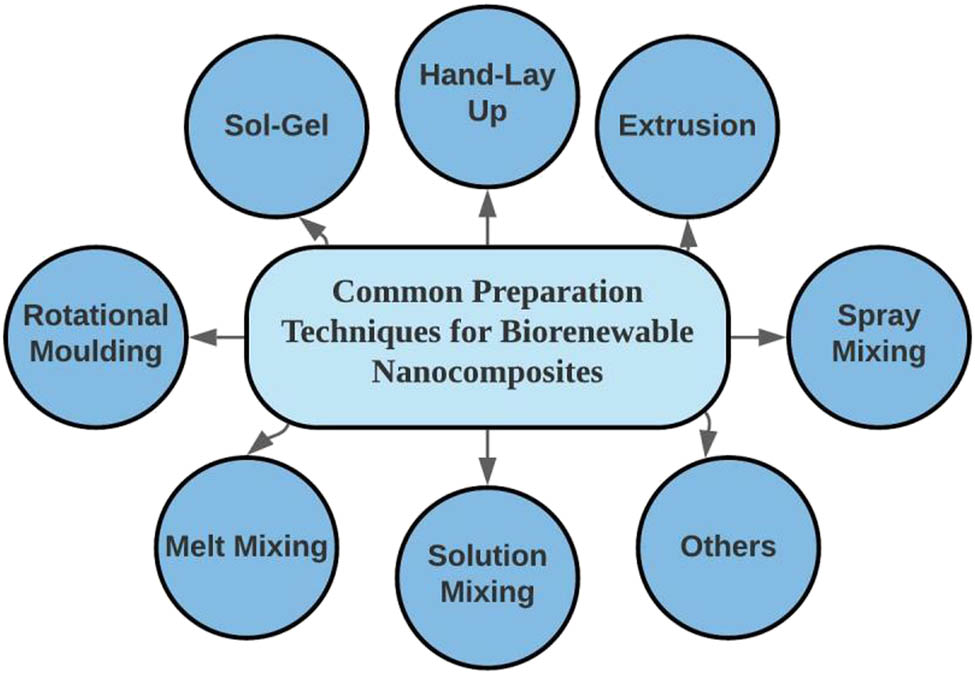
Various preparation methods employed for the fabrication of biorenewable nanocomposites.
3.1 Sol–gel methods
Template synthesis is one of the oldest bottom-up approaches utilized to fabricate nanomaterials. It was originally introduced as a “gel route” by Roy [90] who used inorganic gels as templates for the fabrication of diphasic materials such as ceramic–ceramic nanocomposites at low temperatures well below their melting points. This conceptualized innovation represented a new direction for the preparation of ceramic nanocomposites that demonstrated nano-heterogeneity or ultra-heterogeneity by exploiting the thermodynamics of metastable materials including the heat generated during the reaction between separate phases and benefits of epitaxial growth [8]. As illustrated in Figure 4, the processing of multicomponent nanomaterials via a sol–gel (multicomponent colloidal suspension) technique allowed the densification of different types of sol–gel multicomponent systems such as mullite, alumina, and zircon ceramics with a wide range of applications in high-temperature structural materials, refractory materials, and infrared transmitting materials [8]. Owing to the high flexibility of this method, it has been significantly modified within the last several years and successfully employed for the fabrication of multicomponent nanomaterials such as hybrid organic–inorganic nanocomposites [91,92], thus opening new frontiers for the development of a wide range of advanced materials. The sol–gel process can produce spun fibers, layered densified materials, and lightweight porous aerogels with various mechanical properties from multiple resources [93]. For example, Silva et al. [94] reported a green technique for synthesizing porous chitin nanostructures for biomedical applications. This ecofriendly process employed an ionic liquid (1-butyl-3-imidazolium acetate) in conjunction with supercritical fluid technology for chitin dissolution, after which the biopolymer was regenerated in ethanol. The final mesoporous material exhibited low density and high porosity [94]. Nevertheless, although the sol–gel process is suitable for the preparation of various nanocomposites [91,92,93,95,96], it is capable of fabricating biorenewable nanocomposites only on a laboratory scale [7], owing to the complex solubility and chemical properties of biobased resources that undergo solubilization with subsequent regeneration [97,98].
![Figure 4
Simplified flow diagram of the sol–gel process used in the fabrication of nanocomposites. Adapted from ref. [99], Copyright 2010, Springer-Nature.](/document/doi/10.1515/ntrev-2022-0105/asset/graphic/j_ntrev-2022-0105_fig_004.jpg)
Simplified flow diagram of the sol–gel process used in the fabrication of nanocomposites. Adapted from ref. [99], Copyright 2010, Springer-Nature.
3.2 Solution mixing
The solution method is very similar to the sol–gel method; however, composite materials in the former case are obtained by spraying, coating, dipping, casting, or molding after mixing the dissolved matrix with additives [87]. This method has been argued as a nonenvironmentally friendly process (especially in terms of sustainable development) because it produces toxic chemical footprints due to the use of solvents during the recovery and evaporation processes [100], hence the growing interests toward solvent-free and green(er) solvents in this process [101,102].
3.3 Melt mixing
This straightforward technique is widely employed to produce nanocomposite materials. It generally involves melting the matrix phase, after which additives/fillers are incorporated therein, and the resulting mixture is molded or cast into a desired configuration [100]. Various biorenewable nanocomposites have been fabricated using this approach. For example, thermoplastic PU derived from long-chain polyols produced from fatty acids (i.e., linoleic acids) and incorporated into halloysite nanotubes (HNTs) was used to prepare a biorenewable composite material for biomedical applications [103]. In another work, nanocomposite materials consisting of bioderived polyamide 4, 10, and CNTs were produced in a twin-screw extruder by the melt mixing technique and demonstrated high application potentials in the electrical, electronic, and automotive industries [104]. Note that the melt mixing technique utilizes a more environmentally friendly method than the solution mixing process as it produces a smaller chemical footprint due to the use of solvents, and therefore, should be employed for the fabrication of biorenewables whenever possible [87].
3.4 In situ polymerization
In this technique, a filler is swelled inside a low-molecular-weight monomeric system (such as furfuryl alcohol monomer), which promotes the monomer diffusion into the filler/additive. After this step, an in situ polymerization of the low-molecular weight monomer into an oligomer/polymer is initiated inside the filler/additive to form intercalated or exfoliated nanocomposites [87]. Unlike the melt and exfoliation adsorption techniques, in situ polymerization results in better exfoliation, which can be attributed to the homogenous penetration of the monomer and distribution of fillers/additives in the resulting polymer matrix [105]. Figure 5 illustrates the fabrication of the nanofibrillated cellulose (NFC) and PANi composite material with good mechanical properties and high electrical conductivity. A variety of biorenewable composites can be produced via in situ polymerization. For example, epoxidized soybean castor oil fatty acid-based polyol was successfully employed for the production of thermosetting PU/graphene oxide (GO) nanocomposites [106].
![Figure 5
Schematic of the in-situ polymerization process used for fabricating NFC/PANi composite paper. Reproduced from ref. [107]. Copyright 2012, Elsevier Science Ltd.](/document/doi/10.1515/ntrev-2022-0105/asset/graphic/j_ntrev-2022-0105_fig_005.jpg)
Schematic of the in-situ polymerization process used for fabricating NFC/PANi composite paper. Reproduced from ref. [107]. Copyright 2012, Elsevier Science Ltd.
4 Applications of biorenewable nanocomposites
The number of advanced new materials fabricated from biorenewable, and sustainable resources have substantially increased in recent years. Biorenewable materials have many applications ranging from the automotive industry to the built environment. In this section, we highlight several important developments and applications of the nanocomposites produced from biorenewable resources.
4.1 Membrane technology
Basically, membrane technology (i.e., selective barriers) remains one of the most widely employed methods in various separation processes, including purification, remediation, recycling, recovery, and phase separations [1]. In 2020, the global membrane market exceeded 24 billion USD and is projected to grow at a compounded annual growth rate of 7.5% between 2021 and 2028 [108]. These selective barrier systems can be manufactured from organic (polymers), inorganic (ceramics, silica, zeolites), or hybrid (organic–inorganic) materials. However, on a comparative level, polymer-based systems such as organic membranes are extensively employed in a wide range of industrial and domestic applications due to their various advantages, including low manufacturing costs, amenability, versatility, ease of fabrication, high surface area (surface-to-volume ratio), inherently high reactivity, and high performance efficiency [1,109]. Owing to the increasing water scarcity, environmental degradation, pollution, and global health challenges, the demand for membrane technology continues to increase in various areas from oxygen generation [110] to water purification, desalination, and environmental remediation [1]. Moreover, to achieve high sustainability [20], the scientific community has intensified research efforts aimed at producing biocompatible and biodegradable membranes from biorenewable resources, thus advancing and opening new frontiers for the production of innovative and sustainable materials. This section highlights the recent advances in the utilization of biorenewable nanocomposites in separation technologies.
4.1.1 Wastewater treatment
Water is essential for sustaining life, although the access to adequate, safe, and usable water supplies can potentially become a source for conflicts in the future [111,112]. Coupled with the impacts of natural disasters and environmental degradation resulting from human activities, the increasing stress on safe and usable water cannot be overemphasized [113,114]. The considerable volumes of wastewater generated globally per annum can potentially mitigate the problem of water scarcity and increase the water security after proper capture, remediation, and reuse [1,115]. Therefore, effective processes must be developed for the optimal recovery, upgrade, and purification of wastewater to obtain safe and reusable water supplies. In recent years, the scientific community has initiated ambitious research studies on the production of biorenewable materials with high ecosustainability and efficiency for water and wastewater treatment applications. As demonstrated previously [6], biorenewables such as nanocellulose can be potentially used for the efficient treatment of degraded water. In addition to its ubiquity, biodegradability, biocompatibility, wettability, good mechanical properties, and nontoxicity, nanocellulose can efficiently replace many toxic and unfriendly conventional nanomaterials, such as titanium oxide, silver, and ZnO, which are currently employed for the fabrication of membranes utilized in water treatment processes [6]. For example, bacterial nanocellulose (BNC) loaded with GO and palladium (Pd) NPs for the efficient treatment of wastewater [116]. A Pd/GO/BNC biorenewable nanocomposite was obtained through the in situ incorporation of GO flakes into BNC matrix during growth. The resultant material was highly efficient in the removal of methylene orange (MO) (up to 99.3% over a wide range of concentrations) and changing the pH value despite the multiple reuse cycles. This membrane also effectively removed other wastewater contaminants such as rhodamine 6 G (R6G) and even a cocktail of 4-nitrophenol and methylene blue (MB) [116]. As shown in Figure 6, the particle rejection capability of this composite membrane was achieved using gold NPs (AuNPs), and the membrane rejection rate for the particles with diameters exceeding 5 nm was almost 100%, indicating that the pore size of the Pd/GO/BNC composite was below 5 nm [116].
![Figure 6
Schematic of the particle rejection and flux tests performed for the Pd/GO/BNC nanocomposite membrane: (a) layout of the crossflow test setup; (b) transmission electron microscopy images of the AuNPs with diameters of 5 nm; (c) cross-sectional photograph of the membrane in a flow cell; (d) UV transmittance spectra showing the rejection of AuNPs filtered through the nanocomposite material. The inset depicts the feed and permeate solutions. (e) Graphical representation of the water flux characteristics of nanocomposite membranes, including those of the commercial color reduction and nanofiltration membranes obtained at applied pressures of 58 and 100 psi, respectively [116], Copyright 2018, John Wiley & Sons.](/document/doi/10.1515/ntrev-2022-0105/asset/graphic/j_ntrev-2022-0105_fig_006.jpg)
Schematic of the particle rejection and flux tests performed for the Pd/GO/BNC nanocomposite membrane: (a) layout of the crossflow test setup; (b) transmission electron microscopy images of the AuNPs with diameters of 5 nm; (c) cross-sectional photograph of the membrane in a flow cell; (d) UV transmittance spectra showing the rejection of AuNPs filtered through the nanocomposite material. The inset depicts the feed and permeate solutions. (e) Graphical representation of the water flux characteristics of nanocomposite membranes, including those of the commercial color reduction and nanofiltration membranes obtained at applied pressures of 58 and 100 psi, respectively [116], Copyright 2018, John Wiley & Sons.
A similar work of Gholami Derami et al. [117] used a facile and inexpensive process to produce an innovative PDA/BNC hybrid membrane for the efficient removal of multiple heavy metal ions (such as Pb2+ and Cd2+ and organic pollutants (such as R6G, MB, and MO) from wastewater. The hybrid nanocomposite was obtained by the direct introduction (in situ incorporation) of PDA particles into the BNC matrix during growth. The utilized fabrication technique exhibited high integration flexibility for other adsorbent systems and processes, robustness and high stability during and after the use without decreasing its efficiency, and a possibility for industrial upscaling combined with biocompatibility and biodegradability [117]. The efficient removal of Cr ions (such as Cr6+ and Cr3+) was achieved using biodegradable membranes consisting of functionalized cellulosic nanostructures (CNS) based on eucalyptus residues (in the sawdust form) phosphorylated after preparation [118]. The obtained CNS samples were incorporated into a poly(butylene adipate-co-terephthalate) matrix synthesized by an inversion method. The produced material demonstrated the ability to be integrated into personal and public water tap systems for the direct chromium removal from distributed waters, especially in the regions with water scarcity and high levels of chromium contamination. Considering its low fabrication cost, this material is not only affordable but can become a game-changer for low-income households to mitigate chromium poisoning [118]. By achieving optimal removal values of 93% for Cr6+ and 88% for Cr3+, these membranes demonstrated 71% retention of chromium in accordance with the guidelines established for drinking water [118].
With the growth of the numbers of electric vehicles and energy storage systems, tellurium (Te), a rare element that is relatively new in the additive industry, is attracting considerable attention as a strategic element in many applications [119,120]. However, some concerns were expressed regarding the potential short-term and long-term environmental impacts of Te (especially as a food and water contaminant) and the related health implications for living and nonliving systems [121,122]. To mitigate potential health challenges associated with the presence of Te in drinking water, multiple studies have been conducted to explore the removal of Te from wastewater during processing [123,124]. Yao et al. [125] successfully fabricated an ecofriendly membrane that was acid-resistant, biodegradable, recoverable, and highly efficient for the selective recovery of Te from acidic wastewater using a two-step hydrothermal reaction. The produced sheet-like iron sulfide (FeS)–lignin–carbon magnetic nanocomposite was composed of irregular lignin block structures with variable dimensions. The lignin nanospheres had diameters of ∼300 nm and were fully embedded into FeS nanosheets. The obtained composite possessed a large surface area and abundant adsorption sites for trapping Te ions. The advantages of FeS as a magnetic metastable and nontoxic mineral with good activation properties were added advantages, demonstrating high potential of achieving phase separation in harsh environments (such as acidic wastewater) [125].
4.1.2 Dye removal
Because dyes constitute a group of very hazardous environmental pollutants and remain in wastewater during the treatment processes, developing effective, ecofriendly, low-cost, and sustainable methods for their removal is an extremely important task [126,127]. Chitosan, an inexpensive, abundant, nontoxic, biocompatible, biodegradable, and biorenewable polymer with excellent adsorption properties due to its surface functional groups have been used to manufacture efficient membrane materials for removing dyes from wastewater. For example, by employing the concept of mixed matrix membranes, a facile and green approach was employed for the fabrication of chitosan-wrapped multi-walled CNT (MWCNT) filler, which was incorporated into a polyether block amide thin-film membrane for efficient dye removal [128]. The performance of the fabricated membranes was investigated inside a cross-flow system at a pressure of 2 bar, and the rejection rate achieved for Malachite green dyes with a concentration of 30 mg/L was over 95% at a permeate flux exceeding 5.3 L/m2 h with good water permeation properties [128]. Although the applied pressure of 2 bar was lower than the values of 5–15 bar required for nanofiltration systems, it was still possible to achieve high permeate fluxes [128]. In another study, a chitosan membrane modified with ZnO/copper oxide (CuO) heterostructured nanocomposite was prepared for the photodegradation of fast green dyes under artificial and solar irradiation, and its catalytic efficiency under UV irradiation exceeded 80% after three cycles [129]. The obtained scanning electron microscopic (SEM) images (Figure 7) revealed that the incorporation of the ZnO/CuO nanomaterials increased the porosity and active surface area of both the neat chitosan film and chitosan loaded with only ZnO nanostructures [129].
![Figure 7
SEM images of (a) neat chitosan membrane with a homogeneous surface, (b) chitosan–ZnO membrane with a rough pore-containing surface, and (c) chitosan–ZnO/CuO membrane with the highest surface roughness and porosity. Reproduced from ref. [129]. Copyright 2018, SAGE Publications.](/document/doi/10.1515/ntrev-2022-0105/asset/graphic/j_ntrev-2022-0105_fig_007.jpg)
SEM images of (a) neat chitosan membrane with a homogeneous surface, (b) chitosan–ZnO membrane with a rough pore-containing surface, and (c) chitosan–ZnO/CuO membrane with the highest surface roughness and porosity. Reproduced from ref. [129]. Copyright 2018, SAGE Publications.
By employing phosphorylated chitosan modified with GO nanosheets, Song et al. [130] developed an efficient foul-resistant separation membrane for the removal of anionic dyes and inorganic salts (such as NaCl and NaSO4) from wastewater. Their innovative concept was based on a hypothesis that phosphorylated chitosan with a high degree of substitution of its hydroxyl group by the phosphate group (generally at the C-6 position) would produce nanofiltration membranes with exceptionally high surface activities. In addition, highly hydrophilic and negatively charged GO rich in surface oxygen groups can promote interactions with chitosan amino groups, which enable the ring-opening polymerization of these groups and the epoxy (oxygenized) groups of GO nanosheets [130]. The separation efficiency of the chitosan-modified GO nanosheet membrane was evaluated via a crossflow permeation test conducted using a nanofiltration membrane evaluation device at a constant inlet flow velocity of 0.068 m/s, feed temperature of 25°C ± 0.3°C, feed pH of 6.5 ± 0.1, and operating pressure of 0.60 ± 0.05 MPa. A single-component permeation test was performed using NaCl or NaSO4 as a representative monovalent/divalent salt with a concentration of 500 mg/L and anionic dye (direct black, Ponceau S, or xylenol orange) with a concentration of 100 mg/L. The salt rejection rates achieved for NaCl and NaSO4 were 56.8 and 93.6%, respectively. The retention values obtained for the anionic dyes at a permeate flux of 71.6 L/(m2 h) were 99.7% for direct black, 97.5% for xylenol, and 93.4% for Ponceau S. The study revealed that the fabricated biorenewable membrane could efficiently remove salt-containing anionic dyes from wastewater [130].
4.2 Biomedical and pharmaceutical applications
The necessity of improving human health and environmental considerations in the health sector has increased the demand for biorenewable nanomaterials. Because biorenewables exhibit unique surface properties, high biodegradability, and biocompatibility with human tissues and organs, they can be potentially used to advance human health and sustainability. Hence, biorenewable nanomaterials have become promising candidates for biomedical and pharmaceutical applications, including drug delivery/release systems, artificial limbs, tissue regeneration, intraarticular implants, intraocular lenses, and ligament and tendon repair scaffolds [131]. In this section, we describe the recent advances in biorenewable nanomaterials in biomedical and pharmaceutical applications.
4.2.1 Drug delivery
Polysaccharide–protein complexes were successfully utilized in the development of materials for drug delivery systems. For example, by combining bioderived materials, such as sericin (SC), with rice bran albumin (RBA) and embedding it into gellan gum (GG), a smart nanosystem for pH-responsive drug delivery was produced [132]. By dissolving GG in medically benign dimethyl sulfoxide under gentle magnetic stirring at room temperature for 10 min, SC was subsequently added and mixed for 24 h, resulting in the lyophilization of the SC–GG conjugate. The final SC-GG-RBA product possessed an average particle size of 218 nm and polydispersity index of 0.23, indicating that a nanomaterial has been obtained and that the resulting polymeric system was well distributed [132]. Doxorubicin (DOX), a highly effective anticancer drug with a broad spectrum of activities, was then encapsulated into the SC-GG-RBA nanocomposite to investigate the efficiency of its drug release potential in an acidic tumor environment [132]. The efficiency of DOX release in vitro was 84% after 120 h in an acidic environment with pH = 4.0. Only approximately 42% of the MCF-7 cells survived after treatment for a given period; hence, determining the efficiency of green nanocomposites and further demonstrated the capabilities of biorenewables in the biomedical field [132]. In another study, an innovative biocompatible amino-T807-modified human serum albumin nanomaterial consisting of a membrane of erythrocytes (ETm) coating and 1,2-distearoyl-sn-glycerol-3-phosphoethanolamine-N-[succinimidyl(polyethyleneglycol)] (DSPE-PEG3400-Mal) has been reported [133]. To overcome the challenge of the blood–brain barrier (BBB), which prevents the free movement of blood and transportation of therapeutic medications for the mitigation of brain diseases and increases the efficiency of sustained drug delivery across the BBB, a DSPE-PEG3400-T807 nanomaterial was fabricated. The unique targeting properties of NPs coupled with the brain cell targeting of the T807 ligand resulted in their affixation to brain cells, which subsequently promoted the drug transport across the barrier. In vivo live imaging demonstrated that T807/ETm-HSA NPs accumulated in brain cells and produced no cytotoxic effect on these cells at concentrations up to 200 µg/mL; moreover, they did not impair the integrity of the in vitro BBB at 125 µg/mL according to the D-lucifer permeability and P-gp efflux activity obtained in an R123 experiment for the cocultured cells. It was concluded that bio-NPs could sustain the continual release of curcumin within 72 h, further suggesting their usefulness and efficiency for drug delivery systems and the transportation of drugs across the BBB for the treatment of chronic neurological diseases [133]. Another work building on the concept of combinatorial chemotherapy for augmenting therapeutic efficiency through multiple mechanisms to effectively mitigate the toxicity and adverse effects have demonstrated the successful production of DOX and gambogic acid (GA) encapsulated in albumin nanocomposites (DOX-loaded albumin NPs [DNPs] and GA-loaded albumin NPs, GNPs, respectively) for synergistic antitumor efficacy [134]. As demonstrated in Figure 8, these drug-loaded albumin NPs exhibited high synergistic efficiency in the ablation of HepG2 tumor cells at a combination index of 0.38. Confirmatory studies employing ex vivo fluorescence imaging showed that the tumor was fully permeated by the drugs due to the enhanced permeation and retention effect of the augmented therapeutic efficiency of the nanoconstruction [134]. It was argued that the synergistic tumor inhibition efficacy was attained at 3-fold lower doses using the combinatory approach than for a single dose in vivo [134].
![Figure 8
In vivo demonstration of the antitumor efficiency of the drug-encapsulated bionanomaterials: (a) Free DOX and GA slightly inhibited the tumor growth as compared with the control treatment; (b) in a comparative assessment, larger necrotic regions were observed for the DNP and GNP groups than those of the free drugs. Meanwhile, the combined treatment with GDNP (combination of DNP and GNP) and 1/3 GDNP produced enhanced necrosis regions, which resulted in ≈ 90% induced apoptosis of cancer cells. Reproduced from ref. [134], Copyright 2020, Elsevier Science Ltd.](/document/doi/10.1515/ntrev-2022-0105/asset/graphic/j_ntrev-2022-0105_fig_008.jpg)
In vivo demonstration of the antitumor efficiency of the drug-encapsulated bionanomaterials: (a) Free DOX and GA slightly inhibited the tumor growth as compared with the control treatment; (b) in a comparative assessment, larger necrotic regions were observed for the DNP and GNP groups than those of the free drugs. Meanwhile, the combined treatment with GDNP (combination of DNP and GNP) and 1/3 GDNP produced enhanced necrosis regions, which resulted in ≈ 90% induced apoptosis of cancer cells. Reproduced from ref. [134], Copyright 2020, Elsevier Science Ltd.
4.2.2 Tissue engineering
The current bone tissue engineering studies are pushing boundaries by employing innovative biocompatible materials with exceptional biocompatibility and efficient mechanical properties. Tissue engineering is extremely promising for increasing sustainability and the quality of human life while lessening the burdens of the societal and economic costs associated with healthcare and life expectancy [135]. To increase the application scope of tissue engineering, the fields of biology, chemistry, and bioengineering were integrated to regenerate or create entirely new tissues or cellular systems for the replacement, repair, or enhancement of biological systems (such as damaged limbs). As a dynamic field, tissue engineering is capable of discovering new approaches to improving health, human longevity, and clinical conditions [135]. For example, to assess the influence of CNCs on the biocompatibility and osteogenic potential of PLA in bone tissue engineering, a PLA/CNC composite scaffold was fabricated by an electrospinning technique [136]. It was found that the incorporation of CNCs enhanced the mechanical properties of the composite and increased its thermal stability compared with those of pure PLA. In addition, the composite scaffold demonstrated impressive biocompatibility and exceptional surface mineralization with good expression of osteogenic gene markers, indicating a high osteogenic potential. It was concluded that the studied material could be used as a functional system for bone tissue engineering [136]. In another work, the biological functionalities of bioactive ternary gum arabic/κ-carrageenan (κ-CG) incorporated hydroxyapatite nanocomposite (n-HA) were leveraged for bone tissue engineering [137]. Because κ-CG is an anionic unbranched sulfated heteropolysaccharide possessing numerous pharmaceutical properties, such as immunomodulation, anticoagulation, and antihyperlipidemic activities, and its chemical structure resembles that of glycosaminoglycans, which are inherently present in human bone tissues and cartilages, it represents a promising platform for the fabrication of bone tissue materials [137]. Ternary n-HA/gum arabic/κ-CG composites were prepared at the following concentrations: 60/30/10 (CHG1), 60/20/20 (CHG2), and 60/10/30 (CHG3). In addition, an n-HA/gum arabic binary system with the composition 60/40 (HG) was obtained as a control. After 15 days of incubation in a simulated body fluid, rapid mineralization of the apatite layer was observed for the ternary systems, which was confirmed by SEM images [137]. Although CHG2 contained the optimal amount of the deposited apatite layer, the highest mechanical strength was obtained for the scaffold containing 50/50 GA and κ-CG. Moreover, the cytotoxicity of these materials was evaluated by culturing osteoblast-like MG63 cells, and the CHG2 nanocomposite system exhibited the optimal cell viability and proliferation properties. Furthermore, antibacterial activities, protein adsorption and tolerance, biodegradability, and osteogenic differentiation were observed for all ternary systems. It was concluded that the surface chemical interactions between n-HA, GA, and κ-CG molecules played significant roles in the obtained results [137]. Ferreira et al. [138] described the almost endless capabilities of biorenewables in the tissue engineering field. For example, nanocellulose gels and foams can be employed for the fabrication of tissue scaffolds and extracellular matrices from lightweight materials instead of the currently used metals, ceramics, and other polymers with high production costs and unsustainable production steps [138]. Owing to its bioinspired hierarchical construction, pliability, versatility, and biological origin, nanocellulose exhibits high mechanical strength and biocompatibility, which are required for functional materials in tissue engineering [138].
4.3 Electronic applications
The recent technological advances remarkably decreased the size of electronic devices from phones to television sets by making them slimmer, portable, and lighter. It has gradually become customary to demonstrate how efficiency trumps bulkiness for electronics and energy storage systems. This trend consequently influences the behavior of people and industrial development, which directly impact scientific pursuits, although science and technology thrive on a societal paradigm shift. Hence, the development and fabrication of novel materials (especially those with multifunctional capabilities) to simultaneously fulfill several goals are becoming a growing trend, making smart technologies, the fourth industrial revolution, smart materials, and devices popular buzzwords. Moreover, because of the increasing impact of electronic wastes (e-wastes) [139], the scientific community is spending more research efforts on the development of a new innovative class of materials that undergo biodegradation after use, exhibit biocompatibility during decomposition or mineralization in the natural environment, and are sustainable, creating new frontiers in chemistry and materials science beyond the limitations of conventional materials [140]. As the electronic industry remains pivotal for the advancement of human civilization (including robotics, artificial intelligence, synthetic organs, quantum computing, and smart materials), the fabrication of ecofriendly materials from biorenewables for electronic applications has attracted much attention due to their higher efficiency and lower costs than those of traditional materials.
4.3.1 Sensors
Biobased sensory systems and biosensors are widely employed in various fields, including the medical, environmental remediation, food, and pharmaceutical industries. They are generally categorized according to the mode of physiochemical transduction and/or biorecognition element type. Hence, depending on the utilized transducer, these systems can be classified into electrochemical, optical, and thermal sensors, while according to the biorecognition element type, they are divided into enzymatic, aptamer-based, and antibody-based ones [141]. The interest in using biorenewables in biosensory applications has recently increased in almost every field of human endeavor. For example, to efficiently monitor and mitigate potentially negative impacts of elemental materials such as Fe, Mn, and Cr in target environments (including both the human body and natural environment), a new class of fluorescent lignin carbon dots (CDs) for reversible responses to high-valence metal ions has been developed [142]. These biosensors exhibit high sensitivity and short response times and are simpler than conventional analytical methods such as differential pulse polarography, electrochemistry, and atomic absorption spectrometry (which are sophisticated, expensive, and time-consuming and utilize complex sample preparation procedures) [142]. Lignin CDs were synthesized by the facile one-pot hydrothermal carbonization of waste lignin biomass obtained from the pulp industry. The produced bright blue photoluminescent CDs demonstrated remarkably high photostability against belching in various pH environments and excellent fluorescence properties in the presence of Fe3+, Cr+6, and Mn2+ ions [142]. The biosensing of high-valence trace metal ions in fetal bovine serum and ascorbic acid by these CDs was impressive [142]. It was concluded that the valence-dependent response of lignin CDs was related to their sensitive chelation and the formation of stable complexes that inhibited radical recombination and allowed the instantaneous detection of a wide range of metal ions in biological and environmental redox systems and complex composites [142]. Another study described an innovative peptide nucleic acid (PNA) electrochemical biosensor based on reduced GO (rGO) (NH2-rGO)/2,2,6,6-tetramethypiperidin-1-yl)oxyl nanocrystalline cellulose (TEMPO–NCC) for the sensing and detection of Mycobacterium tuberculosis [143]. Because PNA recognition layers are widely used for sequence-specific DNA biosensing, such as M. tuberculosis DNA, PNA was employed to utilize its sensitivity and specificity detection characteristics for the efficient discrimination toward single-base mismatches. Moreover, PNA significantly reduced the hybridization time and dependence on ionic strength at room temperature [143]. The PNA-modified NH2-rGO/TEMPO-NCC was able to successfully differentiate between complementary, noncomplementary, and one-base mismatch DNA sequences by using MB as an electrochemical indicator. The developed electrochemical biosensor also produced a linear calibration curve in the concentration range from 1 × 10⁻⁸ to 1 × 10⁻¹³ M with a maximum detection value of 3.14 × 10⁻¹⁴ M. Because of the increasing global challenges of unpredictable terrorist attacks, the detection of trace explosive materials is critical for conducting preventive and security measures aimed at creating a safer public space and protecting vulnerable targets. Therefore, Wu et al. [144] reported a new type of three-dimensional surface-enhanced Raman scattering (SERS) sensors that were obtained by coating Au nanorods (AuNRs) with a shell of Ag nanocubes (AgNCs) (AuNR@AgNCs), which were subsequently loaded onto BNC aerogels via electrostatic interaction, leading to the formation of three-dimensional hot spots for the detection of 2,4,6-trinitrotoluene (TNT), a well-known explosive generally used in improvised explosive devices [144]. The key significance of the SERS technique is its ability to enhance the Raman scattering signal of target molecules on a specially primed template fabricated from a noble metal such as Au or Ag. Hence, it was concluded that the intensity of inelastic scattering of photons from a target molecule was enhanced due to the long-range EM field and short-range chemical effects [144]. The EM enhancement effect was attributed to surface plasmon resonance and the chemical enhancement caused by charge transfer. Owing to the unique structure and morphologies of the prepared AuNR@AgNC SERS substrates, traces of TNT with a low limit of 8 × 10⁻¹² g/L were detectable at a SERS enhancement factor of 1.87 × 10⁸, clearly demonstrating the enormous application capability of the explosive sensors fabricated from nanocellulose aerogels with high detection efficiency for the protection of human lives and property [144].
4.3.2 Energy storage and conversion systems
The access to affordable and clean energy remains a priority for both the developing and developed countries [20]. The growing interest in mitigating the global warming and pursuing sustainable development have resulted in many scientific breakthroughs ranging from improving the existing energy systems to developing new innovative energy conversion materials and devices. Hence, the utilization of biorenewable materials for energy storage and conversion applications with a potential use in sustainable high-performance storage and conversion systems has been continuously increasing. For example, metal–organic frameworks (MOFs) can be used as sacrificial templates for deriving hierarchical nanostructured materials with high surface areas, porosities, and specific capacitance. Hence, Xiao et al. [145] successfully fabricated a layer-by-layer assembly of free-standing and flexible nanocellulose/porous cobalt(ii,iii) oxide [Co3O4] polyhedron hybrid films for supercapacitor electrode applications by employing the MOF concept. By using a cobalt catalyst in the graphitization of carbon, a Co3O4-based graphitic material with exceptional nanoporosity, sp2 carbon hybridization, and outstanding intrinsic conductivity was obtained. As illustrated in Figure 9, the produced porous Co3O4 polyhedron (PCP, active material) was used for the preparation of NFC/porous Co3O4 polyhedron (called NFC/PCP or NPC) films supercapacitor electrodes via a two-step water-based paper-making technique using NFC as a building block and their substrates with added conductive acetylene black agent [145]. The obtained NPC-60 electrodes exhibited impressive electrochemical performance with a real capacitance of 594.8 mF/cm2 at a cyclic voltammetry scan rate of 5 mV/s, which was significantly higher than that of conventional metal oxide electrodes [145].
![Figure 9
Schematic of the preparation of the NFC/PCP and NPC flexible supercapacitor electrodes. Reproduced from ref. [145], Copyright 2021, Springer Nature.](/document/doi/10.1515/ntrev-2022-0105/asset/graphic/j_ntrev-2022-0105_fig_009.jpg)
Schematic of the preparation of the NFC/PCP and NPC flexible supercapacitor electrodes. Reproduced from ref. [145], Copyright 2021, Springer Nature.
To develop an inexpensive supercapacitor with high stability, specific capacitance, and energy density while overcoming the challenges of the low electric double-layer capacitance, Butnoi et al. [146] fabricated low-cost flexible lignin-based carbon nanofibers (L-CNFs) incorporated into iron oxide NPs (Fe x O y ) [L-CNFs@Fe x O y ] for supercapacitors with high specific capacitance by a one-step electrospinning technique [146]. They hypothesized that because compositional and morphological modifications of carbon nanofibrous materials critically affected their performance in supercapacitors, iron oxides with various valence states (Fe2+, Fe3+, and Fe4+) could be incorporated into lignin-based carbon fibers to mitigate the high electrical resistivity and low charge density resulting from the inherent interspacing of electrospun CNFs [146]. This was achieved by electrospinning a mixture of organosolv lignin and poly(ethylene oxide) with a mass ratio of 99:1 doped with a various iron (III) nitrate nonahydrates followed by stabilization and the subsequent carbonization (Figure 10) [146]. The produced L-CNFs@Fe3O4 electrodes exhibited an impressive optimal specific capacitance of 216 F/g at a specific current of 0.1 A g−1 and ultra-high energy density of 43 Wh/kg, demonstrating a new manufacturing approach for innovative, cost-effective, and sustainable electrodes [146].
![Figure 10
Schematic of the L-CNFs@Fe
x
O
y
fabrication process. Reproduced from ref. [146], Copyright 2021, Elsevier Science Ltd.](/document/doi/10.1515/ntrev-2022-0105/asset/graphic/j_ntrev-2022-0105_fig_010.jpg)
Schematic of the L-CNFs@Fe x O y fabrication process. Reproduced from ref. [146], Copyright 2021, Elsevier Science Ltd.
By incorporating Fe3O4 NPs into chitosan/GO MWCNTs (chitosan (CS)/graphene oxide-multiwall carbon nanotubes (GM)), Hosseini et al. [147] obtained CS/GM/Fe3O4 nanocomposites grafted with PANi through in situ polymerization to produce CS/GM/Fe3O4/PANi nanocomposite materials for supercapacitor applications (Figure 11). The specific capacitance of the manufactured electrode was 1513.4 F/g at a specific current of 4 A g−1, which was 1.9 times higher than that of a control electrode CS/GM/Fe3O4 without PANi (approximately 800 F/g at 4 A/g). Moreover, both the CS/GM/Fe3O4/PANi and CS/GM/Fe3O4 electrodes demonstrated remarkable cycle lives of 99.8 and 93.5%, respectively, at a uniform specific capacitance of 100 A/g during charge–discharge cycles [147]. This synergistic effect of chitosan/GM and iron oxide in conjunction with the exceptional properties of PANi indicated a very high potential for the use of biobased nanocomposites in advanced supercapacitor applications.
![Figure 11
Simplified schematics of the synthesis of CS/GM/Fe3O4/PANi nanocomposite material. Reproduced from ref. [147], Copyright 2021, John Wiley & Son.](/document/doi/10.1515/ntrev-2022-0105/asset/graphic/j_ntrev-2022-0105_fig_011.jpg)
Simplified schematics of the synthesis of CS/GM/Fe3O4/PANi nanocomposite material. Reproduced from ref. [147], Copyright 2021, John Wiley & Son.
4.4 Food and agricultural applications
The food and agricultural sector are fundamental for the advancement and sustenance of the human race; hence, through the mandates of the sustainable development goals (SDGs), the global community is resolute on ending hunger across the countries of the earth, attaining food security, improving nutrition (e.g., through food science and processing technology) and the advancement of agricultural best practices [20]. Recent years have seen the increasing role of nanotechnology in improving crop yield, maintain ecosystem balance (e.g., nitrogen fixation and organic matter cycle), water purification, mitigate the impacts of climate change, improve food security, enhance safe food processing and packaging techniques for better shelf-life and limiting post packaging contamination, plant protection, pest control, etc. [148,149]. It has become necessary to eliminate or mitigate the entrainment of biological (e.g., pathogens) and environmental contaminants (e.g., plastic matter) into the food web; to ensure that the loop between the food–water–agriculture–health nexus is efficiently protected, monitored, and continually assessed to maintain a healthy population, advance food security, sustain agricultural best practices, and enhance environmental, social, and economic sustainability [16,150]. Biorenewables have demonstrated efficiency as green(er), ecological, and sustainable materials toward eliminating the current challenges presented by traditional materials and methods employed in the food and agricultural sector toward sustainable development.
4.4.1 Green(er) and smart fertilizers
With a rapidly changing world, farmers across the globe are engaging science and technology to improve food production and related products (e.g., fibers, raw materials, fodders). The annual growth of populations coupled with limited resources available and demand for food has necessitated the critical improvement of harvesting systems, crop yields, water recycling and conservation, and optimal land usage, while maintaining good soil structure and fertility all year round [151,152]. In 2015, a conservative population of over 3.5 billion people (more than 50% global population) fed on crops that were produced with synthetic or inorganic fertilizers (e.g., nitrogen-based fertilizers). And with the global population projected to exceed the 9 billion mark by 2050, it is therefore unarguable that necessity is laid upon humanity to do more toward achieving food security and improve on sustainable agriculture despite other limitations such as water and land [152,153].
Over the years, the direct application of synthetic agrochemicals such as fertilizers to overcome some of the challenges of crop productivity and enhance agroeconomics has been the way to go for conventional agricultural practices; however, the associated negative environmental impacts of this practice such as eutrophication, loss of soil integrity, increasing soil acidification which have consequent impacts on ocean acidity (a significant contributor to global warming and loss in ocean productivity), ground water contamination, and greenhouse gase (GHG) emissions with consequent impacts on climate change [154,155,156], are significant environmental challenges. In addition, nitrous oxide, a byproduct of nitrogen-based fertilizers, is the third most significant GHGs, after carbon dioxide and methane [157,158,159]. It is therefore evident that the continual use and direct application of inorganic fertilizers hold more devastation to the living and nonliving systems of the environment than the promise of better crop yield, sustainable agricultural best practices and food security. Hence, research has intensified toward benign and efficient fertilizers from nano systems from biobased resources (i.e., organic or green(er) fertilizers) that offer commensurate or better crop yield than inorganic fertilizers, enhance the mitigation of environmental stressors, and improve ethical agricultural best practices and sustainable development. Because runoff of unused or waste fertilizers in the soil into the surrounding environment is the significant culprit of eutrophication, it has been postulated that smart agrochemical systems such as “slow” and controlled release (i.e., deliberate and regulatory distribution) fertilizer systems (CRFs) hold enormous potentials in ameliorating this challenge [160].
Intelligent and green(er) agrochemical systems such as fertilizers have made notable progress in recent years. For example, inspired by nature, whereby butterfly wings and the legs of water striders are biodesigned with unique micronanoscale structures with reduced surface energies and enhanced superhydrophobic properties to prevent water penetration. Xie et al. [161] fabricated a biomimetic superhydrophobic biobased polyurethane-coated fertilizer (SBPF) for the efficient and controlled release of needed nutrients to crops. The green PU was synthesized from cottonseed oil polyol and isocyanate (as raw materials). At the same time, the outermost coating for the PU, containing terminated OH groups (hydrophobic characteristic), was constructed by increasing the ratio of the cottonseed oil polyol. Subsequently, a two-step technique was then employed to enhance the surface roughness through the construction of micrometer–nanoscale diatomite–SiO2 configuration, thereby decreasing the surface energy and afterward embedding fluoroalkylsilanes into the fabricated structure, which conferred the coating with overall superhydrophobicity. They determined that the SBPF demonstrated a 2-fold enhanced efficiency compared to the normal biobased PU-coated fertilizer in terms of significantly enhancing nutrient release characteristics, particularly with crops requiring a relatively long growing period [161]. In a similar study by Wang et al. [160] encapsulated prilled urea (i.e., solid nitrogen-based fertilizer) into a superhydrophobic bionanocomposite system. As demonstrated in Figure 12, biobased PU films were fabricated from the reaction of castor oil and isophorone diisocyanate at predetermined molar ratios. These films were then modified with cheap and ecofriendly HNTs. Two parts of HNTs were employed in this modification; first, to confer superhydrophobic properties on the HNTs, the surfaces were modified employing hydrolytic condensation of hexadecyltrimethoxysilane and tetraethoxysilane which resulted in superhydrophobic HNTs, and subsequently incorporated into the PU films to produce superhydrophobic polyurethane coating (SHPUC) nanomaterials. Second, unmodified HNTS were incorporated into the PU films to produce unmodified HNTs PU coating (PHUC). Afterward, prilled urea pellets were repeatedly coated and cured under heat for about 8–10 min using SHPUC, PHUC, and normal PU films (PUC) at varying coating percentages, for comparative investigation [160]. It was shown that the urea pellets coated with SHPUC demonstrated the most efficient longevity (2 months longer) and controlled release of nitrogen. Further established was that coating rates directly influenced the release characteristics of the CRFs significantly, with the cumulative percent nitrogen release decreasing with an increasing percentage of the coating material. In addition, the percentage nitrogen release of SHPUC and PHUC compared to that of PUC was considerable slower even at the same coating percentages [160]. The technology of superhydrophobic surfaces and the nonwetting characteristics has enormous application possibilities in various research areas [162,163].
![Figure 12
Diagrammatic representation of the various coating modifications employed in the biobased coated CRF [160]. Copyright 2022, Elsevier Science Ltd.](/document/doi/10.1515/ntrev-2022-0105/asset/graphic/j_ntrev-2022-0105_fig_012.jpg)
Diagrammatic representation of the various coating modifications employed in the biobased coated CRF [160]. Copyright 2022, Elsevier Science Ltd.
Elsewhere, an innovative CuO NPs encapsulated in a biobased polymeric shell derived from chitosan and sodium alginate is reported [164]. Drawing inspiration from the fact that metal oxide NPs can interact with amino and hydroxyl groups in biopolymeric systems, it therefore holds the possibility of preventing the leaching of the elements into the soil. Fabricated from environmentally friendly polyelectrolyte complexation, the chitosan and sodium alginate complex acted as the biodegradable shell for the controlled release of the encapsulated nutrients (i.e., CuO NPs) [164]. The study demonstrated that optimizing the synthesis conditions, e.g., pH and polymer/crosslinker ratio, good stability, and accurate size particle control was achieved. Furthermore, analytical investigation evidenced that the efficacy of the developed smart fertilizer on seeding and germination enhanced the advantages of seedling growth with a mutual positive impact in developing the epigean and hypogeal parts [164]. Further demonstrating the endless possibilities in improving crop productivity and sustainable agriculture.
4.4.2 Food packaging and bioactive systems
Conventional materials employed in food and medicinal contact packaging have become a source of environmental and health concerns; thus, research and industrial efforts have intensified toward safer (greener), functional, biocompatible, biodegradable, sustainable, and efficient packaging systems [16,150]. Although challenges such as barrier and mechanical deficiencies have been noted as limitations for exploring biomaterials as effective packaging alternatives, the employment of nanocomposite concepts reverses the trend, expanding the possibilities and advancing the application potentials of biorenewable nanocomposites. For example, biorenewables such as collagen, gelatin, starch, cellulose, chitosan, and soy protein have been used to fabricate films and coatings as selective barriers to moisture, gas, and solvent toward enhancing food safety and antimicrobial activities [7]. In addition, water-soluble gums have found applications as edible coating for fruits and vegetables to limit postharvest losses, improve shelf-life of these perishables, and save the cost of electricity by minimizing or eliminating the need for cold storage [165]. Moreover, it has been shown that postharvest application of gum arabic, as edible coating, on fruits such as persimmon fruits during storage markedly reduced weight losses of the fruits, maintained plasma membrane integrity of the fruit tissues, and so on [166]. Elsewhere, it was reported that aloe vera gel (AVG), a biobased nanocomposite system, is an efficient and functional edible coating for fruits and vegetable preservation as a result of the good antioxidative and antimicrobial properties [167]. It was further evidenced that overall that AVG has the capacity to retain the color of the coated food for any appreciable length of time, maintain the fruits and vegetable firmness and preserve much-needed vitamins, and improve on the ripening delay [167].
A freshwater durable and ocean water degradable cellulose nanofiber (CNF)-reinforced starch film for food packaging is reported in a related development [168]. By employing the wet pulverization process on cellulose powder and mechanical fibrillation, cellulose nanofibers (MCNFs) were obtained. These MCNFs were afterward mixed with a variation of modified tapioca starch powder and subsequently cast into films. These films demonstrated high efficiency as green(er) packaging films for a wide range of food types, hence opening opportunities for pursuing the blue seas initiative toward zero plastic in our oceans [168]. Another report showed that CNF isolated from pineapple leaves blended with potato starch as nanofillers was used to produce UV-resistant transparent nanocomposite films toward sustainable packaging [169]. It was determined that at 3 wt% loading of CNF, lower water sorption resulted in the films attributable to the crystallinity of the CNF reinforcement acting as a barrier to the starch molecules from swelling in the presence of water [169]. Notwithstanding, at higher CNF loading (≥3 wt%), the films began to lose their properties majorly due to possible agglomeration of the CNFs particles in the nanocomposite.
5 Conclusions
It is well known that nature solves material problems through the efficient and unique material designs, which can inspire humans to synthesize new materials for target applications. With the advancement of human civilization caused by the development of smart materials, portable devices, supercapacitors, wearable electronics, electric vehicles, and Internet of Things, biorenewables may be utilized in the fabrication of environmentally friendly, biocompatible, biodegradable, and renewable materials. As a result, it is necessary to expand our knowledge regarding biorenewables and their derivatives to achieve environmental sustainability. The application of green chemistry principles in the processing of bioderived materials for advanced technologies must be prioritized. The nonecofriendly and volatile chemicals used for the derivation, preparation, dissolution, and regeneration of biobased materials should be urgently replaced with greener alternatives such as ionic liquids, which represent organic salts with unique physicochemical characteristics, high thermal and chemical stabilities, and good recyclability properties that allow mitigating several environmental and safety challenges. Furthermore, achieving a better fundamental understanding of the surface chemistry and interactions of bioderived materials as matrix systems containing fillers/additives is critical for expanding their application range in various fields. Therefore, additional studies must be performed to enhance the controlled properties of these materials for targeted applications.
6 Challenges and future prospects
The role of biorenewable materials in SDGs cannot be overemphasized, especially considering the current environmental challenges, energy security, and local growth of economies related to job creation and foreign exchange conservation. Nevertheless, multiple factors limit the use of biorenewables in domestic and industrial applications. One such challenge is the rapid biodegradation of biorenewables in target environments, which can be mitigated by modifying their chemical and surface properties to increase the biopersistence of these materials. Another problem is the inferior physiochemical and mechanical properties of biorenewables compared with those of the traditional materials obtained from fossil hydrocarbons. However, this drawback can be overcome by achieving a fundamental understanding of their biosynthesis and inherent chemical properties that could be adjusted to improve the physiochemical and mechanical characteristics of these materials. Furthermore, the surface properties and solubility of biorenewable materials as well as their interactions with solvents, additives, and/or fillers are another important factor that requires a proper understanding of fundamental theories, new insights, and more advanced processing technologies for ensuring optimal interactions between the matrix and fillers as well as material dissolution and regeneration/reconstitution. Owing to their unique chemical properties, which are not identical to those of fossil-based materials, biorenewable nanomaterials require better characterization techniques to determine their kinetic parameters and reaction mechanisms in various environments. In addition, the theory of chain dynamics and mobility is not fully understood yet and remains speculative despite the significance it holds for enhancing the mechanical properties of biobased nanocomposite materials.
In summary, our main question is whether a combination of two or more nanoscale materials with different structures, chemical properties, and other parameters can eliminate the constraints of the currently used materials. For example, what material can be obtained by embedding copper NPs into cellulose NPs and then into lignin nanospheres followed by a dispersion in a Kevlar matrix? What material would be produced by combining nanoscale cellulose with nanoscale lignin and nanoscale copper and dispersing the resultant NPs in PLA or furfuryl alcohol under microwave irradiation? In addition to elucidating the chemical and other properties of biorenewable nanomaterials, it is also necessary to determine how these properties can be optimized to fabricate superior materials for advanced applications in extreme environments.
Finally, the fabrication of multifunctional nanocomposites remains a very challenging task. Hence, further research is required to develop materials and systems with multifunctional capabilities in a single use based on a hierarchical structure, in which modified functionalities are integrated at different structural levels.
Acknowledgments
The authors would like to thank the Council for Scientific and Industrial Research (086ADMI), the Department of Science and Innovation (C6ACH77), and the University of Johannesburg (086310) for the financial support.
-
Funding information: Council for Scientific and Industrial Research (086ADMI), the Department of Science and Innovation (C6ACH77), and the University of Johannesburg (086310) for the financial support.
-
Author contributions: All the authors have accepted responsibility for the entire content of this study and approved its submission.
-
Conflict of interest: The authors state no conflict of interest.
References
[1] Ray SS, Iroegbu AOC, Bordado JC. Polymer-based membranes and composites for safe, potable, and usable water: a survey of recent advances. Chem Africa. 2020 Sep 27;3(3):593–608.10.1007/s42250-020-00166-zSearch in Google Scholar
[2] Lubin G, editor. Handbook of composites. Boston, MA: Springer US; 1982.10.1007/978-1-4615-7139-1Search in Google Scholar
[3] Dunlop JWC, Fratzl P. Biological composites. Annu Rev Mater Res. 2010;40(1):1–24.10.1146/annurev-matsci-070909-104421Search in Google Scholar
[4] Ajayan PM, Schadler LS, Braun PV, editors. Nanocomposite science and technology. Materials today. Vol. 6, Germany: Wiley-VCH; 2003.10.1002/3527602127Search in Google Scholar
[5] Newman T. Bones: all you need to know. Medical news today. United Kingdom: Healthline Media UK Limited; 2018.Search in Google Scholar
[6] Ray SS, Iroegbu AOC. Nanocellulosics: benign, sustainable, and ubiquitous biomaterials for water remediation. ACS Omega. 2021;6(7):4511–26.10.1021/acsomega.0c06070Search in Google Scholar PubMed PubMed Central
[7] Ates B, Koytepe S, Ulu A, Gurses C, Thakur VK. Chemistry, structures, and advanced applications of nanocomposites from biorenewable resources. Chem Rev. 2020;120(17):9304–62.10.1021/acs.chemrev.9b00553Search in Google Scholar PubMed
[8] Komarneni S. Nanocomposites. J Mater Chem. 1992;2(12):1219–30.10.1039/jm9920201219Search in Google Scholar
[9] Daw R. Nanotechnology is ancient history. Nanotechnology world. United Kingdom: Guardian News & Media Limited; 2012. p. 3–7.Search in Google Scholar
[10] Freestone I, Meeks N, Sax M, Higgitt C. The lycurgus cup – a roman nanotechnology. Gold Bull. 2008;40(4):270–7.10.1007/BF03215599Search in Google Scholar
[11] Zschokke B. Du damassé et des lames de Damas. Rev Métall. 1924;21(11):639.10.1051/metal/192421110639Search in Google Scholar
[12] Reibold M, Paufler P, Levin AA, Kochmann W, Pätzke N, Meyer DC. Discovery of nanotubes in ancient damascus steel. Springer proceedings in physics. Berlin, Heidelberg: Springer; 2009. p. 305–10.10.1007/978-3-540-88201-5_35Search in Google Scholar
[13] Reibold M, Pätzke N, Levin AA, Kochmann W, Shakhverdova IP, Paufler P, et al. Structure of several historic blades at nanoscale. Cryst Res Technol. 2009;44(10):1139–46.10.1002/crat.200900445Search in Google Scholar
[14] Polette-Niewold LA, Manciu FS, Torres B, Alvarado M, Chianelli RR. Organic/inorganic complex pigments: ancient colors maya blue. J Inorg Biochem. 2007;101(11–12):1958–73.10.1016/j.jinorgbio.2007.07.009Search in Google Scholar PubMed
[15] Aliofkhazraei M. Advances in nanostructured composites: carbon nanotube and graphene composites. Vol. 1. Boca Raton, United States: CRC Press – A Taylor & Francis Group; 2019.10.1201/9781315118406Search in Google Scholar
[16] Iroegbu AOC, Ray SS, Mbarane V, Bordado JC, Sardinha JP. Plastic pollution: a perspective on matters arising: challenges and opportunities. ACS Omega. 2021;6(30):19343–55.10.1021/acsomega.1c02760Search in Google Scholar PubMed PubMed Central
[17] Kausar A. Progress in green nanocomposites for high-performance applications. Mater Res Innov. 2021;25(1):53–65.10.1080/14328917.2020.1728489Search in Google Scholar
[18] Bhawani SA, Bhat AH, Ahmad FB, Ibrahim MNM. Green polymer nanocomposites and their environmental applications. Polymer-based nanocomposites for energy and environmental applications: a volume in woodhead publishing series in composites science and engineering. Amsterdam: Elsevier; 2018. p. 617–33.10.1016/B978-0-08-102262-7.00023-4Search in Google Scholar
[19] Moustafa H, Youssef AM, Darwish NA, Abou-Kandil AI. Eco-friendly polymer composites for green packaging: future vision and challenges. Compos Part B Eng. 2019;172:16–25.10.1016/j.compositesb.2019.05.048Search in Google Scholar
[20] UN. The sustainable development goals report 2020. United Nations publication issued by the Department of Economic and Social Affairs. New York, United States of America: United Nations Publications; 2020; p. 1–64.Search in Google Scholar
[21] Kalia S, Dufresne A, Cherian BM, Kaith BS, Avérous L, Njuguna J, et al. Cellulose-based bio- and nanocomposites: a review. Int J Polym Sci. 2011;2011:1–35.10.1155/2011/837875Search in Google Scholar
[22] Rhim JW, Park HM, Ha CS. Bio-nanocomposites for food packaging applications. Prog Polym Sci. 2013;38(10–11):1629–52. 10.1016/j.progpolymsci.2013.05.008 Search in Google Scholar
[23] El-Sherbiny IM, El-Baz NM. A review on bionanocomposites based on chitosan and its derivatives for biomedical applications. Advanced structured materials. Nature Switzerland AG: Springer Nature; 2015. p. 173–208. 10.1007/978-81-322-2473-0_6.Search in Google Scholar
[24] Zafar R, Zia KM, Tabasum S, Jabeen F, Noreen A, Zuber M. Polysaccharide based bionanocomposites, properties and applications: a review. Int J Biol Macromol. 2016;92:1012–24.10.1016/j.ijbiomac.2016.07.102Search in Google Scholar PubMed
[25] Rathore A, Pradhan MK. Hybrid cellulose bionanocomposites from banana and jute fibre: a review of preparation, properties and applications. Mater Today Proc. 2017;4(2):3942–51.10.1016/j.matpr.2017.02.294Search in Google Scholar
[26] Thomas B, Raj MC, Athira BK, Rubiyah HM, Joy J, Moores A, et al. Nanocellulose, a versatile green platform: from biosources to materials and their applications. Chem Rev. 2018;118(24):11575–625. 10.1021/acs.chemrev.7b00627 Search in Google Scholar PubMed
[27] Dubey N, Kushwaha CS, Shukla SK. A review on electrically conducting polymer bionanocomposites for biomedical and other applications. Int J Polym Mater Polym Biomater. 2020;69(11):709–27.10.1080/00914037.2019.1605513Search in Google Scholar
[28] Kim HJ, Jeong JH, Choi YH, Eom Y. Review on cellulose nanocrystal-reinforced polymer nanocomposites: processing, properties, and rheology. Korea Aust Rheol J. 2021;33(3):165–85.10.1007/s13367-021-0015-zSearch in Google Scholar
[29] Thakur S, Verma A, Kumar V, Jin Yang X, Krishnamurthy S, Coulon F, et al. Cellulosic biomass-based sustainable hydrogels for wastewater remediation: chemistry and prospective. Fuel. 2022;309:122114.10.1016/j.fuel.2021.122114Search in Google Scholar
[30] Râpă M, Darie-Nita RN, Vasile C. Biopolymeric nanocomposites for orthopedic applications. In: Hasnain MS, Nayak AK, Alkahtani S, editors. Polymeric and natural composites. Nature Switzerland AG: Springer Nature; 2022. p. 377–400.10.1007/978-3-030-70266-3_12Search in Google Scholar
[31] Passador FR, Ruvolo-Filho A, Pessan LA. Nanocomposites of polymer matrices and lamellar clays. Nanostructures. Amsterdam: Elsevier; 2017. p. 187–20710.1016/B978-0-323-49782-4.00007-3Search in Google Scholar
[32] Pielichowski K, Pielichowska K. Polymer nanocomposites. Handbook of thermal analysis and calorimetry. Amsterdam: Elsevier B.V.; 2018. p. 431–85.10.1016/B978-0-444-64062-8.00003-6Search in Google Scholar
[33] Zax DB, Yang DK, Santos RA, Hegemann H, Giannelis EP, Manias E. Dynamical heterogeneity in nanoconfined poly(styrene) chains. J Chem Phys. 2000;112(6):2945–51.10.1063/1.480867Search in Google Scholar
[34] Vaia RA, Giannelis EP. Polymer nanocomposites: status and opportunities. MRS Bull. 2001;26(5):394–401.10.1557/mrs2001.93Search in Google Scholar
[35] Shawky HA, Chae S-R, Lin S, Wiesner MR. Synthesis and characterization of a carbon nanotube/polymer nanocomposite membrane for water treatment. Desalination. 2011;272(1–3):46–50.10.1016/j.desal.2010.12.051Search in Google Scholar
[36] Pan Z, Wang M, Chen J, Shen B, Liu J, Zhai J. Largely enhanced energy storage capability of a polymer nanocomposite utilizing a core-satellite strategy. Nanoscale. 2018;10(35):16621–9.10.1039/C8NR05295FSearch in Google Scholar
[37] Carraher Jr CE. Carraher’s polymer chemistry. 10th edn. Boca Raton, FL, United States: CRC Press Publications, Taylor & Francis Group, LLC; 2018.Search in Google Scholar
[38] Kenig S, editor. Processing of polymer nanocomposites. processing of polymer nanocomposites. München: Carl Hanser Verlag GmbH & Co. KG; 2019.10.3139/9781569906361Search in Google Scholar
[39] Ray SS, editor. Processing of polymer-based nanocomposites. Cham: Springer International Publishing; 2018(Springer series in materials science; Vol. 277).Search in Google Scholar
[40] Ghosh K, Jones BH. Roadmap to biodegradable plastics – current state and research needs. ACS Sustain Chem Eng. 2021;9(18):6170–87.10.1021/acssuschemeng.1c00801Search in Google Scholar
[41] Pirt SJ. Microbial degradation of synthetic polymers. J Chem Technol Biotechnol. 1980;30(4):176–9.10.1002/jctb.503300122Search in Google Scholar
[42] Jaiswal S, Sharma B, Shukla P. Integrated approaches in microbial degradation of plastics. Environ Technol Innov. 2020;17:100567.10.1016/j.eti.2019.100567Search in Google Scholar
[43] Ru J, Huo Y, Yang Y. Microbial degradation and valorization of plastic wastes. Front Microbiol. 2020 Apr 21;11:1–20.10.3389/fmicb.2020.00442Search in Google Scholar
[44] Volke-Sepúlveda T, Favela-Torres E, Manzur-Guzmán A, Limón-González M, Trejo-Quintero G. Microbial degradation of thermo-oxidized low-density polyethylene. J Appl Polym Sci. 1999;73(8):1435–40.10.1002/(SICI)1097-4628(19990822)73:8<1435::AID-APP12>3.0.CO;2-#Search in Google Scholar
[45] Ritchie H. How long before we run out of fossil fuels? – our world in data. United Kingdom: Our world in data. 2017. p. 1–4.Search in Google Scholar
[46] Pfeifer S. Exploration: rising cost of complex projects hits major. Mexico updates. London, United Kingdom: Financial Times; 2013 Sep 8.Search in Google Scholar
[47] Thorbecke W. How oil prices affect East and Southeast Asian economies: evidence from financial markets and implications for energy security. Energy Policy. 2019;128:628–38.10.1016/j.enpol.2019.01.044Search in Google Scholar
[48] Intergovernmental Panel on Climate Change (IPCC). Climate change widespread, rapid, and intensifying – IPCC. Climate change 2021: the physical science basis. Geneva: IPCC; 2022.10.1017/9781009157896Search in Google Scholar
[49] Lewis S. Let’s say it without flinching: the fossil fuel industry is destroying our future. Opinion. United Kingdom: Guardian News & Media Limited; 2021.Search in Google Scholar
[50] Adekola J, Fischbacher-Smith M, Fischbacher-Smith D, Adekola O. Health risks from environmental degradation in the Niger Delta. Nigeria Environ Plan C Gov Policy. 2017;35(2):334–54.10.1177/0263774X16661720Search in Google Scholar
[51] Jadav GL, Singh PS. Synthesis of novel silica-polyamide nanocomposite membrane with enhanced properties. J Memb Sci. 2009;328(1–2):257–67.10.1016/j.memsci.2008.12.014Search in Google Scholar
[52] Bae TH, Kim IC, Tak TM. Preparation and characterization of fouling-resistant TiO2 self-assembled nanocomposite membranes. J Memb Sci. 2006;275(1–2):1–5.10.1016/j.memsci.2006.01.023Search in Google Scholar
[53] Verma A, Baurai K, Sanjay MR, Siengchin S. Mechanical, microstructural, and thermal characterization insights of pyrolyzed carbon black from waste tires reinforced epoxy nanocomposites for coating application. Polym Compos. 2020;41(1):338–49.10.1002/pc.25373Search in Google Scholar
[54] Pérez-Martínez CJ, Morales Chávez SD, Del Castillo-Castro T, Lara Ceniceros TE, Castillo-Ortega MM, Rodríguez-Félix DE, et al. Electroconductive nanocomposite hydrogel for pulsatile drug release. React Funct Polym. 2016;100:12–7.10.1016/j.reactfunctpolym.2015.12.017Search in Google Scholar
[55] Dhakate SR, Subhedar KM, Singh BP. Polymer nanocomposite foam filled with carbon nanomaterials as an efficient electromagnetic interference shielding material. RSC Adv. 2015;5(54):43036–57.10.1039/C5RA03409DSearch in Google Scholar
[56] National Research Council. Materials and man’s needs: materials science and engineering – volume i, the history, scope, and nature of materials science and engineering. Materials and man’s need. Washington, DC, USA: The National Academies Press; 1975. p. 288. 10.17226/10436.Search in Google Scholar
[57] Ray SS. Environmentally friendly polymer nanocomposites: types. Processing and properties. Oxford: Woodhead Publishing Limited; 2013. p. 1–488.10.1533/9780857097828Search in Google Scholar
[58] Eglinton G, Calvin M. Chemical fossils. Sci Am. 1967;216(1):32–43.10.1038/scientificamerican0167-32Search in Google Scholar
[59] Calvin M. Energy and materials via photosynthesis. Living systems as energy converters. United States: Elsevier; 1977. p. 231–5910.1016/B978-0-7204-0629-0.50024-5Search in Google Scholar
[60] Callaghan TV, Bacon PJ, Lindley DK, el Moghraby AI. The energy crisis in the Sudan: alternative supplies of biomass. Biomass. 1985;8(3):217–32.10.1016/0144-4565(85)90049-6Search in Google Scholar
[61] Marzola DL, Bartholomew DP. Photosynthetic pathway and biomass energy production. Science (80-). 1979;205(4406):555–9.10.1126/science.205.4406.555Search in Google Scholar PubMed
[62] Ibeh CC. Phenol-formaldehyde resins. Handbook of thermoset plastics. Westwood, NJ, USA: Elsevier; 1998. p. 23–71.10.1016/B978-081551421-3.50005-9Search in Google Scholar
[63] Ontl TA, Schulte LA. Soil carbon storage. Soil carbon storage. Vol. 3. Amsterdam: Elsevier; 2018. p. 35.Search in Google Scholar
[64] National Geographic Society. Carbon sources and sinks. Encyclopedic entry. National Geographic Society; 2020.Search in Google Scholar
[65] Stewart C, Hessami M-A. A study of methods of carbon dioxide capture and sequestration – the sustainability of a photosynthetic bioreactor approach. Energy Convers Manag. 2005 Feb;46(3):403–20.10.1016/j.enconman.2004.03.009Search in Google Scholar
[66] Pirt SJ, Lee YK, Walach MR, Watts Pirt M, Balyuzi HHM, Bazin MJ. Tubular bioreactor for photosynthetic production of biomass from carbon dioxide: design and performance. J Chem Technol Biotechnol. 1983;33B(1):35–58.10.1002/jctb.280330105Search in Google Scholar
[67] Robinson D. Implications of a large global root biomass for carbon sink estimates and for soil carbon dynamics. Proc R Soc B Biol Sci. 2007;274(1626):2753–9.10.1098/rspb.2007.1012Search in Google Scholar PubMed PubMed Central
[68] Chambers JQ, Higuchi N, Tribuzy ES, Trumbore SE. Carbon sink for a century. Nature. 2001;410(6827):429.10.1038/35068624Search in Google Scholar PubMed
[69] Hao LT, Eom Y, Tran TH, Koo JM, Jegal J, Hwang SY, et al. Rediscovery of nylon upgraded by interactive biorenewable nano-fillers. Nanoscale. 2020;12(4):2393–405.10.1039/C9NR08091KSearch in Google Scholar PubMed
[70] Delucis RdeA, Magalhães WLE, Petzhold CL, Amico SC. Construction: rigid Bio-based polyurethane foams for sandwich panels. In: Mishra M, editor. Encyclopedia of polymer applications. Boca Raton, FL: CRC Press – Routledge Handbooks; 2018. p. 1–15.Search in Google Scholar
[71] Njuguna J, Pielichowski K, Zhu H. Health and environmental safety of nanomaterials: polymer nancomposites and other materials containing nanoparticles. In: Njuguna J, Pielichowski K, Zhu H, editors. Health and environmental safety of nanomaterials: polymer nancomposites and other materials containing nanoparticles. Amsterdam: Woodhead Publishing Limited; 2014. p. 1–321.Search in Google Scholar
[72] Estrellan CR, Iino F. Toxic emissions from open burning. Chemosphere. 2010;80(3):193–207.10.1016/j.chemosphere.2010.03.057Search in Google Scholar PubMed
[73] Hahladakis JN, Velis CA, Weber R, Iacovidou E, Purnell P. An overview of chemical additives present in plastics: migration, release, fate and environmental impact during their use, disposal and recycling. J Hazard Mater. 2018;344:179–99.10.1016/j.jhazmat.2017.10.014Search in Google Scholar PubMed
[74] Pradhan S, Mohanty S, Nayak SK. Composites: environment-Friendly Nanocomposites. In: Mishra M, editor. Encyclopedia of polymer applications. Boca Raton, FL: CRC Press – Routledge Handbooks; 2018. p. 530.Search in Google Scholar
[75] Tate JS, Akinola AT, Kabakov D. Bio-based nanocomposites: an alternative to traditional composites. J Technol Stud. 2009;35(1):25–32.10.21061/jots.v35i1.a.4Search in Google Scholar
[76] Haneef M, Ceseracciu L, Canale C, Bayer IS, Heredia-Guerrero JA, Athanassiou A. Advanced materials from fungal mycelium: fabrication and tuning of physical properties. Sci Rep. 2017;7(1):41292.10.1038/srep41292Search in Google Scholar PubMed PubMed Central
[77] Kaur M. Bio-based nanocomposites from poultry feather keratin. Edmonton: University of Alberta; 2017. 10.7939/R3HH6CK7H.Search in Google Scholar
[78] Iroegbu AO, Sadiku ER, Ray SS, Hamam Y. Sustainable chemicals: a brief survey of the furans. Chem Africa. 2020 Sep 17;3(3):481–96.10.1007/s42250-020-00123-wSearch in Google Scholar
[79] Avérous L, Pollet E. Biorenewable nanocomposites. MRS Bull. 2011 Sep 16;36(9):703. 10. 10.1557/mrs.2011.206.Search in Google Scholar
[80] Sanyang ML, Jawaid M. Bio-based polymers and nanocomposites: preparation, processing, properties & performance. In: Sanyang ML, Jawaid M, editors. Bio-based polymers and nanocomposites: preparation, processing, properties & performance. Cham: Springer International Publishing; 2019. p. 1–272. 10.1007/978-3-030-05825-8.Search in Google Scholar
[81] Martin RB. Bones: structure and mechanics. J Biomech. 2003;36(6):893.10.1016/S0021-9290(03)00033-2Search in Google Scholar
[82] Ko FK, Wan LY. Engineering properties of spider silk. Handbook of properties of textile and technical fibres. Amsterdam: Elsevier; 2018. p. 185–220.10.1016/B978-0-08-101272-7.00006-7Search in Google Scholar
[83] Blamires SJ, Blackledge TA, Tso IM. Physicochemical property variation in spider silk: ecology, evolution, and synthetic production. Annu Rev Entomol. 2017;62(1):443–60.10.1146/annurev-ento-031616-035615Search in Google Scholar PubMed
[84] Andersson M, Jia Q, Abella A, Lee XY, Landreh M, Purhonen P, et al. Biomimetic spinning of artificial spider silk from a chimeric minispidroin. Nat Chem Biol. 2017;13(3):262–4.10.1038/nchembio.2269Search in Google Scholar PubMed
[85] Dou Y, Wang ZP, He W, Jia T, Liu Z, Sun P, et al. Artificial spider silk from ion-doped and twisted core-sheath hydrogel fibres. Nat Commun. 2019;10(1):5293.10.1038/s41467-019-13257-4Search in Google Scholar PubMed PubMed Central
[86] Abe MM, Martins JR, Sanvezzo PB, Macedo JV, Branciforti MC, Halley P, et al. Advantages and disadvantages of bioplastics production from starch and lignocellulosic components. Polymers (Basel). 2021;13(15):2484.10.3390/polym13152484Search in Google Scholar PubMed PubMed Central
[87] Fawaz J, Mittal V. Synthesis of polymer nanocomposites: review of various techniques. Synthesis techniques for polymer nanocomposites. Weinheim, Germany: Wiley-VCH Verlag GmbH & Co. KGaA; 2014. p. 1–30.10.1002/9783527670307.ch1Search in Google Scholar
[88] Kumar M, Khan MA, Arafat HA. Recent developments in the rational fabrication of thin film nanocomposite membranes for water purification and desalination. ACS Omega. 2020;5(8):3792–800.10.1021/acsomega.9b03975Search in Google Scholar PubMed PubMed Central
[89] Lee JKY, Chen N, Peng S, Li L, Tian L, Thakor N, et al. Polymer-based composites by electrospinning: preparation & functionalization with nanocarbons. Prog Polym Sci. 2018;86:40–84.10.1016/j.progpolymsci.2018.07.002Search in Google Scholar
[90] Roy R. Gel route to homogeneous glass preparation. J Am Ceram Soc. 1969;52(6):344–4.10.1111/j.1151-2916.1969.tb11945.xSearch in Google Scholar
[91] Chen Y, Jin L, Xie Y. Sol–gel processing of organic-inorganic nanocomposite protective coatings. J Sol–Gel Sci Technol. 1998;13(5):735–8.10.1023/A:1008657408992Search in Google Scholar
[92] Chiang CL, Ma CCM, Wu DL, Kuan HC. Preparation, characterization, and properties of novolac-type phenolic/SiO2 hybrid organic-inorganic nanocomposite materials by sol–gel method. J Polym Sci Part A Polym Chem. 2003;41(7):905–13.10.1002/pola.10624Search in Google Scholar
[93] Livage J, Lemerle J. Transition metal oxide gels and colloids. Annu Rev Mater Sci. 1982;12(1):103–22.10.1146/annurev.ms.12.080182.000535Search in Google Scholar
[94] Silva SS, Duarte ARC, Carvalho AP, Mano JF, Reis RL. Green processing of porous chitin structures for biomedical applications combining ionic liquids and supercritical fluid technology. Acta Biomater. 2011;7(3):1166–72.10.1016/j.actbio.2010.09.041Search in Google Scholar
[95] Cheung MC, Chan HLW, Zhou QF, Choy CL. Characterization of barium titanate ceramic/ceramic nanocomposite films prepared by a sol–gel process. Nanostruct Mater. 1999;11(7):837–44.10.1016/S0965-9773(99)00374-8Search in Google Scholar
[96] Salimian Rizi V, Sharifianjazi F, Jafarikhorami H, Parvin N, Saei Fard L, Irani M, et al. Sol–gel derived SnO2/Ag2O ceramic nanocomposite for H2 gas sensing applications. Mater Res Express. 2019;6(11):1150g2.10.1088/2053-1591/ab511eSearch in Google Scholar
[97] Aghanouri A, Sun G. Hansen solubility parameters as a useful tool in searching for solvents for soy proteins. RSC Adv. 2015;5(3):1890–2.10.1039/C4RA09115ASearch in Google Scholar
[98] Oss CJV, Good RJ. Surface tension and the solubility of polymers and biopolymers: the role of polar and apolar interfacial free energies. J Macromol Sci Part A – Chem. 1989;26(8):1183–203.10.1080/00222338908052041Search in Google Scholar
[99] Lee M, Kim T, Bae C, Shin H, Kim J. Fabrication and applications of metal-oxide nanotubes. JOM. 2010;62(4):44–9.10.1007/s11837-010-0058-ySearch in Google Scholar
[100] Mittal V. Synthesis techniques for polymer nanocomposites. In: Mittal V, editor. Synthesis techniques for polymer nanocomposites. Weinheim, Germany: Wiley-VCH Verlag GmbH & Co. KGaA; 2014. p. 1–297.10.1002/9783527670307Search in Google Scholar
[101] Marino T, Blasi E, Tornaghi S, Di Nicolò E, Figoli A. Polyethersulfone membranes prepared with Rhodiasolv®Polarclean as water soluble green solvent. J Memb Sci. 2018;549:192–204.10.1016/j.memsci.2017.12.007Search in Google Scholar
[102] Lonkar SP, Pillai V, Abdala A. Solvent-free synthesis of ZnO-graphene nanocomposite with superior photocatalytic activity. Appl Surf Sci. 2019;465:1107–13.10.1016/j.apsusc.2018.09.264Search in Google Scholar
[103] Marini J, Pollet E, Averous L, Bretas RES. Elaboration and properties of novel biobased nanocomposites with halloysite nanotubes and thermoplastic polyurethane from dimerized fatty acids. Polymer (Guildf). 2014;55(20):5226–34.10.1016/j.polymer.2014.08.049Search in Google Scholar
[104] Otaegi I, Aramburu N, Müller AJ, Guerrica-Echevarría G. Novel biobased polyamide 410/polyamide 6/CNT nanocomposites. Polymers (Basel). 2018;10(9):986.10.3390/polym10090986Search in Google Scholar PubMed PubMed Central
[105] Abedi S, Abdouss M. A review of clay-supported Ziegler-Natta catalysts for production of polyolefin/clay nanocomposites through in situ polymerization. Appl Catal A Gen. 2014;475:386–409.10.1016/j.apcata.2014.01.028Search in Google Scholar
[106] Zhang J, Zhang C, Madbouly SA. In situ polymerization of bio-based thermosetting polyurethane/graphene oxide nanocomposites. J Appl Polym Sci. 2015;132(13):41751.10.1002/app.41751Search in Google Scholar
[107] Luong ND, Korhonen JT, Soininen AJ, Ruokolainen J, Johansson LS, Seppälä J. Processable polyaniline suspensions through in situ polymerization onto nanocellulose. Eur Polym J. 2013;49(2):335–44.10.1016/j.eurpolymj.2012.10.026Search in Google Scholar
[108] Verified Market Research. Global membrane separation technology market – forecast. Membrane separation technology market. Delaware, USA: Verified Market Research; 2021.Search in Google Scholar
[109] Fard AK, McKay G, Buekenhoudt A, Al Sulaiti H, Motmans F, Khraisheh M, et al. Inorganic membranes: preparation and application for water treatment and desalination. Materials (Basel). 2018;11(1):74.10.3390/ma11010074Search in Google Scholar PubMed PubMed Central
[110] Hu T, Zhou H, Peng H, Jiang H. Nitrogen production by efficiently removing oxygen from air using a perovskite hollow-fiber membrane with porous catalytic layer. Front Chem. 2018;6(8):article 329. 10.3389/fchem.2018.00329 Search in Google Scholar PubMed PubMed Central
[111] Petersen-Perlman JD, Veilleux JC, Wolf AT. International water conflict and cooperation: challenges and opportunities. Water Int. 2017;42(2):105–20.10.1080/02508060.2017.1276041Search in Google Scholar
[112] Angelakis AN, Valipour M, Ahmed AT, Tzanakakis V, Paranychianakis NV, Krasilnikoff J, et al. Water conflicts: from ancient to modern times and in the future. Sustain. 2021;13(8):4237.10.3390/su13084237Search in Google Scholar
[113] Clemens M, Khurelbaatar G, Merz R, Siebert C, van Afferden M, Rödiger T. Groundwater protection under water scarcity; from regional risk assessment to local wastewater treatment solutions in Jordan. Sci Total Environ. 2020;706:136066.10.1016/j.scitotenv.2019.136066Search in Google Scholar PubMed
[114] Chowdhary P, Bharagava RN, Mishra S, Khan N. Role of industries in water scarcity and its adverse effects on environment and human health. Environmental concerns and sustainable development. Singapore: Springer Singapore; 2020. p. 235–56.10.1007/978-981-13-5889-0_12Search in Google Scholar
[115] Zhu D, Chang YJ. Urban water security assessment in the context of sustainability and urban water management transitions: an empirical study in Shanghai. J Clean Prod. 2020;275(12):122968.10.1016/j.jclepro.2020.122968Search in Google Scholar
[116] Xu T, Jiang Q, Ghim D, Liu KK, Sun H, Derami HG, et al. Catalytically active bacterial nanocellulose-based ultrafiltration membrane. Small. 2018;14(15):1704006.10.1002/smll.201704006Search in Google Scholar PubMed
[117] Gholami Derami H, Jiang Q, Ghim D, Cao S, Chandar YJ, Morrissey JJ, et al. A robust and scalable polydopamine/bacterial nanocellulose hybrid membrane for efficient wastewater treatment. ACS Appl Nano Mater. 2019;2(2):1092–101.10.1021/acsanm.9b00022Search in Google Scholar
[118] Barbosa RFS, Souza AG, Maltez HF, Rosa DS. Chromium removal from contaminated wastewaters using biodegradable membranes containing cellulose nanostructures. Chem Eng J. 2020;395:125055.10.1016/j.cej.2020.125055Search in Google Scholar
[119] Gupta A. Materials: abundance, purification, and the energy cost associated with the manufacture of Si, CdTe, and CIGS PV. In: Comprehensive A. Guide to solar energy systems. Amsterdam: Elsevier; 2018. p. 445–67.10.1016/B978-0-12-811479-7.00023-3Search in Google Scholar
[120] Tekin HO, Kassab LRP, Kilicoglu O, Magalhães ES, Issa SAM, da Silva Mattos GR. Newly developed tellurium oxide glasses for nuclear shielding applications: an extended investigation. J Non Cryst Solids. 2020;528:119763.10.1016/j.jnoncrysol.2019.119763Search in Google Scholar
[121] Filella M, Reimann C, Biver M, Rodushkin I, Rodushkina K. Tellurium in the environment: current knowledge and identification of gaps. Environ Chem. 2019;16(4):215–28.10.1071/EN18229Search in Google Scholar
[122] Ramos-Ruiz A, Wilkening JV, Field JA, Sierra-Alvarez R. Leaching of cadmium and tellurium from cadmium telluride (CdTe) thin-film solar panels under simulated landfill conditions. J Hazard Mater. 2017;336:57–64.10.1016/j.jhazmat.2017.04.052Search in Google Scholar PubMed PubMed Central
[123] Li Z, Gou M, Yue X, Tian Q, Yang D, Qiu F, et al. Facile fabrication of bifunctional ZIF-L/cellulose composite membrane for efficient removal of tellurium and antibacterial effects. J Hazard Mater. 2021;416(8):125888.10.1016/j.jhazmat.2021.125888Search in Google Scholar PubMed
[124] Qiu Z, Wang M, Zhang T, Yang D, Qiu F. In-situ fabrication of dynamic and recyclable TiO2 coated bacterial cellulose membranes as an efficient hybrid absorbent for tellurium extraction. Cellulose. 2020;27(8):4591–608.10.1007/s10570-020-03096-8Search in Google Scholar
[125] Yao G, Wang K, Wang M, Shao X, Qiu F, Zhang T. Magnetic FeS@Lignin-derived carbon nanocomposites as an efficient adsorbent for multistage collaborative selective recovery of tellurium (IV) from wastewater. J Environ Chem Eng. 2021;9(5):106135.10.1016/j.jece.2021.106135Search in Google Scholar
[126] Shindhal T, Rakholiya P, Varjani S, Pandey A, Ngo HH, Guo W, et al. A critical review on advances in the practices and perspectives for the treatment of dye industry wastewater. Bioengineered. 2021;12(1):70–87.10.1080/21655979.2020.1863034Search in Google Scholar PubMed PubMed Central
[127] Bello IA, Kabbashi NA, Alam MZ, Alkhatib MF, Murad FN, Qudsieh IY. Challenges in textile wastewater and current palliative methods: an overview. IIUM Eng J. 2017;18(2):71–8.10.31436/iiumej.v18i2.742Search in Google Scholar
[128] Mousavi SR, Asghari M, Mahmoodi NM. Chitosan-wrapped multiwalled carbon nanotube as filler within PEBA thin film nanocomposite (TFN) membrane to improve dye removal. Carbohydr Polym. 2020;237:116128.10.1016/j.carbpol.2020.116128Search in Google Scholar PubMed
[129] Alzahrani E. Chitosan membrane embedded with ZnO/CuO nanocomposites for the photodegradation of fast green dye under artificial and solar irradiation. Anal Chem Insights. 2018;13(1):1–13.10.1177/1177390118763361Search in Google Scholar PubMed PubMed Central
[130] Song Y, Sun Y, Chen M, Huang P, Li T, Zhang X, et al. Efficient removal and fouling-resistant of anionic dyes by nanofiltration membrane with phosphorylated chitosan modified graphene oxide nanosheets incorporated selective layer. J Water Process Eng. 2020;34(4):101086.10.1016/j.jwpe.2019.101086Search in Google Scholar
[131] Sharmin E, Zafar F. Biopolymers and nanocomposites for biomedical and pharmaceutical applications. Biopolymers and nanocomposites for biomedical and pharmaceutical applications. Hauppauge: Nova Science Publishers Inc; 2017. p. 1–170 (Nanotechnology Science and Technology Series).Search in Google Scholar
[132] Arjama M, Mehnath S, Rajan M, Jeyaraj M. Sericin/RBA embedded gellan gum based smart nanosystem for pH responsive drug delivery. Int J Biol Macromol. 2018;120:1561–71.10.1016/j.ijbiomac.2018.09.146Search in Google Scholar PubMed
[133] Gao C, Gong W, Yang M, Chu X, Wang Y, Li Z, et al. T807-modified human serum albumin biomimetic nanoparticles for targeted drug delivery across the blood–brain barrier. J Drug Target. 2020;28(10):1085–95.10.1080/1061186X.2020.1777420Search in Google Scholar PubMed
[134] Chen Z, Hong G, Liu Z, Yang D, Kankala RK, Wu W. Synergistic antitumor efficacy of doxorubicin and gambogic acid-encapsulated albumin nanocomposites. Colloids Surf B Biointerfaces. 2020;196(12):111286.10.1016/j.colsurfb.2020.111286Search in Google Scholar PubMed
[135] Bambole, V, Yakhmi, JV. Tissue engineering: use of electrospinning technique for recreating physiological functions. Nanobiomaterials in soft tissue engineering: applications of nanobiomaterials. Amsterdam: Elsevier; 2016. p. 387–455.10.1016/B978-0-323-42865-1.00014-3Search in Google Scholar
[136] Patel DK, Dutta SD, Hexiu J, Ganguly K, Lim KT. Bioactive electrospun nanocomposite scaffolds of poly(lactic acid)/cellulose nanocrystals for bone tissue engineering. Int J Biol Macromol. 2020;162:1429–41.10.1016/j.ijbiomac.2020.07.246Search in Google Scholar PubMed
[137] Mirza S, Jolly R, Zia I, Saad Umar M, Owais M, Shakir M. Bioactive gum arabic/κ-carrageenan-incorporated nano-hydroxyapatite nanocomposites and their relative biological functionalities in bone tissue engineering. ACS Omega. 2020;5(20):11279–90.10.1021/acsomega.9b03761Search in Google Scholar PubMed PubMed Central
[138] Ferreira FV, Otoni CG, De France KJ, Barud HS, Lona LMF, Cranston ED, et al. Porous nanocellulose gels and foams: breakthrough status in the development of scaffolds for tissue engineering. Mater Today. 2020;37:126–41.10.1016/j.mattod.2020.03.003Search in Google Scholar
[139] Purchase D, Abbasi G, Bisschop L, Chatterjee D, Ekberg C, Ermolin M, et al. Global occurrence, chemical properties, and ecological impacts of e-wastes (IUPAC technical report). Pure Appl Chem. 2020;92(11):1733–67.10.1515/pac-2019-0502Search in Google Scholar
[140] Kim JH, Lee D, Lee YH, Chen W, Lee SY. Nanocellulose for energy storage systems: beyond the limits of synthetic materials. Adv Mater. 2019;31(20):1804826.10.1002/adma.201804826Search in Google Scholar PubMed
[141] Sawant SN. Development of biosensors from biopolymercomposites. Biopolymer composites in electronics. Amsterdam: Elsevier; 2017. p. 353–83.10.1016/B978-0-12-809261-3.00013-9Search in Google Scholar
[142] Li Y, Ren J, Sun R, Wang X. Fluorescent lignin carbon dots for reversible responses to high-valence metal ions and its bioapplications. J Biomed Nanotechnol. 2018;14(9):1543–55.10.1166/jbn.2018.2610Search in Google Scholar PubMed
[143] Zaid MHM, Abdullah J, Yusof NA, Wasoh H, Sulaiman Y, Noh MFM, et al. Reduced graphene oxide/TEMPO-nanocellulose nanohybrid-based electrochemical biosensor for the determination of Mycobacterium tuberculosis. J Sensors. 2020;2:1–11.10.1155/2020/4051474Search in Google Scholar
[144] Wu J, Feng Y, Zhang L, Wu W. Nanocellulose-based Surface-enhanced Raman spectroscopy sensor for highly sensitive detection of TNT. Carbohydr Polym. 2020;248:116766.10.1016/j.carbpol.2020.116766Search in Google Scholar PubMed
[145] Xiao L, Qi H, Qu K, Shi C, Cheng Y, Sun Z, et al. Layer-by-layer assembled free-standing and flexible nanocellulose/porous Co3O4 polyhedron hybrid film as supercapacitor electrodes. Adv Compos Hybrid Mater. 2021;4(2):306–16.10.1007/s42114-021-00223-2Search in Google Scholar
[146] Butnoi P, Pangon A, Berger R, Butt HJ, Intasanta V. Electrospun nanocomposite fibers from lignin and iron oxide as supercapacitor material. J Mater Res Technol. 2021;12:2153–67. 10.1016/j.jmrt.2021.04.017 Search in Google Scholar
[147] Hosseini MG, Shahryari E, Yardani Sefidi P. Polyaniline grafted chitosan/GO-CNT/Fe3O4 nanocomposite as a superior electrode material for supercapacitor application. J Appl Polym Sci. 2021;138(38):50976.10.1002/app.50976Search in Google Scholar
[148] Pramanik P, Krishnan P, Maity A, Mridha N, Mukherjee A, Rai V. Application of nanotechnology in agriculture. In: Dasgupta N, Ranjan S, Lichtfouse E, editors. Environmental nanotechnology. Switzerland, AG: Springer Nature; 2020. p. 317–48.10.1007/978-3-030-26668-4_9Search in Google Scholar
[149] Elizabath A. Application of nanotechnology in agriculture. Int J Pure Appl Biosci. 2019;7(2):131–9.10.18782/2320-7051.6493Search in Google Scholar
[150] Iroegbu AOC, Sadiku RE, Ray SS, Hamam Y. Plastics in municipal drinking water and wastewater treatment plant effluents: challenges and opportunities for South Africa – a review. Environ Sci Pollut Res. 2020;27(12):12953–66.10.1007/s11356-020-08194-5Search in Google Scholar PubMed
[151] Cholapandian K, Mythily B. Development of nanocomposites bio-organic fertilizer. Proceeding of IEEE – 2nd International Conference on Advances in Electrical, Electronics, Information, Communication and Bio-Informatics, IEEE – AEEICB 2016. New Jersey: IEEE; 2016. p. 460–3. 10.1109/AEEICB.2016.7538331.Search in Google Scholar
[152] Kumar A, Choudhary A, Kaur H, Mehta S, Husen A. Smart nanomaterial and nanocomposite with advanced agrochemical activities. Nanoscale Res Lett. 2021;16(1):156.10.1186/s11671-021-03612-0Search in Google Scholar PubMed PubMed Central
[153] Ritchie H, Max R. Fertilizers. Our world in data; 2017 [cited 2022 Feb 14].Search in Google Scholar
[154] Wallace A. Soil acidification from use of too much fertilizer. Commun Soil Sci Plant Anal. 1994;25(1–2):87–92.10.1080/00103629409369010Search in Google Scholar
[155] Schroder JL, Zhang H, Girma K, Raun WR, Penn CJ, Payton ME. Soil acidification from long-term use of nitrogen fertilizers on winter wheat. Soil Sci Soc Am J. 2021;75(3):957–64.10.2136/sssaj2010.0187Search in Google Scholar
[156] Savci S. Investigation of effect of chemical fertilizers on environment. APCBEE Procedia. 2012;1:287–92.10.1016/j.apcbee.2012.03.047Search in Google Scholar
[157] Ayoub AT. Fertilizers and the environment. Nutr Cycl Agroecosyst. 1999;55(2):117–21.10.1023/A:1009808118692Search in Google Scholar
[158] Wurtsbaugh WA, Paerl HW, Dodds WK. Nutrients, eutrophication and harmful algal blooms along the freshwater to marine continuum. WIREs Water. 2019;6(5):e1373.10.1002/wat2.1373Search in Google Scholar
[159] Yuan J, Sha Z, Hassani D, Zhao Z, Cao L. Assessing environmental impacts of organic and inorganic fertilizer on daily and seasonal greenhouse gases effluxes in rice field. Atmos Environ. 2017;155:119–28.10.1016/j.atmosenv.2017.02.007Search in Google Scholar
[160] Wang C, Song S, Yang Z, Liu Y, He Z, Zhou C, et al. Hydrophobic modification of castor oil-based polyurethane coated fertilizer to improve the controlled release of nutrient with polysiloxane and halloysite. Prog Org Coat. 2022;165:106756.10.1016/j.porgcoat.2022.106756Search in Google Scholar
[161] Xie J, Yang Y, Gao B, Wan Y, Li YC, Xu J, et al. Biomimetic superhydrophobic biobased polyurethane-coated fertilizer with atmosphere “outerwear.” ACS Appl Mater Interfaces. 2017;9(18):15868–79.10.1021/acsami.7b02244Search in Google Scholar PubMed
[162] Jeevahan J, Chandrasekaran M, Britto Joseph G, Durairaj RB, Mageshwaran G. Superhydrophobic surfaces: a review on fundamentals, applications, and challenges. J Coatings Technol Res. 2018;15(2):231–50.10.1007/s11998-017-0011-xSearch in Google Scholar
[163] Wang D, Sun Q, Hokkanen MJ, Zhang C, Lin F-Y, Liu Q, et al. Design of robust superhydrophobic surfaces. Nature. 2020;582(7810):55–9.10.1038/s41586-020-2331-8Search in Google Scholar PubMed
[164] Leonardi M, Caruso GM, Carroccio SC, Boninelli S, Curcuruto G, Zimbone M, et al. Smart nanocomposites of chitosan/alginate nanoparticles loaded with copper oxide as alternative nanofertilizers. Environ Sci Nano. 2021;8(1):174–87.10.1039/D0EN00797HSearch in Google Scholar
[165] Salehi F. Edible coating of fruits and vegetables using natural gums: a review. Int J Fruit Sci. 2020;20(S2):S570–89.10.1080/15538362.2020.1746730Search in Google Scholar
[166] Saleem MS, Ejaz S, Anjum MA, Nawaz A, Naz S, Hussain S, et al. Postharvest application of gum arabic edible coating delays ripening and maintains quality of persimmon fruits during storage. J Food Process Preserv. 2020;44(8):14583.10.1111/jfpp.14583Search in Google Scholar
[167] Nicolau-Lapeña I, Colàs-Medà P, Alegre I, Aguiló-Aguayo I, Muranyi P, Viñas I. Aloe vera gel: an update on its use as a functional edible coating to preserve fruits and vegetables. Prog Org Coat. 2021;151:106007.10.1016/j.porgcoat.2020.106007Search in Google Scholar
[168] Soni R, Asoh T-A, Hsu Y-I, Uyama H. Freshwater-durable and marine-degradable cellulose nanofiber reinforced starch film. Cellulose. 2022;29(1):1667–78.10.1007/s10570-021-04410-8Search in Google Scholar
[169] Balakrishnan P, Gopi S, Sreekala MS, Thomas S. UV resistant transparent bionanocomposite films based on potato starch/cellulose for sustainable packaging. Starch/Staerke. 2018;70(1–2):1700139.10.1002/star.201700139Search in Google Scholar
© 2022 Austine Ofondu Chinomso Iroegbu and Suprakas Sinha Ray, published by De Gruyter
This work is licensed under the Creative Commons Attribution 4.0 International License.
Articles in the same Issue
- Research Articles
- Theoretical and experimental investigation of MWCNT dispersion effect on the elastic modulus of flexible PDMS/MWCNT nanocomposites
- Mechanical, morphological, and fracture-deformation behavior of MWCNTs-reinforced (Al–Cu–Mg–T351) alloy cast nanocomposites fabricated by optimized mechanical milling and powder metallurgy techniques
- Flammability and physical stability of sugar palm crystalline nanocellulose reinforced thermoplastic sugar palm starch/poly(lactic acid) blend bionanocomposites
- Glutathione-loaded non-ionic surfactant niosomes: A new approach to improve oral bioavailability and hepatoprotective efficacy of glutathione
- Relationship between mechano-bactericidal activity and nanoblades density on chemically strengthened glass
- In situ regulation of microstructure and microwave-absorbing properties of FeSiAl through HNO3 oxidation
- Research on a mechanical model of magnetorheological fluid different diameter particles
- Nanomechanical and dynamic mechanical properties of rubber–wood–plastic composites
- Investigative properties of CeO2 doped with niobium: A combined characterization and DFT studies
- Miniaturized peptidomimetics and nano-vesiculation in endothelin types through probable nano-disk formation and structure property relationships of endothelins’ fragments
- N/S co-doped CoSe/C nanocubes as anode materials for Li-ion batteries
- Synergistic effects of halloysite nanotubes with metal and phosphorus additives on the optimal design of eco-friendly sandwich panels with maximum flame resistance and minimum weight
- Octreotide-conjugated silver nanoparticles for active targeting of somatostatin receptors and their application in a nebulized rat model
- Controllable morphology of Bi2S3 nanostructures formed via hydrothermal vulcanization of Bi2O3 thin-film layer and their photoelectrocatalytic performances
- Development of (−)-epigallocatechin-3-gallate-loaded folate receptor-targeted nanoparticles for prostate cancer treatment
- Enhancement of the mechanical properties of HDPE mineral nanocomposites by filler particles modulation of the matrix plastic/elastic behavior
- Effect of plasticizers on the properties of sugar palm nanocellulose/cinnamon essential oil reinforced starch bionanocomposite films
- Optimization of nano coating to reduce the thermal deformation of ball screws
- Preparation of efficient piezoelectric PVDF–HFP/Ni composite films by high electric field poling
- MHD dissipative Casson nanofluid liquid film flow due to an unsteady stretching sheet with radiation influence and slip velocity phenomenon
- Effects of nano-SiO2 modification on rubberised mortar and concrete with recycled coarse aggregates
- Mechanical and microscopic properties of fiber-reinforced coal gangue-based geopolymer concrete
- Effect of morphology and size on the thermodynamic stability of cerium oxide nanoparticles: Experiment and molecular dynamics calculation
- Mechanical performance of a CFRP composite reinforced via gelatin-CNTs: A study on fiber interfacial enhancement and matrix enhancement
- A practical review over surface modification, nanopatterns, emerging materials, drug delivery systems, and their biophysiochemical properties for dental implants: Recent progresses and advances
- HTR: An ultra-high speed algorithm for cage recognition of clathrate hydrates
- Effects of microalloying elements added by in situ synthesis on the microstructure of WCu composites
- A highly sensitive nanobiosensor based on aptamer-conjugated graphene-decorated rhodium nanoparticles for detection of HER2-positive circulating tumor cells
- Progressive collapse performance of shear strengthened RC frames by nano CFRP
- Core–shell heterostructured composites of carbon nanotubes and imine-linked hyperbranched polymers as metal-free Li-ion anodes
- A Galerkin strategy for tri-hybridized mixture in ethylene glycol comprising variable diffusion and thermal conductivity using non-Fourier’s theory
- Simple models for tensile modulus of shape memory polymer nanocomposites at ambient temperature
- Preparation and morphological studies of tin sulfide nanoparticles and use as efficient photocatalysts for the degradation of rhodamine B and phenol
- Polyethyleneimine-impregnated activated carbon nanofiber composited graphene-derived rice husk char for efficient post-combustion CO2 capture
- Electrospun nanofibers of Co3O4 nanocrystals encapsulated in cyclized-polyacrylonitrile for lithium storage
- Pitting corrosion induced on high-strength high carbon steel wire in high alkaline deaerated chloride electrolyte
- Formulation of polymeric nanoparticles loaded sorafenib; evaluation of cytotoxicity, molecular evaluation, and gene expression studies in lung and breast cancer cell lines
- Engineered nanocomposites in asphalt binders
- Influence of loading voltage, domain ratio, and additional load on the actuation of dielectric elastomer
- Thermally induced hex-graphene transitions in 2D carbon crystals
- The surface modification effect on the interfacial properties of glass fiber-reinforced epoxy: A molecular dynamics study
- Molecular dynamics study of deformation mechanism of interfacial microzone of Cu/Al2Cu/Al composites under tension
- Nanocolloid simulators of luminescent solar concentrator photovoltaic windows
- Compressive strength and anti-chloride ion penetration assessment of geopolymer mortar merging PVA fiber and nano-SiO2 using RBF–BP composite neural network
- Effect of 3-mercapto-1-propane sulfonate sulfonic acid and polyvinylpyrrolidone on the growth of cobalt pillar by electrodeposition
- Dynamics of convective slippery constraints on hybrid radiative Sutterby nanofluid flow by Galerkin finite element simulation
- Preparation of vanadium by the magnesiothermic self-propagating reduction and process control
- Microstructure-dependent photoelectrocatalytic activity of heterogeneous ZnO–ZnS nanosheets
- Cytotoxic and pro-inflammatory effects of molybdenum and tungsten disulphide on human bronchial cells
- Improving recycled aggregate concrete by compression casting and nano-silica
- Chemically reactive Maxwell nanoliquid flow by a stretching surface in the frames of Newtonian heating, nonlinear convection and radiative flux: Nanopolymer flow processing simulation
- Nonlinear dynamic and crack behaviors of carbon nanotubes-reinforced composites with various geometries
- Biosynthesis of copper oxide nanoparticles and its therapeutic efficacy against colon cancer
- Synthesis and characterization of smart stimuli-responsive herbal drug-encapsulated nanoniosome particles for efficient treatment of breast cancer
- Homotopic simulation for heat transport phenomenon of the Burgers nanofluids flow over a stretching cylinder with thermal convective and zero mass flux conditions
- Incorporation of copper and strontium ions in TiO2 nanotubes via dopamine to enhance hemocompatibility and cytocompatibility
- Mechanical, thermal, and barrier properties of starch films incorporated with chitosan nanoparticles
- Mechanical properties and microstructure of nano-strengthened recycled aggregate concrete
- Glucose-responsive nanogels efficiently maintain the stability and activity of therapeutic enzymes
- Tunning matrix rheology and mechanical performance of ultra-high performance concrete using cellulose nanofibers
- Flexible MXene/copper/cellulose nanofiber heat spreader films with enhanced thermal conductivity
- Promoted charge separation and specific surface area via interlacing of N-doped titanium dioxide nanotubes on carbon nitride nanosheets for photocatalytic degradation of Rhodamine B
- Elucidating the role of silicon dioxide and titanium dioxide nanoparticles in mitigating the disease of the eggplant caused by Phomopsis vexans, Ralstonia solanacearum, and root-knot nematode Meloidogyne incognita
- An implication of magnetic dipole in Carreau Yasuda liquid influenced by engine oil using ternary hybrid nanomaterial
- Robust synthesis of a composite phase of copper vanadium oxide with enhanced performance for durable aqueous Zn-ion batteries
- Tunning self-assembled phases of bovine serum albumin via hydrothermal process to synthesize novel functional hydrogel for skin protection against UVB
- A comparative experimental study on damping properties of epoxy nanocomposite beams reinforced with carbon nanotubes and graphene nanoplatelets
- Lightweight and hydrophobic Ni/GO/PVA composite aerogels for ultrahigh performance electromagnetic interference shielding
- Research on the auxetic behavior and mechanical properties of periodically rotating graphene nanostructures
- Repairing performances of novel cement mortar modified with graphene oxide and polyacrylate polymer
- Closed-loop recycling and fabrication of hydrophilic CNT films with high performance
- Design of thin-film configuration of SnO2–Ag2O composites for NO2 gas-sensing applications
- Study on stress distribution of SiC/Al composites based on microstructure models with microns and nanoparticles
- PVDF green nanofibers as potential carriers for improving self-healing and mechanical properties of carbon fiber/epoxy prepregs
- Osteogenesis capability of three-dimensionally printed poly(lactic acid)-halloysite nanotube scaffolds containing strontium ranelate
- Silver nanoparticles induce mitochondria-dependent apoptosis and late non-canonical autophagy in HT-29 colon cancer cells
- Preparation and bonding mechanisms of polymer/metal hybrid composite by nano molding technology
- Damage self-sensing and strain monitoring of glass-reinforced epoxy composite impregnated with graphene nanoplatelet and multiwalled carbon nanotubes
- Thermal analysis characterisation of solar-powered ship using Oldroyd hybrid nanofluids in parabolic trough solar collector: An optimal thermal application
- Pyrene-functionalized halloysite nanotubes for simultaneously detecting and separating Hg(ii) in aqueous media: A comprehensive comparison on interparticle and intraparticle excimers
- Fabrication of self-assembly CNT flexible film and its piezoresistive sensing behaviors
- Thermal valuation and entropy inspection of second-grade nanoscale fluid flow over a stretching surface by applying Koo–Kleinstreuer–Li relation
- Mechanical properties and microstructure of nano-SiO2 and basalt-fiber-reinforced recycled aggregate concrete
- Characterization and tribology performance of polyaniline-coated nanodiamond lubricant additives
- Combined impact of Marangoni convection and thermophoretic particle deposition on chemically reactive transport of nanofluid flow over a stretching surface
- Spark plasma extrusion of binder free hydroxyapatite powder
- An investigation on thermo-mechanical performance of graphene-oxide-reinforced shape memory polymer
- Effect of nanoadditives on the novel leather fiber/recycled poly(ethylene-vinyl-acetate) polymer composites for multifunctional applications: Fabrication, characterizations, and multiobjective optimization using central composite design
- Design selection for a hemispherical dimple core sandwich panel using hybrid multi-criteria decision-making methods
- Improving tensile strength and impact toughness of plasticized poly(lactic acid) biocomposites by incorporating nanofibrillated cellulose
- Green synthesis of spinel copper ferrite (CuFe2O4) nanoparticles and their toxicity
- The effect of TaC and NbC hybrid and mono-nanoparticles on AA2024 nanocomposites: Microstructure, strengthening, and artificial aging
- Excited-state geometry relaxation of pyrene-modified cellulose nanocrystals under UV-light excitation for detecting Fe3+
- Effect of CNTs and MEA on the creep of face-slab concrete at an early age
- Effect of deformation conditions on compression phase transformation of AZ31
- Application of MXene as a new generation of highly conductive coating materials for electromembrane-surrounded solid-phase microextraction
- A comparative study of the elasto-plastic properties for ceramic nanocomposites filled by graphene or graphene oxide nanoplates
- Encapsulation strategies for improving the biological behavior of CdS@ZIF-8 nanocomposites
- Biosynthesis of ZnO NPs from pumpkin seeds’ extract and elucidation of its anticancer potential against breast cancer
- Preliminary trials of the gold nanoparticles conjugated chrysin: An assessment of anti-oxidant, anti-microbial, and in vitro cytotoxic activities of a nanoformulated flavonoid
- Effect of micron-scale pores increased by nano-SiO2 sol modification on the strength of cement mortar
- Fractional simulations for thermal flow of hybrid nanofluid with aluminum oxide and titanium oxide nanoparticles with water and blood base fluids
- The effect of graphene nano-powder on the viscosity of water: An experimental study and artificial neural network modeling
- Development of a novel heat- and shear-resistant nano-silica gelling agent
- Characterization, biocompatibility and in vivo of nominal MnO2-containing wollastonite glass-ceramic
- Entropy production simulation of second-grade magnetic nanomaterials flowing across an expanding surface with viscidness dissipative flux
- Enhancement in structural, morphological, and optical properties of copper oxide for optoelectronic device applications
- Aptamer-functionalized chitosan-coated gold nanoparticle complex as a suitable targeted drug carrier for improved breast cancer treatment
- Performance and overall evaluation of nano-alumina-modified asphalt mixture
- Analysis of pure nanofluid (GO/engine oil) and hybrid nanofluid (GO–Fe3O4/engine oil): Novel thermal and magnetic features
- Synthesis of Ag@AgCl modified anatase/rutile/brookite mixed phase TiO2 and their photocatalytic property
- Mechanisms and influential variables on the abrasion resistance hydraulic concrete
- Synergistic reinforcement mechanism of basalt fiber/cellulose nanocrystals/polypropylene composites
- Achieving excellent oxidation resistance and mechanical properties of TiB2–B4C/carbon aerogel composites by quick-gelation and mechanical mixing
- Microwave-assisted sol–gel template-free synthesis and characterization of silica nanoparticles obtained from South African coal fly ash
- Pulsed laser-assisted synthesis of nano nickel(ii) oxide-anchored graphitic carbon nitride: Characterizations and their potential antibacterial/anti-biofilm applications
- Effects of nano-ZrSi2 on thermal stability of phenolic resin and thermal reusability of quartz–phenolic composites
- Benzaldehyde derivatives on tin electroplating as corrosion resistance for fabricating copper circuit
- Mechanical and heat transfer properties of 4D-printed shape memory graphene oxide/epoxy acrylate composites
- Coupling the vanadium-induced amorphous/crystalline NiFe2O4 with phosphide heterojunction toward active oxygen evolution reaction catalysts
- Graphene-oxide-reinforced cement composites mechanical and microstructural characteristics at elevated temperatures
- Gray correlation analysis of factors influencing compressive strength and durability of nano-SiO2 and PVA fiber reinforced geopolymer mortar
- Preparation of layered gradient Cu–Cr–Ti alloy with excellent mechanical properties, thermal stability, and electrical conductivity
- Recovery of Cr from chrome-containing leather wastes to develop aluminum-based composite material along with Al2O3 ceramic particles: An ingenious approach
- Mechanisms of the improved stiffness of flexible polymers under impact loading
- Anticancer potential of gold nanoparticles (AuNPs) using a battery of in vitro tests
- Review Articles
- Proposed approaches for coronaviruses elimination from wastewater: Membrane techniques and nanotechnology solutions
- Application of Pickering emulsion in oil drilling and production
- The contribution of microfluidics to the fight against tuberculosis
- Graphene-based biosensors for disease theranostics: Development, applications, and recent advancements
- Synthesis and encapsulation of iron oxide nanorods for application in magnetic hyperthermia and photothermal therapy
- Contemporary nano-architectured drugs and leads for ανβ3 integrin-based chemotherapy: Rationale and retrospect
- State-of-the-art review of fabrication, application, and mechanical properties of functionally graded porous nanocomposite materials
- Insights on magnetic spinel ferrites for targeted drug delivery and hyperthermia applications
- A review on heterogeneous oxidation of acetaminophen based on micro and nanoparticles catalyzed by different activators
- Early diagnosis of lung cancer using magnetic nanoparticles-integrated systems
- Advances in ZnO: Manipulation of defects for enhancing their technological potentials
- Efficacious nanomedicine track toward combating COVID-19
- A review of the design, processes, and properties of Mg-based composites
- Green synthesis of nanoparticles for varied applications: Green renewable resources and energy-efficient synthetic routes
- Two-dimensional nanomaterial-based polymer composites: Fundamentals and applications
- Recent progress and challenges in plasmonic nanomaterials
- Apoptotic cell-derived micro/nanosized extracellular vesicles in tissue regeneration
- Electronic noses based on metal oxide nanowires: A review
- Framework materials for supercapacitors
- An overview on the reproductive toxicity of graphene derivatives: Highlighting the importance
- Antibacterial nanomaterials: Upcoming hope to overcome antibiotic resistance crisis
- Research progress of carbon materials in the field of three-dimensional printing polymer nanocomposites
- A review of atomic layer deposition modelling and simulation methodologies: Density functional theory and molecular dynamics
- Recent advances in the preparation of PVDF-based piezoelectric materials
- Recent developments in tensile properties of friction welding of carbon fiber-reinforced composite: A review
- Comprehensive review of the properties of fly ash-based geopolymer with additive of nano-SiO2
- Perspectives in biopolymer/graphene-based composite application: Advances, challenges, and recommendations
- Graphene-based nanocomposite using new modeling molecular dynamic simulations for proposed neutralizing mechanism and real-time sensing of COVID-19
- Nanotechnology application on bamboo materials: A review
- Recent developments and future perspectives of biorenewable nanocomposites for advanced applications
- Nanostructured lipid carrier system: A compendium of their formulation development approaches, optimization strategies by quality by design, and recent applications in drug delivery
- 3D printing customized design of human bone tissue implant and its application
- Design, preparation, and functionalization of nanobiomaterials for enhanced efficacy in current and future biomedical applications
- A brief review of nanoparticles-doped PEDOT:PSS nanocomposite for OLED and OPV
- Nanotechnology interventions as a putative tool for the treatment of dental afflictions
- Recent advancements in metal–organic frameworks integrating quantum dots (QDs@MOF) and their potential applications
- A focused review of short electrospun nanofiber preparation techniques for composite reinforcement
- Microstructural characteristics and nano-modification of interfacial transition zone in concrete: A review
- Latest developments in the upconversion nanotechnology for the rapid detection of food safety: A review
- Strategic applications of nano-fertilizers for sustainable agriculture: Benefits and bottlenecks
- Molecular dynamics application of cocrystal energetic materials: A review
- Synthesis and application of nanometer hydroxyapatite in biomedicine
- Cutting-edge development in waste-recycled nanomaterials for energy storage and conversion applications
- Biological applications of ternary quantum dots: A review
- Nanotherapeutics for hydrogen sulfide-involved treatment: An emerging approach for cancer therapy
- Application of antibacterial nanoparticles in orthodontic materials
- Effect of natural-based biological hydrogels combined with growth factors on skin wound healing
- Nanozymes – A route to overcome microbial resistance: A viewpoint
- Recent developments and applications of smart nanoparticles in biomedicine
- Contemporary review on carbon nanotube (CNT) composites and their impact on multifarious applications
- Interfacial interactions and reinforcing mechanisms of cellulose and chitin nanomaterials and starch derivatives for cement and concrete strength and durability enhancement: A review
- Diamond-like carbon films for tribological modification of rubber
- Layered double hydroxides (LDHs) modified cement-based materials: A systematic review
- Recent research progress and advanced applications of silica/polymer nanocomposites
- Modeling of supramolecular biopolymers: Leading the in silico revolution of tissue engineering and nanomedicine
- Recent advances in perovskites-based optoelectronics
- Biogenic synthesis of palladium nanoparticles: New production methods and applications
- A comprehensive review of nanofluids with fractional derivatives: Modeling and application
- Electrospinning of marine polysaccharides: Processing and chemical aspects, challenges, and future prospects
- Electrohydrodynamic printing for demanding devices: A review of processing and applications
- Rapid Communications
- Structural material with designed thermal twist for a simple actuation
- Recent advances in photothermal materials for solar-driven crude oil adsorption
Articles in the same Issue
- Research Articles
- Theoretical and experimental investigation of MWCNT dispersion effect on the elastic modulus of flexible PDMS/MWCNT nanocomposites
- Mechanical, morphological, and fracture-deformation behavior of MWCNTs-reinforced (Al–Cu–Mg–T351) alloy cast nanocomposites fabricated by optimized mechanical milling and powder metallurgy techniques
- Flammability and physical stability of sugar palm crystalline nanocellulose reinforced thermoplastic sugar palm starch/poly(lactic acid) blend bionanocomposites
- Glutathione-loaded non-ionic surfactant niosomes: A new approach to improve oral bioavailability and hepatoprotective efficacy of glutathione
- Relationship between mechano-bactericidal activity and nanoblades density on chemically strengthened glass
- In situ regulation of microstructure and microwave-absorbing properties of FeSiAl through HNO3 oxidation
- Research on a mechanical model of magnetorheological fluid different diameter particles
- Nanomechanical and dynamic mechanical properties of rubber–wood–plastic composites
- Investigative properties of CeO2 doped with niobium: A combined characterization and DFT studies
- Miniaturized peptidomimetics and nano-vesiculation in endothelin types through probable nano-disk formation and structure property relationships of endothelins’ fragments
- N/S co-doped CoSe/C nanocubes as anode materials for Li-ion batteries
- Synergistic effects of halloysite nanotubes with metal and phosphorus additives on the optimal design of eco-friendly sandwich panels with maximum flame resistance and minimum weight
- Octreotide-conjugated silver nanoparticles for active targeting of somatostatin receptors and their application in a nebulized rat model
- Controllable morphology of Bi2S3 nanostructures formed via hydrothermal vulcanization of Bi2O3 thin-film layer and their photoelectrocatalytic performances
- Development of (−)-epigallocatechin-3-gallate-loaded folate receptor-targeted nanoparticles for prostate cancer treatment
- Enhancement of the mechanical properties of HDPE mineral nanocomposites by filler particles modulation of the matrix plastic/elastic behavior
- Effect of plasticizers on the properties of sugar palm nanocellulose/cinnamon essential oil reinforced starch bionanocomposite films
- Optimization of nano coating to reduce the thermal deformation of ball screws
- Preparation of efficient piezoelectric PVDF–HFP/Ni composite films by high electric field poling
- MHD dissipative Casson nanofluid liquid film flow due to an unsteady stretching sheet with radiation influence and slip velocity phenomenon
- Effects of nano-SiO2 modification on rubberised mortar and concrete with recycled coarse aggregates
- Mechanical and microscopic properties of fiber-reinforced coal gangue-based geopolymer concrete
- Effect of morphology and size on the thermodynamic stability of cerium oxide nanoparticles: Experiment and molecular dynamics calculation
- Mechanical performance of a CFRP composite reinforced via gelatin-CNTs: A study on fiber interfacial enhancement and matrix enhancement
- A practical review over surface modification, nanopatterns, emerging materials, drug delivery systems, and their biophysiochemical properties for dental implants: Recent progresses and advances
- HTR: An ultra-high speed algorithm for cage recognition of clathrate hydrates
- Effects of microalloying elements added by in situ synthesis on the microstructure of WCu composites
- A highly sensitive nanobiosensor based on aptamer-conjugated graphene-decorated rhodium nanoparticles for detection of HER2-positive circulating tumor cells
- Progressive collapse performance of shear strengthened RC frames by nano CFRP
- Core–shell heterostructured composites of carbon nanotubes and imine-linked hyperbranched polymers as metal-free Li-ion anodes
- A Galerkin strategy for tri-hybridized mixture in ethylene glycol comprising variable diffusion and thermal conductivity using non-Fourier’s theory
- Simple models for tensile modulus of shape memory polymer nanocomposites at ambient temperature
- Preparation and morphological studies of tin sulfide nanoparticles and use as efficient photocatalysts for the degradation of rhodamine B and phenol
- Polyethyleneimine-impregnated activated carbon nanofiber composited graphene-derived rice husk char for efficient post-combustion CO2 capture
- Electrospun nanofibers of Co3O4 nanocrystals encapsulated in cyclized-polyacrylonitrile for lithium storage
- Pitting corrosion induced on high-strength high carbon steel wire in high alkaline deaerated chloride electrolyte
- Formulation of polymeric nanoparticles loaded sorafenib; evaluation of cytotoxicity, molecular evaluation, and gene expression studies in lung and breast cancer cell lines
- Engineered nanocomposites in asphalt binders
- Influence of loading voltage, domain ratio, and additional load on the actuation of dielectric elastomer
- Thermally induced hex-graphene transitions in 2D carbon crystals
- The surface modification effect on the interfacial properties of glass fiber-reinforced epoxy: A molecular dynamics study
- Molecular dynamics study of deformation mechanism of interfacial microzone of Cu/Al2Cu/Al composites under tension
- Nanocolloid simulators of luminescent solar concentrator photovoltaic windows
- Compressive strength and anti-chloride ion penetration assessment of geopolymer mortar merging PVA fiber and nano-SiO2 using RBF–BP composite neural network
- Effect of 3-mercapto-1-propane sulfonate sulfonic acid and polyvinylpyrrolidone on the growth of cobalt pillar by electrodeposition
- Dynamics of convective slippery constraints on hybrid radiative Sutterby nanofluid flow by Galerkin finite element simulation
- Preparation of vanadium by the magnesiothermic self-propagating reduction and process control
- Microstructure-dependent photoelectrocatalytic activity of heterogeneous ZnO–ZnS nanosheets
- Cytotoxic and pro-inflammatory effects of molybdenum and tungsten disulphide on human bronchial cells
- Improving recycled aggregate concrete by compression casting and nano-silica
- Chemically reactive Maxwell nanoliquid flow by a stretching surface in the frames of Newtonian heating, nonlinear convection and radiative flux: Nanopolymer flow processing simulation
- Nonlinear dynamic and crack behaviors of carbon nanotubes-reinforced composites with various geometries
- Biosynthesis of copper oxide nanoparticles and its therapeutic efficacy against colon cancer
- Synthesis and characterization of smart stimuli-responsive herbal drug-encapsulated nanoniosome particles for efficient treatment of breast cancer
- Homotopic simulation for heat transport phenomenon of the Burgers nanofluids flow over a stretching cylinder with thermal convective and zero mass flux conditions
- Incorporation of copper and strontium ions in TiO2 nanotubes via dopamine to enhance hemocompatibility and cytocompatibility
- Mechanical, thermal, and barrier properties of starch films incorporated with chitosan nanoparticles
- Mechanical properties and microstructure of nano-strengthened recycled aggregate concrete
- Glucose-responsive nanogels efficiently maintain the stability and activity of therapeutic enzymes
- Tunning matrix rheology and mechanical performance of ultra-high performance concrete using cellulose nanofibers
- Flexible MXene/copper/cellulose nanofiber heat spreader films with enhanced thermal conductivity
- Promoted charge separation and specific surface area via interlacing of N-doped titanium dioxide nanotubes on carbon nitride nanosheets for photocatalytic degradation of Rhodamine B
- Elucidating the role of silicon dioxide and titanium dioxide nanoparticles in mitigating the disease of the eggplant caused by Phomopsis vexans, Ralstonia solanacearum, and root-knot nematode Meloidogyne incognita
- An implication of magnetic dipole in Carreau Yasuda liquid influenced by engine oil using ternary hybrid nanomaterial
- Robust synthesis of a composite phase of copper vanadium oxide with enhanced performance for durable aqueous Zn-ion batteries
- Tunning self-assembled phases of bovine serum albumin via hydrothermal process to synthesize novel functional hydrogel for skin protection against UVB
- A comparative experimental study on damping properties of epoxy nanocomposite beams reinforced with carbon nanotubes and graphene nanoplatelets
- Lightweight and hydrophobic Ni/GO/PVA composite aerogels for ultrahigh performance electromagnetic interference shielding
- Research on the auxetic behavior and mechanical properties of periodically rotating graphene nanostructures
- Repairing performances of novel cement mortar modified with graphene oxide and polyacrylate polymer
- Closed-loop recycling and fabrication of hydrophilic CNT films with high performance
- Design of thin-film configuration of SnO2–Ag2O composites for NO2 gas-sensing applications
- Study on stress distribution of SiC/Al composites based on microstructure models with microns and nanoparticles
- PVDF green nanofibers as potential carriers for improving self-healing and mechanical properties of carbon fiber/epoxy prepregs
- Osteogenesis capability of three-dimensionally printed poly(lactic acid)-halloysite nanotube scaffolds containing strontium ranelate
- Silver nanoparticles induce mitochondria-dependent apoptosis and late non-canonical autophagy in HT-29 colon cancer cells
- Preparation and bonding mechanisms of polymer/metal hybrid composite by nano molding technology
- Damage self-sensing and strain monitoring of glass-reinforced epoxy composite impregnated with graphene nanoplatelet and multiwalled carbon nanotubes
- Thermal analysis characterisation of solar-powered ship using Oldroyd hybrid nanofluids in parabolic trough solar collector: An optimal thermal application
- Pyrene-functionalized halloysite nanotubes for simultaneously detecting and separating Hg(ii) in aqueous media: A comprehensive comparison on interparticle and intraparticle excimers
- Fabrication of self-assembly CNT flexible film and its piezoresistive sensing behaviors
- Thermal valuation and entropy inspection of second-grade nanoscale fluid flow over a stretching surface by applying Koo–Kleinstreuer–Li relation
- Mechanical properties and microstructure of nano-SiO2 and basalt-fiber-reinforced recycled aggregate concrete
- Characterization and tribology performance of polyaniline-coated nanodiamond lubricant additives
- Combined impact of Marangoni convection and thermophoretic particle deposition on chemically reactive transport of nanofluid flow over a stretching surface
- Spark plasma extrusion of binder free hydroxyapatite powder
- An investigation on thermo-mechanical performance of graphene-oxide-reinforced shape memory polymer
- Effect of nanoadditives on the novel leather fiber/recycled poly(ethylene-vinyl-acetate) polymer composites for multifunctional applications: Fabrication, characterizations, and multiobjective optimization using central composite design
- Design selection for a hemispherical dimple core sandwich panel using hybrid multi-criteria decision-making methods
- Improving tensile strength and impact toughness of plasticized poly(lactic acid) biocomposites by incorporating nanofibrillated cellulose
- Green synthesis of spinel copper ferrite (CuFe2O4) nanoparticles and their toxicity
- The effect of TaC and NbC hybrid and mono-nanoparticles on AA2024 nanocomposites: Microstructure, strengthening, and artificial aging
- Excited-state geometry relaxation of pyrene-modified cellulose nanocrystals under UV-light excitation for detecting Fe3+
- Effect of CNTs and MEA on the creep of face-slab concrete at an early age
- Effect of deformation conditions on compression phase transformation of AZ31
- Application of MXene as a new generation of highly conductive coating materials for electromembrane-surrounded solid-phase microextraction
- A comparative study of the elasto-plastic properties for ceramic nanocomposites filled by graphene or graphene oxide nanoplates
- Encapsulation strategies for improving the biological behavior of CdS@ZIF-8 nanocomposites
- Biosynthesis of ZnO NPs from pumpkin seeds’ extract and elucidation of its anticancer potential against breast cancer
- Preliminary trials of the gold nanoparticles conjugated chrysin: An assessment of anti-oxidant, anti-microbial, and in vitro cytotoxic activities of a nanoformulated flavonoid
- Effect of micron-scale pores increased by nano-SiO2 sol modification on the strength of cement mortar
- Fractional simulations for thermal flow of hybrid nanofluid with aluminum oxide and titanium oxide nanoparticles with water and blood base fluids
- The effect of graphene nano-powder on the viscosity of water: An experimental study and artificial neural network modeling
- Development of a novel heat- and shear-resistant nano-silica gelling agent
- Characterization, biocompatibility and in vivo of nominal MnO2-containing wollastonite glass-ceramic
- Entropy production simulation of second-grade magnetic nanomaterials flowing across an expanding surface with viscidness dissipative flux
- Enhancement in structural, morphological, and optical properties of copper oxide for optoelectronic device applications
- Aptamer-functionalized chitosan-coated gold nanoparticle complex as a suitable targeted drug carrier for improved breast cancer treatment
- Performance and overall evaluation of nano-alumina-modified asphalt mixture
- Analysis of pure nanofluid (GO/engine oil) and hybrid nanofluid (GO–Fe3O4/engine oil): Novel thermal and magnetic features
- Synthesis of Ag@AgCl modified anatase/rutile/brookite mixed phase TiO2 and their photocatalytic property
- Mechanisms and influential variables on the abrasion resistance hydraulic concrete
- Synergistic reinforcement mechanism of basalt fiber/cellulose nanocrystals/polypropylene composites
- Achieving excellent oxidation resistance and mechanical properties of TiB2–B4C/carbon aerogel composites by quick-gelation and mechanical mixing
- Microwave-assisted sol–gel template-free synthesis and characterization of silica nanoparticles obtained from South African coal fly ash
- Pulsed laser-assisted synthesis of nano nickel(ii) oxide-anchored graphitic carbon nitride: Characterizations and their potential antibacterial/anti-biofilm applications
- Effects of nano-ZrSi2 on thermal stability of phenolic resin and thermal reusability of quartz–phenolic composites
- Benzaldehyde derivatives on tin electroplating as corrosion resistance for fabricating copper circuit
- Mechanical and heat transfer properties of 4D-printed shape memory graphene oxide/epoxy acrylate composites
- Coupling the vanadium-induced amorphous/crystalline NiFe2O4 with phosphide heterojunction toward active oxygen evolution reaction catalysts
- Graphene-oxide-reinforced cement composites mechanical and microstructural characteristics at elevated temperatures
- Gray correlation analysis of factors influencing compressive strength and durability of nano-SiO2 and PVA fiber reinforced geopolymer mortar
- Preparation of layered gradient Cu–Cr–Ti alloy with excellent mechanical properties, thermal stability, and electrical conductivity
- Recovery of Cr from chrome-containing leather wastes to develop aluminum-based composite material along with Al2O3 ceramic particles: An ingenious approach
- Mechanisms of the improved stiffness of flexible polymers under impact loading
- Anticancer potential of gold nanoparticles (AuNPs) using a battery of in vitro tests
- Review Articles
- Proposed approaches for coronaviruses elimination from wastewater: Membrane techniques and nanotechnology solutions
- Application of Pickering emulsion in oil drilling and production
- The contribution of microfluidics to the fight against tuberculosis
- Graphene-based biosensors for disease theranostics: Development, applications, and recent advancements
- Synthesis and encapsulation of iron oxide nanorods for application in magnetic hyperthermia and photothermal therapy
- Contemporary nano-architectured drugs and leads for ανβ3 integrin-based chemotherapy: Rationale and retrospect
- State-of-the-art review of fabrication, application, and mechanical properties of functionally graded porous nanocomposite materials
- Insights on magnetic spinel ferrites for targeted drug delivery and hyperthermia applications
- A review on heterogeneous oxidation of acetaminophen based on micro and nanoparticles catalyzed by different activators
- Early diagnosis of lung cancer using magnetic nanoparticles-integrated systems
- Advances in ZnO: Manipulation of defects for enhancing their technological potentials
- Efficacious nanomedicine track toward combating COVID-19
- A review of the design, processes, and properties of Mg-based composites
- Green synthesis of nanoparticles for varied applications: Green renewable resources and energy-efficient synthetic routes
- Two-dimensional nanomaterial-based polymer composites: Fundamentals and applications
- Recent progress and challenges in plasmonic nanomaterials
- Apoptotic cell-derived micro/nanosized extracellular vesicles in tissue regeneration
- Electronic noses based on metal oxide nanowires: A review
- Framework materials for supercapacitors
- An overview on the reproductive toxicity of graphene derivatives: Highlighting the importance
- Antibacterial nanomaterials: Upcoming hope to overcome antibiotic resistance crisis
- Research progress of carbon materials in the field of three-dimensional printing polymer nanocomposites
- A review of atomic layer deposition modelling and simulation methodologies: Density functional theory and molecular dynamics
- Recent advances in the preparation of PVDF-based piezoelectric materials
- Recent developments in tensile properties of friction welding of carbon fiber-reinforced composite: A review
- Comprehensive review of the properties of fly ash-based geopolymer with additive of nano-SiO2
- Perspectives in biopolymer/graphene-based composite application: Advances, challenges, and recommendations
- Graphene-based nanocomposite using new modeling molecular dynamic simulations for proposed neutralizing mechanism and real-time sensing of COVID-19
- Nanotechnology application on bamboo materials: A review
- Recent developments and future perspectives of biorenewable nanocomposites for advanced applications
- Nanostructured lipid carrier system: A compendium of their formulation development approaches, optimization strategies by quality by design, and recent applications in drug delivery
- 3D printing customized design of human bone tissue implant and its application
- Design, preparation, and functionalization of nanobiomaterials for enhanced efficacy in current and future biomedical applications
- A brief review of nanoparticles-doped PEDOT:PSS nanocomposite for OLED and OPV
- Nanotechnology interventions as a putative tool for the treatment of dental afflictions
- Recent advancements in metal–organic frameworks integrating quantum dots (QDs@MOF) and their potential applications
- A focused review of short electrospun nanofiber preparation techniques for composite reinforcement
- Microstructural characteristics and nano-modification of interfacial transition zone in concrete: A review
- Latest developments in the upconversion nanotechnology for the rapid detection of food safety: A review
- Strategic applications of nano-fertilizers for sustainable agriculture: Benefits and bottlenecks
- Molecular dynamics application of cocrystal energetic materials: A review
- Synthesis and application of nanometer hydroxyapatite in biomedicine
- Cutting-edge development in waste-recycled nanomaterials for energy storage and conversion applications
- Biological applications of ternary quantum dots: A review
- Nanotherapeutics for hydrogen sulfide-involved treatment: An emerging approach for cancer therapy
- Application of antibacterial nanoparticles in orthodontic materials
- Effect of natural-based biological hydrogels combined with growth factors on skin wound healing
- Nanozymes – A route to overcome microbial resistance: A viewpoint
- Recent developments and applications of smart nanoparticles in biomedicine
- Contemporary review on carbon nanotube (CNT) composites and their impact on multifarious applications
- Interfacial interactions and reinforcing mechanisms of cellulose and chitin nanomaterials and starch derivatives for cement and concrete strength and durability enhancement: A review
- Diamond-like carbon films for tribological modification of rubber
- Layered double hydroxides (LDHs) modified cement-based materials: A systematic review
- Recent research progress and advanced applications of silica/polymer nanocomposites
- Modeling of supramolecular biopolymers: Leading the in silico revolution of tissue engineering and nanomedicine
- Recent advances in perovskites-based optoelectronics
- Biogenic synthesis of palladium nanoparticles: New production methods and applications
- A comprehensive review of nanofluids with fractional derivatives: Modeling and application
- Electrospinning of marine polysaccharides: Processing and chemical aspects, challenges, and future prospects
- Electrohydrodynamic printing for demanding devices: A review of processing and applications
- Rapid Communications
- Structural material with designed thermal twist for a simple actuation
- Recent advances in photothermal materials for solar-driven crude oil adsorption
