
Bounds for the Z-eigenpair of general nonnegative tensors
-
Qilong Liu


Abstract
In this paper, we consider the Z-eigenpair of a tensor. A lower bound and an upper bound for the Z-spectral radius of a weakly symmetric nonnegative irreducible tensor are presented. Furthermore, upper bounds of Z-spectral radius of nonnegative tensors and general tensors are given. The proposed bounds improve some existing ones. Numerical examples are reported to show the effectiveness of the proposed bounds.
1 Introduction
We start with some preliminaries. First, denote [n] = {1, 2, …, n}. A real mth order n-dimensional tensor 𝓐 = (ai1i2…im) consists of nm real entries:
where ij = 1, 2, …, n for j ∈ [m] [1–5]. It is obvious that a vector is an order 1 tensor and a matrix is an order 2 tensor. Moreover, a tensor 𝓐 = (ai1...im) is called nonnegative (positive) if each entry is nonnegative (positive). A tensor 𝓐 is said to be symmetric [6, 7] if its entries ai1i2…im are invariant under any permutation of the indices. We shall denote the set of all real mth order n-dimensional tensors by ℝ[m,n] and the set of all nonnegative mth order n-dimensional tensors by
and the n-dimensional vector:
The following two definitions were first introduced and studied by Qi and Lim [7, 8].
Definition 1.1 ([7, 8]). Let 𝓐 ∈ ℝ[m,n]. A pair (λ, x) ∈ ℂ× (ℂn\{0}) is called an eigenvalue-eigenvector (or simply eigenpair) of A if they satisfy the equation
We call (λ, x) an H-eigenpair if they are both real.
Definition 1.2 ([7, 8]). Let 𝓐 ∈ ℝ[m,n]. A pair (λ, x) ∈ ℂ × (ℂn\{0}) is called an E-eigenvalue and E-eigenvector (or simply E-eigenpair) of 𝓐 if they satisfy the equation
We call (λ, x) a Z-eigenpair if they are both real.
The mth degree homogeneous polynomial of n variables f𝓐(x) associated with an mth order n-dimensional tensor 𝓐 = (ai1i2 ... im) ∈ ℝ[m, n] can be represented as
where xm can be regarded as an mth order n-dimensional rank-one tensor with entries xi1 … xim[2, 5, 9], and 𝓐xm is the inner product of 𝓐 and xm.
Following concept about weakly symmetric of tensors was first introduced and used by Chang, Pearson, and Zhang [6] for studying the properties of Z-eigenvalue of nonnegative tensor.
Definition 1.3 ([6]). A tensor 𝓐 = (ai1i2…im) ∈ ℝ[m, n]is called weakly symmetric, if the associated homogenous of polynomial f𝓐(x) satisfy
and the right-hand side is not identical to zero.
It should be noted for m = 2, symmetric matrices and weakly symmetric matrices are the same. However, it is shown in [6] that a symmetric tensor is necessarily weakly symmetric for m > 2, but the converse is not true in general. Thus, the results of this paper derived for weakly symmetric tensors, apply also for symmetric tensors. In [8], the notion of irreducible tensors was introduced.
Definition 1.4 ([8]). A tensor 𝓐 = (ai1i2 …im) ∈ ℝ[m, n]is called reducible if there exists a nonempty proper index subset I ⊂ [n], such that
otherwise, we say 𝓐 is irreducible.
The Z-spectral radius of a tensor is defined as follows in [10].
Definition 1.5 ([10]). Let 𝓐 ∈ ℝ[m, n]. We define the Z-spectrum of 𝓐, denoted σ(𝓐) to be the set of all Z-eigenvalues of 𝓐. Assume σ(𝓐) ≠ ∅, then the Z-spectral radius of 𝓐, denoted ϱ(𝓐), is defined as
Chang, Pearson and Zhang [10] studied the Z-eigenpair problem for nonnegative tensors and presented the following Perron-Frobenius type theorem.
Lemma 1.6 ([10]). If
Z-eigenvalues play a fundamental role in the symmetric best rank-one approximation which has numerous applications in engineering and higher order statistics, such as Statistical Data Analysis [2, 5, 9]. The symmetric best rank-one approximation of 𝓐 = (ai1i2…im) is a rank-one tensor νxm = (νxi1xi2… xim), where ν ∈ ℝ, x ∈ ℝn, ||x||2= 1 and ||x||2 is the Euclidean norm of x in ℝn, such that the Frobenius norm ||𝓐 – νxm||F is minimized. The Frobenius norm of the tensor 𝓐 = (ai1i2…im) has the form
According to [11], νxm is a symmetric best rank-one approximation of 𝓐 if and only if ν is a Z-eigenvalue of 𝓐 with the largest absolute value, while x is a Z-eigenvector of 𝓐 associated with the Z-eigenvalue ν. In particular, when
Thus, we obtain the quotient of the residual of a symmetric best rank-one approximation of tensor 𝓐 and the Frobenius norm of tensor 𝓐 as follows:
By Equalities (3) and (4), if we give a bound of Z-spectral radius of A, then a bound of
Recently, some H-spectral of matrices have been successfully extended to higher order tensors [17-19]. For the Z-eigenpair case, Chang, Pearson and Zhang [10] discussed the variation principles of Z-eigenvalues of nonnegative tensors, as a corollary of the main results, they presented a lower bound of the Z-spectral radius for weakly symmetric nonnegative irreducible tensors as follows:
For a general tensor case, they also provided an upper bound for the Z-spectral radius:
Song and Qi [20] obtained the following upper bound for a general mth order n-dimensional tensor:
He and Huang [21] gave a bound for a weakly symmetric positive tensor:
where
Since θ(𝓐) ≤ 1, it is easy to see that the bound (8) is smaller than those in (6) and (7) if the tensor is weakly symmetric positive. Recently, Li, Liu and Vong [22] have given a lower bound and an upper bound for a weakly symmetric nonnegative irreducible tensor:
where
and
They also proved that the upper bound (10) is smaller than that in (8). Furthermore, Li, Liu and Vong [22] obtained the following upper bound for a general mth order n-dimensional tensor:
In this paper, we continue this research on the Z-eigenpair and present some bounds as follows: for a weakly symmetric nonnegative irreducible tensor, we present a bound for Z-spectral radius, which improves the bound in (10). For a weakly symmetric nonnegative tensor, we give an upper bound for Z-spectral radius. Furthermore, for a nonnegative tensor and a general tensor, an upper bound for Z-spectral radius is also provided, which is tighter than the bound in (14) in some sense.
Our paper is organized as follows. In Section 2, an upper bound for the ratio of the largest and smallest values of a Z-eigenvector is given. Also, a lower bound and an upper bound for the Z-spectral radius of a weakly symmetric nonnegative irreducible tensor are presented. Moreover, an upper bound for the Z-spectral radius of a weakly symmetric nonnegative tensor is provided. An upper bound for the Z-spectral radius of a nonnegative tensor and an upper bound for the Z-spectral radius of a general tensor are obtained in Section 3. Numerical examples are presented in the final section.
We first add a comment on the notation that is used. For a tensor 𝓐, let |𝓐| denote the tensor whose .(i1, … im)-th entry is defined as |ai1 … im|. For a set S, |S| denotes the number of elements of S. The function └x┘ indicates the integer round-down of x. Denote
where j ∈ [n], k = 0, 1, …, m – 1.
2 Bounds for weakly symmetric nonnegative tensors
In this section, a lower bound and an upper bound for the Z-spectral radius of a weakly symmetric nonnegative irreducible tensor are provided, which improves the bound (10). We first establish a lemma to estimate the ratio of the largest and smallest values of a Z-eigenvector.
Lemma 2.1. Suppose that
where
Proof. Since (λ0, x) is a Z-eigenpair of 𝓐 with x being positive, then
For simplicity, let xl = xmax, xs = xmin,
Taking i = p in (18) and multiplying by
Similarly, we have
Taking i = q. By (20) and the similar technique to (19) we have
Combining (19) with (21) together gives
Multiplying
Note that
i.e.
So the desired conclusion follows. □
We next compare the bounds (15) in Lemma 2.1 with the corresponding bounds in Theorem 3.1 of [22], in which the authors presented the following bounds:
where δ(𝓐) given as (11).
Lemma 2.2. Suppose that 𝓐 = (ai1i2 …im) ∈ ℝ[m, n]is an irreducible tensor. Then
and
Proof. It follows from Inequality (3.10) of Li, Liu and Vong [22] that δ(𝓐) ≥ y(𝓐) ≥ 1. Hence, we only prove
and
We have from Equality (16) that
Note that
hence
which together with (28), yields Inequality (26).
From Equality (16), we obtain
Since α(𝓐). ≥ γ(𝓐) ≥ 1 and m ≥ 2,
which together with Inequality (29), yields
which implies Inequality (27) holds. The proof is completed. □
Remark 2.3. If 𝓐 is a nonnegative irreducible tensor, Inequality(25)implies the bounds(15)are always larger than the bounds(23).
Now we establish an upper and a lower bound for Z-spectral radius of a weakly symmetric nonnegative irreducible tensor.
Theorem 2.4. Suppose that
where
and τ(𝓐) is given by Lemma 2.1.
Proof. It follows from Lemma 1.6 that there exists a positive Z-eigenvector x corresponding to ϱ(𝓐). Taking the similar technique of (18) we obtain
Since xTx = 1, we have
Taking i = l and multiplying
This proves the second Inequality (30). On the other hand, it is known from Theorem 3.3 of Li, Liu and Vong [22] that for a weakly symmetric nonnegative irreducible tensor 𝓐, we have
which together with (15) yields
which proves the first Inequality of (30). This proves the theorem. □
Remark 2.5. It follows from Inequality(25)that for the parameters η(𝓐) and μ(𝓐) given by(31)we have
and
This implies the bounds(30)are always better than the corresponding bounds(10).
Remark 2.6. For an irreducible weakly symmetric tensor
Example 2.7. Let
It is not difficult see that 𝓐 is a weakly symmetric nonnegative irreducible tensor, and
By the bound(10), we have
which implies
By the bound(30), we have
which means
Before generalizing the upper bound (30) of Theorem 2.4 to weakly symmetric nonnegative tensor, which will be used in Section 4, we first give a lemma in [20].
Lemma 2.8 ([20]). Suppose that
Theorem 2.9. Suppose that
where η(𝓐) given by Theorem 2.4.
Proof. If 𝓐 is irreducible. Inequality (33) follows from Theorem 2.4. If 𝓐 is reducible. Let
letting t → ∞, note that τ(𝓐t) → τ(𝓐), we obtain ϱ(𝓐) ≤ η(𝓐). This yields the desired conclusion. □
3 Upper bound for nonnegative tensors
In this section, we present an upper bound for the Z-eigenvalue of a nonnegative tensor and an upper bound for the Z-eigenvalue of a general tensor, which improves the bound (14). The following two lemmas will be used.
Lemma 3.1 ([6, 18]). Let 𝓐 = (ai1i2 ... im) ∈ ℝ [m, n]and 𝓐 = (bi1i2 ... im) ∈ ℝ[m, n]be given as follows:
then 𝓑 is symmetric and
where Symm is the set of all permutation in [m].
Lemma 3.2 ([10]). If 𝓐 ∈ ℝ[m,n]is weakly symmetric, then σ(𝓐) consists precisely of all critical values of f𝓐(x) = 𝓐xm on Sn–1, where Sn–1 is the standard unit sphere in ℝn.
Based on Lemma 3.2, we have the following lemma.
Lemma 3.3. Suppose that 𝓐 is weakly symmetric. Then
Proof. Assume that 𝓐 is a weakly symmetric tensor. By Lemma 3.2, we have
On the other hand, assume that λ is a Z-eigenvalue of 𝓐 with Z-eigenvector x. It follows from Equation (1.2) that λ = 𝓐xm, thus
which together with (37), yields (36). The proof is completed. □
In the next theorem we have given an upper bound for the Z-eigenvalues of a nonnegative mth order n-dimensional tensor.
Theorem 3.4. Let
where 𝓑 given by (34) and η(𝓑) defined as Theorem 2.4.
Proof. Assume that λ is a Z-eigenvalue of 𝓐 with Z-eigenvector x. It follows from Equation (1.2) that λ = 𝓐xm, thus
Note that 𝓐 is a symmetric tensor, by Lemma 3.3, we have
which together with Inequality (38), yields
From 𝓐 being nonnegative it follows that 𝓑 is also nonnegative, furthermore, 𝓑 is symmetric. By Theorem 2.9, we obtain
which together with Inequality (39), yields
The proof is completed. □
The following result gives an upper bound for the Z-eigenvalue of a general mth order n-dimensional tensor.
Theorem 3.5. Let 𝓐 = (ai1i2 … im) ∈ ℝ[m, n]Then for any Z-eigenvalue λ, we have
where 𝓑 given by (34),
Proof. Assume that λ is a Z-eigenvalue of 𝓐 with Z-eigenvector x. It follows from Equation (1.2) that λ = 𝓐xm, thus
Since |𝓑| is a symmetric tensor, by Lemma 3.3, we obtain
which together with Inequality (41), yields
Obviously, |𝓑| is a nonnegative symmetric tensor, by Theorem 2.9, we have
which together with Inequality (42), yields
The proof is completed. □
By means of the proof technique of Theorem 3.5, the following conclusions are obtained.
Corollary 3.6. Suppose that 𝓐 = (ai1i2 … im) ∈ ℝ[m, n]is a symmetric tensor. Then for any Z-eigenvalue λ, we have
where |𝓐| = (|ai1i2 … im|) ∈ ℝ[m, n], and η(|𝓐|) defined as Theorem 2.4.
Proof. Assume that λ is a Z-eigenvalue of 𝓐 with Z-eigenvector x. It follows from Equation (1.2) that λ = 𝓐xm, thus
The proof is completed. □
4 Comparisons with existing bounds
In this section, we will give some comparisons between our bounds and existing bounds for the Z-spectral radius for tensors. For a weakly symmetric nonnegative irreducible tensor, from Lemma 2.2, we obtain the bounds in (30), which are always better than the ones in (10). In particular, for a weakly symmetric positive tensor, the upper bound in (30) is always smaller than ones in (8).
The following example given in [10, 22] shows the efficiency of the new bound (30).
Example 4.1. Let 𝓐 ∈ ℝ[4, 2]be a symmetric tensor defined by
It follows from [10] that
By the bound(7), we have
By the bound(8), we have
By the bound(10), we have
By the bound(30), we have
This example shows that the bound(30)is the best.
For a general tensor, the following example shows that our bound in (40) is better than the bound in (14) for some tensors.
Example 4.2. Randomly generate 1000 tensors of 4th order 3-dimensional tensor such that the elements of each tensor are generated by uniform distribution (–0.05, 0.40). We compare the upper bounds of the Z-spectral radius of general tensor in(14)and(40). The numerical results are showed in Fig. 1. The x-axis of Fig. 1 refers to the sth random generated tensor. The plus symbol in blue color denotes the difference between the upper bound(14)and(40). As observed from Fig. 1, there are 96.2% of cases above the x-axis.
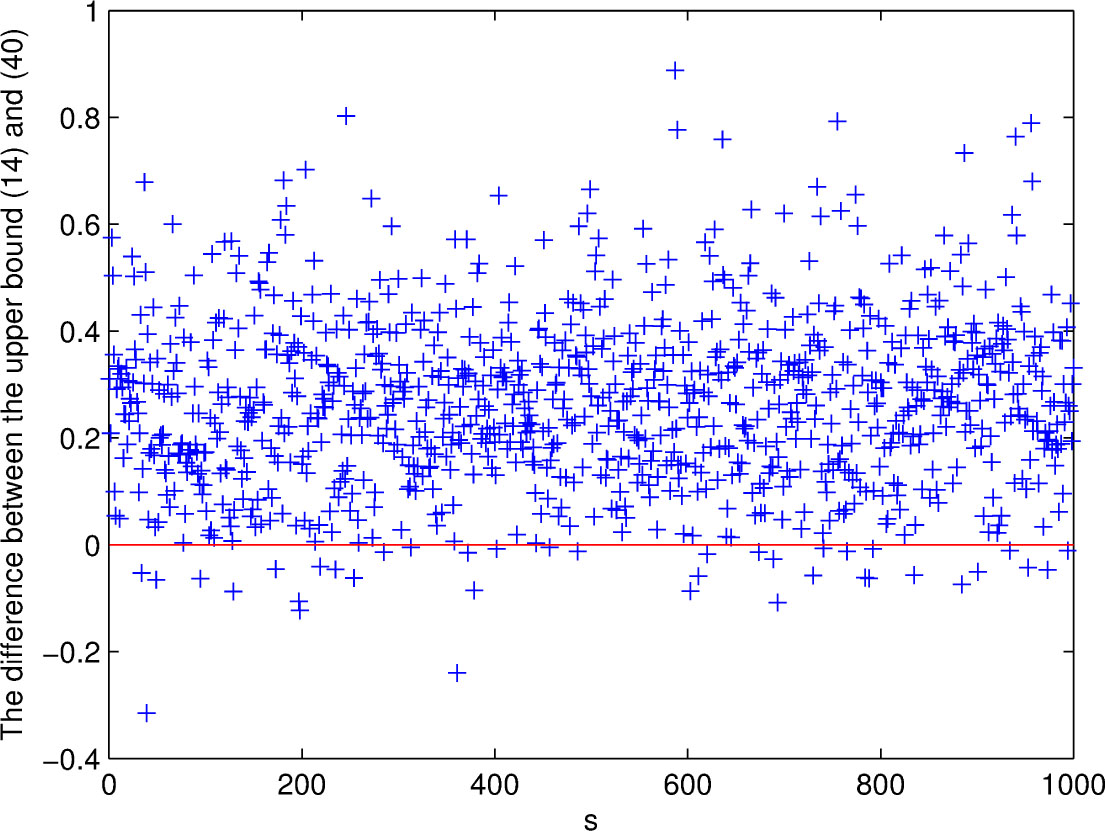
The randomly generated results for Example 4.2
Acknowledgement
The authors are grateful to the anonymous referees for their valuable comments, which helped improve the quality of the paper. The work is supported by National Natural Science Foundations of China (11361074), Natural Science Foundations of Yunnan Province (2013FD002) and IRTSTYN.
References
[1] Chang, K.C., Pearson, K., Zhang, T.: Perron-Frobenius theorem for nonnegative tensors. Commun. Math. Sci. 6 (2008), 507–520.10.4310/CMS.2008.v6.n2.a12Suche in Google Scholar
[2] Lathauwer, L.D., Moor, B.D., Vandewalle, J.: On the best rank-1 andrank-(R1, R2, …, RNapproximation of higer-order tensors. SIAM J. Matrix Anal. Appl. 21 (2000), 1324–1342.10.1137/S0895479898346995Suche in Google Scholar
[3] Liu, Y., Zhou, G., Ibrahim, N.F.: An always convergent algorithm for the largest eigenvalue of an irreducible nonnegative tensor. J. Comput. Appl. Math. 235 (2010), 286–292.10.1016/j.cam.2010.06.002Suche in Google Scholar
[4] Ng, M., Qi, L., Zhou, G.: Finding the largest eigenvalue of a nonnegative tensor. SIAM J. Matrix Anal. Appl. 31 (2009), 1090–1099.10.1137/09074838XSuche in Google Scholar
[5] Zhang, T., Golub, G.H.: Rank-1 approximation of higher-order tensors. SIAM J. Matrix Anal. Appl. 23 (2001), 534–550.10.1137/S0895479899352045Suche in Google Scholar
[6] Chang, K.C., Pearson, K., Zhang, T.: On eigenvalue problems of real symmetric tensors. J. Math. Anal. Appl. 350 (2009), 416–422.10.1016/j.jmaa.2008.09.067Suche in Google Scholar
[7] Qi, L.: Eigenvalues of a real supersymmetric tensor. J. Symbolic Comput. 40 (2005), 1302–1324.10.1016/j.jsc.2005.05.007Suche in Google Scholar
[8] Lim, L.H.: Singular values and eigenvalues of tensors: A variational approach. in CAMSAP'05: Proceeding of the IEEE International Workshop on Computational Advances in MultiSensor Adaptive Processing 2005, pp. 129–132.Suche in Google Scholar
[9] Kofidis, E., Regalia, R.: On the best rank-1 approximation of higher-order supersymmetric tensors. SIAM J. Matrix Anal. Appl. 23 (2002), 863–884.10.1137/S0895479801387413Suche in Google Scholar
[10] Chang, K.C., Pearson, K.J., Zhang, T.: Some variationalprinciples for Z-eigenvalues of nonnegative tensors. Linear Algebra Appl. 438 (2013), 4166–4182.10.1016/j.laa.2013.02.013Suche in Google Scholar
[11] Qi, L.: Rank and eigenvalues of a supersymmetric tensor, the multivariate homogeneous polynomial and the algebraic hypersurface it defines. J. Symbolic Comput. 41 (2006), 1309–1327.10.1016/j.jsc.2006.02.011Suche in Google Scholar
[12] DeVore, R.A., Temlyakov, V.N.: Some remarks on greedy algorithms. Adv. comput. Math. 5 (1996), 173–187.10.1007/BF02124742Suche in Google Scholar
[13] Falco, A., Nouy, A.: A proper generalized decomposition for the solution of elliptic problems in abstract form by using a functional Eckart-Young approach. J. Math. Analysis and Appl. 376 (2011), 469–480.10.1016/j.jmaa.2010.12.003Suche in Google Scholar
[14] Wang, Y., Qi, L.: On the successive supersymmetric rank-1 decomposition of higher-order supersymmetric tensors. Numer. Linear Algebra Appl. 14 (2007), 503–519.10.1002/nla.537Suche in Google Scholar
[15] Ammar, A., Chinesta, F., Falcó, A.: On the convergence of a greedy rank-one update algorithm for a class of linear systems. Arch. Comput. Methods Eng. 17 (2010), 473–486.10.1007/s11831-010-9048-zSuche in Google Scholar
[16] Qi, L.: The best rank-one approximation ratio of a tensor space. SIAM J. Matrix Anal. Appl. 32 (2011), 430–442.10.1137/100795802Suche in Google Scholar
[17] Yang, Y., Yang, Q.: Further results for Perron-Frobenius Theorem for nonnegative tensors. SIAM. J. Matrix Anal. Appl. 31 (2010), 2517–2530.10.1137/090778766Suche in Google Scholar
[18] Li, W., Ng, M.: Some bounds for the spectral radius of nonnegative tensors. Numer. Math. 130 (2015), 315–335.10.1007/s00211-014-0666-5Suche in Google Scholar
[19] Wang, Z., Wu, W.: Bounds for the greatest eigenvalue of positive tensors. J. Ind. Manage. Optim. 10 (2014), 1031–1039.10.3934/jimo.2014.10.1031Suche in Google Scholar
[20] Song. Y., Qi, L.: Spectral properties of positively homogeneous operators induced by higher order tensors. SIAM J. Matrix Anal. Appl. 34 (2013), 1581–1595.10.1137/130909135Suche in Google Scholar
[21] He, J., Huang, T.Z.: Upper bound for the largest Z-eigenvalue of positive tensors. Appl. Math. Lett. 38 (2014), 110–114.10.1016/j.aml.2014.07.012Suche in Google Scholar
[22] Li, W., Liu, D., Vong, S.W.: Z-eigenpair bounds for an irreducible nonnegative tensor. Linear Algebra Appl. 483 (2015), 182–199.10.1016/j.laa.2015.05.033Suche in Google Scholar
© 2016 Liu and Li, published by De Gruyter Open
This work is licensed under the Creative Commons Attribution-NonCommercial-NoDerivatives 3.0 License.
Artikel in diesem Heft
- Regular Article
-
A metric graph satisfying
- Regular Article
- On the Riemann-Hilbert problem in multiply connected domains
- Regular Article
- Hamilton cycles in almost distance-hereditary graphs
- Regular Article
- Locally adequate semigroup algebras
- Regular Article
- Parabolic oblique derivative problem with discontinuous coefficients in generalized weighted Morrey spaces
- Corrigendum
- Corrigendum to: parabolic oblique derivative problem with discontinuous coefficients in generalized weighted Morrey spaces
- Regular Article
- Some new bounds of the minimum eigenvalue for the Hadamard product of an M-matrix and an inverse M-matrix
- Regular Article
- Integral inequalities involving generalized Erdélyi-Kober fractional integral operators
- Regular Article
- Results on the deficiencies of some differential-difference polynomials of meromorphic functions
- Regular Article
- General numerical radius inequalities for matrices of operators
- Regular Article
- The best uniform quadratic approximation of circular arcs with high accuracy
- Regular Article
- Multiple gcd-closed sets and determinants of matrices associated with arithmetic functions
- Regular Article
- A note on the rate of convergence for Chebyshev-Lobatto and Radau systems
- Regular Article
- On the weakly(α, ψ, ξ)-contractive condition for multi-valued operators in metric spaces and related fixed point results
- Regular Article
- Existence of a common solution for a system of nonlinear integral equations via fixed point methods in b-metric spaces
- Regular Article
- Bounds for the Z-eigenpair of general nonnegative tensors
- Regular Article
- Subsymmetry and asymmetry models for multiway square contingency tables with ordered categories
- Regular Article
- End-regular and End-orthodox generalized lexicographic products of bipartite graphs
- Regular Article
- Refinement of the Jensen integral inequality
- Regular Article
- New iterative codes for 𝓗-tensors and an application
- Regular Article
- A result for O2-convergence to be topological in posets
- Regular Article
- A fixed point approach to the Mittag-Leffler-Hyers-Ulam stability of a fractional integral equation
- Regular Article
- Uncertainty orders on the sublinear expectation space
- Regular Article
- Generalized derivations of Lie triple systems
- Regular Article
- The BV solution of the parabolic equation with degeneracy on the boundary
- Regular Article
- Malliavin method for optimal investment in financial markets with memory
- Regular Article
- Parabolic sublinear operators with rough kernel generated by parabolic calderön-zygmund operators and parabolic local campanato space estimates for their commutators on the parabolic generalized local morrey spaces
- Regular Article
- On annihilators in BL-algebras
- Regular Article
- On derivations of quantales
- Regular Article
-
On the closed subfields of
- Regular Article
- A class of tridiagonal operators associated to some subshifts
- Regular Article
- Some notes to existence and stability of the positive periodic solutions for a delayed nonlinear differential equations
- Regular Article
- Weighted fractional differential equations with infinite delay in Banach spaces
- Regular Article
- Laplace-Stieltjes transform of the system mean lifetime via geometric process model
- Regular Article
- Various limit theorems for ratios from the uniform distribution
- Regular Article
- On α-almost Artinian modules
- Regular Article
- Limit theorems for the weights and the degrees in anN-interactions random graph model
- Regular Article
- An analysis on the stability of a state dependent delay differential equation
- Regular Article
- The hybrid mean value of Dedekind sums and two-term exponential sums
- Regular Article
- New modification of Maheshwari’s method with optimal eighth order convergence for solving nonlinear equations
- Regular Article
- On the concept of general solution for impulsive differential equations of fractional-order q ∈ (2,3)
- Regular Article
- A Riesz representation theory for completely regular Hausdorff spaces and its applications
- Regular Article
- Oscillation of impulsive conformable fractional differential equations
- Regular Article
- Dynamics of doubly stochastic quadratic operators on a finite-dimensional simplex
- Regular Article
- Homoclinic solutions of 2nth-order difference equations containing both advance and retardation
- Regular Article
- When do L-fuzzy ideals of a ring generate a distributive lattice?
- Regular Article
- Fully degenerate poly-Bernoulli numbers and polynomials
- Commentary
- Commentary to: Generalized derivations of Lie triple systems
- Regular Article
- Simple sufficient conditions for starlikeness and convexity for meromorphic functions
- Regular Article
- Global stability analysis and control of leptospirosis
- Regular Article
- Random attractors for stochastic two-compartment Gray-Scott equations with a multiplicative noise
- Regular Article
- The fuzzy metric space based on fuzzy measure
- Regular Article
- A classification of low dimensional multiplicative Hom-Lie superalgebras
- Regular Article
- Structures of W(2.2) Lie conformal algebra
- Regular Article
- On the number of spanning trees, the Laplacian eigenvalues, and the Laplacian Estrada index of subdivided-line graphs
- Regular Article
- Parabolic Marcinkiewicz integrals on product spaces and extrapolation
- Regular Article
- Prime, weakly prime and almost prime elements in multiplication lattice modules
- Regular Article
- Pochhammer symbol with negative indices. A new rule for the method of brackets
- Regular Article
- Outcome space range reduction method for global optimization of sum of affine ratios problem
- Regular Article
- Factorization theorems for strong maps between matroids of arbitrary cardinality
- Regular Article
- A convergence analysis of SOR iterative methods for linear systems with weak H-matrices
- Regular Article
- Existence theory for sequential fractional differential equations with anti-periodic type boundary conditions
- Regular Article
- Some congruences for 3-component multipartitions
- Regular Article
- Bound for the largest singular value of nonnegative rectangular tensors
- Regular Article
- Convolutions of harmonic right half-plane mappings
- Regular Article
- On homological classification of pomonoids by GP-po-flatness of S-posets
- Regular Article
- On CSQ-normal subgroups of finite groups
- Regular Article
- The homogeneous balance of undetermined coefficients method and its application
- Regular Article
- On the saturated numerical semigroups
- Regular Article
- The Bruhat rank of a binary symmetric staircase pattern
- Regular Article
- Fixed point theorems for cyclic contractive mappings via altering distance functions in metric-like spaces
- Regular Article
- Singularities of lightcone pedals of spacelike curves in Lorentz-Minkowski 3-space
- Regular Article
- An S-type upper bound for the largest singular value of nonnegative rectangular tensors
- Regular Article
- Fuzzy ideals of ordered semigroups with fuzzy orderings
- Regular Article
- On meromorphic functions for sharing two sets and three sets in m-punctured complex plane
- Regular Article
- An incremental approach to obtaining attribute reduction for dynamic decision systems
- Regular Article
- Very true operators on MTL-algebras
- Regular Article
- Value distribution of meromorphic solutions of homogeneous and non-homogeneous complex linear differential-difference equations
- Regular Article
- A class of 3-dimensional almost Kenmotsu manifolds with harmonic curvature tensors
- Regular Article
- Robust dynamic output feedback fault-tolerant control for Takagi-Sugeno fuzzy systems with interval time-varying delay via improved delay partitioning approach
- Regular Article
- New bounds for the minimum eigenvalue of M-matrices
- Regular Article
- Semi-quotient mappings and spaces
- Regular Article
- Fractional multilinear integrals with rough kernels on generalized weighted Morrey spaces
- Regular Article
- A family of singular functions and its relation to harmonic fractal analysis and fuzzy logic
- Regular Article
- Solution to Fredholm integral inclusions via (F, δb)-contractions
- Regular Article
- An Ulam stability result on quasi-b-metric-like spaces
- Regular Article
- On the arrowhead-Fibonacci numbers
- Regular Article
- Rough semigroups and rough fuzzy semigroups based on fuzzy ideals
- Regular Article
- The general solution of impulsive systems with Riemann-Liouville fractional derivatives
- Regular Article
- A remark on local fractional calculus and ordinary derivatives
- Regular Article
- Elastic Sturmian spirals in the Lorentz-Minkowski plane
- Topical Issue: Metaheuristics: Methods and Applications
- Bias-variance decomposition in Genetic Programming
- Topical Issue: Metaheuristics: Methods and Applications
- A novel generalized oppositional biogeography-based optimization algorithm: application to peak to average power ratio reduction in OFDM systems
- Special Issue on Recent Developments in Differential Equations
- Modeling of vibration for functionally graded beams
- Special Issue on Recent Developments in Differential Equations
- Decomposition of a second-order linear time-varying differential system as the series connection of two first order commutative pairs
- Special Issue on Recent Developments in Differential Equations
- Differential equations associated with generalized Bell polynomials and their zeros
- Special Issue on Recent Developments in Differential Equations
- Differential equations for p, q-Touchard polynomials
- Special Issue on Recent Developments in Differential Equations
- A new approach to nonlinear singular integral operators depending on three parameters
- Special Issue on Recent Developments in Differential Equations
- Performance and stochastic stability of the adaptive fading extended Kalman filter with the matrix forgetting factor
- Special Issue on Recent Developments in Differential Equations
- On new characterization of inextensible flows of space-like curves in de Sitter space
- Special Issue on Recent Developments in Differential Equations
- Convergence theorems for a family of multivalued nonexpansive mappings in hyperbolic spaces
- Special Issue on Recent Developments in Differential Equations
- Fractional virus epidemic model on financial networks
- Special Issue on Recent Developments in Differential Equations
- Reductions and conservation laws for BBM and modified BBM equations
- Special Issue on Recent Developments in Differential Equations
- Extinction of a two species non-autonomous competitive system with Beddington-DeAngelis functional response and the effect of toxic substances
Artikel in diesem Heft
- Regular Article
-
A metric graph satisfying
- Regular Article
- On the Riemann-Hilbert problem in multiply connected domains
- Regular Article
- Hamilton cycles in almost distance-hereditary graphs
- Regular Article
- Locally adequate semigroup algebras
- Regular Article
- Parabolic oblique derivative problem with discontinuous coefficients in generalized weighted Morrey spaces
- Corrigendum
- Corrigendum to: parabolic oblique derivative problem with discontinuous coefficients in generalized weighted Morrey spaces
- Regular Article
- Some new bounds of the minimum eigenvalue for the Hadamard product of an M-matrix and an inverse M-matrix
- Regular Article
- Integral inequalities involving generalized Erdélyi-Kober fractional integral operators
- Regular Article
- Results on the deficiencies of some differential-difference polynomials of meromorphic functions
- Regular Article
- General numerical radius inequalities for matrices of operators
- Regular Article
- The best uniform quadratic approximation of circular arcs with high accuracy
- Regular Article
- Multiple gcd-closed sets and determinants of matrices associated with arithmetic functions
- Regular Article
- A note on the rate of convergence for Chebyshev-Lobatto and Radau systems
- Regular Article
- On the weakly(α, ψ, ξ)-contractive condition for multi-valued operators in metric spaces and related fixed point results
- Regular Article
- Existence of a common solution for a system of nonlinear integral equations via fixed point methods in b-metric spaces
- Regular Article
- Bounds for the Z-eigenpair of general nonnegative tensors
- Regular Article
- Subsymmetry and asymmetry models for multiway square contingency tables with ordered categories
- Regular Article
- End-regular and End-orthodox generalized lexicographic products of bipartite graphs
- Regular Article
- Refinement of the Jensen integral inequality
- Regular Article
- New iterative codes for 𝓗-tensors and an application
- Regular Article
- A result for O2-convergence to be topological in posets
- Regular Article
- A fixed point approach to the Mittag-Leffler-Hyers-Ulam stability of a fractional integral equation
- Regular Article
- Uncertainty orders on the sublinear expectation space
- Regular Article
- Generalized derivations of Lie triple systems
- Regular Article
- The BV solution of the parabolic equation with degeneracy on the boundary
- Regular Article
- Malliavin method for optimal investment in financial markets with memory
- Regular Article
- Parabolic sublinear operators with rough kernel generated by parabolic calderön-zygmund operators and parabolic local campanato space estimates for their commutators on the parabolic generalized local morrey spaces
- Regular Article
- On annihilators in BL-algebras
- Regular Article
- On derivations of quantales
- Regular Article
-
On the closed subfields of
- Regular Article
- A class of tridiagonal operators associated to some subshifts
- Regular Article
- Some notes to existence and stability of the positive periodic solutions for a delayed nonlinear differential equations
- Regular Article
- Weighted fractional differential equations with infinite delay in Banach spaces
- Regular Article
- Laplace-Stieltjes transform of the system mean lifetime via geometric process model
- Regular Article
- Various limit theorems for ratios from the uniform distribution
- Regular Article
- On α-almost Artinian modules
- Regular Article
- Limit theorems for the weights and the degrees in anN-interactions random graph model
- Regular Article
- An analysis on the stability of a state dependent delay differential equation
- Regular Article
- The hybrid mean value of Dedekind sums and two-term exponential sums
- Regular Article
- New modification of Maheshwari’s method with optimal eighth order convergence for solving nonlinear equations
- Regular Article
- On the concept of general solution for impulsive differential equations of fractional-order q ∈ (2,3)
- Regular Article
- A Riesz representation theory for completely regular Hausdorff spaces and its applications
- Regular Article
- Oscillation of impulsive conformable fractional differential equations
- Regular Article
- Dynamics of doubly stochastic quadratic operators on a finite-dimensional simplex
- Regular Article
- Homoclinic solutions of 2nth-order difference equations containing both advance and retardation
- Regular Article
- When do L-fuzzy ideals of a ring generate a distributive lattice?
- Regular Article
- Fully degenerate poly-Bernoulli numbers and polynomials
- Commentary
- Commentary to: Generalized derivations of Lie triple systems
- Regular Article
- Simple sufficient conditions for starlikeness and convexity for meromorphic functions
- Regular Article
- Global stability analysis and control of leptospirosis
- Regular Article
- Random attractors for stochastic two-compartment Gray-Scott equations with a multiplicative noise
- Regular Article
- The fuzzy metric space based on fuzzy measure
- Regular Article
- A classification of low dimensional multiplicative Hom-Lie superalgebras
- Regular Article
- Structures of W(2.2) Lie conformal algebra
- Regular Article
- On the number of spanning trees, the Laplacian eigenvalues, and the Laplacian Estrada index of subdivided-line graphs
- Regular Article
- Parabolic Marcinkiewicz integrals on product spaces and extrapolation
- Regular Article
- Prime, weakly prime and almost prime elements in multiplication lattice modules
- Regular Article
- Pochhammer symbol with negative indices. A new rule for the method of brackets
- Regular Article
- Outcome space range reduction method for global optimization of sum of affine ratios problem
- Regular Article
- Factorization theorems for strong maps between matroids of arbitrary cardinality
- Regular Article
- A convergence analysis of SOR iterative methods for linear systems with weak H-matrices
- Regular Article
- Existence theory for sequential fractional differential equations with anti-periodic type boundary conditions
- Regular Article
- Some congruences for 3-component multipartitions
- Regular Article
- Bound for the largest singular value of nonnegative rectangular tensors
- Regular Article
- Convolutions of harmonic right half-plane mappings
- Regular Article
- On homological classification of pomonoids by GP-po-flatness of S-posets
- Regular Article
- On CSQ-normal subgroups of finite groups
- Regular Article
- The homogeneous balance of undetermined coefficients method and its application
- Regular Article
- On the saturated numerical semigroups
- Regular Article
- The Bruhat rank of a binary symmetric staircase pattern
- Regular Article
- Fixed point theorems for cyclic contractive mappings via altering distance functions in metric-like spaces
- Regular Article
- Singularities of lightcone pedals of spacelike curves in Lorentz-Minkowski 3-space
- Regular Article
- An S-type upper bound for the largest singular value of nonnegative rectangular tensors
- Regular Article
- Fuzzy ideals of ordered semigroups with fuzzy orderings
- Regular Article
- On meromorphic functions for sharing two sets and three sets in m-punctured complex plane
- Regular Article
- An incremental approach to obtaining attribute reduction for dynamic decision systems
- Regular Article
- Very true operators on MTL-algebras
- Regular Article
- Value distribution of meromorphic solutions of homogeneous and non-homogeneous complex linear differential-difference equations
- Regular Article
- A class of 3-dimensional almost Kenmotsu manifolds with harmonic curvature tensors
- Regular Article
- Robust dynamic output feedback fault-tolerant control for Takagi-Sugeno fuzzy systems with interval time-varying delay via improved delay partitioning approach
- Regular Article
- New bounds for the minimum eigenvalue of M-matrices
- Regular Article
- Semi-quotient mappings and spaces
- Regular Article
- Fractional multilinear integrals with rough kernels on generalized weighted Morrey spaces
- Regular Article
- A family of singular functions and its relation to harmonic fractal analysis and fuzzy logic
- Regular Article
- Solution to Fredholm integral inclusions via (F, δb)-contractions
- Regular Article
- An Ulam stability result on quasi-b-metric-like spaces
- Regular Article
- On the arrowhead-Fibonacci numbers
- Regular Article
- Rough semigroups and rough fuzzy semigroups based on fuzzy ideals
- Regular Article
- The general solution of impulsive systems with Riemann-Liouville fractional derivatives
- Regular Article
- A remark on local fractional calculus and ordinary derivatives
- Regular Article
- Elastic Sturmian spirals in the Lorentz-Minkowski plane
- Topical Issue: Metaheuristics: Methods and Applications
- Bias-variance decomposition in Genetic Programming
- Topical Issue: Metaheuristics: Methods and Applications
- A novel generalized oppositional biogeography-based optimization algorithm: application to peak to average power ratio reduction in OFDM systems
- Special Issue on Recent Developments in Differential Equations
- Modeling of vibration for functionally graded beams
- Special Issue on Recent Developments in Differential Equations
- Decomposition of a second-order linear time-varying differential system as the series connection of two first order commutative pairs
- Special Issue on Recent Developments in Differential Equations
- Differential equations associated with generalized Bell polynomials and their zeros
- Special Issue on Recent Developments in Differential Equations
- Differential equations for p, q-Touchard polynomials
- Special Issue on Recent Developments in Differential Equations
- A new approach to nonlinear singular integral operators depending on three parameters
- Special Issue on Recent Developments in Differential Equations
- Performance and stochastic stability of the adaptive fading extended Kalman filter with the matrix forgetting factor
- Special Issue on Recent Developments in Differential Equations
- On new characterization of inextensible flows of space-like curves in de Sitter space
- Special Issue on Recent Developments in Differential Equations
- Convergence theorems for a family of multivalued nonexpansive mappings in hyperbolic spaces
- Special Issue on Recent Developments in Differential Equations
- Fractional virus epidemic model on financial networks
- Special Issue on Recent Developments in Differential Equations
- Reductions and conservation laws for BBM and modified BBM equations
- Special Issue on Recent Developments in Differential Equations
- Extinction of a two species non-autonomous competitive system with Beddington-DeAngelis functional response and the effect of toxic substances
