
Hamilton cycles in almost distance-hereditary graphs
-
Bing Chen


Abstract
Let G be a graph on n ≥ 3 vertices. A graph G is almost distance-hereditary if each connected induced subgraph H of G has the property dH(x, y) ≤ dG(x, y) + 1 for any pair of vertices x, y ∈ V(H). Adopting the terminology introduced by Broersma et al. and Čada, a graph G is called 1-heavy if at least one of the end vertices of each induced subgraph of G isomorphic to K1,3 (a claw) has degree at least n/2, and is called claw-heavy if each claw of G has a pair of end vertices with degree sum at least n. In this paper we prove the following two theorems: (1) Every 2-connected, claw-heavy and almost distance-hereditary graph is Hamiltonian. (2) Every 3-connected, 1-heavy and almost distance-hereditary graph is Hamiltonian. The first result improves a previous theorem of Feng and Guo [J.-F. Feng and Y.-B. Guo, Hamiltonian cycle in almost distance-hereditary graphs with degree condition restricted to claws, Optimazation57 (2008), no. 1, 135–141]. For the second result, its connectedness condition is sharp since Feng and Guo constructed a 2-connected 1-heavy graph which is almost distance-hereditary but not Hamiltonian.
1 Introduction
In this paper, we only consider the graphs which are finite, undirected and without multi-edges and loops. For terminology and notation not defined here, we refer to Bondy and Murty [1].
Let G be a graph with vertex set V(G) and H be a subgraph of G. For a vertex υ ∈ V(G), we denote by NH(υ) the set of vertices which are adjacent to υ in H, and by dH(υ) = |NH(υ)| the degree of υ in H. For two vertices x, y ∈ V(G), an (x, y)-path in H is a path starting from x to y with all vertices in H. The distance of x and y in H, denoted by dH(x, y), is defined as the length of a shortest (x, y)-path in H. When there is no danger of ambiguity, we use N(υ), d(υ) and d(x, y) instead of NG(υ), dG(υ) and dG(x, y), respectively.
A graph is called Hamiltonian if it contains a Hamilton cycle, i.e., a cycle passing through all the vertices of the graph. The study of cycles, especially Hamilton cycles, may be one of the most important and most studied areas of graph theory. It is well-known that to determine whether a given graph contains a Hamilton cycle is
A graph G is called almost distance-hereditary if each connected induced subgraph H of G has the property dH(x, y) ≤ dG(x, y) + 1 for any pair of vertices x, y ∈ V(H). For some properties and a characterization of almost-distance hereditary graphs, we refer to [7].
Let G be a graph. An induced subgraph of G isomorphic to K1,3 is called a claw. The vertex of degree 3 in the claw is called its center and the other vertices are its end vertices. G is called claw-free if G contains no claw. Throughout this paper, whenever the vertices of a claw are listed, its center is always the first one.
Many results about the existence of Hamilton cycles in claw-free graphs have been obtained. In particular, Feng and Guo [8] gave the following result on Hamiltonicity of almost distance-hereditary claw-free graphs.
(Feng and Guo [8]). Let G be a 2-connected claw-free graph. If G is almost distance-hereditary, then G is Hamiltonian.
Let G be a graph on n vertices. A vertex υ of G is called heavy if d(υ) ≥ n/2. Broersma et al. [9] introduced the concepts of 1-heavy graph and 2-heavy graph. Later, Fujisawa and Yamashita [10] and Čada [11] introduced the concept of claw-heavy graphs, independently. Following [9–11], we say that a claw in G is 1-heavy (2-heavy) if at least one (two) of its end vertices is (are) heavy. G is called 1-heavy (2-heavy) if every claw of it is 1-heavy (2-heavy), and called claw-heavy if every claw of it has two end vertices with degree sum at least n. It is easily seen that every claw-free graph is 1-heavy (2-heavy, claw-heavy), every 2-heavy graph is claw-heavy and every claw-heavy graph is 1-heavy. But not every claw-heavy graph is 2-heavy, and not every 1-heavy graph is claw-heavy.
In [12], Feng and Guo extended Theorem 1.1 to a larger graph class of 2-heavy graphs.
(Feng and Guo [12]). Let G be a 2-connected 2-heavy graph. If G is almost distance-hereditary, then G is Hamiltonian.
Feng and Guo [12] also constructed a 2-connected 1-heavy graph which is almost distance-hereditary but not Hamiltonian. Thus it is natural to ask which is the minimum connectivity for a 1-heavy almost distance-hereditary graph under this connectivity condition to be Hamiltonian.
Motivated by [9, 13–15], in this paper we obtain the following two theorems which extend Theorem 1.1 and Theorem 1.2. In particular, Theorem 1.3 improves Theorem 1.2, and Theorem 1.4 answers the problem proposed above.
Let G be a 2-connected claw-heavy graph. If G is almost distance-hereditary, then G is Hamiltonian.
Let G be a 3-connected 1-heavy graph. If G is almost distance-hereditary, then G is Hamiltonian.
We emphasize that our technique of proofs is different from Feng and Guo [12]. One of our main tools is the so called "Ore-cycle" (motivated by Lemma 3 in [13]) introduced by Li et al. [16].
The graph in Fig. 1 shows that the result in Theorem 1.3 indeed strengthen that in Theorem 1.2. As shown in [13, Fig. 2], let n ≥ 10 be an even integer and Kn/2 + Kn/2−3denote the join of two complete graphs Kn/2and Kn/2−3. Choose a vertex y ∈ V(Kn/2) and construct a graph G with V(G) = V(Kn/2 + Kn/2−3) ∪ {υ, u, x} and E(G) = E(Kn/2 + Kn/2−3) ∪ {uυ, uy, ux} ∪ {υw, xw : w ∈ V(Kn/2−3)}. It is easy to see that G is a Hamiltonian graph satisfying the condition of Theorem 1.3, but not the condition of Theorem 1.2.
We postpone the proofs of Theorem 1.3 and 1.4 to Section 3.
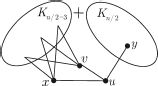
A graph which shows the result in Theorem 1.3 strengthens that in Theorem 1.2.
2 Preliminaries
Let G be a graph on n vertices and k ≥ 3 be an integer. Recall that a vertex of degree at least n/2 in G is a heavy vertex; otherwise it is light. A claw in G is called a light claw if all its end vertices are light, and is called an o-light claw if any pair of end vertices has degree sum less than n. A cycle in G is called a heavy cycle if it contains all heavy vertices of G. Following [16], we use Ẽ(G) to denote the set {uυ : uυ ∈ E(G) or d(u) + d(υ) ≥ n, u, υ ∈ V(G)}. A sequence of vertices C = υ1υ2 … υk υ1 is called an Ore-cycle or briefly, o-cycle of G, if we have υiυi+1 ∈ Ẽ(G) for every i ∈ {1, 2, · , k}, where υ1 = υk+1.
Let G be a graph and k be a nonnegative integer. For a cycle C of G and a vertex u ∈ V(G)\V(C), a subgraph F of G is said to be a (u, C ; k)-fanif F is a union of paths P1, P2, … , Pk, where Pi is a (u, wi)-path (1 ≤ i ≤ k), Pi ∩ C = {wi} (1 ≤ i ≤ k) and Pi ∩ Pj = {u} for 1 ≤ i < j ≤ k. In the following, we use F = (u: P1, P2, … , Pk) to denote the fan. The vertices in V(F)\{w1, w2, … , wk} are called internal vertices of F.
We need some notations from [13]. Let H be a path or a cycle with a given orientation. We denote by
To prove Theorems 1.3 and 1.4, the following six lemmas are needed. In particular, similar proofs of the facts in Lemma 2.3 can be found in [13, 16] (for example, see Claims 1-4 of Theorem 8 in [16]). For the convenience of the readers, we write the detailed proofs here.
(Li, Wang, Ryjáček, Zhang [16]). Let G be graph and let C′ be an o-cycle of G. Then there exists a cycle C of G such that V(C′) ⊆ V(C).
Let G be a non-Hamiltonian graph on n vertices, C be a longest cycle (a longest heavy cycle) of G, R a component of G − V(C), and A = {υ1, υ2, … , υ3} the set of neighbors of R on C. Let u ∈ V(R) andυi, υj ∈ A. Then there hold
(a) uυ−i ∉ Ẽ(G), uυ+i ∉ Ẽ(G); (b) υ−iυ−j ∉ Ẽ(G), υ+iυ+j ∉ Ẽ(G); and (c)ifυ−iυ+i ∉ Ẽ(G), thenυiυ−j ∉ Ẽ(G), υiυ+j ∉ Ẽ(G).
Furthermore, if G is a 2-connected claw-heavy graph, then
(d) υ−iυ+i ∈ Ẽ(G) andυ−jυ+j ∈ Ẽ(G); (e) υ−iυ+i ∈ E(G) orυ−jυ+j ∈ E(G).
Proof. (a) Suppose that uυ−i ∈ Ẽ(G). Then C′ = uυiC[υi, υ−i]υ−iu is an o-cycle of length longer than C, a contradiction. The other assertion can be proved similarly.
(b) Suppose that υ−iυ−j ∈ Ẽ(G). Then
(c) Suppose that υiυ−j ∈ Ẽ(G). Then C′ = υiuυjC[υj, υ−i]υ−iυ+iC[υ+i, υ−i]υ−iυi is an o-cycle of length longer than C, a contradiction. The other assertion can be proved similarly.
(d) If υ−iυ+i ∉ E(G), then by (a), we know uυ−i ∉ E(G), uυ+i ∉ E(G). Thus {υi, u, υi−, υi+}, induces a claw. Since G is claw-heavy, by (a), we have d(υ−i) + d(υ+i) ≥ n. This implies that υ−iυ+i ∈ Ẽ(G). If υ−iυ+i ∈ E(G), then obviously υ−iυ+i ∈ Ẽ(G). The other assertion can be proved similarly.
(e) Suppose that υ−iυ+i ∉ E(G) and υ−jv+j ∉ E(G). By (d), we have d(υ−i) + d(υ+i) ≥ n and d(υ−j) + d(υ+j) ≥ n. This implies that d(υ−i) + d(υ−j) ≥ n or d(υ+i) + d(υ+j) ≥ n. Thus υ−iυ−j ∈ Ẽ(G) or υ+iυ+j ∈ Ẽ(G), a contradiction to (b).
Let G be a non-Hamiltonian graph, C be a longest cycle (a longest heavy cycle) of G, R a component of G − V(C), and A = {υ1, υ2, . . . , υk} the set of neighbors of R on C. Let υi, υj ∈ A. Then there hold
(a) forl ∈ V(C(υi, υ−j]), ifυ−il ∈ Ẽ(G), thenl−υ+j ∉ Ẽ(G) andl+υ+j ∉ Ẽ(G);
(b) forl ∈ V(C(υi, υ−j]) ∩ N(υi), ifυ−iυ+i ∈ Ẽ(G), thenl−υ−j ∉ Ẽ(G) andl+υ+j ∉ Ẽ(G); and
(c) forl ∈ V(C(υi, υ−j]) ∩ N(υi) ∩ N(υ−j), ifυ−iυ+i ∈ Ẽ(G), thenl−l+ ∉ Ẽ(G).
Proof. Let P be a (υi, υj)-path with all internal vertices in R.
(a) Suppose l−υ+j ∈ Ẽ(G). Then
(b) Suppose l−υ−j ∈ Ẽ(G). Then
(c) Suppose l−l+ ∈ Ẽ(G). Then C′ = PC[υj, υ−i]υ−iυ+iC[υ+i, l−]l−l+C[l+, υ−j]υ−jlυi is an o-cycle such that V(C) ⊂ V(C′), a contradiction. □
Let G be a 3-connected 1-heavy non-Hamiltonian graph and C be a longest heavy cycle of G, R a component of G − V(C). Let u ∈ V(R), and υ0, υ1, υ2be three neighbors of u which are in the order around C andυ−1, υ+1are light. Letli ∈ C[υ+i, υ−i+1) such thatυ−i+1li ∈ E(G) and li υi ∈ E(G), si ∈ C(υ+i−1, υ−i] such thatυ+i−1si ∈ E(G) and si υi ∈ E(G) (where the indices are taken modulo 3).
(a) Ifυ−2υ+2 ∉ E(G) andυ−0υ+0 ∉ E(G), then (i) υ−1υ2 ∉ E(G), (ii) υ1l−1 ∈ E(G) andυ1s+1 ∈ E(G), (iii) υ1, l+1, l−1, s−1, s+1, l1, s1are light;
(b) Ifυ−2υ+2 ∈ E(G) andυ−0υ+0 ∈ E(G), then {υ+1, l+0, s+2} induces an independent set.
Proof. By Lemma 2.3 (a), uυ−1 ∉ E(G) and uυ+1 ∉ E(G). If υ−1υ+1 ∉ E(G), then since u, υ−1, υ+1 are light, {υ1, u, υ−1, υ+1} induces a light claw, a contradiction. Thus υ−1υ+1 ∈ E(G).
(a) Since υ−2υ+2 ∉ E(G) and υ−0υ+0 ∉ E(G), we have υ−2, υ+0 are heavy or υ+2, υ−0 are heavy by Lemma 2.3 (b).
(i) Suppose υ−1υ2 ∈ E(G) and υ−2, υ+0 are heavy. Let C′ = υ−1υ2C[υ2, υ0]υ2uυ1C[υ1, υ−2]υ−2υ+0C[υ+0, υ−1]. Then C′ is an o-cycle such that V(C) ⊂ V(C′), a contradiction.
Suppose υ−1υ2 ∈ E(G) and υ+2, υ−0 are heavy. Now {υ2, υ−2, u, υ−1} induces a light claw, a contradiction.
(ii) Suppose υ1l−1 ∉ E(G). Note that υ1l+1 ∉ Ẽ(G) and l−1l+1 ∉ Ẽ(G) by Lemma 2.4 (b) and (c). Since υ−2, υ+0 are heavy or υ+2, υ−0 are heavy, by Lemma 2.3 (c) and Lemma 2.4 (b), υ1, l+1, l−1 are light. Now {l1, l+1, υ1, l−1} induces a light claw, a contradiction. Similarly, we can prove that υ1s+1 ∈ E(G).
(iii) By Lemma 2.3 (c) and Lemma 2.4 (b), υ1, l+1, l−1, s−1, s+1 are light. Since υ1l−1 ∈ E(G), we obtain υ+2l1 ∉ Ẽ(G) and υ+0l1 ∉ Ẽ(G) by Lemma 2.4 (b). Note that either υ+0 or υ+2 is a heavy vertex. This implies l1 is a light vertex. The other assertion that s1 is light can be proved similarly.
(b) Since υ0l0 ∈ E(G) and υ2s2 ∈ E(G), υ+1l+0 ∉ Ẽ(G) and υ+1s+2 ∈ Ẽ(G) by Lemma 2.4 (b). Furthermore, we can prove that l+0s+2 ∉ E(G). (Otherwise,
Let G be a non-Hamiltonian almost distance-hereditary graph, C be a longest cycle (a longest heavy cycle) of G, R a component of G − V(C). If there exists a vertex u ∈ V(R) such that NC(u) = {υ1; υ2, … , υr}, then there hold
(a) for any induced (u, υ)-path P, whereυ ∈ N−C(u) orυ ∈ N+C(u), the length of P is at most 3;
(b) ifυ−iυ+i ∈ Ẽ(G), then there exists a vertexli ∈ C[υ+i, υ−i+1) such thatυ−i+1li ∈ E(G) and liυi ∈ E(G), and there exists a vertexsi ∈ C(υ+i−1, υ−1] such thatυ+i−1si ∈ E(G) and si υi ∈ E(G);
(c) ifυ−iυ+i ∈ E(G) andυ−i+1υ+i+1 ∈ E(G), thenυ+i+1li ∈ E(G); and
(d) ififυ−iυ+i ∈ E(G) andυ−i+1υ+i+1 ∈ E(G), then both {li, l−i, υi, υ−i+1} and {li, l+i, υi, υ+i+1} induce claws.
Proof. (a) Suppose there exists an induced (u, υ)-path P such that the length of P is at least 4. It follows that dP (u, υ) ≥ 4, contradicting the fact that dG(u, υ) = 2 and G is almost distance-hereditary.
(b) Let H = G[{u} ∪ V(C[υi, υi+1])] − {υi+1}. Since dG(υ−i+1, u) = 2 and G is almost distance-hereditary, we have dH(υ−i+1, u) ≤ 3. Since υ−iυ+i ∈ Ẽ(G), by Lemma 2.3 (c), we have υiυ−i+1 ∉ E(G) and dH(υ−i+1, u) = 3. It follows that dH(υ−i+1, υi) = 2. So there exists a vertex li ∈ C[υ+i, υ−i+1) such that υ−i+1li ∈ E(G) and li υi ∈ E(G). The other assertion can be proved similarly.
(c) Suppose υ+i+1li ∉ E(G). Let H = G[{υ+i+1, υ−i+1, li, υi, u}]. By Lemma 2.3 (c), υiυ−i+1 ∉ E(G) and υiυ+i+1 ∉ E(G). We can see H is an induced (u, υ+i+1)-path of length 4 in G, contradicting Lemma 2.6 (a).
(d) By Lemma 2.3 (c) and Lemma 2.4 (b), we have υiυ−i+1 ∉ Ẽ(G) and l−iυ−i+1 ∉ Ẽ(G). By Lemma 2.6 (c) and Lemma 2.4 (b), we have υil−i ∉ E(G). So {li, l−i, υi, υ−i+1} induces a claw. The other assertion can be proved similarly. □
3 Proofs of Theorems 1.3 and 1.4
Proof of Theorem 1.3
Let G be a graph satisfying the condition of Theorem 1.3. Let C be a longest cycle of G and assign an orientation to it. Suppose G is not Hamiltonian. Then
|V(C(υi, υj))| is as small as possible;
|V(P)| is as small as possible subject to (1).
There is no o-cycle C′ in G such that V(C) ⊂ V(C′).
Proof. Otherwise, C′ is an o-cycle such that V(C) ⊂ V(C′). By Lemma 2.2, there exists a cycle containing all vertices in C′ and longer than C, contradicting the choice of C. □
By Lemma 2.3 (e), without loss of generality, assume that υ−iυ+i ∈ E(G).
r = 1, that is, V(P) = {υj, u1, υj}.
Proof. Suppose r ≥ 2. Consider H = G[V(P) ∪ V(C[υi, υj])] − {υj}. Since υ−iυ+i ∈ E(G), υiυ−j ∉ E(G) by Lemma 2.3 (c). Thus dH(υ−j, υi) ≥ 2. By the choice condition of P and Lemma 2.3 (a), we have dP(υi, ur) ≥ 2 and dH(υ−j, ur) = dH(υ−j, υi) + dH(υj, ur) ≥ 4, which yields a contradiction to the fact G is almost distance-hereditary and dG(υ−j, ur) = 2. Hence V(P) = {υi, u1, υj}. □
|V(C[υi, υj])| ≥ 5.
Proof. Suppose |V(C[υi, vj])| = 4 or |V(C[υi, υj])| = 3. This means C[υi, υj] = υiυ+iυ−iυj or C[υi, υj] = υiυ−iυj. Let C′ = υiu1υjυ−jυ+jC[υ+j, υ−i]υ−iυ+iυi or C′ = υiu1υjυ−jυ+jC[υ+j, υi]. Then C′ is an o-cycle such that V(C) ⊂ V(C′) by Lemma 2.3 (d), contradicting Claim 1. □
Recall that υ–iυ+i ∈ E(G). Let H = G[{u1, υ–i} ∪ V(C[υi, υj])] – {υi}. Since dG(υ–i, u1) = 2 and G is almost distance-hereditary, dH(υ–i, u1) ≤ 3. By Lemma 2.3 (c) and (d), we have υ–iυj ∉ E(G). By the choice of P, u1υ ∉ E(G), where υ ∈ C[υ+i, υ–j]. It follows that dH(υ–i, u1) = 3 and dH(υ–i, υj) = 2. By Lemma 2.3 (b), (c) and (d), υ–iυ–j ∉ E(G) and υ+iυj ∉ E(G). Thus there exists a vertex w ∈ C(υ+i, υ–j) such that υ–iw ∈ E(G) and wυj ∈ E(G). Note that w is well-defined.
wυ+j ∉ Ẽ(G).
Proof. Suppose wυ+j ∉ Ẽ(G). By Lemma 2.4 (a), we obtain υ–iw+ ∉ Ẽ(G). Since υ–iw ∈ E(G), we have υjw+ ∉ Ẽ(G) by Lemma 2.4 (b) and by symmetry. Note that υjυ–i ∉ Ẽ(G) by Lemma 2.3 (c). Thus {w, w+, υj, υ–i} induces an o-light claw in G, a contradiction.
Next we will show that {υj, u1, w, υ+j} induces an o-light claw and get a contradiction. Before proving this fact, the following claim is needed.
u1w1 ∉ Ẽ(G).
Proof. First we will show that w–υ–i ∉ Ẽ(G). Since υ–jυ+j ∈ Ẽ(G) and υj w ∈ E(G), we have w–υ–i ∉ Ẽ(G) by Lemma 2.4 (b) and symmetry.
Next we will show that w−υj ∈ Ẽ(G). Suppose not. Consider the subgraph induced by {w, w−, υj, υ–i}. Note that υjυ–i ∉ Ẽ(G) by Lemma 2.3 (c) and w–υ–i ∉ Ẽ(G) by the analysis above. Then {w, w−, υj, υ–i} induces an o-light claw, a contradiction.
Now we will show that u1w ∉ Ẽ(G), since otherwise, C′ = u1wC[w, υ–j]υ–jυ+jC[υ+j, w–]w–υju1 is an o-cycle such that V(C) ⊂ V(C′), contradicting Claim 1. □
By Claims 4, 5 and Lemma 2.3 (a), {υj, u1, w, υ+j} induces an o-light claw, contradicting the fact G is claw-heavy. The proof of Theorem 1.3 is complete. □
Proof of Theorem 1.4.
Let G be a graph satisfying the condition of Theorem 1.4. By Lemma 2.1, there exists a heavy cycle in G. Now choose a longest heavy cycle C of G and assign an orientation to it. Suppose G is not Hamiltonian. Then
By the choice of C, all internal vertices of F are not heavy. By Lemma 2.3 (b), there is at most one heavy vertex in N+C(R) and at most one heavy vertex in N–C(R). Without loss of generality, assume that w–i, w+i are light. Hence w–iw+i ∈ E(G), otherwise {wi, w–i, w+i, xr1} induces a light claw, contradicting G is 1-heavy.
There exists a (u, C; 3)-fan F such that V(F) = {u, wi, wj, wk}.
Proof. Now we choose the fan F in such a way that:
Q1 = uwi;
|V(C[wi, wj])| is as small as possible subject to (1);
|V(Q2)| is as small as possible subject to (1) and (2);
|V(C[wk, wi])| is as small as possible subject to (1), (2) and (3);
|V(Q3)| is as small as possible subject to (1), (2), (3) and (4).
Since G is 3-connected, for any neighbor of C in R, say u (with uwi ∈ E(G), where wi ∈ V(C)), there are three disjoint paths from u to C. Obviously, we can choose one such path as uwi. Thus (1) is well-defined, and furthermore, the choice condition of F is well-defined.
V(Q2) = {U, wj}.
Proof. Suppose
V (Q3) = {u, wk}.
Proof. Suppose
If zwi ∉ E(G), then set H = G[V (Q1) ∪ V (Q3) ∪ V(C[wk, wi])] − {wk}. Since w–iw+i ∈ E(G), we obtain w+kwi ∉ E(G) by Lemma 2.3 (c). This means dH (w+k, wi) ≥ 2. By the choice condition (4), we have
If zwi ∈ E(G), then set H = G[V(C [wi, wj]) ∪ V(Q3 [u, z])] − {wi}. Note that
By Claims 1.1 and 1.2, the proof of Claim 1 is complete. □
By Claim 1, there exists a (u, C; 3)-fan F such that V(F)\V(C) = {u}. Suppose that NC (u) = {υ1, υ2, …, υr} (r ≥ 3) and υ1, υ2, …, υr are in the order of the orientation of C. In the following, all the subscripts of υ are taken modulo r, and υ0 = υr.
By Lemma 2.3 (b), there is at most one heavy vertex in N+C(u) and at most one heavy vertex in N–C (u). Since r ≥ 3, we know that there exists υj ∈ NC (u), such that υ–j, υ+j are light, and hence υ–jυ+j ∈ E(G) by the fact G is 1-heavy. Without loss of generality, assume that υ–1υ+1 ∈ E(G) and υ–1, υ+1 are light. By Lemma 2.6 (b), there exists a vertex l1 ∈ C[υ+1, υ–2) such that υ–2l1 ∈ E(G) and l1υ1 ∈ E(G), and there exists a vertex s1 ∈ C(υ+0, υ–1] such that υ+0s1 ∈ E(G) and s1v1 ∈ E(G).
We divide the proof into two cases.
υ–2υ+2 ∉ E(G) andυ–0μ+0 ∉ E(G).
Both {υ, υ–2, υ+2, u} and {υ, υ–0, υ+0, u} induce claws. By Lemma 2.3 (b) and the fact G is 1-heavy, υ–2 and υ+0 are heavy or υ+2 and υ–0 are heavy.
υ–1l1 ∈ E(G) andl1υ2 ∈ E(G).
Proof. Suppose υ–1l1 ∉ E(G). Note that uv–1 ∉ Ẽ(G) by Lemma 2.3 (a). By Lemma 2.5 (a), l1 is light. Now {υ1, l1, u, υ–1} induces a light claw, a contradiction.
Suppose l1v2 ∉ E(G). Let H = G[{υ–1, l1, υ–2, υ2, u}]. By Lemma 2.3, we get uv–2 ∉ E(G), uv–1 ∉ E(G) and υ–1υ–2 ∉ E(G). Note that υ2υ–1 ∉ E(G) by Lemma 2.5 (a). Now G[{υ–1, l1, υ–2, υ2, u}] is an induced path of length 4 in G, contradicting Lemma 2.6 (a).
Now we consider the following two subcases.
υ–2, υ+0are heavy vertices.
By Lemma 2.3 (a), uυ+2 ∉ Ẽ(G). By Lemma 2.5 (a), we have υ1l–1 ∈ E(G). Note that l′ ≔ l–1 ∈ N(υ1) and υ–1υ+1 ∈ E(G). By Lemma 2.4 (b), l′+υ+2 = l1υ+2 ∉ Ẽ(G). By Lemma 2.5 (a) and Lemma 2.3 (b), l1 and υ+2 are light. Now {υ2, l1, u, υ+2} induces a light claw, a contradiction.
υ+2, υ–0are heavy vertices.
Consider the subgraph induced by {υ+0, s1, l1, υ2, υ}. It is easily to check that υ+0s1 ∈ E(G), l1υ2 ∈ E(G) (by Claim 2) and υ2u ∈ E(G). By Lemma 2.3 (a), υ+0u ∉ E(G). By Lemma 2.5 (a) and Lemma 2.4 (b), we know that υ1l–1 ∈ E(G) and υ+0l1 ∉ E(G). Now we obtain s1l1 ∉ E(G) or υ+0υ2 ∈ E(G) or s1υ2 ∈ E(G) (Otherwise, G[{υ+0, s1, l1, υ2, u}] is an induced path of length 4, contradicting Lemma 2.6 (a)).
Suppose s1l1 ∉ E(G). By Lemma 2.5 (a), l1, s1 are light. Now {υ1, l1, s1, u} induces a light claw, contradicting G is 1-heavy.
Suppose υ+0υ2 ∈ E(G). Consider the subgraph induced by {υ2, υ–2, υ+0, u}. By Lemma 2.3 (a), we have uυ–2 ∉ E(G) and uυ+0 ∉ E(G). Since υ–2, υ+0, u are light and G is 1-heavy, υ+0υ–2 ∈ E(G). By Lemma 2.5 (a) and Claim 2, υ1l–1 ∈ E(G) and l1υ2 ∈ E(G). Now
Suppose s1υ2 ∈ E(G). Consider the subgraph induced by {υ2, υ–2, s1, u}. By Lemma 2.5 (a) and Lemma 2.3 (b), s1 and υ–2 are light. Since G is 1-heavy, s1υ–2 ∈ E(G). Now
υ–2υ+2 ∈ E(G) orυ–0υ+0 ∈ E(G).
Without loss of generality (by symmetry), assume that υ–2υ+2 ∈ E(G).
υ–0υ+0 ∉ E(G).
By Lemma 2.3 (a), uυ–0 ∉ E(G) and uυ+0 ∉ E(G). Now {υ0, υ–0, υ+0, u} induces a claw. Since G is 1-heavy and u is light, υ–0 is heavy or υ+0 is heavy.
Suppose υ–0 is heavy. By Lemma 2.3 (b), (c) and Lemma 2.4 (b), υ–2, υ1 and l–1 are light. By Lemma 2.6 (d), {l1, l–1, υ1, υ–2} induces a light claw, a contradiction.
Suppose υ+0 is heavy. By Lemma 2.3 (b), (c) and Lemma 2.4 (b), we can see υ+2, υ1 and l+1 are light. By Lemma 2.6 (d), {l1, l+1, υ1, υ+2} induces a light claw, a contradiction. (Note that υ–1υ+1 ∈ E(G) and υ–2υ+2 ∈ E(G). By Lemma 6 (c), l1υ+2 ∈ E(G).
υ–0υ+0 ∈ E(G).
By Lemma 6 (b), there exists a vertex s2 ∈ C(υ+1, υ–2] such that υ+1s2 ∈ E(G) and s2υ2 ∈ E(G).
(i) υ1is heavy, (ii) l–0, l+0, s–2, s+2are light.
Proof. Recall that the definition of l0 occurred in the condition of Lemma 5 before. Let l0 ∈ C[υ+0, υ–1) such that υ–0l0 ∈ E(G) and l0υ0 ∈ E(G).
(i) By Lemma 2.6 (d), each of {l0, l–0, υ0, υ–1} and {l1, l–1, υ1, υ–2} induces a claw. Since G is 1-heavy, at least one vertex of {l–1, υ1, υ–2} is heavy.
Suppose υ–2 is heavy. By Lemma 2.3 (b), (c) and Lemma 2.4 (b), υ–1, υ0 and l–0 are light. Now {l0, l–0, υ0, υ–1} induces a light claw, contradicting G is 1-heavy.
Suppose l–1 is heavy. By Lemma 2.6 (c), υ+2l1 ∈ E(G). By Lemma 2.4 (a) and (b), υ–1l–1 ∉ Ẽ(G) and υ0l–1 ∉ Ẽ(G). This implies that υ0, υ–1 are light. At the same time, we can prove that l0– is light. (Otherwise,
Note that {l1, l–1, υ1, υ–2} induces a claw and υ–2, l–1 are light. Since G is 1-heavy, υ1 is heavy.
(ii) Note that υ1 is heavy. If l+0 is heavy, then C′ = υ0uυ1l+0C[l+0, υ–1]υ–1υ+1C[υ+1, υ–0]υ–0υ+0C[υ+0, l0]l0υ0 is an o-cycle such that V(C) ⊂ V(C′), a contradiction. If l–0 is heavy, then C′ = υ0l0C[l0, υ–1]υ–1υ+1C[υ+1, υ–0]υ–0υ+0C[υ+0, l–0]l–0υ1uυ0 is an o-cycle such that V(C) ⊂ V(C′), a contradiction. Similarly, by symmetry, we can prove that s–2, s+2 are light. □
υ–1l+0 ∈ E(G) andυ–1s+2 ∈ E(G).
Proof. Suppose υ–1l+0 ∉ E(G). By Lemma 2.4 (b) and (c), υ–1l–0 ∉ Ẽ(G) and l–0l+0 ∉ Ẽ(G). By Claim 3, l+0, l–0 are light. Now {l0, l–0, l+0, υ–1} induces a light claw, a contradiction.
By Lemma 2.6 (c) and by symmetry, we obtain υ–1s2 ∈ E(G). Suppose υ–1s+2 ∉ E(G). By Lemma 2.4 (b) and (c), υ–1s–2 ∉ Ẽ(G) and s–2s+2 ∉ Ẽ(G). By Claim 3, s+2, s–2 are light. Now {s2, s–2, s+2, υ–1} induces a light claw, a contradiction. □
By Claim 3, Lemma 2.5 (b) and Claim 4, l+0, s+2 are light,
The proof of Theorem 1.4 is complete. □
Acknowledgement
The authors are particularly grateful to the anonymous referee for his/her extensive comments that considerably improved the paper.
The first author is supported by NSFC (No. 11271300) and the Scientific Research Program of Shaanxi Provincial Education Department (No. 2013JK0580).
References
[1] Bondy J.A., Murty, U.S.R., Graph Theory with Applications, Macmillan London and Elsevier, New York, 1976.10.1007/978-1-349-03521-2Search in Google Scholar
[2] Karp R.M., Reducibility among combinatorial problems, In: R.E. Miler et al: Complexity of Computer Computations, Plenum Press, New York, 1972, 85–103.10.1007/978-1-4684-2001-2_9Search in Google Scholar
[3] Howorka E., A characterization of distance-hereditary graphs, Quart. J. Math. Oxford Ser., 1977, 28(112), 417–420.10.1093/qmath/28.4.417Search in Google Scholar
[4] S. Hsieh, C. Ho, T. Hsu, M. Ko, Efficient Algorithms for the Hamiltonian Problem on Distance-Hereditary Graphs, Computing and Combinatorics, Lecture Notes in Computer Science, 2002, 2387, 77–86.10.1007/3-540-45655-4_10Search in Google Scholar
[5] D’Atri A., Moscarini M., Distance-hereditary graphs, Steiner trees, and connected domination, SIAM J. Comput., 1988, 17(3), 521–538.10.1137/0217032Search in Google Scholar
[6] Cogis O., Thierry E., Computing maximum stable sets for distance-hereditary graphs, Discrete Optim., 2005, 2(2), 185–188.10.1016/j.disopt.2005.03.004Search in Google Scholar
[7] Aïder M., Almost distance-hereditary graphs, Discrete Math., 2002, 242(1–3), 1–16.10.1016/S0012-365X(00)00401-5Search in Google Scholar
[8] Feng J.-F., Guo Y.-B., Hamiltonian problem on claw-free and almost distance-hereditary graphs, Discrete Math., 2008, 308(24), 6558–6563.10.1016/j.disc.2007.11.063Search in Google Scholar
[9] Broersma H.J., Ryjáč ek Z., Schiermeyer I., Dirac’s minimum degree condition restricted to claws, Discrete Math., 1997, 167/168, 155–166.10.1016/S0012-365X(96)00224-5Search in Google Scholar
[10] Fujisawa J., Yamashita T., Degree conditions on claws and modified claws for Hamiltonicity of graphs, Discrete Math., 2008, 308(9), 1612–1619.10.1016/j.disc.2007.04.018Search in Google Scholar
[11] Č ada, R., Degree conditions on induced claws, Discrete Math., 2008, 308(23), 5622–5631.10.1016/j.disc.2007.10.026Search in Google Scholar
[12] Feng J.-F., Guo Y.-B., Hamiltonian cycle in almost distance-hereditary graphs with degree condition restricted to claws, Optimazation, 2008, 57(1), 135–141.10.1080/02331930701778981Search in Google Scholar
[13] Chen B., Zhang S.-G., Qiao S.N., Hamilton cycles in claw-heavy graphs, Discrete Math., 2009, 309(8), 2015–2019.10.1016/j.disc.2008.04.013Search in Google Scholar
[14] Ning B., Zhang S.-G., Ore- and Fan-type heavy subgraphs for Hamiltonicity of 2-connected graphs, Discrete Math., 2013, 313(17), 1715–1725.10.1016/j.disc.2013.04.023Search in Google Scholar
[15] Ning B., Zhang, S.-G., Chen, B., Degree and neighborhood intersection conditions restricted to induced subgraphs ensuring Hamiltonicity of graphs, Discrete Math. Algorithms Appl., 2014, 6(3), 1450043, 7pp.10.1142/S1793830914500438Search in Google Scholar
[16] Li B.-L., Ryjáček Z., Wang Y., Zhang S.-G., Pairs of heavy subgraphs for Hamiltonicity of 2-connected graphs, SIAM J. Discrete Math., 2012, 26(3), 1088–1103.10.1137/11084786XSearch in Google Scholar
[17] Bollobás B., Brightwell G., Cycles through specified vertices, Combinatorica, 1993, 13(2), 147–155.10.1007/BF01303200Search in Google Scholar
[18] Shi R.-H., 2-neighborhoods and hamiltonian conditions, J. Graph Theory, 1992, 16(3), 267–271.10.1002/jgt.3190160310Search in Google Scholar
© 2015 Chen and Ning, published by De Gruyter Open
This work is licensed under the Creative Commons Attribution-NonCommercial-NoDerivatives 3.0 License.
Articles in the same Issue
- Regular Article
-
A metric graph satisfying
- Regular Article
- On the Riemann-Hilbert problem in multiply connected domains
- Regular Article
- Hamilton cycles in almost distance-hereditary graphs
- Regular Article
- Locally adequate semigroup algebras
- Regular Article
- Parabolic oblique derivative problem with discontinuous coefficients in generalized weighted Morrey spaces
- Corrigendum
- Corrigendum to: parabolic oblique derivative problem with discontinuous coefficients in generalized weighted Morrey spaces
- Regular Article
- Some new bounds of the minimum eigenvalue for the Hadamard product of an M-matrix and an inverse M-matrix
- Regular Article
- Integral inequalities involving generalized Erdélyi-Kober fractional integral operators
- Regular Article
- Results on the deficiencies of some differential-difference polynomials of meromorphic functions
- Regular Article
- General numerical radius inequalities for matrices of operators
- Regular Article
- The best uniform quadratic approximation of circular arcs with high accuracy
- Regular Article
- Multiple gcd-closed sets and determinants of matrices associated with arithmetic functions
- Regular Article
- A note on the rate of convergence for Chebyshev-Lobatto and Radau systems
- Regular Article
- On the weakly(α, ψ, ξ)-contractive condition for multi-valued operators in metric spaces and related fixed point results
- Regular Article
- Existence of a common solution for a system of nonlinear integral equations via fixed point methods in b-metric spaces
- Regular Article
- Bounds for the Z-eigenpair of general nonnegative tensors
- Regular Article
- Subsymmetry and asymmetry models for multiway square contingency tables with ordered categories
- Regular Article
- End-regular and End-orthodox generalized lexicographic products of bipartite graphs
- Regular Article
- Refinement of the Jensen integral inequality
- Regular Article
- New iterative codes for 𝓗-tensors and an application
- Regular Article
- A result for O2-convergence to be topological in posets
- Regular Article
- A fixed point approach to the Mittag-Leffler-Hyers-Ulam stability of a fractional integral equation
- Regular Article
- Uncertainty orders on the sublinear expectation space
- Regular Article
- Generalized derivations of Lie triple systems
- Regular Article
- The BV solution of the parabolic equation with degeneracy on the boundary
- Regular Article
- Malliavin method for optimal investment in financial markets with memory
- Regular Article
- Parabolic sublinear operators with rough kernel generated by parabolic calderön-zygmund operators and parabolic local campanato space estimates for their commutators on the parabolic generalized local morrey spaces
- Regular Article
- On annihilators in BL-algebras
- Regular Article
- On derivations of quantales
- Regular Article
-
On the closed subfields of
- Regular Article
- A class of tridiagonal operators associated to some subshifts
- Regular Article
- Some notes to existence and stability of the positive periodic solutions for a delayed nonlinear differential equations
- Regular Article
- Weighted fractional differential equations with infinite delay in Banach spaces
- Regular Article
- Laplace-Stieltjes transform of the system mean lifetime via geometric process model
- Regular Article
- Various limit theorems for ratios from the uniform distribution
- Regular Article
- On α-almost Artinian modules
- Regular Article
- Limit theorems for the weights and the degrees in anN-interactions random graph model
- Regular Article
- An analysis on the stability of a state dependent delay differential equation
- Regular Article
- The hybrid mean value of Dedekind sums and two-term exponential sums
- Regular Article
- New modification of Maheshwari’s method with optimal eighth order convergence for solving nonlinear equations
- Regular Article
- On the concept of general solution for impulsive differential equations of fractional-order q ∈ (2,3)
- Regular Article
- A Riesz representation theory for completely regular Hausdorff spaces and its applications
- Regular Article
- Oscillation of impulsive conformable fractional differential equations
- Regular Article
- Dynamics of doubly stochastic quadratic operators on a finite-dimensional simplex
- Regular Article
- Homoclinic solutions of 2nth-order difference equations containing both advance and retardation
- Regular Article
- When do L-fuzzy ideals of a ring generate a distributive lattice?
- Regular Article
- Fully degenerate poly-Bernoulli numbers and polynomials
- Commentary
- Commentary to: Generalized derivations of Lie triple systems
- Regular Article
- Simple sufficient conditions for starlikeness and convexity for meromorphic functions
- Regular Article
- Global stability analysis and control of leptospirosis
- Regular Article
- Random attractors for stochastic two-compartment Gray-Scott equations with a multiplicative noise
- Regular Article
- The fuzzy metric space based on fuzzy measure
- Regular Article
- A classification of low dimensional multiplicative Hom-Lie superalgebras
- Regular Article
- Structures of W(2.2) Lie conformal algebra
- Regular Article
- On the number of spanning trees, the Laplacian eigenvalues, and the Laplacian Estrada index of subdivided-line graphs
- Regular Article
- Parabolic Marcinkiewicz integrals on product spaces and extrapolation
- Regular Article
- Prime, weakly prime and almost prime elements in multiplication lattice modules
- Regular Article
- Pochhammer symbol with negative indices. A new rule for the method of brackets
- Regular Article
- Outcome space range reduction method for global optimization of sum of affine ratios problem
- Regular Article
- Factorization theorems for strong maps between matroids of arbitrary cardinality
- Regular Article
- A convergence analysis of SOR iterative methods for linear systems with weak H-matrices
- Regular Article
- Existence theory for sequential fractional differential equations with anti-periodic type boundary conditions
- Regular Article
- Some congruences for 3-component multipartitions
- Regular Article
- Bound for the largest singular value of nonnegative rectangular tensors
- Regular Article
- Convolutions of harmonic right half-plane mappings
- Regular Article
- On homological classification of pomonoids by GP-po-flatness of S-posets
- Regular Article
- On CSQ-normal subgroups of finite groups
- Regular Article
- The homogeneous balance of undetermined coefficients method and its application
- Regular Article
- On the saturated numerical semigroups
- Regular Article
- The Bruhat rank of a binary symmetric staircase pattern
- Regular Article
- Fixed point theorems for cyclic contractive mappings via altering distance functions in metric-like spaces
- Regular Article
- Singularities of lightcone pedals of spacelike curves in Lorentz-Minkowski 3-space
- Regular Article
- An S-type upper bound for the largest singular value of nonnegative rectangular tensors
- Regular Article
- Fuzzy ideals of ordered semigroups with fuzzy orderings
- Regular Article
- On meromorphic functions for sharing two sets and three sets in m-punctured complex plane
- Regular Article
- An incremental approach to obtaining attribute reduction for dynamic decision systems
- Regular Article
- Very true operators on MTL-algebras
- Regular Article
- Value distribution of meromorphic solutions of homogeneous and non-homogeneous complex linear differential-difference equations
- Regular Article
- A class of 3-dimensional almost Kenmotsu manifolds with harmonic curvature tensors
- Regular Article
- Robust dynamic output feedback fault-tolerant control for Takagi-Sugeno fuzzy systems with interval time-varying delay via improved delay partitioning approach
- Regular Article
- New bounds for the minimum eigenvalue of M-matrices
- Regular Article
- Semi-quotient mappings and spaces
- Regular Article
- Fractional multilinear integrals with rough kernels on generalized weighted Morrey spaces
- Regular Article
- A family of singular functions and its relation to harmonic fractal analysis and fuzzy logic
- Regular Article
- Solution to Fredholm integral inclusions via (F, δb)-contractions
- Regular Article
- An Ulam stability result on quasi-b-metric-like spaces
- Regular Article
- On the arrowhead-Fibonacci numbers
- Regular Article
- Rough semigroups and rough fuzzy semigroups based on fuzzy ideals
- Regular Article
- The general solution of impulsive systems with Riemann-Liouville fractional derivatives
- Regular Article
- A remark on local fractional calculus and ordinary derivatives
- Regular Article
- Elastic Sturmian spirals in the Lorentz-Minkowski plane
- Topical Issue: Metaheuristics: Methods and Applications
- Bias-variance decomposition in Genetic Programming
- Topical Issue: Metaheuristics: Methods and Applications
- A novel generalized oppositional biogeography-based optimization algorithm: application to peak to average power ratio reduction in OFDM systems
- Special Issue on Recent Developments in Differential Equations
- Modeling of vibration for functionally graded beams
- Special Issue on Recent Developments in Differential Equations
- Decomposition of a second-order linear time-varying differential system as the series connection of two first order commutative pairs
- Special Issue on Recent Developments in Differential Equations
- Differential equations associated with generalized Bell polynomials and their zeros
- Special Issue on Recent Developments in Differential Equations
- Differential equations for p, q-Touchard polynomials
- Special Issue on Recent Developments in Differential Equations
- A new approach to nonlinear singular integral operators depending on three parameters
- Special Issue on Recent Developments in Differential Equations
- Performance and stochastic stability of the adaptive fading extended Kalman filter with the matrix forgetting factor
- Special Issue on Recent Developments in Differential Equations
- On new characterization of inextensible flows of space-like curves in de Sitter space
- Special Issue on Recent Developments in Differential Equations
- Convergence theorems for a family of multivalued nonexpansive mappings in hyperbolic spaces
- Special Issue on Recent Developments in Differential Equations
- Fractional virus epidemic model on financial networks
- Special Issue on Recent Developments in Differential Equations
- Reductions and conservation laws for BBM and modified BBM equations
- Special Issue on Recent Developments in Differential Equations
- Extinction of a two species non-autonomous competitive system with Beddington-DeAngelis functional response and the effect of toxic substances
Articles in the same Issue
- Regular Article
-
A metric graph satisfying
- Regular Article
- On the Riemann-Hilbert problem in multiply connected domains
- Regular Article
- Hamilton cycles in almost distance-hereditary graphs
- Regular Article
- Locally adequate semigroup algebras
- Regular Article
- Parabolic oblique derivative problem with discontinuous coefficients in generalized weighted Morrey spaces
- Corrigendum
- Corrigendum to: parabolic oblique derivative problem with discontinuous coefficients in generalized weighted Morrey spaces
- Regular Article
- Some new bounds of the minimum eigenvalue for the Hadamard product of an M-matrix and an inverse M-matrix
- Regular Article
- Integral inequalities involving generalized Erdélyi-Kober fractional integral operators
- Regular Article
- Results on the deficiencies of some differential-difference polynomials of meromorphic functions
- Regular Article
- General numerical radius inequalities for matrices of operators
- Regular Article
- The best uniform quadratic approximation of circular arcs with high accuracy
- Regular Article
- Multiple gcd-closed sets and determinants of matrices associated with arithmetic functions
- Regular Article
- A note on the rate of convergence for Chebyshev-Lobatto and Radau systems
- Regular Article
- On the weakly(α, ψ, ξ)-contractive condition for multi-valued operators in metric spaces and related fixed point results
- Regular Article
- Existence of a common solution for a system of nonlinear integral equations via fixed point methods in b-metric spaces
- Regular Article
- Bounds for the Z-eigenpair of general nonnegative tensors
- Regular Article
- Subsymmetry and asymmetry models for multiway square contingency tables with ordered categories
- Regular Article
- End-regular and End-orthodox generalized lexicographic products of bipartite graphs
- Regular Article
- Refinement of the Jensen integral inequality
- Regular Article
- New iterative codes for 𝓗-tensors and an application
- Regular Article
- A result for O2-convergence to be topological in posets
- Regular Article
- A fixed point approach to the Mittag-Leffler-Hyers-Ulam stability of a fractional integral equation
- Regular Article
- Uncertainty orders on the sublinear expectation space
- Regular Article
- Generalized derivations of Lie triple systems
- Regular Article
- The BV solution of the parabolic equation with degeneracy on the boundary
- Regular Article
- Malliavin method for optimal investment in financial markets with memory
- Regular Article
- Parabolic sublinear operators with rough kernel generated by parabolic calderön-zygmund operators and parabolic local campanato space estimates for their commutators on the parabolic generalized local morrey spaces
- Regular Article
- On annihilators in BL-algebras
- Regular Article
- On derivations of quantales
- Regular Article
-
On the closed subfields of
- Regular Article
- A class of tridiagonal operators associated to some subshifts
- Regular Article
- Some notes to existence and stability of the positive periodic solutions for a delayed nonlinear differential equations
- Regular Article
- Weighted fractional differential equations with infinite delay in Banach spaces
- Regular Article
- Laplace-Stieltjes transform of the system mean lifetime via geometric process model
- Regular Article
- Various limit theorems for ratios from the uniform distribution
- Regular Article
- On α-almost Artinian modules
- Regular Article
- Limit theorems for the weights and the degrees in anN-interactions random graph model
- Regular Article
- An analysis on the stability of a state dependent delay differential equation
- Regular Article
- The hybrid mean value of Dedekind sums and two-term exponential sums
- Regular Article
- New modification of Maheshwari’s method with optimal eighth order convergence for solving nonlinear equations
- Regular Article
- On the concept of general solution for impulsive differential equations of fractional-order q ∈ (2,3)
- Regular Article
- A Riesz representation theory for completely regular Hausdorff spaces and its applications
- Regular Article
- Oscillation of impulsive conformable fractional differential equations
- Regular Article
- Dynamics of doubly stochastic quadratic operators on a finite-dimensional simplex
- Regular Article
- Homoclinic solutions of 2nth-order difference equations containing both advance and retardation
- Regular Article
- When do L-fuzzy ideals of a ring generate a distributive lattice?
- Regular Article
- Fully degenerate poly-Bernoulli numbers and polynomials
- Commentary
- Commentary to: Generalized derivations of Lie triple systems
- Regular Article
- Simple sufficient conditions for starlikeness and convexity for meromorphic functions
- Regular Article
- Global stability analysis and control of leptospirosis
- Regular Article
- Random attractors for stochastic two-compartment Gray-Scott equations with a multiplicative noise
- Regular Article
- The fuzzy metric space based on fuzzy measure
- Regular Article
- A classification of low dimensional multiplicative Hom-Lie superalgebras
- Regular Article
- Structures of W(2.2) Lie conformal algebra
- Regular Article
- On the number of spanning trees, the Laplacian eigenvalues, and the Laplacian Estrada index of subdivided-line graphs
- Regular Article
- Parabolic Marcinkiewicz integrals on product spaces and extrapolation
- Regular Article
- Prime, weakly prime and almost prime elements in multiplication lattice modules
- Regular Article
- Pochhammer symbol with negative indices. A new rule for the method of brackets
- Regular Article
- Outcome space range reduction method for global optimization of sum of affine ratios problem
- Regular Article
- Factorization theorems for strong maps between matroids of arbitrary cardinality
- Regular Article
- A convergence analysis of SOR iterative methods for linear systems with weak H-matrices
- Regular Article
- Existence theory for sequential fractional differential equations with anti-periodic type boundary conditions
- Regular Article
- Some congruences for 3-component multipartitions
- Regular Article
- Bound for the largest singular value of nonnegative rectangular tensors
- Regular Article
- Convolutions of harmonic right half-plane mappings
- Regular Article
- On homological classification of pomonoids by GP-po-flatness of S-posets
- Regular Article
- On CSQ-normal subgroups of finite groups
- Regular Article
- The homogeneous balance of undetermined coefficients method and its application
- Regular Article
- On the saturated numerical semigroups
- Regular Article
- The Bruhat rank of a binary symmetric staircase pattern
- Regular Article
- Fixed point theorems for cyclic contractive mappings via altering distance functions in metric-like spaces
- Regular Article
- Singularities of lightcone pedals of spacelike curves in Lorentz-Minkowski 3-space
- Regular Article
- An S-type upper bound for the largest singular value of nonnegative rectangular tensors
- Regular Article
- Fuzzy ideals of ordered semigroups with fuzzy orderings
- Regular Article
- On meromorphic functions for sharing two sets and three sets in m-punctured complex plane
- Regular Article
- An incremental approach to obtaining attribute reduction for dynamic decision systems
- Regular Article
- Very true operators on MTL-algebras
- Regular Article
- Value distribution of meromorphic solutions of homogeneous and non-homogeneous complex linear differential-difference equations
- Regular Article
- A class of 3-dimensional almost Kenmotsu manifolds with harmonic curvature tensors
- Regular Article
- Robust dynamic output feedback fault-tolerant control for Takagi-Sugeno fuzzy systems with interval time-varying delay via improved delay partitioning approach
- Regular Article
- New bounds for the minimum eigenvalue of M-matrices
- Regular Article
- Semi-quotient mappings and spaces
- Regular Article
- Fractional multilinear integrals with rough kernels on generalized weighted Morrey spaces
- Regular Article
- A family of singular functions and its relation to harmonic fractal analysis and fuzzy logic
- Regular Article
- Solution to Fredholm integral inclusions via (F, δb)-contractions
- Regular Article
- An Ulam stability result on quasi-b-metric-like spaces
- Regular Article
- On the arrowhead-Fibonacci numbers
- Regular Article
- Rough semigroups and rough fuzzy semigroups based on fuzzy ideals
- Regular Article
- The general solution of impulsive systems with Riemann-Liouville fractional derivatives
- Regular Article
- A remark on local fractional calculus and ordinary derivatives
- Regular Article
- Elastic Sturmian spirals in the Lorentz-Minkowski plane
- Topical Issue: Metaheuristics: Methods and Applications
- Bias-variance decomposition in Genetic Programming
- Topical Issue: Metaheuristics: Methods and Applications
- A novel generalized oppositional biogeography-based optimization algorithm: application to peak to average power ratio reduction in OFDM systems
- Special Issue on Recent Developments in Differential Equations
- Modeling of vibration for functionally graded beams
- Special Issue on Recent Developments in Differential Equations
- Decomposition of a second-order linear time-varying differential system as the series connection of two first order commutative pairs
- Special Issue on Recent Developments in Differential Equations
- Differential equations associated with generalized Bell polynomials and their zeros
- Special Issue on Recent Developments in Differential Equations
- Differential equations for p, q-Touchard polynomials
- Special Issue on Recent Developments in Differential Equations
- A new approach to nonlinear singular integral operators depending on three parameters
- Special Issue on Recent Developments in Differential Equations
- Performance and stochastic stability of the adaptive fading extended Kalman filter with the matrix forgetting factor
- Special Issue on Recent Developments in Differential Equations
- On new characterization of inextensible flows of space-like curves in de Sitter space
- Special Issue on Recent Developments in Differential Equations
- Convergence theorems for a family of multivalued nonexpansive mappings in hyperbolic spaces
- Special Issue on Recent Developments in Differential Equations
- Fractional virus epidemic model on financial networks
- Special Issue on Recent Developments in Differential Equations
- Reductions and conservation laws for BBM and modified BBM equations
- Special Issue on Recent Developments in Differential Equations
- Extinction of a two species non-autonomous competitive system with Beddington-DeAngelis functional response and the effect of toxic substances
