Startseite Mathematik On projectively Krylov transitive and projectively weakly transitive Abelian p-groups
Artikel Öffentlich zugänglich

On projectively Krylov transitive and projectively weakly transitive Abelian p-groups

  • Andrey R. Chekhlov EMAIL logo und Peter V. Danchev
Veröffentlicht/Copyright: 5. Mai 2016

Abstract

We define the concepts of projectively Krylov transitive and strongly projectively Krylov transitive Abelian p-groups. These concepts are non-trivial expansions of the projectively fully transitive and strongly projectively fully transitive Abelian p-groups, respectively, defined by the second author and Goldsmith in [13]. Some results concerning them and various other notions of transitivity are established as well, thus also generalizing achievements of Danchev–Goldsmith from [11]. Certain relationships between these classes are also obtained.

1 Introduction and main definitions

Throughout this paper, all groups under consideration are additive p-torsion Abelian groups, where p is a fixed prime integer. All basic notions and notation are standard and follow those from [13, 16, 18, 17, 23, 24]. All other ones, not explicitly defined herein, are explicitly stated below.

For instance, for any group G, the symbol E(G) denotes the ring of all endomorphisms of G with additive group End(G) and multiplicative group of units Aut(G) consisting of all automorphisms in E(G). Likewise, Proj(G) denotes the subring of E(G) generated by all projections in E(G) and Π(G) is its additive group. Thus Proj(G)E(G) and Π(G)End(G)Proj(G).

An endomorphism φ:GG of the group G is said to be a projection or, equivalently, an idempotent endomorphism if φ2=φ. These projection endomorphisms have been of great interest and importance and were studied very intensively by some authors (see, e.g., [2, 7, 12, 13, 20, 25]). They allow us to define numerous new concepts which play an important role in Abelian group theory. Some other valuable sources in that subject, the reader can see respectively in [10, 21, 9, 4, 1, 5].

The motivation of writing this article is to substantially generalize almost all of the results from [13] to the class of (projectively) Krylov transitive groups and (projectively) weakly transitive groups. In doing that, we organize the work as follows: In the first section, we state all new terminology and concepts used in the further work. In the second section, we provide some preliminary assertions and also give a series of non-elementary constructions that show that the notions defined in Section 1 are independent of each other. We proceed in the third section with the main results and their consequences. And finally, we close the work in the fourth section with a series of significant problems that remain unanswered yet.

Our major machinery is the following:

Definition 1

A group G is said to be projectively Krylov transitive if, given elements x,yG with UG(x)=UG(y), there exists ϕProj(G) with ϕ(x)=y.

Note also that by symmetry there is ψProj(G) with ψ(y)=x.

Definition 2

A group G is said to be strongly projectively Krylov transitive if, given x,yG with UG(x)=UG(y), there exists ϕΠ(G) with ϕ(x)=y.

Note also that by symmetry there is ψΠ(G) with ψ(y)=x.

Definition 3

A group G is called projectively transitive if, given x,yG with UG(x)=UG(y), there exists ϕAut(G)Proj(G) with ϕ(x)=y.

Note also that by symmetry there is ψAut(G)Proj(G) with ψ(y)=x. However, is it true that ψ-1Aut(G)Proj(G)?

Definition 4

A group G is called strongly projectively transitive if, given x,yG with UG(x)=UG(y), there exists ϕAut(G)Π(G) with ϕ(x)=y.

Note also that by symmetry there is ψAut(G)Π(G) with ψ(y)=x. However, is it true that ψ-1Aut(G)Π(G)?

Definition 5

We say that the group G is projectively weakly transitive if, for any elements x,yG and ϕ,ψProj(G) with ϕ(x)=y, ψ(y)=x, there exists θAut(G)Proj(G) with θ(x)=y.

Note also that by symmetry there is ηAut(G)Proj(G) with η(y)=x. However, is it true that η-1Aut(G)Proj(G)?

Definition 6

We say that the group G is strongly projectively weakly transitive if, for any elements x,yG and ϕ,ψΠ(G) with ϕ(x)=y,ψ(y)=x, there exists θAut(G)Π(G) with θ(x)=y.

Note also that by symmetry there is ηAut(G)Π(G) with η(y)=x. However, is it true that η-1Aut(G)Π(G)?

Evidently, any (strongly) projectively transitive group is both (strongly) projectively weakly transitive and (strongly) projectively Krylov transitive, and conversely. Also, if the above maps ψ,η are both involutions, i.e., ψ2=1=η2, then these four questions hold in the affirmative.

It is worth noting that some of the results below are announced and reported in [8].

2 Preliminaries and examples

We start here with a reminder of some old results related to our current context.

Proposition 2.1

If G is a p-group with p2, then G is projectively Krylov transitive if, and only if, G is projectively fully transitive.

Proof.

The sufficiency being elementary, we concentrate on the necessity. Reworking the proof of [19, Proposition 2.3], we observe that the same arguments work. ∎

So, the question of when a p-group is proper projectively Krylov transitive reduces to the case p=2. This motivates us to ask whether or not the concepts of projective full transitivity and Krylov full transitivity coincide in general. However, the following example manifestly shows that they are independent notions. Note that Corner constructed in [6] a transitive (and hence Krylov transitive) 2-group G which is not fully transitive such that 2ωG28, but his construction is not directly applicable in our situation and thus a more detailed exhibition is determinably needed here.

Example 2.2

There exists a projectively Krylov transitive 2-group G which is not projectively fully transitive and such that 2ωG is a direct sum of three cyclic groups.

Proof.

Let H=abc, where o(a)=2, o(b)=4, o(c)=8. Whence |H|=64.

The lattice diagram below shows the relationships between the Ulm sequences of the elements of the group H.
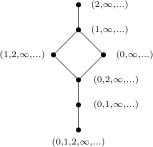
Define the projections φa=a+2b+4c, φb=a+2c, φc=a+b+7c; ψa=a, ψb=0, ψc=c; αa=0, αb=a+b, αc=0. Set Φ to be the subring of E(H) generated by I,φ,ψ,α. Furthermore,

c3I3c7I5c3I7cφ-ψ+Ia+c3Ia+3c7Ia+5c3Ia+7c5φb+c2I+2α+φb+3c5φ-2Ib+5c3I-2αb+7cψαφ+ψ-2Ia+b+c3I-2αa+b+3c7I-2αa+b+5c3I-2αa+b+7c5α-ψ-2ψα2b+c3I2b+3c7I2b+5c3I2b+7c3(ψ-φ-I)a+2b+c3Ia+2b+3c7Ia+2b+5c3Ia+2b+7cφ+α3b+c3ψ3b+3c7I+2α3b+5c3I+2α3b+7c7I+7ψα+2αa+3b+c3ψa+3b+3c7ψ+2αa+3b+5c3I+2αa+3b+7c7(I-α)c

and thus all elements of the Ulm sequence (0,1,2,,) are translated to elements from Φ.

Moreover,

2c𝜑2b+6cI-α6c𝜑2b+2cI-α2c

are elements of the Ulm sequence (1,2,,);

b3I3b3αa+b3Ia+3bI+φa+b+2c2I+3αa+b+4cα+φα+αφαa+b+6cψ+3αb+6c3I-αφαb+2c3(I+ψ)b+4cφ+3Ia+3b+2cI+2ψa+3b+6c2I-αa+3b+4c3(φα+I)+ψα3b+2c3(I+ψ)3b+4c3φ+α3b+6cI-ψb

are elements of the Ulm sequence (0,1,,);

2bI+φ2b+4c𝛼2b

are elements of the Ulm sequence (1,,);

aI+αφa+2bI-φψ+ψa+4cI+αφa+2b+4cI+α+φαa

are elements of the Ulm sequence (0,,);

a+2c3Ia+6c𝜓a+2b+6c3Ia+2b+2cI+αa+2c

are elements of the Ulm sequence (0,2,,) and 4c𝐼4c. One sees that all elements of equal Ulm sequences are sent to elements from Φ.

Taking into account the action on the element a+2c, we obtain

φ=I,α=αφ=ψαψ=φαψ=0,ψφψ=φψ+αψ.

Consequently, Φ(a+2c)=Ψ(a+2c), where Ψ is the subring of Φ, generated by I,ψ,αψ,φψ. In view of the above equalities it is routinely observed that Ψ={xI+yψ+z(αψ)+t(φψ):0x,y,z,t8}. In fact, dropping off the coefficients in the corresponding endomorphisms, we deduce that

Φ={I+φ+ψ+α+φψ+ψφ+φα+αφ+ψα+αψ+φψφ+ψφψ+φαφ+αφα+ψαψ+αψα+φψα+αψφ+ψφα+ψαφ+αφψ+φαψ+};

note that in the space, we have products consisting of four elements, etc. Again considering the action on the element a+2c, one can simply infer that

φψφ=φψ,ψφψ=3ψ,φαφ=αφα=ψαψ=αψα=φψα=0,
αψφ=αψ,ψφα=ψαφ=αφψ=0,φαψ=2φ,

which substantiates our claim that

Ψ={xI+yψ+z(αψ)+t(φψ):0x,y,z,t8}.

If now (xI+yψ+z(αψ)+t(φψ))(a+2c)=a, then we conclude that

(x+y+t)a=a,2(y+z)b=0,2(x+y+3t)c=0,

whence x+y+t=2n+1, y+z=2m, x+y+3t=4k for some integers n,m,k which leads to the contradiction 2(n+t)+1=4k. Hence aΨ(a+2c). However, (0,2,,)=U(a+2c)<U(a)=(0,,), which guarantees that if G is a 2-group such that 2ωG=H and E(G)H=Φ, then G is projectively Krylov transitive but not projectively fully transitive, as wanted. ∎

Remark

It is worth noting that in the case when pωG is a direct sum of two cyclic groups the situation is totally different. To demonstrate this, we first need the following technicality.

Lemma 2.3

Let A=iIAi be a group with projections πi:AAi, R is a ring with 1 and all πiR. Then:

  1. if R acts Krylov transitively on Aand fully transitively on Ai for each iI, then R acts fully transitively on A,

  2. if R acts projectively Krylov transitively on A and projectively fully transitively on Ai for each iI, then R acts projectively fully transitively on A.

Proof.

(1) It suffices to show the result for the direct summand jJAj of A, where JI is a finite set, and thus by induction for the direct sum of only two groups. Let UG(a1+a2)UG(b1+b2). According to [19, Lemma 2.2] it is enough to consider that b1+b2A[p]. Since ht(a1+a2)=min{ht(a1),ht(a2)}, we may with no loss of generality assume that ht(a1+a2)=ht(a1), whence ht(a1)ht(b1+b2)ht(b1). Since b1A1[p], we have UA1(a1)UA1(b1). Write φ(a1)=b1 for some φR. Observing that UA1(a1)UA2(b2), we deduce UG(a1+b2)=UG(a1). So, α(a1)=a1+b2 and (α-I)(a1)=b2, where I is the identity of A (a unit of R). Therefore, π1(a1+a2)=a1, (φ+(α-I))π1R and (φ+(α-I))π1(a1+a2)=φ(a1)+(α-I)a1=b1+b2.

The proof of (2) is similar. ∎

We are now ready to illustrate the following somewhat surprising statement. In [6] a construction was given of a transitive (whence Krylov transitive) 2-group G such that 2ωG is a direct sum of two cyclic groups of orders 2 and 8, respectively, and such that G is not fully transitive. The next assertion contrasts this.

Corollary 2.4

Any projectively Krylov transitive group G for which pωG is a direct sum of two cyclic groups is projectively fully transitive.

Proof.

The action of E(G) on pωG contains at least one non-trivial projection π. Then I-π is an orthogonal projection to π, so pωG=π(pωG)(I-π)(pωG), where each summand is cyclic. The identity map of any cyclic group acts projectively fully transitively. So, the result follows from Lemma 2.3. ∎

It is worth noting that by [13, Corollary 4.2], any separable group and any group G with cyclic subgroup pωG are both strongly projectively fully transitive.

Example 2.5

For every prime number p there exist strongly projectively fully transitive p-groups G with the property pωGpp.

Proof.

Let H=ab, where o(a)=o(b)=p. We consider two cases.

Case (1): p𝟑. Define the idempotents φ and ψ of H by φ(a)=a-b, φ(b)=0 and ψ(a)=0, ψ(b)=a+b. Let G be a group with pωGH and E(G)pωG=Φ, where Φ is a subring of E(H), generated by I,φ,ψ and I is the identity on H. What remains to show is that for all nonzero elements xa+yb and αa+βb in H there exists ϕΠ(Φ) with the property that

ϕ(xa+yb)=αa+βb.

If x=0 and y0, then

[αy-1(ψ-I)+βy-1I](yb)=αa+βb;

if y=0 and x0, then

[αx-1I+βx-1(I-φ)](xa)=αa+βb.

So, let x,y0. Since (kI+mφ+nψ)(xa+yb)=αa+βb, we derive

(kx+mx+ny)a+(ky-mx+ny)b=αa+βb

or

kx+mx+ny=α,ky-mx+ny=β.

From the second equation we solve k=β+mx-nyy. Substituting k in the first equation, we obtain -(xy+x2)m+(y2-xy)n=αy-βx. The coefficients of m and n cannot simultaneously be zero, because if x(y+x)=0 and y(y-x)=0, then 2x=2y=0. Since p2, we conclude x=y=0, which contradicts our assumption. Consequently, if, for instance, xy+x20, then

m=βx-αy+(y2-xy)nxy+x2.

Since n=0,,p-1, we can find such a number m, which means that

ϕ=kI+mφ+nψ.

Case (2): p=𝟐. Write H={0,a,b,a+b} and if φ(a)=b, φ(b)=b, ψ(a)=a, ψ(b)=a, θ(a)=a, θ(b)=0 and Φ is a subring of E(H) generated by I,φ,ψ,θ. Thus we have I(a)=a, φ(a)=b, (I+φ)(a)=a+b; ψ(b)=a, I(b)=b, (I+ψ)b=a+b; θ(a+b)=a, (I+θ)(a+b)=b, I(a+b)=a+b. It is now easily seen that G is a 2-group with 2ωGH and E(G)2ωG=Φ. Hence in both cases G is a strongly projectively fully transitive group, as promised. ∎

The next example sheds some more concrete light on the case of 2-groups.

Example 2.6

There exists a 2-group G, which is both transitive and fully transitive but which is neither projectively transitive nor projectively fully transitive, such that 2ωG is a homogeneous group of rank 4.

Proof.

Let H=a1a2a3a4, where o(aj)=2 with j=1,2,3,4. Define an endomorphism φ of the group H as follows: φa1=a2, φa2=a3, φa3=a4 and φa4=a1+a2+a3+a4. Then

{φ2a1=a3,φ2a2=a4,φ2a3=a1+a2+a3+a4,φ2a4=a1,{φ3a1=a4,φ3a2=a1+a2+a3+a4,φ3a3=a1,φ3a4=a2,{φ4a1=a1+a2+a3+a4,φ4a2=a1,φ4a3=a2,φ4a4=a3.

Thus φ4=I+φ+φ2+φ3, where I is the identity on H. Let G be a 2-group with 2ωGH and E(G)2ωG=Φ, where Φ is a subring of E(H), generated by I,φ. Therefore, Φ={y0I+y1φ+y2φ2+y3φ3:0yi1,i=0,1,2,3}. It is not hard to check that if y0I+y1φ+y2φ2+y3φ3=0, then yi=0. It follows then that (x1I+x2φ+x3φ2+x4φ3)a1=x1a1+x2a2+x3a3+x4a4. To prove that G is fully transitive, it suffices to show that each nonzero element x1a1+x2a2+x3a3+x4a4 will be mapped to the element a1 by the endomorphism ϕ=y0I+y1φ+y2φ2+y3φ3. In fact,

ϕ(x1a1+x2a2+x3a3+x4a4)=(y0x1+y1x4+y2(x3+x4)+y3(x2+x3))a1+(y0x2+y1(x1+x4)+y2x3+y3(x2+x4))a2+(y0x3+y1(x2+x4)+y2(x1+x3)+y3x2)a3+(y0x4+y1(x3+x4)+y2(x2+x3)+y3(x1+x2))a4=a1,

as desired. Furthermore, we obtain a system of linear equations in the variables yi, where i=0,1,2,3:

{x1y0+x4y1+(x3+x4)y2+(x2+x3)y3=1,x2y0+(x1+x4)y1+x3y2+(x2+x4)y3=0,x3y0+(x2+x4)y1+(x1+x3)y2+x2y3=0,x4y0+(x3+x4)y1+(x2+x3)y2+(x1+x2)y3=0.

Any choice of the coefficients x1,x2,x3,x4 of this system corresponds to one of the sixteen elements x1a1+x2a2+x3a3+x4a4 of the group H.

It is also just a routine technical matter to verify that the determinant

|x1x4x3+x4x2+x3x2x1+x4x3x2+x4x3x2+x4x1+x3x2x4x3+x4x2+x3x1+x2|

of that system is manifestly nonzero at least for one nonzero xj. So, the given above system can be successfully solved for these xj and, by what we have just shown above, this means that G is fully transitive, indeed, as wanted.

Moreover, one sees that kerϕ=0 for every ϕ0, i.e., all nonzero endomorphisms of the group H are automorphisms. This also leads us to the fact that G is transitive.

Now we assume that ϕ2=ϕ. Consequently,

ϕ2=(y02+y22)I+(y22+y32)φ+(y12+y22)φ2+y22φ3.

Hence

{y02+y22=y0y22+y32=y1y12+y22=y2y22=y3.

Taking into account that y02=y0 and y22=y2, the only nonzero solutions of that system are the following: y0=1, y1=y2=y3=0. That is why the only nonzero idempotent of the ring Φ is its identity I, so that the group G is neither projectively fully transitive nor projectively transitive, as asserted. ∎

Recall that the n-th Ulm–Kaplansky invariant fn(G) of a group G is the rank of the factor-group (pnG)[p]/(pn+1G)[p].

Lemma 2.7

The following statements hold.

  1. Let G be a separable group such that if fn(G)0, then fn(G)2 and 1R is a subring of E(G) which acts on G Krylov transitively. Then R acts on G fully transitively.

  2. Let G be a group such that pωG is separable and if fn(pωG)0, then fn(pωG)2. If G is Krylov transitive (resp., projectively Krylov transitive), then G is fully transitive (resp., projectively fully transitive).

Proof.

(1) Let yG[p] and U(x)<U(y) for some xG (see Lemma 2.3). If ht(x)<ht(y), then U(x+y)=U(x) and thus f(x)=x+y for fR, whence (f-I)(x)=y. Assume ht(x+y)>ht(y)=k and hence ht(x)=ht(y). Let G=G0G1GkGk+1Gk+1*, where if Gi0 then Gi is a direct sum of cyclic groups of order pi for each n1. Since ht(x)=ht(y)=k, we have x,yGk+1Gk+1*. Let x=a+b and y=c+d, where a,cGk+1 and b,dGk+1*. Since ht(x+y)>k, we have a=-c. So a and c are contained in the same cyclic direct summand of Gk+1. Furthermore, let z be some element from the additional direct summand of (Gk+1)[p]. So, U(z)=U(y) and U(x+z)=U(x). Consequently, η(x)=z for some ηR. If now δ(z)=y, then δη:xy, as required.

Part (2) follows immediately from (1). ∎

The next examples also demonstrate that the new concepts are different from the corresponding old ones, and so the group structure is rather complicated.

Example 2.8

There exists a Krylov transitive group (namely, a fully transitive 2-group) which is not projectively Krylov transitive.

Proof.

In [13, Proposition 3.5] an example was constructed of a fully transitive p-group G which is not projectively fully transitive such that (1) pωG is an elementary group of infinite rank; (2) pωG is an elementary p-group of rank 2 with p=5n+2 or p=2; (3) p=2 and 2ωG24. We shall construct an example of a fully transitive 2-group that is not projectively Krylov transitive for which 2ωG is an elementary group of rank 3.

Let H=abc, where 2a=2b=2c=0, and define the endomorphism φ by φ(a)=c, φ(c)=b and φ(b)=a+c. Then it is easily checked that φ3=I+φ, where I is the identity on H. Let Φ be the subring of E(H) generated by I and φ. Therefore, Φ={xI+yφ+zφ2:x,y,z=0,1}. Assuming that xI+yφ+zφ2 is an idempotent, we get the system of comparisons mod 2, namely: x2=x, z2=y and z4+z2=z, which has only one nonzero solution x=1, y=z=0, i.e., the unique nonzero idempotent of Φ is I. Now, using Corner’s realization theorem, we exhibit a group G such that 2ωG=H and E(G)H=Φ. It is clear that E(G) does not act projectively Krylov transitively on 2ωG and so G is not projectively Krylov transitive by Lemma 3.1 below. However, G is fully transitive. It is enough to show that Φ acts fully transitively on H. Observe that (xI+yφ+zφ2)a=xa+yb+zc. If z0, then z=1 and ((x+y)I-φ)(xa+yb+c)=(x(x+y)-y)a+(y(x+y)-1)b0. In fact, the system of comparisons x(x+y)-y=0 and y(x+y)=1 is insoluble by mod 2. Thus, it is shown that any element xa+yb+zc0 is an image of a. Hereafter, (I+φ+φ2)b=a and φ(a+b)=a that completes the construction of the example. ∎

Example 2.9

There exists a transitive group which is not projectively transitive.

Proof.

As in [13, Proposition 3.5 (ii)], let H=ab, where o(a)=o(b)=p; φ(a)=b, φ(b)=a+b which implies φ2=I+φ; note that φ is a monomorphism of H; Φ is the subring of E(H) generated by I,φ:

Φ={xI+yφ:0x,yp};

and G is a p-group such that pωG=H with E(G)H=Φ. Furthermore, we consider two possibilities for the prime number p:

(1) It is of the form of p=5n+2 for some natural n. In [13] it was shown that G is fully transitive. We shall also prove that it is transitive. To this end, it is sufficient to show that any of its nonzero endomorphisms is a monomorphism. Assuming (xI+yφ)(αa+βb)=0, where x,y0, we have αx+βy=0, βx+(α+β)y=0, whence α=-(βy)/x and β(x2-y2+xy)=0. If β=0, then α=0. But if β0, then we have t2+t-1=0, where t=y/x. However, it was demonstrated in [13] that the equation t2+t-1=0 is unresolved modulo p=5n+2.

(2) Let p=2. It was also directly proved in [6] that G is a transitive group.

However, in both cases, G is not manifestly projectively transitive, because by Lemma 3.2 below E(G) does not act projectively transitively on H=pωG. ∎

Clearly any projectively transitive group is projectively weakly transitive, but the converse need not be true (see Example 2.11 below). In the same way, as in [19, Lemma 3.4], any projectively fully transitive and projectively weakly transitive group is projectively transitive.

Theorem 2.10

Theorem 2.10 ([19, Theorem 3.10])

Let G be a finite group and 1R a subring of E(G). Then R acts weakly transitively on G.

Example 2.11

There exist projectively weakly transitive groups which are neither projectively Krylov transitive nor fully transitive.

Proof.

Choose any finite group H and any subring 1R of E(H) which acts neither projectively Krylov transitively nor fully transitively on H; for instance, R can be taken as a subring, generated by the identity map I of H, that is, the identity of E(H), where H is a decomposable elementary group. If now G is a group such that pωG=H and E(G)H=R, then by Theorem 2.10 the group G is projectively weakly transitive, as claimed. ∎

At this stage, it is impossible to find a weakly transitive group which is not projectively weakly transitive. However, we suspect that such a group exists, and even more that there is a transitive group which is not projectively weakly transitive. The difficulty arises from the fact of [13, Proposition 2.3] that the square GG has only endomorphisms generated by projections, that is, E(GG)=Proj(GG). Thereby, utilizing the main result of [15], if G is fully transitive, then GG is projectively transitive, and vice versa. That GG is projectively fully transitive, provided G is fully transitive, was established in [13, Theorem 3.7]. Moreover, as in [13], we are currently unable to decide whether or not there is a projectively (Krylov transitive, transitive, weakly transitive) group that is not strongly projectively (Krylov transitive, transitive, weakly transitive). And finally, we also ask whether there do exist a projectively fully transitive group which is not (projectively) weakly transitive as well as a projectively Krylov transitive group that is not fully transitive. So, we remain with these four questions still left-open.

3 Basic results and corollaries

We begin here with an attack on the new results. First, four technical but very useful statements are needed. It is worth noting that the first three have proofs which are very similar to those in [13, Lemma 3.12] and [13, Lemma 4.1], so we omit the details and leave them to the interested reader (see also [3, Lemmas 3.12 and 3.26] and [14]).

Lemma 3.1

A group G is (strongly) projectively Krylov transitive if, and only if, E(G) acts (strongly) projectively Krylov transitive on pωG..

Lemma 3.2

A group G is (strongly) projectively transitive if, and only if, E(G) acts (strongly) projectively transitive on pωG..

Lemma 3.3

A group G is (strongly) projectively weakly transitive if, and only if, E(G) acts (strongly) projectively weakly transitive on pωG..

Since divisible groups are both transitive and fully transitive, according to [13, Theorem 3.1] combined with Lemma 3.2, one can derive the following assertion..

Lemma 3.4

Divisible groups are strongly projectively transitive (and so strongly projectively weakly transitive)..

Next, we concentrate on how projective Krylov transitivity is situated on Ulm subgroups and Ulm factors..

Proposition 3.5

If G is (strongly) projectively Krylov transitive, then pβG is (strongly) projectively Krylov transitive for any ordinal β..

Proof.

Letting H=pβG, we observe that if x,yH with UH(x)=UH(y), then we have UG(x)=UG(y). So, there is a map ϕProj(G) with ϕ(x)=y. However, since H is fully invariant in G, it is readily seen that ϕHProj(H), as required.

The case of a strongly projectively Krylov transitive group can be handled similarly. ∎

Under a standard limitation on the quotient group, the following statement somewhat reverses the above implication.

Theorem 3.6

Suppose that α is an ordinal strictly less than ω2, and that G/pαG is totally projective. Then G is (strongly) projectively Krylov transitive if, and only if, pαG is (strongly) projectively Krylov transitive.

Proof.

We will treat only the case of projectively Krylov transitive groups, because its “strong” version holds identically with Lemma 3.1 at hand.

So, the necessity follows directly from Proposition 3.5.

As for the sufficiency, we consider three main cases:

Case 1: α=n is natural. Specifically, we will show that if pnG is (strongly) projectively Krylov transitive for some finite n, then G is (strongly) projectively Krylov transitive.

In fact, by induction, we may restrict our attention to n=1. Set H=pG. Using Lemma 3.1 we need to prove that E(G) acts projectively Krylov transitively on pωG. So, let x,ypωG with UG(x)UG(y). Clearly, pωG=pωH and UG(x)UG(y). By assumption, φ(x)=y for some φProj(H). It follows from [12, Theorem 1.11] that every idempotent in E(H) lifts to an idempotent in E(G), and so each element of Proj(H) lifts to an element of Proj(G), as required.

Case 2: α=ω. Let x,ypωG and UG(x)UG(y). Then we have that UpωG(x)UpωG(y). By assumption, there is a φProj(pωG) with φ(x)=y. It follows either from [22, Theorem 11] or from [7] that every idempotent in E(pωG) lifts to an idempotent in E(G), so the map lifts to a map ψProj(G) with ψ(x)=y, as required.

Case 3: α=ωm+n where m,n<ω are positive integers. We will use again an induction on the ordinal α. To that end, if αω, then we can use Cases 1 and 2. Now let α>ω and α=β+1 for some ordinal β. Put X=pβG and note that by assumption pX=pαG is projectively Krylov transitive. It follows at once from Case 1 that X is projectively Krylov transitive. Moreover,

G/pβG(G/pαG)/(pβG/pαG)(G/pαG)/pβ(G/pαG),

and hence G/pβG is totally projective by a well-known result of Nunke (see, e.g., [16, Exercise 82.3]). So, by the induction hypothesis, G is projectively Krylov transitive, as desired.

Let finally α=β+ω for some β. Set X=pβG, so that pωX=pαG is projectively Krylov transitive. Notice once again that X/pωXpβG/pαG is totally projective. By Case 2 we have that X=pβG is projectively Krylov transitive. Since G/pβG is totally projective and β<α, then by the induction hypothesis we infer that G is projectively Krylov transitive, as wanted. ∎

Proposition 3.7

If G is (strongly) projectively transitive, then pβG is (strongly) projectively transitive for any ordinal β.

Proof.

Given x,yH=pβG with UH(x)=UH(y), it routinely follows that UG(x)=UG(y). Thus, there is a map ϕAut(G)Proj(G) with ϕ(x)=y. Since the subgroup H is known to be characteristic in G, it is obviously seen that ϕHAut(H)Proj(H), as required.

The “strongly” case follows in the same manner. ∎

Theorem 3.8

Suppose that α is an ordinal strictly less than ω2, and that G/pαG is totally projective. Then G is (strongly) projectively transitive if, and only if, pαG is (strongly) projectively transitive.

Proof.

We will deal only with the case of projectively transitive groups, because its “strong” variant can be processed analogically with Lemma 3.2 at hand.

So, the necessity follows directly from Proposition 3.7.

As for the sufficiency, it follows in the same way as that in Theorem 3.6 taking into account Lemma 3.2 and [22]. ∎

Proposition 3.9

If G is (strongly) projectively weakly transitive, then pβG is (strongly) projectively weakly transitive for any ordinal β.

Proof.

This follows in a very similar way to that of Propositions 3.5 and 3.7, so we omit the details. ∎

Theorem 3.10

Suppose that α is an ordinal strictly less than ω2, and that G/pαG is totally projective. Then G is (strongly) projectively weakly transitive if, and only if, pαG is (strongly) projectively weakly transitive.

Proof.

We will consider only the case of projectively weakly transitive groups, because its “strong” part can be proved similarly with Lemma 3.3 at hand.

So, the necessity follows directly from Proposition 3.9.

As for the sufficiency, it follows in the same manner as that in Theorem 3.6 bearing in mind Lemma 3.3 and [22]. ∎

We now act on some generalizations of results from [11], showing when projective Krylov transitivity coincides with projective full transitivity and projective transitivity.

Proposition 3.11

Let G be a projectively Krylov transitive group such that pωG is a direct sum of cyclic groups of order pn, where nN. Then the following two conditions hold:

  1. G is projectively fully transitive.

  2. If G=G1G2 with pωG10 and pωG20, then G is projectively transitive.

Proof.

(i) Supposing x,ypωG with UG(x)UG(y), one can write x=prx and y=psy, where x and y are elements of order pn in pωG and rs. Choose φAut(G) with φ(x)=y. Then ps-rφ(x)=y.

(ii) Utilizing [6, Proposition 2.2], it suffices to show that each endomorphism, represented by the matrix

(1+qσ2σ1σ2qσ11),

where q is an integer and σ1:G1G2, σ2:G2G1 are arbitrary homomorphisms which belong to Proj(G), again lies in Proj(G). In fact,

(00σ10)=(00σ11)-(0001)Π(G).

Analogously,

(0σ200)Π(G).

Consequently,

(1σ2σ11)=(1001)+(0σ200)+(00σ10)Π(G),

while

(σ2σ1000)=(0σ200)(00σ10)Proj(G),

as needed. ∎

Remark

It is perhaps worth noting that Example 2.2 unambiguously shows that this property may fail if pωG is not the direct sum of cyclic groups of the same order pn for some fixed natural number n.

As usual, for any group A define supp(A)={σ<length(A):fA(σ)0}.

Proposition 3.12

If G=G1G2 is projectively Krylov transitive, G2 is projectively transitive and supp(pωG1)supp(pωG2), then G is projectively transitive.

Proof.

The arguments are based on [15, Lemma 2 and Proposition 2], which claimed that the full transitivity of the group forces its transitivity. In these two statements there exist compositions of automorphisms of the sort (10α1) and (10αβ). Since G2 is projectively transitive, we have βProj(G2). Furthermore, appealing to Proposition 3.11, the existing automorphisms belong to Proj(G), as required.∎

We next will need the following well-known result, which appeared as [11, Theorem 2.4].

Theorem 3.13

Suppose that G is a Krylov transitive group and that G has at most two Ulm invariants equal to 1, and if it has exactly two ones, let they correspond to successive ordinals. Then G is fully transitive.

So, we are ready to state and prove the following:

Theorem 3.14

Suppose G=G1G2 and supp(pωG1)=supp(pωG2). Then the following are equivalent:

  1. G is projectively Krylov transitive.

  2. G is projectively fully transitive.

  3. G is projectively transitive.

Proof.

(i)  (ii). According to [13, Lemma 3.12], it is sufficient to show that E(G) acts projectively fully transitively on pωG. Indeed, no Ulm invariant of pωG is equal to 1 and it then follows from Theorem 3.13 and the remarks above that E(G) acts projectively fully transitively on pωG. Thus G is also projectively fully transitive, as required.

(ii)  (iii). The proof is analogous to [15, Theorem 1] accomplished with some simple arguments.

(iii)  (i). This implication is always true. ∎

As an immediate consequence, we yield:

Corollary 3.15

For any group G the following conditions are equivalent:

  1. GG is (strongly) projectively Krylov transitive.

  2. GG is (strongly) projectively fully transitive.

  3. GG is (strongly) projectively transitive.

Notice also that, owing to [13, Proposition 4.12], there is a non-strongly projectively fully transitive group G such that GG is strongly projectively fully transitive. A direct summand of a projectively fully transitive group is not necessarily a projectively fully transitive group by [13, Corollary 3.9] (see Proposition 3.16, too).

Before proving our next two results, the following observation could be useful: Suppose that G0 is a group such that all its elements have comparable Ulm sequences. Then it can be decomposed as G=G1G2, where G1 is a direct sum of cyclic groups of order pn for some finite n and G2 (if G20) is a direct sum of cyclic groups of order pn+1. In fact, the sufficiency is trivial. As for the necessity, assume that AB is such a direct summand of the group G that A=a is a cyclic group of order pn, whereas B=b is a cyclic group of order pm with m>n+1. Thus a and pb have incomparable Ulm sequences because U(a)=(0,1,,n-1,,) and U(b)=(1,2,,m-1,,).

The following assertion slightly strengthens [13, Theorem 3.7 and Proposition 4.10] (see also [13, Remark 4.11]).

Proposition 3.16

Suppose that G is a group such that all elements of pωG have comparable Ulm sequences. Then G is fully transitive if, and only if, GG is strongly projectively fully transitive.

Proof.

The sufficiency is immediate since summands of fully transitive groups are again fully transitive. As for the necessity, let H=GG and x=(a,b)pωG, y=(c,d)pωG with U(x)U(y), where py=0. Moreover, as in [19, Lemma 2.2], it is sufficient to demonstrate that there exists an endomorphism from Π(H), mapping x to y. For instance, assume that a0 and U(a)U(b). Then U(a)U(c),U(d). So, if α(a)=c, β(a)=d-b and α(b)=β(b)=0, then the matrix

Δ=(ααβ1-α)

represents an endomorphism of H which maps x to y and ΔΠ(H) since

Δ=(αα1-α1-α)+(10β+α-10)-(1000),

where one easily checks that each of these matrices is an idempotent. ∎

As a valuable consequence, we derive the following improvement of [11, Theorem 2.13].

Theorem 3.17

Suppose that G is a group such that all elements of pωG have comparable Ulm sequences. Then G is Krylov transitive if, and only if, GG is strongly projectively Krylov transitive.

Proof.

Note that with the Remark at the end of [13] in hand, if G is a Krylov transitive group such that all elements of pωG have comparable Ulm sequences, then G is fully transitive. So, we just need to combine Proposition 3.16 with Corollary 3.15. ∎

If pωG is bounded by p, then all its elements have comparable Ulm sequences and so by Theorem 3.17 we deduce:

Proposition 3.18

Let G be a group with pω+1G={0}. Then G is Krylov transitive if, and only if, GG is strongly projectively Krylov transitive.

Arguing as above, the next worthwhile consequence, which is not explicitly stated in [11], can be also deduced:

Corollary 3.19

Let G be a group with all elements of pωG having comparable Ulm sequences (in particular, if pω+1G={0}). Then G is Krylov transitive if, and only if, G is fully transitive.

The following statement extends [13, Proposition 3.14] in the new context (see also [11, Proposition 3.5]). Recall that a group G is said to be projectively socle-regular if, for any projection-invariant subgroup P of G, there exists an ordinal τ depending on P such that P[p]=(pτG)[p] – see [12] for the original version.

Proposition 3.20

If G is projectively Krylov transitive, then G is projectively socle-regular.

Proof.

Let P be an arbitrary projection-invariant subgroup of G and let α=min{htG(v):vP[p]}, whence P[p](pαG)[p]. Next choose xP[p] with htG(x)=α such that UG(x)=(α,,). Letting y(pαG)[p] be an arbitrary element, we have that UG(y)=(β,,) where βα. If β=α, then UG(x)=UG(y) and thus, with Krylov transitivity at hand, there is an endomorphism ϕProj(G) such that ϕ(x)=y. Hence yϕ(P[p])P[p] because P[p] is projection-invariant in G. If now β>α, it follows that htG(x+y)=α and so UG(x+y)=(α,,)=UG(x). Again, using Krylov transitivity, there exists an endomorphism ψProj(G) with the property ψ(x)=x+y. But then ψ-1GProj(G) and (ψ-1G)(x)=ψ(x)-1G(x)=x+y-x=y, forcing that yP[p] because y=(ψ-1G)(x)(ψ-1G)(P[p])P[p]. Thus in either situation we conclude that (pαG)[p]P[p] which by what we have shown above is tantamount to the desired equality P[p]=(pαG)[p]. ∎

4 Open questions

In closing, we shall state some unresolved problems that still elude us:

It follows from [13, Proposition 2.3] that if G is (Krylov, fully, weakly) transitive, then the square GG is projectively (Krylov, fully, weakly) transitive. So, the following seems to be adequate:

Problem 1

Find some suitable conditions on the (Krylov, fully, weakly) transitive group G under which GG will be strongly projectively (Krylov, fully, weakly) transitive.

Problem 2

Find some non-trivial conditions under which the following are equivalent:

  1. G is (strongly) projectively Krylov transitive.

  2. G is (strongly) projectively fully transitive.

  3. G is (strongly) projectively transitive.

Problem 3

Find some natural conditions on the group G such that pωG being projectively Krylov transitive (projectively fully transitive or projectively transitive, respectively) implies the same for G.

Problem 4

Does it follow that the square GG is projectively weakly transitive, where G is the projectively Krylov transitive 2-group constructed in Example 2.2?

Problem 5

Is it true that Theorems 3.6, 3.8 and 3.10 remain valid without the restriction on the ordinal α?

Problem 6

Suppose that A=GS is a group, where S is a separable subgroup. Is A projectively (Krylov, fully, weakly) transitive if, and only if, G is?

We finish off the work with the following.

Remark

In [12, Problem 2] the word “finite” should be written and read as “finite homogeneous”. For socle-regular groups with only finite (but non homogeneous) first Ulm subgroup, the question is settled in the negative via [12, Proposition 1.13].


Communicated by Evgenii I. Khukhro


Acknowledgements

The authors are thankful to the referee for the insightful corrections made.

References

[1] Carroll D. and Goldsmith B., On transitive and fully transitive Abelian p-groups, Math. Proc. R. Ir. Acad. A96 (1996), no. 1, 33–41. Suche in Google Scholar

[2] Chekhlov A. R., On projective invariant subgroups of abelian groups, J. Math. Sci. (N. Y.) 164 (2010), no. 1, 143–147. 10.1007/s10958-009-9743-1Suche in Google Scholar

[3] Chekhlov A. R. and Danchev P. V., On commutator fully transitive Abelian groups, J. Group Theory 18 (2015), 623–647. 10.1515/jgth-2015-0014Suche in Google Scholar

[4] Corner A. L. S., On endomorphism rings of primary Abelian groups, Quart. J. Math. Oxf. II 20 (1969), 277–296. 10.1093/qmath/20.1.277Suche in Google Scholar

[5] Corner A. L. S., On endomorphism rings of primary Abelian groups II, Quart. J. Math. Oxf. II 27 (1976), 5–13. 10.1093/qmath/27.1.5Suche in Google Scholar

[6] Corner A. L. S., The independence of Kaplansky’s notions of transitivity and full transitivity, Quart. J. Math. Oxf. II 27 (1976), 15–20. 10.1093/qmath/27.1.15Suche in Google Scholar

[7] Danchev P., Extending projections on Ulm subgroups of Abelian p-groups, preprint 2015. Suche in Google Scholar

[8] Danchev P. V. and Chekhlov A. R., On projectively Krylov transitive Abelian p-groups, International Conference Mal’tsev Meeting, Sobolev Institute of Mathematics and Novosibirsk State University, Novosibirsk (2015), 175–175. Suche in Google Scholar

[9] Danchev P. and Goldsmith B., On the socles of fully invariant subgroups of Abelian p-groups, Arch. Math. (Basel) 92 (2009), 191–199. 10.1007/s00013-009-3021-9Suche in Google Scholar

[10] Danchev P. and Goldsmith B., On the socles of characteristic subgroups of Abelian p-groups, J. Algebra 323 (2010), 3020–3028. 10.1016/j.jalgebra.2009.12.005Suche in Google Scholar

[11] Danchev P. and Goldsmith B., On socle-regularity and some notions of transitivity for Abelian p-groups, J. Commut. Algebra 3 (2011), 301–319. 10.1216/JCA-2011-3-3-301Suche in Google Scholar

[12] Danchev P. and Goldsmith B., On projection-invariant subgroups of Abelian p-groups, Groups and Model Theory, Contemp. Math. 576, American Mathematical Society, Providence (2012), 31–40. 10.1090/conm/576/11339Suche in Google Scholar

[13] Danchev P. and Goldsmith B., On projectively fully transitive Abelian p-groups, Results Math. 63 (2013), 1109–1130. 10.1007/s00025-012-0256-8Suche in Google Scholar

[14] Danchev P. and Goldsmith B., On commutator socle-regular Abelian p-groups, J. Group Theory 17 (2014), 781–803. 10.1515/jgt-2014-0003Suche in Google Scholar

[15] Files S. and Goldsmith B., Transitive and fully transitive groups, Proc. Amer. Math. Soc. 126 (1998), 1605–1610. 10.1090/S0002-9939-98-04330-5Suche in Google Scholar

[16] Fuchs L., Infinite Abelian Groups, Vol. I, Pure Appl. Math. 36, Academic Press, New York, 1970. Suche in Google Scholar

[17] Fuchs L., Infinite Abelian Groups, Vol. II, Pure Appl. Math. 36, Academic Press, New York, 1973. Suche in Google Scholar

[18] Fuchs L., Abelian Groups, Springer Monogr. Math., Springer, Cham, 2015. 10.1007/978-3-319-19422-6Suche in Google Scholar

[19] Goldsmith B. and Strüngmann L., Some transitivity results for torsion Abelian groups, Houston J. Math. 23 (2007), 941–957. Suche in Google Scholar

[20] Hausen J., Endomorphism rings generated by idempotents, Tamkang J. Math. 9 (1978), 215–218. Suche in Google Scholar

[21] Hill P., On transitive and fully transitive primary groups, Proc. Amer. Math. Soc. 22 (1969), 414–417. 10.1090/S0002-9939-1969-0269735-0Suche in Google Scholar

[22] Hill P. and Megibben C., Extending automorphisms and lifting decompositions in Abelian groups, Math. Ann. 175 (1968), 159–168. 10.1007/BF01418771Suche in Google Scholar

[23] Kaplansky I., Infinite Abelian Groups, University of Michigan Press, Ann Arbor, 1969. Suche in Google Scholar

[24] Krylov P. A., Mikhalev A. V. and Tuganbaev A. A., Endomorphism Rings of Abelian Groups, Kluwer, Dordrecht, 2003. 10.1007/978-94-017-0345-1Suche in Google Scholar

[25] Megibben C., Projection-invariant subgroups of Abelian groups, Tamkang J. Math. 8 (1977), 177–182. Suche in Google Scholar

Received: 2015-12-19
Revised: 2016-3-18
Published Online: 2016-5-5
Published in Print: 2017-1-1

© 2017 by De Gruyter

Heruntergeladen am 7.12.2025 von https://www.degruyterbrill.com/document/doi/10.1515/jgth-2016-0018/html?lang=de
Button zum nach oben scrollen