
Your Basic Polymer Sciences with the Subcommittee on Polymer Education: From Synthesis to Application!

International conferences, in bringing researchers from different backgrounds and different levels of access to opportunities together, are ideal venues for educational activities to improve the practice of science, particularly in the emerging nations.
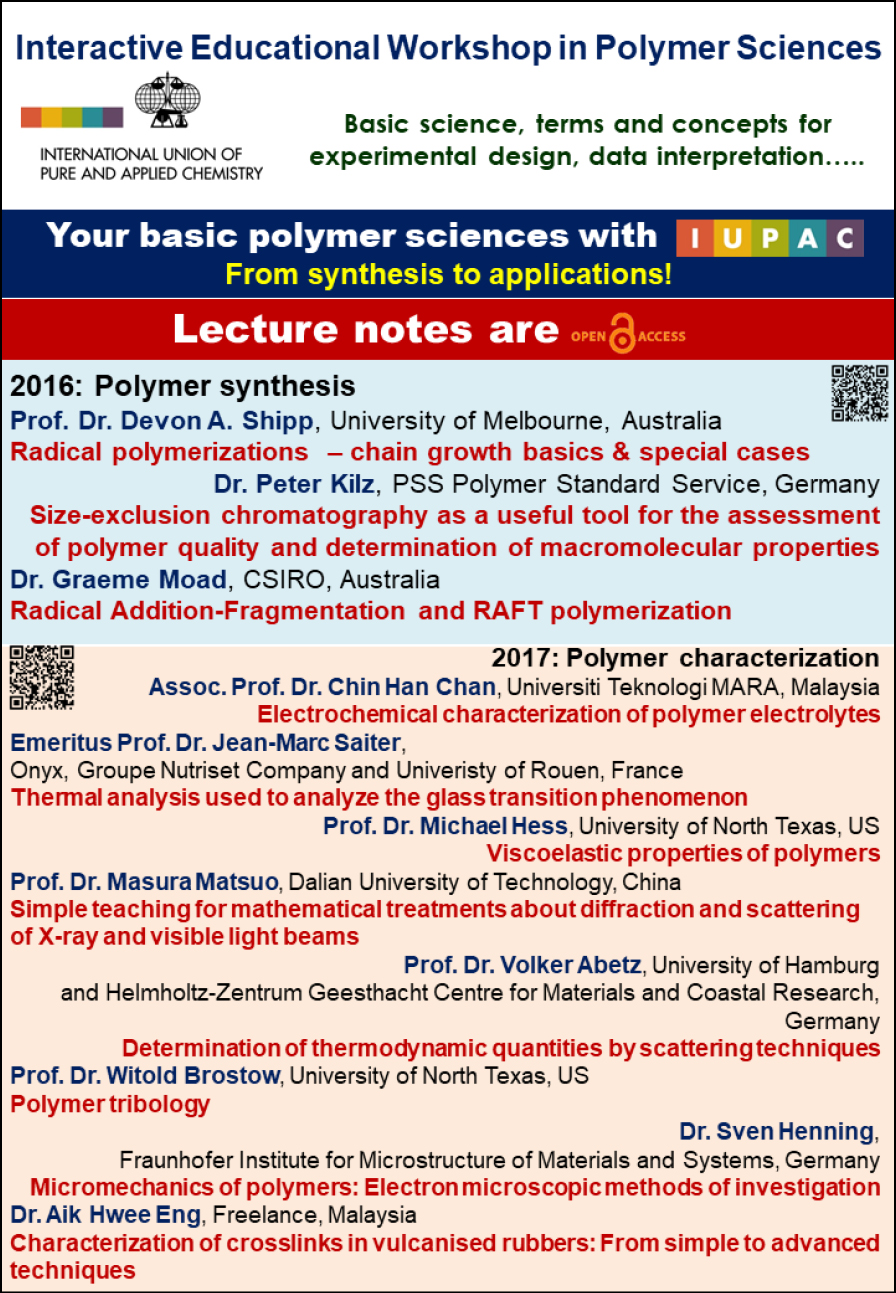
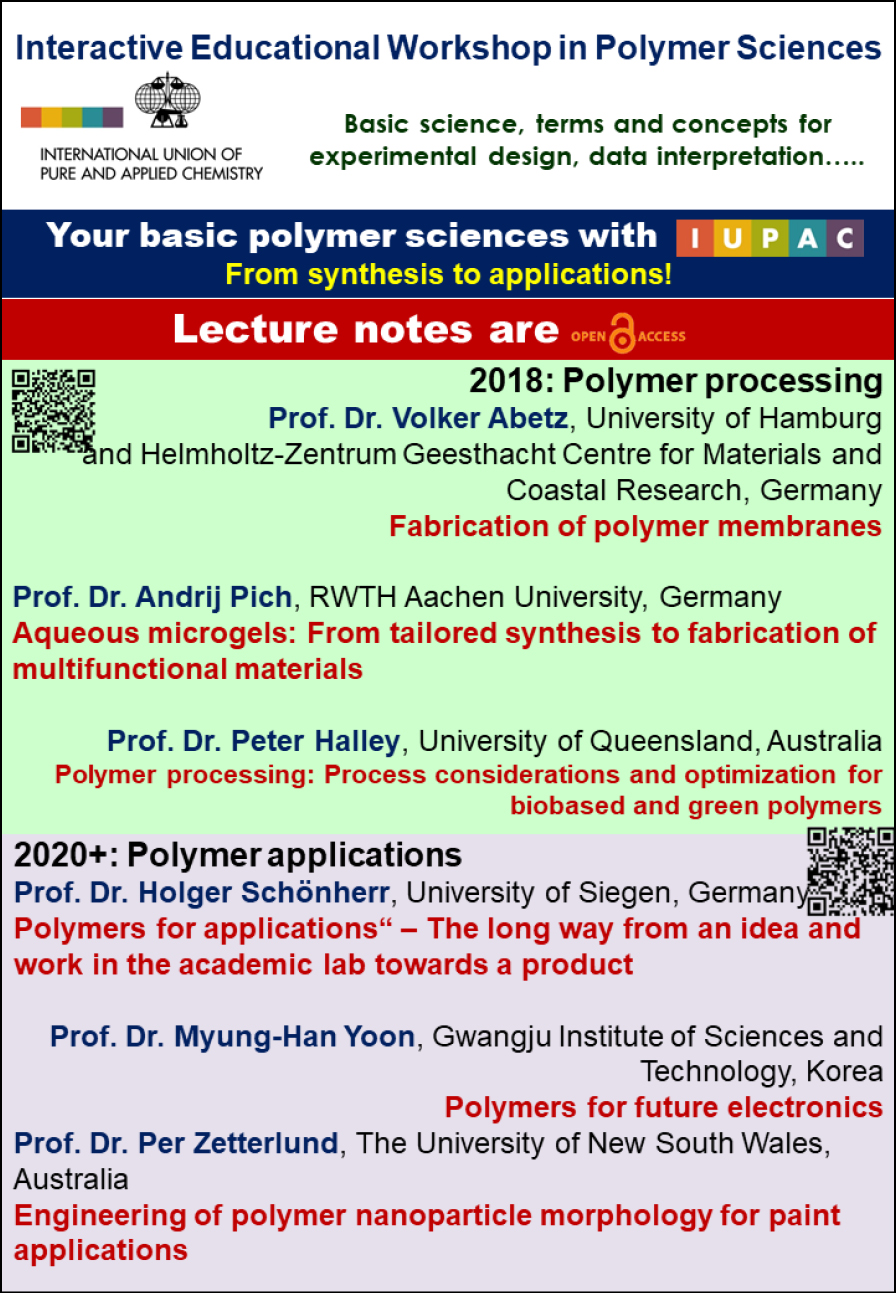
| Educational Workshop in Polymer Sciences 2016 in conjunction with MACRO2016, Istanbul Polymer synthesis |

|
| Educational Workshop in Polymer Sciences 2018 in conjunction with MACRO2018, Cairns Polymer processing |
|
| 25th Short Course on Polymer Characterization in conjunction with 25th POLYCHAR 2017, Kuala Lumpur Polymer characterization |
|
| Educational Workshop in Polymer Sciences 2020+ in conjunction with MACRO2020+, Jeju Applications of polymers |
The Sub Committee on Polymer Education (SCPE) has organized a social series of workshops about Education in Polymer Chemistry on several occasions.
This series of interactive IUPAC Education Workshops in Polymer Sciences (2016, 2017, 2018 and 2020+) on polymer sciences are intended primarily for students or active researchers from emerging countries. The presentation slides from the instructors are accessible from IUPAC project webpages through the QR-codes given below:
The Subcommittee on Polymer Education under IUPAC Polymer Division and IUPAC Committee on Chemistry Education (CCE) wanted to publish the lecture notes of the series workshop as well as the educational materials in polymer sciences in a special issue of Chemistry Teacher International.
One of the goals of Chemistry Teacher International is to bridge the gap between research and education. Good practices and the basics for some topics in polymer sciences for educational purpose should be helpful educational materials for the teachers or lecturers. In this recently released special issue, three articles on polymer synthesis, five articles on polymer characterization, two articles on polymer processing and three articles on polymer applications are published.
Both SCPE and CCE acknowledge the work done by the instructors and the contributors of the articles for the benefits of the young researchers and teachers.
This special issue is available through the website of the Open Access Journal Chemistry Teacher International: https://www.degruyter.com/journal/key/CTI/html
Chin Han Chan is from the University Teknologi MARA, Malaysia, and is a Titular Member of the IUPAC Polymer Division. Jan Apotheker is from the University of Groningen, The Netherlands, and serves as Chair of IUPAC CCE and editor-in-chief of Chemistry Teacher International.
©2021 IUPAC & De Gruyter. This work is licensed under a Creative Commons Attribution-NonCommercial-NoDerivatives 4.0 International License. For more information, please visit: http://creativecommons.org/licenses/by-nc-nd/4.0/
Articles in the same Issue
- Masthead - Full issue pdf
- IUPAC2021
- IUPAC first Virtual World Chemistry Congress and General Assembly
- Features
- Strategies for Success as an Industrial Chemist
- Diversity in Science at the Global Women’s Breakfast Network
- FAIR and Open Data in Science: The Opportunity for IUPAC
- IUPAC Focus on Digital Health
- COMEST: Ethical Advice across Scientific and Geographic Borders
- Diffusion Research with Nanoporous Material
- IUPAC Wire
- Standard Atomic Weight of Lead Revised
- PAC Cheminformatics Special Issue
- IUPAC Periodic Table Challenge 2020: Top Schools Announced
- Winners of the 2021 IUPAC-Solvay International Award For Young Chemists
- Winners of the Inaugural 2021 IUPAC Analytical Chemistry Awards
- 2021 Nominees for Election of IUPAC Officers and Bureau Members
- Project Place
- Your Basic Polymer Sciences with the Subcommittee on Polymer Education: From Synthesis to Application!
- Systems Thinking in Chemistry for Sustainability
- Up for Discussion
- The Challenge to establish a definition
- The International Year of Basic Sciences for Sustainable Development 2022: We Need It More Than Ever
- Making an imPACt
- On good reporting practices for property measurements
- IUPAC Provisional Recommendations
- Bookworm
- The Period System, a history of shaping and sharing
- Conference Call
- IUPAC/CITAC Webinar “Metrology, quality assurance and chemometrics—Correlation of test results and mass balance influence on conformity assessment”
- International Polymer Characterization Conference—POLY-CHAR 2020 (Venice)
- Where 2B & Y
- Impact of Artificial Intelligence on the Future of Chemistry
Articles in the same Issue
- Masthead - Full issue pdf
- IUPAC2021
- IUPAC first Virtual World Chemistry Congress and General Assembly
- Features
- Strategies for Success as an Industrial Chemist
- Diversity in Science at the Global Women’s Breakfast Network
- FAIR and Open Data in Science: The Opportunity for IUPAC
- IUPAC Focus on Digital Health
- COMEST: Ethical Advice across Scientific and Geographic Borders
- Diffusion Research with Nanoporous Material
- IUPAC Wire
- Standard Atomic Weight of Lead Revised
- PAC Cheminformatics Special Issue
- IUPAC Periodic Table Challenge 2020: Top Schools Announced
- Winners of the 2021 IUPAC-Solvay International Award For Young Chemists
- Winners of the Inaugural 2021 IUPAC Analytical Chemistry Awards
- 2021 Nominees for Election of IUPAC Officers and Bureau Members
- Project Place
- Your Basic Polymer Sciences with the Subcommittee on Polymer Education: From Synthesis to Application!
- Systems Thinking in Chemistry for Sustainability
- Up for Discussion
- The Challenge to establish a definition
- The International Year of Basic Sciences for Sustainable Development 2022: We Need It More Than Ever
- Making an imPACt
- On good reporting practices for property measurements
- IUPAC Provisional Recommendations
- Bookworm
- The Period System, a history of shaping and sharing
- Conference Call
- IUPAC/CITAC Webinar “Metrology, quality assurance and chemometrics—Correlation of test results and mass balance influence on conformity assessment”
- International Polymer Characterization Conference—POLY-CHAR 2020 (Venice)
- Where 2B & Y
- Impact of Artificial Intelligence on the Future of Chemistry
