
Green Chemistry
-
Pietro Tundo

After Dresden, Moscow, Ottawa, Foz do Iguaçu, and Durban, the International IUPAC Conference on Green Chemistry (ICGC) moved to Italy. ICGC-6 took place 4-8 September 2016 in Venezia, one of the most beautiful cities in the world, filled with history and culture, which welcomes more than 20 million visitors from all over the world each year. The Centro Culturale Candiani and the Teatro Toniolo of Venezia Mestre hosted the five-day scientific event. The conference belongs to a series developed by the IUPAC Subcommittee on Green Chemistry (a subcommittee of the Organic and Biomolecular Chemistry). Pietro Tundo, chair of the subcommittee, managed the event organization, together with the Organizing Committee, composed of Fabio Aricó, Lucio Ronchin, and Andrea Vavasori from Ca’ Foscari University of Venice, and the Secretary of the Conference, Emilia G. Pasta.
The Conference was organized in collaboration with the Consiglio Nazionale dei Chimici and obtained the endorsement of UNESCO, Italian National Commission for UNESCO, Italian National Committee for IUPAC, ICSU, CNR, Società Chimica Italiana, AIRI, IUAV, Royal Society of Chemistry, Ordine dei Chimici di Venezia, Città Metropolitana di Venezia, Città di Venezia, and 7 Italian Ministries: Ministero dell’Ambiente e della Tutela del Territorio e del Mare, Ministero dello Sviluppo Economico, Ministero della Giustizia, Ministero dei Beni e delle Attività Culturali e del Turismo, Ministero dell’Istruzione, dell’Università e della Ricerca, Ministero della Salute, and Ministero degli Affari Esteri e della Cooperazione Internazionale. It was supported by Ca’ Foscari University of Venice and Regione del Veneto and was sponsored by: PhosAgro, the Organisation for the Prohibition of Chemical Weapons (OPCW); Milestone as platinum sponsor; Mapei, Cefic, L’Oréal and Ecopneus as gold sponsors; Nemo Glass and Perkin Elmer as silver sponsors; and Biogest and Pirelli as bronze sponsors.
The conference was divided into five topics: Green Materials, Green Industrial Processes and Molecular Innovation, Green Bioprocesses, Green Energy, and Green Policy and Education.
ICGC-6 kicked off on Monday, 4 September, at the Teatro Toniolo of Venezia Mestre with Tundo’s welcome message. Then, the following personalities took the floor: Michele Bugliesi, Rector of the University of Venice; Paolo Pellegrini, City of Venice; Romain Murenzi, UNESCO Director for Science Policy and Capacity Building; Andrei Guriev, CEO of PhosAgro; David Black, Secretary General of International Council for Science (ICSU); Xiaohui Wu, Head of the OPCW International Cooperation Branch; Nausicaa Orlandi, President of the Consiglio Nazionale dei Chimici; Mauro Marchetti, Consiglio Nazionale delle Ricerche; and Carlos Tollinche, CHEMRAWN Chair, IUPAC.

Presentation of the IUPAC-CHEMRAWN VII Award: from left, IUPAC President Natalia Tarasova, Award recipient Ali Makeji, CHEMRAWN Chair Carlos Tollinche, and ICGC-6 Chair Pietro Tundo.
After these contributions, two awards were presented: CHEMRAWN Award for Green and Atmospheric Chemistry and the PhosAgro/UNESCO/IUPAC awards. The 2016 IUPAC-CHEMRAWN VII award for Green Chemistry was presented to Ali Maleki from the Iran University of Science and Technology. Next, J. Corish (University of Dublin, Ireland) presented the six awards of the 3rd edition of the PhosAgro/UNESCO/IUPAC “Green Chemistry for Life” to: A. Akhmetshina (Russia), I. Carrera (Uruguay), M. Ismail (Pakistan), E. Ravera (Italy), A. S. Elsayed Sayed (Egypt) and W.C. Wanyonyi (Kenya).
ICGC-6 success is in the numbers: 580 registrations from 76 countries, 400 active participants from more than 60 different countries, 4 daily parallel sessions, 6 plenary lectures, 20 keynote speeches, 2 symposia, 3 round tables, and about 250 original scientific reports. The detailed program listing plenary and keynote is available online. Selected lectures will be published in a special issue of the IUPAC journal Pure and Applied Chemistry.
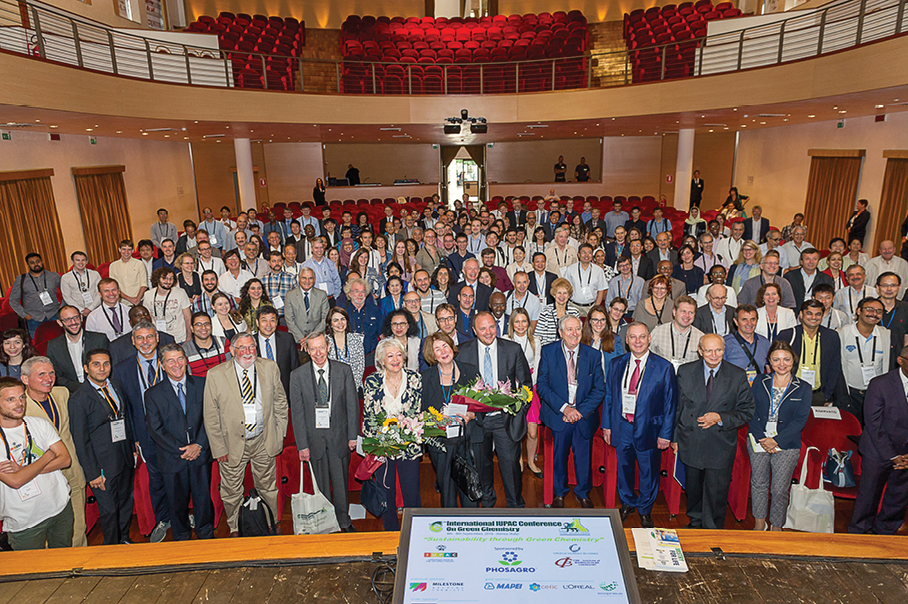
Two symposia of international relevance took place: one organized by UNESCO, PhosAgro, and IUPAC, and the other sponsored by the Organisation for the Prohibition of Chemical Weapons (OPCW). With UNESCO support, new ideas arose from the application of Green Chemistry to restoration and cultural values conservation, while the pharmaceutical industry brought experiences and data on chemical reaction performed by using water in place of chemical solvents. With OPCW, Green Chemistry as a principle and a means to oppose military usage of chemical compounds was explored.
Three open roundtables gave the opportunity to the attendees to deepen some of the issues addressed by the participants. The first was dedicated to the industries. Indeed, the massive participation of industries and companies, both Italian and international, was one of the great success of the Conference. Industries and companies from different production sectors agreed on future industrial strategies proposed by IUPAC, considered a scientifically valid, independent, and trustworthy institution. As examples, Eni thoroughly explained Marghera hydrogenation plant technical aspects, Mapei showcased the usage of recycled materials in building industry, and Pirelli talked about innovative production coming from renewable materials.
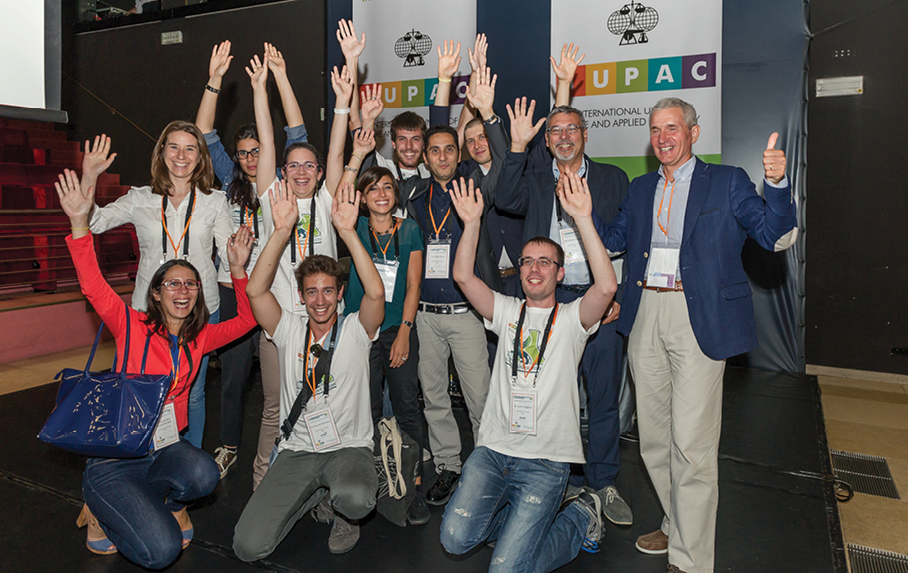
Hands-up for the success of ICGC-6 from the cheerful group of local organizers.

As the Conference Secretariat received many scientific proposals concerning the analysis, utilization, and exploitation of plants in Africa and India, the Conference Organizing Committee decided to organize a second roundtable to open a dialogue among people from these regions. In fact, considering the vastness of the African continent and of a country like India, it is often difficult for people in these geographical areas to meet.
The theme of the third roundtable was education. It took place after the education-dedicated session and was an interesting opportunity for comparison and for dialogue, as many young researchers, students, and representative of international organisations gave their opinion on the best way to teach, to learn, and to share knowledge.
The closing ceremony saw the contribution of Ali Maleki, who illustrated the project that allowed him to win the CHEMRAWN prize. The title of his oral presentation was “Green Reaction Media Protocols: From Solvent-Free to Catalysis State-of-the-Art”.
The awarding ceremony of the poster prizes also took place during the closing ceremony. The participants presented their poster contributions on Monday and on Tuesday. The poster sessions could be considered one of the greatest success of ICGC-6, for the originality and the high scientific value of the contributions, for the significant number of young people who shared their interesting researches with the other attendees, and for the interest demonstrated by the participants in the session.
The winners of the certificates were:
Daichi Nakayama, Muroran Institute of Technology (Japan);
Yuki Takada, Graduate School of Science, Nagoya University (Japan);
Klara Čebular, Department of Physical and Organic Chemistry, Jožef Stefan Institute (Slovenia).
The winners of the publications were:
Stefan B. Lawrenson, Green Chemistry Centre of Excellent, Department of Chemistry, University of York (UK);
Stefania Trita, TU Kaiserslautern (Germany);
Roxanne Brion-Roby, Université du Québec à Rimouski (Canada).
ICGC-6 was not only a great scientific event, it was also a place and time dedicated to social gathering and networking. A boat trip around the Venice lagoon was organized. On board a big motor ship, attendees saw the city of Venice from the Giudecca Canal, visiting Burano and Torcello, and were rewarded with a panoramic view of the Venetian Arsenal. The Organizing Committee also chose an exclusive location for the conference Gala Dinner, which was hosted by Ca’ Vendramin Calergi and held at the Venice Casino, an historical building on the Grand Canal, a great example of renaissance style, and Wagner’s last dwelling place. The dinner was accompanied by live classical music.
The Organizing Committee’s expectations were met. During several sessions, issues of national relevance were discussed. New challenges in different sectors were also undertaken: restoration and cultural values conservation, chemical weapons prohibition, innovative pharmaceutical production processes, and environmental protection. The chemical industry, moving from the image of a “Twentieth Century Monster,” responsible for development, but also environmental and health issues for mankind, is becoming the leader of sustainable development through decades of day-by-day research in thousands of universities and laboratories, looked at as a new hope for populations around the world. The next editions of the International Conference on Green Chemistry will be held in Moscow, Russia, 2-5 October 2017 (http://greeniupac2017.muctr.ru) and in Bangkok, Thailand, in September 2018.
For more pictures from Venice and the full conference program, see
©2017 by Walter de Gruyter Berlin/Boston
Articles in the same Issue
- Masthead - Full issue pdf
- Contents
- President’s Column
- On the Path to Rewarding Times
- Features
- Taking IUPAC Literally: Woodward’s Pure and Applied Chemistry Words
- The Periodic Table (continued?): Eka-francium Et Seq.
- Chemistry Organizations in a Changing World
- IUPAC Wire
- IUPAC and the Organisation for the Prohibition of Chemical Weapons Take Partnership to New Level
- IUPAC Announces the Names of the Elements 113, 115, 117, and 118
- IUPAC Periodic Table of the Elements—Updated Release
- Gender-based Harassment in the Practice of Science
- ICSU to Merge with ISSC
- Remembering Peter Greaves Taylor Fogg (1929-2016)
- Stamps International
- Woodward’s Birth Centennial
- Project Place
- Environmental Fate and Risks of Nano-enabled Pesticides
- Ecological Risk Assessment Workshop for Central America
- A Critical Review of Reporting and Storage of NMR Data for Spin-Half Nuclei in Small Molecules
- Guides in Metrology
- Bookworm
- Successful Drug Discovery
- Making an imPACt
- Source-based Nomenclature for Single-strand Homopolymers and Copolymers (IUPAC Recommendations 2016)
- Comprehensive Definition of Oxidation State (IUPAC Recommendations 2016)
- Glossary of Terms Used in Developmental and Reproductive Toxicology (IUPAC Recommendations 2016)
- IUPAC Provisional Recommendations
- Terminology of Bioanalytical Methods
- Nomenclature and Terminology for Dendrimers with Regular Dendrons and for Hyperbranched Polymers
- Conference Call
- WMFmeetsIUPAC
- Chemistry Education
- Green Chemistry
- Solid State Chemistry
- Where 2B & Y
- Macro- and Supramolecular Architectures and Materials
- POLYCHAR World Forum on Advanced Materials
- Coordination and Bioinorganic Chemistry
- Chemists and IUPAC: Taking Responsibility and Taking Action
- Small Satellites for Space Research
- Mark Your Calendar
Articles in the same Issue
- Masthead - Full issue pdf
- Contents
- President’s Column
- On the Path to Rewarding Times
- Features
- Taking IUPAC Literally: Woodward’s Pure and Applied Chemistry Words
- The Periodic Table (continued?): Eka-francium Et Seq.
- Chemistry Organizations in a Changing World
- IUPAC Wire
- IUPAC and the Organisation for the Prohibition of Chemical Weapons Take Partnership to New Level
- IUPAC Announces the Names of the Elements 113, 115, 117, and 118
- IUPAC Periodic Table of the Elements—Updated Release
- Gender-based Harassment in the Practice of Science
- ICSU to Merge with ISSC
- Remembering Peter Greaves Taylor Fogg (1929-2016)
- Stamps International
- Woodward’s Birth Centennial
- Project Place
- Environmental Fate and Risks of Nano-enabled Pesticides
- Ecological Risk Assessment Workshop for Central America
- A Critical Review of Reporting and Storage of NMR Data for Spin-Half Nuclei in Small Molecules
- Guides in Metrology
- Bookworm
- Successful Drug Discovery
- Making an imPACt
- Source-based Nomenclature for Single-strand Homopolymers and Copolymers (IUPAC Recommendations 2016)
- Comprehensive Definition of Oxidation State (IUPAC Recommendations 2016)
- Glossary of Terms Used in Developmental and Reproductive Toxicology (IUPAC Recommendations 2016)
- IUPAC Provisional Recommendations
- Terminology of Bioanalytical Methods
- Nomenclature and Terminology for Dendrimers with Regular Dendrons and for Hyperbranched Polymers
- Conference Call
- WMFmeetsIUPAC
- Chemistry Education
- Green Chemistry
- Solid State Chemistry
- Where 2B & Y
- Macro- and Supramolecular Architectures and Materials
- POLYCHAR World Forum on Advanced Materials
- Coordination and Bioinorganic Chemistry
- Chemists and IUPAC: Taking Responsibility and Taking Action
- Small Satellites for Space Research
- Mark Your Calendar
