
Comprehensive Definition of Oxidation State (IUPAC Recommendations 2016)

Pavel Karen, Patrick McArdle, and Josef Takats
Pure and Applied Chemistry, 2016Volume 88, Issue 8, pp. 831-839
Oxidation state (OS) gives the degree of oxidation of an atom in terms of counting electrons. [1] It scales trends in redox and acid-base properties, as well as in physical properties such as magnetism, and is a key component when tracking the course of chemical reactions. Thus, the concept of OS is important, and so is an agreed upon definition of what OS is and the algorithmic manner in which it is to be calculated. In the absence of an actual definition, algorithms have thus far been used to define OS.
This recommendation proposes a definition of OS based on ionic approximation of chemical bonds, illustrated on a molecular-orbital scheme and deduced from electronegativity considerations (Allen’s scale). Two algorithms are formulated for the determination of OS in molecules, ions, and extended solids, and are illustrated with examples. Limits, beyond which OS ceases to be well-defined or becomes ambiguous, are exemplified; moving outside these requires additional measurements, round offs, estimates, or plain postulates. Specific uses that justify a nominal OS are also explained.
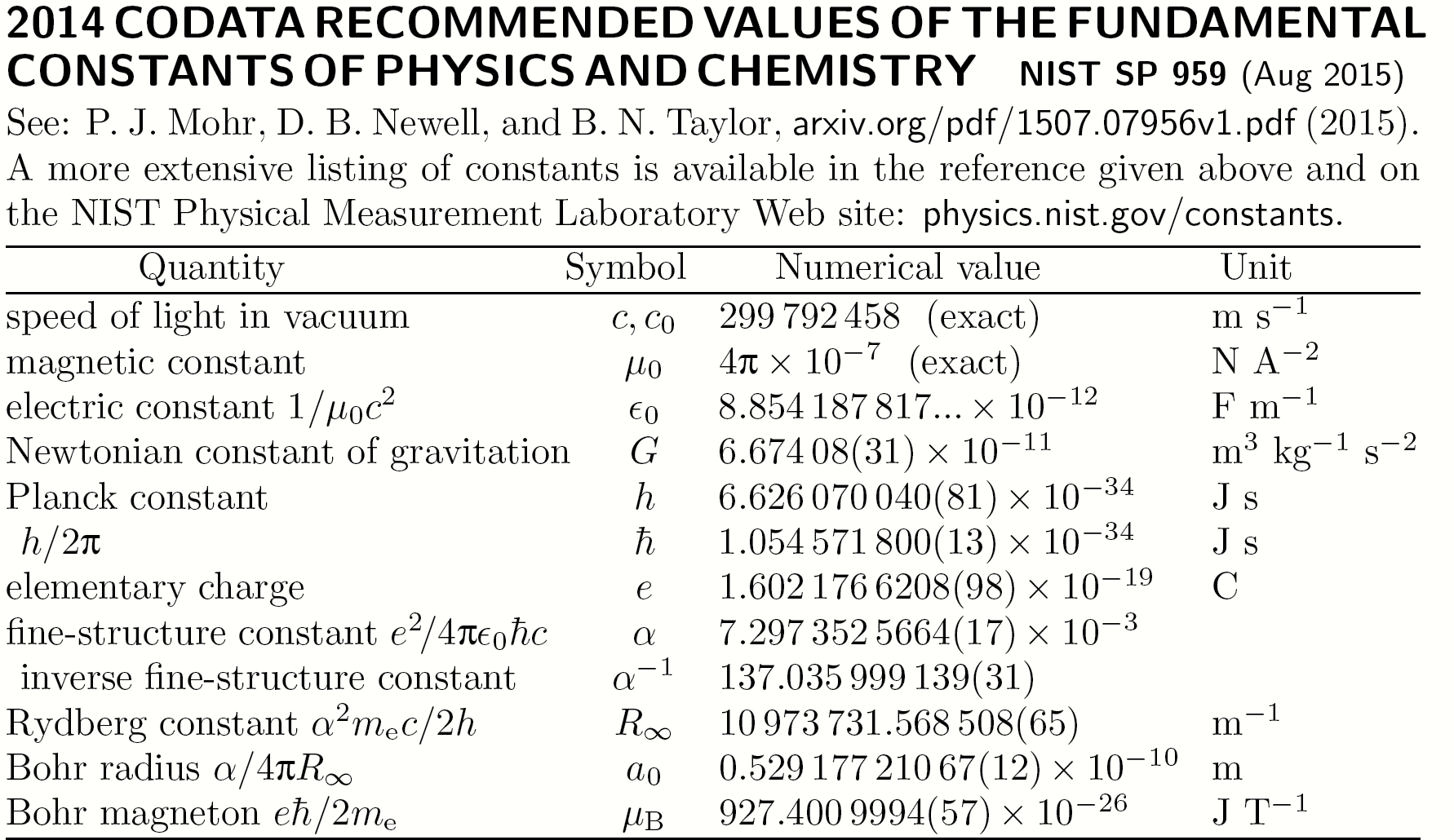
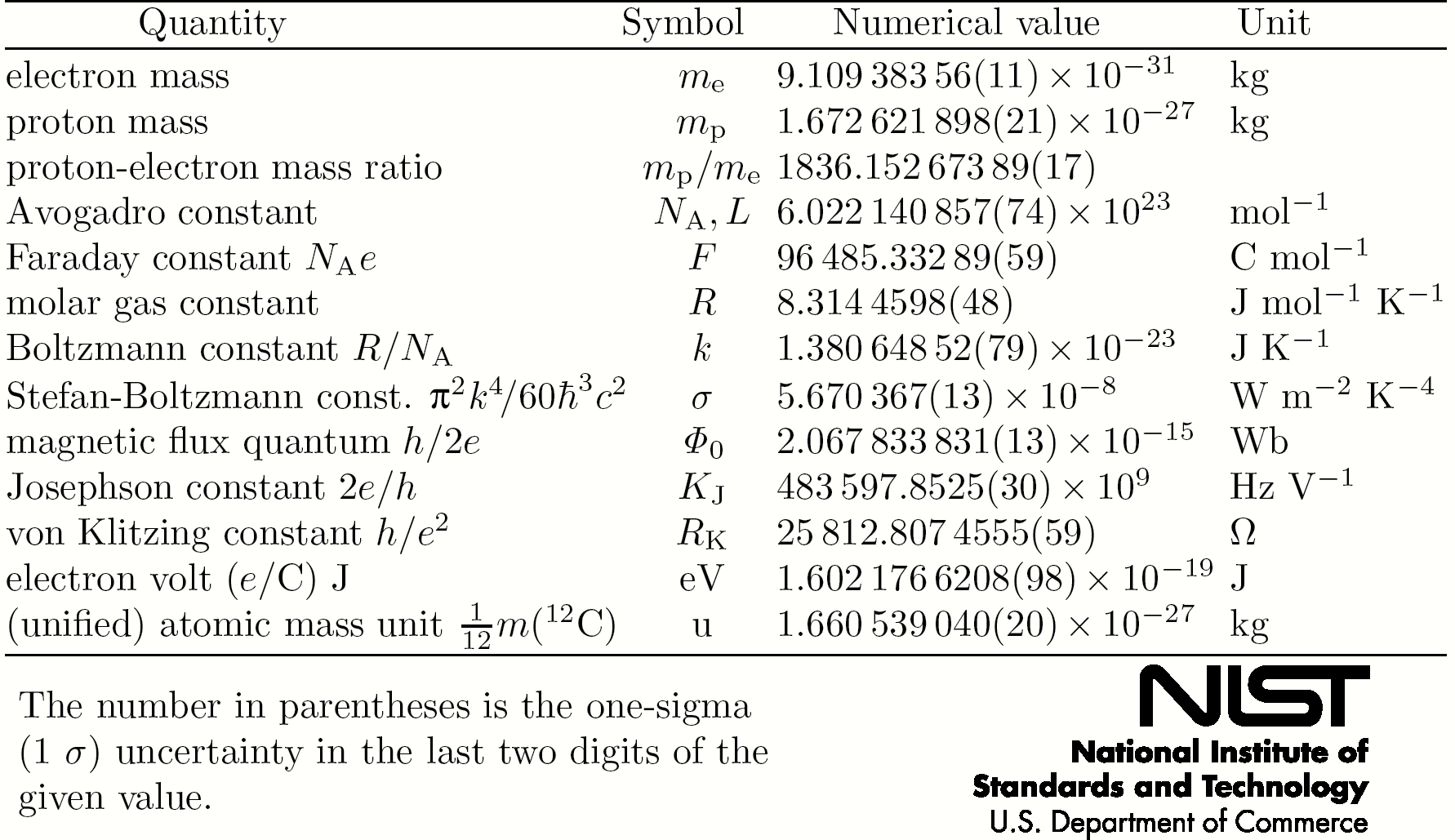
The full scholarly paper providing the 2014 self-consistent set of values of the constants and conversion factors of physics and chemistry recommended by the Committee on Data for Science and Technology (CODATA) was published in September 2016 in Review of Modern Physics 88, 035009 (2016); https://doi.org/10.1103/RevModPhys.88.035009 . The full text article, a wall chart, and a wallet card (reprint below) are available from the NIST website at http://physics.nist.gov/cuu/Constants
©2017 by Walter de Gruyter Berlin/Boston
Artikel in diesem Heft
- Masthead - Full issue pdf
- Contents
- President’s Column
- On the Path to Rewarding Times
- Features
- Taking IUPAC Literally: Woodward’s Pure and Applied Chemistry Words
- The Periodic Table (continued?): Eka-francium Et Seq.
- Chemistry Organizations in a Changing World
- IUPAC Wire
- IUPAC and the Organisation for the Prohibition of Chemical Weapons Take Partnership to New Level
- IUPAC Announces the Names of the Elements 113, 115, 117, and 118
- IUPAC Periodic Table of the Elements—Updated Release
- Gender-based Harassment in the Practice of Science
- ICSU to Merge with ISSC
- Remembering Peter Greaves Taylor Fogg (1929-2016)
- Stamps International
- Woodward’s Birth Centennial
- Project Place
- Environmental Fate and Risks of Nano-enabled Pesticides
- Ecological Risk Assessment Workshop for Central America
- A Critical Review of Reporting and Storage of NMR Data for Spin-Half Nuclei in Small Molecules
- Guides in Metrology
- Bookworm
- Successful Drug Discovery
- Making an imPACt
- Source-based Nomenclature for Single-strand Homopolymers and Copolymers (IUPAC Recommendations 2016)
- Comprehensive Definition of Oxidation State (IUPAC Recommendations 2016)
- Glossary of Terms Used in Developmental and Reproductive Toxicology (IUPAC Recommendations 2016)
- IUPAC Provisional Recommendations
- Terminology of Bioanalytical Methods
- Nomenclature and Terminology for Dendrimers with Regular Dendrons and for Hyperbranched Polymers
- Conference Call
- WMFmeetsIUPAC
- Chemistry Education
- Green Chemistry
- Solid State Chemistry
- Where 2B & Y
- Macro- and Supramolecular Architectures and Materials
- POLYCHAR World Forum on Advanced Materials
- Coordination and Bioinorganic Chemistry
- Chemists and IUPAC: Taking Responsibility and Taking Action
- Small Satellites for Space Research
- Mark Your Calendar
Artikel in diesem Heft
- Masthead - Full issue pdf
- Contents
- President’s Column
- On the Path to Rewarding Times
- Features
- Taking IUPAC Literally: Woodward’s Pure and Applied Chemistry Words
- The Periodic Table (continued?): Eka-francium Et Seq.
- Chemistry Organizations in a Changing World
- IUPAC Wire
- IUPAC and the Organisation for the Prohibition of Chemical Weapons Take Partnership to New Level
- IUPAC Announces the Names of the Elements 113, 115, 117, and 118
- IUPAC Periodic Table of the Elements—Updated Release
- Gender-based Harassment in the Practice of Science
- ICSU to Merge with ISSC
- Remembering Peter Greaves Taylor Fogg (1929-2016)
- Stamps International
- Woodward’s Birth Centennial
- Project Place
- Environmental Fate and Risks of Nano-enabled Pesticides
- Ecological Risk Assessment Workshop for Central America
- A Critical Review of Reporting and Storage of NMR Data for Spin-Half Nuclei in Small Molecules
- Guides in Metrology
- Bookworm
- Successful Drug Discovery
- Making an imPACt
- Source-based Nomenclature for Single-strand Homopolymers and Copolymers (IUPAC Recommendations 2016)
- Comprehensive Definition of Oxidation State (IUPAC Recommendations 2016)
- Glossary of Terms Used in Developmental and Reproductive Toxicology (IUPAC Recommendations 2016)
- IUPAC Provisional Recommendations
- Terminology of Bioanalytical Methods
- Nomenclature and Terminology for Dendrimers with Regular Dendrons and for Hyperbranched Polymers
- Conference Call
- WMFmeetsIUPAC
- Chemistry Education
- Green Chemistry
- Solid State Chemistry
- Where 2B & Y
- Macro- and Supramolecular Architectures and Materials
- POLYCHAR World Forum on Advanced Materials
- Coordination and Bioinorganic Chemistry
- Chemists and IUPAC: Taking Responsibility and Taking Action
- Small Satellites for Space Research
- Mark Your Calendar
