
The syntax of wh-phrases, narrow foci, and neg-words in Georgian
-
Lena Borise


Abstract
This paper demonstrates that narrow foci and wh-phrases, even in a language where they have (nearly-)identical surface distributions, do not have the same syntax – and, as such, are not a uniform category. Specifically, it shows that foci and wh-phrases in Georgian appear immediately preverbally but are derived differently. The evidence comes from standard syntactic tests and language-specific ones: I show that, in Georgian, neg-words can serve as a tool for determining the structural positions of other constituents, and foci and wh-phrases have different distributional properties with respect to neg-words. Based on this, I demonstrate that wh-phrases in Georgian undergo A-bar movement to the specifier of a dedicated projection, accompanied by verb raising. Preverbal foci remain in situ, while the material intervening between the narrow focus and the verb undergoes displacement. This demonstrates that what looks like unified preverbal placement of foci and wh-phrases corresponds to the outcomes of two independent syntactic processes. Additional support for this approach is provided by the analysis of the distribution of postverbal foci, also allowed in Georgian. The Georgian facts, I argue, support the hypothesis that syntactic/semantic notions (e.g., [+Q]) are encoded as syntactic features that drive movement. On the other hand, purely information-structural notions (e.g., semantically non-exhaustive focus) are not encoded syntactically, and, as such, cannot trigger syntactic movement – but can impose their own syntax-prosody mapping requirements onto the syntactic structure.
1 Introduction
This paper investigates the syntactic properties of narrow foci and wh-expressions in Georgian, a Kartvelian language of the Caucasus. Descriptively, narrow foci and wh-phrases in Georgian, like in numerous other OV languages (Kim 1988; Kidwai 1999; van der Wal 2012 a.o.), are found in the immediately preverbal position (henceforth IPrP), as shown in (1):
| Guʃin | dila-s | bebia | ra-s | a-lag-eb-d-a?[1] |
| yesterday | morning-dat | grandma[nom] | what-dat | ver-clean-sf-sm-ipfv.3sg |
| ‘What did grandma clean yesterday morning?’ | ||||
| Guʃin | dila-s | bebia | samzareulo -s | a-lag-eb-d-a. |
| yesterday | morning-dat | grandma[nom] | kitchen-dat | ver-clean-sf-sm-ipfv.3sg |
| ‘Grandma cleaned the kitchen yesterday morning.’ | ||||
Following Rooth’s (1985, 1992, 1996 Alternative Semantics, focus here is understood as indicating “the presence of alternatives that are relevant for the interpretation of linguistic expressions” (Krifka 2008: 247). This includes new information foci, contrastive foci, and constituents modified by focus-inducing particles even and only. According to the same definition, wh-expressions also constitute a type of focus, since they act as substitutes for sets of entities for which the proposition is true (Dik 1997: 331; Eckardt 2007; Romero 1998).[2] Consequently, it may not seem surprising that wh-phrases pattern with foci in some of their properties: e.g., in languages with preverbal focus placement, wh-phrases are often similarly found in the IPrP (Primus 2001).
There are two main syntactic mechanisms that may derive the adjacency between the verb and the element in the IPrP: (i) movement into a Spec-Head configuration and (ii) displacement of the intervening material.[3] In the Spec-Head scenario, the focal/wh-element undergoes (A-bar) movement to the specifier of XP, and the verb moves to X0, thereby creating adjacency (Bhatt 1999 on Kashmiri; Jayaseelan 2001 on Malayalam, a.o.). As motivation for movement, feature-checking in Spec,XP or alignment of the focused constituent with nuclear stress, which coincides with the Spec,XP position, have been invoked. For instance, for Hungarian focus, both motivations for movement have been proposed, by Bródy (1995) and Szendrői (2003), respectively. In the displacement scenario, on the other hand, the focus-verb adjacency is obtained in situ, via the displacement of the intervening material. The displacement may be motivated either by the information-structural properties of the displaced material (Şener 2010 on Turkish) or by the need for the focused constituent to carry nuclear stress (Arregi 2002 on Basque; cf. also Cheng and Downing 2012 on Zulu).
This paper shows that both syntactic mechanisms are at work in Georgian. A Spec-Head analysis best accounts for the IPrP placement of wh-phrases, while preverbal narrow foci remain in situ, and would-be interveners evacuate to the left or right periphery. This conclusion is supported by the different behavior of wh-phrases and narrow foci with respect to traditional diagnostics like island effects, weak crossover facts, and interaction with adverbs. Additionally, a new diagnostic proposed in this paper is the relative positioning of wh-phrases and narrow foci with respect to neg-words – constituents that occur in the presence of negation and exhibit negative concord or may signal negation themselves (nothing, nowhere, etc.). First, I show that neg-words in Georgian cannot displace into the left or right periphery. This is not unexpected from the point of view of information structure (IS): such displacement into the peripheries is typical of topical/given material in Georgian, while neg-words are non-referential, which means that they resist topicalization/backgrounding (more on this in Section 5.3). This, coupled with the fact that Georgian does not have A-movement for case assignment, means that neg-words in Georgian are necessarily found in situ. At the same time, like wh-phrases and preverbal narrow foci, neg-words in Georgian obligatorily appear in the IPrP. Importantly, this is only true in broad focus contexts. In wh-questions (WHQs) and utterances containing narrow foci, neg-words can abandon their IPrP requirement in favor of the focused constituent/wh-phrase occupying the IPrP. They do so differently in the two contexts though: in WHQs, neg-words can only occur postverbally; in narrow focus contexts, neg-words can either precede or follow the focus + verb complex, depending on the theta roles of the neg-word and the narrow focus. Given that neg-words cannot leave their base position, these distributional facts provide evidence about the structural positions of wh-phrases and narrow foci.
I propose that the reason for why wh-phrases – but not narrow foci – undergo movement is that syntactic features, like [+Q], can trigger movement, but purely information-structural notions, like semantically non-exhaustive focus, cannot (Horvath 2007, 2010). In Georgian, [+Q] is responsible for movement of wh-phrases and the accompanying movement of the verb. Narrow foci, not carrying a syntactic feature, cannot trigger movement. At the same time, narrow foci call for a particular prosodic realization. Their interface requirements are implemented as violable constraints, Optimality Theory-style, and cause word order permutations that lead to immediately preverbal placement of narrow foci. Specifically, I argue that narrow foci in Georgian should be right-aligned with a prosodic boundary, according to the Focus-as-Alignment approach proposed by Féry (2013), and form part of the core Intonational Phrase (ɩ). This is fulfilled via the displacement of the non-focal material that can be topicalized to the left periphery or the prosodically external post-verbal domain. This means that focus-verb adjacency is achieved in situ: neither foci nor verbs in the context of narrow foci move to a dedicated projection.
Additionally, Georgian also allows for postverbal placement of narrow foci, as shown in (2):
| (‘What did grandma clean yesterday morning?’) | ||||
| Guʃin | dila-s | bebia | a-lag-eb-d-a | samzareulo-s . |
| yesterday | morning-dat | grandma[nom] | ver-clean-sf-sm-ipfv.3sg | kitchen-dat |
| ‘Grandma cleaned the kitchen yesterday morning.’ | ||||
Postverbal foci are not common in verb-final languages. The known cases have also been subject to different analyses. Postverbal foci in Basque have been derived in the same way as preverbal ones (a raising configuration), but accompanied by remnant movement of post-focal clausal material to the left periphery (Ortiz de Urbina 2002). In contrast, postverbal foci in Old High German and Early New High German have been derived via right-adjunction (Bies 1996; Fuß 2018; Hinterhölzl and Petrova 2018). I show that postverbal foci in Georgian, too, are derived via right-adjunction, as an alternative way of satisfying the prosodic requirements of focused constituents (right-alignment with a prosodic boundary and being part of the core ɩ). Important support for this analysis also comes from the relative distribution of postverbal foci and neg-words.
This paper is structured as follows. Section 2 highlights the relevant properties of Georgian grammar: the headedness of different phrasal projections (2.1), height of the verb in verb-final clauses (2.2), and case marking (2.3). Section 3 introduces the distributional properties of wh-phrases. Section 4 does the same for narrow foci, preverbal and postverbal. Section 5 is dedicated to the properties of neg-words in Georgian: after outlining the general properties of topicalized constituents (5.1), it introduces the distributional (5.2) and structural (5.3–4) properties of neg-words. In Section 6, after the preview of the results (6.1), the argumentation about the different structural positions of wh-phrases and narrow foci is provided, based on the evidence from island effects (6.2), weak cross-over effects (6.3), and the interaction with adverbs (6.4) and neg-words (6.5); finally, the structural height of wh-phrases is determined (6.6). In Section 7, an analysis of post-verbal foci is developed. Section 8 provides an account of the prosodic realization of narrow foci, which motivates their placement. Section 9 concludes.
2 Relevant aspects of Georgian grammar
This section provides a bird’s-eye view of the relevant properties of Georgian grammar: headedness in different phrasal projections, the position of the verb in verb-final clauses, and case marking.
2.1 Headedness
Georgian is a head-final language, though not consistently so, in contrast with prototypical head-final languages like Korean and Japanese. On the one hand, numerous constructions provide evidence for head-finality. Post-positional phrases (3), genitive+noun combinations (4), participial relative clauses (5), and small clauses (6) are strictly head-final:
| alkimik’os-eb-is- tvis |
| alchemist-pl-gen-for |
| ‘for the alchemists’ |
| * tvis | alkimik’os-eb-is |
| for | alchemist-pl-gen |
| (‘for the alchemists’) | |
| Amerik’-is | ʃe-ert-eb-ul-i | ʃt’at’-eb-i |
| America-gen | prv-one-sf-ptcp-nom | state-pl-nom |
| ‘United States of America’ | ||
| *ʃe-ert-eb-ul-i | ʃt’at’-eb-i | Amerik’-is |
| prv-one-sf-ptcp-nom | state-pl-nom | America-gen |
| (‘United States of America’) | ||
| [PtcpP | Ek’a-s | ts’a-k’itx-ul-i ] | ts’ign-i |
| Eka-gen | prv-read.prf-ptcp-nom | book-nom | |
| ‘the book that Eka read’ | (Foley 2013: 8) | ||
| *[PtcpP | ts’a-k’itx-ul-i | Ek’a-s] | ts’ign-i |
| prv-read.prf-ptcp-nom | Eka-gen | book-nom | |
| (‘the book that Eka read’) | |||
| Manana | [SC | Gela-s | ʧ’k’vian-ad ] | tvl-i-s. |
| Manana[nom] | Gela-dat | smart-as | consider-sm-prs.3sg | |
| ‘Manana considers Gela smart.’ | ||||
| *Manana | [SC | ʧ’k’vian-ad | Gela-s] | tvl-i-s. |
| Manana[nom] | smart-as | Gela-dat | consider-sm-prs.3sg | |
| (‘Manana considers Gela smart.’) | ||||
Similarly, object+verb idioms are preferably verb-final, and, for some speakers, lose their idiomatic meaning in VO, as shown in (7) (see also Skopeteas and Fanselow 2010).
| Nino-m | ena | mi-u-tan-a | Dat’o-s. |
| Nino-erg | tongue[nom] | prv-ver-bring-aor.3sg | Dato-dat |
| ‘Nino spilled the beans to Dato.’ (Lit.: brought her tongue to Dato) | |||
| %Nino-m | mi-u-tan-a | ena | Dat’o-s. |
| Nino-erg | prv-ver-bring-aor.3sg | tongue[nom] | Dato-dat |
| ‘Nino spilled the beans to Dato.’ (Lit.: brought her tongue to Dato) | |||
In contrast, other projections exhibit head-initial properties. E.g., while complementizer placement in Georgian is often flexible, there are no clause-final complementizers, (8), which provides evidence against a head-final CP.
| Marik’a-s | mosts’on-s | [< rom > | Giorgi-m | < rom > | mankana | < rom > |
| Marika-dat | like-prs.3sg | comp | Giorgi-erg | comp | car[nom] | comp |
| i-q’id-a | <* rom >]. | |||||
| ver-buy-aor.3sg | comp | |||||
| ‘Marika likes [it] that Giorgi bought a car.’ | ||||||
There is also a modal unda ‘have to, must’, which, in contrast to finite verbs in Georgian, can only be found clause-medially and not clause-finally, (9). This suggests that it is found in a higher, head-initial projection, such as AuxP.[4] The CP- and AuxP-related facts are contrary to what would be expected in a strictly head-final language. I take this to mean that the clausal spine in Georgian above the VP is head-initial, which makes Georgian clausal syntax similar to that of German (Haider 2010), except for the lack of V2.
| Xval | P’raɣa-ʃi | K’arl-is | xid-i | unda | v-nax-o-t. |
| tomorrow | Prague-in | Charles-gen | bridge-nom | mod | 1-see-opt.1-pl |
| ‘We have to see Charles Bridge in Prague tomorrow.’ | |||||
| * Xval | P’raɣa-ʃi | K’arl-is | xid-i | v-nax-o-t | unda . |
| tomorrow | Prague-in | Charles-gen | bridge-nom | 1-see-opt.1-pl | mod |
| (‘We have to see Charles Bridge in Prague tomorrow.’) | |||||
At the same time, there is considerable flexibility with respect to the order of elements within the VP, with both VO and OV widely attested, as shown in (10). Both word orders are frequent in discourse and can be found in all-new contexts (e.g., Tuite 1998: 42). Most authors agree that OV is underlying (Aronson 1990; Boeder 2005: 64; Harris 2000: 141; McGinnis 1997a, 1997b; Nash 1995; Pochkhua 1962; Skopeteas and Fanselow 2010). This view is adopted here as well.
| Giorgi | vaʃl-s | ʧ’am-s. |
| Giorgi[nom] | apple-dat | eat-prs.3sg |
| ‘Giorgi is eating an apple.’ | ||
| Giorgi | ʧ’am-s | vaʃl-s. |
| Giorgi[nom] | eat-prs.3sg | apple-dat |
| ‘Giorgi is eating an apple.’ | ||
This, however, raises questions about the syntactic underpinnings of the frequently attested VO. Both OV and VO in Georgian can be information-structurally neutral. Preverbal and postverbal direct objects (DOs) do not differ in their definiteness or specificity. The fact that VO orders are possible as neutral contexts points to their syntactic organization: as argued in Neeleman (2015), neutral word orders are derived by X0-movement (which is always leftward), as opposed to phrasal movement to the right. Accordingly, I take Georgian VO to be derived by short (e.g, V0-to-v0) movement of the verb (as opposed to e.g., displacement of the DO to the right). This is in line with Skopeteas and Fanselow (2010), who also derive neutral Georgian VO by verb raising, and emphasize that this head-movement is semantically vacuous. Accordingly, the derivations of the examples in (10) are schematized in (11):
| a. | [VP apple eats] |
| b. | [vP eatsi [VP apple ti]] |
The availability of this kind of verb movement means that there is a suitable head position on the left side of the clausal spine for the verb to move to, which fits well with the analysis of the clausal spine above the VP as head-initial. Furthermore, deriving VO via verb movement means that the two object positions in OV and VO orders are one and the same syntactic position, which explains lack of interpretational differences between the two.
2.2 The position of the verb in verb-final clauses
There is evidence that the verb in Georgian does not leave the VP in OV clauses (or the vP in VO clauses). The tests commonly used for determining the position of the verb are based on the relative scope of verbal negation and elements such as NPIs and quantifiers associated with verbal arguments (Han et al. 2007; Simpson and Syed 2014, a.o.). The condition that these tests rely on is that the exponent of negation and the verb form a constituent and, were the verb to move, the exponent of negation would move too – e.g., after cliticizing to the verb. This condition is obtained in Georgian. Verbal negation in Georgian is merged and interpreted low in the clause, below the base position of the external argument. The exponent of negation is a clitic on the verb and cannot be separated from it by any other material, including adverbs, as in (12) (similarly to Romance languages; Cinque 1999):
| *Me | ar | namdvil-ad | mo-m-ts’on-s | es | p’rocedura. [5] |
| 1sg[dat] | neg | really-adv | prv-1sg-like-3sg | this | procedure[nom] |
| (‘I don’t really like this procedure.’) | |||||
This serves as evidence that the negative exponent and the verb combine into a single unit that cannot be broken up. This can be achieved either if negation is a head and combines with the verb (via syntactic head movement, m-merger, or a combination of both), or if negation is phrasal/adverbial and cliticizes to the verb. To avoid postulating an unusual architecture with a low NegP projection, I take Georgian negation to be adverbial, and therefore phrasal, and a clitic in the phonology; see also Erschler (2015: 47).
Now, let us consider the interaction of a quantified subject and a negated verb, with the quantified subject preceding the verb, as in (13) below. There are two possible readings that such a clause can have, depending on the relative scope of the two elements: numeral > negation or negation > numeral. The availability of the negation > numeral reading would be indicative of the negation + verb complex (covertly) raising past the subject to a higher position, while the availability of numeral > negation alone would indicate lack of such movement. In Georgian, a quantified subject scopes over verbal negation, which suggests that negation is generated and interpreted below the position of the subject and, consequently, that the negation + verb complex does not raise past it from its low position in the VP/vP. In particular, (13) can be used to describe a group of three students in which one or two students won’t know the answer (numeral > negation). On the other hand, it cannot be used to say that it is not the case that fewer than three (out of three) students know the answer (*negation > numeral). Note that, because (13) is a VO-clause, the verb has undergone V0-to-v0 movement, but the scope facts demonstrate lack of further movement.
| Sam-ze | nak’leb | st’udent’-s | ar | e-tsodin-eb-a | es | p’asuxi. |
| three-on | less | student-dat | neg | ver-know-sf-fut.3sg | dem | answer[nom] |
| ‘Fewer than three students will not know the answer.’ | ||||||
| NOT: ‘It won’t be the case that fewer than three students will know the answer.’ | ||||||
| (numeral > negation; * negation > numeral) | ||||||
Similarly, the position of the negation + verb complex can be diagnosed by using a verbal argument that contains disjunction. A disjoint reading is only predicted to be felicitous if the disjunction scopes over negation (disjunction > negation), whereas a conjoint reading should be available if the disjunction scopes below negation (negation > disjunction) (Shibata 2015). This is shown in (14):
| Mary does n’t like wine or beer. | |
| a. | (…so, we will get something else; negation > disjunction) |
| b. | (…but I can’t remember which one; disjunction > negation) |
In Georgian, in contrast with English, when a direct object contains a disjunction, it scopes over verbal negation, which is manifested by the availability of the disjoint reading, and the unavailability of the conjoint reading, as shown in (15). The means that the verb is generated and interpreted below the position of the disjunction.
| Dato-s | ( an ) | ɣvino | an | lud-i | ar | u-q’var-s. |
| Dato-dat | or | wine[nom] | or | beer-nom | neg | ver-love-prs.3sg |
| ‘Dato doesn’t like wine or beer.’ (disjunction > negation, *negation > disjunction) | ||||||
The evidence from these two tests indicates that the verb does not raise from its base position in broad-focus declarative clauses. I assume that verbal morphology is assembled via m-merger as opposed to head movement (Harizanov 2014; Matushansky 2006).[6] Accordingly, I conclude that verbs in Georgian stay low in the clausal structure.
2.3 Case marking
Case marking of verbal arguments in Georgian varies between nominative, ergative, and dative, depending on the tense category of the verb (known as ‘series’ in the Kartvelological tradition). This is illustrated in Table 1. Because case-related facts in Georgian are complex, and in-situ case licensing plays an important role in the argument, these facts are discussed in detail below.
Case marking by series.
| Series | ‘Active’ subjects (transitive & unergative) | ‘Inactive’ subjects (unaccusative) | Objects | |
|---|---|---|---|---|
| Present | Nominative | Nominative | Dative | |
| Aorist | Ergative | Nominative | Nominative | |
| Perfect | Dative | Nominative | Nominative | |
With respect to the structural positions and case licensing of verbal arguments, I follow the existing proposals by Legate (2008) and Nash (2017). According to both, case licensing in Georgian is achieved in situ – though, depending on the series of the verb, arguments are generated in different projections. The two analyses differ in some important respects – e.g., in treating ergative case as dependent (Nash 2017) or inherent (Legate 2008). Furthermore, Nash’s (2017) account is a hybrid one, in that some cases are assigned by functional heads and others via dependent case assignment (Baker and Vinokurova 2010; Bobaljik 2008; Marantz 1991). I refrain from proposing a dedicated approach to case licensing in Georgian and, instead, summarize Legate (2008) and Nash (2017) below: most importantly for the present purposes, they align on the structural positions of nominals, while diverging in the mechanics of case assignment. Nothing in the current proposal depends on the latter.
In the present series, subjects (transitive and intransitive) carry nominative, as shown in (16). According to both Legate (2008) and Nash (2017), nominative case is licensed by T0 via c-command. Evidence for T0 as the licenser comes from the regular absence of nominative in the absence of T0: e.g., masdar nominalizations, which do not have a TP, cannot have a nominative argument, as shown in (17). The nominative argument, therefore, is always found in the scope of T0, though its thematic role and structural position vary by series. A dedicated Voice0 head (Kratzer 1994; cf. Nash’s 2017 Event0 head) is also merged above the vP in the present series. It combines two functions: thematically licensing the external argument of vP and expressing the eventuality with respect to the reference time in T0. The nominative subject is merged in Spec,VoiceP – and case-marked by the c-commanding head T0. In transitive clauses in the present series, the direct object is located in the VP and is assigned dative case: either by v0 (Legate 2008) or Voice0 (Nash 2017).
| Giorgi | tsur-av-s. |
| Giorgi[nom] | swim-sf-prs.3sg |
| ‘Giorgi is swimming.’ | |
| Giorgi | lobian-s | ʧ’am-s. |
| Giorgi[nom] | lobiani-dat | eat-prs.3sg |
| ‘Giorgi is eating lobiani.’ | ||
| (*Giorgi) | lobian-is | ʧ’am-a. |
| Giorgi[nom] | lobiani-gen | eat-nmlz |
| (‘Giorgi’s eating of lobiani.’) | ||
The structural positions of the arguments in the present series are illustrated in (18), based on (16b). An intransitive subject would likewise be found in Spec,VoiceP in the present series.
| [VoiceP Giorgi NOM | [vP [VP lobianiDAT | eats]]] |
Next, in the aorist series, ‘active’ subjects carry ergative, and ‘inactive’ subjects and objects carry nominative. In the absence of Voice0 (Event0) in ergative constructions, T0 directly takes the vP as its complement (other functional projections, like AspP, notwithstanding). If the verbal domain contains one argument, its case is checked against T0 and is nominative, as illustrated in (19). This is the case for unaccusative verbs in the aorist series.
| Giorgi | da-brun-d-a. |
| Giorgi[nom] | prv-return-sm-aor.3sg |
| ‘Giorgi returned.’ | |
For Georgian unergatives, I am adopting Nash’s (2017) covert causative analysis, in the spirit of Hale and Keyser (1993), which groups them together with transitives. Both are illustrated in (20). In transitive contexts in the aorist series, (20b), where two arguments need to have their case checked, the lower one of the two, the direct object, receives nominative from T0.
| Giorgi-m | magrad | i-muʃ-av-a. |
| Giorgi-erg | hard | ver-work-sf-aor.3sg |
| ‘Giorgi worked hard.’ | ||
| Giorgi-m | lobian-i | ʃe-ʧ’am-a. |
| Giorgi-erg | lobiani-nom | prv-eat-aor.3sg |
| ‘Giorgi ate lobiani.’ | ||
Ergative, according to Nash (2017), is assigned in Spec,vP via the dependent case mechanism. It is assigned in the absence of VoiceP (EventP), which would have allowed the subject to receive nominative from T0. Instead, ergative appears in configurations where T0 ‘sees’ two arguments with unvalued case features in the same vP domain and marks the higher one with dependent case. The presence of the ergative is therefore a sign that VoiceP is absent and the dependent case algorithm tracks the higher argument. Legate (2008) also takes ergative to be assigned in Spec,vP but treats ergative as inherent case. Accordingly, an illustration of a transitive clause in the aorist series (with an ergative subject) is provided in (21), based on the example in (20b):
| [vP Giorgi ERG | [VP lobianiNOM | eats]] |
Finally, in the perfect series, ‘active’ subjects carry dative, and ‘inactive’ subjects and objects carry nominative. The evidence that dative subjects are true subjects comes from binding: dative subjects can serve as antecedents for tav-reflexivization, which in other series is a property unambiguously characteristic of subjects (Harris 1981: 117; McGinnis 1997a; Thivierge 2021; van der Vijver et al. 1995). Thivierge (2021) takes perfect series verbs to be (dyadic) unaccusatives; accordingly, they lack VoiceP (Kratzer 1994). Following Thivierge’s (2021) analysis of Georgian dative subjects, based on the distributional properties of verbal agreement and the formation of causatives, I take dative subjects to be generated in Spec,ApplP (the same position as dative indirect objects in transitive clauses; Lomashvili 2011). This is shown in (22) and (23) below. Being case-licensed by Appl0, dative subjects do not enter the dependent case calculation.
| Giorgi-s | Nino | u-q’var-s. |
| Giorgi-dat | Nino[nom] | ver-love-prs.3sg |
| ‘Giorgi loves Nino.’ | ||
| [ApplP Giorgis DAT | [VP NinoNOM | likes]] |
To recap, subjects and objects in Georgian vary in their case marking and structural positions based on the series of the verb, but they do not leave the vP/VoiceP domain of the clause for the reasons of case assignment – instead, they are case-licensed in situ. This means that Georgian does not have movement for case assignment.
3 Wh-phrases: the facts
All wh-expressions in Georgian are obligatorily found in the IPrP, as shown in (24) for object and subject wh-expressions; no material can intervene between the wh-expression and the verb, except for verbal negation, as shown in (25). In this, wh-phrases descriptively pattern together with narrow foci, which, if found in the preverbal domain, also occupy the IPrP. Postverbal placement of wh-phrases, as in (26), is infelicitous (unless they receive an echo interpretation).
| Bebia | ra-s | a-lag-eb-d-a? |
| grandma[nom] | what-dat | ver-clean-sf-sm-ipfv.3sg |
| ‘What did grandma clean?’ | ||
| * Ra-s | bebia | a-lag-eb-d-a? |
| what-dat | grandma[nom] | ver-clean-sf-sm-ipfv.3sg |
| (‘What did grandma clean?’) | ||
| Vin | i-q’id-a | xil-i | guʃin? |
| who[erg] | ver-buy-aor.3sg | fruit-nom | yesterday |
| ‘Who bought fruit yesterday?’ | |||
| * Vin | xil-i | i-q’id-a | guʃin? |
| who[erg] | fruit-nom | ver-buy-aor.3sg | yesterday |
| (‘Who bought fruit yesterday?’) | |||
| Vin | ar | i-q’id-a | xil-i | guʃin? |
| who[erg] | neg | ver-buy-aor.3sg | fruit-nom | yesterday |
| ‘Who didn’t buy fruit yesterday?’ | ||||
| *Bebia | a-lag-eb-d-a | ra-s ? |
| grandma[nom] | ver-clean-sf-sm-ipfv.3sg | what-dat |
| (‘What did grandma clean?’) | ||
If there are multiple wh-expressions, they form a single cluster that must be placed preverbally, as shown in (27).
| Vin | ra | i-q’id-a | guʃin? |
| who[erg] | what[nom] | ver-buy-aor.3sg | yesterday |
| ‘Who bought what yesterday?’ | |||
| * Vin | i-q’id-a | ra | guʃin? |
| who[erg] | ver-buy-aor.3sg | what[nom] | yesterday |
| (‘Who bought what yesterday?’) | |||
Finally, wh-phrases are confined to the clause that they are merged in: they must be found in the IPrP of the clause-mate verb (as opposed to any verb). If a wh-phrase merged in an embedded clause needs to take scope in the matrix clause, long-distance/successive cyclic wh-movement is disallowed, as illustrated in (28a). Instead, Georgian employs a strategy known as wh-scope marking (Dayal 1993; Fanselow 2006, a.o.), in which the true wh-phrase is found in the embedded clause, while another wh-phrase signals its scope in the matrix clause, as shown in (28b).[7]
| * Vi-s i /vin i | tkv-a | Nino-m | [CP | (rom) | t i | unda |
| who-dat/who[nom] | say-aor.3sg | Nino-erg | comp | mod | ||
| v-u-q’ur-o-t]? | ||||||
| 1-ver-watch-opt.1-pl | ||||||
| (‘Whom did Nino say (that) we must watch?’) | ||||||
| Ra | tkv-a | Nino-m, | [CP | (rom) | vi-s | unda |
| what[nom] | say-aor.3sg | Nino-erg | comp | who-dat | mod | |
| v-u-q’ur-o-t]? | ||||||
| 1-ver-watch-opt.1-pl | ||||||
| ‘Whom did Nino say that we must watch?’ | ||||||
4 Narrow foci: the facts
Like wh-phrases, narrow foci that are found in the preverbal part of the clause require IPrP placement, as in (29a). Separating the focused constituent (indicated by small caps) further from the verb results in infelicity, as shown in (29b):
| (‘What did grandma clean yesterday morning?’) |
| Guʃin | dila-s | bebia | samzareulo -s | |
| yesterday | morning-dat | grandma[nom] | kitchen-dat | |
| a-lag-eb-d-a. | ||||
| ver-clean-sf-sm-ipfv.3sg | ||||
| ‘Yesterday morning grandma cleaned the kitchen .’ | ||||
| *Guʃin | dila-s | samzareulo -s | bebia | |
| yesterday | morning-dat | kitchen-dat | grandma[nom] | |
| a-lag-eb-d-a. | ||||
| ver-clean-sf-sm-ipfv.3sg | ||||
| (‘Yesterday morning grandma cleaned the kitchen .’) | ||||
On the other hand, unlike wh-phrases, narrow foci of all types (both arguments and adjuncts) can also be found in the immediately postverbal position (IPoP), as (30) shows.
| (‘What did grandma clean yesterday morning?’) | ||||
| Guʃin | dila-s | bebia | a-lag-eb-d-a | samzareulo-s . |
| yesterday | morning-dat | grandma[nom] | ver-clean-sf-sm-ipfv.3sg | kitchen-dat |
| ‘Yesterday morning grandma cleaned the kitchen .’ | ||||
Furthermore, if a narrowly focused constituent is placed postverbally, there is a strong preference for it to be the only one in the postverbal domain, as illustrated in (31). Taken together, (30) and (31) show that Georgian postverbal focus is both immediately postverbal and clause-final.
| (‘What did grandma clean yesterday morning?’) | |||||
| ???Guʃin | dila-s | a-lag-eb-d-a | samzareulo-s | bebia. | |
| yesterday | morning-dat | ver-clean-sf-sm-ipfv.3sg | kitchen-dat | grandma[nom] | |
| (‘Yesterday morning grandma cleaned the kitchen .’) | |||||
In allowing for postverbal focus placement, Georgian differs from most other verb-final languages, which, even if allowing for some postverbal elements, commonly ban foci/new information from the postverbal domain. Other than Georgian, some dialects of Basque (Elordieta 2003; Elordieta and Hualde 2014; Etxepare and Ortiz de Urbina 2011; Ortiz de Urbina 2002), earlier varieties of German (Bies 1996; Fuß 2018; Hinterhölzl and Petrova 2018), and Iron Ossetic (Borise and Erschler 2023) have been reported to allow for postverbal placement of foci in additional to immediately preverbal.
No major interpretational differences, such as contrastiveness or exhaustivity, differentiate preverbal and postverbal foci in Georgian. Contrastive foci, which commonly arise in corrective contexts,[8] can be expressed both preverbally and postverbally, as in (32); for experimental evidence, see Skopeteas and Fanselow (2010).
| (‘Mariam grew poor last year.’) |
| Ara, | Levan-i | ga-ɣarib-d-a | ʃarʃan. |
| no | Levan-nom | prv-grow_poor-sm-aor.3sg | last_year |
| ‘No, L evan grew poor last year.’ | |||
| Ara, | ʃarʃan | ga-ɣarib-d-a | Levan-i . |
| no | last_year | prv-grow_poor-sm-aor.3sg | Levan-nom |
| ‘No, L evan grew poor last year.’ | |||
The next factor to consider is exhaustivity. Exhaustive interpretation of focus means that the focused constituent contributes new information and simultaneously rejects other alternatives as untrue. This can be achieved both preverbally and postverbally in Georgian. To illustrate, both responses in (34) are felicitous corrective replies to the exchange in (33). Notably, Skopeteas and Fanselow (2010: 1388) also conclude that both focus types in Georgian allow for an exhaustive interpretation but do not require it. In terms of the analysis of focus-marking, this indicates that foci in Georgian are not quantificational, and are not associated with an operator – such as, e.g., the exhaustivity operator (Horvath 2007, 2010).
| (The speakers are shown a picture of a girl holding an apple and a banana): | |
| A: | ‘What does Marika have?’ |
| B: | ‘Marika has a banana .’ |
| Ara, | Marik’a-s | banan-i | da | va ʃ l-i(-ts) | a-kv-s. |
| no | Marika-dat | banana-nom | and | apple-nom(-also) | ver-have-prs.3sg |
| ‘No, Marika has a banana and an apple .’ | |||||
| Ara, | Marik’a-s | a-kv-s | banan-i | da | va ʃ l-i(-ts) |
| no | Marika-dat | ver-have-prs.3sg | banana-nom | and | apple-nom(-also) |
| ‘No, Marika has a banana and an apple .’ | |||||
Nevertheless, there are some subtle differences between Georgian preverbal and postverbal foci. First, individual speakers may have strong preferences for preverbal or postverbal focus placement, even when controlled for context (for experimental data and discussion, see, e.g., Borise [2019]). Second, certain contexts favor preverbal over postverbal focus placement. This is the case for constituents modified by focus-inducing particles only and even, which, at least for some speakers, favor preverbal placement:
| Manana-m | mxolod | Giorgi-s | a-k’ots-a. |
| Manana-erg | only | Giorgi-dat | ver-kiss-aor.3sg |
| ‘Manana only kissed G iorgi .’ (only scopes over Giorgi) | |||
| %Manana-m | a-k’ots-a | mxolod | Giorgi-s . |
| Manana-erg | ver-kiss-aor.3sg | only | Giorgi-dat |
| ‘Manana only kissed G iorgi .’ (only scopes over Giorgi) | |||
| Manana-m | Giorgi-sa-ts | k’i | a-k’ots-a. |
| Manana-erg | Giorgi-dat-also | emph | ver-kiss-aor.3sg |
| ‘Manana even kissed G iorgi .’ (even scopes over Giorgi) | |||
| %Manana-m | a-k’ots-a | Giorgi-sa-ts | k’i . |
| Manana-erg | ver-kiss-aor.3sg | Giorgi-dat-also | emph |
| ‘Manana even kissed G iorgi .’ (even scopes over Giorgi) | |||
To sum up, in Section 3 I showed that wh-phrases in Georgian can only surface immediately preverbally; this also holds for multiple wh-phrases, which form preverbal clusters. Section 4 showed that narrow foci can appear immediately preverbally or postverbally, with no semantic or pragmatic differences between the two – though individual speakers may prefer one position over the other and may preferentially place foci modified by only and even preverbally.
5 Neg-words: the facts
Now that the distributional properties of wh-phrases and narrow foci have been established, Section 5.1 shows that, in utterances containing narrow focus or a wh-phrase, other material receives topical interpretation. Syntactically, this is manifested as displacement of non-focal material into the left and/or right periphery. Not all constituents can undergo it, though. Due to their non-referential nature, neg-words cannot be topicalized in either of the peripheries, as illustrated in Sections 5.2 and 5.3. This has important consequences for the syntax of wh-phrases and narrow foci. Recall that, as was established in Section 2, there is no movement for case assignment in Georgian. Taken together, these facts – the ban on topicalization of neg-words, and the absence of obligatory case-related A-movement – mean that neg-words in Georgian are necessarily found in situ. Section 5.4 shows that the in-situ status of neg-words can be used as a diagnostic for determining the structural properties of wh-phrases and narrow foci.
5.1 Non-focal material: distribution
Topicalized constituents in Georgian appear in the left and right peripheries of a clause. In terms of their interpretational properties, there are two types of topics: contrastive/aboutness topics, which are found in the left-periphery, and familiarity topics, which may be found either in the left periphery or postverbally, as backgrounded/given material. Contrastive/aboutness topics either introduce or change the main topic of the utterance.[9] Familiarity topics, in turn, refer to given/backgrounded discourse material but cannot introduce new referents (Frascarelli and Hinterhölzl 2007; Givón 1983; Şener 2010). In the left periphery, contrastive/aboutness topics typically precede familiarity topics, and both types of topics necessarily precede wh-phrases/narrow foci in the IPrP.
The topical status of a constituent can be diagnosed in the following way. The appearance of a new (contrastive) topic may result from deliberately replacing an element in a contrast set: the explicit juxtaposition of two constituents attests to the presence of a contrast between the two. The availability of a contrastive reading can only obtain with topicalized or focused constituents (Lambrecht 1994); therefore, if the same clause also contains a narrowly focused constituent, the constituent with a contrastive interpretation must be a topic. To illustrate, in (37a), the contrastive topic Giorgi is substituted by another one, Mariamma (cf. Neeleman and Van de Koot 2008; Şener 2010). Note also that the contrastive topic Mariamma obligatorily precedes the narrowly focused constituent xaʧ’ap’uri ‘khachapuri’, as manifested by the ungrammaticality of (37b):
| (‘And Giorgi? What did he eat at the party?’) |
| Giorgi | ar | v-i-ts-i, | magram | Mariam-ma |
| Giorgi[nom] | neg | 1sg-ver-know-prs.1sg | but | Mariam-erg |
| xat ʃ ’ap’ur-i | ʧ’am-a. | |||
| khachapuri-nom | eat-aor.3sg | |||
| ‘I don’t know about Giorgi, but Mariam ate khachapuri.’ | ||||
| *Giorgi | ar | v-i-ts-i, | magram | xat ʃ ’ap’ur-i |
| Giorgi[nom] | neg | 1sg-ver-know-prs.1sg | but | khachapuri-nom |
| Mariam-ma | ʧ’am-a. | |||||
| Mariam-erg | eat-aor.3sg | |||||
| (‘I don’t know about Giorgi, but khachapuri, Mariam ate.’) | ||||||
I do not assume dedicated positions for topical constituents, in line with the work that shows that topics do not occupy syntactic positions available only for a particular topic type (Neeleman et al. 2009; Zwart 2007). Instead, I adopt the view that left-peripheral topics are housed in the CP projection, while the preference for contrastive/aboutness topics to precede familiarity topics is an IS-property that is not directly rooted in syntax. In the absence of dedicated projections, this ordering results from the communicative preference to present the main topic or contrastive material first, followed by backgrounded/familiar material (cf. Zwart 2007; Neeleman and Van de Koot 2008; Neeleman et al. 2009). I take the housing projection to be CP as opposed to e.g. TP, given that there is no explicit evidence in Georgian that topics may be available in CP-less structures (cf. Iatridou and Kroch 1992).
There is conflicting evidence with respect to whether left-peripheral topicalized constituents come to occupy their positions by movement or base-generation. This issue requires further scrutiny, which goes beyond the scope of this paper. Nothing in the current account hinges on the mechanisms that underlie displacement of topical/given material.
5.2 Neg-words: distributional properties
Neg-words (also referred to as n-words; Laka 1990) in Georgian (in broad-focus contexts) are also required to appear in the IPrP (Aronson 1990: 47). Placing neg-words further to the left of the verb results in ungrammaticality (regardless of the thematic role of the neg-word). This is shown in (38) and (39):[10]
| Ara-vin | (ar) | ʧ’am-a | xaʧ’ap’ur-i | dɣesasts’aul-ze. |
| neg-who[erg] | neg | eat-aor.3sg | khachapuri-nom | party-at |
| ‘No-one ate khachapuri at the party.’ | ||||
| * Ara-vin | xaʧ’ap’ur-i | (ar) | ʧ’am-a | dɣesasts’aul-ze. |
| neg-who[erg] | khachapuri-nom | neg | eat-aor.3sg | party-at |
| (‘No-one ate khachapuri at the party.’) | ||||
| Mariam-ma | dɣesasts’aul-ze | ara-per-i | (ar) | ʧ’am-a. |
| Mariam-erg | party-at | neg-thing-nom | neg | eat-aor.3sg |
| ‘Mariam didn’t eat anything at the party.’ | ||||
| *Mariam-ma | ara-per-i | dɣesasts’aul-ze | (ar) | ʧ’am-a. |
| Mariam-erg | neg-thing-nom | party-at | neg | eat-aor.3sg |
| (‘Mariam didn’t eat anything at the party.’) | ||||
Direct object neg-words, such as e.g., araperi ‘nothing’, for many (though not all) speakers, can occur postverbally as well, as shown in (40a). Neg-words other than direct objects, in contrast, are considerably more resistant to postverbal placement, as shown in (40b–c).
| %Mariam-ma | *(ar) | ʧ’am-a | ara-per-i . |
| Mariam-erg | neg | eat-aor.3sg | neg-thing-nom |
| ‘Mariam didn’t eat anything.’ | |||
| ???Levan-i | ar | ts’a-vid-a | ar-sad. |
| Levan-nom | neg | prv-go-aor.3sg | neg-where |
| ‘Levan didn’t go anywhere.’ | |||
| ???Mariam-ma | naq’in-i | ar | i-q’id-a | ara-vi-s-tvis . |
| Mariam-erg | ice-cream-nom | neg | ver-buy-aor3.sg | neg-who-gen-for |
| ‘Mariam didn’t buy ice-cream for anyone.’ | ||||
The obligatory IPrP-placement of neg-words (except when co-occurring with wh-phrases & foci – more on this in Section 5.4) makes their distribution similar to that of narrow foci and wh-phrases. This is not surprising, given that there is a robust semantic connection between these types of constituents: focusing and questioning pick a particular entity from a set of alternatives, while neg-words “eliminate entire sets of contextual alternatives” (Drubig 2003: 15). The requirement for immediately preverbal placement of neg-words, found in Georgian, also has some cross-linguistics parallels. In Iron Ossetic, an Iranian language of the Caucasus that has been influenced by Kartvelian, neg-words are also obligatorily immediately preverbal; in contrast with Georgian, no neg-words can be placed postverbally in Iron Ossetic (Borise and Erschler 2023; Erschler 2010, 2012, 2013). In Hittite, an extinct Anatolian language, neg-words together with relative pronouns, wh-phrases and indefinites formed a cluster that had to be adjacent to the verb, either by preceding or following it (Huggard 2015; Sideltsev 2014, 2016, 2017).
5.3 Neg-words: non-topical status
One of the main syntactic properties of neg-words in Georgian is their inability to displace into the clausal peripheries. The reason for this is the non-referential status of neg-words: since they refer to empty sets and do not pick out any referent, they cannot act as topics.[11] This is shown in (41) and the exchange in (42) (the felicitous non-IPrP placement of the neg-words in [42] is discussed in detail in Sections 6.5 and 7).
| (‘And lobiani? Did anyone eat [any]?’) | ||||||
| * Lobian-ze | ar | v-its-i, | magram | ara-per-i | (ar) | ʧ’am-a |
| lobiani-about | neg | 1sg-know-sm | but | neg-thing-nom | neg | eat-aor.3sg |
| Mariam-ma . | ||||||
| Mariam-erg | ||||||
| (‘I don’t know about lobiani, but M ariam ate nothing.’) | ||||||
| Dɣes | vin | ar | i-q’id-a | ara-per-i ? |
| today | who[erg] | neg | ver-buy-aor.3sg | neg-thing-nom |
| ‘Who bought nothing today?’ | ||||
| *Dɣes | ara-per-i | vin | ar | i-q’id-a? |
| today | neg-thing-nom | who[erg] | neg | ver-buy-aor.3sg |
| (‘Who bought nothing today?’) | ||||
| Dɣes | Mariam-ma | ar | i-q’id-a | ara-per-i . |
| today | Mariam-erg | neg | ver-buy-aor.3sg | neg-thing-nom |
| ‘ Mariam bought nothing today.’ | ||||
| *Dɣes | ara-per-i | Mariam-ma | ar | i-q’id-a. | ||
| today | neg-thing-nom | Mariam-erg | neg | ver-buy-aor.3sg | ||
| (‘ Mariam bought nothing today.’) | ||||||
In avoiding topical interpretation, neg-words in Georgian pattern together with their counterparts in other languages, such as Italian, in which they similarly avoid topicalization in Clitic Left Dislocation (CLLD) structures (Alexiadou 2006), as shown in (43):
| *Nessuno | lo | ho | visto. |
| Nobody | him | have | seen |
| (‘No-one has seen him.’) (Alexiadou 2006) | |||
5.4 Neg-words: in-situ placement
Based on the examples in Section 5.2 and 5.3, the following generalization emerges: given their non-referential nature, neg-words cannot receive a topical interpretation and displace into the left periphery. At the same time, because the appearance of post-verbal backgrounded material is also a type of topicalization (familiarity topics), right-peripheral placement of neg-words is also excluded. Based on these generalizations, and the fact that non-IS-motivated movement, such as movement for case, does not exist in Georgian, the conclusion is that Georgian neg-words are always found in situ. As such, they can provide useful evidence about the structural positions of wh-phrases and narrow foci, as shown in Sections 6.5 and 7.
The in-situ status of neg-words is also supported by some general syntactic tests, such as island effects and interaction with adverbs. Because these tests are also used in Sections 6 and 7 to assess the placement of wh-phrases and narrow foci, their results, when applied to neg-words, are provided here for the sake of the uniformity of the argument. First, neg-words can be embedded in islands, as shown in (44), which indicates lack of movement to the left periphery (Spec,CP) of the embedded clause:
| Nino-m | i-q’id-a | surat-i, | [RC | romeli-ts | akamde | ara-vi-s |
| Nino-erg | ver-buy-aor.3sg | picture-nom | which-comp | yet | neg-who-dat |
| u-nakh-av-s]. | ||||||
| ver-see-sf-pfv.3sg | ||||||
| ‘Nino bought a picture that no-one has seen before.’ | ||||||
Second, it is possible to show that, e.g., object neg-words surface low, below AspP-level adverbs like often/seldom (Cinque 1999), which also supports their in-situ status:[12]
| Sit’q’v-eb-i | xʃirad | ara-per-s | amb-ob-en. |
| word-pl-nom | often | neg-thing-dat | say-sf-prs.3pl |
| ‘Words often don’t say anything.’ | |||
Before turning to using neg-words as a diagnostic for the position of other constituents in a clause, recall from Section 5.2 that some speakers allow for direct object neg-words in the postverbal domain:
| %Mariam-ma | ar | ʧ’am-a | ara-per-i . |
| Mariam-erg | neg | eat-aor.3sg | neg-thing-nom |
| ‘Mariam didn’t eat anything.’ | |||
At first sight, it might seem that this violates the generalization derived above, that neg-words are necessarily found in situ. This is only an apparent problem, however. In Section 2.1, it was shown that VO is possible as a neutral word order in broad-focus contexts, and that it is derived by short movement of the verb, which means that the direct object in VO orders, like in OV ones, is found in situ. Accordingly, it is not surprising that direct object neg-words may be found in the postverbal domain: such placement corresponds to their in-situ position, after the verb undergoes movement to v0. Postverbal object neg-words, then, behave like any other postverbal objects. Also, because neg-word direct objects are allowed in the postverbal domain, an alternative analysis of obligatory adjacency between neg-words and verbs – one based on the presence of a NegP projection, the specifier of which would host the neg-word, with the verb raised to Neg0 – is moot. Such an analysis would not explain the dual behavior of direct object neg-words.[13]
6 Structural status of wh-phrases and preverbal foci
6.1 Preview of the results
To recap from Section 3, wh-phrases, if compared to narrow foci (and neg-words), have the simplest distribution: they can only occur in IPrP, as illustrated by (47); This is why wh-words are often picked to exemplify the behavior of constituents with the IPrP-requirement, since their distribution is the most consistent one.
| Bebia | ra-s | a-lag-eb-d-a? | =(24a) |
| grandma[nom] | what-dat | ver-clean-sf-sm-ipfv.3sg | |
| ‘What did grandma clean?’ | |||
| * Ra-s | bebia | a-lag-eb-d-a? | =(24b) |
| what-dat | grandma[nom] | ver-clean-sf-sm-ipfv.3sg | |
| (‘What did grandma clean?’) | |||
By extension, preverbal occurrences of narrow foci (and neg-words) may be assumed to have the same underlying syntax, while also, for some independent reason, allowing for more flexibility. However, the remainder of this paper shows that this is not the case, since wh-expressions in Georgian differ in their syntactic properties from both narrow foci and neg-words: they undergo A-bar movement to the specifier of a dedicated projection between the vP/VoiceP and TP, accompanied by raising of the verb to the head of the same projection (WP). The schematic representation of the structure underlying WHQs is provided in (48), based on (47a):
| [CP Grandma k … [WP what i cleaned j [VoiceP t k … [VP t i t j ]]]] |
The movement analysis for wh-phrases is a type of a Spec-Head configuration that creates adjacency between the preverbal element and the verb. The alternative would be for the wh-phrase to stay in situ, and for any material intervening between the wh-expression and the verb to be displaced. A range of evidence supports the Spec-Head configuration as underlying WHQ-formation in Georgian: island effects, weak crossover (WCO) effects, and interaction of wh-expressions with adverbs and neg-words; these tests are discussed in detail in the next subsections, where the behavior of wh-phrases is compared to that of preverbal foci.
More specifically, island and WCO facts show that wh-question formation involves movement of the wh-expression, though it does not tell us whether the movement is overt or covert (since island effects and WCO effects are sensitive to both overt and covert movement). Next, the interaction of wh-expressions with adverbs and neg-words shows that the movement that wh-phrases undergo is overt but does not identify the height of its landing site. Finally, the interaction of wh-expressions and interrogative complementizers shows that the landing site for wh-constituents is above the thematic domain but below the CP-area.
Similarly to wh-phrases, narrow foci, if found in the preverbal part of the clause, obligatorily surface in the IPrP. This is shown in (49) for narrow focus in a reply to a WHQ, in (50) for contrastive focus, and in (51) for a constituent modified by only.
| (‘What did grandma clean?’) | ||
| Bebia | samzareulo-s | a-lag-eb-d-a. |
| grandma[nom] | kitchen-dat | ver-clean-sf-sm-ipfv.3sg |
| ‘Grandma cleaned the kitchen .’ | ||
| (‘Mariam grew poor last year.’) | =(32a) | ||||
| Ara, | Levan-i | ga-ɣarib-d-a | ʃarʃan. | ||
| no | Levan-nom | prv-grow_poor-sm-aor.3sg | last_year | ||
| ‘No, L evan grew poor last year.’ | |||||
| Manana-m | mxolod | Giorgi-s | a-k’ots-a. | =(35a) |
| Manana-erg | only | Giorgi-dat | ver-kiss-aor.3sg | |
| ‘Manana only kissed G iorgi .’ (only scopes over Giorgi) | ||||
As with wh-phrases, there are two possible ways that the adjacency between the focused constituent and the verb in (49)–(51) may be derived in: the movement-based Spec-Head configuration, and the in-situ adjacency, made possible by the displacement of intervening material to the right or left periphery. The tests applied in the next subsections to both wh-phrases and preverbal narrow foci provide evidence for the in-situ placement of narrow foci in the IPrP. The syntactic structure that they motivate is shown in (52), based on (49):
| [CP Grandma k … [VoiceP t k … [VP kitchen cleaned]]] |
In the following Sections 6.2–6.5, the behavior of preverbal foci and wh-phrases is compared with respect to island effects, WCO effects, and distributional effects relative to adverbs and neg-words; in Section 6.6, the remaining arguments for the positioning of wh-phrases are provided.
6.2 Island effects
Island effects are robustly present in wh-questions in Georgian, which can be demonstrated with a relative clause (RC) island, shown in (53a), alongside a grammatical version that does not involve a wh-phrase in (53b).
| *Marik’a-m | i-q’id-a | ts’ind-eb-i | [RC | romeli-ts | vin | |
| Marika-erg | ver-buy-aor.3sg | socks-pl-nom | which-comp | who[erg] | ||
| mo-ksov-a]? | ||||||
| prv-knit-aor.3sg | ||||||
| (Lit.: ‘Marika bought the socks that who knitted?’) | ||||||
| Marik’a-m | i-q’id-a | ts’ind-eb-i | [RC | romeli-ts | Nana-m |
| Marika-erg | ver-buy-aor.3sg | socks-pl-nom | which-comp | Nana-erg | |
| mo-ksov-a]. | |||||
| prv-knit-aor.3sg | |||||
| ‘Marika bought the socks that Nana knitted.’ | |||||
Evidence of this kind is commonly taken to mean that a wh-phrase raises to a position in the left periphery of the clause that it is merged in – e.g., because it is attracted by a [+Q] feature on the interrogative C0 (Chomsky 1995 and subsequent work). This movement is overt in English but covert in wh-in-situ languages like Mandarin Chinese (Huang 1982). When a wh-phrase is embedded in a RC, this movement is blocked – presumably, because the Spec,CP position of the embedded clause is already occupied by the relative pronoun. Island effects, however, are found both with overt and covert wh-movement to the left periphery and do not differentiate them – they only signal the attempt at either kind of movement to the periphery of the clause in which the wh-phrase is merged. Therefore, (53a) does not yet tell us about the location of overt wh-phrases in embedded clauses – it would be compatible both with an in-situ wh-phrase that raises to CP covertly or one moving to the CP overtly.
Next, let us consider preverbal narrow foci when embedded in a RC island: (54) and (55) illustrate corrective focus and only-focus in RCs, respectively.
| (‘Marika bought the socks that Nino knitted.’) | ||||||
| Ara, | Marik’a-m | i-q’id-a | ts’ind-eb-i | [RC | romeli-ts | Nana-m |
| no | Marika-erg | ver-buy-aor.3sg | socks-pl-nom | which-comp | Nana-erg | |
| mo-ksov-a]. | ||||||
| prv-knit-aor.3sg | ||||||
| ‘No, Marika bought the socks that N ana knitted.’ | ||||||
| Marik’a-m | i-q’id-a | ts’ind-eb-i | [RC | romeli-ts | mxolod | Nana-m |
| Marika-erg | ver-buy-aor.3sg | socks-pl-nom | which-comp | only | Nana-erg | |
| mo-ksov-a]. | ||||||
| prv-knit-aor.3sg | ||||||
| ‘Marika bought the socks that only N ana knitted.’ | ||||||
The grammaticality of these examples, in contrast with (53a), provides evidence against movement of narrow foci to the left periphery: if such movement were involved, placing foci inside a strong island, like a RC, would result in ungrammaticality.
6.3 Weak crossover effects
The next diagnostic to consider is weak crossover (WCO) effects. WCO configurations can help distinguish in-situ constituents from those that have undergone A-bar movement – e.g., in a Spec-Head configuration – or LF movement. WCO effects in languages like English, where wh-expressions undergo overt A-bar movement to Spec,CP, are thought to result from the wh-expression crossing a variable that it is coindexed with on its way to Spec,CP (Chomsky 1976: 19; Higginbotham 1980; Koopman and Sportiche 1982; Reinhart 1983; Safir 1984). In (56a), a WCO effect between a coreferential pronominal within the subject and a wh-object is illustrated; the same effect does not obtain in the absence of coreference between the pronominal and a wh-object, as in (56b). In wh-in-situ languages, there is no overt ‘crossing’, since the wh-expression does not leave its base position, but WCO effects may still be present – arguably, due to the LF movement of the wh-expression over the variable (cf. Huang 1982; Aoun and Li 1993 for Mandarin Chinese). In Georgian, the equivalent of (56a), with the intended coreference, is ungrammatical, as shown in (57a);[14] in the absence of coreference, the example is grammatical, as in (57b), in parallel with (56b).[15]
| a. | ??Who i did her i husband describe t i to Giorgi? |
| b. | OKWho i did her j husband describe t i to Giorgi? |
| * Vin i | aɣ-u-ts’er-a | tavis-ma i | kmar-ma | Giorgi-s? |
| who[nom] | prv-ver-write-aor.3sg | 3sg.refl.poss-erg | husband-erg | Giorgi-dat |
| (‘Whoi did heri husband describe to Giorgi?’) | ||||
| Vin i | aɣ-u-ts’er-a | mis-ma j | kmar-ma | Giorgi-s? |
| who[nom] | prv-ver-write-aor.3sg | 3sg.poss-erg | husband-erg | Giorgi-dat |
| ‘Whoi did herj husband describe to Giorgi?’ | ||||
This indicates that the wh-phrase crosses a coindexed pronominal on the way to its landing site. Furthermore, the word order in (57a), parallel to the English example, suggests that wh-phrases in Georgian undergo overt movement.
Preverbal narrow foci do not give rise to WCO effects in the same configuration, which provides evidence against a movement analysis, in contrast with wh-phrases. This is shown in a (58a) for corrective focus, and in (58b) for only-focus:[16]
| (‘Did you hear that? In a drawing contest, her i son drew Nino i .’) | ||||
| Ara, | Marika-s i | xat’-av-d-a | tavis-i i | ʃvil-i . |
| no | Marika-dat | draw-sf-sm-ipfv.3sg | 3sg.refl.poss-nom | child-nom |
| ‘No, her i son drew M arika i ’. | ||||
| Mxolod | Marika-s i | xat’-av-d-a | tavis-i i | ʃvil-i. |
| only | Marika-dat | draw-sf-sm-ipfv.3sg | 3sg.refl.poss-nom | child-nom |
| ‘Her i son drew only M arika i ’. | ||||
6.4 Interaction with adverbs
Relative placement of a constituent with respect to an adverb whose height is independently known – e.g., based on Cinque’s (1999) hierarchy of adverbs – is frequently used to determine constituent height. Wh-phrases and preverbal narrow foci in Georgian behave differently with respect to AspP-level adverbs like often/seldom (chosen here due to their mid-way height on the clausal spine): wh-phrases are most naturally placed higher than/to the left of iʃviatad ‘seldom’, and preverbal foci lower than/to the right of it:
| Masc’avlebel-i | ra | raodenob-is | st’udent’-s | i-dzax-eb-s | iʃviatad ? |
| teacher-nom | what | number-gen | student-dat | ver-call-sf-prs.3sg | seldom |
| ‘What number of students does the teacher seldom call on?’ | |||||
| (‘How many students does the teacher seldom call on?’) | |||||
| Masts’avlebel-i | iʃviatad | sam-ze | nak’leb | st’udent’-s | i-dzax-eb-s. |
| teacher-nom | seldom | three-on | less | student-dat | ver-call-sf-prs.3sg |
| ‘The teacher seldom calls on fewer than three students .’ | |||||
These data also testify to the movement of wh-phrases and verbs, and in-situ placement of preverbal narrow foci.
6.5 Interaction with neg-words
Finally, we should look at the interaction of wh-phrases, narrow foci, and neg-words. As shown in Section 5.2, like wh-phrases and narrow foci, neg-words have a requirement to surface in the IPrP. At the same time, we have seen that neg-words necessarily stay in situ, since they cannot receive a topical interpretation and undergo displacement into a clause-peripheral position. Because of this, neg-words in wh-questions and narrow focus contexts provide evidence about wh- and focus placement. As shown below, the relative distributions of wh-phrases and narrow foci with respect to neg-words are different.
For wh-phrases, the interaction with neg-words provides further support for the (overt) movement analysis. First, all neg-words, regardless of their argument/adjunct status, obligatorily surface postverbally in WHQs. (60) shows that neg-word direct objects must surface postverbally in WHQs with wh-subjects:[17]
| Dɣes | vin | ar | i-q’id-a | ara-per-i ? | =(42) |
| today | who[erg] | neg | ver-buy-aor.3sg | neg-thing-nom | |
| ‘Who bought nothing today?’ | |||||
| *Dɣes | ara-per-i | vin | (ar) | i-q’id-a? |
| today | neg-thing-nom | who[erg] | neg | ver-buy-aor.3sg |
| (‘Who bought nothing today?’) | ||||
In a parallel fashion, a neg-word subject must be placed postverbally in a WHQ with a wh-object, as shown in (61).
| Dɣes | ra | ar | i-q’id-a | ara-vin ? |
| today | what[nom] | neg | ver-buy-aor.3sg | neg-who[erg] |
| ‘What did no-one buy today?’ | ||||
| *Dɣes | ara-vin | ra | (ar) | i-q’id-a? |
| today | neg-who[erg] | what[nom] | neg | ver-buy-aor.3sg |
| (‘What did no-one buy today?’) | ||||
The fact that the wh+verb complex can only surface to the left of a (postverbal) subject neg-word, as shown in (61), combined with the fact that neg-words are found in situ in Georgian, suggests that the wh-expression and the verb surface in derived positions, as schematized in (62). If so, wh-phrases must occupy these derived positions in a Spec-Head configuration.
| [WP wh-object i [W’ verb j … [vP/VoiceP/ApplP neg-subject … [YP t i [Y’ t j ]]]]] |
Moving on to preverbal narrow foci, consider first a context with a narrowly focused subject and a neg-word direct object. As shown in (63a), the neg-word araperi ‘nothing’ cannot precede a narrowly focused subject, because that would involve a derived position of the neg-word, which is disallowed (in contrast, a referential NP in this context can precede the narrowly focused subject). Leaving araperi ‘nothing’ in its base position, on the other hand, is possible, as shown in (63b). Note that the neg-word is postverbal in (63b) because neg-objects behave like other direct objects, as discussed in Section 5.4: they can be preceded by a verb that has undergone V0-to-v0 movement.
| (‘Who bought nothing today?’) |
| *Dɣes | ara-per-i | Mariam-ma | ar | i-q’id-a. |
| today | neg-thing-nom | Mariam-erg | neg | ver-buy-aor.3sg |
| (‘ Mariam bought nothing today.’) | ||||
| Dɣes | Mariam-ma | ar | i-q’id-a | ara-per-i . |
| today | Mariam-erg | neg | ver-buy-aor.3sg | neg-thing-nom |
| ‘ Mariam bought nothing today.’ | ||||
The neg-word staying in situ here does not yet provide definitive evidence for the structural position of the focus and the verb: both an in-situ placement of focus (accompanied by V0-to-v0 movement of the verb, which derives postverbal placement of the neg-word), and movement of both elements, the focus and the verb, to WP would result in the same linearization, (63b). With that in mind, a context with a narrowly focused DO and a neg-word subject, as in (64), is more informative. Here, the subject neg-word aravin ‘no-one’ can precede a narrowly focused DO. In contrast, postverbal placement of aravin in the same context is degraded – even though such placement would mirror the word order in the WHQ, as was shown in (61a):[18]
| (‘What did no-one buy today?’) |
| Dɣes | ara-vin | p’amidor-i | ar | i-q’id-a. |
| today | neg-who[erg] | tomato-nom | neg | ver-buy-aor.3sg |
| ‘No-one bought tomatoes today.’ | ||||
| ??Dɣes | p’amidor-i | ar | i-q’id-a | ara-vin . |
| today | tomato-nom | neg | ver-buy-aor.3sg | neg-who[erg] |
| ‘No-one bought tomatoes today.’ | ||||
The picture that emerges from (63) and (64) contrasts with what we have seen for wh-questions in (60) and (61), where neg-words, regardless of their thematic role, cannot linearly precede wh-phrases. The contrast in (64) is particularly telling: given that the neg-word is in situ, narrow focus and the verb also must be structurally low. Since it would be unexpected to find a discourse (focus) projection below the base position of the subject, I take the narrowly focused object and the verb in (64a) to be in their in-situ positions. Note that the felicitous responses in (63) and (64) correspond to the two neutral, broad-focus word orders in Georgian, with the arguments staying in situ – SVO and SOV, respectively. This is expected on the analysis that narrow foci, just like neg-words, do not move: if these two elements co-occur, the resulting word order can only be identical to the neutral one. The derivations of (63b) and (64a) are provided in (65a) and (65b), respectively.
| a. | [CP Today … [VoiceP [vP Mariam boughti … [VP nothing ti]]]] |
| b. | [CP Today … [VoiceP [vP no-one … [VP tomatoes bought]]]] |
These facts contrast with the relative distribution of wh-phrases and neg-words: regardless of their thematic role, wh-phrases always ‘win over’ the IPrP, with neg-words surfacing postverbally, as was shown in (60) and (61). These facts would be incompatible with an in-situ analysis of wh-phrases and can only be accounted for if wh-phrases undergo movement.
The idea that narrow foci in Georgian stay in situ is further supported by the finding that some speakers allow for direct object neg-words to intervene between a focused subject and the verb, as shown in (66).[19] The resulting word order, then, corresponds to the unmarked SOV order, and means that both the focused subject and the neg-word object are found in their base positions:
| (‘Who bought nothing?’) | |||
| % Manana-m | ara-per-i | ar | i-q’id-a. |
| Manana-erg | neg-thing-nom | neg | ver-buy-aor.3sg |
| ‘ Manana bought nothing.’ | |||
In contrast, the same word order (narrow focus – neg-word – verb), is impossible when the theta roles are reversed – that is, with a subject neg-word intervening between a focused direct object and the verb, as shown in (67). This is expected under the current proposal, since in this word order neither verbal argument is found in situ:
| (‘What did no-one buy?’) | |||
| * Ɣ vino | ara-vin | ar | i-q’id-a. |
| wine[nom] | neg-who[erg] | neg | ver-buy-aor.3sg |
| (‘No-one bought wine .’) | |||
The interaction between narrow foci and neg-words, therefore, provides decisive evidence against a uniform structural treatment of preverbal narrow foci and wh-phrases in Georgian. It shows that preverbal narrow foci in Georgian are interpreted in situ. Wh-phrases, in contrast, undergo A-bar movement to Spec,WP, accompanied by head-movement of the verb to W0.
6.6 Height of the target projection for wh-phrases
The last remaining step is to determine the height of the WP projection, to which the wh+verb complex raises. To do that, note that in WHQs with a neg-word subject, like (61a), the wh+verb complex is located higher than the subject position. The subject position, depending on the series of the verb, is either Spec,vP (for ergative subjects), Spec,VoiceP (for nominative subjects), or Spec,ApplP (for dative subjects), as discussed in Section 2.3. Accordingly, in WHQs with a neg-word subject, the movements that the wh-object and the verb undergo take them to a projection above the base position of the subject.
Next, evidence that wh-movement targets a position below the CP in Georgian comes from embedded wh-questions. In embedded wh-questions, the optional interrogative complementizer tu, a C0, precedes the wh-phrase. As (68) shows, tu cannot follow a wh-phrase, which means that the wh-phrase is located below the CP (see also Erschler 2015: 62).
| Marik’a-s | u-nda | i-ts-od-es | [CP | < tu > | ra | <*tu> |
| Marika-dat | ver-want | ver-know-sm-3sg | comp.q | what[nom] | comp.q | |
| tkv-a | Manana-m]. | |||||
| say-aor.3sg | Manana-erg | |||||
| ‘Marika wants to know what Manana said.’ | ||||||
Let us bring together what we know about the height of wh-phrases’ landing site. The interaction with adverbs provides evidence for overt A-bar movement of wh-phrases, which I take to be driven by a syntactic interrogative feature [+Q]. Island effects and WCO effects signal the presence of further (covert) movement of the wh-phrase/its subpart to the CP-domain, presumably required for its correct interpretation. Interaction with neg-words shows that wh-phrases move above the position of the subject, but interaction with interrogative complementizers shows that they land in a projection below CP. I propose that this projection is WP, located on the top of the VoiceP, as was shown in (48). Accordingly, wh-phrases do not raise all the way to the left periphery in Georgian. Lack of wh-movement to the left periphery explains why there is no cross-clausal wh-movement, as was shown in (28): wh-phrases simply do not raise high enough (overtly) in their clause to move into the higher clause.
7 Structural status of post-verbal narrow foci: right-adjunction
Georgian also allows for placement of some narrowly focused constituents in the immediately postverbal position (henceforth IPoP). There is no discernable interpretational difference between preverbal and postverbal foci. Narrow foci in replies to WHQs and contrastive foci are often found in the IPoP, as shown in (69) and (70), respectively.
| (‘What did grandma clean yesterday morning?’) | =(30) | ||||
| Guʃin | dila-s | bebia | a-lag-eb-d-a | ||
| yesterday | morning-dat | grandma[nom] | ver-clean-sf-sm-ipfv.3sg | ||
| samzareulo-s . | |||||
| kitchen-dat | |||||
| ‘Yesterday morning grandma cleaned the kitchen .’ | |||||
| (‘Mariam grew poor last year.’) | =(32b) | |||
| Ara, | ʃarʃan | ga-ɣarib-d-a | Levan-i . | |
| no | last_year | prv-grow_poor-sm-aor.3sg | Levan-nom | |
| ‘No, L evan grew poor last year.’ | ||||
There is also a strong preference for no other elements to surface postverbally when the IPoP is filled by a narrowly focused constituent, as shown in (71):
| (‘Who did you describe to Bakar?’) |
| Bakar-s | me | aɣ-v-u-ts’er-e | Marik’a . |
| Bakar-dat | 1sg | prv-1sg-ver-write-aor.3sg | Marika-nom |
| ‘I described M arika to Bakar.’ | |||
| ???Me | aɣ-v-u-ts’er-e | Marik’a | Bakar-s. |
| 1sg | prv-1sg-ver-write-aor.3sg | Marika-nom | Bakar-dat |
| ‘I described M arika to Bakar.’ | |||
The IPrP and IPoP narrow foci behave in a parallel fashion with respect to the island facts and interaction with adverbs (both exemplified below).[20] However, the interaction of postverbal foci with neg-words shows that they are not identical with preverbal foci in their syntax. Based on the cumulative evidence, I propose that postverbal foci are (i) adjoined on the right side of the clausal spine, as shown in (72) for the example in (69).
| [CP [CP Yesterday morning … [VoiceP grandma … [VP proi cleaned]]] [DP the kitchen i ]] |
The main alternatives to this analysis are the following: (ii) postverbal foci are obtained in a Spec-Head configuration, but with a right-hand specifier, or (iii) postverbal foci stay in situ, accompanied by verb raising (in a parallel fashion to the derivation of neutral VO).[21] Option (ii) is implausible for postverbal foci: it would involve a right-hand specifier, which is not a widely accepted syntactic concept (Cinque 2005; Kayne 2013; Ordóñez 1998), and one which, in Georgian, would only be invoked with postverbal focus.
The fact that postverbal foci can be felicitously embedded in RC islands, like preverbal foci, as shown in (73), does not help to differentiate between options (i) and (iii). The fact that postverbal foci necessarily follow adverbs like often/seldom, like preverbal foci, as shown in (74), is not telling about their structural position either.
| (‘Marika bought the socks that Nana knitted.’) | |||||
| Ara, | Marik’a-m | i-q’id-a | ts’ind-eb-i | [RC | romeli-ts |
| no | Marika-erg | ver-buy-aor.3sg | socks-pl-nom | which-comp | |
| mo-ksov-a | Nini-m ]. | |||
| prv-knit-aor.3sg | Nini-erg | |||
| ‘No, Marika bought the socks that N ini knitted.’ | ||||
| (‘How many students does the teacher seldom call on?’) | |||||
| Masts’avlebel-i | iʃviatad | i-dzax -eb-s | sam-ze | nak’leb | st’udent’-s . |
| teacher-nom | seldom | ver-call-sf-prs.3sg | three-on | less | student-dat |
| ‘The teacher seldom calls on fewer than three students .’ | |||||
Crucially, evidence from the interaction of postverbal foci and neg-words provides support for the (i) adjunct status of postverbal foci.[22] As before, the crucial property of neg-words is that they stay in situ. With respect to preverbal foci, this is reflected in the fact that an object neg-word cannot precede a narrowly focused subject in the IPrP, as was established in Section 6.5. For convenience, this is shown again in (75):
| (‘Who bought nothing today?) | =(63a) | |||||
| *Dɣes | ara-per-i | Mariam-ma | (ar) | i-q’id-a. | ||
| today | neg-thing-nom | Mariam-erg | neg | ver-buy-aor.3sg | ||
| (‘ Mariam bought nothing today.’) | ||||||
In a stark contrast, a postverbal narrowly focused subject is felicitous with a preverbal object neg-word, as demonstrated in (76):
| (‘Who bought nothing today?’) | ||||
| Dɣes | ara-per-i | (ar) | i-q’id-a | Mariam-ma . |
| today | neg-thing-nom | neg | ver-buy-aor.3sg | Mariam-erg |
| ‘ Mariam bought nothing today.’ | ||||
Let us unpack the evidence. To recap, (75) is infelicitous, because preverbal narrow foci are interpreted in situ, and consequently, the placement of the object neg-word to the left of the preverbal narrowly focused subject can only result from the topicalization of the neg-word, which is ruled out – hence the infelicity. If (76) also were to rely on Mariamma being interpreted in situ, (76) would be infelicitous too, given that such an analysis would rely on topicalization of araperi too, just like (75) attempts to. However, (76) is perfectly acceptable. The reason for this, I propose, is that araperi in (76) stays in situ, with Mariamma adjoined on the right side of the clausal spine and resumed by a null pronominal in its thematic position. The proposed syntactic representation of (76) is provided in (77):
| [CP [CP Today … [VoiceP [vP pro i … [VP nothing bought]]]] [DP M ariam i ]] |
The only plausible analysis for Georgian postverbal foci, therefore, is adjunction on the right, and the crucial piece of evidence is, again, provided by the interaction between narrow foci and neg-words. The same right-adjunction strategy has been proposed for postverbal foci in Old High German (Fuß 2018; Hinterhölzl and Petrova 2018) and Early New High German (Bies 1996) – verb-final languages that, like Georgian, and in contrast with most other verb-final languages, allow for postverbal foci.
8 Prosodic motivation for information-structural displacement
What motivates focus placement in Georgian (the adjacency between preverbal foci and the verb, and also the possibility for postverbal placement)? I propose that a prosodic requirement on focus placement is at play. Georgian does not provide evidence for nuclear stress on the immediately preverbal or most deeply embedded constituent (Alkhazishvili 1959; Dzidziguri 1954; Zhghenti 1963, 1965), which means that foci do not seek alignment with nuclear stress. Instead, I propose that foci align with a right-edge prosodic boundary, enforced by the constraint Align-Foc-ɩ-R, (78), in line with the Focus-as-Alignment approach (Féry 2013).[23]
| Align-Foc-ɩ-R |
| Align focus with the right edge of an Intonational Phrase (ɩ). |
An important property of syntax-prosody mapping constraints is that they do not call for a particular syntactic implementation – as long as a syntactic configuration is allowed in a given context and satisfies the constraint, it can go through. In narrow focus contexts in Georgian, violations of Align-Foc-ɩ-R are minimized via the displacement of topical material. As described in Section 5.1, this displacement takes topical material either to the left periphery or the postverbal domain. Displacement into the left periphery reduces the number of constituents that separate focus from the right ɩ-edge, indicated by the closing bracket in (79a); note that the verb does not displace, given that verbs do not undergo topicalization in the context of narrow focus in Georgian.[24] Postverbal placement of topical material also goes towards satisfying (78) (again, modulo the position of the verb), as shown in (79b), with the brackets indicating right ɩ-edges, because post-verbal material in Georgian is prosodically separated from the rest of the clause and is outside the core ɩ (Skopeteas et al. 2018).
| a. | XPi YPj Focus ei ej V) |
| b. | Focus ei ej V) XPi YPj) |
Like other post-verbal material, post-verbal foci are also prosodically separated from the rest of the clause (Skopeteas et al. 2018), which leads to the configuration in (80) (argument post-verbal foci are co-indexed with a pro in their thematic position):
| XP YP prok V) Focusk) |
In (80), postverbal focus fully satisfies Align-Foc-ɩ-R, at the cost of right-adjunction. I propose that (79a–b) and (80) are all possible in Georgian, because Align-Foc-ɩ-R is unranked with respect to a constraint that bans focus placement outside of the core ɩ, Foc ι-core :
| Foc ι-core |
| A focus must be contained within the core ɩ (see also Szendrői 2003). |
The resulting constraint interaction is shown in (82). Candidates (a) and (b) violate Align-Foc-ɩ-R, and candidate (c) violates Foc ι-core , but because the two constraints are unranked with respect to each other, candidates (a–c) all win. Candidate (d) is excluded due to two violations of Align-Foc-ɩ-R.
| Constraints deriving focus placement |
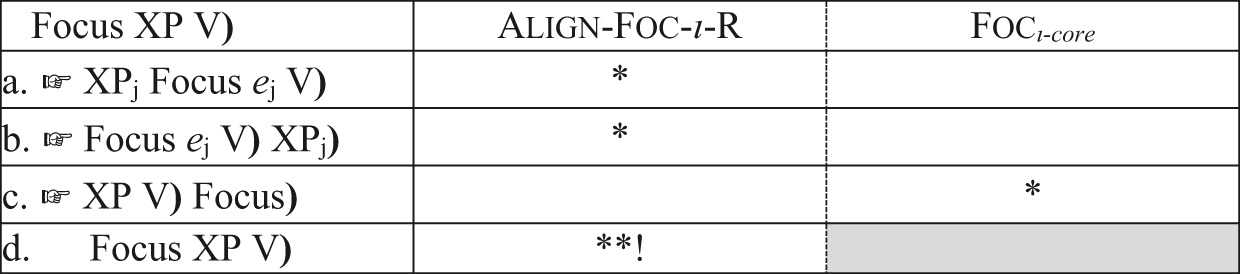
The system of syntax-prosody mapping constraints proposed here, therefore, successfully accounts for focus placement in Georgian, and derives both immediately preverbal and postverbal placement. It also shows that immediately preverbal focus placement differs from that of wh-phrases, in that it is derived by the requirements on the prosodic realization of foci, as opposed to movement to a dedicated projection triggered by a syntactic feature.[25]
9 Conclusion
This paper demonstrated that wh-phrases and narrow foci in Georgian, despite surfacing immediately preverbally, have different syntax. Wh-phrases undergo short A-bar movement to Spec,WP, accompanied by raising of the verb to W0, driven by the [+Q] feature, which results in the adjacency between the two elements. In contrast, preverbal narrow foci stay in situ, and their adjacency with the verb is achieved via displacement of the would-be intervening material, motivated by the prosodic requirements of the focused constituent. A key diagnostic used here for establishing the syntactic positions of wh-phrases and narrow foci is their interaction with neg-words, since Georgian neg-words are always found in situ. This appears to be a unique diagnostic tool that Georgian offers.
The varying syntactic behavior of wh-phrases and narrow foci is explained as follows. Wh-phrases undergo syntactic movement that is driven by a syntactic feature [+Q]. Information-structural notions, like (non-exhaustive) focus, in the absence of a syntactic feature, cannot drive syntactic movement. They might, however, have prosodic requirements, implemented as syntax-prosody mapping constraints. In Georgian, foci require to be aligned with the right ɩ-edge and be part of the core ɩ. The constraints that embody these requirements are unranked with each other and are satisfied via the displacement of topical material or right-adjunction of focus. The winning candidates correspond to immediately preverbal and postverbal foci, respectively. The Georgian evidence strengthens the case for the hypothesis that only syntactic features, like [+Q], can trigger movement, while purely information-structural notions, like semantically non-exhaustive focus, cannot (Horvath 2007, 2010), which is contrary to prevalent cartographic approaches (Cinque 2002; Rizzi 1997, 2004).
These results have implications for the syntax of focus in verb-final languages, many of which have a requirement/strong preference for adjacency between narrow foci/wh-phrases and the verb. The Georgian data shows that, in a single language, this adjacency may have different syntactic sources. The fact that narrow foci and wh-phrases do not have the same syntax means that the two are not as closely related as is often thought. This falls in line with Cable’s (2008) re-analysis of wh-phrases and narrow foci in Hungarian, according to which the IPrP-placement of wh-phrases cannot be triggered by the same feature that ensures the IPrP-placement of narrow foci.
Funding source: National Research, Development, and Innovation Office of Hungary
Award Identifier / Grant number: NKFIH KKP 129921
Award Identifier / Grant number: NKFIH K 135958
Funding source: Davis Center for Russian and Eurasian Studies at Harvard University
Award Identifier / Grant number: Graduate Research Travel Grant
Acknowledgments
I am deeply indebted to many people for their help, advice and comments on the earlier versions of this paper: Carlos Arregi, Rajesh Bhatt, Jonathan Bobaljik, Lauren Clemens, Veneeta Dayal, Marcel den Dikken, Katalin É. Kiss, Gisbert Fanselow, Manfred Krifka, Léa Nash, Balkiz Öztürk, Omer Preminger, Kevin Ryan, Andreas Pregla, Stavros Skopeteas, Balázs Surányi, Kriszta Szendrői, Jenneke van der Wal, Annemarie van Dooren, Malte Zimmerman, and many others. Special thanks are due to Maria Polinsky, who first introduced me to the fascinating Georgian grammar. I also thank my Georgian consultants for their patience and enthusiasm in sharing their language with me – დიდი მადლობა! All remaining errors are my responsibility.
-
Research funding: This research was supported by grants NKFIH KKP 129921 and NKFIH K 135958 of the National Research, Development, and Innovation Office of Hungary. The fieldwork was funded by a Graduate Research Travel Grant from the Davis Center for Russian and Eurasian Studies at Harvard University.
References
Aboh, Enoch Oladé. 2007. Focused versus non-focused wh-phrases. In Enoch Oladé Aboh, Katharina Hartmann & Malte Zimmermann (eds.), Focus strategies in African languages: The interaction of focus and grammar in Niger-Congo and Afro-Asiatic, 287–314. Berlin, New York: Mouton de Gruyter.10.1515/9783110199093Search in Google Scholar
Alexiadou, Artemis. 2006. Left Dislocation (including CLLD). In Martin Everaert & Hendrik Cornelis van Riemsdijk (eds.), Blackwell companion to syntax, vol. 2. Malden, MA, USA: Blackwell.10.1002/9780470996591.ch37Search in Google Scholar
Alkhazishvili, Archil. 1959. Porjadok slov i intonacija v prostom povestvovateljnom predloženii gruzinskogo jazyka [Word order and intonation in simple declarative clauses in Georgian]. Fonetika 1. 367–414.Search in Google Scholar
Amiridze, Nino. 2006. Reflexivization strategies in Georgian. Utrecht: Lot.Search in Google Scholar
Aoun, Joseph & Yen-hui Audrey Li. 1993. Wh-elements in Situ: Syntax or LF? Linguistic Inquiry 24(2). 199–238.Search in Google Scholar
Aronson, Howard. 1990. Georgian: A reading grammar. Bloomington, IN: Slavica Publishers Inc.Search in Google Scholar
Arregi, Karlos. 2002. Focus on Basque movements. Cambridge, MA: Massachusetts Institute of Technology Doctoral dissertation.Search in Google Scholar
Baker, Mark C. & Nadya Vinokurova. 2010. Two modalities of case assignment: Case in Sakha. Natural Language & Linguistic Theory 28(3). 593–642. https://doi.org/10.1007/s11049-010-9105-1.Search in Google Scholar
Bhatt, Rakesh Mohan. 1999. Verb movement and the syntax of Kashmiri, vol. 46. Dordrecht, Boston, London: Kluwer Academic Publishers.10.1007/978-94-015-9279-6Search in Google Scholar
Bies, Ann. 1996. Syntax and discourse Factors in early new high German: Evidence for verb-final word order. University of Pennsylvania MA Thesis.Search in Google Scholar
Bobaljik, Jonathan David. 2008. Where’s phi? Agreement as a post-syntactic operation. In David Adger, Daniel Harbour & Susana Béjar (eds.), Phi-theory: Phi features across interfaces and modules, 295–328. Oxford: Oxford University Press.10.1093/oso/9780199213764.003.0010Search in Google Scholar
Boeder, Winfried. 2005. The South Caucasian languages. Lingua 115(1–2). 5–89. https://doi.org/10.1016/j.lingua.2003.06.002.Search in Google Scholar
Borise, Lena. 2019. Phrasing is key: The syntax and prosody of focus in Georgian. Harvard University PhD Dissertation.Search in Google Scholar
Borise, Lena & David Erschler. 2023. Flexible syntax-prosody mapping of intonational phrases in the context of varying verb height. Phonology 1–42. https://doi.org/10.1017/s0952675723000015. Search in Google Scholar
Borise, Lena, Andreas Pregla & Balázs Surányi. 2022. Raised and in-situ preverbal foci: A unified prosodic account. In Paper presented at GLOW 45, Queen Mary University of London.Search in Google Scholar
Bródy, Michael. 1995. Focus and checking theory. In István Kenesei (ed.), Approaches to Hungarian, vol. 5, 29–44. Szeged, Jate, Philadelphia: John Benjamins.Search in Google Scholar
Büring, Daniel. 1999. Topic. In Peter Bosch & Rob A. van der Sandt (eds.), Focus – linguistic cognitive and computational perspectives, 142–165. Cambridge: Cambridge University Press.Search in Google Scholar
Cable, Seth. 2008. Wh-fronting (in Hungarian) is not focus-fronting. Manuscript. Amherst, Vancouver: University of Massachusetts, Amherst & University of British Columbia.Search in Google Scholar
Cheng, Lisa Lai-Shen & Laura J. Downing. 2012. Against FocusP: Arguments from Zulu. In Ivona Kučerová & Ad Neeleman (eds.), Contrasts and positions in information structure, 247–266. Cambridge: Cambridge University Press.10.1017/CBO9780511740084.012Search in Google Scholar
Chomsky, Noam. 1976. Conditions on rules in grammar. Linguistic Analysis 2. 303–351.Search in Google Scholar
Chomsky, Noam. 1995. The minimalist program. Cambridge MA: MIT Press.Search in Google Scholar
Cinque, Guglielmo. 1999. Adverbs and functional heads: A cross-linguistic perspective. Oxford: Oxford University Press.10.1093/oso/9780195115260.001.0001Search in Google Scholar
Cinque, Guglielmo (ed.). 2002. Functional structure in DP and IP (Oxford Studies in Comparative Syntax v. 1). Oxford, New York: Oxford University Press.Search in Google Scholar
Cinque, Guglielmo. 2005. Deriving Greenberg’s universal 20 and its exceptions. Linguistic Inquiry 36(3). 315–332. https://doi.org/10.1162/0024389054396917.Search in Google Scholar
Cresti, Diana. 1995. Indefinite topics. Massachusetts Institute of Technology PhD thesis.Search in Google Scholar
Dayal, Veneeta Srivastav. 1993. Scope marking as indirect wh-dependency. Natural Language Semantics 2(2). 137–170. https://doi.org/10.1007/bf01250401.Search in Google Scholar
Dik, Simon C. 1997. The theory of functional grammar. (Functional Grammar Series 20). 2., rev. ed. Vol. 1: The structure of the clause. Berlin: Mouton de Gruyter.Search in Google Scholar
Drubig, Hans Bernhard. 2003. Toward a typology of focus and focus constructions. Linguistics 41(1). 1–50. https://doi.org/10.1515/ling.2003.003.Search in Google Scholar
Dzidziguri, Shota. 1954. Dziebani kartuli dialekt’ologiidan [Studies in Georgian dialectology]. Tbilisi: Samecniero-metoduri k’abinet’is gamomcemloba.Search in Google Scholar
Eckardt, Regine. 2007. Inherent focus on wh-phrases. Sinn und Bedeutung 11. 209–228.Search in Google Scholar
Elordieta, Gorka. 2003. Intonation. In Jose-Ignacio Hualde & Jon Ortiz de Urbina (eds.), A grammar of Basque, 72–112. Berlin, New York: Walter de Gruyter.10.1515/9783110895285.72Search in Google Scholar
Elordieta, Gorka & José Ignacio Hualde. 2014. Intonation in Basque. In Sun-Ah Jun (ed.), Prosodic typology II, 405–463. Oxford: Oxford University Press.10.1093/acprof:oso/9780199567300.003.0014Search in Google Scholar
Erschler, David. 2010. Otricatel’nye mestoimenija v osetinskom jazyke: areal’nye i i tipologicheskie aspekty. [Negative pronouns in Ossetic: Areal and typological issues.]. Voprosy jazykoznanija 2. 84–105.Search in Google Scholar
Erschler, David. 2012. From preverbal focus to preverbal “left periphery”: The Ossetic clause architecture in areal and diachronic perspective. Lingua 122(6). 673–699. https://doi.org/10.1016/j.lingua.2012.01.009.Search in Google Scholar
Erschler, David. 2013. On negative indefinites and “negative conjunctions” in Iron Ossetic. In Sergius Tokhtasev & Paulus Luria (eds.), Commentationes Iranicae. Vladimiro f. Aaron Livschits nonagenario donum natalicium, 649–653. Saint-Petersburg: Nestor.Search in Google Scholar
Erschler, David. 2015. Embedded questions and sluicing in Georgian and Svan. Languages of the Caucasus 1(1). 38–74. https://doi.org/10.5070/l911029246.Search in Google Scholar
Erteschik-Shir, Nomi. 1986. Wh-questions and focus. Linguistics and Philosophy 9(2). 117–149. https://doi.org/10.1007/bf00635608.Search in Google Scholar
Etxepare, Ricardo & Jon Ortiz de Urbina. 2011. Focalization. In A grammar of Basque, 459–516. Berlin, New York: Walter de Gruyter.Search in Google Scholar
Fanselow, Gisbert. 2006. Partial wh-movement. In Hendrik Cornelis van Riemsdijk, Martin Everaert, Rob Goedemans & Bart Hollebrandse (eds.), The Blackwell companion to syntax, 437–492. Malden, MA, USA: Blackwell Publishing.10.1002/9780470996591.ch47Search in Google Scholar
Féry, Caroline. 2013. Focus as prosodic alignment. Natural Language & Linguistic Theory 31(3). 683–734. https://doi.org/10.1007/s11049-013-9195-7.Search in Google Scholar
Foley, Steven. 2013. The syntax of Georgian relative clauses. NYU Senior Honors Thesis. (29 November, 2016).Search in Google Scholar
Frascarelli, Mara & Roland Hinterhölzl. 2007. Types of topics in German and Italian. In Kerstin Schwabe & Susanne Winkler (eds.), On information structure, meaning and form: Generalizations across languages, 87–116. Amsterdam: John Benjamins.10.1075/la.100.07fraSearch in Google Scholar
Fuß, Eric. 2018. The OV/VO alternation in early German. In Agnes Jäger, Gisella Ferraresi & Helmut Weiß (eds.), Clause structure and word order in the history of German, vol. 28, 230–262. Oxford: Oxford University Press.10.1093/oso/9780198813545.003.0012Search in Google Scholar
Givón, Talmy. 1983. Topic continuity in discourse: An introduction. In Talmy Givón (ed.), Topic continuity in discourse: A quantitative cross-language study, vol. 3, 3–41. Amsterdam, Philadelphia: John Benjamins.10.1075/tsl.3Search in Google Scholar
Haider, Hubert. 2010. The syntax of German. Cambridge: Cambridge University Press.10.1017/CBO9780511845314Search in Google Scholar
Hale, Kenneth & S. Jay Keyser. 1993. On argument structure and the lexical expression of syntactic relations. In Kenneth Hale & S. Jay Keyser (eds.), The view from Building 20: Essays in honor of Sylvain Bromberger, 53–109. Cambridge, MA: MIT Press.Search in Google Scholar
Han, Chung-hye, Jeffrey Lidz & Julien Musolino. 2007. V-raising and grammar competition in Korean: Evidence from negation and quantifier scope. Linguistic Inquiry 38(1). 1–47. https://doi.org/10.1162/ling.2007.38.1.1.Search in Google Scholar
Harizanov, Boris. 2014. Clitic doubling at the syntax-morphophonology interface: A-movement and morphological merger in Bulgarian. Natural Language & Linguistic Theory 32. 1033–1088. https://doi.org/10.1007/s11049-014-9249-5.Search in Google Scholar
Harris, Alice C. 1981. Georgian syntax: A study in relational grammar (Cambridge Studies in Linguistics), vol. 33. Cambridge: Cambridge University Press.Search in Google Scholar
Harris, Alice C. 2000. Word order harmonies and word order change in Georgian. In Rosanna Sornicola, Erich Poppe & Ariel Shisha-Halevy (eds.), Stability, variation and change of word order patterns over time, 133–163. Amsterdam: John Benjamins.10.1075/cilt.213.13harSearch in Google Scholar
Higginbotham, James. 1980. Pronouns and bound variables. Linguistic Inquiry 11(4). 679–708.Search in Google Scholar
Hinterhölzl, Roland & Svetlana Petrova. 2018. Prosodic and information-structural factors in word order variation. In Agnes Jäger, Gisella Ferraresi & Helmut Weiß (eds.), Clause structure and word order in the history of German, vol. 28, 277–288. Oxford: Oxford University Press.10.1093/oso/9780198813545.003.0014Search in Google Scholar
Horvath, Julia. 2007. Separating focus movement from focus. In Simin Karimi, Vida Samiian & Wendy Wilkins (eds.), Phrasal and clausal architecture: Syntactic derivation and interpretation, 108–145. Amsterdam: John Benjamins.10.1075/la.101.07horSearch in Google Scholar
Horvath, Julia. 2010. “Discourse features”, syntactic displacement and the status of contrast. Lingua 120(6). 1346–1369. https://doi.org/10.1016/j.lingua.2008.07.011.Search in Google Scholar
Huang, James C.-T. 1982. Move WH in a language without WH movement. The Linguistic Review 1(4). 369–416. https://doi.org/10.1515/tlir.1982.1.4.369.Search in Google Scholar
Huggard, Mattyas Georges Charles. 2015. Wh-words in Hittite: A study in syntax-semantics and syntax-phonology interfaces. UCLA PhD thesis.Search in Google Scholar
Iatridou, Sabine & Anthony Kroch. 1992. The licensing of CP-recursion and its relevance to the Germanic verb-second phenomenon. Working Papers in Scandinavian Syntax 50. 1–24.Search in Google Scholar
Jayaseelan, Karattuparambil A. 2001. IP-internal topic and focus phrases. Studia Linguistica 55(1). 39–75. https://doi.org/10.1111/1467-9582.00074.Search in Google Scholar
Kayne, Richard S. 2013. Why are there no directionality parameters? In Theresa Biberauer & Michelle Sheehan (eds.), Theoretical approaches to disharmonic word orders, 219–244. Oxford: Oxford University Press.10.1093/acprof:oso/9780199684359.003.0008Search in Google Scholar
Kidwai, Ayesha. 1999. Word order and focus positions in Universal Grammar. In Georges Rebuschi & Laurice Tuller (eds.), The grammar of focus, 213–244. Amsterdam, Philadelphia: John Benjamins.10.1075/la.24.08kidSearch in Google Scholar
Kim, Alan Hyun-Oak. 1988. Preverbal focusing and type XXIII languages. In Michael Hammond, Edith A. Moravcsik & Jessica Wirth (eds.), Studies in syntactic typology, 147–169. Amsterdam, Philadelphia: John Benjamins Publishing.10.1075/tsl.17.12kimSearch in Google Scholar
Koopman, Hilda & Dominique Sportiche. 1982. Variables and the bijection principle. The Linguistic Review 2(2). 139–160. https://doi.org/10.1515/tlir.1982.2.2.139.Search in Google Scholar
Kratzer, Angelika. 1994. The event argument and the semantics of voice. Amherst, ms: University of Massachusetts.Search in Google Scholar
Krifka, Manfred. 2008. Basic notions of information structure. Acta Linguistica Hungarica 55(3–4). 243–276. https://doi.org/10.1556/aling.55.2008.3-4.2.Search in Google Scholar
Kuno, Susumu. 1976. Subject, theme, and the speaker’s empathy. A Reexamination of relativization phenomena in subject and topic. In Charles N. Li (ed.), Subject and topic, 417–444. New York: Academic Press.Search in Google Scholar
Laka, Itziar. 1990. Negation in syntax–on the nature of functional categories and projections. Massachusetts Institute of Technology PhD thesis.Search in Google Scholar
Lambrecht, Knud. 1994. Information structure and sentence form: Topic, focus, and the mental representations of discourse referents. Cambridge: Cambridge University Press.10.1017/CBO9780511620607Search in Google Scholar
Legate, Julie Anne. 2008. Morphological and abstract case. Linguistic Inquiry 39(1). 55–101. https://doi.org/10.1162/ling.2008.39.1.55.Search in Google Scholar
Lomashvili, Leila. 2011. Complex predicates: The syntax-morphology interface (Linguistik Aktuell/Linguistics Today v. 174). Amsterdam, Philadelphia: John Benjamins Pub. Co.10.1075/la.174Search in Google Scholar
Marantz, Alec. 1991. Case and licensing. In Germán F. Westphal & Hee-Rahk Chae (eds.), Proceedings of the 8th Eastern States Conference on Linguistics (ESCOL 8), 234–253. Ithaca, NY: CLC Publications.Search in Google Scholar
Matushansky, Ora. 2006. Head movement in linguistic theory. Linguistic Inquiry 37(1). 69–109. https://doi.org/10.1162/002438906775321184.Search in Google Scholar
McGinnis, Martha. 1997a. Case and locality in L-syntax: Evidence from Georgian. In Heidi Harley (ed.), MITWPL 32. Cambridge, MA: MIT Working Papers in Linguistics.Search in Google Scholar
McGinnis, Martha. 1997b. Reflexive external arguments and lethal ambiguity. In Emily Curtis, James Lyle & Gabriel Webster (eds.), Proceedings of WCCFL, vol. 16, 303–317. Stanford: CSLI Publications.Search in Google Scholar
McGinnis, Martha. 1999a. A-scrambling exists. University of Pennsylvania Working Papers in Linguistics 6(1). 283–297.Search in Google Scholar
McGinnis, Martha. 1999b. Evidence for feature-driven A-scrambling. In Proceedings of the West Coast Conference on Formal Linguistics, vol. 18, 364–378. Somerville, MA: Cascadilla Proceedings Project.Search in Google Scholar
Nash, Léa. 1995. Portée argumentale et marquage casuel dans les langues SOV et dans les langues ergatives: L’exemple du géorgien. Paris 8 PhD Dissertation.Search in Google Scholar
Nash, Léa. 2017. The structural source of split ergativity and ergative case in Georgian. In Jessica Coon, Diane Massam & Lisa deMena Travis (eds.), The Oxford handbook of ergativity, 175–200. Oxford: Oxford University Press.10.1093/oxfordhb/9780198739371.013.8Search in Google Scholar
Neeleman, Ad. 2015. Two asymmetries between pre-and post-head order and their implications for syntactic theory. University College London, ms.Search in Google Scholar
Neeleman, Ad, Elena Titov, Hans Van de Koot & Reiko Vermeulen. 2009. A syntactic typology of topic, focus and contrast. In Jeroen Van Craenenbroeck (ed.), Alternatives to cartography, 15–51. Berlin, New York: Mouton de Gruyter.10.1515/9783110217124.15Search in Google Scholar
Neeleman, Ad & Hans Van de Koot. 2008. Dutch scrambling and the nature of discourse templates. The Journal of Comparative Germanic Linguistics 11(2). 137–189. https://doi.org/10.1007/s10828-008-9018-0.Search in Google Scholar
Ordóñez, Francisco. 1998. Post-verbal asymmetries in Spanish. Natural Language & Linguistic Theory 16(2). 313–345. https://doi.org/10.1023/a:1006051703562.10.1023/A:1006051703562Search in Google Scholar
Ortiz de Urbina, Jon. 2002. Focus of correction and remnant movement in Basque. In Xabier Artiagoitia, Patxi Goenaga & Joseba Lakarra (eds.), Erramu Boneta: Festschrift for Rudolf P.G. De Rijk, 511–524. Bilbao: Universidad del País Vasco/Euskal Herriko Unibertsitatea.Search in Google Scholar
Pochkhua, Bidzina. 1962. Sit’q’vatganlagebisatvis kartulši [About the word order in Georgian]. Iberiul-k’avk’asiuri enatmecniereba 13. 119–121.Search in Google Scholar
Primus, Beatrice. 2001. Word order typology. In Martin Haspelmath, Ekkehard König, Wulf Oesterreicher & Wolfgang Raible (eds.), Language typology and language universals: An international handbook, vol. 2, 855–872. Berlin, New York: W. de Gruyter.Search in Google Scholar
Reinhart, Tanya. 1981. Pragmatics and linguistics: An analysis of sentence topics. Philosophica 27(1). 53–94. https://doi.org/10.21825/philosophica.82606.Search in Google Scholar
Reinhart, Tanya. 1983. Anaphora and semantic interpretation. London: Croom Helm.Search in Google Scholar
Reinhart, Tanya. 1991. Elliptic conjunctions: Non-quantificational LF. In Aka Kasher (ed.), The Chomskyan Turn, 360–384. Cambridge, MA: Blackwell.Search in Google Scholar
Rizzi, Luigi. 1997. The fine structure of the left periphery. In Liliane, Haegeman (ed.), Elements of grammar. Kluwer International Handbooks of Linguistics, 281–337. Dordrecht: Springer. 10.1007/978-94-011-5420-8_7Search in Google Scholar
Rizzi, Luigi (ed.). 2004. The structure of CP and IP (Oxford Studies in Comparative Syntax v. 2). Oxford, New York: Oxford University Press.Search in Google Scholar
Romero, Maribel. 1998. Focus and reconstruction effects in wh-phrases. University of Massachusetts at Amherst PhD thesis.Search in Google Scholar
Rooth, Mats. 1985. Association with focus. Amherst: University of Massachusetts PhD Dissertation.Search in Google Scholar
Rooth, Mats. 1992. A theory of focus interpretation. Natural Language Semantics 1(1). 75–116. https://doi.org/10.1007/bf02342617.Search in Google Scholar
Rooth, Mats. 1996. Focus. In Shalom Lappin (ed.), The handbook of contemporary semantic theory, 271–297. Oxford, UK, Cambridge, MA: Blackwell Reference.Search in Google Scholar
Safir, Ken. 1984. Multiple variable binding. Linguistic Inquiry 15(4). 603–638.Search in Google Scholar
Şener, Serkan. 2010. (Non-) peripheral matters in Turkish syntax. University of Connecticut Doctoral dissertation.Search in Google Scholar
Shibata, Yoshiyuki. 2015. Exploring syntax from the interfaces. University of Connecticut PhD thesis.Search in Google Scholar
Sideltsev, Andrej V. 2014. Wh-in-situ in Hittite. In Ekaterina Lyutikova, Anton Zimmerling & Maria B. Konoshenko (eds.), Tipologija morfosintaksičeskix parametrov [Typology of morphosyntactic parameters], 199–222. Moscow: Moscow State University.Search in Google Scholar
Sideltsev, Andrej V. 2016. Vnutriklauznaja levaja periferija v xettskom: formal’noje opisanie [Clause-internal left periphery is Hittite: A formal description]. In Anton Zimmerling & Ekaterina Lyutikova (eds.), Arxitektura klauzy v parametričeskix modeliax: Sintaksis, informacionnaja struktura, poriadok slov [Clause architecture in parametric models: syntax, information structure, word order], 104–164. Moscow: LRC Press.Search in Google Scholar
Sideltsev, Andrej V. 2017. Sintaksis prostogo predloženia v xettskom jazyke [The syntax of simple clause in Hittite]. Moscow: Jazyki slavianskoj kul’tury.Search in Google Scholar
Simpson, Andrew & Saurov Syed. 2014. Finiteness, negation and the directionality of headedness in Bangla. Natural Language & Linguistic Theory 32(1). 231–261. https://doi.org/10.1007/s11049-013-9223-7.Search in Google Scholar
Skopeteas, Stavros & Gisbert Fanselow. 2010. Focus in Georgian and the expression of contrast. Lingua 120(6). 1370–1391. https://doi.org/10.1016/j.lingua.2008.10.012.Search in Google Scholar
Skopeteas, Stavros, Caroline Féry & Rusudan Asatiani. 2018. Prosodic separation of postverbal material in Georgian. In Evangelia Adamou, Katharina Haude & Martine Vanhove (eds.), Information structure in lesser-described languages: Studies in prosody and syntax, vol. 199, 17–50. Amsterdam, Philadelphia: John Benjamins.10.1075/slcs.199.02skoSearch in Google Scholar
Strawson, Peter F. 1964. Identifying reference and truth-values. Theoria 30(2). 96–118. https://doi.org/10.1111/j.1755-2567.1964.tb00404.x.Search in Google Scholar
Szendrői, Kriszta. 2003. A stress-based approach to the syntax of Hungarian focus. The Linguistic Review 20. 37–78. https://doi.org/10.1515/tlir.2003.002.Search in Google Scholar
Thivierge, Sigwan. 2021. Phasehood and Phi-Intervention. University of Maryland Doctoral dissertation.Search in Google Scholar
Tuite, Kevin. 1998. Kartvelian morphosyntax. Munich: Lincom Europa.Search in Google Scholar
van der Vijver, Reuben João Costa & Rob Goedemans (eds.). 1995. Projection and position: Evidence from Georgian. In Proceedings of ConSole IV, 203–220. Leiden: Holland Institute of Linguistics.Search in Google Scholar
van der Wal, Jenneke. 2012. Why does focus want to be adjacent to the verb? In Paper presented at Parametric variation in discourse configurationality, 45th meeting of the Societas Linguistica Europaea, Stockholm University, August 29 – September 1, 2012.Search in Google Scholar
van der Wal, Jenneke. 2016. Diagnosing focus. Studies in Language 40(2). 259–301. https://doi.org/10.1075/sl.40.2.01van.Search in Google Scholar
Wiltschko, Martina. 1997. D-Linking, scrambling und superiority in German. GAGL: Groninger Arbeiten zur germanistischen Linguistik 41. 107–142.Search in Google Scholar
Zanuttini, Raffaella. 1991. Syntactic properties of sentential negation. A comparative study of Romance languages. University of Pennsylvania Doctoral dissertation.Search in Google Scholar
Zhghenti, Sergi. 1963. Kartuli enis rit’mik’ul-melodik’uri st’rukt’ura [The rhythmic-melodic structure of Georgian language]. Tbilisi: Tsodna.Search in Google Scholar
Zhghenti, Sergi. 1965. Ob udarenii v gruzinskom jazyke [On stress in Georgian]. In Voprosy fonetiki kartvel’skix jazykov, 260–264. Tbilisi: Ganatleba.Search in Google Scholar
Zwart, Jan-Wouter. 2007. Uncharted territory? Towards a non-cartographic account of Germanic syntax. GAGL: Groninger Arbeiten zur germanistischen Linguistik 45. 55–75.Search in Google Scholar
© 2023 the author(s), published by De Gruyter, Berlin/Boston
This work is licensed under the Creative Commons Attribution 4.0 International License.
Articles in the same Issue
- Frontmatter
- Articles
- The syntax of wh-phrases, narrow foci, and neg-words in Georgian
- Morphological analysis of alienability contrast in Nuer: an atypical typical case
- Hanging Topic Left Dislocations as extrasentential constituents: toward a paratactic account. Evidence from English and Spanish
- Towards a theory of syntactic workspaces: neighbourhoods and distances in a lexicalised grammar
Articles in the same Issue
- Frontmatter
- Articles
- The syntax of wh-phrases, narrow foci, and neg-words in Georgian
- Morphological analysis of alienability contrast in Nuer: an atypical typical case
- Hanging Topic Left Dislocations as extrasentential constituents: toward a paratactic account. Evidence from English and Spanish
- Towards a theory of syntactic workspaces: neighbourhoods and distances in a lexicalised grammar
