
An experimental perspective on embedded gapping in Persian
-
Gabriela Bîlbîie
 and
Pegah Faghiri
and
Pegah Faghiri

Abstract
This paper empirically tests the embedding constraints on gapping in Persian. It has been suggested that gapping differs from other kinds of ellipsis in banning embedding. However, the first counter-examples in the literature come from Persian. Following up on previous experiments on embedded gapping in several languages, we report the results of two acceptability judgment tasks. Our results show that, while embedded gapping is overall acceptable in Persian, speakers’ acceptability judgements also vary depending on the semantic type of the embedding predicate, as well as the presence/absence of the complementizer. Data from Persian highlight that, despite the cross-linguistic variation observed with respect to the acceptability of embedded gapping, a general semantic constraint is at work across languages: non-factive verbs embed more easily than factive ones; inside factive verbs, semi-factive (cognitive) predicates embed more easily than true factive (emotive) ones. Moreover, whereas previous theoretical literature indicates no systematic preference for the absence or the presence of the complementizer in Persian, these new experimental data suggest a preference for complementizer drop. To account for the gradience observed in our experimental data, we propose an approach of gapping based on acceptability rather than grammaticality.
1 Gapping and embedding: an introduction
Ellipsis, and in particular gapping, has long been of interest to linguists (from Ross 1967, 1970 onwards). While most research has been done on English (and other Germanic languages), there are limited studies that have looked at ellipsis in other languages and, in particular, on Persian. The few existing gapping studies on Persian (e.g., Farudi 2013; Toosarvandani 2018) are rather theoretical and based on constructed data, obtained by informal introspective judgments. To our knowledge, gapping in Persian has never been experimentally investigated and the aim of this study is to shed light on some complex aspects of this phenomenon.
Gapping refers to constructions in which a sequence of phrases lacking a verbal head, but displaying a clausal content is coordinated with a full clause which specifies its form and interpretation. A typical example of gapping in Persian is given in (1), where one coordinates a full clause (Ānāhitā māhi xord ‘Anahita ate fish’), called the source clause, with an elliptical clause (Rod gušt ‘Rod meat’), called the target clause. The target clause only contains remnants (Rod ‘Rod’, gušt ‘meat’) which syntactically mirror some correlates in the source (Ānāhitā ‘Anahita’, māhi ‘fish’). There is a missing material (called the gap) in the target clause, which is semantically reconstructed based on the material which is present in the source, namely antecedent (xord ‘ate’). The minimal criteria which are usually taken into account to identify gapping configurations are the number of remnants and the gap category; therefore, it is usually assumed that the gapping construction has at least two remnants (unlike its related construction, stripping,[1] which displays a single remnant in the elliptical sequence), and it lacks at least the verbal head (unlike its related construction, pseudogapping,[2] which displays two remnants, along with an auxiliary or modal verb).
| Ānāhitā | māhi | xord | va | Rod | gušt. |
| Anahita | fish | ate.3sg | and | Rod | meat |
| ‘Anahita ate fish and Rod meat.’ | |||||
| (Farudi 2013: 57) | |||||
One of the specific properties of gapping is assumed to be the ‘No Embedding Constraint’, in particular the Downward Bounding Constraint postulated by Hankamer (1979) and discussed in detail by Johnson (2009, 2018. According to Hankamer (1979: 20), “the Gapping rule […] has to be constrained to operate strictly in structures directly conjoined with each other. This constraint can be viewed as a kind of bounding: we can say that the rule is downward bounded since it does not go down into subordinate clauses”. This syntactic constraint would explain the ungrammaticality of the English examples in (2), as the missing material in gapping cannot be contained within an embedded clause:
| a. | *Alfonso stole the emeralds, and I think that Mugsy the pearls. (Hankamer 1979: 19) |
| b. | *Some had eaten mussels and she claims that others shrimp. (Johnson 2009: 293) |
However, it has been shown that this proposed syntactic constraint does not hold for Persian. Based on some elicited data given in (3), Farudi (2013) observes that in Persian embedded gapping is grammatical, with and without complementizer (compare (3a) and (3b–c)), under various kinds of verbs (compare (3a–b), (3c), and (3d)), regardless of the person of the embedding verb (compare (3a–b) and (3c)).
| Māmān | čāi | xord | va | fekr | mi-kon-am | bābā | qahve. |
| mother | tea | ate.3sg | and | think | ipfv-do-1sg | father | coffee |
| ‘Mother drank tea and I think Father (drank) coffee.’ | |||||||
| Jiān | be | Sārā | gol | dād | va | fekr | mi-kon-am | ke | Ārtur | be |
| Jian | to | Sarah | flower | gave.3sg | and | think | ipfv-do-1sg | that | Arthur | to |
| Giti | ketāb. | ||||||||||||
| Giti | book | ||||||||||||
| ‘Jian gave flowers to Sarah and I think that Arthur (gave) books to Giti.’ | |||||||||||||
| Mahsā | in | ketāb=ro | dust | dār-e | va | Minu | mi-dun-e | ke |
| Mahsa | this | book=obj | like | have-3sg | and | Minu | ipfv-know-3sg | that |
| māmān=eš | un | ketāb=ro. | |||||||||
| mother=3sg | that | book=obj | |||||||||
| ‘Masha likes this book and Minu knows that her mother (likes) that book.’ | |||||||||||
| Mehrān | gušt=ro | xord | (mesl | hamiše) | vali | ta’job | mi-kon-am | ke |
| Mehran | meat=obj | ate.3sg | (like | always) | and | surprise | ipfv-do-1sg | that |
| Rādmehr | māhi=ro. | ||||||||||||||||||
| Rodmehr | fish=obj | ||||||||||||||||||
| ‘Mehran ate the meat (as usual) but I am surprised that Rodmehr (ate) the fish.’ | |||||||||||||||||||
| (Farudi 2013: 83) | |||||||||||||||||||
The observation that embedded gapping is not constrained in Persian implies that the Downward Bounding Constraint is not a strong and universal syntactic constraint. However, we cannot confirm this without providing solid empirical evidence to support Farudi’s counter-examples and claim.
Several reasons motivate the need for using experimental methods to assess the existing claims: as we already mentioned, previous data from Farudi (2013) are based on informal elicited data and some of her examples are questionable, in particular, when interspeaker variations are taken into account.[3] It is well-established now that for many syntactic structures, judgments can be much more versatile than we think and, if their elicitation does not follow precise methodological standards (Gibson and Fedorenko 2013), one can reasonably doubt their reliability. As pointed out by Dahl (1979: 141): “It is well-known among linguists that intuitions about the acceptability of utterances tend to be vague and inconsistent, depending on what you had for breakfast and which judgment would best suit your own pet theory.” In the case of Persian, indeed some recent experimental studies have allowed to debunk certain well-established affirmations that were similarly based on unreliable informal grammaticality judgments (see, e.g., Faghiri and Samvelian 2016, 2021). Furthermore, corpus studies on other languages (e.g., English) suggest that gapping has a very low frequency in spontaneous language production and occurs much more often in written language than in spoken language (Meyer 1995; Tao and Meyer 2006) – it may even be restricted to formal registers (Goldberg and Florian 2018). Therefore, it is difficult to find naturalistic data with embedded gapping and, consequently, the most accessible empirically solid way to study the behavior of embedded gapping would be through experimentation. Finally, given that there are several competing syntactic analyses proposed for gapping (see Section 4) and that the data on embedding may constitute strong evidence in favor of one or the other approach, the theoretical stakes are high and therefore experimental data would give a safer ground to assess the evidence and evaluate competing analyses. Therefore, the main goal of this paper is to test the embedding constraint on gapping in Persian using acceptability rating experiments.
The paper is structured as follows: In Section 2, we briefly discuss previous experimental studies on embedded gapping in other languages. In Section 3, we present our experimental data. In Section 4, we offer a theoretical perspective on gapping, discussing how the availability of embedded gapping in Persian challenges one of the most prominent syntactic analyses of gapping. In Section 5, we assess our experimental results in a cross-linguistic perspective, to corroborate our findings with the previous experimental results from other languages.
Before discussing embedded gapping in other languages, it is necessary to mention that Persian, a flexible word order language with a canonical SOV word order, allows both ‘forward gapping’ (i.e. the source clause precedes the elliptical clause, as in (1) and (4a)) and ‘backward gapping’ (i.e. the source clause follows the elliptical clause, as in (4b)),[4] unlike English, which always allows only forward gapping (5). Whereas the configuration with forward gapping (SOV+SO) is an unambiguous occurrence of gapping, the configuration with backward gapping (SO+SOV), as in (4b), is structurally ambiguous: it could be analyzed either as an instance of Right-Node Raising or as an instance of Argument Cluster Coordination. In the former case, an elliptical phrase lacking the head in final position (Rodmehr gušt ‘Rodmehr meat’) precedes a complete phrase which determines its interpretation (Ānāhitā māhi xord ‘Anahita fish ate’), giving rise to an asymmetric structure (cf. van Oirsouw 1987; Wilder 1997). In the latter case, two clusters (non-standard constituents: Rodmehr gušt ‘Rodmehr meat’ and Ānāhitā māhi ‘Anahita fish’) are conjoined in the scope of a shared verbal head (xord ‘ate’), by eschewing ellipsis (cf. Dowty 1988; Steedman 2000). As Farudi (2013) suggests, there are empirical properties supporting a different analysis for cases such as (4b) with backward gapping, compared to those of forward gapping. We mention here two of them: first, backward gapping requires a stricter morphological identity on the shared head (6b) than forward gapping (6a); second, clause final auxiliaries can be shared in the case of backward gapping (7b), but not with forward gapping (7a), which obligatorily targets both the auxiliary and the lexical verb (8).[5] Consequently, in this paper, we focus on the non-ambiguous gapping configuration, namely forward gapping.[6]
| Rodmehr | gušt | xord | va | Ānāhitā | māhi. |
| Rodmehr | meat | ate.3sg | and | Anahita | fish |
| ‘Rodmehr ate meat and Anahita fish.’ | |||||
| Rodmehr | gušt | va | Ānāhitā | māhi | xord. | |||||
| Rodmehr | meat | and | Anahita | fish | ate.3sg | |||||
| ‘Rodmehr ate meat and Anahita fish.’ | ||||||||||
| (Farudi 2013: 65) | ||||||||||
| a. | John ate fish and Mary meat. |
| b. | *John fish and Mary meat ate. |
| man | māhi | xord- am | va | Giti | gušt |
|
||||||
| I | fish | ate.1sg | and | Giti | meat | ate.3sg | ||||||
| ‘I ate fish and Giti (ate) meat.’ | ||||||||||||
| ??/*man | māhi |
|
va | Giti | gušt | xord | ||||||
| I | fish | ate.1sg | and | Giti | meat | ate.3sg | ||||||
| ‘I ate fish and Giti (ate) meat.’ | ||||||||||||
| (Farudi 2013: 66–67) | ||||||||||||
| *Sārā | be | Giti | pul | dāde | bud | va | Mahin | be | Maziar | ketāb |
| Sara | to | Giti | money | give.ptcp | be.pst.3sg | and | Mahin | to | Maziar | book |
| dāde |
|
||||||||||||
| give.ptcp | be.pst.3sg | ||||||||||||
| ‘Sara had given money to Giti and Mahin given books to Maziar.’ | |||||||||||||
| Sārā | be | Giti | pul | dāde |
|
va | Mahin | az | Maziar | ketāb |
| Sara | to | Giti | money | give.ptcp | be.pst.3sg | and | Mahin | from | Maziar | book |
| gerefte | bud | |||||||||
| take.ptcp | be.pst.3sg | |||||||||
| ‘Sara had given money to Giti and Mahin taken a book from Maziar.’ | ||||||||||
| (Farudi 2013: 69, 70) | ||||||||||
| Sārā | be | Giti | pul | dāde | bud | va | Mahin | be | Māziār | ketāb. |
| Sara | to | Giti | money | give.ptcp | be.pst.3sg | and | Mahin | to | Maziar | book |
| ‘Sara had given money to Giti and Mahin (had given) books to Maziar.’ | ||||||||||
| *Sārā be Giti pul dāde bud va Mahin be Māziār ketāb bud . |
| ‘Sara had given money to Giti and Mahin had books to Maziar.’ |
| *Sārā be Giti pul dāde bud va Mahin be Māziār ketāb dāde . |
| ‘Sara had given money to Giti and Mahin given books to Maziar.’ |
| (Farudi 2013: 68–69) |
2 Previous experimental studies on other languages
After Farudi’s (2013) first reported counter-examples from Persian, other scholars pointed out similar exceptions to the Downward Bounding Constraint in other languages. Some of them experimentally tested the conditions under which such embedding gapping was acceptable. We address here the experimental studies on Spanish (Bîlbîie and de la Fuente 2019) and Romanian (Bîlbîie et al. 2021), that make use of acceptability judgment tasks (Likert scale: 1–10) and analyze the results from 50 Spanish native speakers and 72 Romanian native speakers, respectively. Note that in both Romance languages the presence of the complementizer is obligatory in embedded contexts.
The experimental studies on Spanish and Romanian hypothesize that embedded gapping is acceptable in these languages, but it is semantically constrained; in particular, factivity is assumed to play a crucial role in explaining the acceptability of embedded gapping. Previous theoretical studies on Spanish fragments (de Cuba and MacDonald 2013) proposed a binary/categorical contrast between non-factive predicates, that allow embedding, and factive predicates, that do not allow embedding. However, Bîlbîie and de la Fuente (2019) and Bîlbîie et al. (2021) take into account a more fine-grained distinction, by paying attention to the heterogeneous behaviour of factive predicates. Consequently, they propose three semantic classes (cf. Karttunen 1971; Kiparsky and Kiparsky 1971; Hooper 1975): (i) non-factives, which do not presuppose the truth of their embedded complement, leaving room for doubt and uncertainty (e.g., to think, to imagine, to suspect), (ii) semi-factives (cognitive verbs, e.g., to know, to see, to observe), and (iii) true factives (emotive verbs, e.g., to regret, to like, to be surprised); the last two classes presuppose the truth of their embedded complement, in other words, the complement is an established fact. The three semantic classes which have been considered in these experiments are illustrated in (9) for Spanish. In the experimental condition in (9a), gapping is embedded under the non-factive verb sospechar ‘suspect’. In (9b), gapping is embedded under the semi-factive verb saber ‘know’, whereas in the condition in (9c), gapping is embedded under the true factive predicate molestarse ‘be bothered’. In all of these experimental conditions, the complement clause is introduced by the complementizer que ‘that’, which is obligatory in Spanish.
| Pablo | pidió | una | cerveza | y | sospecho | que | Juan | un | whisky. | |
| Pablo | ordered | a | beer | and | suspect.1sg | that | Juan | a | whisky | |
| ‘Pablo ordered a beer and I suspect that Juan ordered a whisky.’ | ||||||||||
| Pablo | pidió | una | cerveza | y | sé | que | Juan | un | whisky. | |
| Pablo | ordered | a | beer | and | know.1sg | that | Juan | a | whisky | |
| ‘Pablo ordered a beer and I know that Juan ordered a whisky.’ | ||||||||||
| Pablo | pidió | una | cerveza | y | me | molesta | que | Juan | un | whisky. |
| Pablo | ordered | a | beer | and | me | bother.3sg | that | Juan | a | whisky |
| ‘Pablo ordered a beer and I am bothered that Juan ordered a whisky.’ | ||||||||||
| (from Bîlbîie and de la Fuente 2019) | ||||||||||
Crucially, the experimental results from Spanish and Romanian show a gradience rather than a clear-cut categorical contrast: embedded gapping is indeed acceptable in these two Romance languages, but the acceptability decreases depending on the semantic type of predicate. As summarized in Table 1, we see that in Spanish and Romanian (i) embedded gapping is very well accepted under a non-factive predicate compared to factive predicates; and (ii) within factive predicates, semi-factives embed better than true factives. The differences between non-factives and factives, between semi-factives and true factives, as well as between non-factives and semi-factives are all statistically significant.
Mean acceptability judgments (Likert scale: 1–10) for embedded gapping in Romance languages.
| Spanish | Romanian | French | |
|---|---|---|---|
| Embedding under non-factives (ex. 9a) | 8.98/10 | 8.19/10 | 5.51/10 |
| Embedding under factives | 7.45/10 | 6.90/10 | 4.40/10 |
| Embedding under semi-factives (ex. 9b) | 8.05/10 | 7.73/10 | 5.33/10 |
| Embedding under true factives (ex. 9c) | 6.86/10 | 5.99/10 | 3.86/10 |
Unlike previous theoretical studies which postulate two different syntactic structures for non-factives versus factives (de Cuba and MacDonald 2013), Bîlbîie and de la Fuente (2019) appeal to semantic and discourse constraints to explain these effects and provide non-syntactic explanations for the observed gradience. On the one hand, semantically, a non-factive predicate, such as sospechar ‘suspect’ in (9a), can have a ‘parenthetical’ use, in that the content of its embedded complement is the main assertion of the utterance. At the discourse level, the first conjunct and the embedded gapped sequence under a non-factive verb answer the same question under discussion (QUD); in the example at stake, the QUD in the embedded clause is ‘what drink did Juan order’, similar to the QUD of the first conjunct ‘what drink did Pablo order’. On the other hand, a factive predicate, such as molestarse ‘be bothered’ in (9c), puts its evaluative component in the foreground whereas the content of its embedded complement is backgrounded. Moreover, there is a discourse incongruence, as the first conjunct and the gapped sequence embedded under a factive verb do not answer the same QUD (in the example at stake, the embedded clause answers a different QUD, namely ‘what effect did it have on the speaker’), which gives rise to a decrease in acceptability. As for semi-factive predicates, they display a hybrid behavior: they presuppose the truth of their complement (like true factives), but this presupposition may be easily cancelled (cf. ‘weak’ presupposition triggers, see Jayez et al. 2015 a.o.) and they may thus come closer to non-factive predicates.
Finally, it is worth noting that, in both Romance languages, the authors observe no significant difference between embedded gapping under a non-factive verb and non-embedded gapping, which means that at least in some contexts embedded gapping is as natural as non-embedded gapping. Therefore, a typical (non-embedded) example of gapping such as (10) in Spanish gets roughly the same scores as the experimental condition in (9a), where gapping is embedded under the non-factive verb sospechar ‘suspect’.
| Pablo pidió una cerveza y Juan un whisky. |
| ‘Pablo ordered a beer and Juan a whisky.’ |
| (Bîlbîie and de la Fuente 2019) |
Bîlbîie et al. (2021) ran a similar experiment in French, which similar to English, is assumed to not allow embedded gapping. The experimental results are given in the last column of Table 1. Though in French embedded gapping is overall much less acceptable than in Spanish or Romanian, the same sensitivity to the semantic type of the embedding predicate is observed: embedded gapping under a non-factive verb gets higher scores than under a factive verb, and embedding under semi-factives gets higher scores than under true factives.
In a parallel experimental study on embedded gapping in English, Bîlbîie et al. (to appear) observe that the Downward Bounding Constraint is too strong even for English. As English allows the complementizer drop in some complement clauses (see Jaeger 2006 for a detailed discussion), the authors considered both cases of embedding: embedded gapping under the complementizer that and embedded gapping without a complementizer, as illustrated by the experimental conditions in (11). The results of this study are given in Table 2. Though in English embedded gapping is degraded in the presence of the complementizer compared to Spanish or Romanian, we can observe a gradience in speakers’ acceptability judgments depending on the semantic type of the embedding predicate. More importantly, embedded gapping gets higher scores under non-factive predicates in the absence of the complementizer. This shows that the omission of the complementizer that has an ameliorating effect on embedding gapping in English,[7] which is modulated by the semantic type of the embedding predicate. This effect is clearly visible with non-factive predicates, however it arises as well when we compare semi-factive to true factive predicates. The experimental results on English allow us to conclude that the Downward Bounding Constraint is affected not only by the semantic class of the embedding predicate, but also by the presence/absence of the complementizer.
Mean acceptability judgments (Likert scale: 1–7) for embedded gapping in English.
| With complementizer | Without complementizer | |
|---|---|---|
| Embedding under non-factives | 4.60/7 | 5.31/7 |
| Embedding under factives | 2.73/7 | 2.76/7 |
| Embedding under semi-factives | 2.74/7 | 3.26/7 |
| Embedding under true factives | 2.71/7 | 2.29/7 |
| a. | At the bar, Paul ordered a beer and I suspect (that) John a whisky. |
| b. | At the bar, Paul ordered a beer and I know (that) John a whisky. |
| c. | At the bar, Paul ordered a beer and I regret (that) John a whisky. |
| (from Bîlbîie et al. to appear) | |
Table 3 summarizes the main results for different languages which have been experimentally investigated for embedded gapping.
Summary of the previous experimental studies.
| Embedded gapping | Non-factive verb | Semi-factive verb | True factive verb |
|---|---|---|---|
| With complementizer | Spanish | Spanish | ?Spanish |
| Romanian | Romanian | ?Romanian | |
| ?French | ??French | ??French | |
| ?English | ??English | ??English | |
| Without complementizer | English | ?English | ??English |
As Persian allows the omission of the complementizer,[8] we want to test embedded gapping in both syntactic contexts: with and without complementizer. One of the advantages of the experimental approach is the possibility to test the same hypothesis in different languages using comparable material. We thus built on the experimental design used in the studies mentioned above, adapting it for Persian.
3 Experimental data from Persian
3.1 Research questions, hypotheses and method
Recall that the informal Persian data gathered by Farudi (2013) show that embedded gapping is possible in Persian under a wide range of embedding predicates, irrespective of the semantic type of the predicate (see the data in (3) above, where one has the non-factive verb fekr kardan ‘to think’ in (3a–b), the semi-factive verb mi-dun-e ‘to know’ in (3c), and the true factive verb ta’ajob ‘to be surprised’ in (3d)). Also recall that, since in Persian the complementizer ke is optional in regular embedded clauses, embedded gapping should be possible both with and without complementizer. Therefore, according to Farudi (2013), there is no systematic (dis)preference for absence or presence of the complementizer.
Now, if we consider Farudi’s (2013) assumptions and the previous experimental results from other languages, two main research questions arise: i) Is there an interaction between gapping and embedding, and between embedded gapping and factivity? ii) Is there an interaction between gapping and complementizer drop?
Firstly, similar to previous experimental studies, we expect an interaction both between gapping and embedding, and between gapping and factivity. In particular, contrary to Farudi’s (2013) claim about the uniform behavior of embedded gapping in Persian, we expect to observe the same gradience across the three semantic classes of predicates (non-factives, semi-factives, true factives). Secondly, we expect an interaction between gapping and the complementizer drop. Recall that in Bîlbîie et al. (to appear) the effect of the latter in English is suggested to be a frequency effect (see footnote 7), but we do not have similar corpus data on Persian to assess this hypothesis. However, if the complementizer drop does indeed play a role in the acceptability of embedded gapping cross-linguistically, then we would expect the same preference in Persian.
We have conducted two separate acceptability rating experiments to address each of these questions. Both of our experiments were carried out via web-based questionnaires administrated on the Ibex Farm (Drummond 2013). Participants were recruited by sharing the experiment links via social networks, and filled in the questionnaire on a voluntary basis (without receiving any compensations). Each questionnaire contained a form at the beginning that collected (anonymous) data on individual profiles, e.g., sex, age, region, languages. Importantly, only the results from monolingual Persian speakers were kept for analyses. After reading the instructions and answering the background questions, participants started by rating a number of practice items (unrelated to the question under study) in order to become familiar with the task.
In acceptability rating experiments, participants are asked to give a score on a Likert scale to rate the acceptability of a series of sentences they see on a screen. In our experiments, we used a 11-point scale going from 0 (lowest acceptability score: completely unacceptable) to 10 (highest acceptability score: completely acceptable). Sentences were presented in a Latin Square within-subjects design, so that participants were exposed to all experimental conditions, but never see the same item in more than one condition. Each experiment included a list of filler items combined with experimental items, consisting of a set of clearly ungrammatical control items as well as a series of items related to other studies (e.g., two studies on word order variations, reported in Faghiri and Samvelian 2021 and Faghiri and Thuilier 2021). Also, to make sure that participants actually read each sentence carefully before rating it, as it is now common practice in acceptability rating experiments, in both experiments we included (yes/no) content-related comprehension questions for a set of (filler and target) items and only took into account data from participants with more than 80% of correct answers.
3.2 Experiment 1
In this experiment, we tested the acceptability of embedded gapping in Persian in the presence of the complementizer ke ‘that’, to empirically observe the behavior of Persian with respect to the Downward Bounding Constraint. In addition, in line with the previous experimental studies on embedded gapping, we considered the factivity factor, in order to see whether Persian is also sensitive to the semantic class of embedding predicates or not.
3.2.1 Experimental design
We created a set of 24 experimental items following a 2 × 3 factorial design with two factors (gapping and embedding), respectively with two and three levels. We manipulated embedding on three levels by comparing non-embedded clauses with embedded clauses while varying the factivity of the embedding predicate (−Embedding, +Embedding/+Factive, +Embedding/−Factive). We prepared each sentence in two versions, one elliptical (+Gapping) and the other non-elliptical (−Gapping), to rule out any other source of variation that may be involved and to have a better control over the factors under study. This design gave rise to 6 conditions illustrated in (12).
| [+Gapping, −Embedding] | ||||||||
| šab=e | arusi | Ava | lebās=e | sefid | mi-puš-ad | va | Ali | lebās=e |
| night=ez [9] | wedding | Ava | cloth=ez | white | ipfv-wear-3sg | and | Ali | cloth=ez |
| mahalli | ||||||||
| local | ||||||||
| ‘On the wedding night, Ava wears a white dress and Ali a traditional cloth.’ | ||||||||
| [+Gapping, +Embedding/−Factive] | ||||||||
| šab=e | arusi | Ava | lebās=e | sefid | mi-puš-ad | va | šenide=am | |
| night=ez | wedding | Ava | cloth=ez | white | ipfv-wear-3sg | and | heard=cop.1sg | |
| ke | Ali | lebās=e | mahalli | ||||||
| that | Ali | cloth=ez | local | ||||||
| ‘On the wedding night, Ava wears a white dress and I have heard that Ali (wears) a traditional cloth.’ | |||||||||
| [+Gapping, +Embedding/+Factive] | ||||||||
| šab=e | arusi | Ava | lebās=e | sefid | mi-puš-ad | va | xošhal=am | |
| night=ez | wedding | Ava | cloth=ez | white | ipfv-wear-3sg | and | happy=cop.1sg | |
| ke | Ali | lebās=e | mahalli | ||||||
| that | Ali | cloth=ez | local | ||||||
| ‘On the wedding night, Ava wears a white dress and I am happy that Ali (wears) a traditional cloth.’ | |||||||||
| [−Gapping, −Embedding] | ||||||||
| šab=e | arusi | Ava | lebās=e | sefid | mi-puš-ad | va | Ali | lebās=e |
| night=ez | wedding | Ava | cloth=ez | white | ipfv-wear-3sg | and | Ali | cloth=ez |
| Mahalli | mi-puš-ad | |||||||
| local | ipfv-wear-3sg | |||||||
| ‘On the wedding night, Ava wears a white dress and Ali wears a traditional cloth.’ | ||||||||
| [−Gapping, +Embedding/−Factive] | ||||||||
| šab=e | arusi | Ava | lebās=e | sefid | mi-puš-ad | va | šenide=am | |
| night=ez | wedding | Ava | cloth=ez | white | ipfv-wear-3sg | and | heard=cop.1sg | |
| ke | Ali | lebās=e | mahalli | mi-puš-ad | |||||
| that | Ali | cloth=ez | local | ipfv-wear-3sg | |||||
| ‘On the wedding night, Ava wears a white dress and I have heard that Ali wears a traditional cloth.’ | |||||||||
| [−Gapping, +Embedding/+Factive] | ||||||||
| šab=e | arusi | Ava | lebās=e | sefid | mi-puš-ad | va | xošhal=am | |
| night=ez | wedding | Ava | cloth=ez | white | ipfv-wear-3sg | and | happy=cop.1sg | |
| ke | Ali | lebās=e | mahalli | mi-puš-ad | |||||
| that | Ali | cloth=ez | local | ipfv-wear-3sg | |||||
| ‘On the wedding night, Ava wears a white dress and I am happy that Ali wears a traditional cloth.’ | |||||||||
Similar to (12), in all our 24 sentences, the main verb is a transitive verb in the present tense of the indicative mood. Sentences include an animate agentive subject and an inanimate object used in its bare form, to avoid any ambiguity and also to avoid differential object marking (as in Spanish and Romanian). It should be noted that Persian makes use of the subjunctive/indicative distinction. In all sentences, we have used an embedding verb that accepts an indicative continuation. As our stimuli are in form of written text (as it is the case in the other languages that have been investigated so far), we prepared our sentences according to the (standard) written convention, hence using the formal variant of the coordination conjunction, i.e. va ‘and’,[10] in all sentences.[11] In order to facilitate gapping, each sentence begins with a circumstantial frame-setter adjunct.
Importantly, in line with the experimental studies mentioned above, we took the heterogeneous behavior of factive predicates into account and considered a fine-grained classification. Consequently, in half of our [+factive] condition we used a true factive predicate (e.g., “I am happy”) and in the other half a semi-factive one (e.g., “I know”). In the [−factive] condition we used non-factive predicates such as “I think/have heard that”. All the embedding verbs used in our items are listed in Table 4.[12]
Embedding verbs (by factivity) used in our experimental items.
| Non-factives | |
|---|---|
| šenide=am | ‘I have heard’ |
| fekr mi-kon-am | ‘I think’ |
| be nazar=am mi-res-ad | ‘It seems to me’ |
|
|
|
| Semi-factives | |
|
|
|
| xabardār šode=am | ‘I have learned/I have been told’ |
| mi-dān-am | ‘I know’ |
| dide=am | ‘I have seen’ |
| motevvajeh šode=am | ‘I have noticed’ |
|
|
|
| True factives | |
|
|
|
| mote’asef=am | ‘I am sorry’ |
| xošhāl=am | ‘I am happy’ |
| ta’ajob kard-am | ‘I was surprised’ |
| jāleb bud | ‘It was interesting’ |
These items were combined by a series of 58 filler items of which 20 sentences were ungrammatical controls. The experiment included a total of 82 items and in average took less than 10 min to complete.
A total of 158 Persian native speakers volunteered to complete the questionnaire of which we report the results of 119 monolingual participants (68 females and 52 males) who were scored as valid (mean age: 29, mode: 35, range: 18–69).
3.2.2 Results and discussion
The acceptability judgments were analyzed via a mixed-effect linear regression modelling using the lme4 package (Bates et al. 2015) in R (R Development Core Team 2008). We included the predictors Gapping, Embedding and Factivity as binary (sum-coded) fixed effects, and Items and Participants as random effects (Barr et al. 2013). Table 5 and Figure 1 provide mean rates of the acceptability judgments given by the participants to the set of items in all 6 conditions. The summary of results for the fixed effects is given in Table 6, whereas in Figure 2, we provide separate graphs for Gapping by Embedding and by Factivity as binary variables.
Mean acceptability judgments (0–10) for Experiment 1.
| Gapping | No gapping | |
|---|---|---|
| No embedding | 8.16 | 7.39 |
| Embedding | 6.59 | 7.45 |
| Embedding under non-factives | 6.89 | 7.52 |
| Embedding under factives | 6.29 | 7.38 |
| Ungrammatical controls | 1.08 | |
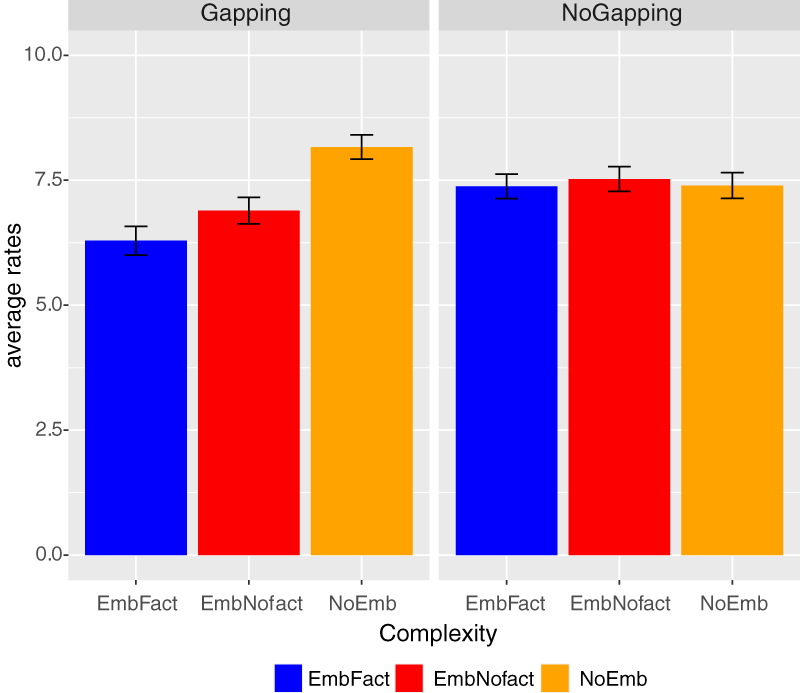
Experiment 1: mean acceptability judgments (0–10) for all 6 conditions.
Experiment 1: summary of results for fixed effects.
| Estimate | Std. error | Df | t-Value | Pr(>|t|) | |
|---|---|---|---|---|---|
| (Intercept) | 7.27036 | 0.23808 | 59.06762 | 30.538 | <2e-16 |
| Gapping | −0.11337 | 0.09656 | 61.98.968 | −1.174 | 0.2448 |
| Embedding | −0.24760 | 0.10077 | 33.93.913 | −2.457 | 0.0193 |
| Fact | −0.19209 | 0.04731 | 742.18596 | −4.060 | 5.42e-05 |
| Gap:Emb | −0.33118 | 0.04633 | 2466.87260 | −7.149 | 1.15e-12 |
| Gap:Fact | −0.11643 | 0.04586 | 2485.44206 | −2.539 | 0.0112 |
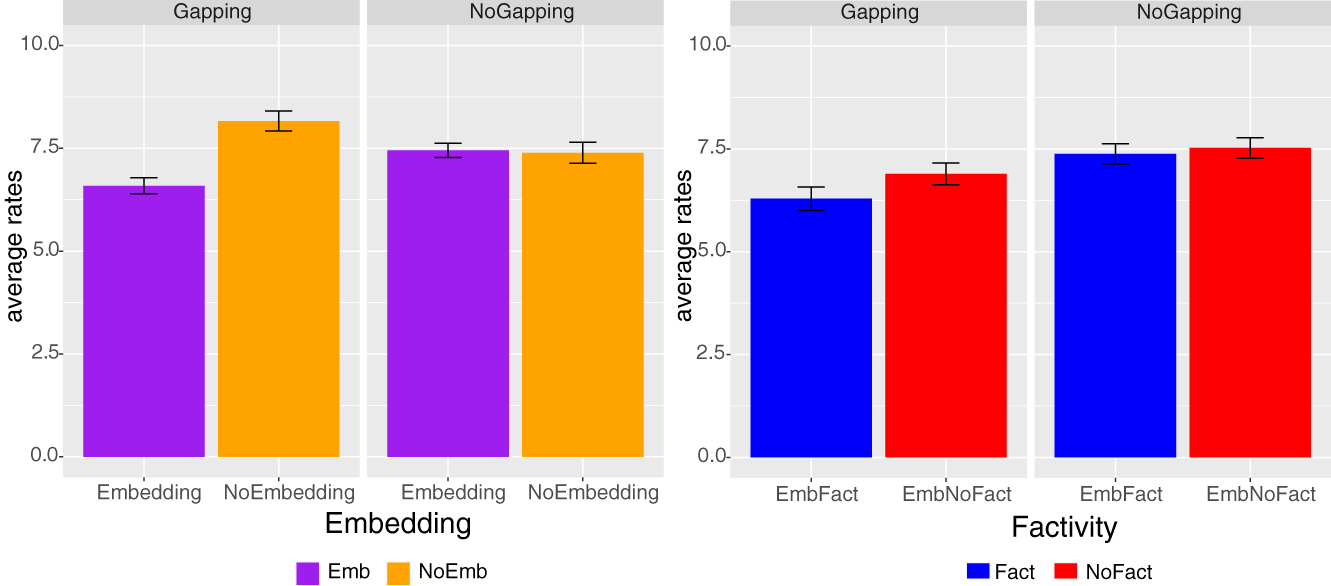
Experiment 1: mean acceptability judgments (0–10) for gapping by embedding and by factivity.
As shown in Table 6, we found a negative main effect of Embedding (Est. = −0.248; p < 0.05), confirming, as expected, that sentences with an embedded construction are overall less acceptable than sentences with no embedding. The results also showed a significant negative interaction between Embedding and Gapping (Est. = −0.331; p < 0.01), highlighting the combined degrading effect of the two factors. The results do not show any main effect of Gapping.[13] In other words, embedded gapping has a negative effect on the acceptability of sentences, whereas non-embedded gapping does not result in lower acceptability. Moreover, the results showed a negative main effect of Factivity (Est. = −0.192; p < 0.01) as well as an interaction between Factivity and Gapping (Est. = −0.116; p < 0.05). This means that, while factive embedding is overall less acceptable than non-factive embedding, the acceptability of sentences with gapping is even lower compared to non-elliptical sentences. In sum, gapping is acceptable in coordinated sentences, but when embedded, in particular under a factive verb, the acceptability decreases significantly.
We then explored the semantic type of embedding factive predicates, by comparing true factive predicates with semi-factive predicates (see Table 7). We observe a difference between true factive and semi-factive predicates in the Gapping condition (see Figure 3). Analyzing the subset of embedded items (1904 datapoints) via mixed-effect modelling, the results (see Table 8) show that (i) with respect to the main effect of factivity, true factives have a larger negative coefficient than semi-factives (regardless of gapping), and (ii) there is a significant interaction showing that gapping significantly worsens the acceptability only with true factives.
Mean acceptability judgments (0–10) for Experiment 1: zoom into factivity.
| Gapping | No gapping | |
|---|---|---|
| Embedding under factives | 6.29 | 7.38 |
| Semi-factives | 6.66 | 7.37 |
| True factives | 5.99 | 7.39 |
| Embedding under non-factives | 6.89 | 7.52 |
-
Bold values of semi-factives and true factives as these two classes are of interest.
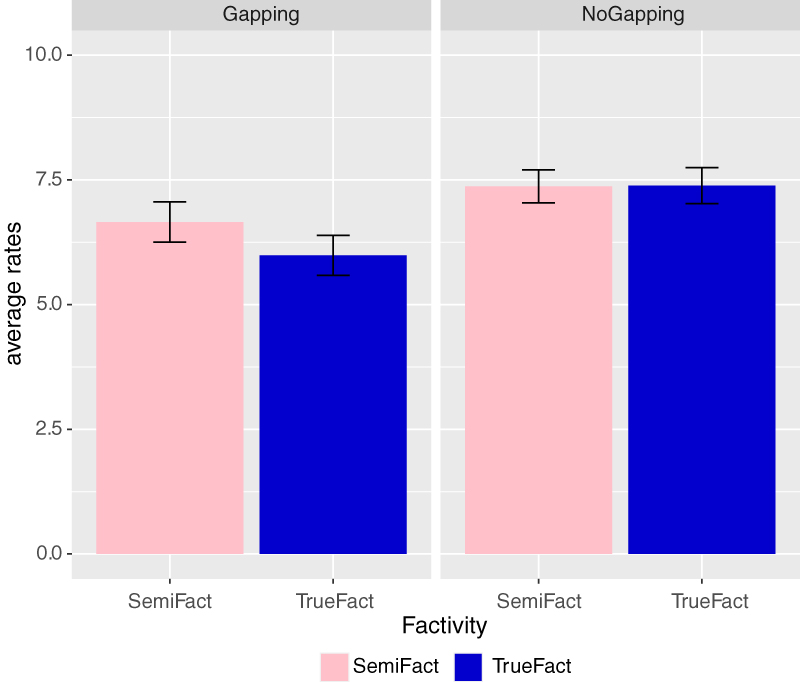
Experiment 1: zoom into factive verbs.
Experiment 1 – zoom into factivity: summary of results for fixed effects.
| Estimate | Std. error | Df | t-Value | Pr(>|t|) | |
|---|---|---|---|---|---|
| (Intercept) | 7.22308 | 0.24336 | 8.974.581 | 29.681 | <2e-16 |
| SemiFact | −0.25813 | 0.12746 | 117.388.958 | −2.025 | 0.043068 |
| TrueFact | −0.47463 | 0.12822 | 17.925.635 | −3.702 | 0.000285 |
| Gapping | −0.35311 | 0.10021 | 10.865.543 | −3.524 | 0.000624 |
| SemiFact:Gap | −0.08431 | 0.11131 | 29.882.658 | −0.757 | 0.449382 |
| TrueFact:Gap | −0.27331 | 0.10748 | 45.192.367 | −2.543 | 0.011330 |
Considering our predictions formulated in Section 3.2, we observe that they are all borne out by the data. First, we found significant interactions between gapping and embedding, as well as between gapping and factivity, showing that gapping is less acceptable when it is embedded in general, and when it is embedded under a factive predicate in particular. Furthermore, we observe the expected gradience across the three semantic classes of predicates (non-factives, semi-factives, true factives): true factives yield the lowest acceptability mean rate among the three, while non-factives yield the highest mean rate.
3.3 Experiment 2
In this experiment, we tested the acceptability of embedded gapping in Persian in the absence of the complementizer ke ‘that’, in order to study whether the presence/absence of the complementizer plays a role in the acceptability of embedded gapping in Persian as it is shown to play a role in English.
3.3.1 Experimental design
We prepared a set of 20 experimental items following a 2 × 2 factorial design, manipulating the presence/absence of the complementizer ke ‘that’ in elliptical versus non-elliptical sentences. The design gave rise to the four conditions illustrated in (13). In all the items, we use non-factive embedding predicates; everything else is similar to the items in Experiment 1.
| [+Gapping, +Complementizer] | ||||||||
| šab=e | arusi | Ava | lebās=e | sefid | mi-puš-ad | va | šenide=am | |
| night=ez | wedding | Ava | cloth=ez | white | ipfv-wear-3sg | and | heard=cop.1sg | |
| ke | Ali | lebās=e | mahalli | ||||||
| that | Ali | cloth=ez | local | ||||||
| ‘On the wedding night, Ava wears a white dress and I have heard that Ali (wears) a traditional cloth.’ | |||||||||
| [+Gapping, −Complementizer] | |||||||
| šab=e | arusi | Ava | lebās=e | sefid | mi-puš-ad | va | šenide=am |
| night=ez | wedding | Ava | cloth=ez | white | ipfv-wear-3sg | and | heard=cop.1sg |
| Ali | lebās=e | mahalli | ||||||||||||
| Ali | cloth=ez | local | ||||||||||||
| ‘On the wedding night, Ava wears a white dress and I have heard Ali (wears) a traditional cloth.’ | ||||||||||||||
| [−Gapping, +Complementizer] | |||||||||||||||
| šab=e | arusi | Ava | lebās=e | sefid | mi-puš-ad | va | šenide=am | ||||||||
| night=ez | wedding | Ava | cloth=ez | white | ipfv-wear-3sg | and | heard=cop.1sg | ||||||||
| ke | Ali | lebās=e | mahalli | mi-puš-ad | |||||
| that | Ali | cloth=ez | local | ipfv-wear-3sg | |||||
| ‘On the wedding night, Ava wears a white dress and I have heard that Ali wears a traditional cloth.’ | |||||||||
| [−Gapping, −Complementizer] | ||||||||||||||
| šab=e | arusi | Ava | lebās=e | sefid | mi-puš-ad | va | šenide=am | |||||||
| night=ez | wedding | Ava | cloth=ez | white | ipfv-wear-3sg | and | heard=cop.1sg | |||||||
| Ali | lebās=e | mahalli | mi-puš-ad | ||||||||||||||
| Ali | cloth=ez | local | ipfv-wear-3sg | ||||||||||||||
| ‘On the wedding night, Ava wears a white dress and I have heard Ali wears a traditional cloth.’ | |||||||||||||||||
We combined these 20 items with 42 fillers, of which 8 were clear ungrammatical sentences. The experiment included a total of 62 items and in average took about 7 min to complete. A total of 74 Persian native monolingual speakers (41 females and 33 males) completed the questionnaire of which we report the results of 69 who were scored as valid (mean age: 36, mode: 38, range: 18–62).
3.3.2 Results and discussion
Table 9 and Figure 4 provide the mean acceptability judgments across different conditions. We observe that in sentences with gapping the presence of complementizer yields lower acceptability.
Mean acceptability judgments (0–10) for Experiment 2.
| Gapping | No gapping | |
|---|---|---|
| Complementizer | 7.84 | 8.17 |
| No complementizer | 8.15 | 8.09 |
| Ungrammatical controls | 1.64 | |
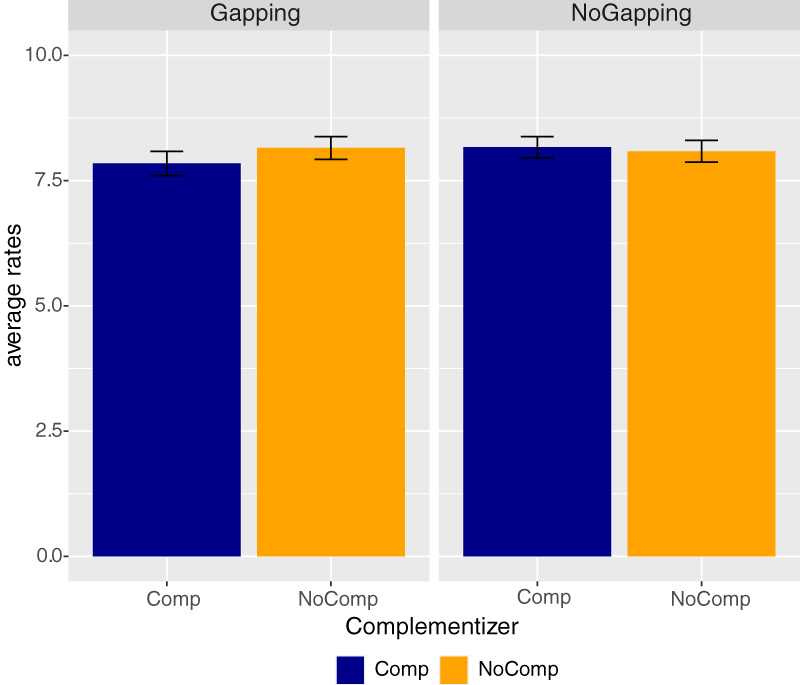
Experiment 2: mean acceptability judgments (0–10) for gapping by complementizer.
Here again, we analyzed the data via a mixed-effect linear regression modelling including the predictors Gapping and Complementizer as fixed effects, and Items and Participants as random effects. The results (see Table 10) show, as expected, a significant negative interaction between the two factors (Est. = −0.087; p < 0.05), confirming the negative effect of the presence of the complementizer in elliptical sentences.
Experiment 2: summary of results for fixed effects.
| Estimate | Std. error | Df | t-Value | Pr(>|t|) | |
|---|---|---|---|---|---|
| (Intercept) | 8.06493 | 0.17074 | 7.669.039 | 47.235 | <2e-16 |
| Gapping | −0.06315 | 0.09709 | 6.421.094 | −0.650 | 0.5177 |
| Comp | −0.04852 | 0.04498 | 3.600.583 | −1.079 | 0.2879 |
| Gap:Comp | −0.08717 | 0.04210 | 124.082.757 | −2.070 | 0.0386 |
Considering our research question, these results suggest that complementizer drop has the same effect in Persian as in English. This may imply that this tendency is a cross-linguistic preference, or it may be the case that, similar to English, it is related to frequency in Persian as well. Current data do not allow us to rule out any of these possibilities.
3.4 Preliminary conclusion
From an empirical perspective, if we compare our experimental results and the elicited data from Farudi (2013), we get a more nuanced picture. First, Farudi’s (2013) study suggests that all embedding predicates behave the same, whereas our study shows gradience across the three semantic classes (non-factives vs. semi-factives vs. true factives), that is, the acceptability of embedded gapping is largely affected by the semantic class of embedding predicates. Second, in Farudi’s (2013) study, the presence/absence of the complementizer is ignored, suggesting that complementizer drop is not expected to play any role. However, our experimental results show that speakers do manifest preferences, in that embedded gapping in the absence of the complementizer gets higher scores than in sentences where the complementizer is present. Overall, we can conclude that both factivity and the absence/presence of the complementizer play a role in the acceptability of embedded gapping in Persian. In addition, from a cross-linguistic perspective, Persian constitutes one more argument against the Downward Bounding Constraint postulated by Hankamer (1979) and Johnson (2018).
4 Consequences for the syntactic analysis of gapping
In the literature, gapping has received several syntactic analyses, each of them claiming to account for the properties of this elliptical construction. They can be classified in two main accounts, according to the size of coordination: (i) a Large Conjunct Gapping (LCG) account, involving a ‘high’ coordination that occurs at the clausal level; (ii) a Small Conjunct Gapping (SCG) account, involving a ‘low’ coordination that occurs at the subclausal level, targeting roughly VP-sized constituents.
Within LCG accounts, gapping is assumed to involve either deletion of a phrasal projection of the verb (Hankamer 1979; Ross 1967, 1970 a.o.), preceded in some versions by remnants movement to left-peripheral positions (Hartmann 2000; Sag 1976 a.o.) as illustrated in (14a), or a dedicated form-meaning rule that maps a fragment to a clausal meaning (Abeillé et al. 2014; Culicover and Jackendoff 2005; Ginzburg and Sag 2000; Steedman 2000 a.o.) as illustrated in (14b).
| Large Conjunct Gapping approaches | |
| a. |
Paul ordered a beer and
TopP
[John
1
FocP
[a whisky
2
TP
[ |
| b. | Paul ordered a beer and S [ NP [John] NP [a whisky]]. |
Within SCG accounts, gapping is explained either by a non-elliptical analysis which appeals to across-the-board movement of the shared material (and asymmetric extraction of preverbal non-shared constituents in the first conjunct, cf. Johnson 2009) as illustrated in (15a), or by a deletion operation targeting a VP-sized constituent (Coppock 2001; López and Winkler 2003 a.o.) as illustrated in (15b), in both analyses remnants being extracted to the left periphery in some functional projections. For the purpose of this paper, we are not going into the details of each of these variants.
| Small Conjunct Gapping approaches | |
| a. | Paul 1 TP [ordered 2 [ vP [t 1 t 2 a beer] and vP [John t 2 a whisky]]]. |
| b. |
Paul ordered a beer and
VP
[John
1
VP
[a whisky
2
VP
[ |
What is crucial here is the prediction that each of these two main accounts makes with respect to the behavior of gapping under embedding. The LCG account predicts the embedding of the gapped sequence, as the elliptical sequence is assumed to have a clausal structure. The mainstream deletion-based analysis (14a) postulates a TP-deletion in the gapped sequence after the movement of remnants to left-peripheral positions. Under such an analysis involving leftward movement of remnants, embedded gapping is allowed only in some specific configurations, namely only under some specific embedding predicates which allow leftward movement, namely ‘bridge’ verbs (cf. Hooper and Thompson 1973; Erteschik-Shir 2006). Consequently, in this account, embedded gapping should be available only under non-factive predicates (since semi-factive and true factive predicates are assumed to not allow extraction, cf. ‘non-bridge’ verbs). In addition, for languages that allow complementizer drop, the deletion-based LCG account predicts availability of embedded gapping under non-factive predicates only with an overt complementizer, since activation of the left periphery of the clause for a topic or focus constituent is assumed to force the presence of a complementizer (Doherty 2000; Grimshaw 1997). On the other hand, the construction-based LCG account (14b) considers the gapped clause as a fragment, which is a non-finite clause. Therefore, under such an account, embedded gapping should be allowed only in the absence of the complementizer (as complementizers such as that in English require a finite clause).
Meanwhile, the SCG accounts in (15) automatically rule out any configuration of embedded gapping. As gapping involves a coordination of vPs, a single T head being shared across all conjuncts, there is no finite verbal element in the gapped sequence. Moreover, a TP from a matrix clause cannot dominate the vP of an embedded sequence. Therefore, in the case of embedded gapping, the single T head cannot be shared by the first conjunct and the vP constituent that is embedded inside the second conjunct.
It is precisely the impossibility of embedding the gapped sequence in English (see examples in (2) above) that constituted the main syntactic motivation for a SCG account of gapping in Johnson’s perspective (in addition to semantic motivation, such as the wide scope of modal and negation with gapping, cf. Siegel 1984, 1987). In particular, based on the behavior of gapping under embedding in English, Johnson (2018) built on the Downward Bounding Constraint postulated by Hankamer (1979) and reiterated it as following: “Let α be some member of the verbal sequence of the right conjunct, and β be the set of elements in the sequence that c-command α. If gapping […] includes α then it must include β.” (Johnson 2018: 579). According to Johnson, the Downward Bounding Constraint is therefore a consequence of a SCG account of gapping.
In the light of our experimental results from Persian (and other languages), if we compare the predictions made by the two main syntactic approaches of gapping in terms of embedding, we definitely could not adopt any SCG account of gapping. According to the SCG account, any occurrence of embedded gapping should be ruled out, as gapping only involves a ‘low’ coordination of vPs, with a single T head that is shared by the two ‘small’ conjuncts. Any occurrence of gapping that contains the head of a CP (e.g., a complementizer) in the gapped sequence should be ungrammatical. Our experimental results go against this prediction. We observed that embedded gapping in Persian is acceptable, being highly above the ungrammatical controls. Consequently, we cannot maintain a SCG account for embedded gapping in Persian.
Therefore, we should adopt a LCG account of gapping. However, the deletion-based LCG account seems to be a bit problematic as well, since, in our experiments, we do not observe a categorical contrast between non-factive (‘bridge’) and factive (‘non-bridge’) predicates, as predicted by this account. We observed indeed a difference in acceptability between non-factive and factive predicates (non-factive embedding configurations getting higher score than factive embedding ones), but the factive configurations still receive much higher scores than ungrammatical controls. In addition, our experimental results show a preference for the complementizer omission, which is not expected under a deletion-based LCG account. Therefore, based on our experimental results, we consider that the construction-based LCG account seems to be a better fit to account for the preferences we observe in our data. One of the advantages of a constructionist LCG approach of gapping is the fact that we do not have to postulate two different syntactic structures for non-factives (‘bridge’ verbs) and factives (‘non-bridge’ verbs) as in the deletion-based LCG account. In a construction-based perspective, gapping makes use of a dedicated rule mapping a headless structure (i.e. a fragment) to a clausal meaning. In addition, the rule of gapping has its specific constraints; crucially, as discussed in Section 2, the gapped clause must address the same QUD as the antecedent clause. We therefore automatically get the gradience we observed across the three semantic classes of predicates. In addition, as the gapping fragment is non-finite, the preference we observe for embedded gapping without complementizer is not surprising. Providing an exhaustive syntactic analysis of embedded gapping in Persian is beyond the scope of this paper. For more details about its application in embedded gapping, see Bîlbîie and de la Fuente (2019) and Bîlbîie et al. (to appear).
By considering non-syntactic constraints such as the QUD-based constraint, the construction-based LCG account of gapping could integrate the notion of acceptability. We consider the latter as being more adequate than the categorical notion of grammaticality. The theoretical notion of grammaticality refers to the hypothesis of a given sentence possibly being generated by the grammar of the language or not. Grammaticality is not gradable, but rather binary (i.e. sentences are either grammatical or ungrammatical). Acceptability, on the other hand, is gradable (i.e. sentences can be fully acceptable or partially acceptable, all the way down to completely unacceptable). While there is unquestionably a relation between the two notions, it is now well-established that grammaticality does not fully reflect the actual acceptability that speakers attribute to sentences. Not only we now know that some sentences may be judged poorly by speakers because of parsing difficulties, but also that speakers could perceive sentences considered ungrammatical by linguists as acceptable with a reliable interpretation. In other words, it is now broadly accepted that (un)grammaticality and (un)acceptability are not necessarily equated. However, the exact way in which these two notions interact, and the precise role played by performance factors in the evaluation of (un)grammaticality and (un)acceptability by speakers are to date unknown and subject of ongoing research (see, e.g., Tubau et al. 2020 for a review). Importantly, beyond factors related to processing complexities that are widely considered as performance factors, there is much less agreement on the role played by other (non-syntactic) factors related to the context and/or to the content. In the absence of a clear theory to account for the relation between grammaticality and acceptability in full extent, we assume that the latter is a more reliable notion to account for embedded gapping.
Moreover, the kind of behavioral data that we have gathered in this study is based on the notion of acceptability, that is, whether a sentence sounds more or less acceptable in a particular context. These data (those reported in our study on Persian alongside similar data from the four other languages) have allowed to highlight the role that a non-syntactic factor plays in improving the acceptability of embedding gapping, namely the factive/non-factive type of the embedding verb, explained as a QUD-based constraint, while previous accounts that included the ‘No Embedding Constraint’, based on the notion of grammaticality, fall short of accounting for the data in its full extension.
5 Towards a crosslinguistic perspective on embedded gapping
The comparison of our experimental results on Persian with the experimental results from Spanish, Romanian, French, and English (cf. Section 2) allows to observe some cross-linguistic effects. In all these languages, embedded gapping conditions are rated lower than the other experimental conditions, but higher than the ungrammatical controls. There is a significant interaction between gapping and embedding; namely, embedded constructions are rated lower with gapping than with no gapping. Moreover, there is a significant interaction between gapping and factivity: embedding under a factive verb is rated lower than under a non-factive verb, independently of language and/or independently of ellipsis. Crucially, in all these languages, embedded gapping is sensitive to the semantic class of embedding predicate: embedding under true factive verbs is rated lower than under semi-factive verbs. Finally, for languages which allow embedding without a complementizer, such as Persian and English, we observe that the presence/absence of the complementizer influences acceptability, that is embedded gapping without a complementizer is rated higher than gapping embedded under an overt complementizer. In other words, complementizer drop renders embedded gapping more acceptable.
Based on these rich experimental data from several languages, we can now conclude that both factivity and the presence/absence of the complementizer affect the acceptability of embedded gapping in a given language. In other words, these are not language-specific but rather cross-linguistic preferences.
Moreover, the Downward Bounding Constraint is not universal, and therefore must be reconsidered. Embedded gapping is acceptable in some languages (e.g., Persian, Spanish, Romanian), and less so in others (e.g., English, French). The strong version of the constraint does not hold even for languages that are supposed to exclude embedded gapping (e.g., English, French, cf. Section 2). We can now conclude that, instead of having a ‘hard’ syntactic constraint à la Johnson, we rather have a ‘soft’ constraint, involving gradient judgments. As Sorace and Keller (2005) mention, ‘soft’ constraints are generally at the interface between syntax and other domains. Indeed, the effects we observe with embedded gapping cross-linguistically could receive a non-syntactic explanation. As discussed in length by Bîlbîie and de la Fuente (2019) and Bîlbîie et al. (to appear), the effect of the semantic class of the embedding predicate could be explained by a discourse constraint. More precisely, as non-factives do not presuppose the truth of their complement clause and do not contribute the main point of utterance, both the embedded gapped clause and the source clause may address the same QUD. This explains the higher scores that we get for embedding under non-factives than under factives. On the other hand, as factives presuppose the truth of their complement clause and contribute to the main point of utterance, in these cases, the embedded gapped clause and the source clause do not answer the same QUD. This explains the lower scores for factive predicates compared to non-factive ones. As for the intermediate class of semi-factives, they may come closer to non-factives in cases where presupposition is suspended, which explains why this class gets higher scores than true factives. For an exhaustive analysis of embedded gapping, see Bîlbîie and de la Fuente (2019) and Bîlbîie et al. (to appear).
Finally, it is interesting to note that there are differences with respect to the preferences between gapping structures and their non-elliptical counterparts. The results of previous experimental studies show no clear preference for one or the other structure in Romance (Bîlbîie et al. 2021), whereas English disprefers gapping, favoring a non-elliptical structure (Bîlbîie et al. to appear; Carlson 2001). As for Persian, our results may suggest that there is, on the contrary, a preference for gapping. This preference may be due to the fact that redundancy in general is stylistically strongly disfavored in written Persian; in other words, speakers are used to elliptical structures in written language. However, future research is needed to i) establish the preference for gapping in Persian and the potential role of register/style independently and ii) investigate cross-linguistic preferences in comparable material.
From a methodological perspective, all these experimental studies show the importance of having high methodological standards in linguistics, when it comes to gathering data. The experiments allowed us to highlight some differences that we would not have been able to see via informal introspective judgments or corpus data, in order to have a clear and nuanced picture. Once again, experimental studies show that some linguistic phenomena, such as embedded gapping, are better described in terms of acceptability rather than grammaticality.
We close this paper with a quote by Borsley (2005: 1479): “It is not really clear when informally gathered intuitions provide a satisfactory basis for research and when more formal methods of data gathering are necessary. […] However, some things are fairly clear. It is clear that informally gathered intuitions are not always a satisfactory basis for syntactic theorizing. It is also clear that experimental methods are sometimes necessary and may provide richer data than informal methods. […] Above all it is clear that questions about data are more important than is sometimes assumed.”
References
Abeillé, Anne, Gabriela Bîlbîie & François Mouret. 2014. A Romance perspective on gapping constructions. In Hans Boas & Francisco Gonzálvez-García (eds.), Romance perspectives on construction grammar, 227–267. Amsterdam/Philadelphia: John Benjamins.10.1075/cal.15.07abeSearch in Google Scholar
Barr, Dale J., Roger Levy, Christoph Scheepers & Harry J. Tily. 2013. Random effects structure for confirmatory hypothesis testing: Keep it maximal. Journal of Memory and Language 68(3). 255–278. https://doi.org/10.1016/j.jml.2012.11.001.Search in Google Scholar
Bates, Douglas, Martin Maechler, Bolker Ben & Steve Walker. 2015. Fitting linear mixed-effects models using lme4. Journal of Statistical Software 67(1). 1–48. https://doi.org/10.18637/jss.v067.i01.Search in Google Scholar
Bîlbîie, Gabriela & Israel de la Fuente. 2019. Can gapping be embedded? Experimental evidence from Spanish. Glossa: A Journal of General Linguistics 4(1). 1–39. Special issue Experimental Approaches to Ellipsis.10.5334/gjgl.782Search in Google Scholar
Bîlbîie, Gabriela, Israel de la Fuente & Anne Abeillé. 2021. L’ellipse verbale enchâssée dans les langues romanes. Langages 223(3). 61–80.10.3917/lang.223.0061Search in Google Scholar
Bîlbîie, Gabriela, Israel de la Fuente & Anne Abeillé. to appear. Factivity and complementizer omission in English embedded gapping. Special issue on ellipsis to appear in Journal of Linguistics.10.1017/S0022226722000445Search in Google Scholar
Borsley, Robert. 2005. Introduction. Lingua 115(11). 1475–1480. Special issue Data in theoretical linguistics. https://doi.org/10.1016/j.lingua.2004.06.009.Search in Google Scholar
Carlson, Katy. 2001. The effects of parallelism and prosody in the processing of gapping structures. Language and Speech 44(1). 1–26. https://doi.org/10.1177/00238309010440010101.Search in Google Scholar
Coppock, Elizabeth. 2001. Gapping: In defense of deletion. In Proceedings from the annual meeting of the Chicago Linguistic Society, vol. 37, 133–148. Chicago, IL: Chicago Linguistic Society.Search in Google Scholar
Culicover, Peter & Ray Jackendoff. 2005. Simpler syntax. Oxford: Oxford University Press.10.1093/acprof:oso/9780199271092.001.0001Search in Google Scholar
Dahl, Östen. 1979. Is linguistics empirical? A critique of Esa Itkonen’s linguistics and metascience. In Thomas A. Perry (ed.), Evidence and argumentation in linguistics, 13–45. Berlin/New York: Mouton de Gruyter.10.1515/9783110848854-008Search in Google Scholar
de Cuba, Carlos & Jonathan E. MacDonald. 2013. On the referential status of embedded polarity answers in Spanish. In Jennifer Cabrelli Amaro, Gillian Lord, Ana de Prada Pérez & Jessi Elana Aaron (eds.), Selected proceedings of the 16th hispanic linguistics symposium, 312–323. Somerville, MA: Cascadilla Press.Search in Google Scholar
Doherty, Cathal. 2000. Clauses without that: The case for bare sentential complementation in English. New York: Routledge.Search in Google Scholar
Dowty, David. 1988. Type raising, functional composition, and non-constituent conjunction. In Richard Oehrle, Emmon Bach & Deirdre Wheeler (eds.), Categorial grammar and natural language structures, 153–198. Dordrecht: Kluwer.10.1007/978-94-015-6878-4_7Search in Google Scholar
Drummond, Alex. 2013. Ibex farm. http://spellout.net/ibexfarm/ (accessed 2 August 2018).Search in Google Scholar
Erteschik-Shir, Nomi. 2006. Bridge phenomena. In Martin Everaert & Henk van Riemsdijk (eds.), The Blackwell companion to syntax, vol. 1, 284–294. Malden, Ma/Oxford: Blackwell Publishing.10.1002/9780470996591.ch10Search in Google Scholar
Faghiri, Pegah & Juliette Thuilier. 2021. Contribution méthodologique à l’étude de l’ordre des mots: jugements d’acceptabilité et complétion de phrases. Langages 223(3). 25–42. https://doi.org/10.3917/lang.223.0025.Search in Google Scholar
Faghiri, Pegah & Pollet Samvelian. 2016. How much structure is needed? The case of the Persian VP. In Doug Arnold, Miriam Butt, Berthold Crysmann, Tracy Holloway King & Stefan Müller (eds.), Proceedings of the joint 2016 conference on head-driven phrase structure grammar and lexical functional grammar, 236–254. Stanford, CA: CSLI Publications.10.21248/hpsg.2016.13Search in Google Scholar
Faghiri, Pegah & Pollet Samvelian. 2021. The issue of “separability” in Persian complex predicates. In Berthold Crysmann & Manfred Sailer (eds.), One-to-many relations in morphology, syntax and semantics, 117–149. Berlin: Language Sciences Press.Search in Google Scholar
Farudi, Annahita. 2013. Gapping in Farsi: A cross-linguistic investigation. Amherst, MA: University of Massachusetts Amherst dissertation.Search in Google Scholar
Gibson, Edward & Evelina Fedorenko. 2013. The need for quantitative methods in syntax and semantics research. Language and Cognitive Processes 28(1–2). 88–124. https://doi.org/10.1080/01690965.2010.515080.Search in Google Scholar
Ginzburg, Jonathan & Ivan A. Sag. 2000. Interrogative investigations: The form, meaning and use of English interrogatives, vol. 123. Stanford, CA: CSLI Publications.Search in Google Scholar
Goldberg, Adele & Florian Perek. 2018. Ellipsis in construction grammar. In Jeroen van Craenenbroeck & Tanja Temmerman (eds.), The Oxford handbook of ellipsis, Chapter 8, 188–205. Oxford: Oxford University Press.10.1093/oxfordhb/9780198712398.013.8Search in Google Scholar
Grimshaw, Jane. 1997. Projection, heads, and optimality. Linguistic Inquiry 28(3). 373–422.Search in Google Scholar
Hankamer, Jorge. 1979. Deletion in coordinate structures. New York: Garland Publishing.Search in Google Scholar
Hartmann, Katharina. 2000. Right node raising and gapping. Interface conditions on prosodic deletion. Amsterdam/Philadelphia: John Benjamins.10.1075/z.106Search in Google Scholar
Haspelmath, Martin. 2007. Coordination. In Timothy Shopen (ed.), Language typology and syntactic description complex constructions, 2, 1–51. Cambridge: Cambridge University Press.10.1017/CBO9780511619434.001Search in Google Scholar
Hooper, Joan. 1975. On assertive predicates. In John P. Kimball (ed.), Syntax and semantics 4, 91–124. New York: Academic Press.10.1163/9789004368828_005Search in Google Scholar
Hooper, Joan & Sandra Thompson. 1973. On the applicability of root transformations. Linguistic Inquiry 4. 465–497.Search in Google Scholar
Jaeger, T. Florian. 2006. Redundancy and syntactic reduction in spontaneous speech. Stanford: Stanford University dissertation.Search in Google Scholar
Jayez, Jacques, Valeria Mongelli, Anne Reboul & Jean-Baptiste van der Henst. 2015. Weak and strong triggers. In Florian Schwarz (ed.), Experimental perspectives on presuppositions, 173–193. Cham: Springer.10.1007/978-3-319-07980-6_8Search in Google Scholar
Johnson, Kyle. 2009. Gapping is not (VP)-Ellipsis. Linguistic Inquiry 40. 289–328. https://doi.org/10.1162/ling.2009.40.2.289.Search in Google Scholar
Johnson, Kyle. 2018. Gapping and stripping. In Jeroen van Craenenbroeck & Tanja Temmerman (eds.), The Oxford handbook of ellipsis, Chapter 23, 562–604. Oxford: Oxford University Press.10.1093/oxfordhb/9780198712398.013.24Search in Google Scholar
Karttunen, Lauri. 1971. Some observations of factivity. Papers in Linguistics 4. 55–69. https://doi.org/10.1080/08351817109370248.Search in Google Scholar
Kiparsky, Paul & Carol Kiparsky. 1971. Fact. In Danny D. Steinberg & Leon A. Jakobovits (eds.), Semantics. An interdisciplinary reader in philosophy, linguistics and psychology, 345–369. Cambridge: Cambridge University Press.10.1515/9783111350219.143Search in Google Scholar
Lau, Jey Han, Alexander Clark & Shalom Lappin. 2016. Grammaticality, acceptability, and probability: A probabilistic view of linguistic knowledge. Cognitive Science 41(5). 1202–1241. https://doi.org/10.1111/cogs.12414.Search in Google Scholar
López, Luis & Susanne Winkler. 2003. Variation at the syntax-semantics interface: Evidence from gapping. In Kerstin Schwabe & Susanne Winkler (eds.), The interfaces: Deriving and interpreting omitted structures, 227–248. Amsterdam/Philadelphia: John Benjamins.10.1075/la.61.11lopSearch in Google Scholar
Meyer, Charles F. 1995. Coordination ellipsis in spoken and written American English. Language Sciences 17. 241–269. https://doi.org/10.1016/0388-0001(95)00013-5.Search in Google Scholar
R Development Core Team. 2008. R: A language and environment for statistical computing. Vienna: R Foundation for Statistical Computing.Search in Google Scholar
Ramat, Paolo. 1987. Linguistic typology. Berlin/New York: Mouton de Gruyter.10.1515/9783110859126Search in Google Scholar
Rasekhi, Vahideh. 2020. Stripping structures with negation in Persian. In Richard K. Larson, Sedigheh Moradi & Vida Samiian (eds.), Advances in Iranian linguistics, Chapter 12, 257–273. Amsterdam/Philadelphia: John Benjamins.10.1075/cilt.351.12rasSearch in Google Scholar
Ross, John Robert. 1967. Constraints on variables in syntax. Cambridge, MA: MIT dissertation.Search in Google Scholar
Ross, John Robert. 1970. Gapping and the order of constituents. In Manfred Bierwisch & Karl Erich Heidolph (eds.), Progress in linguistics, 249–259. La Haye: Mouton.10.1515/9783111350219.249Search in Google Scholar
Sag, Ivan A. 1976. Deletion and logical form. Cambridge, MA: MIT dissertation.Search in Google Scholar
Samvelian, Pollet. 2007. A (phrasal) affix analysis of the Persian Ezafe. Journal of Linguistics 43(3). 605–645. https://doi.org/10.1017/s0022226707004781.Search in Google Scholar
Siegel, Muffy. 1984. Gapping and interpretation. Linguistic Inquiry 15(3). 523–530.Search in Google Scholar
Siegel, Muffy. 1987. Compositionality, case, and the scope of auxiliaries. Linguistics and Philosophy 10. 53–76. https://doi.org/10.1007/bf00603392.Search in Google Scholar
Sorace, Antonella & Frank Keller. 2005. Gradience in linguistic data. Lingua 115(11). 1497–1524. Special issue Data in theoretical linguistics. https://doi.org/10.1016/j.lingua.2004.07.002.Search in Google Scholar
Steedman, Mark. 2000. The syntactic process. Cambridge: MIT Press.10.7551/mitpress/6591.001.0001Search in Google Scholar
Tao, Hongyin & Charles F. Meyer. 2006. Gapped coordinations in English: Form, usage, and implications for linguistic theory. Corpus Linguistics and Linguistic Theory 2(2). 129–163. https://doi.org/10.1515/cllt.2006.008.Search in Google Scholar
Toosarvandani, Maziar. 2018. In Jeroen van Craenenbroeck & Tanja Temmerman (eds.), The Oxford handbook of ellipsis, Chapter 35, 934–961. Oxford: Oxford University Press.10.1093/oxfordhb/9780198712398.013.32Search in Google Scholar
Tubau, Susagna, Urtzi Etxeberria, Viviane Déprez & Maria Teresa Espinal. 2020. Editorial: What are (un)acceptability and (un)grammaticality? How do they relate to one another and to interpretation? Frontiers in Psychology 11. 621267. https://doi.org/10.3389/fpsyg.2020.621267.Search in Google Scholar
van Oirsouw, Robert. 1987. The syntax of coordination. London/New York: Routledge.Search in Google Scholar
Wilder, Chris. 1997. Some properties of ellipsis in coordination. In Artemis Alexiadou & Tracy Alan Hall (eds.), Studies in universal grammar and typological variation, 59–107. Amsterdam/Philadelphia: John Benjamins.10.1075/la.13.04wilSearch in Google Scholar
© 2022 the author(s), published by De Gruyter, Berlin/Boston
This work is licensed under the Creative Commons Attribution 4.0 International License.
Articles in the same Issue
- Frontmatter
- Editorial
- Introduction: Special issue on empirical approaches to elliptical constructions
- Articles
- Explaining ellipsis without identity*
- Experimentally testing the interpretation of multiple sluicing and multiple questions in Hungarian
- Multiple sluicing and islands: a cross-linguistic experimental investigation of the clausemate condition
- Pseudogapping in English: a direct interpretation approach
- Me too fragments in English and French: a direct interpretation approach
- Complementizer deletion in embedded gapping in Spanish
- An experimental perspective on embedded gapping in Persian
Articles in the same Issue
- Frontmatter
- Editorial
- Introduction: Special issue on empirical approaches to elliptical constructions
- Articles
- Explaining ellipsis without identity*
- Experimentally testing the interpretation of multiple sluicing and multiple questions in Hungarian
- Multiple sluicing and islands: a cross-linguistic experimental investigation of the clausemate condition
- Pseudogapping in English: a direct interpretation approach
- Me too fragments in English and French: a direct interpretation approach
- Complementizer deletion in embedded gapping in Spanish
- An experimental perspective on embedded gapping in Persian
