
A family of singular functions and its relation to harmonic fractal analysis and fuzzy logic
-
Enrique de Amo
 ,
Manuel Díaz Carrillo
,
Manuel Díaz Carrillo

Abstract
We study a parameterized family of singular functions which appears in a paper by H. Okamoto and M. Wunsch (2007). Various properties are revisited from the viewpoint of fractal geometry and probabilistic techniques. Hausdorff dimensions are calculated for several sets related to these functions, and new properties close to fractal analysis and strong negations are explored.
1 Introduction and preliminaries
Examples of singular functions, that is, monotone increasing continuous functions whose derivatives vanish almost everywhere, have been known since the end of the 19th century (see [1]). Since then, these functions have been studied from a wide variety of fields very distant from one another. Some classes of these functions have been considered in Probability Theory (see [2-4]) as well as in Number Theory, where what is known as Minkowski’s question mark function is specially relevant (see [5-8]). It relates to the alternate dyadic and continuous fraction systems of representation. Another example of singular function that relates to representation number systems can be found in [9]. Possibly the best known and most widely studied singular function is Cantor’s (see [10] and the references therein) which can be studied with the aid of the 2- or 3-base representation systems, although it is often geometrically built as the limit of a sequence of functions with polygonal graphs. This is also the case of the functions firstly studied by Cahen [11], which Salem [7] introduced using geometric ideas similar to those of Cantor. Other references related to these functions can be found in [7, 12-16].
In recent times, a parameterized family of continuous functions has been considered by Okamoto in [17], and revisited in [18] to see if they are also singular. They contain Bourbaki and Perkins’ nowhere differentiable functions as well as Cantor’s singular function. In this paper, we study a wide family of two-parametric singular functions fa,b and explore new properties, several of them closely related to fractal analysis and strong negations. We borrow a few ideas from [18, Sec.4], starting with an exact definition of what we mean by fa,b.
Let a,b ∈ ]0, 1[ and fa,b be defined on the unit interval [0, 1] by iterations of piecewise affine functions
Let f0(x) = x, and suppose that fn has been properly defined on the whole unit interval. Then, for fn+1we define
Now, let fa,b(x) = limn→∞fn(x) for all x ∈ [0,1].
Let us mention that
consider 0 < a < b < 1 such that
([18, Th.5]). fa,b is a continuous, strictly monotone, and singular function.
This paper is structured in the following way: In Section 2 we show new properties of fa,b, from the viewpoint of fractal geometry theory. We prove that the graph of fa,b is a compact set (an attractor) that appears as the fixed point of a suitable contraction mapping, which directly implies its monotony and continuity. Moreover, we characterize fa,b as the unique bounded function satisfying a given system of functional equations. We will provide further proof of the singularity of fa,b with the sole aid of probabilistic techniques, using the result that the sequence of Fourier coefficients of its associated measure d fa,b does not converge to zero (for a given monotone function S, dS denotes its Stieltjes measure). In the same section, we also establish the Hausdorff dimension of sets related to fa,b, one of them is a measure zero set whose image by fa,b has measure one, and its dimension is obtained as an application of the Besicovitch-Eggleston theorem. To this end, we previously introduced a representation system called a, b-system. In Section 3 we generalize all the results to a 4-parametric family of functions. Once more, we calculate Hausdorff dimensions for the sets associated with these functions again. The last section is devoted to applications of the family of singular functions studied. With these and the representation system referred to above, we find a bi-parametric family of Katok foliations. In addition, we establish its relation to harmonic analysis on fractals and to strong negations in fuzzy logic.
2 Properties of fa,b
2.1 Analytic properties
First, as we pointed out above, we examine new properties of fa,b from a geometric point of view. But the tool we shall use is the Hausdorff-Pompeiu metric (see [20, 21]). A straightforward way to introduce this metric is as follows:
Let 𝒦([0,1]2) denote the space of compact subsets in [0,1]2. For each A and B in 𝒦 ( [0,1]2) we put
ρ (A, B) := sup {dist (b, A) : b ∈ B},
and then 𝒦 ([0,1]2) is complete metric space endowed with the metric
D (A, B) := max {ρ (A, B), ρ(B, A)}.
Thus, the graph of fa,b is a self-affine subset of the unit square [0,1]2, obtained as the fixed point of a suitable contraction C in the space 𝒦 ([0, l]2), via the Contaction Mapping Theorem.
The underlying idea is graphically expressed in Fig. 1.
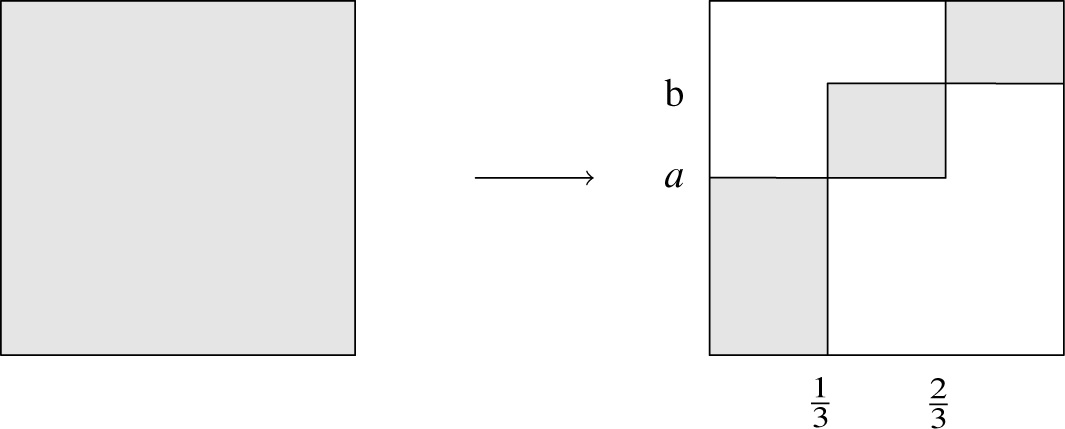
The transform of the unit square by C
The graph of the polygonal fn is defined by iteration as the image, by a contraction C that is defined below, of the graph of fn-1 with the start f0 = identity.
For convenience, let us put a1= a; a2 = b – a; a3 = 1 – b.
The mapping
(a, b, a2, a3 ∈ ]0,1 [) is a contraction for the Hausdorff metric in 𝒦 ([0, 1]2).
The graph of fa,b, is the unique invariant set for the iterated function system defined by (1), that is the fixed point of C. The next result follows as a consequence of the definition of fa,b, and its graph is a compact set.
The function fa,b is monotonic and continuous.
Now, since each affine contraction represents a functional equation, according to the Banach fixed point theorem, we have fa ,b determined by the following functional equations.
The function fa,b is the unique bounded solution of the system of functional equations
The area under the graph of fa,b, is
In [22], for Okamoto’s one-parameterized function it is proved that fa = fa, 1-a is non-differentiable almost everywhere at the critical parameter value. In [19], the performance of
The derivative
If
limits of the quotients
A similar argument allows us to obtain
By repeting this reasoning or using the system of functional equations (2), it follows that if exist, the numbers
Let us suppose that x cannot be expanded in the form
for sequences (xk) and (yk) that converge to x such that xk ≤ x < yk.
Let us take
and
then we have
Thus, if 3ai ≠ 1 for the three values, this is a contradiction. If some of them equal 1, then the other two differ from 1, because we have avoided the case a = 1/3 and b = 2/3. Therefore, if we obtain 3ai = 1, we shall change that quotient by
or by
This quotient is
For each k we have described the possibility of taking the quotient on a finite set (where 1 is not included). Consequently, the limit
Note that the theorem above provides a new proof for the singularity of fa,b.
2.2 Singular functions as the convolution of distribution functions
We shall prove that fa,b can be obtained as an infinite convolution S of atomic probabilities, and that the sequence of Fourier coefficients of dS does not converge to zero. A number of definitions and results to be used later are recorded bellow.
If F1 and F2 are distribution functions, then the function
Let F be a distribution function, then its characteristic function
the nth moment Mn of F is defined as
By imposing conditions on the distribution functions, Jessen and Wintner in their paper [3], obtain convergence criteria for the convolution of distribution functions. To be more specific, in [3] they obtain the following results.
([3, Th. 4]). If F2(Fn) is finite for every n, then the convergence of two series
([3, Th. 35]). If F = F1 * F2 * · · · is a convergent infinite convolution of distribution functions Fn each of which is purely discontinuous, then F is either purely discontinuous, or singular, or absolutely continuous.
The next result can be found in [23, pg. 46].
Let γn = maxz{Fn(z+) – Fn(z–)}, then the infinite convolution F(x) = (F1 * F2 * ...) (x) iscontinuous if and only if the series
Finally, in [26] the following useful result is proven.
If Fn and F have characteristic functions
Let be the infinite convolution function S := F1 *F2*F3*..., where F1, F2, F3,... are distribution functions given, for each positive integeer n, by
This function S is well defined. In fact, let us note that, for every n:
The convergence of the corresponding series ensures, by Lemma 2.6, the weak convergence of the convolution, that is, S(x) exists for every x.
With the notation as in the above definition, we have:
The characteristic function of S is
The sequence of Fourier coefficients of
S is a singular function.
The characteristic function of Fn is
Let us denote by
The functions in the convolution are purely discontinuous, thus S is also pure. But it is neither discontinuous, by Theorem 2.8, nor absolutely continuous, because by b) it does not satisfy the Riemann-Lebesgue theorem. Therefore, it must be singular.
For a nonnegative integer m < 3n, let us consider its expansion in the base 3 m = r030 + r13l + r232 + ... + rn-13n-1, with ri ∈ {0, 1, 2}. Set c(m) (resp., u(m) and d(m)) the number of times that the digit 0 appears (resp., 1s and 2s) in the above expansion of m.
The distribution function F1 * F2 * · · · * Fn has the following associated probability
The proof is reached by induction. The statement is true for the first values. Let us suppose that it is true for n — 1, and we will prove it for n. (Let us denote by
If m is congruent with zero module 3, i.e. m = 3k, then
and
Taking into account that the expansion of m has one less 0 than the expansion of k, and the same number of 1s and 2s, by applying the induction hypothesis we obtain the desired result.
For the cases m = 1 (mod 3) and m = 2 (mod 3) we proceed in a similar way.
Applying the above lemma and making an inductive hypothesis we obtain the following result.
a)
b)
Now, we show the relationship between fa,b and S.
fa,b is the infinite convolution function S.
We have to prove that the graph of Gn = F1 * F2 *...* Fn and Cn(d) are the same set, where d denotes the segment
Set Cn(x) := max{y : (x, y) ∈ Cn(d)}. It is immediate that
For 0 ≤ m < 3n-1, we consider these possibilities:
a)
b)If
c)If
This ensures that the statement is also true for n.
If Gn are step functions that coincide with fa,b at points in the form
Theorems 2.11and 2.14 give further proof of Okamoto and Wunsch’s result [18, Th. 5] using exclusively probability theory methods. In fact, fa,b is a singular function and additionally we know its characteristic function, as well as the fact that the sequence of its Fourier coefficients does not converge to zero.
3 Fractal sets associated with fa,b
This section is devoted to describing several sets related to the function fa,b and to computing their Hausdorff dimensions. We need some additional results.
We are going to introduce a representation system of real numbers in [0,1] .The method employed is based on the imitation of the action of fa,b on the Y axis. With notations already used above, let us divide the unit interval into subintervals [0, a], [a, b] and [b, 1]. Thus, if y ∈ [0,1], then y can be written as one of the following expressions:
with b1 = 0, b2 = a, b3, = b, and z ∈ [0,1 ]. We can now apply the above algorithm to z ∈ [0,1], and by iteration we have the formal relation
with di = bj , j = 1,2,3, and si = ak for a suitable j and k, such that if di = bj, then si = aj.
Observe that if y := b2 + a2 z, with z ∈ {0,1}, then y has two formal equalities. But this fact is of no relevance to our task because it is true on a denumerable set, hence on a set of measure zero. The nature of the construction also ensures that for different points their corresponding formal equalities are different, as well.
The series d1+ s1 d2+s1s2d3 +s1s2 s3d4converges to y, that is, the formal equality above is in fact an equality.
Note that s1 ... sndn+1 ≤ max {a1,a2,a3,b}n+1. Thus, by construction
which implies that the series converges to y.
Next, the family of parameterized singular functions is described with the help of the a,b-representation system.
The series in the proposition above is named as the a, b-representation of y ∈ [0, 1].
The random variables dn(x) are independent and equally distributed with probability function
Applying the Law of Large Numbers we obtain the following result.
With the above notation the set of points whose proportion of times that dn = 0 is a1, for dn = a is a2 times or dn = b is a3, has measure 1.
We are now going to exhibit a set of measure zero whose image under fa,b is of measure one and vice versa.
There exists a set of measure zero and Hausdorff dimension
The nature of the construction of the representation for a point
The Hausdorff dimension is calculated in [20, Chp. 10].
In addition, we shall give another analogue property using the measure of the normal numbers in [0,1].
We recall that a number is normal in the 3-base if the proportions of 0s, 1s and 2s in this base is 1/3 for each case, and that the set of normal numbers in the 3-base is of measure 1 (see, for instance, [24] or [25]).
There exists a set of measure one that is mapped by fa,b on a set of measure zero and Hausdorff dimension
A normal number in the base 3 has the same proportion for each of the three digits in its expansion. Their images will have the same proportion in the random variables dn. Corollary 3.4 shows that the proportions must be a1, a2 and a3, on a set of measure 1. Thus, the image of normal numbers is a measure zero set.
To calculate the Hausdorff dimension for this zero-measure set, we use that the measure d fa,b concentrates its mass on it. Thus, applying [20, Lemma 4.9], by substitution of balls by neigbourhoods in the following way: If
then we use the representation method and, in the n-th iteration, we do z = 0 and z = 1, obtaining the extremes of an interval containing x, namely:
Clearly, its Lebesgue measure is s1s2 ... sn, and, by construction, its
Therefore, the Hausdorff dimension is given by the number
Taking logs, because it must be finite,
and the supremum β of these values is
4 Generalization
Although their description is complex, a geometric generalization of the preceding functions can be easily carried out. We directly proceed in the following way, avoiding proofs in the results that follow. They can be derived from the techniques and ideas already used in the proofs of the preceding results.
Let a, b, a’, b’ ∈ ]0, 1[ such that a < b and a’ < b’. We set the function
(Functional Equations), faba’b’ is the only bounded function defined in [0, 1] satisfying
The function faba’b’ is continuous.
faba’b’ is an increasing and singular function whose derivative
i) There exists a set of measure zero and Hausdorff dimension
ii) A set of measure one exists that is mapped by faba’b’ on a set of measure zero and Hausdorff dimension
5 Applications
In this section we apply the main results obtained in this paper to provide nontrivial examples in Measure Theory and Fractal Analysis. On the one hand, we will construct an example of Katok foliation, and on the other hand, we study singular functions and their interaction with harmonic functions defined on a self-similar set.
5.1 Katok Foliation
The first example of a pathological foliation was constructed by Katok. A different version of this construction on the square appeared in Milnor’s work [27], which showed examples of foliations of the unit square such that a full measure set intersects each leaf of the foliation at exactly one point.
Here we introduce all the necessary notions required for the precise formulation of our results.
A pair (E, fα) is a Katok foliation if:
E ⊂ [0, l]2is a set of measure 1;
fα is a family of analytic functions from ]0,1[ to [0, 1];
the graphs of the functions fα fill the interior of [0, 1]2;
the graphs of the functions fα are pairwise disjoint;
the graph of each function fα intersects with E at one point at most.
For each x ∈ ]0, 1 [, the function
If x = d1 + s1d2 + s1s2d3 + s1s2s3d4 +.... then gx(t) is obtained by the substitution of di,si with one of the values 0, t, t2, 1 — t, f (1 — f), depending on d¡. For each substitution, we obtain an expansion series in powers of t. It is clear that gx(0) = 0 and gx(1) = 1 : the series expansion begins with a term in the tn power, thus gx (0) = 0. For the latter, we can write in the form tn + a series of positive terms, with 0 ≤ gx (t) ≤ 1. Hence, by continuity, the equality follows.
For x, x’ ∈ ]0, 1[, x≠ x’, the graphs of g x and gx’ in ]0, l[ are disjoint.
If (t, gx(t)) and (t, gx’(t)) are equal, the series expansion in the t2, t -representation system of x and x’ is the same. But this would imply x = x’, a contradiction.
The functions
Singularity follows from the above results. Let x ∈ ]0,1[. The function gx is continuous with gx(0) = 0 and gx(1) = 1, and as a consequence, it takes all the values 0 < y < 1.
The pair (E,gx), where
E is a set of measure 1 by Fubini’s theorem. The analyticity was already obtained above. To deduce that the graph of each function in the foliation intersects at most at one point is a consequence of the fact that the variables d¡ (that only depend on x) appear in the same proportion in the image of gx. Because this proportion is a limit, it is possible that it does not exist. If it exists, then we find a value t with the desired proportions.
In exchange of t2,t for tu ,tv with u > v, one can obtain a bi-parametric family of foliations.
5.2 Fractal Analysis
Applications of fractal sets in physics phenomena have brought about an important development of fractal techniques in the last twenty years, specifically in harmonic functions in fractals. A good introduction to this topic can be found in [28]. A study of the harmonic functions on the Sierpinski triangle can be found in [29]. In this subsection we study the harmonic functions on these sets and their relationship with singular functions which are the object of our research in this paper.
We focus our study on a self-similar subset in the unit square [0, 1]2, which is determined as the fixed point of a suitable contraction in the metric space 𝒦([0, l]2), endowed with the Hausdorff metric.
For r such that 0 < r < 1/2, let us set functions:
The only fixed point of G will be denoted by Nr.
Nr is a fractal set, and we will study harmonic functions on it. This type of sets has already been used to show the first example of copulas with fractal support (see for instance [30] or [31]). Let us recall that the fixed point Nr in the Banach contraction mapping is obtained as the limit by iterations of G starting at any choosen point. Taking as the starting point the compact unit square, for r = 1/3, the first two are as Figure 2 shows.
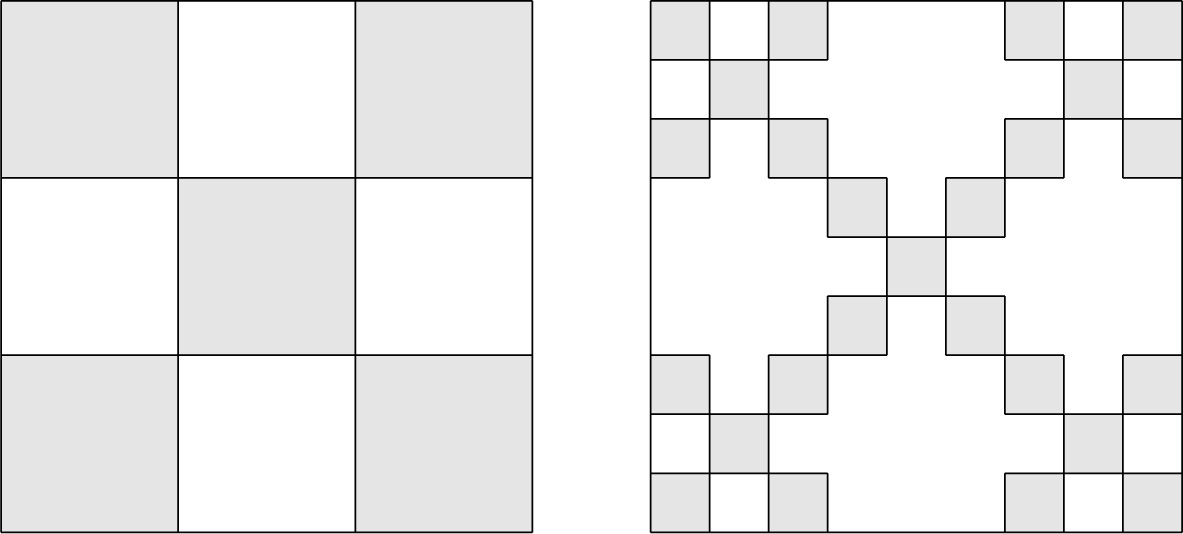
The two first iterations of the unit square in the case r = 1/3
We name the vertices of [0,1]2 : p1 = (0, 1), p2 = (1, 1), p3 = (0,0) and p4, = (1,0), and for the vertices in the first iteration:
(see Figure 3).
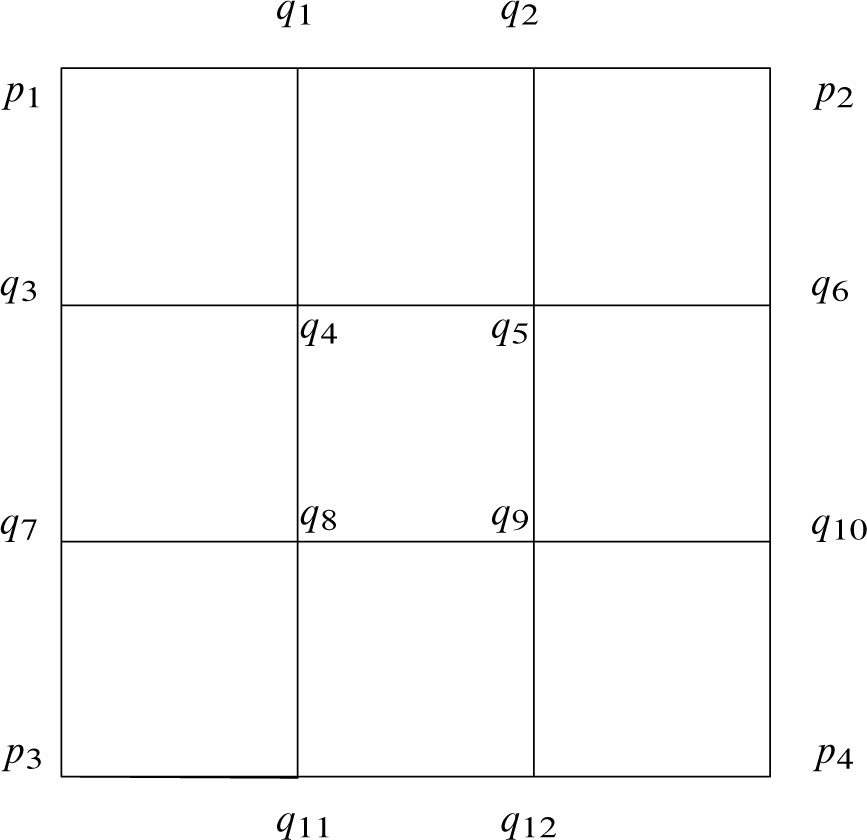
Vertices considered in the unit square
For the sake of our paper, we state that a function h defined in C is harmonic if
implies that
And the same occurs on each of the squares that appear at each stage. G can be extended to C by continuity, because the set of vertices of the squares form a dense set. These functions will be denoted by
When we are restricted to the diagonal, it is necessary to study the subsets G1 ([0, 1]2), G3 ([0, 1]2) and G5([0, 1]2) : they are the new squares having a non-empty intersection with it. The self-similarity of the set and the way the function takes the values at the vertices of the new squares, allow us to write the following equations:
that can be rewritten as:
Set gα : [0,1] → [0,1], gα(x) := hα ((x, x)) for all x ∈ [0,1]. The above equalities for these functions give:
and if α = 1/2, then they become the functional equations for
Now attending to the functional equations of fr,1-r (with 0 < r < 1/2) we have the following result.
gα is a singular function.
Proof. The equalities already established for the family of functions gα ensure the way to divide the unit interval [0,1] into subintervals where the corresponding function is the scale copy of
There exists a set of measure zero and Hausdorff dimension
There exists a set of measure one that is mapped on a set of measure zero by gα,r and Hausdorff dimension
This study can be generalized to the set C’ determined as the fixed point of the mapping generated by the following functions:
The results are analogous, but the functions we now obtain are the inverses of fr, r’, and the fractal dimensions of the related fractal sets are
5.3 Strong Negations
In the framework of Fuzzy Logic, a strictly decreasing mapping n : [0,1] → [0,1] is a strong negation if n2(x) : = n ∘ n(x) = x for all x in [0,1] (see [32]). Next, we are going to introduce a family of strong negations related to the functions we have studied.
For 0 < a < b < 1, the function na,b : [0, 1] → [0, 1] given by
for all x in [0, 1] is a strong negation.
Proof. Continuity and monotony are evident. Through functional equations (3), we deduce that na,b, is the only function defined in [0,1] that is bounded and satisfies the relations:
By the definition of na,b and properties of fab(1-b)(1-a):
The others follow is an analogous way. Finally, its uniqueness follows from that of fab(1—b)(1—a) in (3) or from the fixed point Banach theorem.
To show that
However, the solution of this system is unique in the unit interval, and this is the identity function. Thus,
6 Conclusions
We have studied a wide family of two-parametric singular functions. To this end, we introduce a biparametric representation system that allows us to give an explicit expression of these functions and to calculate the Hausdorff dimension of several sets with distinguished properties for fa,b.
In addition, we have examined some applications of the study of these families of singular functions obtaining Katok foliations, results concerning its relations with fractal harmonic analysis and with strong negations.
For further investigations we are interested in the study of these functions in the context of homeomorphisms between the supports of copulas with fractal support [31], as they appear in the disintegration of the measure associated to some self-similar copulas, and in the study of functions generated as fa,b but with random a and b.
Acknowledgement
This work was supported by the Ministerio de Economía y Competitividad (Spain) under Research Project No. MTM2014-60594-P and partially supported by FEDER.
References
[1] Cantor G., De la puissance des ensembles parfait de points, Acta Math., 1884, 4, 381-39210.1007/BF02418423Search in Google Scholar
[2] Billingsley P., Probability and Measure (2nd edn.), Wiley, New York, 1995Search in Google Scholar
[3] Jessen B., Wintner A., Distribution functions and the Riemann zeta-function, Trans.Amer.Math.Soc., 1935, 38, 48-8810.1090/S0002-9947-1935-1501802-5Search in Google Scholar
[4] Wen L., An approach to construct the singular monotone functions by using Markov chains, Taiwanese J. Math., 1998, 2 (3), 361- 36810.11650/twjm/1500406976Search in Google Scholar
[5] Minkowski H., Verhandlungen des III Internationalen Mathematiker-kongresses in Heidelberg, 1904Search in Google Scholar
[6] Paradís J., Viader P., Bibiloni L., The derivative of Minkowski’s ?(x) function, J. Math. Anal. Appl., 2001, 253 (1), 107-12510.1006/jmaa.2000.7064Search in Google Scholar
[7] Salem R., On Some Singular Monotone Functions which Are Strictly Increasing, Trans. Amer. Math. Soc, 1943, 53, 427-43910.1090/S0002-9947-1943-0007929-6Search in Google Scholar
[8] Viader P., Paradís J., Bibiloni L., A New Light on Minkowski’s ?(x) Function, J. Number Theory, 1998, 73, 212-22710.1006/jnth.1998.2294Search in Google Scholar
[9] Bibiloni L., Paradís J., Viader P., Fibonacci, Van der Corput and Riesz-Nágy, J. Math. Anal. Appl., 2010, 362 (2), 401-41410.1016/j.jmaa.2009.08.004Search in Google Scholar
[10] Dovgoshey O., Martio O., Ryazanov V., Vuorinen M., The Cantor function, Expo. Math., 2006, 24, 1-3710.1016/j.exmath.2005.05.002Search in Google Scholar
[11] Cahen E., Exemple simple d’une fonction continue n’ayant pas de dérivée pour une infinite de valeurs de la variable, L’Enseignement Mathématique, 1906, 8, 361-365Search in Google Scholar
[12] Kairies H.H., Functional equations for peculiar functions, Aequ. Math., 1997, 53, 207-24110.1007/BF02215973Search in Google Scholar
[13] Paradís J., Viader P., Bibiloni L., Riesz-N ágy singular functions revisited, J. Math. Anal. Appl., 2007, 329, 592-60210.1016/j.jmaa.2006.06.082Search in Google Scholar
[14] Takacs L., An increasing continuous singular function, Amer. Math. Soc., 1978, 85, 35-3610.2307/2978047Search in Google Scholar
[15] de Amo E., Díaz Carrillo M., Fernández Sánchez J., On duality of aggregation operators and k-negations, Fuzzy Sets and Systems, 2011, 181, 14-2710.1016/j.fss.2011.05.021Search in Google Scholar
[16] de Amo E., Díaz Carrillo M., Fernández Sánchez J., On Singular Functions with Applications to Fractal Dimensions and Generalized Takagi Functions, 2012, Acta Appl. Math. 119 (1), 129-14810.1007/s10440-011-9665-zSearch in Google Scholar
[17] Okamoto H., A remark on continuous, nowhere differentiable functions, Proc. Japan Acad. Ser. A Math. Sci., 2005, 81 (3), 47-5010.3792/pjaa.81.47Search in Google Scholar
[18] Okamoto H., Wunsch M., A geometric construction of continuous, strictly increasing singular functions, Proc. Japan Acad., Ser. A Math. Sci., 2007, 83, 114-11810.3792/pjaa.83.114Search in Google Scholar
[19] McCollum J., Further notes on a family of continuous, nondifferentiable functions, New York J. Math., 2011, 17, 569-577Search in Google Scholar
[20] Falconer K.J., Fractal Geometry. Mathematical foundations and Applications, John Whiley Sons, Chichester, 199010.2307/2532125Search in Google Scholar
[21] Edgar G.A., Measure, Topology and Fractal Geometry, Springer-Verlag, New York, 199010.1007/978-1-4757-4134-6Search in Google Scholar
[22] Kobayashi K., On the critical case of Okamoto’s continuous non-differentiable functions, Proc.Japan Acad. Ser. A, 2009, 85, 101- 10410.3792/pjaa.85.101Search in Google Scholar
[23] Elliott P.D.T.A., Probabilistic number theory, I: Mean-value theorems, Grundlehren der MathematischenWissenschaften, Springer, New York, 197910.1007/978-1-4612-9989-9Search in Google Scholar
[24] Hardy G.H., Wright E.M., An Introduction to the Theory of Numbers, 5th edn., Oxford, England, Clarendon Press, 1979Search in Google Scholar
[25] Niven I.M., Irrational Numbers, Wiley, New York, 195610.5948/9781614440116Search in Google Scholar
[26] Kuwata T., Udagawa M., On infinite convolutions , Kadai Math. Sem. Rep., 1949, 1 (3-4), 15-2210.2996/kmj/1138833471Search in Google Scholar
[27] Milnor J., Fubini foiled: Katok’s paradoxical example in Measure Theory, Math. Intelligencer, 1997, 19, 30-3210.1007/BF03024428Search in Google Scholar
[28] Kigami J.I., Analysis on Fractals, Cambridge University Press, 200110.1017/CBO9780511470943Search in Google Scholar
[29] de Amo, E., Díaz Carrillo, M. and Fernández-Sánchez, J.: Harmonic Analysis on the Sierpinski gasket and singular functions, Acta Math. Hungar., 2014 143 , 58-7410.1007/s10474-013-0373-1Search in Google Scholar
[30] de Amo E., Díaz Carrillo M., Fernández Sánchez J., Copulas and associated fractal sets, J. Math. Anal. Appl., 2012, 386, 528- 54110.1016/j.jmaa.2011.08.017Search in Google Scholar
[31] Fredricks G.A., Nelsen R.B., Rodríguez-Lallena J.A., Copulas with fractal supports, Insurance Math. Economics, 2005 37, 42-4810.1016/j.insmatheco.2004.12.004Search in Google Scholar
[32] Trillas E., Sobre funciones de negación en la teoría de conjuntos difusos, Stochastica, 1979, 3 (1), 47-59Search in Google Scholar
© 2016 de Amo et al.
This work is licensed under the Creative Commons Attribution-NonCommercial-NoDerivatives 3.0 License.
Articles in the same Issue
- Regular Article
-
A metric graph satisfying
- Regular Article
- On the Riemann-Hilbert problem in multiply connected domains
- Regular Article
- Hamilton cycles in almost distance-hereditary graphs
- Regular Article
- Locally adequate semigroup algebras
- Regular Article
- Parabolic oblique derivative problem with discontinuous coefficients in generalized weighted Morrey spaces
- Corrigendum
- Corrigendum to: parabolic oblique derivative problem with discontinuous coefficients in generalized weighted Morrey spaces
- Regular Article
- Some new bounds of the minimum eigenvalue for the Hadamard product of an M-matrix and an inverse M-matrix
- Regular Article
- Integral inequalities involving generalized Erdélyi-Kober fractional integral operators
- Regular Article
- Results on the deficiencies of some differential-difference polynomials of meromorphic functions
- Regular Article
- General numerical radius inequalities for matrices of operators
- Regular Article
- The best uniform quadratic approximation of circular arcs with high accuracy
- Regular Article
- Multiple gcd-closed sets and determinants of matrices associated with arithmetic functions
- Regular Article
- A note on the rate of convergence for Chebyshev-Lobatto and Radau systems
- Regular Article
- On the weakly(α, ψ, ξ)-contractive condition for multi-valued operators in metric spaces and related fixed point results
- Regular Article
- Existence of a common solution for a system of nonlinear integral equations via fixed point methods in b-metric spaces
- Regular Article
- Bounds for the Z-eigenpair of general nonnegative tensors
- Regular Article
- Subsymmetry and asymmetry models for multiway square contingency tables with ordered categories
- Regular Article
- End-regular and End-orthodox generalized lexicographic products of bipartite graphs
- Regular Article
- Refinement of the Jensen integral inequality
- Regular Article
- New iterative codes for 𝓗-tensors and an application
- Regular Article
- A result for O2-convergence to be topological in posets
- Regular Article
- A fixed point approach to the Mittag-Leffler-Hyers-Ulam stability of a fractional integral equation
- Regular Article
- Uncertainty orders on the sublinear expectation space
- Regular Article
- Generalized derivations of Lie triple systems
- Regular Article
- The BV solution of the parabolic equation with degeneracy on the boundary
- Regular Article
- Malliavin method for optimal investment in financial markets with memory
- Regular Article
- Parabolic sublinear operators with rough kernel generated by parabolic calderön-zygmund operators and parabolic local campanato space estimates for their commutators on the parabolic generalized local morrey spaces
- Regular Article
- On annihilators in BL-algebras
- Regular Article
- On derivations of quantales
- Regular Article
-
On the closed subfields of
- Regular Article
- A class of tridiagonal operators associated to some subshifts
- Regular Article
- Some notes to existence and stability of the positive periodic solutions for a delayed nonlinear differential equations
- Regular Article
- Weighted fractional differential equations with infinite delay in Banach spaces
- Regular Article
- Laplace-Stieltjes transform of the system mean lifetime via geometric process model
- Regular Article
- Various limit theorems for ratios from the uniform distribution
- Regular Article
- On α-almost Artinian modules
- Regular Article
- Limit theorems for the weights and the degrees in anN-interactions random graph model
- Regular Article
- An analysis on the stability of a state dependent delay differential equation
- Regular Article
- The hybrid mean value of Dedekind sums and two-term exponential sums
- Regular Article
- New modification of Maheshwari’s method with optimal eighth order convergence for solving nonlinear equations
- Regular Article
- On the concept of general solution for impulsive differential equations of fractional-order q ∈ (2,3)
- Regular Article
- A Riesz representation theory for completely regular Hausdorff spaces and its applications
- Regular Article
- Oscillation of impulsive conformable fractional differential equations
- Regular Article
- Dynamics of doubly stochastic quadratic operators on a finite-dimensional simplex
- Regular Article
- Homoclinic solutions of 2nth-order difference equations containing both advance and retardation
- Regular Article
- When do L-fuzzy ideals of a ring generate a distributive lattice?
- Regular Article
- Fully degenerate poly-Bernoulli numbers and polynomials
- Commentary
- Commentary to: Generalized derivations of Lie triple systems
- Regular Article
- Simple sufficient conditions for starlikeness and convexity for meromorphic functions
- Regular Article
- Global stability analysis and control of leptospirosis
- Regular Article
- Random attractors for stochastic two-compartment Gray-Scott equations with a multiplicative noise
- Regular Article
- The fuzzy metric space based on fuzzy measure
- Regular Article
- A classification of low dimensional multiplicative Hom-Lie superalgebras
- Regular Article
- Structures of W(2.2) Lie conformal algebra
- Regular Article
- On the number of spanning trees, the Laplacian eigenvalues, and the Laplacian Estrada index of subdivided-line graphs
- Regular Article
- Parabolic Marcinkiewicz integrals on product spaces and extrapolation
- Regular Article
- Prime, weakly prime and almost prime elements in multiplication lattice modules
- Regular Article
- Pochhammer symbol with negative indices. A new rule for the method of brackets
- Regular Article
- Outcome space range reduction method for global optimization of sum of affine ratios problem
- Regular Article
- Factorization theorems for strong maps between matroids of arbitrary cardinality
- Regular Article
- A convergence analysis of SOR iterative methods for linear systems with weak H-matrices
- Regular Article
- Existence theory for sequential fractional differential equations with anti-periodic type boundary conditions
- Regular Article
- Some congruences for 3-component multipartitions
- Regular Article
- Bound for the largest singular value of nonnegative rectangular tensors
- Regular Article
- Convolutions of harmonic right half-plane mappings
- Regular Article
- On homological classification of pomonoids by GP-po-flatness of S-posets
- Regular Article
- On CSQ-normal subgroups of finite groups
- Regular Article
- The homogeneous balance of undetermined coefficients method and its application
- Regular Article
- On the saturated numerical semigroups
- Regular Article
- The Bruhat rank of a binary symmetric staircase pattern
- Regular Article
- Fixed point theorems for cyclic contractive mappings via altering distance functions in metric-like spaces
- Regular Article
- Singularities of lightcone pedals of spacelike curves in Lorentz-Minkowski 3-space
- Regular Article
- An S-type upper bound for the largest singular value of nonnegative rectangular tensors
- Regular Article
- Fuzzy ideals of ordered semigroups with fuzzy orderings
- Regular Article
- On meromorphic functions for sharing two sets and three sets in m-punctured complex plane
- Regular Article
- An incremental approach to obtaining attribute reduction for dynamic decision systems
- Regular Article
- Very true operators on MTL-algebras
- Regular Article
- Value distribution of meromorphic solutions of homogeneous and non-homogeneous complex linear differential-difference equations
- Regular Article
- A class of 3-dimensional almost Kenmotsu manifolds with harmonic curvature tensors
- Regular Article
- Robust dynamic output feedback fault-tolerant control for Takagi-Sugeno fuzzy systems with interval time-varying delay via improved delay partitioning approach
- Regular Article
- New bounds for the minimum eigenvalue of M-matrices
- Regular Article
- Semi-quotient mappings and spaces
- Regular Article
- Fractional multilinear integrals with rough kernels on generalized weighted Morrey spaces
- Regular Article
- A family of singular functions and its relation to harmonic fractal analysis and fuzzy logic
- Regular Article
- Solution to Fredholm integral inclusions via (F, δb)-contractions
- Regular Article
- An Ulam stability result on quasi-b-metric-like spaces
- Regular Article
- On the arrowhead-Fibonacci numbers
- Regular Article
- Rough semigroups and rough fuzzy semigroups based on fuzzy ideals
- Regular Article
- The general solution of impulsive systems with Riemann-Liouville fractional derivatives
- Regular Article
- A remark on local fractional calculus and ordinary derivatives
- Regular Article
- Elastic Sturmian spirals in the Lorentz-Minkowski plane
- Topical Issue: Metaheuristics: Methods and Applications
- Bias-variance decomposition in Genetic Programming
- Topical Issue: Metaheuristics: Methods and Applications
- A novel generalized oppositional biogeography-based optimization algorithm: application to peak to average power ratio reduction in OFDM systems
- Special Issue on Recent Developments in Differential Equations
- Modeling of vibration for functionally graded beams
- Special Issue on Recent Developments in Differential Equations
- Decomposition of a second-order linear time-varying differential system as the series connection of two first order commutative pairs
- Special Issue on Recent Developments in Differential Equations
- Differential equations associated with generalized Bell polynomials and their zeros
- Special Issue on Recent Developments in Differential Equations
- Differential equations for p, q-Touchard polynomials
- Special Issue on Recent Developments in Differential Equations
- A new approach to nonlinear singular integral operators depending on three parameters
- Special Issue on Recent Developments in Differential Equations
- Performance and stochastic stability of the adaptive fading extended Kalman filter with the matrix forgetting factor
- Special Issue on Recent Developments in Differential Equations
- On new characterization of inextensible flows of space-like curves in de Sitter space
- Special Issue on Recent Developments in Differential Equations
- Convergence theorems for a family of multivalued nonexpansive mappings in hyperbolic spaces
- Special Issue on Recent Developments in Differential Equations
- Fractional virus epidemic model on financial networks
- Special Issue on Recent Developments in Differential Equations
- Reductions and conservation laws for BBM and modified BBM equations
- Special Issue on Recent Developments in Differential Equations
- Extinction of a two species non-autonomous competitive system with Beddington-DeAngelis functional response and the effect of toxic substances
Articles in the same Issue
- Regular Article
-
A metric graph satisfying
- Regular Article
- On the Riemann-Hilbert problem in multiply connected domains
- Regular Article
- Hamilton cycles in almost distance-hereditary graphs
- Regular Article
- Locally adequate semigroup algebras
- Regular Article
- Parabolic oblique derivative problem with discontinuous coefficients in generalized weighted Morrey spaces
- Corrigendum
- Corrigendum to: parabolic oblique derivative problem with discontinuous coefficients in generalized weighted Morrey spaces
- Regular Article
- Some new bounds of the minimum eigenvalue for the Hadamard product of an M-matrix and an inverse M-matrix
- Regular Article
- Integral inequalities involving generalized Erdélyi-Kober fractional integral operators
- Regular Article
- Results on the deficiencies of some differential-difference polynomials of meromorphic functions
- Regular Article
- General numerical radius inequalities for matrices of operators
- Regular Article
- The best uniform quadratic approximation of circular arcs with high accuracy
- Regular Article
- Multiple gcd-closed sets and determinants of matrices associated with arithmetic functions
- Regular Article
- A note on the rate of convergence for Chebyshev-Lobatto and Radau systems
- Regular Article
- On the weakly(α, ψ, ξ)-contractive condition for multi-valued operators in metric spaces and related fixed point results
- Regular Article
- Existence of a common solution for a system of nonlinear integral equations via fixed point methods in b-metric spaces
- Regular Article
- Bounds for the Z-eigenpair of general nonnegative tensors
- Regular Article
- Subsymmetry and asymmetry models for multiway square contingency tables with ordered categories
- Regular Article
- End-regular and End-orthodox generalized lexicographic products of bipartite graphs
- Regular Article
- Refinement of the Jensen integral inequality
- Regular Article
- New iterative codes for 𝓗-tensors and an application
- Regular Article
- A result for O2-convergence to be topological in posets
- Regular Article
- A fixed point approach to the Mittag-Leffler-Hyers-Ulam stability of a fractional integral equation
- Regular Article
- Uncertainty orders on the sublinear expectation space
- Regular Article
- Generalized derivations of Lie triple systems
- Regular Article
- The BV solution of the parabolic equation with degeneracy on the boundary
- Regular Article
- Malliavin method for optimal investment in financial markets with memory
- Regular Article
- Parabolic sublinear operators with rough kernel generated by parabolic calderön-zygmund operators and parabolic local campanato space estimates for their commutators on the parabolic generalized local morrey spaces
- Regular Article
- On annihilators in BL-algebras
- Regular Article
- On derivations of quantales
- Regular Article
-
On the closed subfields of
- Regular Article
- A class of tridiagonal operators associated to some subshifts
- Regular Article
- Some notes to existence and stability of the positive periodic solutions for a delayed nonlinear differential equations
- Regular Article
- Weighted fractional differential equations with infinite delay in Banach spaces
- Regular Article
- Laplace-Stieltjes transform of the system mean lifetime via geometric process model
- Regular Article
- Various limit theorems for ratios from the uniform distribution
- Regular Article
- On α-almost Artinian modules
- Regular Article
- Limit theorems for the weights and the degrees in anN-interactions random graph model
- Regular Article
- An analysis on the stability of a state dependent delay differential equation
- Regular Article
- The hybrid mean value of Dedekind sums and two-term exponential sums
- Regular Article
- New modification of Maheshwari’s method with optimal eighth order convergence for solving nonlinear equations
- Regular Article
- On the concept of general solution for impulsive differential equations of fractional-order q ∈ (2,3)
- Regular Article
- A Riesz representation theory for completely regular Hausdorff spaces and its applications
- Regular Article
- Oscillation of impulsive conformable fractional differential equations
- Regular Article
- Dynamics of doubly stochastic quadratic operators on a finite-dimensional simplex
- Regular Article
- Homoclinic solutions of 2nth-order difference equations containing both advance and retardation
- Regular Article
- When do L-fuzzy ideals of a ring generate a distributive lattice?
- Regular Article
- Fully degenerate poly-Bernoulli numbers and polynomials
- Commentary
- Commentary to: Generalized derivations of Lie triple systems
- Regular Article
- Simple sufficient conditions for starlikeness and convexity for meromorphic functions
- Regular Article
- Global stability analysis and control of leptospirosis
- Regular Article
- Random attractors for stochastic two-compartment Gray-Scott equations with a multiplicative noise
- Regular Article
- The fuzzy metric space based on fuzzy measure
- Regular Article
- A classification of low dimensional multiplicative Hom-Lie superalgebras
- Regular Article
- Structures of W(2.2) Lie conformal algebra
- Regular Article
- On the number of spanning trees, the Laplacian eigenvalues, and the Laplacian Estrada index of subdivided-line graphs
- Regular Article
- Parabolic Marcinkiewicz integrals on product spaces and extrapolation
- Regular Article
- Prime, weakly prime and almost prime elements in multiplication lattice modules
- Regular Article
- Pochhammer symbol with negative indices. A new rule for the method of brackets
- Regular Article
- Outcome space range reduction method for global optimization of sum of affine ratios problem
- Regular Article
- Factorization theorems for strong maps between matroids of arbitrary cardinality
- Regular Article
- A convergence analysis of SOR iterative methods for linear systems with weak H-matrices
- Regular Article
- Existence theory for sequential fractional differential equations with anti-periodic type boundary conditions
- Regular Article
- Some congruences for 3-component multipartitions
- Regular Article
- Bound for the largest singular value of nonnegative rectangular tensors
- Regular Article
- Convolutions of harmonic right half-plane mappings
- Regular Article
- On homological classification of pomonoids by GP-po-flatness of S-posets
- Regular Article
- On CSQ-normal subgroups of finite groups
- Regular Article
- The homogeneous balance of undetermined coefficients method and its application
- Regular Article
- On the saturated numerical semigroups
- Regular Article
- The Bruhat rank of a binary symmetric staircase pattern
- Regular Article
- Fixed point theorems for cyclic contractive mappings via altering distance functions in metric-like spaces
- Regular Article
- Singularities of lightcone pedals of spacelike curves in Lorentz-Minkowski 3-space
- Regular Article
- An S-type upper bound for the largest singular value of nonnegative rectangular tensors
- Regular Article
- Fuzzy ideals of ordered semigroups with fuzzy orderings
- Regular Article
- On meromorphic functions for sharing two sets and three sets in m-punctured complex plane
- Regular Article
- An incremental approach to obtaining attribute reduction for dynamic decision systems
- Regular Article
- Very true operators on MTL-algebras
- Regular Article
- Value distribution of meromorphic solutions of homogeneous and non-homogeneous complex linear differential-difference equations
- Regular Article
- A class of 3-dimensional almost Kenmotsu manifolds with harmonic curvature tensors
- Regular Article
- Robust dynamic output feedback fault-tolerant control for Takagi-Sugeno fuzzy systems with interval time-varying delay via improved delay partitioning approach
- Regular Article
- New bounds for the minimum eigenvalue of M-matrices
- Regular Article
- Semi-quotient mappings and spaces
- Regular Article
- Fractional multilinear integrals with rough kernels on generalized weighted Morrey spaces
- Regular Article
- A family of singular functions and its relation to harmonic fractal analysis and fuzzy logic
- Regular Article
- Solution to Fredholm integral inclusions via (F, δb)-contractions
- Regular Article
- An Ulam stability result on quasi-b-metric-like spaces
- Regular Article
- On the arrowhead-Fibonacci numbers
- Regular Article
- Rough semigroups and rough fuzzy semigroups based on fuzzy ideals
- Regular Article
- The general solution of impulsive systems with Riemann-Liouville fractional derivatives
- Regular Article
- A remark on local fractional calculus and ordinary derivatives
- Regular Article
- Elastic Sturmian spirals in the Lorentz-Minkowski plane
- Topical Issue: Metaheuristics: Methods and Applications
- Bias-variance decomposition in Genetic Programming
- Topical Issue: Metaheuristics: Methods and Applications
- A novel generalized oppositional biogeography-based optimization algorithm: application to peak to average power ratio reduction in OFDM systems
- Special Issue on Recent Developments in Differential Equations
- Modeling of vibration for functionally graded beams
- Special Issue on Recent Developments in Differential Equations
- Decomposition of a second-order linear time-varying differential system as the series connection of two first order commutative pairs
- Special Issue on Recent Developments in Differential Equations
- Differential equations associated with generalized Bell polynomials and their zeros
- Special Issue on Recent Developments in Differential Equations
- Differential equations for p, q-Touchard polynomials
- Special Issue on Recent Developments in Differential Equations
- A new approach to nonlinear singular integral operators depending on three parameters
- Special Issue on Recent Developments in Differential Equations
- Performance and stochastic stability of the adaptive fading extended Kalman filter with the matrix forgetting factor
- Special Issue on Recent Developments in Differential Equations
- On new characterization of inextensible flows of space-like curves in de Sitter space
- Special Issue on Recent Developments in Differential Equations
- Convergence theorems for a family of multivalued nonexpansive mappings in hyperbolic spaces
- Special Issue on Recent Developments in Differential Equations
- Fractional virus epidemic model on financial networks
- Special Issue on Recent Developments in Differential Equations
- Reductions and conservation laws for BBM and modified BBM equations
- Special Issue on Recent Developments in Differential Equations
- Extinction of a two species non-autonomous competitive system with Beddington-DeAngelis functional response and the effect of toxic substances
