
Exploring L2 graduate writers’ identity construction in research writing practices: a symbolic interactionism perspective
-
Yujie Peng
Yujie Peng is a lecturer and a postdoctoral researcher at the School of Foreign Languages, Soochow University, China. Her research interests include English for academic purposes, second language writing, and computer-assisted language learning.


Abstract
Research on identity construction among second language (L2) writers has revealed the dynamic interactions between L2 writers and the linguistic, textual, and social resources. However, how emerging scholarly writers construct their identities during their initial attempts at English research writing remains underexplored. To address this gap, the study investigated how two L2 graduate writers constructed their identities during the microprocess of writing their thesis proposals, using a symbolic interactionism perspective. Drawing on multiple data sources, the study found that, through their engagement with textual and social practices, the participants explored and interpreted their roles as scholarly writers, researchers, and graduate students. By interacting with peers, instructors, and advisors within their communities of practice, they each developed unique identities through passive or agentive role-taking and even active role-making. The findings underscore the dynamic, interactive process by which L2 graduate writers negotiated their roles and constructed their identities in the microprocesses of English research writing. The study also highlights the potential of symbolic interactionism as a framework for revealing the meanings underlying interactions between individuals and their social or textual practices.
1 Introduction
Over the past two decades, the issue of identity has garnered significant attention in the field of applied linguistics, particularly in the topic area of English research writing. The construction of an appropriate disciplinary or academic identity plays a vital role in the success of research writing and the writers’ scholarly career development (Flowerdew and Wang 2015; Hyland 2015). Previous research has examined the identity construction of academic writers from various perspectives, including the textual representation of writer identity (Burgess and Ivanič 2010; Hyland 2012; Ivanič 1998), readers’ perception and construction of writer identity (Jeffery 2011; Matsuda and Tardy 2007), and the dynamics of identity formation within the social processes of academic writing (Canagarajah 2015; Mochizuki and Starfield 2021). Studies among English as a Foreign Language learners have also pointed out the essential role of interaction in their ongoing identity construction (e.g., Guan 2021). Nevertheless, relatively few studies have delved into the microprocesses of writing to explore how identity construction is shaped by writers’ ongoing interactions within their communities of practice, recognizing that different writers may interpret and derive meaning from these interactions in diverse ways.
Furthermore, while existing research has explored the identity construction of early-career scholars (e.g., Starfield and Paltridge 2019), it has predominantly focused on doctoral students, with relatively little attention given to master’s students. For master’s students, their engagement in English research writing at this stage may be pivotal in shaping their early decisions or judgment about whether they can establish and maintain an academic identity through research writing. Therefore, this study adopts a symbolic interactionist approach (Blumer 1969; Turner 1990) to examine how two L2 graduate writers constructed their identities during the thesis proposal writing process through intensive interactions with academic peers, their seminar instructor, and advisors. This study offers practical insights into how master’s programs and research writing courses may effectively support the development of academic identities among master’s students.
2 Literature review
Around the early 2000s, research on writer identity was influenced by postmodernist views (Ivanič 1998; Matsuda 2001), which conceptualized identity as shaped by social practices (González et al. 1994; Leary 1994). These socially shared concepts and practices often manifest in the discursive features of written texts (Gee 1990). Ivanič (1998), through a study of eight native English-speaking writers, identified four dimensions of writer identity: autobiographical self, discoursal self, self as author, and the possibilities of selfhood. Similarly, in the studies of language learning, it was found that learners might use semiotic resources and their lived experiences to make sense of and engage with the target language and culture (Chen and Zhou 2024). Researchers have also analyzed the discursive features of writing in disciplinary and professional contexts to examine how writers constructed their identities. For instance, Hyland (2008, 2012 used corpus-based methods to examine the lexico-grammatical features of written texts, uncovering patterns of disciplinary identity construction through recurring lexico-grammatical features in academic genres specific to certain fields. His studies, by comparing individual written texts with a corpus representative of writing in a particular discipline, allows for an understanding how writers balance expressing their individuality while adhering to the conventions of the disciplinary discourse communities.
In addition to studies examining the construction of scholarly or authorial identity through the choice of textual resources, identity research in writing has also explored how writers negotiate and develop their academic identities within the social practices of writing, such as classroom writing, supervisory guidance, and peer review activities (e.g., Mochizuki and Starfield 2021; Starfield and Paltridge 2019). According to Bakhtin’s (1981, 1986 theory of dialogism, academic identity is constructed through dialogues, emerging from dialogues with other members of the community. Canagarajah (2015) used a narrative approach to describe the process through which a master’s student negotiated meaning and constructed voice by leveraging rich teacher–student and peer-to-peer interactional resources in a classroom setting. He framed the construction of the student’s desired voice along four dimensions: identity, role, subjectivity, and awareness. In the context of his study, identity refers to an individual’s personal experiences and background that exist beyond the written text. Role relates to the responsibilities and identities a person holds within academic, institutional, professional, or familial settings. Subjectivity involves the ideological influences on one’s voice, conveyed through established genre conventions, communication norms, and value systems. Awareness represents an individual’s capacity for reflective understanding, enabling them to strategically and consciously choose language while distancing themselves from social, historical, and ideological constraints (Canagarajah 2015; Tardy 2012). While Canagarajah (2015) highlighted how L2 writers navigated predetermined responsibilities and social expectations in constructing their voices in writing, his work also underscored the interplay between social structure and individual agency. His findings align with the broader understanding that identity construction is shaped by both external expectations and writers’ internalized responses to these expectations.
Although empirical studies on writer identity have explored the psychological and agentive dimensions of writer agency (e.g., Canagarajah 2015), relatively few have explicitly examined how writers actively negotiate and redefine socially prescribed roles during the microprocesses of writing. One notable exception is Ho (2017), who observed that doctoral students demonstrated agency while responding to reviewer feedback, particularly when navigating tensions between their supervisors’ advice and journal reviewers’ expectations. In these instances, students acted as role-makers, strategically persuading their supervisors and challenging conventional hierarchies to reconcile feedback with their evolving scholarly identities. Such findings illustrate that role-making can occur within the nuanced interactions of academic writing and may often manifest as strategic decisions during specific microprocesses, such as revising and negotiating feedback. Role-making, as theorized by Turner (1962, 1990), denotes actively negotiating and redefining socially prescribed roles to align with one’s evolving self-concept. This perspective expands our understanding of identity as not merely a reflection of societal expectations but also a process of creative agency.
In summary, research on identity in academic writing has extensively examined textual and discursive expressions of identity, often emphasizing the influence of social structures on writers’ choices of linguistic and rhetorical resources (e.g., Hyland 2012; Ivanič 1998). However, while empirical studies provided evidence of the agentic, iterative process by which writers engage with and shape their roles (e.g., Canagarajah 2015; Ho 2017), there remains still a paucity of focused inquiry into writers’ adoption of socially prescribed roles and their agentive redefinition of those roles. Understanding how writers navigate this dynamic process requires examining how they interpret the meanings embedded in their interactions during the microprocesses of composing and revising, and how these interpretations contribute to their identity construction, yet this remains a challenge within existing research frameworks.
3 Theoretical perspective: symbolic interactionism
To explore how graduate students construct their identities through their interpretation of social interactions during the microprocesses of English research writing, this study adopts symbolic interactionism as its theoretical framework. Symbolic interactionism provides a lens for understanding the interplay between social structures and individual agency in identity construction. Blumer (1969) developed symbolic interactionism based on Mead’s (1934) foundational ideas about the interplay between self and society. While Mead emphasized the interconnectedness of self-identification and the enactment of social roles, Blumer introduced his own view of human behavior as a process of symbol manipulation and meaning negotiation (Carter and Fuller 2015). Blumer, deeply influenced by Mead as his former teaching assistant, expanded upon Mead’s ideas and formalized the core principles of symbolic interactionism. He outlined three key premises of symbolic interactionism: 1) Individuals act toward objects based on the meanings those objects hold for them; 2) Identity construction emerges through individuals’ participation in social interactions and is shaped by the roles they take on in these interactions; and 3) The meaning assigned to objects evolve through ongoing interpretation of social reality. Blumer also advocated for the use of a qualitative approach to studying the nature of human actions, underscoring the importance of clearly defining concepts, and using them to interpret the participants’ actions.
A key aspect of symbolic interactionism is the interplay between role-taking and role-making in identity construction. Role-taking refers to individuals adopting socially prescribed responsibilities or expectations (Mead 1934). However, this process is not entirely passive, as individuals may choose whether to adopt certain roles or challenge the expectations associated with them. Role-making, on the other hand, refers to the active creation or modification of roles based on individuals’ interpretations of the role demands in relational terms while they interact with the corresponding roles in social structure (Turner 1962, 1990). For example, understanding what it means to be a student requires understanding the corresponding role of a teacher. This perspective underscores that roles are shaped by societal expectations yet open to reinterpretation by individuals (Carter and Fuller 2015). Role-making thus enables individuals to transcend societal constraints at behavioral or cognitive levels, as they redefine or reimagine their roles. As Scott (2024: 151) explains, “The definition of the situation provides the cast with a template set of roles to perform and scripts to follow,” yet how individuals perform these roles can vary depending on their subjective interpretations and alignment with socially desirable values. This dynamic duality is particularly relevant for understanding how L2 graduate writers navigate the complexities of research writing, as they balance societal expectations with their agency in constructing their scholarly identities. Identity in this study is conceptualized as both a social and personal construct. Mead (1934) and Blumer (1969) emphasize the evolving nature of identity, which is continuously shaped through role-taking, role-making, and interactions with others. From this perspective, identity is not merely an individual attribute but a fluid, dynamic process that reflects the interplay between external social structures and internal self-concepts (Scott 2015, 2024).
The emphasis of the symbolic interactionism perspective on the subjective interpretation of social realities aligns with the focus of the present study. In the context of research writing, as graduate writers interact with peers, advisors, and disciplinary conventions, they may engage in role-taking and role-making to shape their scholarly and personal identities, often adapting to or challenging the expectations placed upon them (Ho 2017). While some theoretical perspectives may be more directly related to identity research, they may not be well-suited to the specific context of the present study. For example, while Darvin and Norton’s (2015) model of investment has offered valuable insights into how learners’ investments in language are shaped by ideologies, capital, and social positioning, the model is primarily designed to examine language learners’ identity construction through the lens of broader, often macro-level social and ideological forces. In contrast, symbolic interactionism, with its focus on the micro-level, allows for a more nuanced exploration of the dynamic, everyday interactions between graduate writers and their immediate communities of practice. The focus of symbolic interactionism on the continuous negotiation and interpretation of roles within specific social situations aligns more closely with the aim of the present study to understand how graduate writers actively construct their identities through specific acts of role-taking and role-making in the writing process. By focusing on the evolving interactions between writers and their communities of practice, the perspective of symbolic interactionism allows for an exploration of the dynamic processes underlying graduate writers’ identity construction.
While symbolic interactionism has not been extensively applied in L2 writing research, its use in L2 learning highlights its potential for examining diverse engagement patterns. For example, Peng (2023) developed a model based on symbolic interactionism to examine English learners’ engagement in the Chinese higher education context. Her findings revealed that the meanings learners associated with English learning, ranging from its material attributes (as a subject) to its social attributes (as a vital skill) and abstract attributes (as an area of interest), resulted in variations in learners’ cognitive, affective, and behavioral engagement. This study revealed how students’ agency emerged through their interpretations of social meanings across these three dimensions. Building on this, the present study extends symbolic interactionism to explore how L2 graduate writers engage with textual and social practices while constructing their identities through the microprocesses of composing and revising.
4 Conceptual framework
This study posits that English research writers function as identity symbols, from which social roles, self-awareness, and identity may emerge. Writers’ role choices encompass both their perception of self-identities and the social construction of their identities. In other words, the interaction between subjective interpretation and social construction generates meaning for student writers’ textual and practical practices. As illustrated in Figure 1, this study conceptualizes the identity of L2 graduate writers as continuously shaped through their interactions within the community of practice during the thesis proposal writing process. Through role-taking and role-making, writers negotiate, reconstruct, and refine their identities at different stages of thesis proposal writing. Symbolic interactionism thus provides a robust theoretical framework for understanding how these dynamic interactions contribute to the ongoing development of their identities.
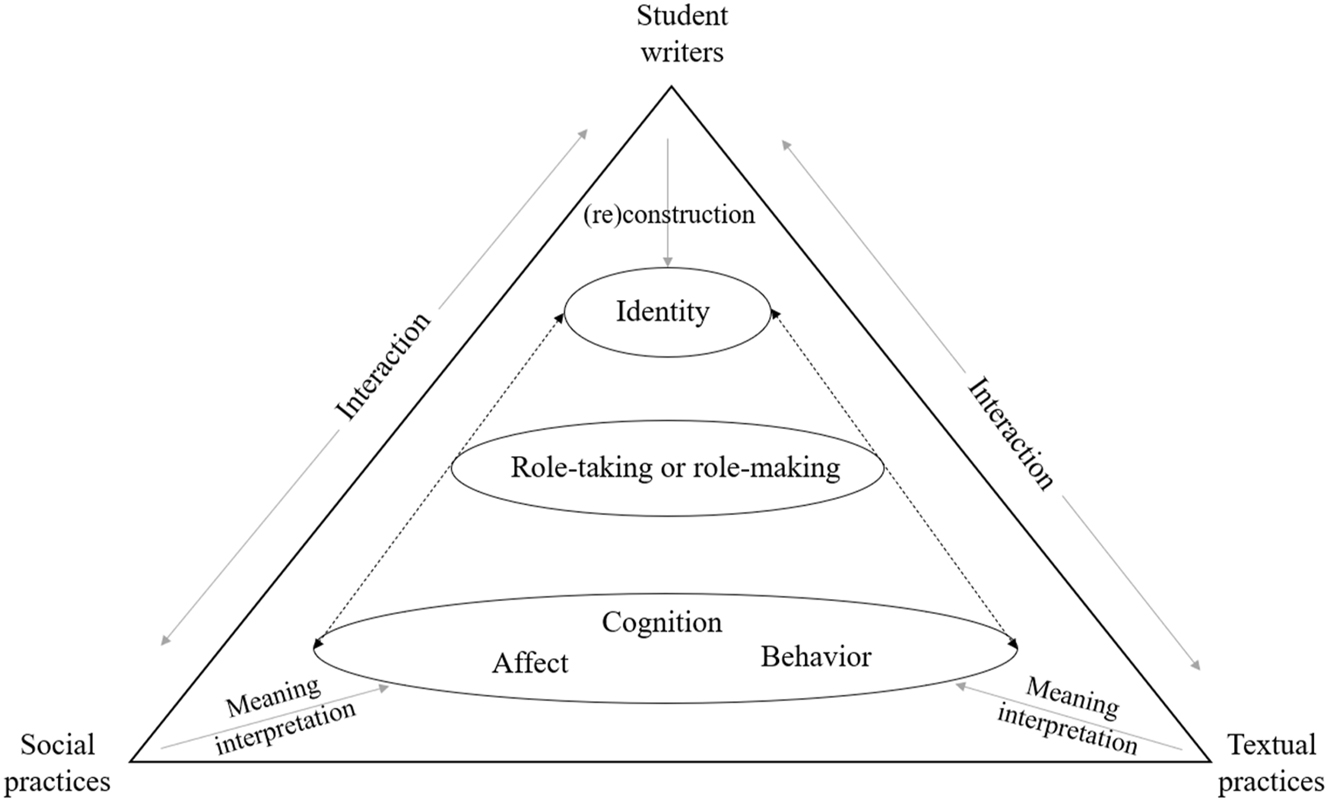
Conceptual framework of the present study.
In the present study, a role refers to the socially defined expectations, behaviors, and norms associated with a particular status or position in society. Roles are often externally assigned and carry expectations for how individuals should behave in particular situations. Identity, on the other hand, is the individual’s internal sense of who they are, which emerges from a combination of social roles and personal experiences. Role-taking is the process by which an individual adopts the perspective of others to understand their thoughts, feelings, and behaviors. Role-making, on the other hand, emphasizes the agentic aspect of social roles, where individuals actively shape and modify the roles they assume, rather than merely occupying the social positions with predefined expectations (Turner 1962). While role-taking involves understanding and internalizing societal roles, role-making allows individuals to add their own personal touch to roles, making them more flexible and dynamic (Turner 1990). In the context of L2 graduate writers, identity construction involves cognitive, affective, and behavioral dimensions as they engage with textual and social practices during the thesis proposal writing process. Identity construction is the ongoing process through which individuals develop a sense of self based on their social interactions, experiences, and the roles they take on or modify. Together, these concepts constitute a framework for this study, illustrating how L2 graduate writers continuously shape and reshape both their identities through interactions with social and textual practices.
The analytical focus of this study centers on how these interactions involve multidimensional engagement across cognitive, affective, and behavioral dimensions. The inclusion of these engagement dimensions is grounded in the theoretical perspective of symbolic interactionism, which emphasizes the interplay between individuals’ internal processes and their social contexts. Symbolic interactionism views emotions, cognition, and behaviors as key mechanisms through which individuals interpret and negotiate social meanings. As Wiest (2024: 278) observes, “membership in particular communities and groups, along with their location in relevant social stratification systems, influence what they notice and acknowledge in and about social life, what rouses their emotional and cognitive processes, and what meanings they ultimately derive from environmental signals.” Emotions, in particular, are deeply social and represent how individuals exercise agency in responding to their social worlds, helping them “navigate dilemmas, constraints, and ambiguities” (McCarthy 2024: 232). Similarly, cognition and behavior are shaped by social situations, as these situations form the preconditions for self-consciousness and thought (McCarthy 2024). Thus, understanding how social meanings influence individuals in specific situations, such as interactions in research writing practices, requires exploration at cognitive, affective, and behavioral levels. These dimensions collectively allow for a nuanced analysis of how writers interpret and respond to social practices during their writing processes.
5 The study
This study employs a qualitative case study approach (Yin 2009) to document the dynamic process of two L2 graduate students’ identity construction during the writing of their thesis proposals over 18 weeks in an academic semester. By examining two individual cases, the study explores both similarities and differences in how these students assume roles and construct their identities. This approach provides insights into the complexity of identity formation in the specific context of graduate-level English research writing.
5.1 Research questions
The study was guided by the following two research questions:
What roles did L2 graduate writers adopt or negotiate during the process of thesis proposal writing?
How did the roles adopted or negotiated by L2 graduate writers during thesis proposal writing influence their identity construction?
5.2 Context and participants
The current study was conducted at a top national university in Southeast China, where master’s students in English departments are required to write a thesis in English as part of their 3-year degree program. By the end of their second academic year, students must submit and defend their thesis proposals, which shall include an introduction to the research topic, the significance of the study, a literature review, the theoretical framework, research methods, and any preliminary findings. To prepare for the thesis, students complete an 18-week research and writing course prior to their proposal defense. The course is structured as a seminar in which second-year graduate students present their thesis proposals for 10- to 20-min sessions, followed by feedback from the class and the instructor. In addition to receiving guidance from their advisors, the seminar serves a crucial source of feedback for their thesis proposals.
I employed a purposeful and criterion-based sampling method to recruit participants (Creswell and Poth 2018). The recruitment was based on the following criteria: (1) the participants must be current master’s students in the program and (2) they must work on their thesis proposals in an environment that involves interactions with others. Five students who met the criteria voluntarily agreed to participate in the present research project. Daisy and Yvone (both pseudonyms) were selected as focal participants in this paper due to their distinct approaches to thesis proposal writing. Yvone initially demonstrated strong academic writing skills but ultimately engaged only superficially with the writing process. In contrast, Daisy, who began with a lack of confidence in her writing abilities, successfully completed her thesis proposal ahead of schedule with high quality.
Both participants were enrolled in the same research and writing course, which included a total of 15 doctoral and master’s students in linguistics and applied linguistics. The course met weekly on Tuesdays from February to June during the spring semester. Daisy presented drafts of her proposal drafts in the 6th and 13th weeks of the course, while Yvone presented hers in the 5th and 10th weeks. Their thesis proposal defense was held on June 21, with a submission deadline of June 12. Both Daisy and Yvone were native Chinese speakers with strong English proficiency.
Daisy scored 109/120 on the TOEFL and received a “Good” rating (70/100 to 79/100) on a national English test for English majors. She earned her Bachelor of Arts (BA) degree from a provincial normal university, where she received limited training in English academic writing (Daisy, interview 1). Specializing in applied linguistics, Daisy focused her thesis on a topic suggested by her advisor, Professor Yu. She was required to provide monthly progress updates to Professor Yu, either in person, via email, or over the phone.
Yvone also received a “Good” rating on the national English test for English majors. Specialized in linguistics, she independently selected her thesis topic. Her advisor, Professor Tang, also taught the research and writing course, where Yvone received oral feedback from her classmates and written feedback from Professor Tang. Unlike Daisy, Yvone had a strong background in academic writing, having won a prize for her BA thesis at a prestigious Chinese university. In her first interview, she expressed confidence in her writing abilities, a contrast to Daisy’s lack of confidence in her own writing skills.
5.3 Data collection
This study developed a data collection framework centered on student behavior, cognition, affect, social practices, and textual practices. Data were collected over the 18-week semester from multiple sources, including four semi-structured interviews with each participant, audio recordings of seminars and thesis proposal defenses, the researcher’s field notes, and WeChat conversation histories. Seminar recordings, along with written feedback from their advisors, were used to document the feedback received by the participants. Additional data sources, such as multiple drafts of their thesis proposal and recordings of their defense presentations, were used to track their revisions and to triangulate the interview transcripts and observation notes. At different points during the study, I collected different types of data in correspondence with the participants’ revision progress. The timeline of activities related to Daisy’s and Yvone’s revisions, as well as the corresponding data collection procedures, is illustrated in Figure 2.
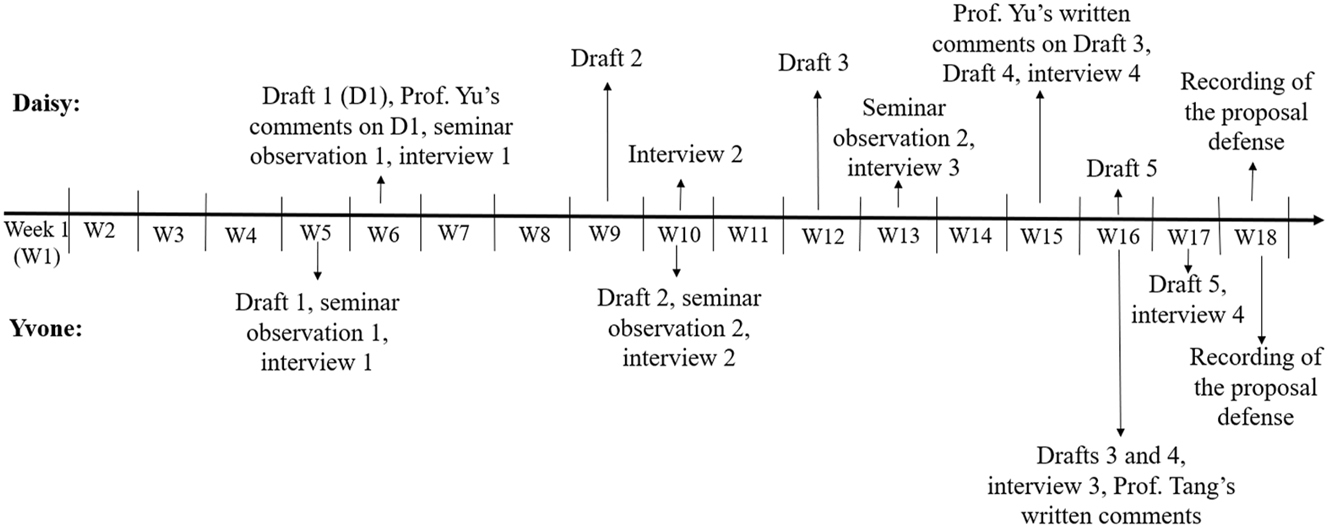
Timeline of data collection.
I conducted semi-structured interviews with the participants at locations of their choice, including the library, their dormitory rooms, or the campus café. The interviews, which lasted between 15 and 45 min, were conducted in Chinese, the first language of both the author and the participants. The interview questions were used to elicit the interviewers’ retrospective verbal reports on the revision process in details. Interviews conducted prior to revision focused on the participants’ attitudes toward and perceptions of the feedback they received, their concerns regarding the thesis project, the proposal writing, and the feedback, their understanding of their roles, and their plans for future actions. Interviews conducted after the revision centered on the revision changes they had made, their motivations for different types of revisions, the challenges they faced during the revision process, and their affective responses toward thesis proposal writing. Additionally, participants were encouraged to discuss any reflections they had regarding their roles and identities during the interviews.
5.4 Data analysis
The interview and seminar data were transcribed with the assistance of two undergraduate students experienced in transcription, and I subsequently reviewed the transcripts for accuracy. While reviewing, I highlighted relevant excerpts for further analysis. I conducted a content analysis on the highlighted excerpts (Hsieh and Shannon 2005), employing both inductive and deductive reasoning to code the participants’ cognitive, affective, behavioral engagement with thesis proposal writing. Following this, I carried out intercase analyses and cross-case comparisons (Yin 2009) to identify recurring patterns of role-taking and role-making among the participants. The identified patterns were compared with the existing categories in the conceptual framework and modifications were made based on iterative data analysis until a coding scheme was developed (see Table 1).
Coding scheme for the present study.
| Categories | Subcategories | Codes |
|---|---|---|
| Role-taking | Affect | Lack of confidence; frustration; optimism |
| Behavior | Minimal revision; performative responses; adherence to established academic conventions | |
| Cognition | Viewing feedback as requirements; lack of a thorough understanding of the research | |
| Role-making | Affect | Self-assertiveness; pride |
| Behavior | Proactive nonfeedback-based revision; innovative word-use beyond convention; self-directed writing schedule | |
| Cognition | Positive evaluation of one’s own academic capacity | |
| Identities | Student | A competent graduate student |
| Scholar | A less authoritative academic peer; a contributor to the field knowledge; an emerging scholar; an aspiring scholar | |
| Writer | A novice academic writer; a competent academic writer |
To enhance the validity of the study, I triangulated the interview data with observation notes and conducted intertextual analysis of multiple drafts. I attended the seminars and frequently interacted with the two participants in informal settings, which facilitated the development of a friendship and allowed me to gain a deeper understanding of their contexts (Spradley 1980). Additionally, member checking was employed throughout the process. Once the initial findings were documented, the report was sent to Daisy and Yvone for their feedback on its accuracy. They confirmed most of the findings, and their additional reflections further supported my arguments. The quoted excerpts in the preliminary versions of the report were translated into English and subsequently verified by the two participants through member checking to ensure the preservation of meaning.
6 Findings
The two graduate students, in their respective identity construction trajectories, employed distinct strategies for choosing roles during their thesis proposal writing. Through their interactions with textual and social practices, they interpreted the meanings of their roles as scholarly writers, researchers, and graduate students. Engaging with peers, instructors, and advisors within their communities of practice allowed them to shape their identities in different ways.
6.1 Daisy: role-taking and role-making toward the construction of a scholarly identity
In the earlier stages of her writing process, Daisy transitioned from being an unconfident student to a novice researcher who sought authoritative validation through role-taking. As the defense day approached, she ultimately evolved into a researcher who confidently questioned teacher feedback and took greater initiative in directing her own research writing through role-making. Starting from her identity as a graduate student writer, her identification with the role of a researcher grew increasingly stronger throughout this process.
In the first few weeks of her thesis proposal, Daisy’s engagement with the writing process was characterized by a significant reliance on her advisor. This dependence underscored her perception of the advisor’s authority within the academic environment, shaping her identity as a novice scholar. Although excited about the topic suggested by her advisor, Daisy soon found herself overwhelmed and uncertain about how to proceed, reflecting her struggle to establish confidence in her scholarly role.
During the seminar, criticism of her coding scheme further influenced her self-concept. Despite having used the scheme effectively in her pilot study, the negative feedback led her to question its validity and her own capabilities. She expressed doubt about her ability to create a new framework that had not been previously established in the literature: “Is it risky for me to create a new coding scheme that have never been previously developed in the literature? After all, it is merely a thesis for a master’s degree” (Daisy, Interview 2). This moment illustrates how external evaluations reinforced her feelings of inadequacy, as she compared herself to more experienced doctoral peers. Her identity as a master’s student influenced her evaluation of her capabilities, leading her to view herself as less authoritative than her peers and advisors. Daisy’s concern over the originality of her coding scheme revealed her tendency to seek validation from her advisor, “As long as my advisor says yes, I can do it” (Daisy, interview 2), indicating the social dynamics at play in her academic identity formation.
Then, in her revision of the literature review, she gradually took on the role of a researcher through her unique interpretation of interactions with her seminar peers, seminar teacher feedback, and reflections on prior guidance from her advisor. In Draft 1, she presented the definitions of six topic-related terms in separate paragraphs without clarifying their relationships or relevance to her study. This issue was pointed out by Professor Tang and her classmates during the March seminar. Daisy acknowledged: “This suggestion is extremely helpful to me. I do need to consider how my study connects to previous research. But I don’t believe I can fully figure it out on my own… I need to start by writing something down and then discuss it with my advisor” (Daisy, interview 1).
This feedback, coupled with her advisor’s guidance, helped Daisy recognize the importance of engaging with the literature beyond merely summarizing findings. It prompted her to actively consider the authors’ perspectives and their contributions to the field. As she reflected: “When I read the literature, I didn’t pay much attention to the authors’ perspectives on the issues or how the field has developed through the contributions of various authors. My approach was simply to read the findings and discussions of each article to gain a general understanding of what each study was about” (Daisy, interview 1).
Through this process, Daisy exhibited an increasing awareness of her role in engaging with academic discourse, as she remarked: “Next time, after finishing reading an article, I should set it aside for a while before moving on to the next one. I need to reflect on why the author wrote in a particular way, why they chose to address that specific topic, and what stance they are taking” (Daisy, interview 1).
Following the feedback, Daisy began the subsection with a general review of existing research on the topic before narrowing her focus down to the central issue of her study. Furthermore, even without direct feedback, she proactively revised her citation formats, thereby demonstrating a deeper understanding of key studies. In Draft 2, Daisy embraced the role of a disciplinary insider by referencing a field expert’s work as “[Author]’s (Year) milestone paper,” in contrast to the nonintegral citation format “(Author, Year)” she had used in Draft 1. This transition was evident in her ability to contextualize her study within the broader academic conversation, allowing her to position herself more confidently among established scholars.
Regarding her research methods, her peers and advisors also suggested alternative approaches. While the critiques were intended to foster improvement, they often led Daisy to feelings of frustration and confusion, particularly as she attempted to reconcile their suggestions with her vision for the research. Faced with the challenge, she initially struggled to recruit participants for qualitative interviews. However, as the semester progressed, Daisy began to assert her agency more prominently. She ultimately chose to retain her original qualitative design, articulating: “I still want to do this my way. Only qualitative interviews can help answer my research questions” (Daisy, interview 2). This decision reflected a significant shift in her self-concept, marking a pivotal moment in her development as a researcher. By affirming her qualitative approach, Daisy started to view her academic work as an expression of her own values and interests, rather than merely a response to external feedback. This dynamic underscored the complexities of her academic identity, as she navigated the tension between external expectations and her own scholarly voice.
By the final stages of her thesis proposal, Daisy’s emotional connection to the project grew, as evidenced by her determination not to compromise its quality despite the time constraint. Her assertion, “I don’t want to be the person who ruins this project” (Daisy, interview 3), highlighted her evolving sense of responsibility and ownership over her work. This shift in mindset was pivotal, indicating that she no longer viewed her project solely as a requirement but as a significant contribution to her field and an extension of her identity as a researcher. At this point, her growing sense of ownership was further reinforced by her aspirations to pursue doctoral studies, making the quality of her thesis increasingly significant to her future academic endeavors. As her project became central to her aspirations, she felt a heightened sense of responsibility, motivating her to engage more deeply with the proposal and solidifying her identity as an emerging scholar.
By the time of her defense, Daisy’s newfound confidence empowered her to articulate her capabilities as a self-directed researcher, evidenced by her assertion: “It was not difficult for me to manage the project now. I can do it” (Daisy, interview 4). During the proposal defense, she again demonstrated this confidence by asserting her readiness to complete her thesis ahead of schedule to the defense committee members (Daisy, defense recording).
Daisy’s trajectory of identity construction illustrates that her interactions with peers and advisors served as symbolic cues, profoundly influencing her understanding of her capabilities and the academic standards she was expected to meet. The feedback she received, whether supportive or critical, was pivotal in shaping her self-perception. This iterative process of engagement and reflection allowed Daisy to internalize concepts of authority and competence, ultimately contributing to the formation of her scholarly identity. As she navigated the challenges of the thesis proposal writing process, her increasing agency and confidence reflect a significant transformation, marking her transition from a novice to a capable researcher fully engaged in her academic journey.
6.2 Yvone: role-taking toward the construction of a committed student identity
As Yvone engaged with her writing and responded to feedback, her identity evolved from that of an aspiring innovator to one primarily concerned with merely completing her degree. This shift indicates the fluid nature of identity as it is constructed through ongoing interactions with peers and her advisor.
Initially, Yvone approached her thesis proposal with enthusiasm and a sense of creativity, expressing a desire to explore innovative ideas and methodologies: “I want to make some innovation in theory. I don’t like to move in a groove” (Yvone, interview 1). This ambition was linked to her developing self-concept as a graduate student, which drove her to establish high standards for her work. However, despite her initial optimism, her engagement with external feedback led to an increasing awareness of her advisor’s low expectations for her and the perceived limitations of her research topic. Yvone tended to focus her revisions solely on the sections identified as problematic by her peers and advisor, indicating a reliance on external validation rather than a proactive engagement with her work.
As Yvone navigated the theoretical framework, she encountered a significant turning point. During the March seminar, Professor Tang advised her against using all three dimensions of the theoretical model as the base framework for her data analysis. Nevertheless, she hesitated to fully embrace his suggestion to streamline her focus. She commented:
Professor Tang suggested that I don’t need to go into so many details for the [key] theory. But you know I have already read so much on the theory. Now I have to do the reading, writing, and data analysis all over again. It’s time-consuming. Also, it could be useful to go into the details. But now that Professor Tang mentioned it, and maybe he didn’t want me to have a heavy load of work with so many details to attend to, so…yes, it somehow makes sense to me. (Yvone, interview 1)
Her decision to adhere to her advisor’s guidance, despite her initial resistance, reflects her internalization of the workload expectations associated with her identity as a master’s student.
Subsequently, in the April seminar, Professor Tang advised Yvone to integrate two existing theories, while one of her senior peers suggested she consider the distinctions between two closely related terms in the theories. However, Yvone had anticipated more explicit feedback on how to effectively justify her theoretical framework, resulting in feelings of disappointment and frustration:
I’m at a loss. Why should the two theories be combined? It feels like I’m creating a new framework, and I can’t find any previous studies to reference. Sometimes, I think I’m just torturing myself by choosing such an unusual theory to work on. Even though I’ve tried hard to make sense of it, I feel more confused than ever. (Yvone, interview 2)
While she showed an increasing awareness of the demands associated with her role as a researcher, she also exhibited a tendency to conform to perceived academic norms rather than assert her distinctive voice.
Furthermore, her revisions over drafts were often minimal, particularly when the guidance she received was unclear. For example, when peers pointed out citation format issues, Yvone made only superficial adjustments in the first drafts. When questioned about the thoroughness of her literature review, she attempted to engage with the feedback by consulting relevant literature and peers. However, she ultimately retreated to her advisor for direct answers without fully negotiating her understanding. This scenario represents another pivotal moment in her identity negotiation, as she prioritized meeting external expectations over deepening her engagement with the content. Her revisions frequently took on a performative nature, such as adding topic sentences to her literature review merely to counter perceptions of negligence: “I need to make the revision. Or else, it would seem as if I was not working hard” (Yvone, Interview 2). The revisions underscored her efforts to maintain harmony and gain acceptance among her academic peers in the classroom.
As the semester progressed, she voiced perspectives that contrasted sharply with her original ambitions: “I just want to conclude my graduate study smoothly with this thesis. After all, I may not go for further studies. Professor Tang doesn’t seem to have a high expectation for me. It wasn’t a well-chosen topic, either” (Yvone, interview 3).
During the revision process, her diminishing concern for the proposal’s quality became evident, culminating in a prioritization of job-hunting over the thesis. The shift illustrates her transition from an aspiring researcher to a graduate student focused on completing her degree. Yvone’s evolution highlights how her engagement with the thesis process influenced her self-perception, leading her to prioritize completion over innovation. By June, the quality of her thesis proposal had become secondary to the primary goal of obtaining her degree.
This trajectory suggests that her interpretation of interactions with feedback and social expectations contributed to a loss of ownership in her writing process, framing her work as a means to an end rather than a genuine expression of her scholarly identity. By ultimately aligning her work with established academic norms in the final draft, Yvone solidified her identity as a committed member of her academic community within her institute.
7 Discussion
The findings of this study underscore the dynamic and interactive nature of L2 graduate writers’ role-taking, role-making, and identity construction in the microprocesses of English research writing. The interactions experienced by the participants, along with their textual and social practices, were imbued with symbolic meanings that shaped their evolving identities as scholarly writers and graduate students. These interactions transcended mere mechanical exchanges of feedback and revision but encompassed two primary types of role negotiation: role-taking and role-making. How these roles are not merely adopted or performed in isolation, but are actively negotiated and reshaped through continuous social interactions, reflects the fluidity of identity formation in the academic context. By foregrounding the symbolic meanings embedded in feedback, interactions, and textual practices, this study enriches the theoretical understanding of academic identity as a fluid, negotiated construct shaped by social exchanges and individual agency.
A central contribution of the present study lies in extending the application of symbolic interactionism to academic writing research. Symbolic interactionism emphasizes the interpretive process through which individuals assign meaning to social interactions and negotiate their identities (Blumer 1969). This study illustrates how graduate writers, through role-taking and role-making, continuously interpret and redefine the symbolic cues conveyed through interactions with peers, advisors, and disciplinary conventions. Unlike models such as Darvin and Norton’s (2015) investment framework, which situate identity at the intersection of capital, ideology, and imagined futures, symbolic interactionism highlights the micro-level negotiation of meaning within specific writing practices. This approach provides a nuanced lens for examining the agentive and interactive processes by which writers navigate the often-competing expectations of academia.
During the process of writing their thesis proposals, Daisy and Yvone demonstrated distinctly different trajectories of identity construction and role negotiation. This contrast can be understood through the lens of symbolic interactionism, which asserts that “[t]he meaning of objects for a person arises fundamentally out of the way they are defined to him by others with whom he interacts,” and that “[a]n object may have a different meaning for different individuals” (Blumer 1969: 11). Daisy’s role-making illustrates an agentive process of interpreting feedback not as fixed directives but as symbolic resources for constructing her scholarly identity. This dynamic engagement enabled her to align her academic pursuits with personal values, illustrating how role-making fosters agency and self-direction. Daisy’s growing confidence as a researcher, from a dependent student to a more autonomous scholar, illustrates the evolving and agentive nature of identity construction. In contrast, Yvone’s role-taking reflects a more passive acceptance of externally imposed roles, shaped by her adherence to genre conventions and reliance on external validation. As members within a cultural group can understand shared symbolic meanings through codes and words (Liadi 2024), student writers who undergo similar research writing practices can also interpret symbolic meanings through genre features and feedback exchanges. Yvone, for example, adhered closely to the genre conventions outlined in her thesis proposal, adopting the social roles expected by others without actively reshaping them. Through role-taking, Yvone adopted the perspective of the generalized other (Mead 1934), which represents the academic community shaping her evaluation of her academic writing and research capabilities (Wiest 2024). Meanwhile, her role-taking showed the tension between individual agency and social expectation, as adopting a socially prescribed role may stifle the development of a more self-directed academic identity.
The findings also contribute to the theorization of identity by highlighting the interplay of emotional, cognitive, and behavioral dimensions in role negotiation. For Daisy, the affective enjoyment of qualitative research and the cognitive alignment between her methods and research questions motivated her to resist the passive role of a dependent student. Behaviorally, her use of innovative textual features, such as unconventional subsection titles, further reinforced her agency. Conversely, Yvone’s emotional disappointment and cognitive limitations constrained her ability to challenge external expectations, leading her to adopt the socially prescribed role of a compliant graduate writer. This interplay of affect, cognition, and behavior provides a holistic understanding of identity construction within academic writing, revealing the mechanisms through which writers navigate the tension between individual agency and social expectation.
Furthermore, this study contributes to the growing body of research on writer identity by emphasizing the symbolic significance of feedback interactions. While prior studies have highlighted the role of feedback in shaping academic writing practices (Ho 2017; Li 2006), this study demonstrates how feedback functions as a symbolic medium through which roles and identities are negotiated. By interpreting feedback as more than technical advice and viewing it instead as a site of symbolic exchange, this research offers a conceptual bridge between the micro-level dynamics of writing and broader frameworks of identity. These findings align with Peng’s (2023) study on students’ English learning engagement, which is also grounded in symbolic interactionism. Peng’s research suggests that the different meanings students attached to English learning during subject–object interactions can account for differences in their motivations to learn. These differences in motivation subsequently lead to varying emotional, cognitive, and behavioral engagement, ultimately influencing their academic achievement. Consistent with Peng’s findings, this study further explains the distinctions in students’ interpretations of meaning within the context of English research writing. Additionally, echoing Guan and Xu’s (2024) study, which explored the identity construction of an EFL student, this study emphasizes the significance of social interaction. However, while Guan and Xu interpreted the dynamic construction of the student’s identities using Darvin and Norton’s (2015) model of investment, this study elucidates the potential for role negotiation within the microprocesses of writing through participants’ role-taking and role-making.
The findings of this study suggest that academic writing instruction for L2 graduate students should emphasize fostering agency and promoting role-making in their textual and social practices. By highlighting the symbolic meaning embedded in interactions pertaining to academic writing, writing instructors and advisors can encourage students to engage actively in their identity construction process. Empowering students to negotiate their roles within the academic community can lead to more meaningful revisions and a stronger sense of ownership over their work. Educators should be mindful of the interactions that occur during feedback sessions and within the broader academic environment. It is essential to ensure that students are not merely passive recipients of advice but rather active participants in shaping their own identities. This aligns with Zhu and Li’s (2023) assertion about the significant role of multilayered contexts in fostering collective resilience. Just as teachers in “less stressed marginalised contexts” (Zhu and Li 2023: 17) mobilized personal and contextual resources for professional growth, student writers in master’s degree programs have the potential to do the same. Unlike doctoral students, who face considerable high-stakes writing pressures (Li 2006), master’s students can leverage feedback and social interactions to enhance their writing capabilities. By promoting agency and critical engagement with these symbolic cues in the academic community, educators can help L2 writers develop into more confident and self-directed scholars.
8 Conclusions
The study employs symbolic interactionism as a theoretical lens to explore the role choices and identity construction of two L2 graduate writers engaged in English research writing. The findings reveal how individuals’ affect, cognition, and behavior are shaped through social interactions and the meanings they derive from these interactions. By interpreting these meanings, student writers assumed multiple roles and demonstrated ongoing identity construction within their textual and social practices, particularly in the context of thesis proposal writing. The study employed a case study approach and does not aim to generalize about the identity construction trajectories or writing practices of all L2 graduate writers. Nevertheless, the study shows how a symbolic interactionism perspective can provide insights into the complexity and fluidity of individual writers’ role negotiation within the communities of practice. Future research could focus on more experienced scholarly writers or investigate writers’ social interactions in different writing contexts to enrich our understanding of identity construction in academic settings.
Funding source: The General Project Fund of Philosophy and Social Science Research in Universities, Jiangsu Province
Award Identifier / Grant number: 2022SJYB1440
About the author
Yujie Peng is a lecturer and a postdoctoral researcher at the School of Foreign Languages, Soochow University, China. Her research interests include English for academic purposes, second language writing, and computer-assisted language learning.
Acknowledgments
I thank the editors and anonymous reviewers for their constructive comments and suggestions. This research was funded by a grant from the General Project Fund of Philosophy and Social Science Research in Universities, Jiangsu Province (No. 2022SJYB1440) to the author.
References
Bakhtin, Mikhail. 1981. The dialogic imagination: Four essays. Austin: University of Texas Press.Search in Google Scholar
Bakhtin, Mikhail. 1986. Speech genres and other late essays. Austin: University of Texas Press.Search in Google Scholar
Blumer, Herbert. 1969. Symbolic interactionism: Perspective and method. Berkeley: University of California Press.Search in Google Scholar
Burgess, Amy & Roz Ivanič. 2010. Writing and being written: Issues of identity across timescales. Written Communication 27(2). 228–255. https://doi.org/10.1177/0741088310363447.Search in Google Scholar
Canagarajah, A. Suresh. 2015. “Blessed in my own way”: Pedagogical affordances for dialogical voice construction in multilingual student writing. Journal of Second Language Writing 27. 122–139. https://doi.org/10.1016/j.jslw.2014.09.001.Search in Google Scholar
Carter, Michael J. & Celene Fuller. 2015. Symbolic interactionism. Sociopedia.isa. https://doi.org/10.1177/205684601561 (accessed 13 May 2016).Search in Google Scholar
Chen, Ningyang & Chunxia Zhou. 2024. Making sense of a new language: Authenticity and semiotics in additional language learning. Language and Semiotic Studies 10(3). 317–342. https://doi.org/10.1515/lass-2024-0021.Search in Google Scholar
Creswell, John Ward & Cheryl-Anne Poth. 2018. Qualitative inquiry research design: Choosing among five approaches. Thousand Oaks: Sage.Search in Google Scholar
Darvin, Ron & Bonny Norton. 2015. Identity and a model of investment in applied linguistics. Annual Review of Applied Linguistics 35. 36–56. https://doi.org/10.1017/s0267190514000191.Search in Google Scholar
Flowerdew, John & Simon Wang Ho. 2015. Identity in academic discourse. Annual Review of Applied Linguistics 35. 81–99. https://doi.org/10.1017/s026719051400021x.Search in Google Scholar
Gee, James Paul. 1990. Social linguistics and literacies: Ideology in discourse. London: The Falmer Press.Search in Google Scholar
González, Roberto Cortéz, Joan L. Biever & Glen T. Gardner. 1994. The multicultural perspective in therapy: A social constructionist approach. Psychotherapy: Theory, Research, Practice, Training 31(3). 515–524. https://doi.org/10.1037/0033-3204.31.3.515.Search in Google Scholar
Guan, Jingjing. 2021. Eryu Touzi Shijiao xia Yingyu Xuexizhe de Shenfen Jiangou — Yixiang Gean Xushi Yanjiu [Identity, investment, and English language learning: A narrative inquiry of an EFL learner]. Waiyu Jiaoyu Yanjiu Qianyan [Foreign Language Education in China] 4(3). 75–83+95.Search in Google Scholar
Guan, Jingjing & Haiming Xu. 2024. In between the neoliberal reality and the humanities imagination: A narrative inquiry of an English major’s identity construction in China. Journal of Multilingual and Multicultural Development. 1–15. https://doi.org/10.1080/01434632.2024.2410384.Search in Google Scholar
Ho, Mei-ching. 2017. Navigating scholarly writing and international publishing: Individual agency of Taiwanese EAL doctoral students. Journal of English for Academic Purposes 27. 1–13. https://doi.org/10.1016/j.jeap.2017.02.004.Search in Google Scholar
Hsieh, Hsiu-Fang & Sarah E. Shannon. 2005. Three approaches to qualitative content analysis. Qualitative Health Research 15(9). 1277–1288. https://doi.org/10.1177/1049732305276687.Search in Google Scholar
Hyland Ken. 2008. Disciplinary voices: Interactions in research writing. English Text Construction 1(1). 5–22. https://doi.org/10.1075/etc.1.1.03hyl.Search in Google Scholar
Hyland, Ken. 2012. Disciplinary identities: Individuality and community in academic discourse. Cambridge: Cambridge University Press.10.1017/9781009406512Search in Google Scholar
Hyland, Ken. 2015. Genre, discipline and identity. Journal of English for Academic Purposes 19. 32–43. https://doi.org/10.1016/j.jeap.2015.02.005.Search in Google Scholar
Ivanič, Roz. 1998. Writing and identity: The discoursal construction of identity in academic writing. Amsterdam: John Benjamins.10.1075/swll.5Search in Google Scholar
Jeffery, Jill V. 2011. Subjectivity, intentionality, and manufactured moves: Teachers’ perceptions of voice in the evaluation of secondary students’ writing. Research in the Teaching of English 46(1). 92–127. https://doi.org/10.58680/rte201117151.Search in Google Scholar
Leary, Kimberlyn. 1994. Psychoanalytic “problems” and postmodern “solutions”. Psychoanalytic Quarterly 68. 433–465. https://doi.org/10.1080/21674086.1994.11927422.Search in Google Scholar
Li, Yongyan. 2006. A doctoral student of physics writing for publication: A sociopolitically-oriented case study. English for Specific Purposes 25. 456–478. https://doi.org/10.1016/j.esp.2005.12.002.Search in Google Scholar
Liadi, Olusegun Fariudeen. 2024. Meaning construction in Nigerian multilingual hip hop: A study in sociology of music. Language and Semiotic Studies 10(1). 83–105. https://doi.org/10.1515/lass-2023-0021.Search in Google Scholar
Matsuda, Paul Kei. 2001. Voice in Japanese written discourse: Implications for second language writing. Journal of Second Language Writing 10. 35–53. https://doi.org/10.1016/s1060-3743(00)00036-9.Search in Google Scholar
Matsuda, Paul Kei & Christine M. Tardy. 2007. Voice in academic writing: The rhetorical construction of author identity in blind manuscript review. English for Specific Purposes 26(2). 235–249. https://doi.org/10.1016/j.esp.2006.10.001.Search in Google Scholar
McCarthy, E. Doyle. 2024. Interactionist theories of emotion: From G. H. Mead to culture theory. In Wayne Brekhus, Thomas Degloma & William Ryan Force (eds.). The oxford handbook of symbolic interactionism, 221–240. New York: Oxford University Press.10.1093/oxfordhb/9780190082161.013.12Search in Google Scholar
Mead, George Herbert. 1934. Mind, self, and society from the standpoint of a social behaviorist. Chicago: University of Chicago Press.Search in Google Scholar
Mochizuki, Naoko & Starfield Sue. 2021. Dialogic interactions and voice negotiations in thesis writing groups: An activity systems analysis of oral feedback exchanges. Journal of English for Academic Purposes 50. 1–12.10.1016/j.jeap.2020.100956Search in Google Scholar
Peng, Gaoli. 2023. Zhongguo Qingjing Yingyu Xuexi Touru Jizhi Moxing Goujian — Jiyu Daxuesheng Yingyu Xuexi Jingli de Zhixing Yanjiu [The construction of a model of English learning engagement mechanism in the Chinese context: A case study of English learning experiences of college students]. Waiyujie [Foreign Language World] 217(4). 56–63.Search in Google Scholar
Scott, Susie. 2015. Negotiating identity: Symbolic interactionist approaches to social identity. Cambridge: Polity.Search in Google Scholar
Scott, Susie. 2024. Dramaturgical traditions: Performance and interaction. In Wayne Brekhus, Thomas Degloma & William Ryan Force (eds.). The oxford handbook of symbolic interactionism, 146–161. New York: Oxford University Press.10.1093/oxfordhb/9780190082161.013.6Search in Google Scholar
Spradley, James P. 1980. Participant observation. New York: Holt, Rinehart and Winston.Search in Google Scholar
Starfield, Sue & Brian Paltridge. 2019. Thesis and dissertation writing in a second language: Context, identity, genre. Journal of Second Language Writing 43. 1–3. https://doi.org/10.1016/j.jslw.2018.10.002.Search in Google Scholar
Tardy, Christine. 2012. Voice construction, assessment, and extra-textual identity. Research in the Teaching of English 47(1). 64–99. https://doi.org/10.58680/rte201220672.Search in Google Scholar
Turner, Ralph Herbert. 1962. Role-taking: Process versus conformity. In Arnold M. Rose (ed.). Human behavior and social process: An interactionist approach, 20–40. London: Routledge.Search in Google Scholar
Turner, Ralph Herbert. 1990. Role change. Annual Review of Sociology 16. 87–110. https://doi.org/10.1146/annurev.soc.16.1.87.Search in Google Scholar
Wiest, Julie B. 2024. Sociology of mass and new media through an interactionist lens. In Wayne Brekhus, Thomas Degloma & William Ryan Force (eds.). The oxford handbook of symbolic interactionism, 275–295. New York: Oxford University Press.10.1093/oxfordhb/9780190082161.013.26Search in Google Scholar
Yin, Robert Kuo-zuir. 2009. Case study research: Design and methods. Thousand Oaks: Sage.Search in Google Scholar
Zhu, Yandan & Li Citing. 2023. Exploring language teachers’ collective resilience: Experiences of Chinese language teachers in a transnational university in China. Language Culture and Curriculum 36(4). 489–508. https://doi.org/10.1080/07908318.2023.2240348.Search in Google Scholar
© 2024 the author(s), published by De Gruyter on behalf of Soochow University
This work is licensed under the Creative Commons Attribution 4.0 International License.
Articles in the same Issue
- Frontmatter
- Social Semiotic Studies
- Behind the scenes of theatrical meaning: a social semiotic approach to inter- and intramodal interactions in performance
- The construction of anti-pandemic image: a semiotic study of the role metaphors play in pandemic discourse in China
- Like-simile and metaphor in cooperation: from expressing similarities to expressing contrasts
- How to detonate a semiotic bomb: the dynamics of Lotmanian explosion in the semiosphere
- Language and Culture
- A predictive human model of language challenges traditional views in linguistics and pretrained transformer research
- Culture-specific discourse in marketing: a study of socio-cultural traditions in Jordanian shops and streets
- Exploring L2 graduate writers’ identity construction in research writing practices: a symbolic interactionism perspective
Articles in the same Issue
- Frontmatter
- Social Semiotic Studies
- Behind the scenes of theatrical meaning: a social semiotic approach to inter- and intramodal interactions in performance
- The construction of anti-pandemic image: a semiotic study of the role metaphors play in pandemic discourse in China
- Like-simile and metaphor in cooperation: from expressing similarities to expressing contrasts
- How to detonate a semiotic bomb: the dynamics of Lotmanian explosion in the semiosphere
- Language and Culture
- A predictive human model of language challenges traditional views in linguistics and pretrained transformer research
- Culture-specific discourse in marketing: a study of socio-cultural traditions in Jordanian shops and streets
- Exploring L2 graduate writers’ identity construction in research writing practices: a symbolic interactionism perspective
