
International Polymer Characterization
-
Chin Han Chan

POLY-CHAR [Halle-Siegen] 2022 is an International Polymer Characterization Conference organized by Fraunhofer IMWS and Universität Siegen and under the auspices of the POLY-CHAR Scientific Committee. This was an IUPAC-endorsed conference and was sponsored by Groupe Nutriset.
With the purpose of unrestricted worldwide participation in times of global uncertainty regarding travel restrictions due to the COVID-19 pandemic, POLY-CHAR [Halle-Siegen] 2022 was organized as a live digital event from 22 to 25 May 2022. The conference’s topics included polymer synthesis, polymer characterization, polymer physics, theory and simulations, circular economy of polymers and sustainable applications, polymers for biomedical applications, biopolymers, biomedical materials and biotechnology, biopolymers in nutrition and health, elastomers and amorphous materials, nanomaterials and smart materials, the economics of polymeric materials, mechanics of polymers, adhesives and coatings, advanced hybrid materials etc.
The scientific and organizing committees of POLY-CHAR were extremely grateful for the participation of more than 100 interdisciplinary participants from all five continents, who shared their research findings ranging from theoretical to experimental and fundamental to applied aspects of polymers. The program’s areas of competence were diverse.
A total of five plenary speakers, 24 invited speakers, 66 oral speakers, nine poster presenters from 28 countries participated in POLY-CHAR 2022 [Halle-Siegen].
The POLY-CHAR Short Course was held on the first day of the conference. Eight prestigious researchers delivered graduate-level tutorial presentations on the following topics:
Analysis of polymer nano environments with AFM and time-resolved fluorescence methods – Holger Schönherr
NMR for testing materials – Bernhard Blümich
X-ray scattering in polymer science – Paul Topham
Starch and glycogen: Two complex glucose polymers of importance to human health – A polymer science perspective – Bob Gilbert
Polymer phase diagrams and what we can learn from them – Natalie Stingelin
Random phenomena - Jean-Marc Saiter
Advanced electron microscopy – Sven Henning
Development in semiconducting polymer synthesis – Christine Luscombe
Outstanding researchers were honored with the POLY-CHAR awards, which are named in honor of three distinguished Nobel Laureates:
The Richard Robert Ernst Award went to Jianyong Jin, The University of Auckland, New Zealand; the Jean-Marie Lehn Award went to Zheng Li, Peking University, China; and the Pierre-Gilles de Gennes Award was awarded to José Luis Gómez Ribelles, Universitat Polìtècnica de València, Spain.
Three POLY-CHAR prizes for the Best Oral Presentations were awarded to:
Ana Iglesias-Mejuto for the work on 3D-printing of methycellulose aerogels for bone regenerative medicine.
Max Müller for the work on Chitosan-based nanogels for improved selective detection of pathogenic bacteria.
Giulia Guidotti for the work on New poly(butylene succinate)-based polyesters for cardiac tissue engineering: From synthesis to cell differentiation on scaffolds.
Three IUPAC Awards for Best Student Posters were presented to:
Bruna Frugoli Alves for the work on Production and characterization of EVA:palygorskite and EVA:montmorillonite nanocomposites and their evaluation as pur point reduces for waxy systems.
Raffaelo Longo for the work on Differences between materials produced via coaxial and monoaxial electrospinning for biomedical application.
Vladimir A. Kolupaev for the work on Optimized specimen for in plane shear test on polymers.
Three POLY-CHAR Prize for the Best Student Posters were awarded to:
Warunnya Ussama for the work on Self-healing polyester networks prepared from poly(butylene-co-butylene itaconate) and thiol-terminated polyether containing disulfide linkages.
Patrick Imrie for the work on Mechanical property modification of “living” networks via PET-RAFT photopolymerization.
Pan Xu for the work on Strong emission of excimers realized by dense packing of pyrenes in tailored Bola-amphiphile nanoassemblies.
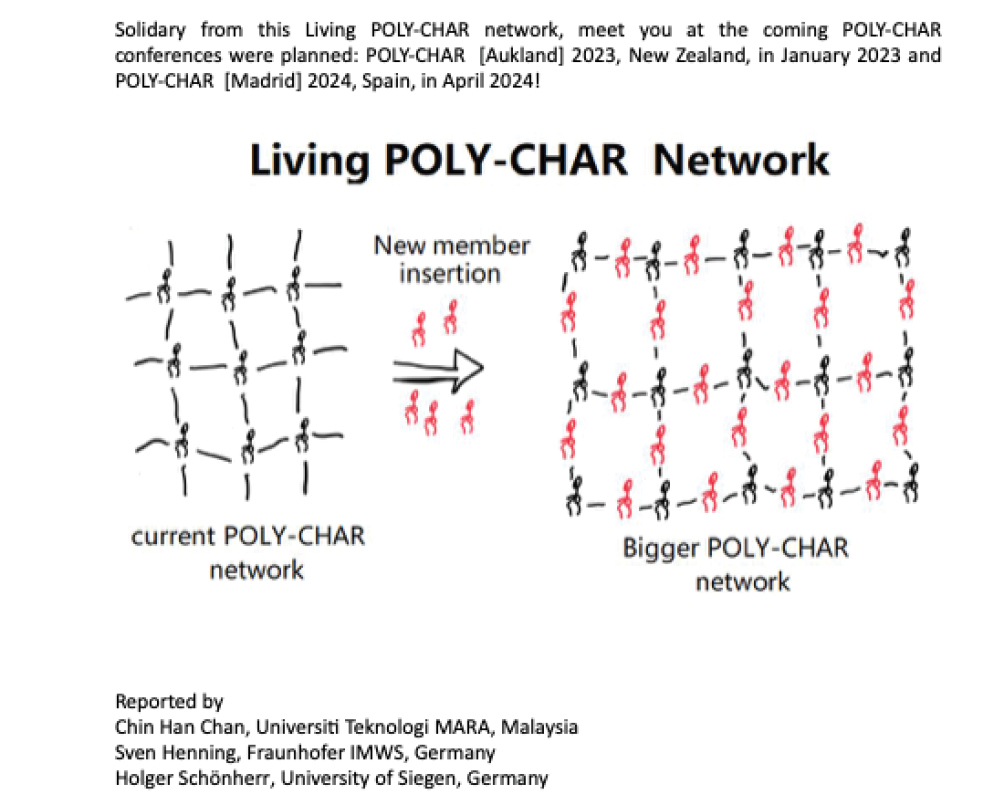
The coming POLY-CHAR conferences are being planned already and will be POLY-CHAR [Aukland] 2023, New Zealand, in January 2023 and POLY-CHAR [Madrid] 2024, Spain, in April 2024.
<https://iupac.org/event/poly-char-2022/>

©2022 IUPAC & De Gruyter. This work is licensed under a Creative Commons Attribution-NonCommercial-NoDerivatives 4.0 International License. For more information, please visit: http://creativecommons.org/licenses/by-nc-nd/4.0/
Articles in the same Issue
- Masthead - Full issue pdf
- Vice President's Column
- The Chemist’s Oath
- Features
- IUPAC Top Ten Emerging Technologies in Chemistry 2022
- Implementing Data Sharing Policies at De Gruyter
- Behind the Scenes: Stories of the Global Women’s Breakfast
- IUPAC Wire
- Vivek Polshettiwar is Awarded the 2022 IUPAC-Chemrawn VII Prize For Green Chemistry
- IUPAC Announces the 2022 Top Ten Emerging Technologies in Chemistry
- IUPAC International Award For Advances In Harmonized Approaches To Crop Protection Chemistry—Call For Nominations
- 2023 IUPAC-Solvay International Award For Young Chemists—Call For Applicants
- 2023 Distinguished Women in Chemistry/Chemical Engineering Award—Call for Nominations
- IUPAC Elections for the 2024–2025 Term
- NAO Forum
- Project Place
- Bioavailability and Significance of Endocrine Disruptive Compounds in Ecosystems
- IUPAC Projects Contributions to the UN Sustainable Development Goals: Past, present, and future
- Bookworm
- Multi-Scale Biogeochemical Processes in Soil Ecosystems: Critical Reactions and Resilience to Climate Changes
- Green Chemistry and Sustainable Development
- Conference Call
- International Year of Basic Sciences for Sustainable Development
- Making Global Green Connections: The Importance of Green Chemistry Summer School for Sustainable Development
- International Polymer Characterization
Articles in the same Issue
- Masthead - Full issue pdf
- Vice President's Column
- The Chemist’s Oath
- Features
- IUPAC Top Ten Emerging Technologies in Chemistry 2022
- Implementing Data Sharing Policies at De Gruyter
- Behind the Scenes: Stories of the Global Women’s Breakfast
- IUPAC Wire
- Vivek Polshettiwar is Awarded the 2022 IUPAC-Chemrawn VII Prize For Green Chemistry
- IUPAC Announces the 2022 Top Ten Emerging Technologies in Chemistry
- IUPAC International Award For Advances In Harmonized Approaches To Crop Protection Chemistry—Call For Nominations
- 2023 IUPAC-Solvay International Award For Young Chemists—Call For Applicants
- 2023 Distinguished Women in Chemistry/Chemical Engineering Award—Call for Nominations
- IUPAC Elections for the 2024–2025 Term
- NAO Forum
- Project Place
- Bioavailability and Significance of Endocrine Disruptive Compounds in Ecosystems
- IUPAC Projects Contributions to the UN Sustainable Development Goals: Past, present, and future
- Bookworm
- Multi-Scale Biogeochemical Processes in Soil Ecosystems: Critical Reactions and Resilience to Climate Changes
- Green Chemistry and Sustainable Development
- Conference Call
- International Year of Basic Sciences for Sustainable Development
- Making Global Green Connections: The Importance of Green Chemistry Summer School for Sustainable Development
- International Polymer Characterization
