
Vivek Polshettiwar is Awarded the 2022 IUPAC-Chemrawn VII Prize For Green Chemistry

Abstract
Vivek Polshettiwar (India) has been awarded the 2022 IUPAC-CHEMRAWN VII Prize for Green Chemistry in recognition of his outstanding contributions to the field of green chemistry.
Professor Vivek Polshettiwar (Tata Institute of Fundamental Research, Mumbai, India) works on the development of novel nanomaterials for catalysis, solar energy harvesting, and CO2 capture-conversion to tackle climate change. With his group, they have developed next-generation green nanocatalysts via the morphological control of nanomaterials, dendritic fibrous nanosilica (DFNS) whose uniqueness is high surface area resulting from the fibrous structure instead of the formation of pores, making the large surface area easily accessible (Nature Protocol. 2019, 14, 2177-2204). DFNS is now being used for various applications, such as catalysis, photocatalysis, CO2 capture-conversion, RNA extraction from viruses, energy harvesting and storage, drug delivery, etc.
For example, by using the techniques of nanotechnology, Polshettiwar has transformed DFNS-based yellow gold to black gold by changing the size and gaps between gold nanoparticles. Similar to real trees, the developed black gold acts like an artificial tree that uses CO2, sunlight, and water to produce fuel. This work on “Black (nano)Gold” is one-of-its-kind and a way forward to develop “Artificial Trees” which captures and converts CO2 to fuel and other valuable chemicals (Chemical Science, 2019, 10, 6694-6603). His group also showed how cooperativity in defects sites of DFNS convert CO2 to fuel (Proc. Natl. Acad. Sci. USA 2020, 117, 6383) and how DFNS can be converted to green solid-acid for waste plastic degradation (Nature Commun. 2020, 11, 3828)
The research field of “Green Catalysis using Fibrous Nanosilica” which Polshettiwar has developed, is now explored by more than 150 groups worldwide (Accounts Chem. Res. 2022, 55, 1395). Polshettiwar is now trying to commercialize these technologies for solar energy harvesting, CO2 capture and conversion to green fuels and chemicals.
The CHEMRAWN VII Prize was first announced in August 2008 and since, has been awarded every two years at the IUPAC International Conference on Green Chemistry. The Prize of USD 5000 is granted to a young investigator (less than 45 years of age) from an emerging region who is actively contributing to research in Green Chemistry. The 2022 CHEMRAWN VII Prize was presented to Professor Vivek Polshettiwar at the 9th IUPAC Conference on Green Chemistry that will be held 5-9 September 2022, in Athens, Greece.
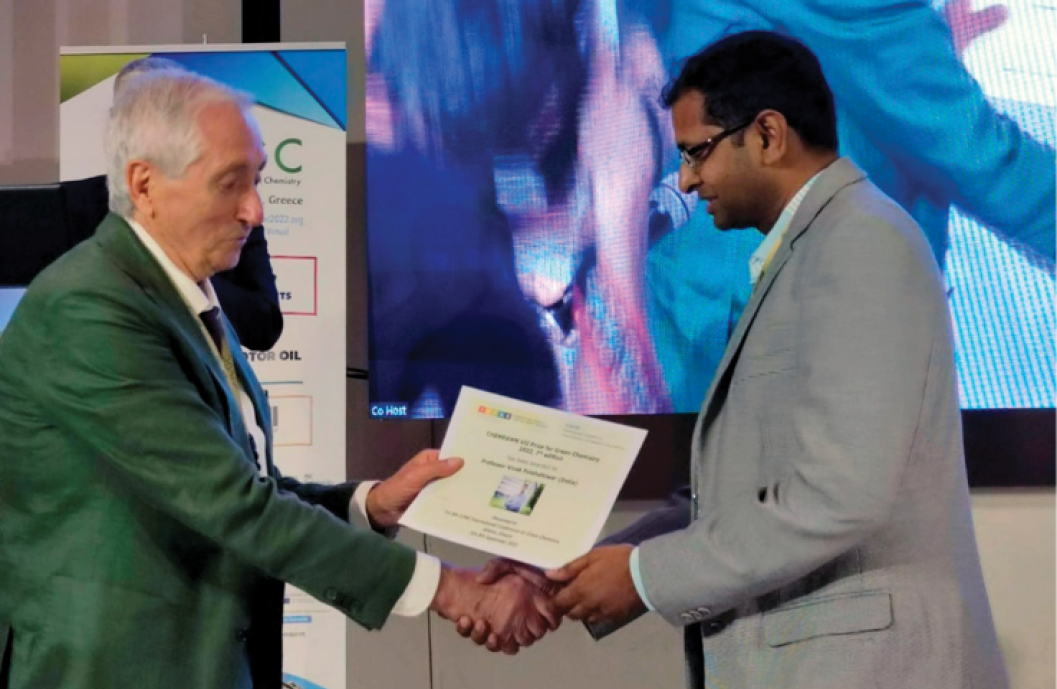
Vivek Polshettiwar, (right) received the 2022 IUPAC-CHEMRAWN VII Prize for Green Chemistry, from Pietro Tundo, founding chair of the IUPAC ICGCSD.
The IUPAC CHEMRAWN VII prize has previously been awarded to Noureddine Yassaa (Algeria) in 2010, Rashimi Sanghi (India) in 2012, Vania G. Zuin (Brazil) in 2014, Ali Maleki (Iran) in 2016, Mirabbos Hojamberdiev (Uzbekistan) in 2018, and to Huizhen Liu (China), and Banothile Makhubela (South Africa) in 2020.
©2022 IUPAC & De Gruyter. This work is licensed under a Creative Commons Attribution-NonCommercial-NoDerivatives 4.0 International License. For more information, please visit: http://creativecommons.org/licenses/by-nc-nd/4.0/
Articles in the same Issue
- Masthead - Full issue pdf
- Vice President's Column
- The Chemist’s Oath
- Features
- IUPAC Top Ten Emerging Technologies in Chemistry 2022
- Implementing Data Sharing Policies at De Gruyter
- Behind the Scenes: Stories of the Global Women’s Breakfast
- IUPAC Wire
- Vivek Polshettiwar is Awarded the 2022 IUPAC-Chemrawn VII Prize For Green Chemistry
- IUPAC Announces the 2022 Top Ten Emerging Technologies in Chemistry
- IUPAC International Award For Advances In Harmonized Approaches To Crop Protection Chemistry—Call For Nominations
- 2023 IUPAC-Solvay International Award For Young Chemists—Call For Applicants
- 2023 Distinguished Women in Chemistry/Chemical Engineering Award—Call for Nominations
- IUPAC Elections for the 2024–2025 Term
- NAO Forum
- Project Place
- Bioavailability and Significance of Endocrine Disruptive Compounds in Ecosystems
- IUPAC Projects Contributions to the UN Sustainable Development Goals: Past, present, and future
- Bookworm
- Multi-Scale Biogeochemical Processes in Soil Ecosystems: Critical Reactions and Resilience to Climate Changes
- Green Chemistry and Sustainable Development
- Conference Call
- International Year of Basic Sciences for Sustainable Development
- Making Global Green Connections: The Importance of Green Chemistry Summer School for Sustainable Development
- International Polymer Characterization
Articles in the same Issue
- Masthead - Full issue pdf
- Vice President's Column
- The Chemist’s Oath
- Features
- IUPAC Top Ten Emerging Technologies in Chemistry 2022
- Implementing Data Sharing Policies at De Gruyter
- Behind the Scenes: Stories of the Global Women’s Breakfast
- IUPAC Wire
- Vivek Polshettiwar is Awarded the 2022 IUPAC-Chemrawn VII Prize For Green Chemistry
- IUPAC Announces the 2022 Top Ten Emerging Technologies in Chemistry
- IUPAC International Award For Advances In Harmonized Approaches To Crop Protection Chemistry—Call For Nominations
- 2023 IUPAC-Solvay International Award For Young Chemists—Call For Applicants
- 2023 Distinguished Women in Chemistry/Chemical Engineering Award—Call for Nominations
- IUPAC Elections for the 2024–2025 Term
- NAO Forum
- Project Place
- Bioavailability and Significance of Endocrine Disruptive Compounds in Ecosystems
- IUPAC Projects Contributions to the UN Sustainable Development Goals: Past, present, and future
- Bookworm
- Multi-Scale Biogeochemical Processes in Soil Ecosystems: Critical Reactions and Resilience to Climate Changes
- Green Chemistry and Sustainable Development
- Conference Call
- International Year of Basic Sciences for Sustainable Development
- Making Global Green Connections: The Importance of Green Chemistry Summer School for Sustainable Development
- International Polymer Characterization
