
A comprehensive study on the metallographic preparation of W-Re samples for high resolution electron-based microscopy
-
M. Sommerauer
born in 1995, Ph.D. student at the Chair of Physical Metallurgy and Metallic Materials of the Montanuniversität Leoben. His research focuses on the thermomechanical fatigue of refractory metal alloys.

Abstract
Modern day rotating X-ray anodes utilize a conversion layer comprised of a tungstenrhenium alloy. The thermomechanical loading of this layer during computed tomography operation introduces various signs of fatigue like cracking, roughening, melting, or microstructural changes. Previous work on preparing tungsten samples primarily considered intact thin films or bulk material. This work focuses on the metallographic preparation of the conversion layer surface, which represents the sample edge in polished cross-sectional cuts. The main goals were minimizing preparation artefacts and maximizing obtainable image quality during electron backscatter diffraction. Twelve preparation methods were compared with regard to edge rounding, chipping, and obtainable image quality. Coating the samples with a thin layer of molybdenum and adding a tungsten sheet for edge stabilization led to vastly improved results. Chemical-mechanical polishing of such a sample gave the most balanced set of considered benchmarks.
Kurzfassung
Bei modernen Röntgendrehanoden kommt eine Konversionsschicht aus einer Wolfram-Rhenium-Legierung zum Einsatz. Die thermomechanische Beanspruchung dieser Schicht im Rahmen der Computertomographie führt zu verschiedenen Ermüdungserscheinungen, beispielsweise Rissbildung, Aufrauung, Aufschmelzen oder Veränderungen im Gefüge. In früheren Arbeiten zur Präparation von Wolframproben wurden überwiegend intakte Dünnschichten oder Bulkmaterialien betrachtet. Die vorliegende Arbeit befasst sich mit der metallographischen Präparation der Oberfläche der Konversionsschicht, die in Querschliffen der Probenkante entspricht. Primäre Ziele der Arbeit waren eine Minimierung von Präparationsartefakten und das Maximieren der im Rahmen der Elektronenrückstreubeugung erreichbaren Bildqualität. Dabei wurden zwölf Präparationsverfahren hinsichtlich der entstehenden Kantenverrundung, Absplitterungen und erreichbaren Bildqualität miteinander verglichen. Wurden die Proben mit einer dünnen Schicht aus Molybdän beschichtet und ein Wolframblech zur Kantenstabilisierung aufgebracht, konnten deutlich verbesserte Ergebnisse erzielt werden. Wurde eine solche Probe chemisch-mechanisch poliert, brachte dies die ausgewogenste Kombination aus betrachteten Richtwerten hervor.
About the author
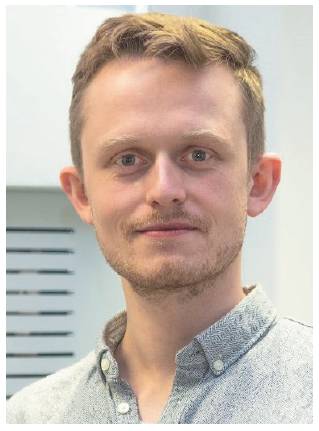
born in 1995, Ph.D. student at the Chair of Physical Metallurgy and Metallic Materials of the Montanuniversität Leoben. His research focuses on the thermomechanical fatigue of refractory metal alloys.
5 Acknowledgements
The author would like to express his gratitude towards Ing. Karl-Heinz Pichler (Chair of Functional Materials and Materials Systems) for the help regarding coating the samples with thin Mo layers, as well as towards Dipl.-Ing. Michael Wurmshuber (Chair of Materials Physics). The latter gave his support for the EBSD scans.
5 Danksagung
Der Autor möchte sich bei Ing. Karl-Heinz Pichler (Lehrstuhl für Funktionale Werkstoffe und Werkstoffsysteme) für dessen Hilfe beim Aufbringen der Mo-Dünnschichten auf die Proben sowie bei Dipl.-Ing. Michael Wurmshuber (Lehrstuhl für Materialphysik) für die Unterstützung mit den EBSD-Scans bedanken.
References / Literatur
[1] Behling, R.: Modern Diagnostic X-Ray Sources, 2nd Edition, CRC Press, London, UK, 2021. DOI:10.1201/978100309540810.1201/9781003095408Suche in Google Scholar
[2] Sedlatschek, K.; Elsas, A.: Höhere Belastung von Drehanodenröhren durch Verwendung von legierten Anoden. Zeit. f. ang. Phys. 15 (1963) 2, p. 175.Suche in Google Scholar
[3] Siller, M.; Schatte, J.; Gerzoskovitz, S.; Knabl, W.; Pippan, R.; Clemens, H.; Maier-Kiener, V.: Microstructural evolution of W-10Re alloys due to thermal cycling at high temperatures and its impact on surface degradation. Int. J. Ref. Met. & Hard Met. 92 (2020). DOI:10.1016/j.ijrmhm.2020.10528510.1016/j.ijrmhm.2020.105285Suche in Google Scholar
[4] Loewenhoff, T.; Linke, J.; Pintsuk, G.; Thomser, C.: Tungsten and CFC degradation under combined high cycle transient and steady state heat loads. Fus. Eng. and Des. 87 (2021), p. 1201–1205. DOI:10.1016/j.fusengdes.2012.02.10610.1016/j.fusengdes.2012.02.106Suche in Google Scholar
[5] Siller, M.; Minkkinen, M.; Bogust, P.; Jelinek, A.; Schatte, J.; Bostrom, N.; Greenland, K.; Knabl, W.; Clemens, H.; Pippan, ‚R.; Maier-Kiener, V.: Geometrical model for calculating the effect of surface morphology on total x-ray output of medical x-ray tubes. Med. Phys. 48 (2021) 4, p. 1546–1556. DOI:10.1002/mp.1464910.1002/mp.14649Suche in Google Scholar PubMed PubMed Central
[6] Schwartz, A. J.; Kumar, M.; Adams, B. L.; Field, D. P.: Electron Backscatter Diffraction in Materials Science, 2nd Edition, Springer New York, NY, USA, 2009. DOI:10.1007/978-0-387-88136-210.1007/978-0-387-88136-2Suche in Google Scholar
[7] Wright, S. I.; Nowell, M. M.: EBSD Image Quality Mapping. Microsc. & Microanalys. 12 (2006) 1, p. 72–84. DOI:10.1017/S143192760606009010.1017/S1431927606060090Suche in Google Scholar PubMed
[8] Claxton, N. S.; Fellers, T. J.; Davidson, M. W.: Laser Scanning Confocal Microscopy, AP Technologies Limited, Bath, (2006). DOI:10.1002/0471732877.emd29110.1002/0471732877.emd291Suche in Google Scholar
[9] Shen, Y. G.; Mai, Q. Y. W.; Zhang, C.; McKenzie, D. R.; McFall, W. W. D.; McBride: Residual stress, microstructure, and structure of tungsten thin films deposited by magnetron sputtering. E.: J. Appl. Phys. 87 (2000) 177 DOI:10.1063/1.37184110.1063/1.371841Suche in Google Scholar
[10] Manhard, A.; Matern, G.; Balden, M.: A Step-By-Step Analysis of the Polishing Process for Tungsten Specimens. Prakt. Met. 50 (2013) 1, pp. 5–16. DOI:10.3139/147.11021510.3139/147.110215Suche in Google Scholar
[11] Jedlicka, C.; Pölzl, S.; Hawranek, G.; Leitner, H.; Clemens, H.; Stickler, R.; Hoffmann, A.; Knabl, W.: Metallographische Praparation von Wolfram und Wolframlegierungen zur Gefugeuntersuchung mittels licht-und rasterelektronenmikroskopischer Methoden. Sonderband der Praktischen Metallographie 38 (2006), pp. 371–376.Suche in Google Scholar
[12] Poludniowski, G. G.; Evans, P. M.: Calculation of x-ray spectra emerging from an x-ray tube. Part II. X-ray production and filtration in x-ray targets. Med. Phys. 34 (2007) 6, pp. 2164–2186. DOI:10.1118/1.273472610.1118/1.2734726Suche in Google Scholar PubMed
[13] Kelly, P. J.; Arnell, R. D.: Magnetron sputtering: a review of recent developments and applications. Vacuum 56 (2000) 3, pp. 159–172. DOI:10.1016/S0042-207X(99)00189-X10.1016/S0042-207X(99)00189-XSuche in Google Scholar
[14] Zhao D.; Lu. X.: Chemical mechanical polishing: Theory and experiment .Friction 1 (2013), pp. 306–326. DOI:10.1007/s40544-013-0035-x10.1007/s40544-013-0035-xSuche in Google Scholar
[15] Nanz, G.; Camilletti, L. E.: Modeling of chemical-mechanical polishing: a review. IEEE Trans. Semicon. Man. 8 (1995) 4, pp. 382–389. DOI:10.1109/66.47517910.1109/66.475179Suche in Google Scholar
[16] Brodusch, N.; Boisvert, S.; Gauvin, R.: Flat ion milling: a powerful tool for preparation of cross-sections of lead-silver alloys. Microscopy 62 (2013) 3, pp. 411–418. DOI:10.1093/jmicro/dfs07710.1093/jmicro/dfs077Suche in Google Scholar PubMed
[17] Hawkins, D. T.: Ion milling (ion-beam etching), 1954–1975: A bibliography. J. Vac. Sci. and Tech. 12 (1975) 1389. DOI:10.1116/1.56854910.1116/1.568549Suche in Google Scholar
[18] Chen, Y.; Chen, P.; Lin, H.; Li, X.: Effect of Selected Process Parameters on Efficiency Enhancement of Electrochemical Etching and Polishing of Tungsten under Forced Convection. Int. J. Electrochem. Sci. 15 (2020), pp. 10955–10970. DOI:10.20964/2020.11.7210.20964/2020.11.72Suche in Google Scholar
© 2023 Walter de Gruyter GmbH, Berlin/Boston, Germany
Artikel in diesem Heft
- Contents
- Editorial
- Editorial
- Image processing methods and light optical microscopy for in-situ quantification of chromatic change and anode dilation in Li-ion battery graphite anodes during (de-)lithiation
- A comprehensive study on the metallographic preparation of W-Re samples for high resolution electron-based microscopy
- Failure Analysis
- Hot Tearing in an Investment Cast Burner Swirler
- Picture of the Month
- Picture of the Month
- News
- Researchers develop optical method to verify topological phases in magnetic materials
- Meeting Dairy
- Meeting Diary
Artikel in diesem Heft
- Contents
- Editorial
- Editorial
- Image processing methods and light optical microscopy for in-situ quantification of chromatic change and anode dilation in Li-ion battery graphite anodes during (de-)lithiation
- A comprehensive study on the metallographic preparation of W-Re samples for high resolution electron-based microscopy
- Failure Analysis
- Hot Tearing in an Investment Cast Burner Swirler
- Picture of the Month
- Picture of the Month
- News
- Researchers develop optical method to verify topological phases in magnetic materials
- Meeting Dairy
- Meeting Diary
