
Comparison of LPBF-manufactured and rolled tensile test samples made of 17-4PH
-
Robin Roj
Robin Roj studied Mechanical Engineering at the University of Wuppertal and finished his Master of Science in 2011. He graduated with his PhD about CAD-software in 2016. After two years in industry, he continued his scientific career at the FGW. There he is managing the department for Transformation & Innovation.Aileen Blondrath finished her Bachelor of Science in Mechanical Engineering at the University of Wuppertal in 2019 and her Master of Science in 2021. Now she is focusing on her PhD at the RWTH Aachen. Besides her studies she was working for the FGW.

Abstract
In recent years additive manufacturing techniques for metals became more and more enhanced and a great variety of processable materials are available. Nevertheless, the quality of 3D-printed components is often not obvious, and, depending on the material, it is not known whether they are as resilient as conventionally manufactured parts. In this paper rolled tensile test samples made of 17-4PH are compared with additively manufactured ones. For this purpose, they were printed by Laser Powder Bed Fusion in three different orientations, 0°, 45°, and 90°, and subsequently tensile tested. The presented results contain mesoscopic images of the fracture surfaces, as well as an analysis of the metallographic microstructure. Further details about the measured hardness, the phase diagrams as well as an optimized heat treatment are described in detail. It is shown that specifically the heat treated specimens with a 45° orientation reaches the highest ultimate tensile stress, but possess a low ductility in comparison to the conventional components.
Kurzfassung
In den vergangenen Jahren wurden additive Fertigungsverfahren für Metalle stetig verbessert und eine Vielzahl verarbeitbarer Werkstoffe steht zur Verfügung. Häufig ist die Qualität der 3D-gedruckten Bauteile jedoch keine Selbstverständlichkeit. Für einige Werkstoffe ist zudem nicht bekannt, ob die so hergestellten Teile so belastbar wie konventionell gefertigte sind. In diesem Beitrag werden gewalzte Zugproben aus 17-4PH mit additiv gefertigten Proben verglichen. Zu diesem Zweck wurden Letztere mittels Selektivem Laserschmelzen (Laser Powder Bed Fusion, LPBF) in den drei unterschiedlichen Orientierungen 0°, 45° und 90° gedruckt. Anschließend wurden Zugversuche durchgeführt. Die vorgestellten Ergebnisse umfassen mesoskopische Abbildungen der Bruchflächen sowie eine Analyse des Metallgefüges. Weitere Details zur gemessenen Härte, die Phasendiagramme sowie eine optimierte Wärmebehandlung werden eingehend beschrieben. Es wird gezeigt, dass insbesondere die mit einer Orientierung von 45° gefertigten wärmebehandelten Proben zwar die höchste Zugfestigkeit erreichen, verglichen mit den konventionell gefertigten Bauteilen allerdings auch eine geringe Duktilität aufweisen.
About the authors
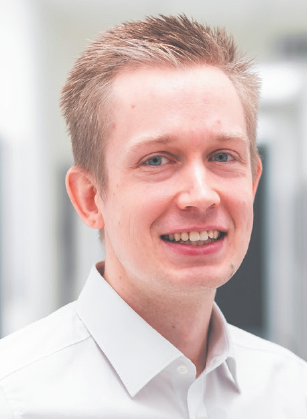
Robin Roj studied Mechanical Engineering at the University of Wuppertal and finished his Master of Science in 2011. He graduated with his PhD about CAD-software in 2016. After two years in industry, he continued his scientific career at the FGW. There he is managing the department for Transformation & Innovation.

Aileen Blondrath finished her Bachelor of Science in Mechanical Engineering at the University of Wuppertal in 2019 and her Master of Science in 2021. Now she is focusing on her PhD at the RWTH Aachen. Besides her studies she was working for the FGW.
References / Literatur
[1] Deutsche Edelstahlwerke – Werkstoffdatenblatt X5CrNiCuNb164 1.4542, URL: https://www.dew-stahl.com/fileadmin/files/dew-stahl.com/documents/Publikationen/Werkstoffdatenblaetter/RSH/1.4542_de.pdf accessed: 22.12.2020Suche in Google Scholar
[2] Bryson, W. E.: Heat Treatment – Master Control Manual, Carl Hanser Verlag, München, Germany, 201510.3139/9781569904862Suche in Google Scholar
[3] Mahesha, N. S.; Hanumantharaya, R.; Mahesh, B. D.; Ramakrishna Devananda, P.; Shivakumar, K. M.: Tribological Wear Behavior of AISI 630 (17-4 PH) Stainless Steel Hardened by Precipitation Hardening, American Journal of Materials Science 6 (2016) No. 4A, 6-14. DOI: 10.5923/c.materials.201601.0210.5923/c.materials.201601.02Suche in Google Scholar
[4] Oerlikon – Material Product Data Sheet: MetcoAdd 17-4PH-A, URL: https://www.oerlikon.com/ecoma/files/DSMA-0004.0_HighStrengthSS_AM-2.pdf accessed: 22.12.2020Suche in Google Scholar
[5] OR-Laser – 3D Metal Printing of Tomorrow, URL: https://creator.or-laser.com/wp-content / uploads/2016/09/CREATOR_EN_web.pdf, accessed: 23.12.2020Suche in Google Scholar
[6] Blondrath, A.: Erstellung und Untersuchung 3D-gedruckter Komponenten im SLM-Verfahren mit anschließendem Vergleich zu konventionell hergestellten Proben, University of Wuppertal – Lehrstuhl für Neue Fertigungstechnologien und Werkstoffe, Wuppertal, Germany, 2019Suche in Google Scholar
[7] Serleti, F.: Optimierung der Wärmebehandlung der mittels selektiven Laserschmelzens (SLM) hergestellten Legierung 17-4PH, University of Wuppertal – Lehrstuhl für Neue Fertigungstechnologien und Werkstoffe, Wuppertal, Germany, 2019Suche in Google Scholar
[8] Ghosh, R.; Venugopal, A.; Arun Chand, C. V.; Ramesh Narayanan, P.; Pant, B.; Cherian, R. M.: Effect of Heat Treatment Anomaly on the Stress Corrosion Cracking Behavior of 17-4 PH Martensitic Stainless Steel, Transactions of the Indian Institute of Metals 72 (2019) No. 6, 1503-1506. DOI: 10.1007/s12666-019-01659-310.1007/s12666-019-01659-3Suche in Google Scholar
[9] Yoo, W.-D.; Lee, J.-H.; Youn, K.-T.; Rhyim, Y.-M.: Study on the Microstructure and Mechanical Properties of 17-4 PH Stainless Steel depending on Heat Treatment and Aging Time, Solid State Phenomena 118 (2006), 15-20. DOI: 10.4028/www.scientific.net/SSP.118.1510.4028/3-908451-25-6.15Suche in Google Scholar
[10] Zai, L.; Zhang, C.; Wang, Y.; Guo, W.; Wellmann, D.; Tong, X.; Tian, Y.: Laser Powder Bed Fusion of Precipitation-Hardened Martensitic Stainless Steels: A Review, Metals 10 (2020) No. 2, 255-279. DOI: 10.3390/met1002025510.3390/met10020255Suche in Google Scholar
[11] Piili, H.; Happonen, A.; Väistö, T.; Venkataramanan, V.; Partanen, J.; Salminen, A.: Cost Estimation of Laser Additive Manufacturing of Stainless Steel, Physics Procedia 78 (2015), 388-396. DOI: 10.1016/j.phpro.2015.11.05310.1016/j.phpro.2015.11.053Suche in Google Scholar
[12] Wimler, D.; Kardos, S.; Lindemann, J.; Clemens, H.; Mayer, S.: Aspects of Powder Characterization for Additive Manufacturing, Practical Metallography 55 (2018) No. 9, 620-636. DOI: 10.3139/147.11054710.3139/147.110547Suche in Google Scholar
[13] Ahmed, F.; Ali, U.; Sarker, D.; Marzbanrad, E.; Choi, K.; Mahmoodkhani, Y.; Toyserkani, E.: Study of powder recycling and its effect on printed parts during laser powder-bed fusion of 17-4 PH stainless steel, Journal of Materials Processing Technology 278 (2020), 116522. DOI: 10.1016/j.jmatprotec.2019.11652210.1016/j.jmatprotec.2019.116522Suche in Google Scholar
[14] Yadollahi, A.; Shamsaei, N.; Thompson, S.; Elwany, A.; Bian, L.: MECHANICAL AND MICRO STRUCTURAL PROPERTIE S OF SELECTIVE LASER MELTED 17-4 PH STAINLESS STEEL, in: Proc. of the ASME 2015 International Mechanical Engineering Congress and Exposition, Houston, Texas, USA (2015), pp. IMECE2015-52362. DOI: 10.1115/IMECE2015-5236210.1115/IMECE2015-52362Suche in Google Scholar
[15] Alnajjar, M.; Christien, F.; Barnier, V.; Bosch, C.; Wolski, K.; Fortes, A. D.; Telling, M.: Influence of microstructure and manganese sulfides on corrosion resistance of selective laser melted 17-4 PH stainless steel in acidic chloride medium, Corrosion Science 168 (2020), 108585. DOI: 10.1016/j.corsci.2020.10858510.1016/j.corsci.2020.108585Suche in Google Scholar
[16] Burns, D. E.; Kudzal, A.; McWilliams, B.; Manjarres, J.; Hedges, D.; Parker, P. A.: Investigating Additively Manufactured 17-4 PH for Structural Applications, Journal of Materials Engineering and Performance 28 (2019) No. 8, 4943-4951. DOI: 10.1007/s11665-019-04206-910.1007/s11665-019-04206-9Suche in Google Scholar
[17] Yadollahi, A.; Shamsaei, N.; Thompson, S. M.; Elwany, A.; Bian, L.; Mahmoudi, M.: FATIGUE BEHAVIOR OF SELECTIVE LASER MELTED 17-4 PH STAINLESS STEEL, in: Proc. of the 2015 Annual International Solid Freeform Fabrication Symposium – An Additive Manufacturing Conference, Austin, Texas, USA (2015), pp. 721-731Suche in Google Scholar
[18] Ponnusamy, P.; Masood, S. H.; Ruan, D.; Palanisamy, S.; Rahman Rashid, R. A.; Mohamed, O. A.: Mechanical performance of selective laser melted 17-4 PH stainless steel under compressive loading, in: Proc. of the 2017 Annual International Solid Freeform Fabrication Symposium – An Additive Manufacturing Conference, Austin, Texas, USA (2017), pp. 321-331Suche in Google Scholar
[19] Rowolt, C.; Milkereit, B.; Gebauer, M.; Seidel, C.; Müller, B.; Kessler, O.: In-Situ Phase Transition Analysis of Conventional and Laser Beam Melted AlSi10Mg and X5CrNiCuNb16-4 Alloys, HTM Journal of Heat Treatment and Materials 73 (2018) No. 6, 317-334. DOI: 10.3139/105.11036610.3139/105.110366Suche in Google Scholar
[20] DIN 50125:2016-12: Testing of metallic materials – Tensile test pieces, Beuth, Berlin, Germany (2016). DOI: 10.31030/257739010.31030/2577390Suche in Google Scholar
[21] DIN EN ISO 6892-1:2017-02: Metallic materials – Tensile testing – Part 1: Method of test at room temperature, Beuth, Berlin, Germany (2017). DOI: 10.31030/238483110.31030/2384831Suche in Google Scholar
[22] DIN 50157-1:2008-04: Metallic materials – Hardness testing with portable measuring instruments operating with mechanical penetration depth – Part 1: Test method, Beuth, Berlin, Germany (2008). DOI: 10.31030/138612510.31030/1386125Suche in Google Scholar
[23] Petzow, G.: Metallographisches, Keramographisches, Plastographisches Ätzen, Gebrüder Borntraeger, Berlin, Stuttgart, Germany, 2006. ISBN: 3443230148Suche in Google Scholar
© 2022 Walter de Gruyter GmbH, Berlin/Boston, Germany
Artikel in diesem Heft
- Contents
- Editorial
- Editorial
- Comparison of LPBF-manufactured and rolled tensile test samples made of 17-4PH
- Effect of heat treatment process on microstructure and properties of S47450 bolt
- Failure analysis
- Excessive Lack of Fusion in Welds of Limited Accessibility
- Picture of the month
- Picture of the month
- People
- 2022 Henry Clifton Sorby Awardee: Professor Harry Bhadeshia
- News
- News
- Meeting diary
- Meeting diary
Artikel in diesem Heft
- Contents
- Editorial
- Editorial
- Comparison of LPBF-manufactured and rolled tensile test samples made of 17-4PH
- Effect of heat treatment process on microstructure and properties of S47450 bolt
- Failure analysis
- Excessive Lack of Fusion in Welds of Limited Accessibility
- Picture of the month
- Picture of the month
- People
- 2022 Henry Clifton Sorby Awardee: Professor Harry Bhadeshia
- News
- News
- Meeting diary
- Meeting diary
