
A result for O2-convergence to be topological in posets
-
Qingguo Li
 und
Zhiwei Zou
und
Zhiwei Zou

Abstract
In this paper, the α waybelow relation, which is determined by O2-convergence, is characterized by the order on a poset, and a sufficient and necessary condition for O2-convergence to be topological is obtained.
1. Introduction
The O2-convergence on a poset P, which is a generalization of O-convergence, is defined as follows [1–4]: Let P be a poset, a net (xi)i ∈ I is said to O2-converges to x ∈ P if there exist subsets M and N of P such that
sup M = inf N = x;
For each a ∈ M and b ∈ N, there exists k ∈ I such that a ≤ xi ≤ b holds for all i ≥ k.
By saying the O2-convergence on a poset P is topological, we mean that there exists a topology 𝒯 on P such that a net (xi)i ∈ I in PO2-converges to x ∈ P if and only if it converges to x with respect to the topology 𝒯. Otherwise, we say that O2-convergence is not topological. As is pointed in [5], in general, O2-convergence is not topological. The same problem exists for O-convergence and Lim-inf-convergence, Zhao and others have done some excellent work in [6–8].
In [5], Zhao and Li proved that if the O2-convergence on a poset P is topological, then P is an α-doubly continuous poset. Also they give a sufficient condition: If P is an α*-doubly continuous poset, then O2-convergence is topological. Moreover, if P is a poset satisfying condition (*), O2-convergence is topological if and only if P is an α-doubly continuous poset.
But as pointed in this paper, there exists poset which is α-doubly continuous but not α*-doubly continuous. Then for such a poset, is the O2-convergence topological? In other words, can we find a sufficient and necessary condition for O2-convergence to be topological for any poset?
In this paper, the α waybelow relation is characterized just by the order on a poset. The concept of O2-doubly continuous poset is given, which is strictly stronger than α-doubly continuous and strictly weaker than α*-doubly continuous. Most important, we prove that for a poset P, the O2-convergence on it is topological if and only if P is an O2-doubly continuous poset.
2. Preliminaries
This section will briefly mention some of the important results that Zhang and Li presented in [5]. For terms which are not defined here, please refer to [9, 10] and related references.
For a poset P, a, b ∈ P, we denote [a, b] = {x ∈ P : a ≤ x ≤ b}. We use M0 ⊆finM to indicate M0 is a finite subset of M.
([5]).Let P be a poset. For x, y, z ∈ P, define x ≪αy if for every net (xi)i ∈ Iin P which O2-converges to y, x ≤ xi holds eventually; z ⊳α y if for every net (xi)i ∈ Iin P which O2-converges to y, xi ≤ z holds eventually.
It follows from Definition 2.1 that x ≪α y ⟹ x ≤ y and z ⊳α y ⟹ z ≥ y. If P has a bottom element ⊥ (top element ⊤), then ⊥ ≪α x (⊤ ⊳α x) for each x ∈ P
([5]). A poset P is called an α-doubly continuous poset if a = sup {x ∈ P : x ≪α a} = inf {y ∈ P: z ⊳α a} for every a ∈ P.
Every finite lattice is α-doubly continuous, every chain or antichain is α-doubly continuous.
If P is α-doubly continuous, then for every a ∈ P, the set {x ∈ P : x ≪α a} and {y ∈ P : z ⊳α a} are both nonempty.
([5]). Let P be a poset. For x, y, z ∈ P, define x ≪α*y if for every net (xi)i ∈ Iin P which O2-converges to some ω ∈ P with y ≤ ω, x ≤ xi holds eventually. We define the order dual relation z ⊳α*y if z ≪α*y in Pop, where Pop denotes P endowed with the reverse order.
([5]). A poset P is called an α*-doubly continuous poset if a= sup {x ∈ P : x ≪α*a} = inf {y ∈ P: z ⊳α*a} for every a ∈ P.
([5]).
Obviously, x ≪α*y ⟹ x ≪α y and z ⊳α*y ⟹ z ⊳α y, then an α*-doubly continuous poset is α-doubly continuous.
If P is an α*-doubly continuous poset, then for each x ∈ P,
x = sup{a ∈ P : ∃a′ ∈ P, a ≪α*a′ ≪α*x} = inf{b ∈ P : ∃b′ ∈ P, b ⊳α*b′ ⊳α*x}.
([5]). For any poset P, if O2-convergence is topological, then P is α-doubly continuous.
([5]). If P is an α*-doubly continuous poset, then O2-convergence is topological.
That is to say, α*-doubly continuous ⟹ O2-convergence is topological⟹ α-doubly continuous.
Condition (*). Let P be a poset and x, y, z ∈ P with x ≪α y ≤ z, then x ≪α z. Let w, s, t ∈ P with s ⊳α t ≥ w, then s ⊳α w.
([5]). For any poset P which satisfies condition (*), O2-convergence is topological if and only if P is α-doubly continuous.
3. O2-doubly continuous posets
In this section, we give a characterization of the relations ≪α and ⊳α, then introduce the concept of O2-doubly continuous poset which is strictly stronger than α-doubly continuous and strictly weaker than α*-doubly continuous.
Let P be a poset. y ≪α x if and only if for every subset M and N such that sup M = inf N = x, there exist M0 ⊆finM and N0 ⊆fin N such that
Dually, z ⊳α x if and only if for every subset M and N such that sup M = inf N = x, there exist M0 ⊆finM and N0 ⊆fin N such that
Sufficiency, if there exists a net (xi)i ∈ I in P which O2-converges to x, then there exist subsets M and N of P such that sup M = inf N = x, and for each pair a ∈ M and b ∈ N, xi ∈ [a, b] holds eventually. By the condition there exist M0 ⊆fin M and N0 ⊆fin N such that
Necessary, suppose y ≪α x and sup M = inf N = x, denote
A poset P is called an O2-doubly continuous poset if it satisfies the following condition:
P is α-doubly continuous, i.e. x = sup {y ∈ P : y ≪α*x} = inf {z ∈ P : z ⊳α*x} for each x ∈ P.
If y ≪α x and z ⊳α x, then there exist finite A ⊆fin {a ∈ P : a ≪α x} and B ⊆fin {b ∈ P : b ⊳α x} such that y ≪α c and z ⊳α
Every finite lattice is O2-doubly continuous, every chain or antichain is O2-doubly continuous.
If P is an α*-doubly continuous poset, then P is an O2-doubly continuous poset.
By Remark 2.6 we know an α*-doubly continuous poset is α-doubly continuous. In an α*-doubly continuous poset P, we denote Mx = {a ∈ P : ∃a′ ∈ P; a ≪α*a′ ≪α*x} and Ny = {b ∈ P : ∃ b′ ∈ P : ⊳α*b′ ⊳α*x} for each x ∈ P, then sup Mx = inf Nx = x. If y ≪α x and z ⊳α x, from Proposition 3.1 there exist finite M0 ⊆finMx and N0 ⊆finNx such that
If there exists a net (xi)i ∈ IO2-convergence to c, for each a ∈ M0 and b ∈ N0, a ≪α c and b ⊳α c, then xi ∈ [a, b] holds eventually. Because M0 and N0 are both finite, thus
An α*-doubly continuous poset implies it is O2-doubly continuous. An O2-doubly continuous poset implies it is α-doubly continuous. But conversely both are untrue – see the following examples:
Let P1 = {1} ⋃ {aji ∈ ℕ} ⋃ {bi : i ∈ ℕ} ⋃ {ci: i ∈ ℕ}, ⋃ {bij: i, j ∈ ℕ} ⋃ {cij: i, j ∈ ℕ} where ℕ denotes the set of all positive integers. The order ≤ on P1is constructed as follows (see Fig. 1 for the Hasse diagram of P1:
ai ≤ ai+1; bi ≤ bi+1;ci ≤ ci+1; for all i ∈ ℕ.
ai ≤ bi; ai ≤ ci for all i ∈ ℕ
bij ≤ bi,j+1 ≤ bi and cij ≤ ci,j+1, ≤ ci for all i, j ∈ ℕ.
1 is the greatest element in P.
It is straightforward to verify that P1is α-doubly continuous, {x ∈ P : x ≪α 1 = {ai : i ∈ ℕ} and {x ∈ P : x ⊳α 1} = {1}. Notice a1 ≪α 1, for any finite A ⊆fin {x ∈ P : x ≪α 1} = {ai : i ∈ ℕ}, there exists i0 ∈ ℕ such that
Moreover, a1 ≪αa2 ≤ b2but a1 ≪αb2does not hold, that means P1does not satisfy the condition(*).
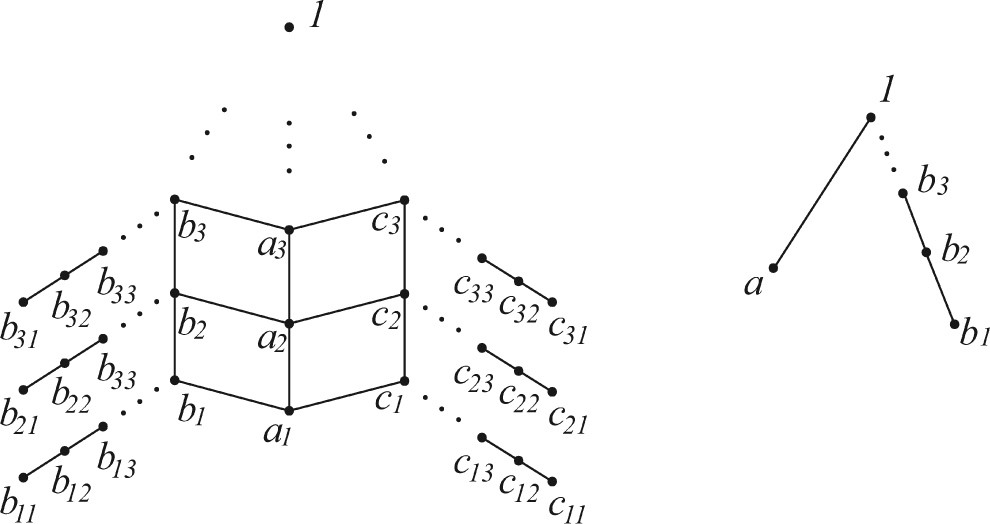
Let P2 = {1}⋃{a}⋃{b1, b2, b3, ...}. The order “≤” on P2is defined as follows: (see Fig. 1 for the Hasse diagram): a ≤ 1; bi ≤ 1 for all i ∈ ℕ; bi ≤ bj , whenever i ≤ j, for all i, j ∈ ℕ.
It is obvious that P is an α-doubly continuous poset and satisfies the condition (2) in Definition 3.2, then P is an O2-doubly continuous poset. But it is not α*-doubly continuous because {x ∈ P : x ≪α*a} = ϕ.
4. A sufficient and necessary condition for O2-convergence to be topological
In this section, we obtain the main result that O2-convergence on a poset P is topological if and only if P is an O2-doubly continuous poset.
We recall that saying the O2-convergence on a poset P is topological means that there exists a topology 𝒯 on P such that a net (xi)i∈I in P O2-converges to x ∈ P if and only if it converges to x with respect to the topology 𝒯. Zhao and Li proved that for any poset P, if the O2-convergence is topological, then P is α-doubly continuous in [5]. We will prove it again using another method in the following theorem because some results from the process will be used next. The following theorem is a further result of Zhao and Li’s.
For any poset P, if the O2-convergence is topological, then P is an O2-doubly continuous poset.
For a poset P, if the O2-convergence is topological, then there exists a topology 𝒯 on P such that a net (xi)i∈IO2-converges to x ∈ P if and only if it converges to x with respect to the topology 𝒯. For every x ∈ P, let Ix = {(W,k,r) ∈ 𝒩(x)× ℕ× P : r ∈ W}, where 𝒩(x) consists of all open sets containing x in the topology 𝒯, i.e., 𝒩(x) = {W ∈ 𝒯: x ∈ W}. Now we define the lexicographic order on the first two coordinates on Ix, this means for (W1, k1, r1), (W2, k2, r2) ∈ Ix, (W1, k1, r1) ≤. (W2, k2, r2) if and only if W2 is a proper subset of W1 or W1 = W2 and k1 ≤ k2. This is a preorder. Arbitrarily take (W1, k1, r1), (W2, k2, r2) ∈ Ix, then (W1 ⋂ W2, max{k1, k2}, x) ≤ (W1, k1, r1) and (W1 ⋂ W2, max{k1, k2},x) ≤ (W2, k2, r2). Hence Ix is directed. Let xi = r for every i = (W,k,r) ∈ Ix. Then it is straightforward to verify that the net (xi)i∈Ix converges to x with respect to the topology 𝒯. Thus (xi)i∈IxO2-converges to x. By the definition of O2-convergence, there exist subsets M0 and N0 such that sup M0 = inf N0 = x, and for each m ∈ M0 and n ∈ N0 there exists i0 = (W0, k0, r0) ∈ Ix such that xi = r ∈ [m, n] holds for every i = (W,k,r) ≥ i0. In particular, we have (W0, k0 + 1; w) ≥ (W0, k0 + 1, w) ≥ (w0, k0, r0) for all w ∈ W0, hence x(W0, k0+1, w) = w ∈ [m, n] for all w ∈ W0, this means W0 ⊆ [m, n]. Since W0 is related to m and n, we denoted it by Wmn.
For arbitrary m ∈ M0 and n ∈ N0, if there exists a net (xj)j∈JO2-convergence to x, then (xj)j∈J converges to x with respect to the topology 𝒯, this means xj is eventually in Wmn ⊆ [m, n] (Wmn is an open neighborhood of x in the topology 𝒯), thus m ≪αx and n ⊳αx. We conclude that M0 ⊆ {y ∈ P : y ≪αx} and N0 ⊆ {z ∈ P : z ⊳αx}, since sup M0 = inf N0 = x, we have sup {y ∈ P : y ≪αx} = inf{z ∈ P : z ⊳αx} = x, i.e., P is an α-doubly continuous poset.
Suppose y ≪αx and z ⊳αx, by Proposition 3.1 we know there exist M1 ⊆finM0 and N1 ⊆finN0 such that
Since P is an α-doubly continuous poset, we know sup Ax = inf Bx = x, for each a ∈ Ax and b ∈ Bx, [a, b] ∈ 𝒟, when (r, U) ≥ (x, [a, b]) i.e. U ⊆[a, b], x(r,U) = r ∈ U ⊆[a, b], so a ≤ (x(r,U))(r,U)∈𝒟 ≤ b holds eventually, by the definition of O2-convergence we know that (x(r,U))(r,U)∈𝒟 O2-convergence to x.
For poset P, the O2-convergence is topological, then (x(r,U))(r,U)∈𝒟 converges to x with respect to the topology 𝒯, hence x(r,U) ∈ W1 holds eventually. There exist finite subsets A1 ⊆finAx and B1 ⊆finBx such that when
The relations among
We review the general relation between convergence and topology. If on any set P a class 𝓛 of pairs ((xi)i∈I, x) is given, then 𝓞(𝓛) = {U ⊆ X : whenever (xi)i∈I ∈ 𝓛 and x ∈ U, xi ∈ U eventually} is a topology on X. In this paper, we denote the class 𝓛 = {((xi)i∈I, x) : (xi)i∈IO2-converges to x}. Kelly gave a standard characterization for a class 𝓛 of convergent nets to be topological:

([11]). Given a poset P, the class 𝓛 is topological if and only if the following axioms are satisfied.
(Constant) If (xi)i∈I is a constant net with value xi = x for every i ∈ I, then ((xi)i∈I, x) ∈ 𝓛.
(Subnets) If ((xi)i∈I, x) ∈ 𝓛 and (yj)j∈J is a subnet of (xi)i∈I, then ((yj)j∈J ((yj)j∈J, x) ∈ 𝓛.
(Divergence) If ((xi)i∈I,x) is not in 𝓛, then there exists a subnet (yj)j∈J of (xi)i∈I which has no subnet (zk)k∈K so that ((zk)k∈K, x) belongs to 𝓛.
(Iterated Limits) If ((xi)i∈I, x), ∈ 𝓛, and if ((xi, j)j∈J(i), xi) ∈ 𝓛 for all i ∈ I, then ((xi, f(i))i, f∈I×M,x) ∈ 𝓛, where
For an α-doubly continuous poset P, a net (xi)i∈IO2-converges to x ∈ P if and only if for any y, z ∈ P with y ≪α x and z ⊳α x, y ≤ xi ≤ z holds eventually.
Necessary, if net (xi)i∈IO2-converges to x ∈ P and y ≪αx, z ⊳αx, by the Definition of ≪α and ⊳α we know y ≤ xi ≤ z holds eventually. Conversely, just let M = {y ∈ P : y ≪αx} and N = {z ∈ P : z ⊳αx}, then supM = infN = x. For each y ∈ M and z ∈ N, y ≤ xi ≤ z holds eventually, we have (xi)i∈IO2-converges to x.
For an O2-doubly continuous poset P, a net (xi)i∈IO2-converges to x ∈ P if and only if for any y, z ∈ P with y ≪α x and z ⊳α x, y ≪α xi and z ⊳α xi hold eventually.
Necessary, if net (xi)i∈IO2-converges to x ∈ P and y ≪αx, z ⊳αx, by Definition 3.2 there exist finite A ⊆fin {a ∈ P : a ≪αx} and B ⊆fin {b ∈ P : b ⊳αx} such that y ≪α c and z ⊳α c for each c ∈ c ∈
For any poset P, the class 𝓛 satisfies axiom (Constant).
Suppose xi = x for every i ∈ I, just take M = N = {x}, sup M = inf N = x and x ≤ xi = x ≤ x holds for all i ∈ I. Therefore ((xi)i∈I, x) ∈ 𝓛.
For any poset P, the class 𝓛 satisfies axiom (Subnets).
Let ((xi)i∈I, x) ∈ 𝓛. There exist subsets M and N such that sup M = inf N = x, and for every m ∈ M and every n ∈ N there exists k ∈ I such that m ≤ xi ≤ n for all i ≥ k. For any subnet (yj)j∈J of net (xi)i∈I, there exists a mapping f : J ⟶ I such that yj = xf(j) for every j ∈ J, and for every i ∈ I there exists ji ∈ J such that f(j) ≥ i for every j ≥ ji. In particular, for k ∈ I, there exists jk ∈ J such that f(j) ≥ k for all j ≥ J such that f(j) ≤ i for every j ≤ ji . In particular, for k ∈ I, there exists jk ∈ J such that f(j) ≥ k for all j ≥ jk. Hence m ≤ yj = xf(j) ≤ n for all j ≥ jk. Therefore ((yj)j∈J, x) ∈ 𝓛.
For an α-doubly continuous poset P, the class 𝓛 satisfies axiom (Divergence).
Assume that ((xi)i∈I, x) is not in 𝓛. By lemma 4. 4, there exist y0, z0 ∈ P with y0 ≪αx and z0 ⊳αx such that y0 ≤ xi ≤ z0 does not hold eventually. This means that for every i ∈ I we can choose a ji ∈ I such that y0 ≰ xji or z0 ≱ xji. Let J = {ji : i ∈ I} ⊆ I, then J is a cofinal subset of I. We now consider the subnet (xj)j∈J of (xi)i∈I, since y0 ≰ xj or z0 ≱ xj for every j ∈ J, by Lemma 4.4 again, (xj)j∈J has no subnet (zk)k∈K such that ((zk)k∈K, x) belongs to 𝓛. Thus the class 𝓛 satisfies axiom (Divergence).
For an O2-doubly continuous poset P, the class 𝓛 satisfies axiom (Iterated Limits).
Let ((xi)i∈I, x) ∈ 𝓛 and ((xi, j)j∈Ji, ∈ 𝓛 for every i ∈ I. For any y, z ∈ P with y ≪αx and z ⊳αx, by Lemma 4.5 we know y ≪α xi and z ⊳α xi hold eventually, i.e., there exists i0 ∈ I such that y ≪α xi and z ⊳α xi for all i ≥ i0. Since ((xi, j)j∈Ji, xi) ∈ 𝓛, by Lemma 4.5 again, for every i ∈ I with i ≥ i0 there exists ji ∈ Ji such that y ≪αxi, j and z ⊳αxi, j for every j ≥ ji. Define
From Propositions 4.6 –4.9 and Fact 4. 3, we have
For any poset P, if P is O2-doubly continuous, then O2-convergence is topological.
Combining Theorem 4.1 with Theorem 4.1 0, we obtain the following theorem.
Let P be a poset. Then the O2-convergence is topological if and only if P is O2-doubly continuous.
By Proposition 3.4 and Theorem 4.1 0, we have the following corollary.
([5]). If P is an α*-doubly continuous poset, then O2-convergence is topological.
For the poset P1showed in Example 3.5, the O2-convergence is not topological.
In Example 3.6, the O2-convergence on the poset P2is topological.
Acknowledgement
This work is supported by the Natural Science Foundation of China (Grant No: 11371130) and (Grant No: 2014GXNSFBA118015).
References
[1] Frink O., Topology in lattice Trans. Amer. Math. Soc., 1942, 51, 569-582.10.1090/S0002-9947-1942-0006496-XSuche in Google Scholar
[2] Mathews J.C., Anderson R.F., A comparison of two modes of order convergence, Proc. Amer. Math. Soc., 1967, 18(1), 100-104.10.1090/S0002-9939-1967-0203675-6Suche in Google Scholar
[3] Wolk E.S., On order-convergence, Proc. Amer. Math. Soc., 1961, 12(3), 379-384.10.1090/S0002-9939-1961-0136562-7Suche in Google Scholar
[4] Olejcek V., Order Convergence and Order Topology on a Poset, Int. J. Theor. Phys., 1999, 38, 557-561.10.1023/A:1026690820346Suche in Google Scholar
[5] Zhao B., Li J., O2-convergence in posets, Topology Appl., 2006, 153, 2971-2975.10.1016/j.topol.2006.01.004Suche in Google Scholar
[6] Wang K.Y., Zhao B., Some further result on order-convergence in posets, Topology Appl., 2013, 160, 82-86.10.1016/j.topol.2012.09.018Suche in Google Scholar
[7] Zhao B., Zhao D., Lim-inf-convergence in partially ordered sets, J. Math. Anal. Appl., 2005, 309, 701-708.10.1016/j.jmaa.2004.11.028Suche in Google Scholar
[8] Zhou Y., Zhao B., Order-convergence and Lim-inf-convergence in poset, J. Math. Anal. Appl., 2007, 325, 655-664.10.1016/j.jmaa.2006.02.016Suche in Google Scholar
[9] Gierz G., Hofmann K.H., Keimel K., Lawson J.D., Mislove M., Scott D.S., Continuous Lattices and Domain, Camberidge University Press, Cambridge, 2003.10.1017/CBO9780511542725Suche in Google Scholar
[10] Birkhoff G., Lattice Theory, Amer. Math. Soc. Colloq. Publ., New York, 1940.10.1090/coll/025Suche in Google Scholar
[11] Kelly J.L., General topology, Van Nostrand, New York, 1955.Suche in Google Scholar
© 2016 Li and Zou, published by De Gruyter Open
This work is licensed under the Creative Commons Attribution-NonCommercial-NoDerivatives 3.0 License.
Artikel in diesem Heft
- Regular Article
-
A metric graph satisfying
- Regular Article
- On the Riemann-Hilbert problem in multiply connected domains
- Regular Article
- Hamilton cycles in almost distance-hereditary graphs
- Regular Article
- Locally adequate semigroup algebras
- Regular Article
- Parabolic oblique derivative problem with discontinuous coefficients in generalized weighted Morrey spaces
- Corrigendum
- Corrigendum to: parabolic oblique derivative problem with discontinuous coefficients in generalized weighted Morrey spaces
- Regular Article
- Some new bounds of the minimum eigenvalue for the Hadamard product of an M-matrix and an inverse M-matrix
- Regular Article
- Integral inequalities involving generalized Erdélyi-Kober fractional integral operators
- Regular Article
- Results on the deficiencies of some differential-difference polynomials of meromorphic functions
- Regular Article
- General numerical radius inequalities for matrices of operators
- Regular Article
- The best uniform quadratic approximation of circular arcs with high accuracy
- Regular Article
- Multiple gcd-closed sets and determinants of matrices associated with arithmetic functions
- Regular Article
- A note on the rate of convergence for Chebyshev-Lobatto and Radau systems
- Regular Article
- On the weakly(α, ψ, ξ)-contractive condition for multi-valued operators in metric spaces and related fixed point results
- Regular Article
- Existence of a common solution for a system of nonlinear integral equations via fixed point methods in b-metric spaces
- Regular Article
- Bounds for the Z-eigenpair of general nonnegative tensors
- Regular Article
- Subsymmetry and asymmetry models for multiway square contingency tables with ordered categories
- Regular Article
- End-regular and End-orthodox generalized lexicographic products of bipartite graphs
- Regular Article
- Refinement of the Jensen integral inequality
- Regular Article
- New iterative codes for 𝓗-tensors and an application
- Regular Article
- A result for O2-convergence to be topological in posets
- Regular Article
- A fixed point approach to the Mittag-Leffler-Hyers-Ulam stability of a fractional integral equation
- Regular Article
- Uncertainty orders on the sublinear expectation space
- Regular Article
- Generalized derivations of Lie triple systems
- Regular Article
- The BV solution of the parabolic equation with degeneracy on the boundary
- Regular Article
- Malliavin method for optimal investment in financial markets with memory
- Regular Article
- Parabolic sublinear operators with rough kernel generated by parabolic calderön-zygmund operators and parabolic local campanato space estimates for their commutators on the parabolic generalized local morrey spaces
- Regular Article
- On annihilators in BL-algebras
- Regular Article
- On derivations of quantales
- Regular Article
-
On the closed subfields of
- Regular Article
- A class of tridiagonal operators associated to some subshifts
- Regular Article
- Some notes to existence and stability of the positive periodic solutions for a delayed nonlinear differential equations
- Regular Article
- Weighted fractional differential equations with infinite delay in Banach spaces
- Regular Article
- Laplace-Stieltjes transform of the system mean lifetime via geometric process model
- Regular Article
- Various limit theorems for ratios from the uniform distribution
- Regular Article
- On α-almost Artinian modules
- Regular Article
- Limit theorems for the weights and the degrees in anN-interactions random graph model
- Regular Article
- An analysis on the stability of a state dependent delay differential equation
- Regular Article
- The hybrid mean value of Dedekind sums and two-term exponential sums
- Regular Article
- New modification of Maheshwari’s method with optimal eighth order convergence for solving nonlinear equations
- Regular Article
- On the concept of general solution for impulsive differential equations of fractional-order q ∈ (2,3)
- Regular Article
- A Riesz representation theory for completely regular Hausdorff spaces and its applications
- Regular Article
- Oscillation of impulsive conformable fractional differential equations
- Regular Article
- Dynamics of doubly stochastic quadratic operators on a finite-dimensional simplex
- Regular Article
- Homoclinic solutions of 2nth-order difference equations containing both advance and retardation
- Regular Article
- When do L-fuzzy ideals of a ring generate a distributive lattice?
- Regular Article
- Fully degenerate poly-Bernoulli numbers and polynomials
- Commentary
- Commentary to: Generalized derivations of Lie triple systems
- Regular Article
- Simple sufficient conditions for starlikeness and convexity for meromorphic functions
- Regular Article
- Global stability analysis and control of leptospirosis
- Regular Article
- Random attractors for stochastic two-compartment Gray-Scott equations with a multiplicative noise
- Regular Article
- The fuzzy metric space based on fuzzy measure
- Regular Article
- A classification of low dimensional multiplicative Hom-Lie superalgebras
- Regular Article
- Structures of W(2.2) Lie conformal algebra
- Regular Article
- On the number of spanning trees, the Laplacian eigenvalues, and the Laplacian Estrada index of subdivided-line graphs
- Regular Article
- Parabolic Marcinkiewicz integrals on product spaces and extrapolation
- Regular Article
- Prime, weakly prime and almost prime elements in multiplication lattice modules
- Regular Article
- Pochhammer symbol with negative indices. A new rule for the method of brackets
- Regular Article
- Outcome space range reduction method for global optimization of sum of affine ratios problem
- Regular Article
- Factorization theorems for strong maps between matroids of arbitrary cardinality
- Regular Article
- A convergence analysis of SOR iterative methods for linear systems with weak H-matrices
- Regular Article
- Existence theory for sequential fractional differential equations with anti-periodic type boundary conditions
- Regular Article
- Some congruences for 3-component multipartitions
- Regular Article
- Bound for the largest singular value of nonnegative rectangular tensors
- Regular Article
- Convolutions of harmonic right half-plane mappings
- Regular Article
- On homological classification of pomonoids by GP-po-flatness of S-posets
- Regular Article
- On CSQ-normal subgroups of finite groups
- Regular Article
- The homogeneous balance of undetermined coefficients method and its application
- Regular Article
- On the saturated numerical semigroups
- Regular Article
- The Bruhat rank of a binary symmetric staircase pattern
- Regular Article
- Fixed point theorems for cyclic contractive mappings via altering distance functions in metric-like spaces
- Regular Article
- Singularities of lightcone pedals of spacelike curves in Lorentz-Minkowski 3-space
- Regular Article
- An S-type upper bound for the largest singular value of nonnegative rectangular tensors
- Regular Article
- Fuzzy ideals of ordered semigroups with fuzzy orderings
- Regular Article
- On meromorphic functions for sharing two sets and three sets in m-punctured complex plane
- Regular Article
- An incremental approach to obtaining attribute reduction for dynamic decision systems
- Regular Article
- Very true operators on MTL-algebras
- Regular Article
- Value distribution of meromorphic solutions of homogeneous and non-homogeneous complex linear differential-difference equations
- Regular Article
- A class of 3-dimensional almost Kenmotsu manifolds with harmonic curvature tensors
- Regular Article
- Robust dynamic output feedback fault-tolerant control for Takagi-Sugeno fuzzy systems with interval time-varying delay via improved delay partitioning approach
- Regular Article
- New bounds for the minimum eigenvalue of M-matrices
- Regular Article
- Semi-quotient mappings and spaces
- Regular Article
- Fractional multilinear integrals with rough kernels on generalized weighted Morrey spaces
- Regular Article
- A family of singular functions and its relation to harmonic fractal analysis and fuzzy logic
- Regular Article
- Solution to Fredholm integral inclusions via (F, δb)-contractions
- Regular Article
- An Ulam stability result on quasi-b-metric-like spaces
- Regular Article
- On the arrowhead-Fibonacci numbers
- Regular Article
- Rough semigroups and rough fuzzy semigroups based on fuzzy ideals
- Regular Article
- The general solution of impulsive systems with Riemann-Liouville fractional derivatives
- Regular Article
- A remark on local fractional calculus and ordinary derivatives
- Regular Article
- Elastic Sturmian spirals in the Lorentz-Minkowski plane
- Topical Issue: Metaheuristics: Methods and Applications
- Bias-variance decomposition in Genetic Programming
- Topical Issue: Metaheuristics: Methods and Applications
- A novel generalized oppositional biogeography-based optimization algorithm: application to peak to average power ratio reduction in OFDM systems
- Special Issue on Recent Developments in Differential Equations
- Modeling of vibration for functionally graded beams
- Special Issue on Recent Developments in Differential Equations
- Decomposition of a second-order linear time-varying differential system as the series connection of two first order commutative pairs
- Special Issue on Recent Developments in Differential Equations
- Differential equations associated with generalized Bell polynomials and their zeros
- Special Issue on Recent Developments in Differential Equations
- Differential equations for p, q-Touchard polynomials
- Special Issue on Recent Developments in Differential Equations
- A new approach to nonlinear singular integral operators depending on three parameters
- Special Issue on Recent Developments in Differential Equations
- Performance and stochastic stability of the adaptive fading extended Kalman filter with the matrix forgetting factor
- Special Issue on Recent Developments in Differential Equations
- On new characterization of inextensible flows of space-like curves in de Sitter space
- Special Issue on Recent Developments in Differential Equations
- Convergence theorems for a family of multivalued nonexpansive mappings in hyperbolic spaces
- Special Issue on Recent Developments in Differential Equations
- Fractional virus epidemic model on financial networks
- Special Issue on Recent Developments in Differential Equations
- Reductions and conservation laws for BBM and modified BBM equations
- Special Issue on Recent Developments in Differential Equations
- Extinction of a two species non-autonomous competitive system with Beddington-DeAngelis functional response and the effect of toxic substances
Artikel in diesem Heft
- Regular Article
-
A metric graph satisfying
- Regular Article
- On the Riemann-Hilbert problem in multiply connected domains
- Regular Article
- Hamilton cycles in almost distance-hereditary graphs
- Regular Article
- Locally adequate semigroup algebras
- Regular Article
- Parabolic oblique derivative problem with discontinuous coefficients in generalized weighted Morrey spaces
- Corrigendum
- Corrigendum to: parabolic oblique derivative problem with discontinuous coefficients in generalized weighted Morrey spaces
- Regular Article
- Some new bounds of the minimum eigenvalue for the Hadamard product of an M-matrix and an inverse M-matrix
- Regular Article
- Integral inequalities involving generalized Erdélyi-Kober fractional integral operators
- Regular Article
- Results on the deficiencies of some differential-difference polynomials of meromorphic functions
- Regular Article
- General numerical radius inequalities for matrices of operators
- Regular Article
- The best uniform quadratic approximation of circular arcs with high accuracy
- Regular Article
- Multiple gcd-closed sets and determinants of matrices associated with arithmetic functions
- Regular Article
- A note on the rate of convergence for Chebyshev-Lobatto and Radau systems
- Regular Article
- On the weakly(α, ψ, ξ)-contractive condition for multi-valued operators in metric spaces and related fixed point results
- Regular Article
- Existence of a common solution for a system of nonlinear integral equations via fixed point methods in b-metric spaces
- Regular Article
- Bounds for the Z-eigenpair of general nonnegative tensors
- Regular Article
- Subsymmetry and asymmetry models for multiway square contingency tables with ordered categories
- Regular Article
- End-regular and End-orthodox generalized lexicographic products of bipartite graphs
- Regular Article
- Refinement of the Jensen integral inequality
- Regular Article
- New iterative codes for 𝓗-tensors and an application
- Regular Article
- A result for O2-convergence to be topological in posets
- Regular Article
- A fixed point approach to the Mittag-Leffler-Hyers-Ulam stability of a fractional integral equation
- Regular Article
- Uncertainty orders on the sublinear expectation space
- Regular Article
- Generalized derivations of Lie triple systems
- Regular Article
- The BV solution of the parabolic equation with degeneracy on the boundary
- Regular Article
- Malliavin method for optimal investment in financial markets with memory
- Regular Article
- Parabolic sublinear operators with rough kernel generated by parabolic calderön-zygmund operators and parabolic local campanato space estimates for their commutators on the parabolic generalized local morrey spaces
- Regular Article
- On annihilators in BL-algebras
- Regular Article
- On derivations of quantales
- Regular Article
-
On the closed subfields of
- Regular Article
- A class of tridiagonal operators associated to some subshifts
- Regular Article
- Some notes to existence and stability of the positive periodic solutions for a delayed nonlinear differential equations
- Regular Article
- Weighted fractional differential equations with infinite delay in Banach spaces
- Regular Article
- Laplace-Stieltjes transform of the system mean lifetime via geometric process model
- Regular Article
- Various limit theorems for ratios from the uniform distribution
- Regular Article
- On α-almost Artinian modules
- Regular Article
- Limit theorems for the weights and the degrees in anN-interactions random graph model
- Regular Article
- An analysis on the stability of a state dependent delay differential equation
- Regular Article
- The hybrid mean value of Dedekind sums and two-term exponential sums
- Regular Article
- New modification of Maheshwari’s method with optimal eighth order convergence for solving nonlinear equations
- Regular Article
- On the concept of general solution for impulsive differential equations of fractional-order q ∈ (2,3)
- Regular Article
- A Riesz representation theory for completely regular Hausdorff spaces and its applications
- Regular Article
- Oscillation of impulsive conformable fractional differential equations
- Regular Article
- Dynamics of doubly stochastic quadratic operators on a finite-dimensional simplex
- Regular Article
- Homoclinic solutions of 2nth-order difference equations containing both advance and retardation
- Regular Article
- When do L-fuzzy ideals of a ring generate a distributive lattice?
- Regular Article
- Fully degenerate poly-Bernoulli numbers and polynomials
- Commentary
- Commentary to: Generalized derivations of Lie triple systems
- Regular Article
- Simple sufficient conditions for starlikeness and convexity for meromorphic functions
- Regular Article
- Global stability analysis and control of leptospirosis
- Regular Article
- Random attractors for stochastic two-compartment Gray-Scott equations with a multiplicative noise
- Regular Article
- The fuzzy metric space based on fuzzy measure
- Regular Article
- A classification of low dimensional multiplicative Hom-Lie superalgebras
- Regular Article
- Structures of W(2.2) Lie conformal algebra
- Regular Article
- On the number of spanning trees, the Laplacian eigenvalues, and the Laplacian Estrada index of subdivided-line graphs
- Regular Article
- Parabolic Marcinkiewicz integrals on product spaces and extrapolation
- Regular Article
- Prime, weakly prime and almost prime elements in multiplication lattice modules
- Regular Article
- Pochhammer symbol with negative indices. A new rule for the method of brackets
- Regular Article
- Outcome space range reduction method for global optimization of sum of affine ratios problem
- Regular Article
- Factorization theorems for strong maps between matroids of arbitrary cardinality
- Regular Article
- A convergence analysis of SOR iterative methods for linear systems with weak H-matrices
- Regular Article
- Existence theory for sequential fractional differential equations with anti-periodic type boundary conditions
- Regular Article
- Some congruences for 3-component multipartitions
- Regular Article
- Bound for the largest singular value of nonnegative rectangular tensors
- Regular Article
- Convolutions of harmonic right half-plane mappings
- Regular Article
- On homological classification of pomonoids by GP-po-flatness of S-posets
- Regular Article
- On CSQ-normal subgroups of finite groups
- Regular Article
- The homogeneous balance of undetermined coefficients method and its application
- Regular Article
- On the saturated numerical semigroups
- Regular Article
- The Bruhat rank of a binary symmetric staircase pattern
- Regular Article
- Fixed point theorems for cyclic contractive mappings via altering distance functions in metric-like spaces
- Regular Article
- Singularities of lightcone pedals of spacelike curves in Lorentz-Minkowski 3-space
- Regular Article
- An S-type upper bound for the largest singular value of nonnegative rectangular tensors
- Regular Article
- Fuzzy ideals of ordered semigroups with fuzzy orderings
- Regular Article
- On meromorphic functions for sharing two sets and three sets in m-punctured complex plane
- Regular Article
- An incremental approach to obtaining attribute reduction for dynamic decision systems
- Regular Article
- Very true operators on MTL-algebras
- Regular Article
- Value distribution of meromorphic solutions of homogeneous and non-homogeneous complex linear differential-difference equations
- Regular Article
- A class of 3-dimensional almost Kenmotsu manifolds with harmonic curvature tensors
- Regular Article
- Robust dynamic output feedback fault-tolerant control for Takagi-Sugeno fuzzy systems with interval time-varying delay via improved delay partitioning approach
- Regular Article
- New bounds for the minimum eigenvalue of M-matrices
- Regular Article
- Semi-quotient mappings and spaces
- Regular Article
- Fractional multilinear integrals with rough kernels on generalized weighted Morrey spaces
- Regular Article
- A family of singular functions and its relation to harmonic fractal analysis and fuzzy logic
- Regular Article
- Solution to Fredholm integral inclusions via (F, δb)-contractions
- Regular Article
- An Ulam stability result on quasi-b-metric-like spaces
- Regular Article
- On the arrowhead-Fibonacci numbers
- Regular Article
- Rough semigroups and rough fuzzy semigroups based on fuzzy ideals
- Regular Article
- The general solution of impulsive systems with Riemann-Liouville fractional derivatives
- Regular Article
- A remark on local fractional calculus and ordinary derivatives
- Regular Article
- Elastic Sturmian spirals in the Lorentz-Minkowski plane
- Topical Issue: Metaheuristics: Methods and Applications
- Bias-variance decomposition in Genetic Programming
- Topical Issue: Metaheuristics: Methods and Applications
- A novel generalized oppositional biogeography-based optimization algorithm: application to peak to average power ratio reduction in OFDM systems
- Special Issue on Recent Developments in Differential Equations
- Modeling of vibration for functionally graded beams
- Special Issue on Recent Developments in Differential Equations
- Decomposition of a second-order linear time-varying differential system as the series connection of two first order commutative pairs
- Special Issue on Recent Developments in Differential Equations
- Differential equations associated with generalized Bell polynomials and their zeros
- Special Issue on Recent Developments in Differential Equations
- Differential equations for p, q-Touchard polynomials
- Special Issue on Recent Developments in Differential Equations
- A new approach to nonlinear singular integral operators depending on three parameters
- Special Issue on Recent Developments in Differential Equations
- Performance and stochastic stability of the adaptive fading extended Kalman filter with the matrix forgetting factor
- Special Issue on Recent Developments in Differential Equations
- On new characterization of inextensible flows of space-like curves in de Sitter space
- Special Issue on Recent Developments in Differential Equations
- Convergence theorems for a family of multivalued nonexpansive mappings in hyperbolic spaces
- Special Issue on Recent Developments in Differential Equations
- Fractional virus epidemic model on financial networks
- Special Issue on Recent Developments in Differential Equations
- Reductions and conservation laws for BBM and modified BBM equations
- Special Issue on Recent Developments in Differential Equations
- Extinction of a two species non-autonomous competitive system with Beddington-DeAngelis functional response and the effect of toxic substances
