
Remembering Peter Greaves Taylor Fogg (1929-2016)

Abstract
As a young man, Peter Fogg won an open scholarship to Trinity College, Oxford, where he read chemistry. After gaining a first class degree, he went on to do a doctorate under the supervision of J.D. Lambert. His thesis was on Ultrasonic Dispersion in Gases.
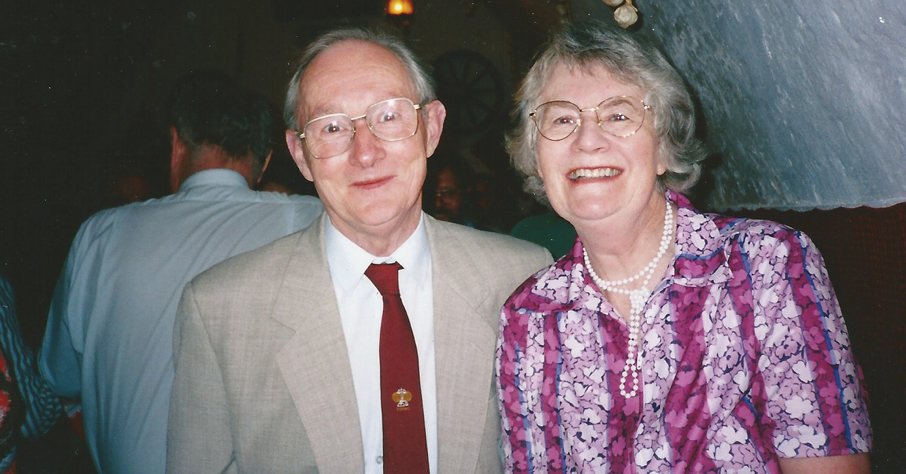
Peter and Heather at a 1996 IUPAC conference in Hungary
From 1954-1955 Peter worked as a Scientific Officer at The Atomic Energy Research Establishment in Harwell, Oxfordshire, where he worked on the chemistry of plutonium. He was an assistant lecturer at Queen’s University, Belfast from 1956 to 1958 and worked as a research chemist for Monsanto Chemicals, Ltd. between 1958 and 1962. In 1962 he became a lecturer at Flintshire Technical College in North Wales.
Peter taught at the University (formerly Polytechnic) of North London from 1965 until 1986. His undergraduate teaching was primarily concerned with Physical Chemistry and was much appreciated by his students, who found him especially helpful in both practical sessions and tutorials. At the University, Peter supervised the PhD/postgraduate work of several students and gained their gratitude and respect. When joining the University, Peter was active in the research of fast reaction kinetics and then, in collaboration with colleague John Charalambous, on the development of metal complexes for scintillation counting applications, leading to publication in Polyhedron.
He was a very active member of the IUPAC Solubility Data Commission V.8 of the Analytical Chemistry Division from its early years, and contributed to the shaping of its successor, the Subcommittee on Solubility and Equilibrium Data. The Solubility Data Project benefited greatly from his expertise in, and passion for, the field of gas solubilities in liquids and solutions. Between 1983 and 2013, Peter was compiler, evaluator, and editor for seven volumes (numbers: 21, 32, 42, 50, 70, 76 and 97) of the IUPAC Solubility Data Series.
Peter was also Chair of Subcommittee V.8.1 (Gases in Liquids) from 1992 to 2000 and was a Titular Member of Commission V.8 in 1987–1989 and again in 1995–1997.
He also actively participated in the International Symposia on Solubility Phenomena (ISSP). He was Co-Chair of the 3rd ISSP (1988, Guildford, University of Surrey) and was Guest Editor for the plenary and invited lectures of the 7th (Leoben, Austria, 1996), 8th (Niigata, Japan, 1998) and 9th (Hammamet, Tunisia, 2000) ISSPs, published in Pure and Applied Chemistry.
Peter Fogg and William (Bill) Gerrard collaborated on the publication of Solubility of Gases in Liquids: A Critical Evaluation of Gas/Liquid Systems in Theory and Practice (John Wiley and Sons, 1991), which was a significant contribution to that field, providing extensive information on, and data for, selected systems. Peter was also Editor-in-Chief of the Wiley Series in Solution Chemistry, which comprised authoritative, comprehensive, and up-to-date accounts of many aspects of solution chemistry. Seven volumes were published in this series between 1996 and 2003, including the seminal works: Octanol–Water Partition Coefficients: Fundamentals and Physical Chemistry (J. Sangster, 1997), The Experimental Determination of Solubilities (G. T. Hefter and R. P. T. Tomkins, eds., 2003) and Chemicals in the Atmosphere: Solubility, Sources and Reactivity (P. G. T. Fogg and J. Sangster, 2003).
Peter thoroughly enjoyed his involvement with IUPAC and the opportunities that it gave him and his wife Heather to travel and make friends all over the world. Peter’s involvement was characterized by friendship and conviviality, together with passionate professional activity and challenging scientific discussions. Peter was both a gentle man and a gentleman, and both he and Heather enriched the life of all of us.
©2017 by Walter de Gruyter Berlin/Boston
Artikel in diesem Heft
- Masthead - Full issue pdf
- Contents
- President’s Column
- On the Path to Rewarding Times
- Features
- Taking IUPAC Literally: Woodward’s Pure and Applied Chemistry Words
- The Periodic Table (continued?): Eka-francium Et Seq.
- Chemistry Organizations in a Changing World
- IUPAC Wire
- IUPAC and the Organisation for the Prohibition of Chemical Weapons Take Partnership to New Level
- IUPAC Announces the Names of the Elements 113, 115, 117, and 118
- IUPAC Periodic Table of the Elements—Updated Release
- Gender-based Harassment in the Practice of Science
- ICSU to Merge with ISSC
- Remembering Peter Greaves Taylor Fogg (1929-2016)
- Stamps International
- Woodward’s Birth Centennial
- Project Place
- Environmental Fate and Risks of Nano-enabled Pesticides
- Ecological Risk Assessment Workshop for Central America
- A Critical Review of Reporting and Storage of NMR Data for Spin-Half Nuclei in Small Molecules
- Guides in Metrology
- Bookworm
- Successful Drug Discovery
- Making an imPACt
- Source-based Nomenclature for Single-strand Homopolymers and Copolymers (IUPAC Recommendations 2016)
- Comprehensive Definition of Oxidation State (IUPAC Recommendations 2016)
- Glossary of Terms Used in Developmental and Reproductive Toxicology (IUPAC Recommendations 2016)
- IUPAC Provisional Recommendations
- Terminology of Bioanalytical Methods
- Nomenclature and Terminology for Dendrimers with Regular Dendrons and for Hyperbranched Polymers
- Conference Call
- WMFmeetsIUPAC
- Chemistry Education
- Green Chemistry
- Solid State Chemistry
- Where 2B & Y
- Macro- and Supramolecular Architectures and Materials
- POLYCHAR World Forum on Advanced Materials
- Coordination and Bioinorganic Chemistry
- Chemists and IUPAC: Taking Responsibility and Taking Action
- Small Satellites for Space Research
- Mark Your Calendar
Artikel in diesem Heft
- Masthead - Full issue pdf
- Contents
- President’s Column
- On the Path to Rewarding Times
- Features
- Taking IUPAC Literally: Woodward’s Pure and Applied Chemistry Words
- The Periodic Table (continued?): Eka-francium Et Seq.
- Chemistry Organizations in a Changing World
- IUPAC Wire
- IUPAC and the Organisation for the Prohibition of Chemical Weapons Take Partnership to New Level
- IUPAC Announces the Names of the Elements 113, 115, 117, and 118
- IUPAC Periodic Table of the Elements—Updated Release
- Gender-based Harassment in the Practice of Science
- ICSU to Merge with ISSC
- Remembering Peter Greaves Taylor Fogg (1929-2016)
- Stamps International
- Woodward’s Birth Centennial
- Project Place
- Environmental Fate and Risks of Nano-enabled Pesticides
- Ecological Risk Assessment Workshop for Central America
- A Critical Review of Reporting and Storage of NMR Data for Spin-Half Nuclei in Small Molecules
- Guides in Metrology
- Bookworm
- Successful Drug Discovery
- Making an imPACt
- Source-based Nomenclature for Single-strand Homopolymers and Copolymers (IUPAC Recommendations 2016)
- Comprehensive Definition of Oxidation State (IUPAC Recommendations 2016)
- Glossary of Terms Used in Developmental and Reproductive Toxicology (IUPAC Recommendations 2016)
- IUPAC Provisional Recommendations
- Terminology of Bioanalytical Methods
- Nomenclature and Terminology for Dendrimers with Regular Dendrons and for Hyperbranched Polymers
- Conference Call
- WMFmeetsIUPAC
- Chemistry Education
- Green Chemistry
- Solid State Chemistry
- Where 2B & Y
- Macro- and Supramolecular Architectures and Materials
- POLYCHAR World Forum on Advanced Materials
- Coordination and Bioinorganic Chemistry
- Chemists and IUPAC: Taking Responsibility and Taking Action
- Small Satellites for Space Research
- Mark Your Calendar
